290
QC-GO Submission for MADAR Shared Task:
Arabic Fine-Grained Dialect Identification
Younes Samih1 Hamdy Mubarak1 Ahmed Abdelali1 Mohammed Attia2 Mohamed Eldesouki1 Kareem Darwish1
1{ysamih,hmubarak,aabdelali,mohamohamed,kdarwish}@hbku.edu.qa 2{attia}@google.com
1Qatar Computing Research Institute, HBKU Research Complex, Doha, Qatar 2Google LLC, New York City, USA
Abstract
This paper describes the QC-GO team submis-sion to the MADAR Shared Task Subtask 1 (travel domain dialect identification) and Sub-task 2 (Twitter user location identification). In our participation in both subtasks, we explored a number of approaches and system combina-tions to obtain the best performance for both tasks. These include deep neural nets and heuristics. Since individual approaches suffer from various shortcomings, the combination of different approaches was able to fill some of these gaps. Our system achieves F1-Scores of 66.1% and 67.0% on the development sets for Subtasks 1 and 2 respectively.
1 Introduction
Arabic, similar to other languages have a number of dialectal varieties. With the emergence of social media, many of these varieties of Arabic started having wide representation in the written form. Twitter, Facebook, and YouTube are among the leading sources of such data (Zaidan and Callison-Burch,2011;Mubarak and Darwish,2014;Samih et al., 2017;Samih and Maier, 2016). The wide spread of dialectal use has increased the richness and diversity of the language, requiring greater complexity in dealing with it. Non-standard or-thography, increased borrowing and coinage of new terms, and code switching are just a few among a long list of new challenges researchers have to deal with.
Studying language varieties in particular is as-sociated with important applications such as Di-alect Identification (DID), Machine Translation (MT), and other text mining tasks. Perform-ing DID can be achieved usPerform-ing a variety of fea-tures, such as character n-grams (Darwish,2014; Zaidan and Callison-Burch,2014;Malmasi et al., 2015), and a myriad of techniques, such as
string kernels (Ionescu and Popescu, 2016) and DNN (Elaraby and Abdul-Mageed,2018).
In this paper, two resources created under the Multi-Arabic Dialect Applications and Resources (MADAR) project were used as the main re-sources for the task of Fine-Grained Dialect Iden-tification (Salameh et al., 2018; Bouamor et al., 2018). The MADAR Shared Task (Bouamor et al., 2019) aims to identify dialects at the city/country level for two datasets . Subtask 1 uses a travel domain collection of 110k sentences that contain both Modern Standard Arabic (MSA) sentences and their translations into 25 dialects representing major cities in the Arab world. Subtask 2 aims to classify tweeps (Twitter users) per their location using 100 of their tweets or less. In this paper, we describe the approaches that we utilized for dialect identification, which include the use of deep neu-ral networks and heuristics.
2 System descriptions
For both SubTask 1 and SubTask 2, we employed a hybrid system that incorporates different classi-fiers and components such DNNs and heuristics to perform sentence level dialectal Arabic identifi-cation. The classification strategy is built as a cas-caded voting system that tags each sequence based on the decisions from two other underlying classi-fiers.
em-beddings. To use these embeddings in our model, we simply replace one hot encoding word rep-resentations with corresponding 300-dimensional vectors. Note that in this settings, we trained our embeddings on the provided training set. We used two approaches for preparing the embed-dings, namely gensim word2vec (Reh˚uˇrek and So-ˇ jka,2010) and fastText (Joulin et al.,2016), which will be referred later as DNN-wv and DNN-ft re-spectively.
At the character level, to capture word morphol-ogy and reduce out-of-vocabulary, we used con-volutions to learn local n-gram features. This ap-proach has also been especially useful for handling languages with rich morphology and large charac-ter sets (Kim et al.,2016). The first layer projects each character into its corresponding character embeddings, as with a look-up table, and stacks them to form a matrix Ck. Convolution opera-tions with the same padding are applied between
Ckand multiple filter matrices. A max-over-time pooling operation is then executed to infer a fixed-dimensional representation of the words. This rep-resentation is then concatenated with word embed-dings and fed to a highway network (Srivastava et al., 2015). The highway network’s output is applied to a multi-layer Bi-LSTM. At the output layer, a softmax is applied over the hidden repre-sentation of the two LSTMs to obtain the proba-bility distribution over all labels. Training is per-formed using stochastic gradient descent with mo-mentum, optimizing the cross-entropy objective function.
FastText: FastText is a deep learning based li-brary for efficient learning of word representations and text classification. It represents words as the sum of their charactern-grams vectors. It has been shown to be effective for text classification for dif-ferent tasks (Joulin et al.,2017).
Arabic is a rich Semitic language with complex morphology where a large number of prefixes and suffixes can be attached to words. Additionally, in Arabic dialects, words can be written in many different ways, because there is no conventional orthography. The aforementioned reasons suggest that using words alone as features for classifica-tion is less optimal. We opted to compliment that with variable length charactern-grams to capture sub-word information and local contextual infor-mation. For Subtask 1 and Subtask 2, we tuned different settings on the development set, and the
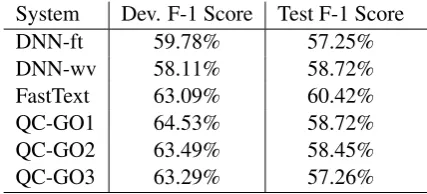
System Dev. F-1 Score Test F-1 Score
DNN-ft 59.78% 57.25%
DNN-wv 58.11% 58.72%
FastText 63.09% 60.42%
QC-GO1 64.53% 58.72%
QC-GO2 63.49% 58.45%
[image:2.595.308.522.62.159.2]QC-GO3 63.29% 57.26%
Table 1: SubTask 1 Results for the submissions for De-velopment and Test sets.
best results were obtained when using character n-grams varying from 3 to 6 characters, dimensions of vectors of 100, a learning rate of 0.1, and 50 training epochs.
Heuristics: For sub-task 2, we constructed a list of all Arabic speaking countries (e.g.
QåÓ
(Egypt)) along with major cities in these countries (e.g.èQëA
®Ë@
(Cairo)). Given our list, we counted the number of times a tweep mentions the names of countries or any of the cities therein in his/her tweets. Then, we labeled a tweep with the county that is mentioned most in the tweets.Ensemble model: For both sub-tasks, our final system combines the output from the different sys-tems using a simple majority vote to perform di-alectal Arabic predictions. The ensemble model can either assign varying weights to different sys-tems depending on their overall performance on the dev set or it takes the average by setting equal weights for all systems.
3 Results
In this section we present the results of our system output for Subtask 1 and Subtask 2 on both the validation and the test sets.
3.1 SubTask 1
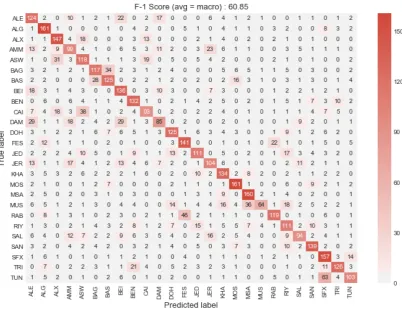
Figure 1: Confusion matrix for results of SubTask 1 system combination
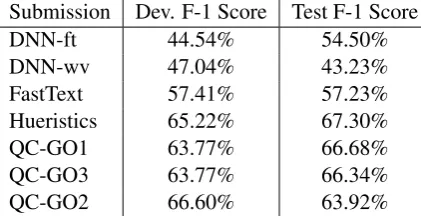
[image:3.595.98.502.433.719.2]Submission Dev. F-1 Score Test F-1 Score
DNN-ft 44.54% 54.50%
DNN-wv 47.04% 43.23%
FastText 57.41% 57.23%
Hueristics 65.22% 67.30%
QC-GO1 63.77% 66.68%
QC-GO3 63.77% 66.34%
[image:4.595.76.287.63.171.2]QC-GO2 66.60% 63.92%
Table 2: SubTask 2 results for the submissions for De-velopment and Test sets.
3.2 SubTask 2
As for SubTask 2, the combination of DNN-ft with DNN-wv was not as effective as either alone. A decrease of 1.2% was observed. On the other hand using fastText by itself achieved an F-1 score of 57.23%, which is higher than both DNN-ft and DNN-wv. Using the heuristics approach yielded the best performance with 64.09%. Adding a back-off to use a majority vote per user, when a tweep did not mention any country or any city therein, to get the most frequent predicted country improved result to 67.30%. This system ranked third among all submitted systems for SubTask 2.
4 Discussion and conclusions
Our analysis of the system output on the validation set for Subtask 1 shows that the highest accuracy obtained at the dialect level was for MSA, SFX, ALX, and MOS, (Figure 1) while the lowest ac-curacy was for MUS, DAM, and AMM. Local di-alects within the same country caused the vast ma-jority of confusion. For example, the most confu-sion for SFX came from TUN, for BAS came from BAG, and for JED came from RIY. We also ob-served a heightened confusion between cities from neighboring countries, such as ALG and FES, BEI and ALE, and JER and AMM. This observation emphasizes the perception that there is a level of homogeneity between dialects with physical prox-imity whether at the national and regional levels. As for the Subtask 2, the challenging ambiguity between gulf dialects is still a major issue that caused the accuracy drop; See (Figure 2). Ex-panding the data for these subdialects would en-hance their respective accuracy.
References
Houda Bouamor, Nizar Habash, Mohammad Salameh, Wajdi Zaghouani, Owen Rambow, Dana Abdul-rahim, Ossama Obeid, Salam Khalifa, Fadhl Eryani, Alexander Erdmann, and Kemal Oflazer. 2018. The MADAR Arabic Dialect Corpus and Lexicon. In Proceedings of the Language Resources and Eval-uation Conference (LREC), Miyazaki, Japan.
Houda Bouamor, Sabit Hassan, and Nizar Habash. 2019. The MADAR Shared Task on Arabic Fine-Grained Dialect Identification. InProceedings of the Fourth Arabic Natural Language Processing Work-shop (WANLP19), Florence, Italy.
Kareem Darwish. 2014. Arabizi detection and conver-sion to arabic. Proceedings of the EMNLP 2014 Workshop on Arabic Natural Language Processing (ANLP), pages 217–224.
Mohamed Elaraby and Muhammad Abdul-Mageed. 2018. Deep models for Arabic dialect identification on benchmarked data. In Proceedings of the Fifth Workshop on NLP for Similar Languages, Varieties and Dialects (VarDial 2018).
Radu Tudor Ionescu and Marius Popescu. 2016. Unibuckernel: An approach for arabic dialect iden-tification based on multiple string kernels. In Pro-ceedings of the Third Workshop on NLP for Similar Languages, Varieties and Dialects (VarDial3), pages 135–144.
Armand Joulin, Edouard Grave, Piotr Bojanowski, Matthijs Douze, H´erve J´egou, and Tomas Mikolov. 2016. Fasttext.zip: Compressing text classification models. arXiv preprint arXiv:1612.03651.
Armand Joulin, Edouard Grave, Piotr Bojanowski, and Tomas Mikolov. 2017. Bag of tricks for efficient text classification. InProceedings of the 15th Con-ference of the European Chapter of the Association for Computational Linguistics: Volume 2, Short Pa-pers, pages 427–431. Association for Computational Linguistics.
Yoon Kim, Yacine Jernite, David Sontag, and Alexan-der M Rush. 2016. Character-aware neural language models. InThirtieth AAAI Conference on Artificial Intelligence.
Shervin Malmasi, Eshrag Refaee, and Mark Dras. 2015. Arabic dialect identification using a parallel multidialectal corpus. InConference of the Pacific Association for Computational Linguistics, pages 35–53. Springer.
Hamdy Mubarak and Kareem Darwish. 2014. Using twitter to collect a multi-dialectal corpus of arabic. In Proceedings of the EMNLP 2014 Workshop on Arabic Natural Language Processing (ANLP), pages 1–7.
Proceedings of the LREC 2010 Workshop on New Challenges for NLP Frameworks, pages 45–50, Val-letta, Malta. ELRA.
Mohammad Salameh, Houda Bouamor, and Nizar Habash. 2018. Fine-grained Arabic dialect identi-fication. InProceedings of the International Con-ference on Computational Linguistics (COLING), pages 1332–1344, Santa Fe, New Mexico, USA.
Younes Samih, Mohamed Eldesouki, Mohammed At-tia, Kareem Darwish, Ahmed Abdelali, Hamdy Mubarak, and Laura Kallmeyer. 2017. Learning from relatives: Unified dialectal Arabic segmenta-tion. In(CoNLL 2017), pages 432–441, Vancouver, Canada. Association for Computational Linguistics.
Younes Samih and Wolfgang Maier. 2016. An Arabic-Moroccan Darija code-switched corpus. In Pro-ceedings of the Tenth International Conference on Language Resources and Evaluation (LREC 2016), pages 4170–4175, Portoroˇz, Slovenia. European Language Resources Association (ELRA).
Rupesh K. Srivastava, Klaus Greff, and J¨urgen Schmid-huber. 2015. Training very deep networks. In Ad-vances in neural information processing systems, pages 2377–2385.
Omar F. Zaidan and Chris Callison-Burch. 2011. The arabic online commentary dataset: an annotated dataset of informal arabic with high dialectal con-tent. InProceedings of the 49th Annual Meeting of the ACL-HLT: short papers-Volume 2, pages 37–41.