Annotating and Predicting Non-Restrictive Noun Phrase Modifications
Gabriel Stanovsky Ido Dagan
Computer Science Department, Bar-Ilan University [email protected]
Abstract
The distinction between restrictive and non-restrictive modification in noun phrases is a well studied subject in linguistics. Automatically identifying non-restrictive modifiers can provide NLP applications with shorter, more salient arguments, which were found beneficial by several recent works. While previous work showed that restrictiveness can be annotated with high agreement, no large scale corpus was created, hindering the development of suitable classification algorithms. In this work we devise a novel crowdsourcing annotation methodology, and an accompanying large scale corpus. Then, we present a robust automated system which identifies non-restrictive modifiers, notably improving over prior methods.
1 Introduction
Linguistic literature provides a large body of re-search distinguishing between two types of mod-ifiers within noun phrases: (1) Restrictive modi-fiers, which constitute an integral part of the entity referenced by the NP, e.g., the underlined modifier in “She wore the necklace that her mother gave her”, versus (2) Non-restrictive modifiers, which provide an additional or parenthetical information on an already definite entity, e.g., “The speaker thanked president Obama who just came into the room” (Huddleston et al., 2002; Fabb, 1990; Um-bach, 2006).
The distinction between the two types is seman-tic in nature and relies heavily on the context of the NP. Evidently, many syntactic constructions can appear in both restrictive and non-restrictive uses. While the previous examples were of
rela-tive clauses, Figure 1 demonstrates this distinction in various other syntactic constructions.
Identifying and removing non-restrictive mod-ifiers yields shorter NP arguments, which proved beneficial in many NLP tasks. In the context of abstractive summarization (Ganesan et al., 2010) or sentence compression (Knight and Marcu, 2002), non-restrictive modifiers can be removed to shorten sentences, while restrictive modification should be preserved.
Further, recent work in information extraction showed that shorter arguments can be beneficial for downstream tasks. Angeli et al. (2015) built an Open-IE system which focuses on shorter ar-gument spans, and demonstrated its usefulness in a state-of-the-art Knowledge Base Population sys-tem. Stanovsky et al. (2015) compared the per-formance of several off-the-shelf analyzers in dif-ferent semantic tasks. Most relevant to this work is the comparison between Open-IE and Seman-tic Role Labeling (Carreras and M`arquez, 2005). Specifically, they suggest that SRL’s longer argu-ments introduce noise which hurts performance for downstream tasks.
Finally, in question answering, omitting non-restrictive modification can assist in providing more concise answers, or in matching between multiple answer occurrences.
Despite these benefits, there is currently no con-sistent large scale annotation of restrictiveness, which hinders the development of automatic tools for its classification. In prior art in this field, Dor-nescu et al. (2014) used trained annotators to mark restrictiveness in a large corpus. Although they reached good agreement levels in restrictiveness annotation, their corpus suffered from inconsisten-cies, since it conflated restrictiveness annotation with inconsistent modifier span annotation.
The contributions of this work are twofold. Pri-marily, we propose a novel crowdsroucing
tation methodology which decouples the binary (restrictive / non-restrictive) distinction from the modifier span annotation (Section 3). Following this methodology, in Section 4 we present a large scale annotated corpus, which will allow further research into the automatic identification of non-restrictive modification.
Additionally, we developed a strong automatic classifier, which learns from our new corpus (Sec-tion 5). This classifier uses new linguistically mo-tivated features which are robust enough to per-form well over automatically predicted parse trees. The corpus and the automatic classifier are both made publicly available.1
While there is still much room for improve-ment, especially in some of the harder, more context-dependent, cases (most notably, preposi-tional and adjectival modifiers), our system pro-vides an applicable means for identifying non-restrictive modification in a realistic NLP setting.
2 Background
In this section we cover relevant literature from several domains. In Section 2.1 we discuss the es-tablished linguistic distinction between restrictive and non-restrictive modification. Following, in Section 2.2 we discuss previous NLP work on an-notating and identifying this distinction. Finally, in Section 2.3 we briefly describe the recent QA-SRL annotation paradigm (He et al., 2015), which we utilize in Section 3 as part of our annotation scheme.
2.1 Non-Restrictive Modification
Throughout the paper we follow Huddleston et al.’s (2002) well-known distinction between two types of NP modifiers: (1) Restrictive modifiers, for which the content of the modifier is an integral part of the meaning of the containing NP, and, in contrast, (2)Non-restrictive modifiers, that present a separate, parenthetical unit of information about the NP.
While some syntactic modifiers (such as deter-miners or genitives) are always restrictive, others are known to appear in both restrictive as well as non-restrictive uses, depending on semantics and context (Huddleston et al., 2002; Fabb, 1990; Um-bach, 2006). Among these are relative clauses, ad-jectival, prepositional, non-finite, and verbal
mod-1http://www.cs.biu.ac.il/˜nlp/ resources/downloads
(RC1) The necklacethat her mother gave her+
is in the safe.
(RC2) The governor disagreed with the U.S am-bassador to Chinawho seemed nervous−. (NF1) Peopleliving near the site+ will have to
be evacuated.
(NF2) sheriff Arthur Lester,standing against the wall−, looked tired.
(PP1) The kidfrom New York+won the lottery.
(PP2) The assassination of Franz Ferdinandfrom Austria−started WWI.
(AD1) Thegood+boys won.
(AD2) The water level rose agood−12 inches.
Figure 1: Restrictive (marked in red and a plus sign) and non-restrictive (marked in blue and a mi-nus sign) examples in different syntactic construc-tions, see elaboration in Section 2. Examples in-dex: RC - Relative clause, NF - Non-finite clauses (Huddleston et al. [p. 1265]), PP - Prepositional modifiers, AD - Adjectival modifiers (Huddleston et al. [p. 528]).
ifiers. See Figure 1 for examples of different syn-tactic constructions appearing in both restrictive as well as non-restrictive contexts.
For example, for relative clause, Huddleston et al. [p. 1058] identifies both restrictive as well as non-restrictive uses (for which they use the terms integrated and supplementary, respec-tively). In the sentence marked (RC1), the high-lighted relative clause is restrictive, distinguishing the necklace being referred to from other neck-laces, while in sentence (RC2), the relative clause does not pick an entity from a larger set, but in-stead presents separate information about an al-ready specified definite entity.
2.2 Non-Restrictive Modification in NLP
Syntactic and semantic annotations generally avoid the distinction between restrictive and non-restrictive modification (referred here as “restric-tiveness” annotation).
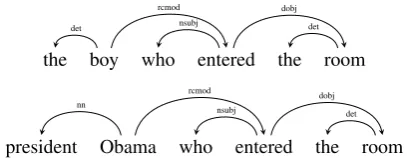
The syntactic annotation of the Penn TreeBank (Marcus et al., 1993) and its common conversion to dependency trees (e.g., (de Marneffe and Man-ning, 2008)) do not differentiate the cases dis-cussed above, providing the same syntactic struc-ture for the semantically different instances. See Figure 2 for an example.
such as PropBank (Palmer et al., 2005), AMR (Banarescu et al., 2013), CCG (Hockenmaier and Steedman, 2007), or FrameNet (Baker et al., 1998), also avoid this distinction. For exam-ple, PropBank does not differentiate between such modifiers, treating both types of modification as an integral part of an argument NP.
Two recent works have focused on automat-ically identifying non-restrictive modifications. Honnibal et al. (2010) added simple automated restrictiveness annotations to NP-modifiers in the CCGbank (Hockenmaier and Steedman, 2007). Following a writing style and grammar rule, a modifier was judged as non-restrictive if and only if it was preceded by a comma.2 This annotation
was not intrinsically evaluated, as it was carried as part of an extrinsic evaluation of a statistical parser.
Having similar goals to ours, Dornescu et al. (2014) sets the prior art at annotating and predict-ing non-restrictive modification. In the annotation phase, each of their trained annotators was asked to (1) Mark spans of words in the sentence as forming an NP modifier, and (2) Mark each span they annotated in (1) as either restrictive or non-restrictive, and specify its type from a predefined list (e.g., relative clause, adjectival modifier, etc.). Their inter-annotator agreement on the first task (modifier span) was low, reaching pairwise F1 score of only 54.9%, possibly due to problems in the annotation procedure, as acknowledged by the authors. The second part of the annotation achieved better agreement levels, reaching kappa of 0.78 (substantial agreement) for type annotation and 0.51 (moderate agreement) for restrictiveness annotation.3
Following the creation of the annotated dataset, they developed rule based and machine learning classifiers. All of their classifiers performed only at about 47% F1, at least partly due to the incon-sistencies in span annotation discussed above.
To conclude this survey, although an effort was made by Dorenscu et al. (2014), there is currently no available consistent corpus annotated with non-restrictive modifiers.
2Notice that this is indeed the case in some of the non-restrictive examples in Figure 1.
3Note that the agreement for the first task is reported in F1 while the second task is reported in Cohen’s kappa.
the boy who entered the room
det nsubj
rcmod
det dobj
president Obama who entered the room
nn nsubj
rcmod
det dobj
Figure 2: Restrictive (top) and non-restrictive (bottom) NP modifications receive the same rep-resentation in dependency trees. See Section 2.2.
2.3 QA-SRL
Traditional Semantic Role Labeling (SRL) (Car-reras and M`arquez, 2005) is typically perceived as answeringargument role questions, such aswho, what, to whom, when, or where, regarding a tar-get predicate. For instance, PropBank’s ARG0 for the predicatesayanswers the question “whosaid
something?”.
QA-SRL (He et al., 2015) suggests that answer-ing explicit role questions is an intuitive means to solicit predicate-argument structures from non-expert annotators. Annotators are presented with a sentence in which a target predicate4was marked,
and are requested to annotate argument role ques-tions, phrased using a restricted grammar, and cor-responding answers.
For example, given the sentence “President Obama who flew to Russia called the vice presi-dent” and the target predicatecalled, an annotator can intuitively provide the following QA pairs: (1) Who called?President Obamaand (2)Whom did someone call?the vice president.
In order to assess the validity of their annotation scheme, He et al. annotated a large sample of the PropBank corpus (1241 sentences) with QA-SRL, and showed high agreement with PropBank over this sample. In the following sections we make use of these explicit role questions for annotating non-restrictive modifiers.
3 Annotation Methodology
As mentioned in the Introduction, the first goal of this work is to assemble a large and consis-tent corpus, annotated with non-restrictive modifi-cations. In this section, we present a crowdsourc-ing methodology which allows us to generate such corpus in a cost-effective manner (Section 3.2). As a preliminary step, we conducted a smaller scale
[image:3.595.314.518.64.143.2]expert annotation (Section 3.1), which will serve as a gold standard with which to test the crowsd-sourced annotations.
3.1 Expert Annotation
Two researchers, with linguistics and NLP educa-tion, were presented with a sample of 219 mod-ifiers of NPs in 100 sentences,5 and were asked
to annotate each modifier as either restrictive or non-restrictive, according to the linguistic defini-tion presented in Secdefini-tion 2. Prior to annotating the expert dataset, the annotators discussed the pro-cess and resolved conflicts on a development set of 20 modifiers.
The annotators agreement was found to be high, reaching agreement on 93.5% of the instances, and κof 84.2% . An analysis of the few disagreements found that the deviations between the annotators stem from semantic ambiguities, where two legit-imate readings of the sentence led to disagreeing annotations. For example, in “sympathetic fans havesentMs. Shere copies of her recipes clipped from magazines over the years”, one annotator read the underlined modifier clause as restrictive, identifying particular recipes, while the second an-notator read the modifier as non-restrictive, adding supplementary information on the sent recipes.
Finally, we compose the expert annotation dataset from the 207 modifiers agreed upon by both annotators. In the next section we use this dataset to evaluate the quality of our crowd-sourced annotations.
3.2 Crowdsourcing Annotation Process
In our scheme, each annotation instance assigns a binary label (restrictive or non-restrictive) to a 4-tuple(s, v, p, m) – wherem is a modifier of the noun phrase p, which is an argument of a verbal predicatev, in a sentences. We incorporatev in our scheme in order to provide non-trained anno-tators with an argument role question (discussed in 2.3), as elaborated below.6
Consider, for example, the sentence s – “the speakerthanked[President Obama who just en-tered the room]”. We want to annotate the re-strictiveness value of the relative clausem (under-lined), which modifies the matrix noun phrase p
5These were taken at random from the development par-tition of the corpus described in Section 4.
6Our annotation currently covers the most common case of NPs which serve as arguments of verbal predicates.
(bracketed), which is in turn an argument of a gov-erning predicatev(in bold).
Our annotation procedure does not require the annotator to be familiar with the formal linguistic definition of restrictiveness. Instead, we use bi-nary question-answering (true / false questions) as an intuitive formulation of non-restrictive modifi-cation. We present annotators with the argument role question pertaining to the argument NP, and ask whether this NPwithoutthe modifier gives the same answer to the argument role question as the original NP did.
In our example, an annotator is presented with the argument role question “whom did someone thank?” (which is answered by p), and is asked to decide whether the reduced NP, “President Obama”, provides the same answer to the ques-tion as the full NP does. If the answer is positive (as in this case), we consider the modifier to be non-restrictive, otherwise we consider it to be re-strictive.
As an example for the restrictive case, consider “she wore [the necklace that her mother gave her]”, and the respective argument role-question “what did someone wear?”. In this case, as op-posed to the previous example, the reduced NP (“the necklace”) does not refer to the same entity as the original NP, since we lose the specific iden-tity of the necklace which was worn.
The intuition for this process arises from the linguistic definition for modifier restrictiveness. Namely, a restrictive modifier is defined as an in-tegral part of the NP, and a non-restrictive modifier as providing supplementary or additional informa-tion about it. Therefore, in the restrictive case, omitting the modifier would necessarily change the meaning of the answer, while in the non-restrictive case, omitting it would not change the entity referenced by the full NP, and would there-fore provide the same answer to the argument role question.
4 Corpus
Modifier Type Identified By # Non-Restrictive Agreementκ %
Adjectival pos= JJ 684 41.36% 74.70 87.36
Prepositional pos= IN / TMP / LOC 693 36.22% 61.65 85.10
Appositive rel= APPO / PRN 342 73.68% 60.29 80.00
Non-Finite rel= TO 279 68.82% 71.04 86.48
Verbal pos= VB and not relative clause 150 69.33% 100 100
Relative clause pos= VB and childpos= WP 43 79.07% 100 100
[image:5.595.86.512.59.203.2]Total - 2191 51.12% 73.79 87.00
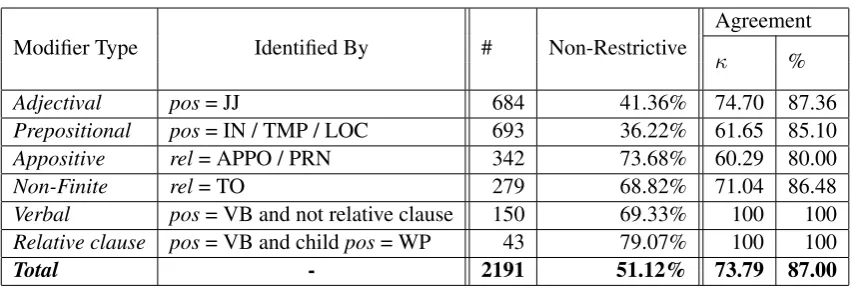
Table 1: Corpus statistics by modifier types, which were identified by part of speech (pos) and depen-dency label (rel) (Section 4.1). The number of instances (#) and non-restrictiveness percentage refer to the full crowdsourced annotation. Agreement (Cohen’sκand percent of matching instances) is reported for the expert-annotated data (Section 4.2), between the expert and crowdsourced annotations.
4.1 Data Collection
We use the dataset which He et al. (2015) an-notated with Question-Answer pairs (discussed in Section 2.3), and keep their train / dev / test split into 744 / 249 / 248 sentences, respectively. This conveniently allows us to link between argument NPs and their corresponding argument role ques-tion needed for our annotaques-tion process, as de-scribed in previous section.
This dataset is composed of 1241 sentences from the CoNLL 2009 English dataset (Hajiˇc et al., 2009), which consists of newswire text anno-tated by the Penn TreeBank (Marcus et al., 1993), PropBank (Palmer et al., 2005), and NomBank (Meyers et al., 2004), and converted into depen-dency grammar by (Johansson and Nugues, 2008). As mentioned in Section 3.2, each of our anno-tation instances is composed of a sentences, a ver-bal predicatev, a noun phrasep, and a modifierm. We extract each such possible tuple from the set of sentences in the following automatic manner:
1. Identify a verbvin the gold dependency tree.
2. Follow its outgoing dependency arcs to a noun phrase argument p (a dependent of v with a nominal part of speech).
3. Findm, a modifying clause ofpwhich might be non-restrictive, according to the rules de-scribed in Table 1, under the “Identified By” column. This filters out modifiers which are always restrictive, such as determiners or genitives, following (Huddleston et al., 2002), as discussed in Section 2. Notice that this automatic modifier detection decouples
the span annotation from the restrictiveness annotation, which was a source for inconsis-tencies in Dornescu et al’s annotation (Sec-tion 2.2).
This automatic process yields a dataset of 2191 modifiers of 1930 NPs in 1241 sentences. We note that our collection process ensures that the cor-pus correlates with the syntactic dependency an-notation of the CoNLL 2009 shared task, and can therefore be seen as an augmentation of its modi-fier labels to include restrictiveness annotations.
In order to find the corresponding argument role question, we follow the process carried by He et al.; An argument NP is matched to an annotated Question-Answer pair if the NP head is within the annotated answer span. Following this matching process yields a match for 1840 of the NPs.
For the remaining 90 NPs we manually com-pose an argument role question by looking at the governing predicate and its argument NP. For ex-ample, given the sentence “[The son of an im-migrant stonemason of Slovenian descent] was
raisedin a small borough outside Ebensburg”, the predicateraisedand the bracketed NP argument, we produce the argument role question “Who was raised?”.
The corpus category distribution is depicted in Table 1, under column labeled “#”. In later sec-tions we report agreement and performance across these categories to produce finer grained analyses.
4.2 Crowdsourcing Annotation
We use Amazon Mechanical Turk7to annotate the
2191 modifiers for restrictiveness, according to the
process defined in Section 3.2. Each modifier was given to 5 annotators, and the final tag was as-signed by majority vote. We used the development set to refine the guidelines, task presentation, and the number of annotators.
Each annotator was paid 5c for the annotation of an NP, which in average provided 1.16 modifiers. This sets the average price for obtaining a single modifier annotation at5· 5
1.16 = 21.5c.
The agreement with the 217 NP modifiers anno-tated by the experts (Section 3.1) and percentage of positive (non-restrictive) examples per category can be found in Table 1, in the columns labeled “agreement”. The labels are generally balanced, with 51.12% non-restrictive modifiers in the entire dataset (varying between 36.22% for prepositional modifiers and 79.07% for relative clauses).
Overall, the crowdsourced annotation reached good agreement levels with our expert annota-tion, achieving 73.79 κ score (substantial agree-ment). The lowest agreement levels were found on prepositional and appositive modifiers (61.65% and 60.29%).8 Indeed, as discussed in Section
2, these are often subtle decisions which rely heavily on context. For example, the following instances were disagreed upon between our ex-pert annotation and the crowdsourced annotation: In “[Charles LaBella , the assistant U.S. attor-ney prosecuting the Marcos case], did n’t return
phone calls seeking comment” (an appositive ex-ample), the experts annotated the underlined mod-ifier as non-restrictive, while the crowdsource an-notation marked it as restrictive. Inversely, in “The amendment prompted [an ironic protest] from Mr. Thurmond”, the experts annotated the adjecti-val modifier as restrictive, while the crowdsource annotation tagged it as non-restrictive.
5 Predicting Non-Restrictive Modification
In this section we present an automatic system which: (1) Identifies NP modifiers in a depen-dency parser’s output (as shown in Table 1, col-umn “Identified By”) and (2) Uses a CRF model to classify each modifier as either restrictive or non-restrictive, based on the features listed in Table 2,
8While linguistic literature generally regards appositives as non-restrictive, some of the appositions marked in the de-pendency conversion are in fact misclassified coordinations, which explains why some of them were marked as restrictive.
and elaborated below.9
5.1 Baselines
We begin by replicating the algorithms in the two prior works discussed in Section 2.2. This allows us to test their performance consistently against our new human annotated dataset.
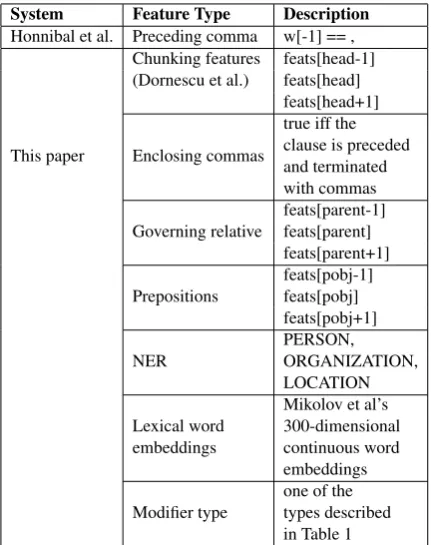
Replicating (Honnibal et al., 2010) They anno-tated a modifier as restrictive if and only if it was preceded with a comma. We re-implement this baseline and classify all of the modifiers in the test set according to this simple property.
Replicating (Dornescu et al., 2014) Their best performing ML-based algorithm10uses the
super-vised CRFsuite classifier (Okazaki, 2007) over “standard features used in chunking, such as word form, lemma and part of speech tags”. Replicat-ing their baseline, we extract the list of features detailed in Table 2 (in the row labeled “chunking features”).
5.2 Our Classifier
In addition to Dornescu et al.’s generic chunking framework, we also extract features which were identified in the linguistic literature as indicative for non-restrictive modifications. These features are then used in the CRFsuite classifier (the same CRF classifier used by Donescu et al.) to make the binary decision. The following paragraphs elabo-rate on the motivation for each of the features.
Enclosing commas We extend Honnibal’s et al.’s classification method as a binary feature which marks whether the clause is both preceded and terminated with a comma. This follows from a well-known writing style and grammar rule which indicates that non-restrictive clausal modi-fiers should be enclosed with a comma.
Governing relative In the linguistic literature, it was posited that the word introducing a clausal modifier (termedrelative) is an indication for the restrictiveness of the subordinate clause. For ex-ample, Huddleston. et al. (2002) [p. 1059] analyzes the word “that” as generally introduc-ing a restrictive modifier, while a wh-pronoun is
9We use our new crowdsourced corpus to train our model as well as the baseline model.
more likely to introduce non-restrictive modifica-tion. We therefore extract features of the word which governs the relative, such as the surface form, its lemma, POS tag, and more. The full list is shown under “Governing relative” in Table 2.
Named entities As illustrated throughout the paper, modifiers of named entities tend to be non-restrictive. We run the Stanford Named Entity Recognizer (NER) (Finkel et al., 2005) and intro-duce a feature indicating the type of named entity (PERSON, ORG or LOC), where applicable.
Lexical word embeddings We include the pre-trained word embeddings of the modifier’s head word, calculated by (Mikolov et al., 2013). These distributional features help the classifier associate between similar words (for example, if “good” is non-restrictive in some contexts, it is likely that “fine” is also non-restrictive within similar con-texts).
Modifier type We add the automatically identi-fied modifier type as a feature, to associate certain features as indicative for certain types of modifiers (e.g., enclosing commas might be good indicators for relative clause, while word embeddings can be specifically helpful for adjectival modifiers).
6 Evaluation
We use the QA-SRL test section (containing 412 NP modifiers) to evaluate each of the systems de-scribed in Section 5 on gold and predicted trees, both provided in the CoNLL 2009 dataset (the pre-dicted dependency relations were obtained using MaltParser (Nivre et al., 2007)). The gold setting allows us to test the performance of the systems without accumulating parser errors. In addition, it allows us to partition and analyze our dataset ac-cording to the gold modifier type. The predicted setting, on the other hand, allows us to evaluate our classifier in a real-world application scenario, given automatic parsing output.
6.1 Gold Trees
The results for each of the systems across our cate-gories on the gold trees are shown in Table 3. Note that we regard non-restrictive modification as pos-itive examples, and restrictive modification as neg-ative examples. This is in line with the applicneg-ative goal of reducing argument span by removing non-restrictive modifiers, discussed in the Introduction. Switching the labels does not significantly change
System Feature Type Description
Honnibal et al. Preceding comma w[-1] == , Chunking features feats[head-1] (Dornescu et al.) feats[head]
feats[head+1]
This paper Enclosing commas
true iff the clause is preceded and terminated with commas feats[parent-1] Governing relative feats[parent]
feats[parent+1] feats[pobj-1] Prepositions feats[pobj]
feats[pobj+1]
NER PERSON,ORGANIZATION, LOCATION
Lexical word embeddings
Mikolov et al’s 300-dimensional continuous word embeddings
[image:7.595.309.525.61.334.2]Modifier type one of thetypes described in Table 1
Table 2: Features used for classification in each of the systems as described in Section 5. head -head of the modifier in the dependency tree. par-ent- parent ofheadin the dependency tree. pobj - object of the preposition, in case of prepositional head. feats[i] refers to extracting the following features from the wordi: POS tag, lemma, is title, is all lower case, is all upper case, is beginning / end of sentence.
the numbers, since the corpus is relatively well balanced between the two labels (as can be seen in Table 1). Following are several observations based on an error analysis of these results.
Prepositional and adjectival modifiers are harder to predict All systems had more diffi-culties in classifying both of these categories. This reiterates the relatively lower agreement for these categories between the crowdsource and expert annotation, discussed in Section 4.2.
Modifier Type # Precision Recall F1
Honnibal Dornescu Our Honnibal Dornescu Our Honnibal Dornescu Our
Prepositional 135 .83 .67 .69 .1 .16 .41 .18 .26 .51
Adjectival 111 .33 .38 .59 .06 .06 .21 .11 .11 .31
Appositive 78 .77 .81 .82 .34 .93 .98 .47 .87 .89
Non-Finite 55 .77 .63 .64 .29 .97 .97 .42 .76 .77
Verbal 20 0 .75 .75 0 1 1 0 .86 .86
Relative clause 13 1 .85 .85 .27 1 1 .43 .92 .92
[image:8.595.74.526.61.175.2]Total 412 .72 .72 .73 .19 .58 .68 .3 .64 .72
Table 3: Test set performance of the 3 different systems described in Sections 5 and 6 on gold trees from the CoNLL 2009 dataset, across the different categories defined in Section 4.
Features P R F1
All .73 .68 .72
Baseline - comma- chunking .72 .68 .70.72 .66 .69
New - governing relative .74 .61 .67- prepositions .73 .67 .70 - word embeddings .72 .69 .71
- NER .71 .68 .70
[image:8.595.71.295.225.353.2]- mod type .74 .66 .70
Table 4: Feature ablation tests on gold trees. Each row specifies a different feature set – “All” speci-fies the entire feature set from Table 2, while each subsequent line removes one type of features.
(Dornescu et al., 2014) performs better on our dataset Their method achieves much better re-sults on our dataset (compare 64% overall F1 on our dataset with their reported 45.29% F1 on their dataset). This speaks both for their method as a valid signal for restrictiveness annotation, as well as for the improved consistency of our dataset.
Our system improves recall Overall, our sys-tem significantly outperforms both baselines by more than 8% gain in F1 score. Specifically, the numbers show clearly that we improve recall in the frequent categories of prepositional and adjectival modifiers. Furthermore, the results of an ablation test on our features (shown in Table 4) show that chunking and governing relative features provide the highest individual impact.
6.2 Predicted Trees
To test our classifier in a realistic setting we evalu-ate its performance on predicted dependency trees. To obtain the candidate modifiers, we use the same extractor presented in previous sections, applied on the predicted trees in the test section of the CoNLL 2009 dataset. We then apply the models
System P R F1
Candidate Extraction .91 .93 .92
Honnibal .71 .18 .29
Dornescu .68 .53 .59
Our .69 .63 .66
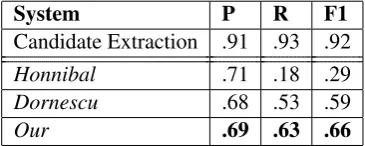
Table 5: Restrictiveness results (bottom three lines) on predicted trees. The top line (Candidate Extraction) measures the percent of correct modi-fiers identified in the predicted trees (shared across all of the classifiers). See Section 6.2.
trained on the gold train set of the same corpus. For evaluation, we use the gold labels and com-pute (1) precision – the percent of predicted restrictive modifiers which match a gold non-restrictive modifier, and (2) recall – the percent of gold non-restrictive modifiers which match a pre-dicted non-restrictive modifier. Note that this met-ric is stmet-rict, conflating both parser errors with our classifier’s errors. The results are shown in Table 5.
The first line in the table measures the perfor-mance of the modifier extractor module on the pre-dicted trees. A prepre-dicted modifier is considered correct if it agrees with a gold modifier on both its syntactic head as well as its span. The modifier extractor module is shared across all classifiers, as discussed in Section 5, and its performance on the predicted trees imposes an upper bound on all the classifiers.
Both our and Dornescu’s classifiers drop 5-6 points in F1, keeping the differences observed on the gold trees, while Honnibal et al.’s simple comma-based classifier is less sensitive to parser errors, dropping only one point in F1.
[image:8.595.325.508.226.299.2]parsing errors within the modifier subtree.
7 Conclusions and Future Work
We presented an end-to-end framework for restric-tiveness annotation, including a novel QA-SRL based crowdsourcing methodology and a first con-sistent human-annotated corpus. Furthermore, we presented a linguistically motivated classifier, sur-passing the previous baseline by 8% gain in F1.
Future work can use our annotated corpus to de-velop classifiers that deal better with prepositional and adjectival modifiers, which require deeper se-mantic analysis.
Acknowledgments
We would like to thank Michael Elhadad and Yoav Goldberg for fruitful discussions, and the anony-mous reviewers for their helpful comments.
This work was supported in part by grants from the MAGNET program of the Israeli Office of the Chief Scientist (OCS), the Israel Science Founda-tion grant 880/12, and the German Research Foun-dation through the German-Israeli Project Cooper-ation (DIP, grant DA 1600/1-1).
References
Gabor Angeli, Melvin Johnson Premkumar, and Christopher D. Manning. 2015. Leveraging lin-guistic structure for open domain information
ex-traction. In Proceedings of the 53rd Annual
Meet-ing of the Association for Computational LMeet-inguistics (ACL 2015).
Collin F Baker, Charles J Fillmore, and John B Lowe.
1998. The berkeley framenet project. In
Proceed-ings of ACL, pages 86–90. Association for
Compu-tational Linguistics.
Laura Banarescu, Claire Bonial, Shu Cai, Madalina Georgescu, Kira Griffitt, Ulf Hermjakob, Kevin Knight, Philipp Koehn, Martha Palmer, and Nathan Schneider. 2013. Abstract meaning representation for sembanking.
Xavier Carreras and Llu´ıs M`arquez. 2005. Introduc-tion to the conll-2005 shared task: Semantic role
la-beling. InProceedings of CONLL, pages 152–164.
Marie-Catherine de Marneffe and Christopher D Man-ning. 2008. The stanford typed dependencies
rep-resentation. In Coling 2008: Proceedings of the
workshop on Cross-Framework and Cross-Domain Parser Evaluation, pages 1–8.
Iustin Dornescu, Richard Evans, and Constantin Orasan. 2014. Relative clause extraction for syn-tactic simplification. COLING 2014, page 1.
Nigel Fabb. 1990. The difference between english re-strictive and nonrere-strictive relative clauses. Journal of linguistics, 26(01):57–77.
Jenny Rose Finkel, Trond Grenager, and Christopher Manning. 2005. Incorporating non-local informa-tion into informainforma-tion extracinforma-tion systems by gibbs
sampling. InProceedings of the 43rd Annual
Meet-ing on Association for Computational LMeet-inguistics,
pages 363–370. Association for Computational Lin-guistics.
Kavita Ganesan, ChengXiang Zhai, and Jiawei Han. 2010. Opinosis: a graph-based approach to abstrac-tive summarization of highly redundant opinions. In
Proceedings of the 23rd international conference on computational linguistics, pages 340–348. Associa-tion for ComputaAssocia-tional Linguistics.
Jan Hajiˇc, Massimiliano Ciaramita, Richard Johans-son, Daisuke Kawahara, Maria Ant`onia Mart´ı, Llu´ıs M`arquez, Adam Meyers, Joakim Nivre, Sebastian Pad´o, Jan ˇStˇep´anek, et al. 2009. The conll-2009 shared task: Syntactic and semantic dependencies in multiple languages. InProceedings of the Thir-teenth Conference on Computational Natural
Lan-guage Learning: Shared Task, pages 1–18.
Associa-tion for ComputaAssocia-tional Linguistics.
Luheng He, Mike Lewis, and Luke Zettlemoyer. 2015. Question-answer driven semantic role labeling: Us-ing natural language to annotate natural language.
Inthe Conference on Empirical Methods in Natural
Language Processing (EMNLP).
Julia Hockenmaier and Mark Steedman. 2007. Ccg-bank: A corpus of ccg derivations and dependency structures extracted from the penn treebank. In
Computational Linguistics.
Matthew Honnibal, James R Curran, and Johan Bos. 2010. Rebanking ccgbank for improved np inter-pretation. InProceedings of the 48th Annual Meet-ing of the Association for Computational LMeet-inguis- Linguis-tics, pages 207–215. Association for Computational Linguistics.
Rodney Huddleston, Geoffrey K Pullum, et al. 2002.
The cambridge grammar of english. Language.
Cambridge: Cambridge University Press.
Richard Johansson and Pierre Nugues. 2008.
Dependency-based syntactic-semantic analysis with
propbank and nombank. In Proceedings of the
Twelfth Conference on Computational Natural
Lan-guage Learning, pages 183–187. Association for
Computational Linguistics.
Kevin Knight and Daniel Marcu. 2002. Summariza-tion beyond sentence extracSummariza-tion: A probabilistic ap-proach to sentence compression. Artificial Intelli-gence, 139(1):91–107.
Adam Meyers, Ruth Reeves, Catherine Macleod, Rachel Szekely, Veronika Zielinska, Brian Young, and Ralph Grishman. 2004. The nombank project:
An interim report. InHLT-NAACL 2004 workshop:
Frontiers in corpus annotation, pages 24–31. Tomas Mikolov, Kai Chen, Greg Corrado, and
Jef-frey Dean. 2013. Efficient estimation of word
representations in vector space. arXiv preprint
arXiv:1301.3781.
Joakim Nivre, Johan Hall, Jens Nilsson, Atanas Chanev, G¨ulsen Eryigit, Sandra K¨ubler, Svetoslav Marinov, and Erwin Marsi. 2007. Maltparser: A language-independent system for data-driven
de-pendency parsing. Natural Language Engineering,
13(02):95–135.
Naoaki Okazaki. 2007. Crfsuite: a fast implementa-tion of condiimplementa-tional random fields (crfs).
Martha Palmer, Daniel Gildea, and Paul Kingsbury. 2005. The proposition bank: An annotated cor-pus of semantic roles. Computational linguistics, 31(1):71–106.
Gabriel Stanovsky, Ido Dagan, and Mausam. 2015. Open IE as an intermediate structure for semantic tasks. InProceedings of the 53rd Annual Meeting of the Association for Computational Linguistics (ACL 2015).
Carla Umbach. 2006. Non-restrictive modification and
backgrounding. InProceedings of the Ninth