Proceedings of the 55th Annual Meeting of the Association for Computational Linguistics (Short Papers), pages 547–553 Proceedings of the 55th Annual Meeting of the Association for Computational Linguistics (Short Papers), pages 547–553
Disfluency Detection using a Noisy Channel Model and a Deep Neural
Language Model
Paria Jamshid Lou
Department of Computing Macquarie University
Sydney, Australia
Mark Johnson
Department of Computing Macquarie University
Sydney, Australia
Abstract
This paper presents a model for disflu-ency detection in spontaneous speech tran-scripts calledLSTM Noisy Channel Model. The model uses a Noisy Channel Model (NCM) to generate n-best candidate dis-fluency analyses and a Long Short-Term Memory (LSTM) language model to score the underlying fluent sentences of each analysis. The LSTM language model scores, along with other features, are used in a MaxEnt reranker to identify the most plausible analysis. We show that using an LSTM language model in the reranking process of noisy channel disfluency model improves the state-of-the-art in disfluency detection.
1 Introduction
Disfluency is a characteristic of spontaneous speech which is not present in written text. Disfluencies are informally defined as interrup-tions in the normal flow of speech that occur in different forms, including false starts, correc-tions, repetitions and filled pauses. According to Shriberg’s (1994) definition, the basic pattern of speech disfluencies contains three parts: reparan-dum1, interregnum and repair. Example 1
illus-trates a disfluent structure, where the reparandum
to Boston is the part of the utterance that is re-placed, the interregnumuh, I mean is an optional part of a disfluent structure that consists of a filled pauseuhand a discourse markerI meanand the re-pairto Denver replaces the reparandum. The flu-ent version of Example1 is obtained by deleting
1Reparandum is sometimes callededit.
reparandum and interregnum words.
I want a flight
reparandum z }| { to Boston, uh, I mean
| {z }
interregnum
to Denver
| {z }
repair
on Friday (1)
While disfluency rate varies with the context, age and gender of speaker,Bortfeld et al. (2001) reported disfluencies once in every 17 words. Such frequency is high enough to reduce the read-ability of speech transcripts. Moreover, disfluen-cies pose a major challenge to natural language processing tasks, such as dialogue systems, that rely on speech transcripts (Ostendorf et al.,2008). Since such systems are usually trained on fluent, clean corpora, it is important to apply a speech disfluency detection system as a pre-processor to find and remove disfluencies from input data. By disfluency detection, we usually mean identifying and deleting reparandum words. Filled pauses and discourse markers belong to a closed set of words, so they are trivial to detect (Johnson and Charniak,
2004).
In this paper, we introduce a new model for de-tecting restart and repair disfluencies in sponta-neous speech transcripts calledLSTM Noisy Chan-nel Model (LSTM-NCM). The model uses a Noisy Channel Model (NCM) to generaten-best candi-date disfluency analyses, and a Long Short-Term Memory (LSTM) language model to rescore the NCM analyses. The language model scores are used as features in a MaxEnt reranker to select the most plausible analysis. We show that this novel approach improves the current state-of-the-art.
2 Related Work
Approaches to disfluency detection task fall into three main categories: sequence tagging, parsing-based and noisy channel model. The sequence
tagging models label words as fluent or disfluent using a variety of different techniques, including conditional random fields (Ostendorf and Hahn,
2013;Zayats et al.,2014;Ferguson et al.,2015), hidden Markov models (Liu et al., 2006;Schuler et al.,2010) or recurrent neural networks (Hough and Schlangen, 2015; Zayats et al., 2016). Al-though sequence tagging models can be easily generalized to a wide range of domains, they require a specific state space for disfluency de-tection, such as begin-inside-outside (BIO) style states that label words as being inside or outside of a reparandum word sequence. The parsing-based approaches refer to parsers that detect disfluen-cies, as well as identifying the syntactic structure of the sentence (Rasooli and Tetreault,2013; Hon-nibal and Johnson,2014;Yoshikawa et al.,2016). Training a parsing-based model requires large an-notated tree-banks that contain both disfluencies and syntactic structures. Noisy channel models (NCMs) use the similarity between reparandum and repair as an indicator of disfluency. However, applying an effective language model (LM) inside an NCM is computationally complex. To allevi-ate this problem, some researchers use more effec-tive LMs to rescore the NCM disfluency analyses. Johnson and Charniak (2004) applied a syntactic parsing-based LM trained on the fluent version of the Switchboard corpus to rescore the disfluency analyses. Zwarts and Johnson (2011) trained ex-ternal n-gram LMs on a variety of large speech and non-speech corpora to rank the analyses. Us-ing the external LM probabilities as features into the reranker improved the baseline NCM (Johnson and Charniak,2004). The idea of applying exter-nal language models in the reranking process of the NCM motivates our model in this work.
3 LSTM Noisy Channel Model
We follow Johnson and Charniak (2004) in us-ing an NCM to find the n-best candidate disflu-ency analyses for each sentence. The NCM, how-ever, lacks an effective language model to capture more complicated language structures. To over-come this problem, our idea is to use different LSTM language models to score the underlying fluent sentences of the analyses proposed by the NCM and use the language model scores as fea-tures to a MaxEnt reranker to select the best anal-ysis. In the following, we describe our model and its components in detail.
In the NCM of speech disfluency, we assume that there is a well-formed source utterance X to which some noise is added and generates a disflu-ent utteranceY as follows.
X = a flight to Denver
Y = a flightto Boston uh I meanto Denver GivenY, the goal of the NCM is to find the most likely source sentence ˆX such that:
ˆ
X=argmax
X P(Y|X)P(X) (2)
As shown in Equation2, the NCM contains two components: the channel modelP(Y|X) and the
language model P(X). Calculating the channel
model and language model probabilities, the NCM generates 25-best candidate disfluency analyses as follows.
(3)
Example 3 shows sample outputs of the NCM, where potential reparandum words are specified with strikethrough text. The MaxEnt reranker is applied on the candidate analyses of the NCM to select the most plausible one.
3.1 Channel Model
We assume thatXis a substring ofY, so the source sentence X is obtained by deleting words from
Y. For each sentence Y, there are only a finite number of potential source sentences. However, with the increase in the length ofY, the number of possible source sentences X grows exponen-tially, so it is not feasible to do exhaustive search. Moreover, since disfluent utterances may contain an unbounded number of crossed dependencies, a context-free grammar is not suitable for finding the alignments. The crossed dependencies refer to the relation between repair and reparandum words which are usually the same or very similar words in roughly the same order as in Example4.
(4)
which is a more expressive formalism and pro-vides a systematic way of formalising the chan-nel model. The TAG chanchan-nel model encodes the crossed dependencies of speech disfluency, rather than reflecting the syntactic structure of the sen-tence. The TAG transducer is effectively a simple first-order Markov model which generates each word in the reparandum conditioned on the pre-ceding word in the reparandum and the corre-sponding word in the repair. Further detail about the TAG channel model can be found in (Johnson and Charniak,2004).
3.2 Language Model
The language model of the NCM evaluates the fluency of the sentence with disfluency removed. The language model is expected to assign a very high probability to a fluent sentence X (e.g. a flight to Denver) and a lower probability to a sen-tence Y which still contains disfluency (e.g. a flight to Boston uh I mean to Denver). However, it is computationally complex to use an effective language model within the NCM. The reason is the polynomial-time dynamic programming pars-ing algorithms of TAG can be used to search for likely repairs if they are used with simple language models such as a bigram LM (Johnson and Char-niak, 2004). The bigram LM within the NCM is too simple to capture more complicated lan-guage structure. In order to alleviate this problem, we follow Zwarts and Johnson (2011) by training LMs on different corpora, but we apply state-of-the-art recurrent neural network (RNN) language models.
LSTM
We use a long short-term memory (LSTM) neu-ral network for training language models. LSTM is a particular type of recurrent neural net-works which has achieved state-of-the-art perfor-mance in many tasks including language mod-elling (Mikolov et al., 2010; Jozefowicz et al.,
2016). LSTM is able to learn long dependencies between words, which can be highly beneficial for the speech disfluency detection task. Moreover, it allows for adopting a distributed representation of words by constructing word embedding (Mikolov et al.,2013).
We train forward and backward (i.e. input sen-tences are given in reverse order) LSTM language models using truncated backpropagation through time algorithm (Rumelhart et al.,1986) with
mini-batch size 20 and total number of epochs 13. The LSTM model has two layers and 200 hidden units. The initial learning rate for stochastic gra-dient optimizer is chosen to 1 which is decayed by 0.5 for each epoch after maximum epoch 4. We
limit the maximum sentence length for training our model due to the high computational complex-ity of longer histories in the LSTM. In our exper-iments, considering maximum 50 words for each sentence leads to good results. The size of word embedding is 200 and it is randomly initialized for all LSTM LMs2.
Using each forward and backward LSTM lan-guage model, we assign a probability to the under-lying fluent parts of each candidate analysis.
3.3 Reranker
In order to rank the the 25-best candidate disflu-ency analyses of the NCM and select the most suitable one, we apply the MaxEnt reranker pro-posed by Johnson et al. (2004). We use the fea-ture set introduced by Zwarts and Johnson (2011), but instead ofn-gram scores, we apply the LSTM language model probabilities. The features are so good that the reranker without any external lan-guage model is already a state-of-the-art system, providing a very strong baseline for our work. The reranker uses both model-based scores (in-cluding NCM scores and LM probabilities) and surface pattern features (which are boolean in-dicators) as described in Table 1. Our reranker optimizes the expected f-score approximation de-scribed in Zwarts and Johnson (2011) with L2 reg-ularisation.
4 Corpora for Language Modelling
In this work, we train forward and backward LSTM language models on Switchboard (Godfrey and Holliman,1993) and Fisher (Cieri et al.,2004) corpora. Fisher consists of 2.2×10⁷ tokens of transcribed text, but disfluencies are not annotated in it. Switchboard is the largest available cor-pus (1.2×10⁶ tokens) in which disfluencies are annotated according to Shriberg’s (1994) scheme. Since the bigram language model of the NCM is trained on this corpus, we cannot directly use Switchboard to build LSTM LMs. The reason is that if the training data of Switchboard is used both for predicting language fluency and optimizing the loss function, the reranker will overestimate the
model-based features
1-2. forward & backward LSTM LM scores 3-7. log probability of the entire NCM
8. sum of the log LM probability & the log channel model probability plus number of ed-its in the sentence
9. channel model probability
surface pattern features
10. CopyFlags X Y: if there is an exact copy in the input text of lengthX (1≤X ≤3) and the gap between the copies isY (0≤Y ≤3) 11. WordsFlags L n R: number of flags to the left (L) and to the right (R) of a 3-gram area (0≤L,R≤1)
12. SentenceEdgeFlags B L: it captures the lo-cation and length of disfluency. The Boolean B sentence initial or sentence final disfluency, L (1≤L≤3) records the length of the flags.
Table 1: The features used in the reranker. They, except for the first and second one, were applied by Zwarts and Johnson (2011).
weight related to the LM features extracted from Switchboard. This is because the fluent sentence itself is part of the language model (Zwarts and Johnson,2011). As a solution, we apply ak-fold cross-validation (k=20) to train the LSTM
lan-guage models when using Switchboard corpus. We follow Charniak and Johnson (2001) in splitting Switchboard corpus into training, devel-opment and test set. The training data consists of all sw[23]∗.dps files, development training con-sists of all sw4[5-9]∗.dps files and test data con-sists of all sw4[0-1]∗.dps files. Following Johnson
and Charniak (2004), we remove all partial words and punctuation from the training data. Although partial words are very strong indicators of disflu-ency, standard speech recognizers never produce them in their outputs, so this makes our evaluation both harder and more realistic.
5 Results and Discussion
We assess the proposed model for disfluency de-tection with all MaxEnt features described in Ta-ble1against the baseline model. The noisy chan-nel model with exactly the same reranker features except the LSTM LMs forms the baseline model.
To evaluate our system, we use two metrics
f-score and error rate. Charniak and John-son (2001) used the f-score of labelling reparanda
or “edited” words, while Fiscus et al (2004) de-fined an “error rate” measure, which is the number of words falsely labelled divided by the number of reparanda words. Since only 6% of words are disfluent in Switchboard corpus, accuracy is not a good measure of system performance. F-score, on the other hand, focuses more on detecting “edited” words, so it is a decent metric for highly skewed data.
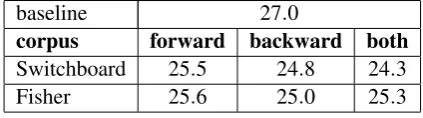
According to Tables 2and3, the LSTM noisy channel model outperforms the baseline. The experiment on Switchboard and Fisher corpora demonstrates that the LSTM LMs provide infor-mation about the global fluency of an analysis that the local features of the reranker do not capture. The LSTM language model trained on Switch-board corpus results in the greatest improvement. Switchboard is in the same domain as the test data and it is also disfluency annotated. Either or both of these might be the reason why Switch-board seems to be better in comparison with Fisher which is a larger corpus and might be expected to make a better language model. Moreover, the backward LSTMs have better performance in comparison with the forward ones. It seems when sentences are fed in reverse order, the model can more easily detect the unexpected word order as-sociated with the reparandum to detect disfluen-cies. In other words, that the disfluency is ob-served “after” the fluent repair in a backward lan-guage model is helpful for recognizing disfluen-cies.
baseline 85.3
corpus forward backward both
Switchboard 86.1 86.6 86.8
[image:4.595.312.521.511.567.2]Fisher 86.2 86.5 86.3
Table 2: F-scores on the dev set for a variety of LSTM language models.
baseline 27.0
corpus forward backward both
Switchboard 25.5 24.8 24.3
Fisher 25.6 25.0 25.3
Table 3: Expected error rates on the dev set for a variey of LSTM language models.
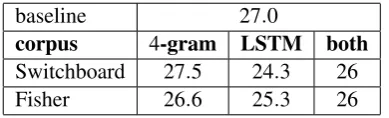
[image:4.595.310.522.635.694.2]smoothed 4-gram language models with the LSTM corresponding on the reranking process of the noisy channel model. We estimate the 4-gram models and assign probabilities to the flu-ent parts of disflueny analyses using the SRILM toolkit (Stolcke, 2002). As Tables 4 and5 show including scores from a conventional 4-gram lan-guage model does not improve the model’s abil-ity to find disfluencies, suggesting that the LSTM model contains all the useful information that the 4-gram model does. In order to give a more gen-eral idea on the performance of LSTM over stan-dard LM, we evaluate our model when the lan-guage model scores are used as the only features of the reranker. The f-score for the NCM alone without applying the reranker is 78.7, while using
4-gram language model scores in the reranker in-creases the f-score to 81.0. Replacing the 4-gram
scores with LSTM language model probabilities leads to further improvement, resulting an f-score 82.3.
baseline 85.3
corpus 4-gram LSTM both
Switchboard 85.1 86.8 86.1
[image:5.595.326.511.61.213.2]Fisher 85.6 86.3 86
Table 4: F-score for 4-gram, LSTM and combina-tion of both language models.
baseline 27.0
corpus 4-gram LSTM both
Switchboard 27.5 24.3 26
Fisher 26.6 25.3 26
Table 5: Expected error rates for 4-gram, LSTM and combination of both language models.
We also compare our best model on the develop-ment set to the state-of-the-art methods in the liter-ature. As shown in Table6, the LSTM noisy chan-nel model outperforms the results of prior work, achieving a state-of-the-art performance of 86.8.
It also has better performance in comparison with Ferguson et al. (2015) and Zayat et al.’s (2016) models, even though they use richer input that in-cludes prosodic features or partial words.
6 Conclusion and Future Work
In this paper, we present a new model for dis-fluency detection from spontaneous speech
tran-Model f-score
Yoshikawa et al.(2016) 62.5 Johnson and Charniak(2004) 79.7 Johnson et al.(2004) 81.0 Rasooli and Tetreault(2013) 81.4 Qian and Liu(2013) 82.1 Honnibal and Johnson(2014) 84.1 Ferguson et al.(2015)* 85.4 Zwarts and Johnson(2011) 85.7 Zayats et al.(2016)* 85.9
[image:5.595.90.277.355.412.2]LSTM-NCM 86.8
Table 6: Comparison of the LSTM-NCM to state-of-the-art methods on the dev set. *Models have used richer input.
scripts. It uses a long short-term memory neural network language model to rescore the candidate disfluency analyses produced by a noisy channel model. The LSTM language model scores as fea-tures in a MaxEnt reranker improves the model’s ability to detect restart and repair disfluencies. The model outperforms other models reported in the literature, including models that exploit richer in-formation from the input. As future work, we ap-ply more complex LSTM language models such as sequence-to-sequence on the reranking process of the noisy channel model. We also intend to in-vestigate the effect of integrating LSTM language models into other kinds of disfluency detection models, such as sequence labelling and parsing-based models.
Acknowledgements
We would like to thank the anonymous review-ers for their insightful comments and sugges-tions. This research was supported by a Google award through the Natural Language Understand-ing Focused Program, and under the Australian Research Councils Discovery Projects funding scheme (project number DP160102156).
References
[image:5.595.85.280.471.530.2]Shlens, Benoit Steiner, Ilya Sutskever, Kunal Tal-war, Paul Tucker, Vincent Vanhoucke, Vijay Vasude-van, Fernanda Viegas, Oriol Vinyals, Pete Warden, Martin Wattenberg, Martin Wicke, Yuan Yu, and Xi-aoqiang Zheng. 2015. TensorFlow: Large-scale ma-chine learning on heterogeneous systems. Software available from tensorflow.org.
Heather Bortfeld, Silvia Leon, Jonathan Bloom, Michael Schober, and Susan Brennan. 2001. Disflu-ency rates in conversation: Effects of age, relation-ship, topic, role, and gender. Language and Speech 44(2):123–147.
Eugene Charniak and Mark Johnson. 2001. Edit detection and parsing for transcribed speech. In Proceedings of the 2nd Meeting of the North American Chapter of the Association for Com-putational Linguistics on Language Technologies. Stroudsburg, USA, NAACL’01, pages 118–126.
http://aclweb.org/anthology/N01-1016.
Christopher Cieri, David Miller, and Kevin Walker. 2004. Fisher English training speech part 1 tran-scripts LDC2004T19. Published by: Linguistic Data Consortium, Philadelphia, USA.
James Ferguson, Greg Durrett, and Dan Klein. 2015. Disfluency detection with a semi-Markov model and prosodic features. In Proceedings of the Confer-ence of the North American Chapter of the As-sociation for Computational Linguistics: Human Language Technologies. Denver, USA, NAACL’15, pages 257–262.
Jonathan Fiscus, John Garofolo, Audrey Le, Alvin Martin, David Pallet, Mark Przybocki, and Greg Sanders. 2004. Results of the fall 2004 STT and MDE evaluation. InProceedings of Rich Transcrip-tion Fall Workshop.
John Godfrey and Edward Holliman. 1993. Switchboard-1 release 2 LDC97S62. Published by: Linguistic Data Consortium, Philadelphia, USA.
Matthew Honnibal and Mark Johnson. 2014. Joint incremental disfluency detection and depen-dency parsing. Transactions of the Association for Computational Linguistics 2(1):131–142.
http://www.aclweb.org/anthology/Q14-1011.
Julian Hough and David Schlangen. 2015. Recurrent neural networks for incremental disfluency detec-tion. InProceedings of the 16th Annual Conference of the International Speech Communication Associ-ation (INTERSPEECH). Dresden, Germany, pages 845–853.
Mark Johnson and Eugene Charniak. 2004. A
TAG-based noisy channel model of speech re-pairs. In Proceedings of the 42nd Annual Meet-ing on Association for Computational LMeet-inguis- Linguis-tics. Barcelona, Spain, ACL’04, pages 33–39.
http://aclweb.org/anthology/P04-1005.
Mark Johnson, Eugene Charniak, and Matthew Lease. 2004. An improved model for recognizing disflu-encies in conversational speech. InProceedings of Rich Transcription Workshop.
Rafal Jozefowicz, Oriol Vinyals, Mike Schuster, Noam Shazeer, and Yonghui Wu. 2016. Exploring the lim-its of language modeling. CoRRabs/1602.02410. Yang Liu, Elizabeth Shriberg, Andreas Stolckeand,
Dustin Hillard, Mari Ostendorf, and Mary Harper. 2006. Enriching speech recognition with auto-matic detection of sentence boundaries and disflu-encies. IEEE/ACM Transactions on Audio, Speech, and Language Processing14(5):1526–1540. Tomas Mikolov, Martin Karafiat, Lukas Burget, Jan
Cernocky, and Sanjeev Khudanpur. 2010. Recurrent neural network based language model. In Proceed-ings of the 11th Annual Conference of the Interna-tional Speech Communication Association (INTER-SPEECH). Makuhari, Japan, pages 1045–1048.
Tomas Mikolov, Ilya Sutskever, Kai Chen, Greg Cor-rado, and Jeffrey Dean. 2013. Distributed represen-tations of words and phrases and their composition-ality. InProceedings of the 27th Annual Conference on Neural Information Processing Systems (NIPS). Curran Associates Inc., pages 3111–3119.
Mari Ostendorf, Benoit Favre, Ralph Grishman, Dilek Hakkani-Tur, Mary Harper, Dustin Hillard, Julia Hirschberg, Heng Ji, Jeremy G. Kahn, Yang Liu, Sameer Maskey, Evgeny Matusov, Hermann Ney, Andrew Rosenberg, Elizabeth Shriberg, Wen Wang, and Chuck Wooters. 2008. Speech segmentation and its impact on spoken document processing. IEEE Signal Processing Magazine25(3):59–69. Mari Ostendorf and Sangyun Hahn. 2013. A
sequen-tial repetition model for improved disfluency detec-tion. InProceedings of the 14th Annual Conference of the International Speech Communication Associ-ation (INTERSPEECH). Lyon, France, pages 2624– 2628.
Xian Qian and Yang Liu. 2013. Disfluency detec-tion using multi-step stacked learning. In Pro-ceedings of the Conference of the North Amer-ican Chapter of the Association for Computa-tional Linguistics: Human Language Technolo-gies. Atlanta, USA, NAACL’13, pages 820–825.
http://aclweb.org/anthology/N13-1102.
Mohammad Sadegh Rasooli and Joel Tetreault. 2013.
Joint parsing and disfluency detection in linear time. InProceedings of the 2013 Conference on Empirical Methods in Natural Language Processing. Associ-ation for ComputAssoci-ational Linguistics, Seattle, USA, pages 124–129. http://aclweb.org/anthology/D13-1013.
William Schuler, Samir AbdelRahman, Tim Miller, and Lane Schwartz. 2010. Broad-coverage parsing us-ing human-like memory constraints. Computational Linguistics36(1):1–30.
Elizabeth Shriberg. 1994. Preliminaries to a theory of speech disfluencies. Ph.D. thesis, University of Cal-ifornia, Berkeley, USA.
Andreas Stolcke. 2002. SRILM: An extensible lan-guage modeling toolkit. InProceedings of Interna-tional Conference on Spoken Language Processing. Association for Computational Linguistics, Denver, Colorado, USA, volume 2, pages 901–904.
Masashi Yoshikawa, Hiroyuki Shindo, and Yuji Mat-sumoto. 2016. Joint transition-based dependency parsing and disfluency detection for automatic speech recognition texts. In Proceedings of the Conference on Empirical Methods in Natural Lan-guage Processing (EMNLP). pages 1036–1041.
http://aclweb.org/anthology/D16-1109.
Victoria Zayats, Mari Ostendorf, and Hannaneh Ha-jishirzi. 2014. Multi-domain disfluency and re-pair detection. In Proceedings of the 15th Annual Conference of the International Speech Commu-nication Association (INTERSPEECH). Singapore, pages 2907–2911.
Victoria Zayats, Mari Ostendorf, and Hannaneh Ha-jishirzi. 2016. Disfluency detection using a bidirec-tional LSTM. In Proceedings of the 16th Annual Conference of the International Speech Communica-tion AssociaCommunica-tion (INTERSPEECH). San Francisco, USA, pages 2523–2527.
Simon Zwarts and Mark Johnson. 2011. The impact of language models and loss functions on repair disfluency detection. In Proceedings of the 49th Annual Meeting of the Association for Computa-tional Linguistics: Human Language Technologies. Association for Computational Linguistics, Port-land, USA, volume 1 of HLT’11, pages 703–711.