Proceedings of the 57th Annual Meeting of the Association for Computational Linguistics, pages 1842–1861 1842
Visually Grounded Neural Syntax Acquisition
Haoyue Shi†,∗ Jiayuan Mao‡,∗ Kevin Gimpel† Karen Livescu† †: Toyota Technological Institute at Chicago, IL, USA
‡: ITCS, Institute for Interdisciplinary Information Sciences, Tsinghua University, China
{freda, kgimpel, klivescu}@ttic.edu, [email protected]
Abstract
We present the Visually Grounded Neural Syntax Learner (VG-NSL), an approach for learning syntactic representations and struc-tures without explicit supervision. The model learns by looking at natural images and read-ing paired captions. VG-NSL generates con-stituency parse trees of texts, recursively com-poses representations for constituents, and matches them with images. We define the
concretenessof constituents by their matching scores with images, and use it to guide the parsing of text. Experiments on the MSCOCO data set show that VG-NSL outperforms var-ious unsupervised parsing approaches that do not use visual grounding, in terms of F1scores against gold parse trees. We find that VG-NSL is much more stable with respect to the choice of random initialization and the amount of training data. We also find that the con-cretenessacquired by VG-NSL correlates well with a similar measure defined by linguists. Fi-nally, we also apply VG-NSL to multiple lan-guages in the Multi30K data set, showing that our model consistently outperforms prior un-supervised approaches.1
1 Introduction
We study the problem of visually grounded syn-tax acquisition. Consider the images in Figure1, paired with the descriptive texts (captions) in En-glish. Given no prior knowledge of English, and sufficient such pairs, one can infer the correspon-dence between certain words and visual attributes, (e.g., recognizing that “a cat” refers to the objects in the blue boxes). One can further extract con-stituents, by assuming that concrete spans of words should be processed as a whole, and thus form the
∗
HS and JM contributed equally to the work.
1 Project page: https://ttic.uchicago.edu/
˜freda/project/vgnsl
A catstandsunder an umbrella. A cat is on the ground.
[image:1.595.323.506.222.354.2]A dog sits under an umbrella.
Figure 1: We propose to use image-caption pairs to extract constituents from text, based on the assumption that similar spans should be matched to similar visual objects and these concrete spans form constituents.
constituents. Similarly, the same process can be applied to verb or prepositional phrases.
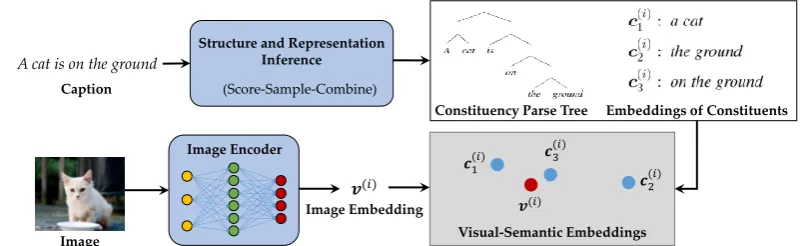
This intuition motivates the use of image-text pairs to facilitate automated language learning, in-cluding both syntax and semantics. In this paper we focus on learning syntactic structures, and pro-pose the Visually Grounded Neural Syntax Learner (VG-NSL, shown in Figure2). VG-NSL acquires syntax, in the form of constituency parsing, by looking at images and reading captions.
At a high level, VG-NSL builds latent con-stituency trees of word sequences and recursively composes representations for constituents. Next, it matches the visual and textual representations. The training procedure is built on the hypothesis that a better syntactic structure contributes to a better representation of constituents, which then leads to better alignment between vision and lan-guage. We use no human-labeled constituency trees or other syntactic labeling (such as part-of-speech tags). Instead, we define aconcretenessscore of constituents based on their matching with images, and use it to guide the parsing of sentences. At test time, no images paired with the text are needed.
do not use visual grounding. Our first finding is that VG-NSL improves over the best previous ap-proaches to unsupervised constituency parsing in terms of F1 scores against gold parse trees. We also find that many existing approaches are quite unstable with respect to the choice of random ini-tialization, whereas VG-NSL exhibits consistent parsing results across multiple training runs. Third, we analyze the performance of different models on different types of constituents, and find that our model shows substantial improvement on noun phrases and prepositional phrases which are com-mon in captions. Fourth, VG-NSL is much more data-efficient than prior work based purely on text, achieving comparable performance to other ap-proaches using only 20% of the training captions. In addition, theconcretenessscore, which emerges during the matching between constituents and im-ages, correlates well with a similar measure defined by linguists. Finally, VG-NSL can be easily ex-tended to multiple languages, which we evaluate on the Multi30K data set (Elliott et al.,2016,2017) consisting of German and French image captions.
2 Related Work
Linguistic structure induction from text. Re-cent work has proposed several approaches for in-ducing latent syntactic structures, including con-stituency trees (Choi et al.,2018;Yogatama et al.,
2017;Maillard and Clark,2018;Havrylov et al.,
2019;Kim et al.,2019;Drozdov et al.,2019) and dependency trees (Shi et al.,2019), from the distant supervision of downstream tasks. However, most of the methods are not able to produce linguisti-cally sound structures, or even consistent ones with fixed data and hyperparameters but different ran-dom initializations (Williams et al.,2018).
A related line of research is to induce latent syntactic structure via language modeling. This approach has achieved remarkable performance on unsupervised constituency parsing (Shen et al.,
2018a,2019), especially in identifying the bound-aries of higher-level (i.e., larger) constituents. To our knowledge, the Parsing-Reading-Predict Net-work (PRPN;Shen et al.,2018a) and the Ordered Neuron LSTM (ON-LSTM;Shen et al.,2019) cur-rently produce the best fully unsupervised con-stituency parsing results. One issue with PRPN, however, is that it tends to produce meaningless parses for lower-level (smaller) constituents (Phu Mon Htut et al.,2018).
Over the last two decades, there has been ex-tensive study targeting unsupervised constituency parsing (Klein and Manning, 2002, 2004, 2005;
Bod,2006a,b;Ponvert et al.,2011) and dependency parsing (Klein and Manning,2004;Smith and Eis-ner,2006;Spitkovsky et al.,2010;Han et al.,2017). However, all of these approaches are based on lin-guistic annotations. Specifically, they operate on the part-of-speech tags of words instead of word tokens. One exception isSpitkovsky et al.(2011), which produces dependency parse trees based on automatically induced pseudo tags.
In contrast to these existing approaches, we fo-cus on inducing constituency parse trees with vi-sual grounding. We use parallel data from another modality (i.e., paired images and captions), instead of linguistic annotations such as POS tags. We in-clude a detailed comparison between some related works in the supplementary material.
There has been some prior work on improv-ing unsupervised parsimprov-ing by leveragimprov-ing extra sig-nals, such as parallel text (Snyder et al., 2009), annotated data in another language with parallel text (Ganchev et al.,2009), annotated data in other languages without parallel text (Cohen et al.,2011), or non-parallel text from multiple languages ( Co-hen and Smith,2009). We leave the integration of other grounding signals as future work.
Grounded language acquisition. Grounded lan-guage acquisition has been studied for image-caption data (Christie et al.,2016a), video-caption data (Siddharth et al.,2014;Yu et al.,2015), and visual reasoning (Mao et al.,2019). However, ex-isting approaches rely on human labels or rules for classifying visual attributes or actions. Instead, our model induces syntax structures with no human-defined labels or rules.
Meanwhile, learning visual-semantic representa-tions in a joint embedding space (Ngiam et al.,
2011) is a widely studied approach, and has achieved remarkable results on image-caption re-trieval (Kiros et al.,2014;Faghri et al.,2018;Shi et al., 2018a), image caption generation (Kiros et al.,2014;Karpathy and Fei-Fei,2015;Ma et al.,
2015), and visual question answering (Malinowski et al.,2015). In this work, we borrow this idea to match visual and textual representations.
Image Encoder
Image
A cat is on the ground
Caption
Structure and Representation Inference
𝒗(𝑖)
𝒄1(𝑖)
𝒄2(𝑖) 𝒄3(𝑖)
𝒗(𝑖)
Constituency Parse Tree
Visual-Semantic Embeddings
Embeddings of Constituents
Image Embedding
[image:3.595.95.498.63.186.2](Score-Sample-Combine)
Figure 2: VG-NSL consists of two modules: a textual module for inferring structures and representations for captions, and a visual-semantic module for matching constituents with images. VG-NSL induces constituency parse trees of captions by looking at images and reading paired captions.
word-level concreteness estimation based on text (Turney et al.,2011;Hill et al.,2013), human judg-ments (Silberer and Lapata, 2012; Hill and Ko-rhonen,2014a;Brysbaert et al.,2014), and multi-modal data (Hill and Korhonen,2014b;Hill et al.,
2014;Kiela et al.,2014;Young et al.,2014;Hessel et al.,2018;Silberer et al.,2017; Bhaskar et al.,
2017). As withHessel et al.(2018) andKiela et al.
(2014), our model uses multi-modal data to esti-mate concreteness. Compared with them, we define concreteness for spans instead of words, and use it to induce linguistic structures.
3 Visually Grounded Neural Syntax Learner
Given a set of paired images and captions, our goal is to learn representations and structures for words and constituents. Toward this goal, we propose the Visually Grounded Neural Syntax Learner (VG-NSL), an approach for the grounded acquisition of syntax of natural language. VG-NSL is inspired by the idea of semantic bootstrapping (Pinker,1984), which suggests that children acquire syntax by first understanding the meaning of words and phrases, and linking them with the syntax of words.
At a high level (Figure2), VG-NSL consists of 2 modules. First, given an input caption (i.e., a sentence or a smaller constituent), as a sequence of tokens, VG-NSL builds a latent constituency parse tree, and recursively composes representations for every constituent. Next, it matches textual represen-tations with visual inputs, such as the paired image with the constituents. Both modules are jointly optimized from natural supervision: the model ac-quires constituency structures, composes textual representations, and links them with visual scenes, by looking at images and reading paired captions.
3.1 Textual Representations and Structures
VG-NSL starts by composing a binary constituency structure of text, using an easy-first bottom-up parser (Goldberg and Elhadad,2010). The compo-sition of the tree from a caption of lengthnconsists ofn−1steps. LetX(t)= (x(t)
1 ,x (t) 2 ,· · ·,x
(t) k ) de-note the textual representations of a sequence of constituents after stept, wherek=n−t. For sim-plicity, we useX(0)to denote theword embeddings for all tokens (the initial representations).
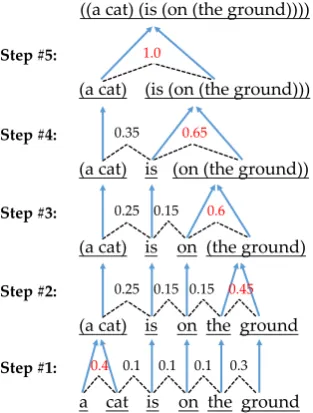
At stept, a score functionscore(·; Θ), parameter-ized byΘ, is evaluated on all pairs of consecutive constituents, resulting in a vectorscore(X(t−1); Θ) of lengthn−t:
score(X(t−1); Θ)j
,score
h
x(t−1)j ,x(t−1)j+1
i
; Θ
.
We implement score(·; Θ) as a two-layer feed-forward network.
A pair of constituents
x(t−1)j∗ ,x
(t−1) j∗+1
is sam-pled from all pairs of consecutive constituents, with respect to the distribution produced by a
softmax:2
Pr [j∗] =
expscore X(t−1); Θ
j∗
P
jexp
score X(t−1); Θ
j
.
The selected pair is combined to form a single new constituent. Thus, after stept, the number of con-stituents is decreased by 1. The textual represen-tation for the new constituent is defined as the L2-normed sum of the two component constituents:
combine
x(t−1)j∗ ,x
(t−1) j∗+1
, x (t−1) j∗ +x
(t−1) j∗+1
x
(t−1) j∗ +x
(t−1) j∗+1
2
.
a cat is on the ground Step #1: 0.4 0.1 0.1 0.1 0.3
(a cat) is on the ground Step #2: 0.25 0.15 0.15 0.45
(a cat) is on (the ground) Step #3: 0.25 0.15 0.6
(a cat) is (on (the ground)) Step #4: 0.35 0.65
(a cat) (is (on (the ground)))
Step #5: 1.0
[image:4.595.103.260.65.272.2]((a cat) (is (on (the ground))))
Figure 3: An illustration of how VG-NSL composes a constituency parse tree. At each step, the score func-tionscoreis evaluated on all pairs of consecutive con-stituents (dashed lines). Next, a pair of concon-stituents is sampled from all pairs w.r.t. a distribution computed by thesoftmaxof all predicted scores. The selected pair of constituents is combined into a larger one, while the other constituents remain unchanged (solid lines).
We find that using a more complex encoder for constituents, such as GRUs, will cause the repre-sentations to be highly biased towards a few salient words in the sentence (e.g., the encoder encodes only the word “cat” while ignoring the rest part of the caption;Shi et al.,2018a;Wu et al.,2019). This significantly degrades the performance of linguistic structure induction.
We repeat this score-sample-combine process for n−1 steps, until all words in the input text have been combined into a single constituent (Fig-ure3). This ends the inference of the constituency parse tree. Since at each time step we combine two consecutive constituents, the derived treetcontains 2n−1constituents (including all words).
3.2 Visual-Semantic Embeddings
We follow an approach similar to that of Kiros et al.(2014) to define the visual-semantic embed-ding (VSE) space for paired images and text con-stituents. Letv(i)denote the vector representation of an imagei, andc(i)j denote the vector represen-tation of thej-th constituent of its corresponding text caption. During the matching with images, we ignore the tree structure and index them as a list of constituents. A functionm(·,·; Φ)is defined as the
matching score between images and texts:
m(v(i),c(i)j ; Φ),cos(Φv,c)
where the parameter vectorΦaligns the visual and textual representations into a joint space.
3.3 Training
We optimize the visual-semantic representations (Φ) and constituency structures (Θ) in an alternat-ing approach. At each iteration, given constituency parsing results of caption,Φis optimized for match-ing the visual and the textual representations. Next, given the visual grounding of constituents,Θis op-timized for producing constituents that can be bet-ter matched with images. Specifically, we optimize textual representations and the visual-semantic em-bedding space using a hinge-based triplet ranking loss:
L(Φ;V,C) =
X
i,k6=i,j,`
h
m(c(k)` ,v(i))−m(c(i)j ,v(i)) +δ i
+
+ X
i,k6=i,j
h
m(c(i)j ,v(k))−m(c(i)j ,v(i)) +δ i
+,
whereiandkindex over all image-caption pairs in the data set, whilej and`enumerate all con-stituents of a specific caption (c(i)andc(k), respec-tively),V ={v(i)}is the set of image representa-tions,C = {c(i)j }is the set of textual representa-tions of all constituents, andδis a constant margin, [·]+denotesmax(0,·). The lossLextends the loss for image-caption retrieval ofKiros et al.(2014), by introducing the alignments between images and sub-sentence constituents.
We optimize textual structures via distant super-vision: they are optimized for a better alignment between the derived constituents and the images. Intuitively, the following objective encourages ad-jectives to be associated (combined) with the corre-sponding nouns, and verbs/prepositions to be asso-ciated (combined) with the corresponding subjects and objects. Specifically, we use REINFORCE (Williams, 1992) as the gradient estimator forΘ. Consider the parsing process of a specific caption
(visual) concretenessconcrete(z,v(i))as:
concrete(z,v(i)) =
X
k6=i,p
h
m(z,v(i))−m(c(k)p ,v(i))−δ0 i
+
+X
k6=i
h
m(z,v(i))−m(z,v(k))−δ0 i
+, (1)
where δ0 is a fixed margin. At step t, we define the reward function for a combination of a pair of constituents (x(t−1)j ,x(t−1)j+1 ) as:
r(x(t−1)j ,x(t−1)j+1 ) =concrete(z,v(i)) (2)
where z , combine(x(t−1)j ,x(t−1)j+1 ). In plain words, at each step, we encourage the model to compose a constituent that maximizes the align-ment between the new constituent and the corre-sponding image. During training, we sample con-stituency parse trees of captions, and reinforce each composition step using Equation2. During test, no paired images of text are needed.
3.4 The Head-Initial Inductive Bias
English and many other Indo-European languages are usually head-initial (Baker,2001). For exam-ple, in verb phrases or prepositional phrases, the verb (or the preposition) precedes the complements (e.g., the object of the verb). Consider the simple captiona white cat on the lawn. While the asso-ciation of the adjective (white) could be induced from the visual grounding of phrases, whether the preposition (on) should be associated witha white catorthe lawnis more challenging to induce. Thus, we impose an inductive bias to guide the learner to correctly associate prepositions with their com-plements, determiners with corresponding noun phrases, and complementizers with the correspond-ing relative clauses. Specifically, we discourage abstract constituents (i.e., constituents that cannot be grounded in the image) from being combined with a preceding constituent, by modifying the orig-inal reward definition (Equation2) as:
r0(x(t−1)j ,x(t−1)j+1 )
= r(x
(t−1) j ,x
(t−1) j+1 )
λ·abstract(x(t−1)j+1 ,v(i)) + 1, (3)
whereλis a scalar hyperparameter,v(i)is the im-age embedding corresponding to the caption be-ing parsed, andabstractdenotes theabstractness
of the span, defined analogously to concreteness (Equation1):
abstract(z,v(i)) =
X
k6=i,p
h
m(c(k)p ,v(i))−m(z,v(i)) +δ0i
+
+X
k6=i
h
m(z,v(k))−m(z,v(i)) +δ0 i
+,
The intuition here is that the initial heads for prepositional phrases (e.g.,on) and relative clauses (e.g., which, where) are usually abstract words. During training, we encourage the model to as-sociate these abstract words with the succeeding constituents instead of the preceding ones. It is worth noting that such an inductive bias is language-specific, and cannot be applied to head-final lan-guages such as Japanese (Baker,2001). We leave the design of head-directionality inductive biases for other languages as future work.
4 Experiments
We evaluate VG-NSL for unsupervised parsing in a few ways: F1 score with gold trees, self-consistency across different choices of random ini-tialization, performance on different types of con-stituents, and data efficiency. In addition, we find that theconcretenessscore acquired by VG-NSL is consistent with a similar measure defined by linguists. We focus on English for the main experi-ments, but also extend to German and French.
4.1 Data Sets and Metrics
We use the standard split of the MSCOCO data set (Lin et al.,2014), followingKarpathy and Fei-Fei(2015). It contains 82,783 images for training, 1,000 for development, and another 1,000 for test-ing. Each image is associated with 5 captions.
For the evaluation of constituency parsing, the Penn Treebank (PTB; Marcus et al., 1993) is a widely used, manually annotated data set. However, PTB consists of sentences from abstract domains, e.g., theWall Street Journal(WSJ), which are not visually grounded and whose linguistic structures can hardly be induced by VG-NSL. Here we eval-uate models on the MSCOCO test set, which is well-matched to the training domain; we leave the extension of our work to more abstract domains to future work. We apply Benepar (Kitaev and Klein,2018),3an off-the-shelf constituency parser
with state-of-the-art performance (95.52 F1score) on the WSJ test set,4 to parse the captions in the MSCOCO test set as gold constituency parse trees. We evaluate all of the investigated models using the F1score compared to these gold parse trees.5
4.2 Baselines
We compare VG-NSL with various baselines for unsupervised tree structure modeling of texts. We can categorize the baselines by their training objec-tive or supervision.
Trivial tree structures. Similarly to recent work on latent tree structures (Williams et al.,2018;Phu Mon Htut et al.,2018;Shi et al.,2018b), we include three types oftrivialbaselines without linguistic information: random binary trees, left-branching binary trees, and right-branching binary trees.
Syntax acquisition by language modeling and statistics. Shen et al. (2018a) proposes the Parsing-Reading-Predict Network (PRPN), which predicts syntactic distances (Shen et al., 2018b) between adjacent words, and composes a binary tree based on the syntactic distances to improve language modeling. The learned distances can be mapped into a binary constituency parse tree, by recursively splitting the sentence between the two consecutive words with the largest syntactic dis-tance.
Ordered neurons (ON-LSTM;Shen et al.,2019) is a recurrent unit based on the LSTM cell ( Hochre-iter and Schmidhuber,1997) that explicitly regular-izes different neurons in a cell to represent short-term or long-short-term information. After being trained on the language modeling task,Shen et al.(2019) suggest that the gate values in ON-LSTM cells can be viewed as syntactic distances (Shen et al.,
2018b) between adjacent words to induce latent tree structures. ON-LSTM has the state-of-the-art unsupervised constituency parsing performance on the WSJ test set. We train both PRPN and ON-LSTM on all captions in the MSCOCO training set and use the models as baselines.
Inspired by the syntactic distance–based ap-proaches (Shen et al., 2018a,2019), we also in-troduce another baseline, PMI, which uses negative
4We also manually label the constituency parse trees for
50 captions randomly sampled from the MSCOCO test split, where Benepar has an F1score of 95.65 with the manual labels.
Details can be found in the supplementary material.
5Following convention (Sekine and Collins,1997), we
re-port the F1score across all constituents in the data set, instead
of the average of sentence-level F1scores.
pointwise mutual information (Church and Hanks,
1990) between adjacent words as the syntactic dis-tance. We compose constituency parse trees based on the distances in the same way as PRPN and ON-LSTM.
Syntax acquisition from downstream tasks.
Choi et al.(2018) propose to compose binary con-stituency parse trees directly from downstream tasks using the Gumbel softmax trick (Jang et al.,
2017). We integrate a Gumbel tree-based caption encoder into the visual semantic embedding ap-proach (Kiros et al.,2014). The model is trained on the downstream task of image-caption retrieval.
Syntax acquisition from concreteness estima-tion. Since we apply concreteness information to train VG-NSL, it is worth comparing against un-supervised constituency parsing based on previous approaches for predicting word concreteness. This set of baselines includes semi-supervised estima-tion (Turney et al.,2011), crowdsourced labeling (Brysbaert et al., 2014), and multimodal estima-tion (Hessel et al.,2018). Note that none of these approaches has been applied to unsupervised con-stituency parsing. Implementation details can be found in the supplementary material.
Based on the concreteness score of words, we introduce another baseline similar to VG-NSL. Specifically, we recursively combine two consecu-tive constituents with the largest average concrete-ness, and use the average concreteness as the score for the composed constituent. The algorithm gen-erates binary constituency parse trees of captions. For a fair comparison, we implement a variant of this algorithm that also uses a head-initial inductive bias and include the details in the appendix.
4.3 Implementation Details
Model NP VP PP ADJP Avg. F1 Self F1
Random 47.3±0.3 10.5±0.4 17.3±0.7 33.5±0.8 27.1±0.2 32.4
Left 51.4 1.8 0.2 16.0 23.3 N/A
Right 32.2 23.4 18.7 14.4 22.9 N/A
PMI 54.2 16.0 14.3 39.2 30.5 N/A
PRPN (Shen et al.,2018a) 72.8±9.7 33.0±9.1 61.6±9.9 35.4±4.3 52.5±2.6 60.3 ON-LSTM (Shen et al.,2019) 74.4±7.1 11.8±5.6 41.3±16.4 44.0±14.0 45.5±3.3 69.3 Gumbel (Choi et al.,2018)† 50.4±0.3 8.7±0.3 15.5±0.0 34.8±1.6 27.9±0.2 40.1
VG-NSL (ours)† 79.6±0.4 26.2±0.4 42.0±0.6 22.0±0.4 50.4±0.3 87.1 VG-NSL+HI (ours)† 74.6±0.5 32.5±1.5 66.5±1.2 21.7±1.1 53.3±0.2 90.2 VG-NSL+HI+FastText (ours)*† 78.8±0.5 24.4±0.9 65.6±1.1 22.0±0.7 54.4±0.4 89.8
Concreteness estimation–based models
Turney et al.(2011)* 65.5 30.8 35.3 30.4 42.5 N/A
Turney et al.(2011)+HI* 74.5 26.2 47.6 25.6 48.9 N/A
Brysbaert et al.(2014)* 54.1 27.8 27.0 33.1 34.1 N/A
Brysbaert et al.(2014)+HI* 73.4 23.9 50.0 26.1 47.9 N/A
Hessel et al.(2018)† 50.9 21.7 32.8 27.5 33.2 N/A
[image:7.595.74.523.66.335.2]Hessel et al.(2018)+HI† 72.5 34.4 65.8 26.2 52.9 N/A
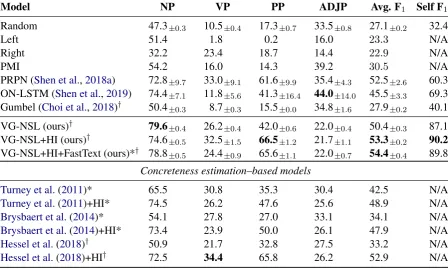
Table 1: Recall of specific typed phrases, and overall F1score, evaluated on the MSCOCO test split, averaged over 5 runs with different random initializations. We also include self-agreement F1score (Williams et al.,2018) across the 5 runs. ±denotes standard deviation. * denotes models requiring extra labels and/or corpus, and†denotes models requiring a pre-trained visual feature extractor. We highlight the best number in each column among all models that do not require extra data other than paired image-caption data, as well as the overall best number. The Left, Right, PMI, and concreteness estimation–based models have no standard deviation or self F1(shown as N/A) as they are deterministic given the training and/or testing data.
rate is re-initialized to2.5×10−4after 15 epochs. We tune other hyperparameters of VG-NSL on the development set using the self-agreement F1score (Williams et al.,2018) over 5 runs with different choices of random initialization.
4.4 Results: Unsupervised Constituency Parsing
We evaluate the induced constituency parse trees via the overall F1 score, as well as the recall of four types of constituents: noun phrases (NP), verb phrases (VP), prepositional phrases (PP), and ad-jective phrases (ADJP) (Table1). We also evaluate the robustness of models trained with fixed data and hyperparameters, but different random initial-ization, in two ways: via the standard deviation of performance across multiple runs, and via the self-agreement F1score (Williams et al.,2018), which is the average F1taken over pairs of different runs. Among all of the models which do not require extra labels, VG-NSL with the head-initial induc-tive bias (VG-NSL+HI) achieves the best F1score. PRPN (Shen et al., 2018a) and a concreteness estimation-based baseline (Hessel et al.,2018) both
produce competitive results. It is worth noting that the PRPN baseline reaches this performance with-out any information from images. However, the performance of PRPN is less stable than that of VG-NSL across random initializations. In contrast to its state-of-the-art performance on the WSJ full set (Shen et al.,2019), we observe that ON-LSTM does not perform well on the MSCOCO caption data set. However, it remains the best model for ad-jective phrases, which is consistent with the result reported byShen et al.(2019).
In addition to the best overall F1 scores, VG-NSL+HI achieves competitive scores across most phrase types (NP, VP and PP). Our models (VG-NSL and VG-(VG-NSL+HI) perform the best on NP and PP, which are the most common visually grounded phrases in the MSCOCO data set. In addition, our models produce much higher self F1than the base-lines (Shen et al.,2018a,2019;Choi et al.,2018), showing that they reliably produce reasonable con-stituency parse trees with different initialization.
0 20 40 60 80 100 Percentage (%)
30 35 40 45 50
F1
with
gold
trees
PRPN ON-LSTM VG-NSL VG-NSL+HI
(a) The percent data-F1curves.
0 20 40 60 80 100 Percentage (%)
40 50 60 70 80 90
self
F1
PRPN ON-LSTM
VG-NSL VG-NSL+HI
[image:8.595.314.517.65.129.2](b) The percent data-self F1curves.
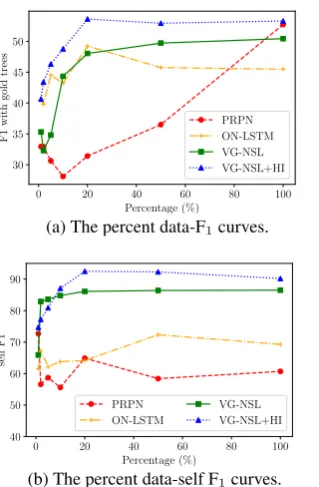
Figure 4: F1score and self F1score with respect to the amount of training data. All numbers are averaged over 5 runs with different random initialization.
embedding (300-D,Joulin et al.,2016), concate-nated with a 212-D trainable embedding, as the word embedding. Using pre-trained word embed-dings further improves performance to an average F1of 54.4% while keeping a comparable self F1.
4.5 Results: Data Efficiency
We compare the data efficiency for PRPN (the strongest baseline method), ON-LSTM, VG-NSL, and VG-NSL+HI. We train the models using 1%, 2%, 5%, 10%, 20%, 50% and 100% of the MSCOCO training set, and report the overall F1 and self F1scores on the test set (Figure4).
Compared to PRPN trained on the full training set, VG-NSL and VG-NSL+HI reach comparable performance using only 20% of the data (i.e., 8K images with 40K captions). VG-NSL tends to quickly become more stable (in terms of the self F1 score) as the amount of data increases, while PRPN and ON-LSTM remain less stable.
4.6 Analysis: Consistency with Linguistic Concreteness
During training, VG-NSL acquires concreteness estimates for constituents via Equation1. Here, we evaluate the consistency between word-level con-creteness estimates induced by VG-NSL and those produced by other methods (Turney et al., 2011;
Brysbaert et al.,2014;Hessel et al.,2018). Specifi-cally, we measure the correlation between the
con-Model/method VG-NSL (+HI)
Turney et al.(2011) 0.74 0.72
Brysbaert et al.(2014) 0.71 0.71
[image:8.595.102.262.71.315.2]Hessel et al.(2018) 0.84 0.85
Table 2: Agreement between our concreteness esti-mates and existing models or labels, evaluated via the Pearson correlation coefficient computed over the most frequent 100 words in the MSCOCO test set, averaged over 5 runs with different random initialization.
Model Criterion Avg. F1 Self F1
VG-NSL Self F1 50.4±0.3 87.1
VG-NSL R@1 47.7±0.6 83.4
VG-NSL+HI Self F1 53.3±0.2 90.2
[image:8.595.307.527.201.284.2]VG-NSL+HI R@1 53.1±0.2 88.7
Table 3: Average F1scores and Self F1 scores of VG-NSL and VG-VG-NSL+HI with different model selection methods. R@1 denotes using recall at 1 (Kiros et al.,
2014) as the model selection criterion. All hyperparam-eters are tuned with respect to self-agreement F1score. The numbers are comparable to those in Table1.
creteness estimated by VG-NSL on MSCOCO test set and existing linguistic concreteness definitions (Table2). For any word, of which the representa-tion is z, we estimate its concreteness by taking the average ofconcrete(z,v(i)), across all associ-ated images v(i). The high correlation between VG-NSL and the concreteness scores produced by
Turney et al. (2011) andBrysbaert et al. (2014) supports the argument that the linguistic concept of concreteness can be acquired in an unsupervised way. Our model also achieves a high correlation withHessel et al.(2018), which also estimates word concreteness based on visual-domain information.
4.7 Analysis: Self-Agreement F1Score as the
Criterion for Model Selection
We introduce a novel hyperparameter tuning and model selection method based on the self-agreement F1score.
Let M(i,j)H denote the j-th checkpoint of the i-th model trained wii-th hyperparametersH, where
M(i1,·)H andM(i2,·)H differ in their random initial-ization. The hyperparametersHare tuned to maxi-mize:
X
1≤i<k≤N max |ji−jk|<δ
F1
M(i,ji)
H ,M (k,jk) H
,
Model EN DE FR
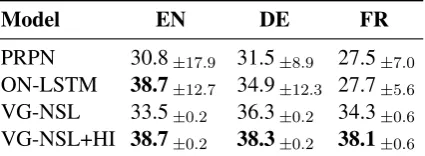
[image:9.595.74.287.63.141.2]PRPN 30.8±17.9 31.5±8.9 27.5±7.0 ON-LSTM 38.7±12.7 34.9±12.3 27.7±5.6 VG-NSL 33.5±0.2 36.3±0.2 34.3±0.6 VG-NSL+HI 38.7±0.2 38.3±0.2 38.1±0.6
Table 4: F1 scores on the Multi30K test split (Young
et al.,2014;Elliott et al.,2016,2017), averaged over 5 runs with different random initialization.±denotes the standard deviation.
different runs, and δ the margin to ensure only nearby checkpoints are compared.6
After finding the best hyperparametersH0, we train the model for anotherN times with different random initialization, and select the best models by
arg max {j`}N`=1
X
1≤i<k≤N F1
M(i,ji)
H0 ,M (k,jk) H0
.
We compare the performance of VG-NSL se-lected by the self F1score and that selected by re-call at 1 in image-to-text retrieval (R@1 in Table3;
Kiros et al.,2014). As a model selection criterion, self F1 consistently outperforms R@1 (avg. F1: 50.4vs. 47.7 and 53.3vs. 53.1 for VG-NSL and VG-NSL+HI, respectively). Meanwhile, it is worth noting that even if we select VG-NSL by R@1, it shows better stability compared with PRPN and ON-LSTM (Table1), in terms of the score variance across different random initialization and self F1. Specifically, the variance of avg. F1is always less than 0.6 while the self F1is greater than 80.
Note that the PRPN and ON-LSTM models are not tuned using self F1, since these models are usu-ally trained for hundreds or thousands of epochs and thus it is computationally expensive to evalu-ate self F1. We leave the efficient tuning of these baselines by self F1 as a future work.
4.8 Extension to Multiple Languages
We extend our experiments to the Multi30K data set, which is built on the Flickr30K data set (Young et al.,2014) and consists of English, German ( El-liott et al.,2016), and French (Elliott et al.,2017) captions. For Multi30K, there are 29,000 images in the training set, 1,014 in the development set and 1,000 in the test set. Each image is associated with one caption in each language.
We compare our models to PRPN and ON-LSTM in terms of overall F1score (Table4). VG-NSL with the head-initial inductive bias
consis-6In all of our experiments,N= 5, δ= 2.
tently performs the best across the three languages, all of which are highly head-initial (Baker,2001). Note that the F1 scores here are not comparable to those in Table1, since Multi30K (English) has 13x fewer captions than MSCOCO.
5 Discussion
We have proposed a simple but effective model, the Visually Grounded Neural Syntax Learner, for visually grounded language structure acquisition. VG-NSL jointly learns parse trees and visually grounded textual representations. In our exper-iments, we find that this approach to grounded language learning produces parsing models that are both accurate and stable, and that the learning is much more data-efficient than a state-of-the-art text-only approach. Along the way, the model ac-quires estimates of word concreteness.
The results suggest multiple future research di-rections. First, VG-NSL matches text embeddings directly with embeddings of entire images. Its per-formance may be boosted by considering struc-tured representations of both images (e.g.,Lu et al.,
2016;Wu et al.,2019) and texts (Steedman,2000). Second, thus far we have used a shared representa-tion for both syntax and semantics, but it may be useful to disentangle their representations ( Steed-man, 2000). Third, our best model is based on the head-initial inductive bias. Automatically ac-quiring such inductive biases from data remains challenging (Kemp et al., 2006; Gauthier et al.,
2018). Finally, it may be possible to extend our ap-proach to other linguistic tasks such as dependency parsing (Christie et al.,2016b), coreference resolu-tion (Kottur et al.,2018), and learning pragmatics beyond semantics (Andreas and Klein,2016).
There are also limitations to the idea of grounded language acquisition. In particular, the current ap-proach has thus far been applied to understanding grounded texts in a single domain (static visual scenes for VG-NSL). Its applicability could be ex-tended by learning shared representations across multiple modalities (Castrejon et al.,2016) or in-tegrating with pure text-domain models (such as PRPN,Shen et al.,2018a).
Acknowledgement
References
Jacob Andreas and Dan Klein. 2016. Reasoning about pragmatics with neural listeners and speakers. In
Proc. of EMNLP.
Mark C. Baker. 2001. The Atoms of Language: The Mind’s Hidden Rules of Grammar. Basic books. Sai Abishek Bhaskar, Maximilian K¨oper,
Sabine Schulte Im Walde, and Diego Frassinelli. 2017. Exploring multi-modal text+image models to distinguish between abstract and concrete nouns. In Proc. of the IWCS workshop on Foundations of Situated and Multimodal Communication.
Ann Bies, Mark Ferguson, Karen Katz, Robert Mac-Intyre, Victoria Tredinnick, Grace Kim, Mary Ann Marcinkiewicz, and Britta Schasberger. 1995. Bracketing guidelines for treebank II style Penn tree-bank project. University of Pennsylvania, 97. Rens Bod. 2006a. An all-subtrees approach to
unsuper-vised parsing. InProc. of COLING-ACL.
Rens Bod. 2006b. Unsupervised parsing with U-DOP. InProc. of CoNLL.
Marc Brysbaert, Amy Beth Warriner, and Victor Ku-perman. 2014.Concreteness ratings for 40 thousand generally known English word lemmas. Behav. Res. Methods, 46(3):904–911.
Lluis Castrejon, Yusuf Aytar, Carl Vondrick, Hamed Pirsiavash, and Antonio Torralba. 2016. Learning aligned cross-modal representations from weakly aligned data. InProc. of CVPR.
Jihun Choi, Kang Min Yoo, and Sang-goo Lee. 2018.
Learning to compose task-specific tree structures. In
Proc. of AAAI.
Gordon Christie, Ankit Laddha, Aishwarya Agrawal, Stanislaw Antol, Yash Goyal, Kevin Kochersberger, and Dhruv Batra. 2016a. Resolving language and vision ambiguities together: Joint segmentation & prepositional attachment resolution in captioned scenes. InProc. of EMNLP.
Gordon Christie, Ankit Laddha, Aishwarya Agrawal, Stanislaw Antol, Yash Goyal, Kevin Kochersberger, and Dhruv Batra. 2016b. Resolving language and vision ambiguities together: Joint segmentation & prepositional attachment resolution in captioned scenes. InProc. of EMNLP.
Kenneth Ward Church and Patrick Hanks. 1990. Word association norms, mutual information, and lexicog-raphy.Comput. Linguist., 16(1):22–29.
Shay Cohen and Noah A. Smith. 2009.Shared logistic normal distributions for soft parameter tying in un-supervised grammar induction. InProc. of NAACL-HLT.
Shay B. Cohen, Dipanjan Das, and Noah A. Smith. 2011. Unsupervised structure prediction with non-parallel multilingual guidance. InProc. of EMNLP. Max Coltheart. 1981. The MRC psycholinguistic
database.Q. J. Exp. Psychol., 33(4):497–505. Andrew Drozdov, Pat Verga, Mohit Yadav, Mohit Iyyer,
and Andrew McCallum. 2019. Unsupervised latent tree induction with deep inside-outside recursive au-toencoders. InProc. of NAACL-HLT.
Desmond Elliott, Stella Frank, Lo¨ıc Barrault, Fethi Bougares, and Lucia Specia. 2017. Findings of the second shared task on multimodal machine transla-tion and multilingual image descriptransla-tion. InProc. of WMT.
Desmond Elliott, Stella Frank, Khalil Sima’an, and Lu-cia SpeLu-cia. 2016. Multi30K: Multilingual English-German image descriptions. In Proc. of the 5th Workshop on Vision and Language.
Fartash Faghri, David J. Fleet, Jamie Ryan Kiros, and Sanja Fidler. 2018. VSE++: Improving visual-semantic embeddings with hard negatives. InProc. of BMVC.
Kuzman Ganchev, Jennifer Gillenwater, and Ben Taskar. 2009. Dependency grammar induction via bitext projection constraints. In Proc. of ACL-IJCNLP.
Jon Gauthier, Roger Levy, and Joshua B. Tenen-baum. 2018. Word learning and the acquisition of syntactic–semantic overhypotheses. InProc. of CogSci.
Yoav Goldberg and Michael Elhadad. 2010. An effi-cient algorithm for easy-first non-directional depen-dency parsing. InProc. of NAACL-HLT.
Wenjuan Han, Yong Jiang, and Kewei Tu. 2017. De-pendency grammar induction with neural lexicaliza-tion and big training data. InProc. of EMNLP. Serhii Havrylov, Germ´an Kruszewski, and Armand
Joulin. 2019. Cooperative learning of disjoint syn-tax and semantics. InProc. of NAACL-HLT. Kaiming He, Xiangyu Zhang, Shaoqing Ren, and Jian
Sun. 2016. Deep residual learning for image recog-nition. InProc. of CVPR.
Jack Hessel, David Mimno, and Lillian Lee. 2018.
Quantifying the visual concreteness of words and topics in multimodal datasets. InProc. of NAACL-HLT.
Felix Hill, Douwe Kiela, and Anna Korhonen. 2013.
Concreteness and corpora: A theoretical and practi-cal study. InProc. of CMCL.
Felix Hill and Anna Korhonen. 2014b. Learning ab-stract concept embeddings from multi-modal data: Since you probably cant see what i mean. InProc. of EMNLP.
Felix Hill, Roi Reichart, and Anna Korhonen. 2014.
Multi-modal models for concrete and abstract con-cept meaning. TACL, 2(1):285–296.
Sepp Hochreiter and J¨urgen Schmidhuber. 1997. Long short-term memory. Neural Comput., 9(8):1735– 1780.
Eric Jang, Shixiang Gu, and Ben Poole. 2017. Categor-ical reparameterization with Gumbel-softmax. In
Proc. of ICLR.
Fred Jelinek, Robert L Mercer, Lalit R Bahl, and James K Baker. 1977. Perplexity—a measure of the difficulty of speech recognition tasks. The Journal of the Acoustical Society of America, 62(S1):S63– S63.
Armand Joulin, Edouard Grave, Piotr Bojanowski, Matthijs Douze, H´erve J´egou, and Tomas Mikolov. 2016. FastText.zip: Compressing text classification models.arXiv preprint arXiv:1612.03651.
Andrej Karpathy and Li Fei-Fei. 2015. Deep visual-semantic alignments for generating image descrip-tions. InProc. of CVPR.
Charles K. Kemp, Amy Perfors, and Joshua B. Tenen-baum. 2006. Learning overhypotheses. InProc. of CogSci.
Douwe Kiela, Felix Hill, Anna Korhonen, and Stephen Clark. 2014. Improving multi-modal representa-tions using image dispersion: Why less is sometimes more. InProc. of ACL.
Yoon Kim, Alexander M Rush, Lei Yu, Adhiguna Kun-coro, Chris Dyer, and G´abor Melis. 2019. Unsuper-vised recurrent neural network grammars. InProc. of NAACL-HLT.
Diederik P. Kingma and Jimmy Ba. 2015. Adam: A method for stochastic optimization. In Proc. of ICLR.
Ryan Kiros, Ruslan Salakhutdinov, and Richard S. Zemel. 2014. Unifying visual-semantic embed-dings with multimodal neural language models.
arXiv:1411.2539.
Nikita Kitaev and Dan Klein. 2018. Constituency pars-ing with a self-attentive encoder. InProc. of ACL. Dan Klein and Christopher D. Manning. 2002. A
generative constituent-context model for improved grammar induction. InProc. of ACL.
Dan Klein and Christopher D. Manning. 2004. Corpus-based induction of syntactic structure: Models of de-pendency and constituency. InProc. of ACL.
Dan Klein and Christopher D. Manning. 2005. Nat-ural language grammar induction with a genera-tive constituent-context model.Pattern Recognition, 38(9):1407–1419.
Satwik Kottur, Jos´e MF Moura, Devi Parikh, Dhruv Ba-tra, and Marcus Rohrbach. 2018.Visual coreference resolution in visual dialog using neural module net-works. InProc. of ECCV.
Tsung-Yi Lin, Michael Maire, Serge Belongie, James Hays, Pietro Perona, Deva Ramanan, Piotr Doll´ar, and C. Lawrence Zitnick. 2014. Microsoft COCO: Common objects in context. InProc. of ECCV. Cewu Lu, Ranjay Krishna, Michael Bernstein, and
Li Fei-Fei. 2016. Visual relationship detection with language priors. InProc. of ECCV.
Lin Ma, Zhengdong Lu, Lifeng Shang, and Hang Li. 2015. Multimodal convolutional neural networks for matching image and sentence. InProc. of CVPR. Jean Maillard and Stephen Clark. 2018. Latent tree learning with differentiable parsers: Shift-reduce rarsing and chart parsing. InProc. of the Workshop on the Relevance of Linguistic Structure in Neural Architectures for NLP.
Mateusz Malinowski, Marcus Rohrbach, and Mario Fritz. 2015. Ask your neurons: A neural-based ap-proach to answering questions about images. In
Proc. of ICCV.
Jiayuan Mao, Chuang Gan, Pushmeet Kohli, Joshua B Tenenbaum, and Jiajun Wu. 2019. The neuro-symbolic concept learner: Interpreting scenes, words, and sentences from natural supervision. In
Proc. of ICLR.
Mitchell Marcus, Beatrice Santorini, and Mary Ann Marcinkiewicz. 1993. Building a large annotated corpus of English: The Penn treebank.Comput. Lin-guist., 19(2).
Jiquan Ngiam, Aditya Khosla, Mingyu Kim, Juhan Nam, Honglak Lee, and Andrew Y. Ng. 2011. Mul-timodal deep learning. InProc. of ICML.
Phu Mon Htut, Kyunghyun Cho, and Samuel R. Bow-man. 2018. Grammar induction with neural lan-guage models: An unsual replication. In Proc. of EMNLP.
Steven Pinker. 1984. Language Learnability and Lan-guage Development. Cambridge University Press. Elias Ponvert, Jason Baldridge, and Katrin Erk. 2011.
Simple unsupervised grammar induction from raw rext with cascaded finite state models. InProc. of ACL.
Satoshi Sekine and Michael Collins. 1997. Evalb bracket scoring program.
Yikang Shen, Zhouhan Lin, Chin-Wei Huang, and Aaron Courville. 2018a. Neural language modeling by jointly learning syntax and lexicon. In Proc. of ICLR.
Yikang Shen, Zhouhan Lin, Athul Paul Jacob, Alessan-dro Sordoni, Aaron Courville, and Yoshua Bengio. 2018b. Straight to the tree: Constituency parsing with neural syntactic distance. InProc. of ACL. Yikang Shen, Shawn Tan, Alessandro Sordoni, and
Aaron Courville. 2019. Ordered neurons: Integrat-ing tree structures into recurrent neural networks. In
Proc. of ICLR.
Haoyue Shi, Jiayuan Mao, Tete Xiao, Yuning Jiang, and Jian Sun. 2018a. Learning visually-grounded semantics from contrastive adversarial samples. In
Proc. of COLING.
Haoyue Shi, Hao Zhou, Jiaze Chen, and Lei Li. 2018b.
On tree-based neural sentence modeling. InProc. of EMNLP.
Jiaxin Shi, Lei Hou, Juanzi Li, Zhiyuan Liu, and Han-wang Zhang. 2019. Learning to embed sentences using attentive recursive trees. InProc. of AAAI. N. Siddharth, Andrei Barbu, and Jeffrey Mark Siskind.
2014. Seeing what you’re told: Sentence-guided ac-tivity recognition in video. InProc. of CVPR. Carina Silberer, Vittorio Ferrari, and Mirella Lapata.
2017. Visually grounded meaning representations.
TPAMI, 39(11):2284–2297.
Carina Silberer and Mirella Lapata. 2012. Grounded models of semantic representation. In Proc. of EMNLP-CoNLL.
Noah A. Smith and Jason Eisner. 2006. Annealing structural bias in multilingual weighted grammar in-duction. InProc. of COLING-ACL.
Benjamin Snyder, Tahira Naseem, and Regina Barzi-lay. 2009. Unsupervised multilingual grammar in-duction. InProc. of ACL-IJCNLP.
Valentin I. Spitkovsky, Hiyan Alshawi, Angel X. Chang, and Daniel Jurafsky. 2011.Unsupervised de-pendency parsing without gold part-of-speech tags. InProc. of EMNLP.
Valentin I. Spitkovsky, Hiyan Alshawi, and Daniel Ju-rafsky. 2010. From baby steps to leapfrog: How “less is more” in unsupervised dependency parsing.
InProc. of NAACL-HLT.
Mark Steedman. 2000. The Syntactic Process. MIT press Cambridge, MA.
Peter D. Turney, Yair Neuman, Dan Assaf, and Yohai Cohen. 2011. Literal and metaphorical sense iden-tification through concrete and abstract context. In
Proc. of EMNLP.
Adina Williams, Andrew Drozdov, and Samuel R. Bowman. 2018. Do latent tree learning models identify meaningful structure in sentences? TACL, 6:253–267.
Ronald J. Williams. 1992. Simple statistical gradient-following algorithms for connectionist reinforce-ment learning.Mach. Learn., 8(3-4):229–256. Hao Wu, Jiayuan Mao, Yufeng Zhang, Weiwei Sun,
Yuning Jiang, Lei Li, and Wei-Ying Ma. 2019. Uni-fied Visual-Semantic Embeddings: Bridging Vision and Language with Structured Meaning Representa-tions. InProc. of CVPR.
Dani Yogatama, Phil Blunsom, Chris Dyer, Edward Grefenstette, and Wang Ling. 2017. Learning to compose words into sentences with reinforcement learning. InProc. of ICLR.
Peter Young, Alice Lai, Micah Hodosh, and Julia Hock-enmaier. 2014. From image descriptions to visual denotations: New similarity metrics for semantic in-ference over event descriptions.TACL, 2:67–78. Haonan Yu, N. Siddharth, Andrei Barbu, and
Jef-frey Mark Siskind. 2015. A compositional frame-work for grounding language inference, generation, and acquisition in video. JAIR, 52:601–713.
Supplementary Material
The supplementary material is organized as fol-lows. First, in SectionA, we summarize and com-pare existing models for constituency parsing with-out explicit syntactic supervision. Next, in Sec-tionB, we present more implementation details of VG-NSL. Third, in SectionC, we present the im-plementation details for all of our baseline models. Fourth, in SectionD, we present the evaluation de-tails of Benepar (Kitaev and Klein, 2018) on the MSCOCO data set. Fifth, in SectionE, we qualita-tively and quantitaqualita-tively compare the concreteness scores estimated or labeled by different methods. Finally, in SectionF, we show sample trees gener-ated by VG-NSL on the MSCOCO test set.
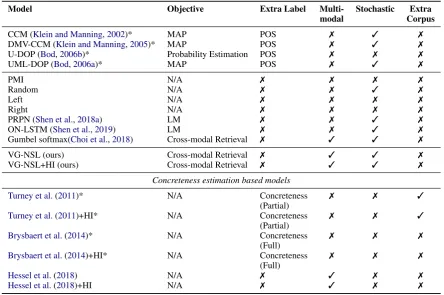
A Overview of Models for Constituency Parsing without Explicit Syntactic Supervision
Model Objective Extra Label Multi- Stochastic Extra modal Corpus
CCM (Klein and Manning,2002)* MAP POS 7 3 7
DMV-CCM (Klein and Manning,2005)* MAP POS 7 3 7
U-DOP (Bod,2006b)* Probability Estimation POS 7 7 7
UML-DOP (Bod,2006a)* MAP POS 7 3 7
PMI N/A 7 7 7 7
Random N/A 7 7 3 7
Left N/A 7 7 7 7
Right N/A 7 7 7 7
PRPN (Shen et al.,2018a) LM 7 7 3 7
ON-LSTM (Shen et al.,2019) LM 7 7 3 7
Gumbel softmax(Choi et al.,2018) Cross-modal Retrieval 7 3 3 7
VG-NSL (ours) Cross-modal Retrieval 7 3 3 7
VG-NSL+HI (ours) Cross-modal Retrieval 7 3 3 7
Concreteness estimation based models
Turney et al.(2011)* N/A Concreteness
(Partial)
7 7 3
Turney et al.(2011)+HI* N/A Concreteness
(Partial)
7 7 3
Brysbaert et al.(2014)* N/A Concreteness
(Full)
7 7 7
Brysbaert et al.(2014)+HI* N/A Concreteness
(Full)
7 7 7
Hessel et al.(2018) N/A 7 3 7 7
[image:13.595.77.522.62.357.2]Hessel et al.(2018)+HI N/A 7 3 7 7
Table 5: Comparison of models for constituency parsing without explicit syntactic supervision. * denotes models requiring extra labels, such as POS tags or manually labeled concreteness scores. All multimodal methods listed in the table require a pretrained visual feature extractor (i.e., ResNet-101;He et al.,2016). A model is labeled as stochastic if for fixed training data and hyperparameters the model may produce different results (e.g., due to different choices of random initialization). To the best of our knowledge, results on concreteness estimation (Turney et al.,2011;Brysbaert et al.,2014;Hessel et al.,2018) have not been applied to unsupervised parsing so far.
a aa ! ! !
b bb " " "
Q Q
Z Z
@@
A cat is
on the
ground
(a) Left-branching tree.
H HH
A
b bb " " "
cat
b bb " " "
is
b bb " " "
on
Z Z
the ground
(b) Right-branching tree.
Figure 5: Examples of some trivial tree structures.
B Implementation Details for VG-NSL
We adopt the code released byFaghri et al.(2018)7 as the visual-semantic embedding module for VG-NSL. Following them, we fix the marginδto0.2. We also use the vocabulary provided byFaghri et al.
7https://github.com/fartashf/vsepp
(2018),8which contains 10,000 frequent words in
the MSCOCO data set. Out-of-vocabulary words are treated as unseen words. For either VG-NSL or baselines, we use the same vocabulary if applica-ble.
8
[image:13.595.119.475.471.617.2]Hyperparameter tuning. As stated in main text, we use the self-agreement F1score (Williams et al.,
2018) as an unsupervised signal for tuning all hyperparamters. Besides the learning rate and other conventional hyperparameters, we also tune
λ, the hyperparameter for the head-initial bias model. λindicates the weight of penalization for “right abstract constituents”. We choose λfrom
{1,2,5,10,20,50,100} and found that λ = 20 gives the best self-agreement F1score.
C Implementation Details for Baselines
Trivial tree structures. We show examples for left-branching binary trees and right-branching bi-nary trees in Figure5. As for binary random trees, we iteratively combine two randomly selected adja-cent constituents. This procedure is similar to that shown in Algorithm2.
Parsing-Reading-Predict Network (PRPN).
We use the code released by Shen et al. (2018a) to train PRPN.9 We tune the hyperparameters with respect to language modeling perplexity (Jelinek et al.,1977). For a fair comparison, we fix the hidden dimension of all hidden layers of PRPN as 512. We use an Adam optimizer (Kingma and Ba,2015) to optimize the parameters. The tuned parameters are number of layers (1, 2, 3) and learning rate (1 × 10⁻³, 5 × 10⁻⁴, 2×10⁻⁴). The models are trained for 100 epochs on the MSCOCO dataset and 1,000 epochs on the Multi30K dataset, and are early stopped using the criterion of language model perplexity.
Ordered Neurons (ON-LSTM). We use the code release by Shen et al. (2019) to train ON-LSTM.10We tune the hyperparameters with respect to language modeling perplexity (Jelinek et al.,
1977), and use perplexity as an early stopping crite-rion. For a fair comparison, the hidden dimension of all hidden layers is set to 512, and the chunk size is changed to 16 to fit the hidden layer size. Following the original paper (Shen et al.,2019), we set the number of layers to be 3, and report the constituency parse tree with respect to the gate values output by the second layer of ON-LSTM. In order to obtain a better perplexity, we explore both Adam (Kingma and Ba,2015) and SGD as the optimizer. We tune the learning rate (1×10⁻³,
9
https://github.com/yikangshen/PRPN
10https://github.com/yikangshen/
Ordered-Neurons
Algorithm 1:Constituency parsing based on given syntactic distance.
Input:text lengthm, list of syntactic distancesd= (d1, d2, . . . , dm−1)
Output: Boundaries of constituents
B ={(Li, Ri)}i=1,...,m−1
B =parse(d,1,m)
Functionparse(d, left, right)
ifleft=rightthen returnEmptySet
end
p= arg maxj∈[left,right-1]dj boundaries=union(
{(left,right)},
parse(d,left,left+p),
parse(d,left+p+ 1,right)
)
returnboundaries
5×10−4,2×10−4for Adam, and0.1,1,10,30 for SGD). The models are trained for 100 epochs on the MSCOCO dataset and 1,000 epochs on the Multi30K dataset, and are early stopped using the criterion of language model perplexity.
PMI based constituency parsing. We estimate the pointwise mutual information (PMI;Church and Hanks, 1990) between two words using all captions in MSCOCO training set. We apply nega-tive PMI as syntactic distance (Shen et al.,2018b) to generate a binary constituency parse tree recur-sively. The method of constituency parsing with a given list of syntactic distances is shown in Algo-rithm1.
Gumbel-softmax based latent tree. We inte-grate Gumbel-softmax latent tree based text en-coder (Choi et al.,2018)11to the visual semantic embedding framework (Faghri et al., 2018), and use the tree structure produced by it as a baseline.
Concreteness estimation. For the semi-supervised concreteness estimation, we reproduce the experiments byTurney et al.(2011), applying the manually labeled concreteness scores for 4,295 words from the MRC Psycholinguistic Database Machine Usable Dictionary (Coltheart,1981) as supervision,12 and use English Wikipedia pages
11
https://github.com/jihunchoi/ unsupervised-treelstm
12http://ota.oucs.ox.ac.uk/headers/1054.
Turney et al.(2011) Brysbaert et al.(2014) Hessel et al.(2018) VG-NSL+HI
Turney et al.(2011) 1.00 0.84 0.58 0.72
Brysbaert et al.(2014) 0.84 1.00 0.55 0.71
Hessel et al.(2018) 0.58 0.55 1.00 0.85
[image:15.595.95.506.64.124.2]VG-NSL+HI 0.72 0.71 0.85 1.00
Table 6: Pearson correlation coefficients between existing concreteness estimation methods, including baselines and VG-NSL+HI. In order to make a fair comparison, the correlation coefficients are evaluated on the 100 most frequent words on MSCOCO test set.
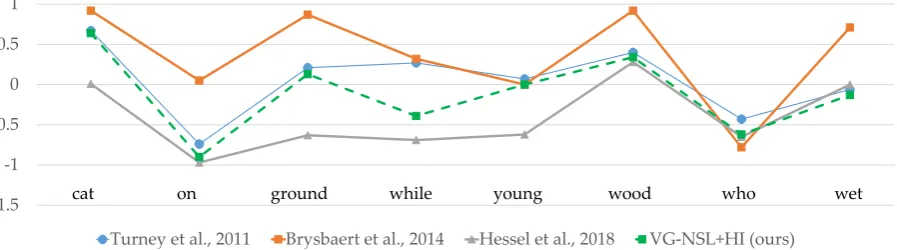
-1.5 -1 -0.5 0 0.5 1
Turney et al., 2011 Brysbaert et al., 2014 Hessel et al., 2018 VG-NSL+HI (ours)
cat on ground while young wood who wet
Figure 6: Normalized concreteness scores of example words.
to estimate PMI between words.13 The PMI is then used to compute similarity between seen and unseen words, which is further used as weights to estimate concreteness for unseen words. For the concreteness scores from crowdsourcing, we use the released data set of Brysbaert et al.
(2014).14 Similarly to VG-NSL, the multimodal concreteness score (Hessel et al., 2018) is also estimated on the MSCOCO training set, using an open-sourced implementation.15
Constituency parsing with concreteness scores.
Denoteα(w)as the concreteness score estimated by a model for the wordw. Given a sequence of concreteness scores of caption tokens denoted by (α(w1), α(w2), . . . , α(wm)), we aim to produce a binary constituency parse tree. We first normal-ize the concreteness scores to the range of[−1,1], via:16
α0(wi) = 2
α(wi)− maxjα(wj)−minjα(wj) 2
maxjα(wj)−minjα(wj)
.
We treat unseen words (i.e., out-of-vocabulary words) in the same way in VG-NSL, by assigning
13https://dumps.wikimedia.org/other/
static_html_dumps/April_2007/en/
14
http://crr.ugent.be/archives/1330
15https://github.com/victorssilva/
concreteness
16 For the concreteness scores estimated byHessel et al.
(2018), we letα(w) = logα(w)before normalizing, as the original scores are in the range of(0,+∞).
the concreteness of−1to unseen words, with the assumption that unseen words are the most abstract ones.
We compose constituency parse trees using the normalized concreteness scores by iteratively com-bining consecutive constituents. At each step, we select two adjacent constituents (initially, words) with the highest average concreteness score and combine them into a larger constituent, of which the concreteness is the average of its children. We repeat the above procedure until there is only one constituent left.
As for the head-initial inductive bias, we weight the concreteness of the right constituent with a hy-perparemeterτ >1when ranking all pairs of con-secutive constituents during selection. Meanwhile, the concreteness of the composed constituent re-mains the average of the two component con-stituents. In order to keep consistent with VG-NSL, we setτ = 20in all of our experiments.
The procedure is summarized in Algorithm2.
D Details of Manual Ground Truth Evaluation
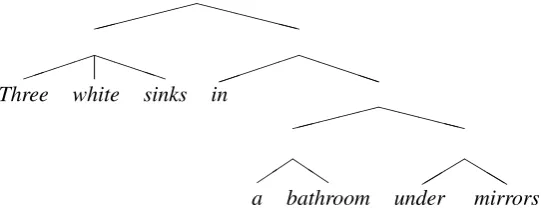
[image:15.595.78.527.189.314.2]XX XXX
X
P P
PP
Three white sinks
P P
P P P
in
XX XXX
Q Q
a bathroom
b bb " " "
under mirrors
(a) Constituency parse tree labeled by Benepar (Kitaev and Klein,2018).
hhhhhh
hhhh
( ( ( ( ( ( ( ( ( (
P P
PP
Three white sinks
Q Q
in
Q Q
a bathroom
b bb " " "
under mirrors
[image:16.595.164.435.75.180.2](b) Manually labeled constituency parse tree.
Figure 7: A failure example by Benepar, where it fails to parse the noun phrase “three white sinks in a bathroom under mirrors” – according to human commonsense, it is much more common for sinks, rather than a bathroom, to be under mirrors. However, most of the constituents (e.g., “three white sinks” and “under mirrors”) are still successfully extracted by Benepar.
Algorithm 2:Constituency parsing based on concreteness estimation.
Input: list of normalized concreteness scores
a= (a1, a2, . . . , am), hyperparameter
τ
Output: Boundaries of constituents
B ={(Li, Ri)}i=1,...,m−1
forj= 1tomdo
leftj =j
rightj =j end
whilelen(a)>1do
p= arg maxjaj+τ aj+1 add(leftp,rightp+1)toB
a=a<p+ (ap+a2p+1) +a>p+1
left=left<p+ (leftp) +left>p+1
right=right<p+ (rightp+1) +right>p+1 end
from the MSCOCO test split, and manually label the constituency parse trees without reference to either Benepar or the paired images, following the principles byBies et al.(1995) as much as possi-ble.17 Note that we only label the tree structures
17 The manually labeled constituency parse trees are
publicly available athttps://ttic.uchicago.edu/ ˜freda/vgnsl/manually_labeled_trees.txt
without constituency labels (e.g.,NPandPP). Most failure cases by Benepar are related to human com-monsense in resolving parsing ambiguities, e.g., prepositional phrase attachments (Figure7).
We compare the manually labeled trees and those produced by Benepar (Kitaev and Klein,2018), and find that the F1score between them are 95.65.
E Concreteness by Different Models
E.1 Correlation between Different Concreteness Estimations
We report the correlation of different methods for concreteness estimation, shown in (Table6). The concreteness given by Turney et al. (2011) and
Brysbaert et al.(2014) highly correlate with each other. The concreteness scores estimated on multi-modal dataset (Hessel et al., 2018) also moder-ately correlates with the aforementioned two meth-ods (Turney et al., 2011;Brysbaert et al., 2014). Compared to the concreteness estimated byHessel et al.(2018), the one estimated by our model has a stronger correlation with the scores estimated from linguistic data (Turney et al.,2011;Brysbaert et al.,
E.2 Concreteness Scores of Sample Words by Different Methods
We present the concreteness scores estimated or labeled by different methods in Figure6, which qualitatively shows that different methods correlate with others well.
F Sample Trees Generated by VG-NSL
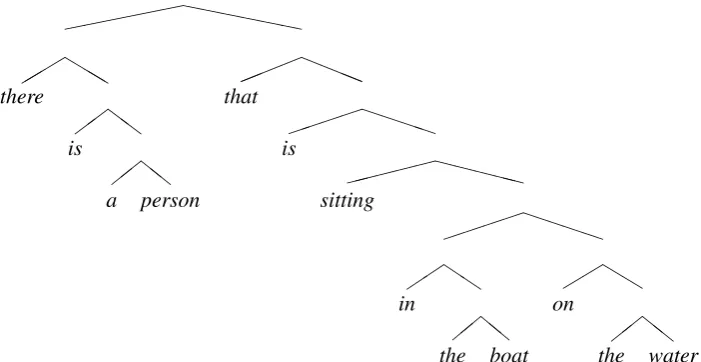
XX XXX c c # # a kitchen XX XXX with XX XXX b b " " two windows H H H and H HH two Q Q metal sinks
(a) a kitchen with two windows and two metal sinks
hhhhhh h ( ( ( ( ( ( ( H HH a H HH blue Q Q small plane a a a ! ! ! standing b b b " " " at Q Q the airstrip
(b) a blue small plane standing at the airstrip
P P P P H HH Z Z young boy sitting H HH on b bb " " " top Q Q of Q Q a briefcase
(c) young boy sitting on top of a briefcase
XX XXX X P P PP b bb " " " a Z Z small dog eating a a a ! ! ! @@ a plate Z Z of broccoli
hhhhhh hh ( ( ( ( ( ( ( ( hhhhhh hhhh ( ( ( ( ( ( ( ( ( ( P P P P P Z Z a building H HH with H HH a H HH bunch c c # # of people H HH standing around it
(e) a building with a bunch of people standing around it
XX XXX a a a ! ! ! ll , , a horse walking a a a ! ! ! by a a a ! ! ! @@ a tree b b " " in Z Z the woods
(f) a horse walking by a tree in the woods
```` ``` XX XXX a aa ! ! ! the b b " " golden waffle b b " " has c c # # a banana \\ in it
(g) the golden waffle has a banana in it .
hhh hhhh ( ( ( ( ( ( ( a a aa ! ! ! ! @@ a bowl b bb " " " full Z Z of oranges H HH that H HH still Q Q have stems
```` ``
b bb " " "
there
Z Z
is
c c # #
a person
a a
aa ! ! ! !
that
P P
PP
is
XX XXX
sitting
P P
PP
Q Q
in
l l , ,
the boat
b b " "
on
c c # #
the water
(i) there is a person that is sitting in the boat on the water
XX XXX
P P
PP
Q Q
a sandwich
c c # #
and soup
b b " "
sit
Z Z
on
@@
a table
(j) a sandwich and soup sit on a table
XX XX
XX
b bb " " "
a
b b " "
big umbrella
H HH
sitting
b b b " " "
on
Z Z
the beach
[image:20.595.124.475.173.354.2](k) a big umbrella sitting on the beach