1180
Context-specific language modeling for human trafficking detection from
online advertisements
Saeideh Shahrokh Esfahani Accenture Technology Labs
San Francisco, CA
Michael J. Cafarella Department of Computer Science
University of Michigan
Maziyar Baran Pouyan Accenture Technology Labs
San Francisco, CA
maziyar.baran.pouyan@accenture
Gregory J. DeAngelo Department of Economics Claremont Graduate University
Elena Eneva
Accenture Technology Labs San Francisco, CA
Andrew E. Fano Accenture Technology Labs
San Francisco, CA
Abstract
Human trafficking is a worldwide crisis. Traf-fickers exploit their victims by anonymously offering sexual services through online adver-tisements. These ads often contain clues that law enforcement can use to separate out po-tential trafficking cases from volunteer sex ad-vertisements. The problem is that the sheer volume of ads is too overwhelming for man-ual processing. Ideally, a centralized semi-automated tool can be used to assist law en-forcement agencies with this task. Here, we present an approach using natural language processing to identify trafficking ads on these websites. We propose a classifier by integrat-ing multiple text feature sets, includintegrat-ing the publicly available pre-trained textual language model Bi-directional Encoder Representation from transformers (BERT). In this paper, we demonstrate that a classifier using this com-posite feature set has significantly better per-formance compared to any single feature set alone.
1 Introduction
In 2013, the Global Slavery Index reported that 30 million individuals were living in involuntary servitude. Another estimation found that 600,000 women are trafficked in the sex industry per year with the United States being the second most popular destination for these individuals (Kara, 2009); (Schauer and Wheaton,2006). In the last decade, it has become more difficult for law en-forcement (LE) to trace traffickers as they have
(a)
Close your eyes and imagine sliding into a warm flowing river of relaxation as I slowly pull and push your worries away. I want you here with me. Satisfy my need to please you now.
Call Lisa xxx-xxxx-xxxx
(A)
(b)
Hi gentlemen,
Meet xxxx beauty Annie, She is 5\'8, very slim, honey blonde hair, gorgeous long legs. Very sexy, friendly and engaging.
Call xxx-xxxx-xxxx to schedule your visit. Xo Xo,
See u soon
[image:2.595.99.257.80.253.2](B)
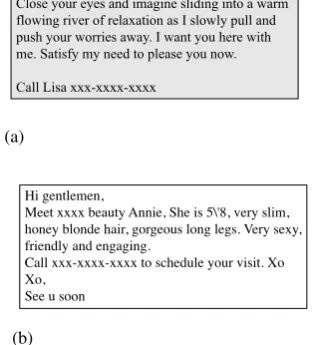
Figure 1: Two examples of online sex ads describ-ing (a) a traffickdescrib-ing victim and (b) a non-trafficked provider, selected from our labeled ads.
in a sample of online ads, as indicated by inter-views with law enforcement officials and individ-uals combating human trafficking. Taking a differ-ent approach, Tong, Zadeh, and colleagues (Tong et al.,2017) collaborated with LE officials and an-notated 10,000 ads. With these anan-notated texts, they proposed the use of deep multimodal models to reach the accuracy of LE officials in identifying suspicious ads. Szekely and colleagues (Szekely et al., 2015) created a large generic knowledge graph from a large database of online sexual ads that allows for visualization and querying data.
In this paper, we present part of an ongoing project. Unlike previous studies, we tested our method on a relatively large number of ads labeled based on the corresponding phone number rather than human interpretation of the text itself. In the following sections, we propose a method relying on extracting feature sets from ads to quantify their context. We later use these feature sets in several predictive models to flag suspicious ads. We also investigate the performance of a newly released pre-trained language model called the Bidirec-tional Encoder Representation from Transformers (BERT) (Devlin et al.,2018) to assess its power in analyzing this type of unstructured data.
2 Advertisement Annotation
We created a dataset of advertisement texts by crawling thousands of ads extracted from various adult websites in 2017. We then performed our analysis to a subset, only including the data from
January, February and March of 2017. In order to annotate the ads in our dataset, we further ex-tracted phone numbers from these ads leading to a set of more than 3 million distinct phone num-bers. We then used a database consisting of phone numbers associated with trafficking victims, con-structed in conjunction with human trafficking do-main experts without direct reference to the ad-vertising texts. Afterwards, we created a labeled data set by finding phone numbers that appear in both sets. The overlapping set contains 6,387 phone numbers, which we used to label as traf-ficking ads (i.e., the positive label in our preci-sion/recall analysis). We limited our analysis to two websites, Backpage and Eroticmugshots, with 4385 ads. We selected non-trafficking’s ad exam-ples by randomly sub-sampling from the remain-ing ads (i.e. not labeled as traffickremain-ing) and treated them as negative examples to make a balanced 10K dataset. We assumed a very low prevalence of trafficking ads (less than5%) in our initial set (≈ 3 million phones). We discuss this decision later in the paper.
After choosing approximately 10K ads, we in-vestigated the basic characteristics of the two la-bels. The median lengths of ads, including white spaces, are 538 and 401 for positive and negative labels, respectively. After excluding stop-words and lemmatizing the words, we found 24,000 dis-tinct uni-grams in non-trafficking ads, and 9,662 distinct unigrams in the trafficking ads. It should be noted that lemmatizing was only done for cal-culating the statistics in this section.
3 Text Featurization
In the feature extraction step, the fundamen-tal challenge is to quantify the textual context while retrieving information from unconventional words, abbreviations and equivocals. Here, we re-visit different developed feature sets that eventu-ally lead us to our desired contextual model.
3.1 Topic Modeling Via LDA
with the use of LDA to enhance the featuriza-tion, would allow us to identify the performance of words in specialized textual contexts. LDA model assigns a score based on the importance of repre-sentation of the words within each topic. There-fore, the value of assigned scores to topics indi-cates which ones dominate throughout the text and create the feature set assi = [si1, . . . , sik],where
siis thei-th feature vector for documenti
contain-ingkscores.
3.2 Average Word Vector
We choose to use word embedding as a key part of our model. Although Word2Vec (Mikolov et al., 2013) and GloVe (Pennington et al.,2014) word embeddings have shown promising results in se-mantic vector representations of words, when we used these models on our texts we found that they missed many of the novel word uses and abbre-viations. Instead, we chose to use FastText ( Bo-janowski et al.,2017) for our semantic word rep-resentation, as it is based on character-level word embedding and the word representation is the sum of vectors. With that said, we hereby define the second feature set for each text asνi =
P jνi,j
n ,
wherenis the number of words in the texti,νi,jis
the vector representation ofj-th word of language model with dimension ofpν(here set to 100 based
on experiment).
3.3 Pre-trained BERT
Thus far, we have defined features which need to be trained using the ads we already had. As our next features set, we propose to use a pre-trained model. Since we believe pre-trained word em-bedding on general domain is not able to capture all the rare, equivocal, and abbreviated words and phrases in our sexual advertisement text (Tong et al.,2017), we are motivated in finding the most comprehensive deep learning model and chose to assess the newly released Bidirectional Encoder Representation from Transformers (BERT) ( De-vlin et al., 2018). A word representation using BERT is made by using its bidirectional, i.e., left and right, context. BERT is released with two model sizes: (1) BERTBASE with12layers, 768
hidden layers and12 self-attention heads, and (2)
BERTLARGE with24layers,1024hidden layers,
and 16 self-attention heads. One should note that in this study we do not use fine-tuned BERT model to examine the true power of BERT. Here, we
choose to use the pre-trainedBERTBASE model
which encodes our document to a vector represen-tation of size768for each documentiand denote that bybi = [bi1, . . . , bi768].
3.4 Integrating LDA, AWV and BERT
Finally, we propose a new feature set consisting of the three types of features explained above. The rationale behind this composite feature set is to al-low for the use of textual context as well as the simpler features. Therefore, we have the final fea-ture vector defined as asxi= [si,νi,bi], with the
dimension ofp=k+pν + 768.
4 Experiments
In our study, we employ the feature models de-scribed above and compare the results of the bi-nary classification corresponding to them. We use logistic regression and compute the precision and recall curve (PRC) to evaluate the performance of different models. Moreover, in this application, it is important to have a model with good recall while keeping high precision, i.e., a high positive predictive value (PPV) to avoid unnecessary ac-tions. To do so, we investigate the sensitivity of models in different high PPVs.
Pre-processing.We choose to not remove stop words or not use any stemming or lemmatization techniques as we are faced with different writ-ing structures which could be informative for our model. We test the impact of emojis and punctua-tion by training and testing our model by creating two text sets. In the first text set, we keep the emo-jis and punctuation and remove them in the sec-ond set. In the secsec-ond set, we convert the emojis to words. Numbers in the texts are removed, be-cause: 1) we have made the labels based on phone numbers and 2), the ads are likely to have the same age or same price throughout the texts. We then di-vide the data into an80/20%training/testing set. In the following sections, we describe how each set of features is processed while using logistic re-gression as our fixed classification model.
LDA Features.We begin with features coming
AWV Features. Our FastText model is trained on a set including a minimum count of 2 words and a window size of 3 to give us a vector of di-mension 100. After training the FastText model, the average word vector of the training set is com-puted. Using this saved language model from the training set, we compute the feature test vectors.
BERT Features. For encoding our texts
us-ing BERT, we make a list of all documents and use the BERT service client. We use the weights of the words that BERTBASE learned in its
pre-training to encode each document to a vector of size 768 for both the training and testing sets. We examine encoding texts with both Cased BERT (C-BASED) and Uncased BERT (U-BERT). In the U-BERT, the text has been lower cased, whereas in C-BERT, the true case and accent markers are preserved.
Full Features. In this final step in featuriza-tion towards our composite model, we combine all three types of features to build a unified feature set, i.e. combining LDA, AWV and BERT.
5 Results and Discussions
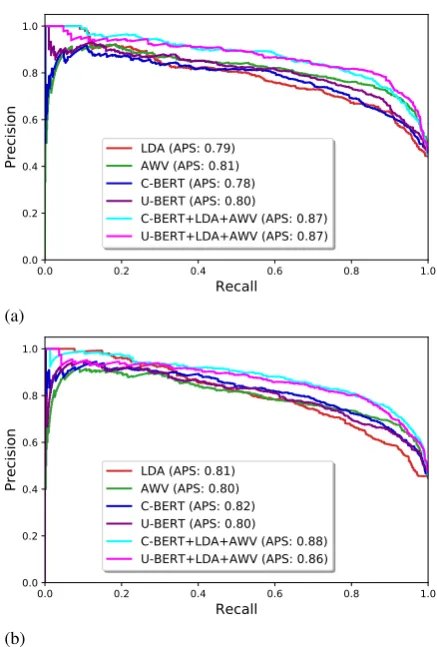
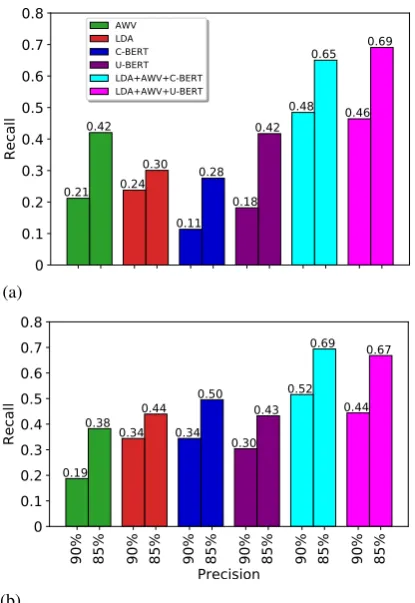
Figure2depicts the results of the classifications of the different feature sets. It can be seen that both classification approaches based on LDA and the average word vector features achieve similarly av-erage precision scores (APS). Based on our anal-ysis, keeping the entire text or removing emojis and punctuation do not significantly impact the re-sults. From Figure2, it can be seen that, despite small improvements, different featurizations pro-vide similar APS values. However, focusing more on the early parts of the PRC, i.e., high precision, we can see that there is a significant improvement of recall. For example, as summarized in Figure3, at 85% precision, our proposed full model (with U-BERT) achieves 69% and 67% sensitivity on pure text and text without emojis and punctuation, respectively. However, in the composite model with C-BERT, there is an opposite effect where re-calls become65%and69%for the two scenarios, respectively.
Comparing to the results of the classifiers with different feature sets (under U-BERT), the model utilizing the full feature set provides 26% recall improvement over the three individual ones, i.e.
69%vs28%−42%, when precision is set to85%. A similar observation holds for90%precision. As a concluding remark, we should emphasize our
(a)
0.0 0.2 0.4 0.6 0.8 1.0
Recall
0.0 0.2 0.4 0.6 0.8 1.0
Precision LDA (APS: 0.79)AWV (APS: 0.81) C-BERT (APS: 0.78) U-BERT (APS: 0.80)
C-BERT+LDA+AWV (APS: 0.87) U-BERT+LDA+AWV (APS: 0.87)
(b)
0.0 0.2 0.4 0.6 0.8 1.0
Recall
0.0 0.2 0.4 0.6 0.8 1.0
Precision LDA (APS: 0.81)AWV (APS: 0.80) C-BERT (APS: 0.82) U-BERT (APS: 0.80)
[image:4.595.306.525.56.380.2]C-BERT+LDA+AWV (APS: 0.88) U-BERT+LDA+AWV (APS: 0.86)
Figure 2: Precision and Recall curves (PRCs) and their corresponding APS values: (a) pure text, (b) text with-out emojis and punctuation.
significant improvement in recall rate over each in-dividual model.
6 Conclusions and Future Work
In this paper, we introduced different models based on different text featurizations where the main goal was to engineer features that allowed for understanding the context of sexual ads and re-move the restriction of using keywords. We have proposed a composite model and compared its per-formance with other simpler models. For more evaluation, we examined the recall rate of mod-els in85%and90%of precision. The full feature set, i.e. LDA+AWV+BERT, outperformed others as it indicated that having comprehensive features may be conveying more information about the ad-vertisements.
(a)
0 0.1 0.2 0.3 0.4 0.5 0.6 0.7 0.8
Recall
0.21 0.24
0.11 0.18
0.48 0.46 0.42
0.30 0.28 0.42
0.65 0.69
AWV LDA C-BERT U-BERT LDA+AWV+C-BERT LDA+AWV+U-BERT
(b)
90% 85% 90% 85% 90% 85% 90% 85% 90% 85% 90% 85%
Precision 0
0.1 0.2 0.3 0.4 0.5 0.6 0.7 0.8
Recall
0.19
0.34 0.34 0.30 0.52
0.44 0.38 0.44
0.50 0.43
[image:5.595.77.285.59.361.2]0.69 0.67
Figure 3: Recall rates corresponding to90%and85% precision: (a) pure text, (b) text without emojis and punctuation.
our future work, we will be investigating those false positive cases with our collaborators to as-sess what the correct label for these ads should be. Moreover, since the proposed full feature set involves hundreds of features we plan to increase our sample size to have a better estimation of the performance of our final predictor. We also en-vision that by including other underlying compo-nents from these advertisements, we can assist law enforcement officers with an automated frame-work to sift millions of sexual advertisements and spend time on especially suspicious activities. Fi-nally, in this study, we tested our model on a bal-anced data set. However, in the real world, the number of trafficking ads is always far lower than the number of non-trafficking ones. After col-lecting more labeled data, and tuning our model using anomaly detection techniques like Isolation Forests (Liu et al.,2008), we hope to expand this study to the stage where we are able to use unbal-anced data sets.
Acknowledgments
This study was supported by Accenture Labs. We would like to thank Jana Thompson for critical feedback on the manuscript.
References
David M Blei, Andrew Y Ng, and Michael I Jordan. 2003. Latent dirichlet allocation. Journal of Ma-chine Learning Research, 3(Jan):993–1022.
Piotr Bojanowski, Edouard Grave, Armand Joulin, and Tomas Mikolov. 2017. Enriching word vectors with subword information. Transactions of the Associa-tion for ComputaAssocia-tional Linguistics, 5:135–146.
Jacob Devlin, Ming-Wei Chang, Kenton Lee, and Kristina Toutanova. 2018. Bert: Pre-training of deep bidirectional transformers for language understand-ing.arXiv preprint arXiv:1810.04805.
Siddharth Kara. 2009. Sex trafficking: Inside the busi-ness of modern slavery. Columbia University Press.
Fei Tony Liu, Kai Ming Ting, and Zhi-Hua Zhou. 2008. Isolation forest. In2008 Eighth IEEE International Conference on Data Mining, pages 413–422. IEEE.
Tomas Mikolov, Kai Chen, Greg Corrado, and
Jef-frey Dean. 2013. Efficient estimation of word
representations in vector space. arXiv preprint arXiv:1301.3781.
Jeffrey Pennington, Richard Socher, and Christopher Manning. 2014. Glove: Global vectors for word representation. In Proceedings of the 2014 Con-ference on Empirical Methods in Natural Language Processing (EMNLP), pages 1532–1543.
Edward J Schauer and Elizabeth M Wheaton. 2006. Sex trafficking into the united states: A literature re-view. Criminal Justice Review, 31(2):146–169.
Pedro Szekely, Craig A Knoblock, Jason Slepicka, Andrew Philpot, Amandeep Singh, Chengye Yin, Dipsy Kapoor, Prem Natarajan, Daniel Marcu, Kevin Knight, et al. 2015. Building and using a knowledge graph to combat human trafficking. In
International Semantic Web Conference, pages 205– 221. Springer.
Edmund Tong, Amir Zadeh, Cara Jones, and
Louis-Philippe Morency. 2017. Combating human
traf-ficking with deep multimodal models. arXiv
preprint arXiv:1705.02735.