Proceedings of the Fourth Conference on Machine Translation (WMT), Volume 2: Shared Task Papers (Day 1) pages 335–341 335
Apertium-fin-eng—Rule-based shallow machine translation for WMT
2019 shared task
Tommi A Pirinen Universit¨at Hamburg
Hamburger Zentrum f¨ur Sprachkorpora [email protected]
Abstract
In this paper I describe a rule-based, bi-directional machine translation system for the Finnish—English language pair. The origi-nal system is based on the existing data of FinnWordNet, omorfi and apertium-eng. I have built the disambiguation, lexical selec-tion and translaselec-tion rules by hand. The dic-tionaries and rules have been developed based on the shared task data. I describe in this arti-cle the use of the shared task data as a kind of a test-driven development workflow in RBMT development and show that it suits perfectly to a modern software engineering continuous integration workflow of RBMT and yields big increases to BLEU scores with minimal effort. The system described in the article is mainly developed during shared tasks.
1 Introduction
This paper describes our submission for Finnish— English language pair to the machine translation shared task of the Fourth conference on machine translation(WMT19) at ACL 2019. Traditionally
rule-based machine translation(RBMT) is not in the focus for WMT shared tasks, however, there are two reasons I experimented with this system this year. One is that we have had an extensively large amount of lesser used resources for this pair: omorfi1(Pirinen,2015) has well over 400,000 lex-emes2, apertium-eng3 has over 40,000 lexemes and apertium-fin-eng4 over 160,000 lexeme-to-lexeme translations. One of our key interests in the shared task like this is that it provides an ideal data for test-driven development of lexical resources.
1https://github.com/flammie/omorfi 2
https://flammie.github.io/omorfi/ statistics.html
3
http://wiki.apertium.org/wiki/English
4https://github.com/apertium/
apertium-fin-eng
One concept I experimented with the shared task is various degrees of automation—expert su-pervision for the lexical data enrichment. In this experiment I used automatic methods to refine the lexical selection of the machine translation, and semi-automatised workflows for the generation of the lexical data, as well as some expert-driven development of the more grammatical rules like noun phrase chunking and determiner generation. It might be noteworthy that this machine trans-lator I describe in the article is not actively de-veloped outside the shared tasks, so the article is moreso motivated as an exploration of the work-flow and methods on semi-automatically gener-ated shallow RBMT than a description of a fully developed RBMT.
The rest of the article is organised as follows: In Section2I describe the components of our RBMT pipeline, in Section3 I describe the development workflow and in Section4I show the shared task results and I perform error analysis and discuss the results and finally in Section5 we summarise the findings.
2 System description and setup
The morphological analyser for Finnish is based on omorfi (Pirinen,2015), a large morphological lexical database for Finnish. Data from omorfi has been converted into Apertium format and is freely available in the apertium-style format in the github repository apertium-fin5. For English I have used Apertium’s standard English analyser apertium-eng6. Both analysers were downloaded from github in the beginning of the shared task and we have updated and further developed them based on the development data during the shared
5
https://github.com/apertium/ apertium-fin
6https://github.com/apertium/
Dictionary Lexemes Manual rules
Finnish 426,425 143
English 40,185 187
Finnish-English 164,501 273
Table 1: Sizes of dictionaries. The numbers are num-bers of unique word entries or translation entries as defined in the dictionary, e.g., homonymy judgements have been made by the dictionary writers. The rule counts are combined counts of all sorts of linguistic rules: disambiguation, lexical selection, transfer and so forth.
task. I developed the Apertium’s Finnish-English7 dictionary initially based on the FinnWordNet’s translated data, which was over 260,000 Wordnet-style lexical items; of these I discarded most which had multiple spaces in them or didn’t match any source or target words in Finnish and English dictionaries, ending with around 150,000 lexical translations. The size of dictionaries at the time of writing is summarized in Table 1, however more up-to-date numbers can be found in Apertium’s Wiki8
The system is based on the Apertium9 ma-chine translation platform (Forcada et al., 2011), a shallow transfer rule-based machine translation toolkit. For morphological analysis and genera-tion, HFST10 (Lindn et al.,2011) is used and for morphological disambiguation VISL CG-3 11 is used. The whole platform as well as all the lin-guistic data are licensed under the GNU General Public Licence (GPL).
Apertium is a modular NLP system based on UNIX command-line ideology. The source text is processed step-by-step to form a shallow analy-sis (morphological analyanaly-sis), then translated (lex-ical transfer) and re-arranged (structural transfer) to target language analyses and finally generated (morphological generation). Each of the steps can be processed with arbitrary command-line tool that transforms the input in expected formats. All of the steps also involve ambiguity or one-to-many mappings, that requires a decision, and while these
7https://github.com/apertium/
apertium-fin-eng
8http://wiki.apertium.org/wiki/List_
of_dictionaries
9https://github.com/apertium 10
https://hfst.github.io
11http://visl.sdu.dk/cg3.html
decisions can be made using expert written rules, the writing of the rules is also a demanding task, and it is interesting to see how much can be achieved by simply bootstrapping the rulesets us-ing automatic rule acquisition.
To illuminate how apertium does RBMT in Finnish—English, and the kinds of ambiguities I resolve, I show in Table 3 examples of the am-biguities with an example sentence. The ambi-guity of source morphology is the true ambiambi-guity rate of the language (according to the morpholog-ical analyser), i.e. how many potential interpreta-tion each word has. It is no surprise that Finnish has relatively high ambiguity rate, however, En-glish is nearly unambiguous is more due to lim-itation of apertium’s English dictionary than fea-ture of English per se, given that English has a bit of productive zero-derivations, e.g. verbing nouns and vice versa. The lexical selection ambiguity is the translation dictionary’s rate of choices per source word, and FinnWordNet on average has 5 synonyms per word to suggest. The target mor-phology ambiguity is the rate of allomorphy or free variation, in Finnish as target language there’s some systematic problems, such as plural geni-tives and partigeni-tives, whereas English literally has two incidents in the whole dev set: sown / sowed
andfish / fishes. Assuming a perfect RBMT sys-tem would keep all options open, until final deci-sion, the number of hypotheses at the end would be at least MASL ×LSSL→TL ×MATL, where
M Ais morphological ambiguity rate,LS is lexi-cal selection ambiguity rate,SLis source language
andT Lis target language. For Finnish—English I
show the example figures of the ambiguities based on the development and test sets in Table2.
The rule-based machine translation process as it is performed by apertium is shown in Table3. The first step of the RBMT here is morphological anal-ysis, in apertium this covers both tokenisation and morphological analysis as seen here; in apertium-eng the expression ‘in front of’ is considered to be a single token and is packaged as a preposition (we have also omitted an ambiguity between at-tributive and nominal reading of the house, since the distinction does not currently make difference in English to Finnish translation, in order to fit the table in the paper). The morphological analysis in apertium is performed by finite-state morphologi-cal analysis as defined in Beesley and Karttunen
Feature: Source Lexical Target Total
Corpus morphology selection morphology
Finnish dev set 1.68 5.04 1.0002 8.46 Finnish test set 1.69 4.80 1.0003 8.13
[image:3.595.151.448.64.162.2]English dev set 1.04 1.15 1.0013 1.19 English test set 1.03 1.12 1.0006 1.15
Table 2: Ambiguity influencing RBMT Finnish-to-English and English-to-Finnish
by Lindn et al. (2011). After analysis, the next step is to disambiguate, i.e. pick 1-best lists of morphological analyses; in apertium this is done by constraint grammar, as described byKarlsson
(1990) and implemented in open source by VISL CG 3.12. In lexical translation phase, each lemma is looked up from the translation dictionary, and in lexical selection the translation that is most suit-able by the context and statistics is selected. In the structural transfer phase a number of things is per-formed: the English morphological analyses are rewritten into Finnish analyses, e.g. the adjective and noun will receive a genitive case tag due to the adposition, and the adposition is moved before the noun phrase since it is a preposition in Finnish and postposition in English, and the article is just removed, as the use of articles is non-standard in Finnish. Finally the Finnish analysis is generated into a surface string using a finite-state morpho-logical analyser, since they are inherently bidirec-tional this needs no extra software or algorithms.
3 RBMT development workflow
I present here different levels of automation in the RBMT workflow: in Subsection3.1 I have auto-mated the generation of rules, in Subsection 3.2
I have a semi-automated workflow and finally in Subsection 3.3 I have an expert-driven develop-ment workflow.
3.1 Lexical selection training
One of the key components of this experiment was to try automatic rule-creation mechanisms for the converted Wordnet dictionary refinement. A large number of translation quality issues in the initial converted Wordnet dictionary was a high number of low-frequency ‘synonyms’ in translations. To overcome this some automatic methods were used. For automatic bootstrapping of the lexical
selec-12http://visl.sdu.dk/cg3.html
tion rules I used Europarl corpus (Koehn, 2005) data and the methods demonstrated byTyers et al.
(2012). Since the result of this training seemed also insufficient, I experimented with another sys-tem to generate more rules for lexical selection.13
On top of that, I have updated the lexical selec-tion with some manual rules, that were either not covered by Europarl hits or skewed wrongly for the news domain, for example, the word ‘letter’ seemed to mainly have translations ofkirje(a mes-sage written on paper), while in the development set all the sentences I sampled, a more suitable translation would of been kirjain (a character of alphabet). The resulting lexical selection rule sets are summarised in the table 4. The first method of creating rules is based on n-gram patterns, due to restricted time and processing resources I have only included bigrams into this model, and the sec-ond model only considers unigrams. The results are added up in the table lines + bigrams and+ unigramsrespectively.
3.2 Lexicon development workflow
One of the key components of this experiment is to show that a shared-task driven development
(STDD) is a usable workflow for the develop-ment of the lexical data in rule-based machine translation system. As such, a ‘training’ phase in the RBMT development has been replaced by a very simple semiautomated native speaker -driven project workflow consisting of following:
1. Collect all lexemes unknown to source lan-guage dictionary, and add them with neces-sary morpholexical information
2. Collect all lexemes unknown to bilingual translation dictionary, and add their transla-tions
13https://svn.code.sf.net/p/apertium/
Input: In front of the big house
Morphological analysis: In front of.PREPthe.DET.DEF.SPbig.ADJhouse.N.SG
Morphological disambiguation: In front of.PREPthe.DET.DEF.SPbig.ADJhouse.N.SG
Lexical translation: In front of.PREP→Edess¨a.POST the.DET.DEF.SP→se.DET.DEF.SP
big.ADJ→iso∼raju∼paha∼kova∼. . . jalomielinen.ADJ
house.N.SG→huone∼talo∼suku∼. . . edustajainhuone.N.SG
Lexical selection: Edess¨a.POSTse.DET.DEF.SPiso.ADJtalo.N.SG
Structural transfer: iso.ADJ.POS.SG.GENtalo.N.SG.GENEdess¨a.POST
Finnish translation: ison talon Edess¨a
Table 3: Translation process for the English phrase ‘In front of the big house’
Orig. Fin-Eng 18,066 + bigrams 24,662 + unigrams 30,049
[image:4.595.304.544.273.370.2]Orig. Eng-Fin 22 + bigrams 24,631 + unigrams 25,748
Table 4: Lexical selection rules statistically generated
3. Collect all lexemes unknown to the target lan-guage dictionary, and add them to the dictio-nary with necessary morpholexical informa-tion
The semi-automation that I have developed lies in collecting the different unknown lexemes or
out-of-vocabulary items (OOVs), and guessing a lexical entry or multiple plausible entries for them and have the dictionary writer select and correct them.
3.3 Grammar development
An expert-driven part of the RBMT workflow in our current methodology is the grammar devel-opment. This consists manually reading the sen-tences produced by the MT system to spot system-atic errors caused by grammsystem-atical differences be-tween languages. For the purposes of this shared task and the workshop, the linguistics or grammar are not a central concept, so I will not detail it here in detail. In practice this concerns of such gram-matical rules as mapping between no articles in Finnish to articles in English, mapping between case or possessive suffixes and their correspond-ing lexical representations in English and so forth.
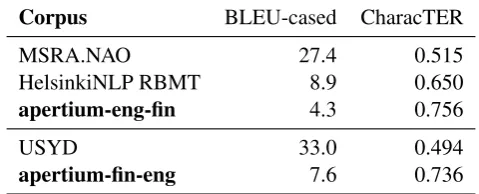
Corpus BLEU-cased CharacTER
MSRA.NAO 27.4 0.515
HelsinkiNLP RBMT 8.9 0.650
apertium-eng-fin 4.3 0.756
USYD 33.0 0.494
apertium-fin-eng 7.6 0.736
Table 5: automatic scores from http://matrix. statmt.org, we show our scores (boldfaced), the highest ranking RBMT and the highest ranking NMT for reference.
The details can be seen in the code that is available in github.
4 Evaluation, error analysis and discussion
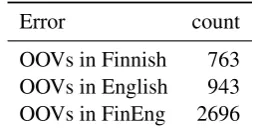
Error count
OOVs in Finnish 763 OOVs in English 943 OOVs in FinEng 2696
Table 6: Classification of mainly lexical errors in apertium-fin-eng submissions for 2019
Corpus BLEU-cased
apertium-eng-fin 2015 2.9
2017 3.5
2019 4.3
apertium-fin-eng 2015 6.9
2017 6.3
2019 7.6
Table 7: Progress of apertium-fin-eng over the years using only the WMT shared task driven development method.
layout given in Section3 and is the same for de-velopment and error analysis phase. I have, to that effect, categorised the errors in translations along the workflow:
1. OOV in source language dictionary (includ-ing typos and non-words)
2. OOV in bilingual dictionary
3. OOV in target language dictionary
4. disambiguation or lexical selection fail
5. structural failure or higher level
The OOV’s can be calculated automatically from the corpus data, but the higher level failures need human annotation. A summary of the errors can be seen in the table 6, this is based on the errors that were fixed as a part of error analysis process. As a result of this workflow, I have im-proved the BLEU points of apertium-fin-eng over the years, as can be seen in the table7.
The OOV numbers might look moderately large but a major part falls under proper nouns, which are generally low frequency and do not cause a large problem in translation pipeline, the untranslated proper noun is recognisable and the mapping of adpositions and case inflections will fail where applicable. The task of adding proper nouns to the dictionaries is also simplest, they are
easy to gather from the text, and for English and bilingual dictionaries no further classification is necessary; for the Finnish dictionary entry gener-ation, paradigm guessing is necessary, although the paradigms used in foreign names are much more limited than with other parts-of-speech to be added. In the newstest 2019data there was a number of words that I decided not to add to our dictionaries, unlike our usual workflow where I aim at virtual 100 % coverage with gold corpora. The unadded words were for example words like “Toimiluvanmuodossatoteutettavajulki-senjayksityisensektorinkumppanuus”, which seems to have a large number of missing spaces and extra hyphen, these as well as extraneous spaces were quite common in the data in our error analysis as well as ‘words’ like ‘OIet’, ‘OIi’, ‘OIin’, ‘OIisi’, ‘OIIut’, i.e. forms of ‘olla’ (to be) where lowercase L has been replaced with uppercase I. While I do account for common spelling mistakes in our dictionaries, these kind of errors are probably more suited for robustness testing and implemented with spelling correction methods for specific problematic generated text, such as OCR. We will look into implementing spelling correction into our pipeline in the future. Comparing the performance of RBMT to NMT, it can be clearly seen that contemporary NMT is better suited for error tolerance, in part because it can be more character-based than token-based, in part because any large training data set will actually have some OCR errors and run-in tokens.
After OOV-errors one of the biggest easily solv-able problems is ambiguity, so word sense dis-ambiguation and lexical selection. For lexical se-lection I found about 200 lexical translations that were still badly wrong and could be solved with-out coming up complex context conditions. For disambiguation problems, a surprisingly common problem was sentence-initial proper noun that is a common noun as well, as a high frequency ex-ample, for the word ‘trump’ meaning a winning suit in card games (= Finnish ‘valtti’) would get selected over the POTUS, plausibly when most of the training and development before WMT 2019 did not contain so many proper noun Trumps. Also rather common problem still is the ambiguity in English verb forms, and between English zero derivations.
[image:5.595.116.246.62.128.2]For example for Finnish to English proper noun phrases regardless of length of the phrase, the Finnish shows case in last word or postposition after the last word, English has preposition be-fore the word, but when phrase gets chunked par-tially the adpositions or case suffixes end up in the middle with a rather jarring effect to the trans-lated sentence. The same applies for other ef-fects where generating correct language depends on correct chunk detection, e.g. the article genera-tion is very limited in the current code because the articles need to be generated from nothing, when translating from Finnish to English, only at the very beginning of specific noun phrases.
Finally a number of problems were caused for such grammatical differences between languages that do not have a good solution in lexical rule-based machine translation, such as difference be-tween English noun phrases and corresponding Finnish compound nouns or for example the com-mon English class of -able suffixed adjectives that does not have accurate lexical Finnish translation at all.
In terms of where RBMT is perhaps more us-able than NMT, one important factor is how pre-dictable and systematic the errors are when they appear. For example just looking at the first page of the top-ranking system in Finnish-to-English14 one can see the Finnish “Aika nopeasti saatiin hommat sovittua, Kouki sanoi” translated into “Pretty quickly we got the gays agreed, Kouki said.” whereas the correct translation is “We reached a pretty quick agreement, Kouki said.”, the big problem with the neural translation is that it is deceptively fluent language but conveys some-thing completely different, comparing to the rule-based version: “Kinda swiftly let jobs agreed, Kouki said.” which is not fluent at all, but doesn’t hallucinate gays there so it may be more usable for post-editing. For further research in the prob-lems of NMT for real-world use, see for exam-pleMoorkens et al.(2018).
In comparison to neural and statistical sys-tems, the rule-based approach does not generally fare well as measured with automatic metrics like BLEU, for a human evaluation refer to (Bojar et al.,2019). However, the experiment I describe here is also not the most actively developed ma-chine translators, rather I use the experiment to
14http://matrix.statmt.org/matrix/
output/1903?score_id=39757
gauge the effects the described workflow has to quality of semi-automatically generated RBMT, to see how more developed systems fare on the same task you should also refer to (Hurskainen and Tiedemann,2017;Kolachina and Ranta,2015).
5 Concluding remarks
In this article I’ve shown a workflow ofshared task driven developmentfor rule-based machine trans-lations, namely the lexicons and rules. I show that a small effort to update lexical data based on yearly released gold corpora increases BLEU points and enlarges dictionaries as well as im-proves rulesets sizes and qualities by a significant amount. In future I aim to build more automati-sation for the workflow to make it trivially usable with continuous integration.
The systems are all available as free/libre open-source software under the GNU GPL licence, and can be downloaded from the internet.
Acknowledgements
This work has been written while employed in the Hamburger Zentrum f¨ur Sprachkorpora by CLARIN-D. Thanks to all contributors of the re-lated projects: omorfi, FinnWordNet, Apertium, and everyone helping with fin, apertium-eng and apertium-fin-apertium-eng.
References
Kenneth R Beesley and Lauri Karttunen. 2003. Finite State Morphology. CSLI publications.
Ondˇrej Bojar, Christian Federmann, Mark Fishel, Yvette Graham, Barry Haddow, Matthias Huck, Philipp +Koehn, Christof Monz, Mathias M¨uller, and Matt Post. 2019. Findings of the 2019 confer-ence on machine translation (wmt19). In Proceed-ings of the Fourth Conference on Machine Transla-tion, Volume 2: Shared Task Papers, Florence, Italy. Association for Computational Linguistics.
Mikel L Forcada, Mireia Ginest´ı-Rosell, Jacob Nord-falk, Jim ORegan, Sergio Ortiz-Rojas, Juan An-tonio P´erez-Ortiz, Felipe S´anchez-Mart´ınez, Gema Ram´ırez-S´anchez, and Francis M Tyers. 2011. Apertium: a free/open-source platform for rule-based machine translation. Machine translation, 25(2):127–144.
Fred Karlsson. 1990. Constraint grammar as a frame-work for parsing unrestricted text. InProceedings of the 13th International Conference of Computational Linguistics, volume 3, pages 168–173, Helsinki.
Philipp Koehn. 2005. Europarl: A parallel corpus for statistical machine translation. InMT summit, vol-ume 5, pages 79–86.
Prasanth Kolachina and Aarne Ranta. 2015. Gf wide-coverage english-finnish mt system for wmt 2015. InProceedings of the Tenth Workshop on Statistical Machine Translation, pages 141–144.
Krister Lindn, Erik Axelson, Sam Hardwick, Tommi A Pirinen, and Miikka Silfverberg. 2011. Hfstframe-work for compiling and applying morphologies. Systems and Frameworks for Computational Mor-phology, pages 67–85.
Joss Moorkens, Antonio Toral, Sheila Castilho, and Andy Way. 2018. Translators perceptions of liter-ary post-editing using statistical and neural machine translation. Translation Spaces, 7(2):240–262.
Kishore Papineni, Salim Roukos, Todd Ward, and Wei-Jing Zhu. 2002. Bleu: a method for automatic eval-uation of machine translation. In Proceedings of the 40th annual meeting on association for compu-tational linguistics, pages 311–318. Association for Computational Linguistics.
Tommi A Pirinen. 2015. Development and use of com-putational morphology of finnish in the open source and open science era: Notes on experiences with omorfi development. SKY Journal of Linguistics, 28.
Francis M Tyers, Felipe S´anchez-Mart´ınez, Mikel L Forcada, et al. 2012. Flexible finite-state lexical se-lection for rule-based machine translation.