Back to the Future of Human
Resource Information
Systems?
“A survey towards the role of country differences
regarding adoption and deployment outcomes of
e-HRM”
General Information
Project Title
The affect of country differences on the adoption and deployment outcomes for e-HRM
Student Information
Name Yorrick Bakker
Student Number s0168378
Telephone Number +31 (0)628945893
E-mail Address [email protected]
Graduation Committee
Chairman/ 1st supervisor Dr. Huub Ruël
Telephone Number +31 (0)534894767
E-mail Address [email protected]
2nd Supervisor Dr. Tanya Bondarouk
Telephone Number +31 (0)534893666
Preface
E-HRM and the related term Human Resource Information Systems are topics that are becoming popular in scientific research. Despite the increasing recognition for e-HRM, there remain several mysteries and realms to be investigated regarding e-HRM adoption and deployment. This thesis aims to support the ongoing investigations for e-HRM, by relating country characteristics in the socio-cultural, political, and economic environment to e-HRM adoption and deployment outcomes. With the viewpoint of you reading this preface and me putting on the finishing touches, a challenging process is nearly to an end. Although my week was not complete with 20 questions regarding the status of my thesis and at a certain point you are wondering if the process is becoming a never-ending story, still the genuine interest by people for the process endured me to develop and finalize this thesis. Therefore I would like to thank all people involved in this process. The list of people is endless and too long to capture in a few sentences (in aggregate family, supervisors, friends, respondents, fellow students (special thanks to Rob Tuinte and Peter van de Top, soon to become successful entrepreneurs instead of “spare time” thesis writers), colleagues, and teammates). Hence I rather refer to the help they offered which they should cherish and spread around to other people who could use these beloved characteristics. The activities performed to assist me, vary from providing feedback to small talk distracting me from the thesis. In essence, the people were willing to listen, provide input, read and/or talk about the thesis or me as a person and I am very grateful for these characteristics.
Additionally I would like to encourage all the present and future researchers determined to complete their queries and quests. I sincerely hope that these researchers do not avert or preclude their studies but rather encourage fellow researchers and themselves to publicize and write about their studies. Although you may not always get the recognition for your hard work, there are always people there to support you, even though you may not recognize them.
Yorrick Bakker
Summary
E-HRM is becoming one of the most promising technologies which for example, enable companies to work more efficiently and could assist companies in realizing the strategic value of HR. The former expectation is however not (yet) fully achieved by companies and moreover the investments for e-HRM differ per country. These country differences could assist in understanding if and why these differences could help in decaying the “realms” surrounding the “underachievement” of e-HRM promises. Hence research could assist by making a reliable international overview regarding country differences and their affect in the adoption and deployment outcomes of HRIS/e-HRM. This thesis aims to support the ongoing investigations for e-HRM, by relating country characteristics in socio-cultural, political, and economic variety to e-HRM adoption and deployment outcomes.
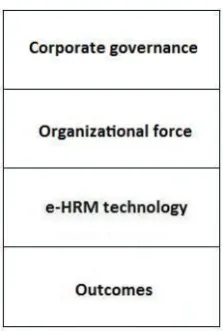
Before the research framework was developed, the context of country differences and e-HRM adoption and deployment outcomes had to be explored. The term e-HRM is for that purpose distinguished in angles which facilitates the recognition of probable country differences interfering with the e-HRM adoption and deployment outcomes. The angles and subsequent variables contained four constructs; corporate governance, organizational force, e-HRM technology and outcomes. This preliminary angle framework guided the literature study and is subsequently used to identify variables measured by the research methodology. The identified angles and components are collected and measured via a questionnaire. The questionnaire was applied in a communication platform for industry experts who for example, can provide answers or advice to queries and research. Hence special groups - e.g., e-HRM, HRIS, HR change group members - have been selected for participation in the questionnaire. After the closing data for the questionnaire, the thesis was confronted with a low response. Hence it was decided to divert the research methodology into a pilot study; thereby the aim is to strengthen the questionnaire and provide preliminary insights for the affect of country differences on the adoption and deployment outcomes for e-HRM. Although the initial research framework could not be applied, still some interesting findings were retrieved which could assist for eventual main research and future research towards e-HRM and country differences.
The interviews and questionnaire did not confirm the expectations that country differences affect the adoption and deployment outcomes for e-HRM. Quite on the contrary, respondents suggested that e-HRM is not achieving the goal to increase the strategic impact of HR. Rather respondents suggested that country differences are more likely to be retrieved via investigation towards the feature of HR processes in the HRM application. Especially the feature of “acquiring HR” in an e-HRM application was suggested to be explained by country differences. Hence it was decided to revise the questionnaire.
Contents
1. INTRODUCTION ... 8
1.1RESEARCH OBJECTIVE ... 11
1.2OPERATIONALIZATION TERMINOLOGY ... 12
1.3RESEARCH PLAN ... 13
2. THEORETICAL FRAMEWORK ... 15
2.1THE CONCEPT OF INFORMATION SYSTEMS REGARDING HRM ... 15
2.2 E-HRMANGLES ... 17
2.3CORPORATE GOVERNANCE ... 19
2.3.1 Political Economy Varieties... 19
2.3.2 Socio-Cultural Force ... 22
2.4ORGANIZATIONAL FORCE ... 26
2.4.1 Size of Organization ... 26
2.4.2 Industry Type ... 27
2.4.3 Strategic Direction ... 27
2.4.4 Role of HR ... 28
2.5 E-HRM TECHNOLOGY ... 29
2.5.1 e-HRM Goals ... 29
2.5.2 e-HRM Direction ... 32
2.5.3 e-HRM Literacy ... 33
2.5.4 e-HRM Portal ... 34
2.6OUTCOMES ... 34
2.6.1 HRM Competencies ... 34
2.6.2 Services of HRM ... 37
2.7THEORETICAL FRAMEWORK ... 38
3. METHODOLOGY ... 40
3.1CONCEPTS... 40
3.2RESEARCH STRATEGY ... 42
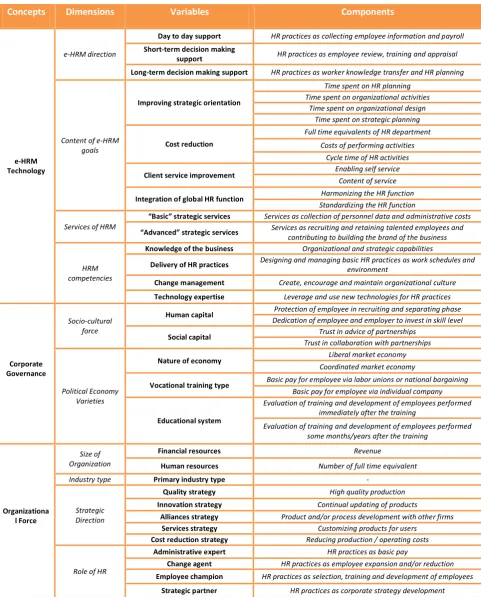
3.3OPERATIONALIZATION OF VARIABLES ... 44
4. RESULTS ... 46
4.1.RESPONSE ... 46
4.2FINDINGS AND INTERPRETATION OF THE DATA ... 46
4.2.1 GasTerra ... 47
4.2.2 Rabobank International... 48
4.2.3 Vitol Tanks Terminal International ... 50
4.2.4 Completed Questionnaires ... 51
5. CONCLUSION, DISCUSSION AND RECOMMENDATIONS ... 53
5.1CONCLUSION ... 53
5.2LIMITATIONS... 55
5.3RECOMMENDATIONS ... 55
REFERENCES ... 57
Figures and Appendices Index
Figure 1 definition of terminology used for research objective, key question and sub questions ... 12
Figure 2 four aspects of e-HRM... 17
Figure 3 angles of e-HRM adoption and deployment process ... 18
Figure 4 social protection and predicted skill profiles ... 24
Figure 5 variables per strategic direction ... 28
Figure 6 roles of HR ... 28
Figure 7 theoretical angle framework ... 39
Figure 8 concepts subjected to research strategy ... 42
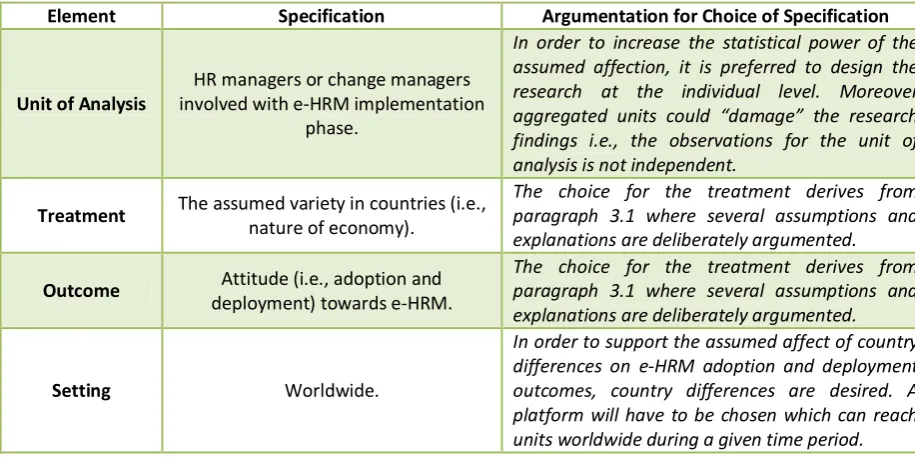
Figure 9 UTOS ... 43
Figure 10 concepts, dimensions, variables and component list ... 45
Figure 11 integration of research findings with research objective and desired results ... 53
Appendix 1 journal top 40 of Financial Times 2007 ... 61
Appendix 2 time schedule for master thesis ... 63
Appendix 3 covering letter for the questionnaire ... 64
Appendix 4 LinkedIn groups invited to participate in the questionnaire ... 65
Appendix 5 questionnaire ... 66
Appendix 6 interview protocol ... 72
Abbreviations
CME Coordinated Market Economy
LME Liberal Market Economy
E-HRM Electronic Human Resource Management
ESS Employee Self Service
IT Information Technology
HR Human Resource
HRIS Human Resource Information Systems
HRM Human Resource Management
MIS Management Information System
MSS Management Self Service
SSC Shared Service Center
U.A.E. United Arab Emirates
U.K. United Kingdom
U.S.A. United States of America
UTOS Unit of analysis, Treatment, Outcome and Setting
1. Introduction
During the last decades the concept “innovative business directions” (e.g., electronic commerce, electronic business, electronic marketing, electronic Human Resource Management henceforth referred to as e-commerce, e-business, e-marketing and e-HRM) have an increasing importance on businesses and corporate governance. The foundation for the new implication of “innovative business directions” is believed to be mainly contributed by changing and increasing customer demands, greater competitive intensity, less expensive and widely available communications, information, transaction and product technologies and an increased complexity in production technology and coordination (St. John, Cannon and Pouder, 2001). Hence the changing factors, believed to shape the demand for “innovative business directions”, are assumed to initiate an increasing uncertainty and a greater complexity in business formulating strategies and implementation. Rapid change within the market of a business is assumed to be affected by the change factors - occurring from the demand for “innovative business directions” - which results in constantly changing demand and preference of suppliers, employees, customers, government, laws, competitors, communities, and so on (St, John et al., 2001). Businesses are thus ever-increasingly in need of new directions and therefore businesses are searching for new paths in their original business setting. One of the areas - with a growing interest for “innovative business directions” - is human resource management as advocated in many journals. Increasingly researchers found several new and innovative ways of deploying human resource management (henceforth referred to as HRM) and terms as e-HRM, HR intranet, web-based HR, computer-based HRM systems, virtual HR (M) and HR portals popped “out of the ground”. Subsequently businesses around the world began to realize that the deployment of e-HRM and the like could result in a competitive advantage e.g., businesses can reduce the cycle times for HR, create service portals for employees and managers, and increase efficiency and effectiveness (Bondarouk and Ruël, 2009). With all the prospects of e-HRM, the increasing complexity and uncertainty deriving from “innovative business directions” and the preceding change factors identified in the business directions field, it seems the separate developments entangle with each other. Before colluding the issues into a research setting, it is more meaningful to introduce the “birth and maturation” of human resource information systems (henceforth referred to as HRIS).
the 1990’s information technologies tremendously changed and cracked into business operations, due to the growing ability of information technologies to fit in the evolving needs of businesses (Zhang & Yuan, 2007). As time moved on the information systems became more directed to the human resource department and moved to a new era where in practically all HR processes can be supported by information systems, or information technologies as it is interchangeably referred to since the 1990’s (Ruël, Bondarouk and Looise, 2004).
The entangling of information technologies, businesses and the direction of those entangled technologies to HR departments, initiated the “birth” of e-HRM (derived from Ruël et al., 2004; Bondarouk and Ruël, 2009). For this thesis it is assumed that e-HRM does have the purpose to support the HR department with the execution of their activities by means of information technologies. The “birth” of e-HRM is indentified by many authors with possible similar terminology as e-HR, virtual HR, human resource information systems, web-based HR, HR intranet and HR portals (Ruël et al., 2004). Consequently like every “baby” the e-HRM framework matured and a more solid foundation was developed and slightly businesses tried to adopt e-HRM concepts. As time moved on the “baby” grew up but never reached out to the stage of “adolescent” i.e., businesses still find it difficult to implement e-HRM or HRIS in an effective and successful way. Illustrative for the relative “baby steps” of e-HRM are for example, the wide variety of definitions available on e-HRM and the wide availability of practice-based articles on e-HRM compared to a small database of scientific literature available on e-HRM (e.g., Ruël et al., 2004; Bondarouk, Van Der Velde and Ruël, 2005; Bell, Lee and Yeung, 2006; Strohmeier, 2009).
When a business considers adoption and deployment of e-HRM, the current discovered and acknowledged advantages could provide significant premises for implementation of e-HRM in an organization. Put bluntly, the implementation of e-HRM does have the potential to affect efficiency and effectiveness in the key HR processes (Lengnick-Hall and Moritz, 2003). The cycle times of HR processes can be reduced since less paperwork is required, data accuracy is increased and this in turn could reduce the necessity for the HR department, hence the efficiency of the processes is affected. The increased data accuracy and less paperwork could also provide the HR department with more time to develop their skills and strategically contribute to the management level. In other words e-HRM enables the HR department with the opportunity to create new paths for contributing to the organizational effectiveness. Hence the HR staff is enabled to make more timely decisions and to make more impact and contribution to strategic decisions at management level (Lengnick-Hall and Moritz, 2003). Another study by Bell et al. (2006) provides even more premises for the suggestions that e-HRM enables a shift of the HR function towards a more strategic position. Bell et al. (2006) identified that the HR staff sensed that e-HRM implementation increased the importance of the competence “knowledge of the businesses” for the HR department. Subsequently more contribution from the HR position to strategic management level was favored by the various businesses investigated (Bell et al., 2006).
field in a multicultural global world for many businesses (St. John et al., 2001). A culturally and ethnically diverse workforce is generated which is becoming more mobile due to the fewer international border restrictions. As indicated at the beginning of this chapter, “innovative business directions” are investigated which could potentially result in a source for competitive advantage. One of these business directions highlighted is the development of existing HR in a business (Kavanaugh et al., 1990). A bunch of complex settings, restrictions and opportunities is then integrated within the traditional HR practices by orientating in an international business operating field. E.g., how are employees selected, trained and compensated in the bigger operation field of the business, which newly acquired tasks embody strategic knowledge or skills that can not be outsourced, which present skills might best be used as competitive advantage and moreover how can a business - operating in a new market - find new ways to increase their efficiency and effectiveness (Dowling et al., 1994). Considering the currently known advantages of e-HRM (e.g., businesses around the world can reduce the cycle times, create service portals for employees and managers, structurally and carefully implement their HRM policies as payroll automation hence increasing efficiency and effectiveness; Bondarouk and Ruël, 2009), the advantages of e-HRM seems to fit and even complete the complex puzzle of international HRM. Hence e-HRM is regarded and predicted as one of the most promising directions towards competitive advantage. Not only can e-HRM serve as a global service portal thus enabling a corporate identity and image of the business, in addition e-HRM enables businesses to integrate domestic and global HRM activities and thereby withdraws possible overlapping HR practices and activities, enables better access to communicate and attract talents from abroad and provides better insights in cost reductions of potentially outsourced HRM practices (Dowling et al., 1994; Harris, 2008).
1.1 Research Objective
Summarizing the introduction, it becomes obvious that relatively more is known and proven about the topic e-HRM than any random myth or folklore. However many issues still remain unidentified, unexplained, uninvestigated or simply put unproven in the field of e-HRM. The main problem surrounding the “realms” of HRIS/e-HRM is a solid foundation on the concept of HRIS/e-HRM in an international context. I.e., it is difficult to identify what is exactly meant and operationalized with the adoption of e-HRM, HRIS, virtual HRM and the like, thus resulting in a blurred view for the deployment of HRIS/e-HRM in an international context. As indicated by Strohmeier (2007) the current body of empirical research in e-HRM is scattered in various journals targeted at several job disciplines connected to HR and elements embodying the concept of e-HRM. The results of the theory for e-HRM is directed at one function type or one variable, immobilizing suggestions on elements encompassing “the realms” of country differences in HRM e.g., e-HRM, HRIS, virtual HR, and so on (Strohmeier, 2007). In essence, various journals are dedicated to sampling elements and the changing impact of their roles or their relation to adoption and deployment outcomes of e-HRM, HRIS, virtual HR and the like (Strohmeier, 2007).
However only a few studies (Ruta, 2005; Smale and Heikkilä, 2009) have assessed and tested the affect of country differences on the adoption and deployment outcomes for e-HRM, the majority of studies on e-HRM only limited their study to country differences in their finalizing section or omits the affect of country differences on the adoption and deployment outcomes for e-HRM. This results in “a tunnel vision” in current scientific journals covering e-HRM, which should consider and possibly expand its view in a global perspective. Hence the chances of e-HRM reaching the phase of “adolescent” are slender in the international research field as well as the international practitioner field. This is assumed due to an absence of a decent framework identifying and conceptualizing the country differences associated with e-HRM, which have not yet been thoroughly tested. Therefore this thesis is dedicated to the development of a reliable international overview regarding the affect of country differences on the adoption and deployment outcomes for e-HRM. This overview shall provide more insights for the affect of country differences on the adoption and deployment outcomes for e-HRM which is absent in current research. The overview can enable monitoring of developments for the affect of country differences on the adoption and deployment outcomes for e-HRM. Additionally this overview can provide insights on differences between national and multinational companies regarding the affect on the adoption and deployment outcomes for e-HRM.
The mindset created so far results in the following research objective:
The main objective of this thesis is to investigate and indentify to what extent country differences are affecting the adoption and deployment outcomes of e-HRM.
From this objective a key question is formulated:
In order to address and justify the setting of the main research question and research objective, the following sub questions were formulated:
What is the concept of human resource information systems?
Which significant elements are part of the adoption and deployment process of information systems in HRM configuration?
Why - if any country differences are notable - do e-HRM adoption and deployment outcomes differ from country to country?
What are the consequences of country differences - regarding e-HRM adoption and deployment outcomes - for business around the world?
It should be noted that the questions in this preliminary phase are targeted at businesses (i.e., in national and global context) as units of analysis. Additionally it should be noted that it is not the purpose of this thesis to assume or describe so called “best practices”. The term “best practices” assume a set of practices that apply in virtually all circumstances (Harris, 2008). Although it could be argued that homogenization is going on worldwide e.g., a technology as Internet is connecting the “western culture” with the world and is thereby affecting other styles and cultures, this thesis shall rather explore if country differences are apparent for e-HRM adoption and deployment outcomes since this is not (yet) widely tested in journals, books, articles, and so on.
1.2 Operationalization Terminology
In the key question and sub questions terminology has been formulated derived from a wide variety of thoughts and meanings. Therefore a preliminary operationalization of the terminology used in the key question and sub questions shall be provided in figure 1. In chapter 2 (i.e., theoretical framework) the terminology shall be verified and investigated in more depth by making use of literature which explores the concept of e-HRM and the significant elements assumed to be part of the e-HRM concept. Hence chapter 2 should provide a general understanding regarding the role of country differences potentially affecting the adoption and deployment outcomes of e-HRM, thereby resulting in a final operationalization for the terminology and variables used within this thesis.
Figure 1 definition of terminology used for research objective, key question and sub questions
Human Resource:All those activities associated with the management of employment relationships in a business. The purpose is to ensure that employees of a given business, i.e., its human resources, are used in such a way that the employer obtains the greatest possible benefit from their abilities and the employees obtain both material and psychological rewards from their work (Dowling et al., 1994).
Information Systems:A set of interrelated components that collect, retrieve, process, store and/or distribute information to support decision making and control in an organization (Laudon and Laudon, 2006).
Country Differences: Different perceptions, values and norms towards aspects as national institutional structure, standardization type, innovation type, corporate governance type (Hall and Soskice, 2001), labour regulation and formation of the skills for human capital (Estevez-Abe, Iversen and Soskice, 2001) and social capital i.e., trust in national law, regulations and interpersonal networks (Redding and Witt, 2007).
Adoption of e-HRM/HRIS: Accept or act in accordance to the organizational goals of e-HRM/HRIS. Deployment of e-HRM/HRIS: Appropriately move to a position of readiness for using e-HRM/HRIS.
1.3 Research Plan
In order to meet up with the research objective, the key question and the sub questions, this thesis shall require a research plan describing how the necessary data is retrieved. As a first source for the research plan, this thesis will be split into two body parts, the literature body part which sets the direction and methodology used for the field research body part which actually addresses the sub questions, key question and research objective. The literature body part is intended to provide a solid foundation for the actual research conducted. Hence the abstract and vague terms used thus far, shall be operationalized in order to understand and imply the constructs of the terminology. Moreover a general understanding should be provided for the affect of country differences on the adoption and deployment outcomes for e-HRM. The literature study conducted shall provide the following results:
A clear definition of the concept e-HRM/HRIS.
A conceptual theoretical framework which identifies the different angles involved within the process of adoption and deployment for e-HRM/HRIS.
Subsequently the methodology will be chosen which shall be used to obtain the data necessary for the key question and sub questions to be answered. Additionally the literature studied shall be leading for the choice of the methodology, as the literature indicates the boundaries and direction for the thesis scope and thus indirectly limits the possibilities for the research strategy. Hence a decision will be made and the UTOS (i.e., unit of analysis, treatment, outcome, and setting) as well as the research methodology shall be operationalized in chapter 3.
The literature being studied shall be obtained by searching in the databases of Google Scholar, Scopus, Picarta and the Web of Science database. The following activities shall be conducted to find qualitative and relevant literature for e-HRM:
Inclusion and exclusion of articles on selected keywords.
Keywords; e-HR(M), innovation, (inter)national business(es), angles, organizational change, human resource (management), information systems, adoption, national culture, deployment, types, goals, socio-cultural forces, organizational settings, country differences, socio-economic forces, outcomes, socio-political forces.
The relevance of the articles based on their titles, abstracts, journal of publication (preferably in the Financial Times journal top 40, depicted in appendix 1) and publication date (preferably 2000-present).
Selection of the articles based on full text.
Via the research the following results shall be achieved:
An in-depth view on the affect of country differences on the adoption and deployment outcomes for e-HRM.
Consequences for businesses around the world, deriving from the results of the research.
Consequently the activities mentioned so far have been split up in sequential steps and are summarized in a time schedule which can be retrieved in appendix 2.
2. Theoretical Framework
The theoretical framework will direct, view and set the subjects mentioned in the key question and sub questions. In essence, this chapter should provide a general understanding about the affect of country differences on the adoption and deployment outcomes for e-HRM. Before constructing the theoretical framework, insights will have to be provided about the mechanism and concept of information systems and HRM. Therefore paragraph 2.1 shall explore the impact of the terminology behind the many concepts of information systems regarding HRM. Subsequently the concept of information systems needs an operationalization into a design or “e-HRM angles” which will be identified in paragraph 2.2. Paragraph 2.3, 2.4, 2.5 and 2.6 shall investigate, provide and explain the possible elements affecting the adoption and deployment process of e-HRM. Each paragraph shall elaborate on a different angle identified in the e-HRM concept. Conclusively paragraph 2.7 shall bundle the concepts found - relating to information systems regarding HRM - clarify the expectations of the variables and consequently present a theoretical angle framework applicable for the preliminary boundaries regarding the data collection for this thesis.
2.1 The Concept of Information Systems Regarding HRM
As discussed previously, the central focus of this thesis shall be on HRM information systems. To make the concept of information systems more understandable, a coherent and clear definition is needed for the concept of HRIS, e-HRM and the like since the current theoretical scope on this topic is scattered through various books, papers and journals (i.e., scientific and practical) and these books, papers and journals do have different perspectives on the concept of e-HRM (Lawler and Mohrman, 2003; Ruël et al., 2004; Strohmeier, 2007). A preliminary concept of information systems has already been presented in figure 1, namely “a set of interrelated components that collect, retrieve, process, store and/or distribute information to support decision making and control in an organization”
(Laudon and Laudon, 2006). In this view HRM processes are supported and distributed throughout the organization via the information system in use. HRM processes in this view are translated in HRM policies which are implemented as HRM practices by the HR department or other organizational members concerned with HR policies (Wright and Boswell, 2002). The distinction between HRM policies and HRM practices is essential. HRM policies refer to the organization’s intangible stated intensions of its various “employee management activities” i.e., the vision of the organization’s top management on HRM. HRM practices are the tangible functioning activities as experienced by the employees (Wright and Boswell, 2002). Consequently information systems should translate the HRM policies into HRM practices, fulfill and ensure the smooth operation of the HRM practices and the maximization of organizational integration, flexibility, quality of work, employee commitment, in order to improve organizational performance (Boselie, Dietz and Boon, 2005).
and Galanaki, 2007). Along the path HRIS and information technologies have paved, many definitions have been provided. Although most journals published on HRIS and information technology differ on the definition, most of the publications indicate that HRIS and information technology provide a portal or service center which enables managers, employees and HR professionals to view, extract or alter information directed at implementation of HRM policies and managing of HRM practices within the organization. However the literature is not unanimous in all aspects i.e., the methods to provide the technology and the affected groups of actors. Various authors indicate internet as exclusive venture of HRIS technology (e.g., Keebler and Rhodes, 2002; Lengnick-Hall and Moritz, 2003), others define a more broad range of venturing like web-based channels (Ruël et al., 2004). Also the affected and involved actors is directed at diverse level, i.e., the HR department (Haines and Petit, 1997; Bell et al., 2006) or the corporate organization (Lengnick-Hall and Moritz, 2003; Ruël et al., 2004; Strohmeier, 2007; Strohmeier, 2009). Since many journals are published on HRIS and information technology, one is not likely to be astonished with the wide variety of terms used to refer to the bundling of information technology and HRIS, such as e-HRM, HR intranet, web-based HR, computer-based human resource management systems, virtual HR and HR portals. The term HRIS is initially defined by DeSanctis (1986) as “a specialized information system within the traditional functional areas of the organization, designed to support the planning, administration, decision-making and control activities of HRM”. As indicated by various journals (Ruël et al., 2004; Strohmeier, 2007; Bondarouk and Ruël, 2009) the definition of DeSanctis (1986) narrows the scope to the HR position and neglects the adoption and deployment of the information systems in the corporate organization. As various studies indicate the adoption and deployment of an information system is crucial for successful innovation or implementation of HRM policies and practices regarding information systems (Ruël et al., 2004; Bell et al., 2006). Later definitions for HRIS by Haines and Petit (1997) gave more attendance to the adoption but remained relatively small in magnitude and reach of the results by implementation of information systems. The term e-HRM is therefore preferably used by various authors (Ruël et al., 2004; Strohmeier, 2007; Bondarouk and Ruël, 2009) since this considers a wider range in magnitude and reach of information systems. This thesis also assumes a magnitude and reach of information systems larger than merely the HR position but at the same time only measures the affect of country differences on HR perceptions for adoption and deployment outcomes of e-HRM instead of various perceptions and roles of different departments. Although this thesis shall use the term e-HRM, it shall not measure the different deployments of the various departments involved (e.g., HRM, IT, administrative, management departments). Rather it shall explore the “corporate governance” involved with the concept of e-HRM. This is argumented by the yet unexplored focus regarding e-HRM and country differences. Investigation of various and scattered departments are likely to result in a blurred vision and at this time offers a too wide scope since country differences are not (yet) assumed to play a significant role for the outcomes of e-HRM adoption and deployment.
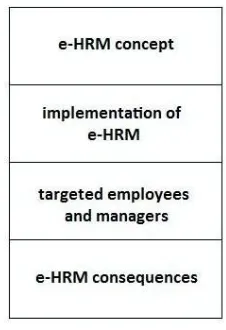
implementation phase. The third aspect involved is the targeted employees and managers. As advocated by Ruël et al. (2004) e-HRM is involved in multiple layers of disciplines in the organization. Hence research results (e.g., Lengnick-Hall and Moritz, 2003; Ruël et al., 2004) supports the suggestions of e-HRM benefits notable for multiple actors involved, consequently increasing the efficiency of the organization as a whole. Research regarding e-HRM should therefore not narrow their scope exclusively to the HR position but rather widen their scope to the HR staff, employees and managers involved. The fourth and final aspect concerns the e-HRM consequences which implies that one or more actors involved in the e-HRM process are willing to exchange money for the value received from e-HRM (Lepak, Smith and Taylor, 2007; Strohmeier, 2009). As a remark Lepak et al. (2007) note that the monetary fund’s exchanged must exceed the producer’s costs (e.g., time, training, effort, money, meetings dedicated to e-HRM projects) in order to be a significant consequence and to increase the likelihood of e-HRM becoming adopted and deployed. The four aspects identified by Bondarouk and Ruël (2009) are displayed in figure 2.
Figure 2 four aspects of e-HRM
2.2 e-HRM Angles
The four aspects identified to be part of e-HRM (Bondarouk and Ruël, 2009) can be used to observe the actual adoption and deployment of e-HRM by businesses. However this thesis is dedicated to the outcomes of e-HRM adoption and deployment and the assumed affect by country differences. Although Bondarouk and Ruël (2009) consider the consequences, they are directed to originators of change. The view of Bondarouk and Ruël (2009) is therefore quite a contrast with the definition of outcomes for this thesis. Rather this thesis assumes outcomes as observable and noticeable measures of change for e-HRM adoption and deployment. Moreover the four aspects mainly concern the actual adoption and deployment of e-HRM whereas this thesis regards the origins of the adoption and deployment of e-HRM i.e., the assumed country differences. Hence this thesis proposes four different angles for e-HRM which shall facilitate the recognition for the affect of country differences on the adoption and deployment outcomes for e-HRM. These four angles are
Figure 3 angles of e-HRM adoption and deployment process
The first angle, corporate governance, is assumed to provide a structure which enables identification of varieties in market mechanisms (Hall and Soskice, 2001). Hence the market mechanisms referred to are assumed to develop a mindset for the governance which potentially affects the adoption and deployment outcomes for e-HRM. The different stakeholders - involved in the business operating field - are operating from their own interests, directions, control, rights and responsibilities which could align or conflict with the interest, direction, right, control and responsibilities of other stakeholders in the business operating field. The market mechanism could identify the variety in structure through which the company’s objectives, interests, direction and control is achieved and monitored. In essence, the corporate governance is assumed to define relationships between a company’s management, its employees, shareholders and other stakeholders which could facilitate the recognition of country differences in market mechanism varieties.
The second angle (i.e., organizational force) involves the espousal of the HRM setting within the organization. Although it is the aim of this study to observe if country differences affect the e-HRM adoption and deployment outcomes, still it would be biased to omit closely related angles as organizational forces. The assumed balance or unsteadiness of interests, directions, rights, control and responsibilities of stakeholders in the business operating field, have to be developed to and fitted in a specific organizational force which defines among others the HRM philosophy and thereby likely to affect e-HRM adoption and deployment outcomes. Deriving from the corporate governance angle, the political economy variety and socio-cultural force can provide a preliminary indication for the importance of HRM in the business operating field. The specification of the angle organizational force is likely to provide a better insight in the different country approaches to HR e.g., the relative importance, direction, rights, control and responsibilities of HR per market mechanism variety. Hence the predictions - regarding the adoption and deployment outcomes for e-HRM - have more premises for a solid foundation framework for the e-HRM process.
angle is therefore incorporated in the framework and is assumed to provide observable and noticeable measures of change for e-HRM adoption and deployment outcomes.
In essence, the dimensions likely to be observed in the four angles identify the background of the e-HRM user and e-e-HRM direction, and could therefore indicate the possible outcomes for adoption, diffusion, misuse, employment of e-HRM, as indicated by numerous studies (e.g., Keebler and Rhodes, 2002; Ruta, 2005; Bell et al., 2006; Smale and Heikkilä, 2009). The dimensions of the angles are likely to predict the mechanism of an e-HRM framework and shall be studied onwards in the following paragraphs.
2.3 Corporate Governance
The former paragraph identified four angles which embody several dimensions likely to affect the adoption and deployment outcomes of e-HRM. Consequently this paragraph shall explore the corporate governance angle. Before heading on however the term corporate governance should be operationalized, enabling a direction to explore the dimensions for the corporate governance angle. The corporate governance is assumed to discontinue the exclusive concernment of HR and management for e-HRM but also - especially regarding country differences - concerns the other stakeholders (i.e., government, suppliers, customers, competitors, and so on) in the business operating field. In essence, the corporate governance’s philosophy concerning e-HRM adoption and deployment outcomes should be in accordance to the market mechanisms and thus enabling a fit between e-HRM adoption and deployment outcomes and the market mechanisms. Hence the corporate governance is expected to affect the design of the e-HRM adoption and deployment outcomes by means of values, norms and corporate mindsets which set boundaries of what direction, inclusions, exclusions and applications e-HRM should serve.
Additionally the following paragraphs frequently refer to “basic” and “advanced” e-HRM direction. In this context a “basic” e-HRM direction implies the support for routine day to day practices, mainly retrieved in the administrative area. HR practices referred to are collecting organizational employee information, payroll and personnel data administration. Contradictory an “advanced” e-HRM direction concerns the long-term decision making support for HR practices. This direction concerns the planning and forecasting of HR practices such as knowledge transfer, organizational change processes, strategic re-orientation of HRM, strategic competence management and HR planning (derived from Lepak and Snell, 1998; Lengnick-Hall and Moritz, 2003).
2.3.1 Political Economy Varieties
corporate goal alignment with e-HRM, aligning the mindset of the corporate strategy with e-HRM, and so on, thus likely to result in different adoption and deployment predictions for businesses regarding the e-HRM direction. Variables believed to affect the political economy variety are numerous (Hall and Soskice, 2001). Hence this thesis selects variables likely to result in observable and measurable variables, and in addition the variables selected are also ideal types of the spectrum. Selection around the ideal type of the spectrum facilitates the recognition and observation of the variables and thereby the indication of country differences. The variables selected are nature of economy and the social preferences for vocational training, educational systems and corporate governance (Hall and Soskice, 2001). The nature of economy is selected since this is the most likely factor which will identify country differences. According to recent findings of Estevez-Abe (2009), the differences between the natures of economy become more apparent and moreover the gap is increasing, between the outer sides of the natures of economy. The variable social preferences for vocational training, educational systems and corporate governance, is selected due to its resemblance for the HRM philosophy. Although it is recognized that vocational training and development is one of the many aspects of HR, still it does provide an adequate indication for the “system” of HRM practices (Gooderham, Nordhaug, and RIngdal (1999).
Hall and Soskice (2001) indicate two natures of economic systems liberal market economies
(henceforth referred to as LME)and coordinated market economies (henceforth referred to as CME).
long-term relationship. Hence CME’s are assumed to invest and emphasize heavily for the development of the employee skill level. Also the development of the employee skill level is expected to lead towards a competitive advantage for businesses e.g., the combination of firm-specific labor skills and industry-specific labor skills is not likely to be framed by competitors due to the unique employee skills (Hall and Soskice, 2001). Hence CME generally disregards the competitive advantage of an effective and efficient market mechanism for managing and regulating products, since this will increase competition, and thereby will disrupt the development of the employee skill level (Hall and Soskice, 2001). Hall and Soskice (2001) note that the two types of economic systems identified (i.e., CME and LME) are ideal types at the poles of a spectrum. In other words, there is a wide variety within the characteristics of CME’s and LME’s, hence only the characteristics are provided which could explain certain mechanisms within the corporate governance angle. An illustration of the small differences around the spectrum is for example, Germany who is assumed to prefer an industry-based coordination, while Japan is expected to favor a group-industry-based coordination. However according to Hall and Soskice (2001) both economies can be characterized as a coordinated market economy.
The social preference for vocational training of employees and educational systems is also assumed to affect the political economy variety (Hall and Soskice, 2001). Put bluntly, the vocational training and educational system for employees provides an indication for the investment in additional skills of human capital which relates to specific firm skills or industry skills. Although both natures of economy (i.e., LME and CME) are determined to invest in vocational training and educational system, the expectations for the realization of the development differ. As merely mentioned, LME’s tend to invest in assets whose value can be realized in the short-term. Moreover the assets invested in LME are preferred to realize her value if diverted to other purposes. Hence it is expected that businesses in LME formally evaluate the vocational training and educational system immediately or some months (i.e., short-term) after the training. The latter assumption is a preliminary indication of calculative HRM practices as identified by Gooderham et al. (1999). Gooderham et al (1999) distinguished two “systems” of HRM practices:
Calculative HRM practices concerns HRM practices which view employees as means in the achievement of goals. Hence calculative HRM practices emphasize on efficiency at the individual level by direct application and evaluation of individual appraisals and reward systems.
Collaborative HRM practices concerns HRM practices which regard employees as participants in the achievement of goals. Hence collaborative HRM practices emphasize on commitment, communication and partnership of the collective by communicating written and formal briefings, statements and mission of the business.
the individual level. Consequently businesses in LME are enabled to control the basic pay and other labor regulations at an efficient level which is suitable for the preferences of the business manager or CEO (Hall and Soskice, 2001). In CME a business tends to adopt national/industry-wide collective bargaining and is thereby spreading the “cost of control” for vocational training and the educational system. Hall and Soskice (2001) indicate that the preference for long-term development of the labor force skills, consequently results in a higher skill level which implies a higher level of labor costs, as a token of gratitude by the businesses for the investment of the employee in their skill level. The higher labor costs for businesses in CME are preferred to be arranged at a universalistic level, in order to ensure that the development of higher skills by businesses does not result in poaching of her employees by businesses which face low labor costs. Hence the business with low labor costs can free-ride from the investment by other businesses in the labor skills. In order to prevent the possible free-ride/poaching of employees, businesses in CME generally prefer arrangement of the basic pay and other labor regulations at a universalistic level (Hall and Soskice, 2001).
When considering the affect of the nature of economy and social preference for vocational training and educational systems, for the prediction of the HRM direction, it is assumed that a “basic” e-HRM direction focuses on the short-term e-HRM practices, which is expected to be more prevalent for businesses in LME, rather than long-term decision making support for HRM practices i.e., “advanced” e-HRM direction. Moreover the general favoring in LME for the evaluation of the labor skill development immediately after the training is not likely to facilitate the long-term decisions for HRM such as knowledge transfer and strategic re-orientation of HRM. An “advanced” e-HRM direction is more likely to be implemented by businesses located in CME, due to the presence of inter-corporate networks favoring relational contracting. Generally businesses in CME prefer a skilled workforce, and the businesses thereby regard employees as partners in the achievement of goals. Contradictory businesses in LME regard their employees as means for the goals achievement. The focus on long-term decision making support for HRM practices - i.e., “advanced” e-HRM direction - is more likely to be recognized and appreciated in an environment which is coordinated by collaborative relationships valuing and exchanging information in order to satisfy most of the directions, rights, responsibilities and control of the involved stakeholders. In essence, it is expected that “an “advanced” e-HRM direction has a greater likelihood to be adopted and deployed by a country characterized as CME, and thereby assumed to favor collaborative HRM practices”. Contradictory it is also expected that “a “basic” e-HRM direction has a greater likelihood to be adopted and deployed by a country characterized as LME, and thereby assumed to favor calculative HRM practices”.
2.3.2 Socio-Cultural Force
Many books and journals have researched and justified the view that socio-cultural variables as human capital, social capital and national culture can significantly affect the HRM setting (e.g., Hofstede, 1984; Ruta, 2005; Smale and Heikkilä, 2009). Derived from these findings, the socio-cultural force is expected to predict the attitude towards the e-HRM direction and the e-HRM adoption and deployment outcomes, since differences in the socio-cultural force are believed to result in different mindsets and emphasize regarding the HRM philosophy. Variables assumed to affect the socio-cultural force are human capital (Hall and Soskice, 2001), social capital (Redding and Witt, 2007) and national culture (Hofstede, 1984).
activity of the individuals i.e., employees (Hall and Soskice, 2001). Hence new profitable opportunities are better perceived by employees who are characterized as high human capital. Employees characterized by high capital subsequently are assumed to better deploy e-HRM and thereby overcome the illiteracy the employee potentially can have with e-HRM. Further the investment made in human capital can affect business choices in various ways (Davidsson and Honig, 2002). For example, over-investment potentially leading to high values for human capital could decrease the need for re-organizing the human capital in new innovative ways, such as e-HRM, while under-investment may persuade the process of e-HRM. Although the former predictions are a logic consequence from the understanding of human capital, the roots of human capital remain neglected by the former assumptions. The roots for the preference for a low or high value of human capital are still ambiguous. Hence characteristics as circumstances on the labor market and dedication to invest in human capital are - for the purpose of this thesis - more interesting to regard as the variables for human capital.
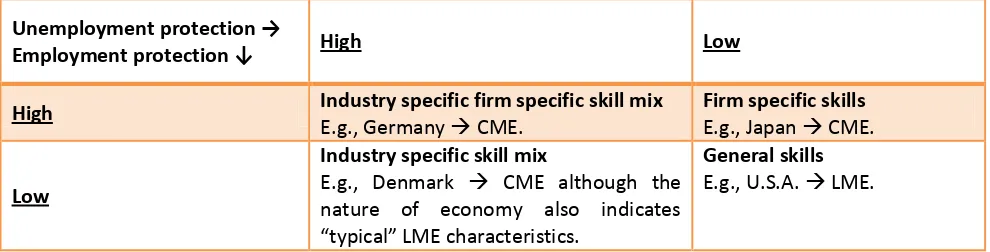
Unemployment protection Determines the speed of job rotation on the labor market i.e., is the employee willing to risk unemployment thus are the skills of the employee applicable in other businesses and is the employer looking for a stable or loose labor force relation.
Employment protection Determines the dedication to invest in firm specific skills by the employee/employer.
Unemployment protection →
Employment protection ↓ High Low
High Industry specific firm specific skill mix
E.g., Germany CME.
Firm specific skills E.g., Japan CME.
Low
Industry specific skill mix
E.g., Denmark CME although the nature of economy also indicates “typical” LME characteristics.
[image:24.595.65.560.160.286.2]General skills E.g., U.S.A. LME.
Figure 4 social protection and predicted skill profiles
The grouping of unemployment protection and employment protection is likely to determine the skill level of the human capital in a country or business as indicated in figure 4 (Estevez-Abe et al., 2001). For this thesis it is assumed that a business with a high employment protection is more likely to adopt and deploy an “advanced” e-HRM direction, due to the emphasis on the human capital and the willingness of employers and employees to invest in industry specific skills. Hence it is assumed that e-HRM could premise the protection of the skill level, and thereby reducing the speed of job rotation. E.g., redistribution of HR practices as a consequence from the adoption and deployment of an “advanced” e-HRM direction provides the employees with more responsibilities and knowledge of the HR practices. Hence dedication towards development of (firm-specific) skills is likely to be a premise - in the setting of high employment protection - for a successful adoption and deployment outcome of the “advanced” e-HRM direction. A business characterized by a low employment protection is assumed to provide less willingness to adopt an “advanced” e-HRM direction, since the business expects less willingness of employers and employees to invest in firm-specific skills. Hence it is expected that “employment protection will have a significant influence on the adoption and deployment outcome of an “advanced” e-HRM direction”.
in their stakeholders as a result of transactions, information exchange, obligations and threat of critique. Hence the trust should identify a better understanding of rationality to the organization’s capability of “catching up” to new developments such as e-HRM. Weak ties - i.e., loose relationships between individuals - could be useful in obtaining information that would otherwise be too costly to locate or unavailable (Burt, 2000). Hence “innovative business directions” are more likely to become nascent in the environment with weak ties, since the network of one is extended by linking individuals together and these linkages provide an interface for information exchange. Businesses are thus more likely to explore, learn and potentially implement innovative ways for HRM, such as e-HRM. Contradictory to the latter, an environment identified with relative strong ties - i.e., close relationships between individuals - is assumed to have a smaller likelihood of exploring, learning and potentially implementing new innovative ways for HRM such as e-HRM. As a result it is expected that “weak ties in the social capital indicate a greater likelihood for adoption and deployment of e-HRM”.
The national culture does have a wide array of definitions. Most of the definitions - regarding national culture - usually describe a shaping process, and is for the purpose of this thesis stated as
“members of a group or society that share a distinct way of life with common values, attitudes and behaviors that are transmitted over time in a gradual, yet dynamic, process” (Dowling et al., 1994). More explicit these members are - in the context of national culture - part of the same nationality and can be categorized in certain cultural dimensions (Hofstede, 1984). The work of Hofstede (1984) shall be used due to its explicitness in the outer scales for the dimensions identified. The journal by Hofstede (1984) explains national culture via five cultural dimensions:
Power distance index Extent to which less powerful members of the society accept and expect that power is distributed unequally among the cultural group.
Individualism/collectivism Degree to which individuals are integrated into the cultural group.
Masculinity/femininity Distribution of roles between genders in the cultural group e.g., masculinity refers to assertive and competitive characteristics whereas femininity refers to modest and caring characteristics.
Uncertainty avoidance index Society’s tolerance for uncertainty and ambiguity in unstructured situations.
Short-term orientation/long-term orientation Short-term orientation concerns values as respect for tradition, fulfilling social obligations and protecting one’s “face”, whereas long-term orientation refers to values as thrift and perseverance.
“advanced” e-HRM direction as indicated by Smale and Heikkilä (2009). However as Hofstede (2001) notes and thereby acknowledges some of the critiques on his study, national culture can and does gradually change. The change drivers for national culture are not (yet) widely acknowledged, and obviously are very difficult to tackle due to the many variables potentially interfering and biasing the relationship between change drivers and national culture (Harris, 2008). Hence national culture could obviously interfere and result in different adoption and deployment outcomes for e-HRM as the study of Smale and Heikkilä (2009) confirmed. However if the national culture is considered as unit of analysis for a study then units should be selected that vary along the spectrum of interest (i.e., five dimensions identified by Hofstede, 1984). Based upon the findings by Estevez-Abe (2009) - i.e., indicating that the gap between LME’s and CME’s increases - this thesis assumes that the political economy variety is more likely to be observed and thereby interfere with the e-HRM direction. Therefore the political economy variety shall be the spectrum of interest alongside the human and social capital. This thesis shall thus neglect the affect of national culture on the adoption and deployment outcome of e-HRM.
2.4 Organizational Force
The organizational force is, as the term indicates ,directed to the organizational setting of the business. Although the organizational setting is not related to country differences, still the dimensions of organizational force could provide a better insight in the adoption and deployment outcome for e-HRM. The size and sector of a business could for example, facilitate the exploration of differences between large and small organizations, as well as the different strategic directions of businesses and the strategic position of HR in the organization. These organizational dimensions are thus expected to facilitate the understanding of the e-HRM process. Hence as predicted by several journals (e.g., Ruël et al., 2004; Strohmeier, 2007; Strohmeier and Kabst, 2009), the organizational force is capable of affecting the adoption and deployment outcomes of e-HRM. Moreover the expectations - regarding the adoption and deployment outcomes for e-HRM - have more premises for a solid foundation framework of the e-HRM process. This paragraph shall provide a more in-depth explanation for the dimensions of the organizational force.
2.4.1 Size of Organization
expected that “large organizations have a greater likelihood for adoption and deployment of e-HRM then smaller organizations”.
2.4.2 Industry Type
Panayotopoulou et al. (2007) discovered that adoption and deployment outcomes for e-HRM differ by primary industry type. Hence the study by Panayotopoulou et al. (2007) indicates that specific industry characteristics can affect the outcome of adoption and deployment, the user expectations, and the user experience for e-HRM. E.g., technology intensive industries are more likely to adopt and deploy an “advanced” e-HRM direction - i.e., the long-term planning and forecasting of HR practices such as knowledge transfer - due to the factor that e-HRM is viewed as a representative image of new technology, which is identified to be important in technology intensive industries (Galanaki, 2002). Businesses in for example, the high-tech manufacturing industry are keen to show early adoption of new technology due to the fear of staying behind, which is “a mismatch” with their image. Also sectors identified to collectively start early technology adoption, consequently introduce a new way of working which facilitated the employee’s attitudes toward e-HRM adoption and deployment (Panayotopoulou et al., 2007). In essence, the type of primary industry is likely to indicate the facilitating factor for adoption and deployment of e-HRM. Hence it is expected that “technology intensive industries as high-tech manufacturing provide a greater likelihood for the adoption and deployment of e-HRM”.
2.4.3 Strategic Direction
The dimension strategic direction is capable of demonstrating a linkage between the strategic business direction and HRM philosophy (Jackson, Schuler and Rivero, 1989). Jackson et al. (1989) indentified that for example, a business adopting a differentiation strategy made their labor force more affianced in risk taking, and thereby had a higher likelihood of adopting a long-term focus. The behavior adopted and deployed by the business is believed to be supportive towards innovation, consequently the HRM philosophy is likely to be aligned with the expected business profile regarding the adoption and deployment of a differentiation strategy. E.g., in the recruitment stage a business seeks for risk taking applicants and labor skills training is mainly focused around long-term topics. The findings of Jackson et al. (1989) still find support in recent studies regarding e-HRM adoption and deployment outcomes (e.g., Thompson, Teo and Sherin, 2007; Smale and Heikkilä, 2009). Hence the strategic direction could serve as indicator for the adoption and deployment outcome of e-HRM.
Quality Innovation Alliances Services CostReduction
Tight quality control. Ensuring high
quality production. Making products for
high price markets. Warranties and
guarantees.
New product development. Product R&D.
State-of-the-art products. Continual
updating of products.
Exchange of technologies with other firms. Product or
process development with other firms. Integration with
suppliers. Integration with
retailers.
Excellent customer service.
Prompt delivery. Catering to market
niches.
Amassing special data on clients. Customizing
products for users. Having a broad
selection of products. Strategic procurement of supplies. Reducing production/ operating costs. Just-in-time manufacturing. Efficient inventory
management. Hone operating
[image:28.595.67.549.72.224.2]efficiency.
Figure 5 variables per strategic direction
2.4.4 Role of HR
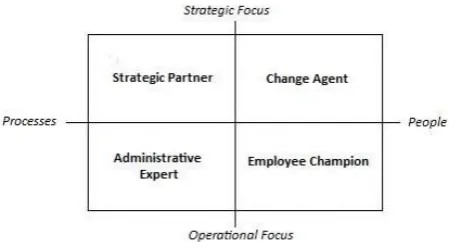
The dimension role of HR identifies the importance of HR staff in execution and implementation of HR processes and practices within the operational business field (derived from Dowling et al., 1994; Ulrich, 1997; Caldwell, 2003; Harris, 2008). Ulrich (1997) acknowledged four roles for HR staff along two axes (i.e., strategic/operational focus and processes/people orientated), administrative expert, change agent, employee champion and strategic partner. The framework by Ulrich (1997) is displayed in figure 6. There exist some criticism on the work of Ulrich (1997) which advocate that e.g., the typology is prescriptive, not empirically proven, based exclusively on U.S.A. experience of HR staff, and that the framework does not address the role conflict of the HR roles (Caldwell, 2003). Still this thesis prefers the framework of Ulrich (1997) over Caldwell’s (2003), since Ulrich (1997) takes the role of HR as “change manager” into account. Hence indicating and recognizing the HR department as adapters of new ways for HRM. Caldwell’s (2003) framework does not incorporate the possible HR role of change manager. Since e-HRM is assumed to be complex in the “basic” and “advanced” direction i.e., dealing with both information technologies and HR practices, change management is assumed to be a necessity in order to convince, encourage and entrust the employees and managers with e-HRM. Essentially HR managers are assumed to have the potential to develop the capabilities for change of HR staff, employees and managers in order to adopt and deploy e-HRM (derived from Hayes, 2007). Hence it is argued that the recognition for the role of change management is important to the HR manager, therefore the framework of Ulrich (1997) is preferred.
[image:28.595.186.412.580.701.2]The roles identified by Ulrich (1997) shall be explained in more detail:
Administrative expert Traditional role of HR, which implies responsibility of HR for the efficiency of their own function as well as the entire organization. The HR staff is primarily participating in administering HR practices (e.g., payroll).
Employee champion This role is considered to keep employees of the business committed to the organization. The HR staff is assumed to be responsible for the engagement of employees within the organization, help the employees to meet the demands placed on them, represent the ideas and mindsets of employees in management discussions, and offer opportunities for growth.
Change agent HR is responsible for building the organizations capacity to change towards new HRM ways (e.g., e-HRM), and thereby take away any resistance and fear in this change.
Strategic partner Combination of the former three roles, and aligns HR practices with strategic management.
The HR roles identified could be related to the e-HRM adoption and deployment outcomes. However before interlocking the two concepts (i.e., e-HRM adoption and deployment outcomes and HR roles), it should be reminisced that the HR roles identified by Ulrich (1997) are the ideal spectrum of the axes. The HR staff is more likely to be typified in between the four roles thus combining characteristics of multiple HR roles. Nevertheless the recognition of HR as “change agent” and/or “strategic partner” is more likely to indicate the adoption and deployment of an “advanced” e-HRM direction i.e., the long-term planning and forecasting of HR practices (derived from Ulrich, 1997; Lepak and Snell, 1998; Lengnick-Hall and Moritz, 2003). As displayed in figure 6, the roles “change agent” and “strategic partner” indicate a more strategic focus instead of the operational focus. Roles exclusively operating at an operational focus are more likely to adopt and deploy a “basic” e-HRM direction i.e., the support for routine day to day practices, mainly retrieved in the administrative area (derived from Ulrich, 1997; Lepak and Snell, 1998; Lengnick-Hall and Moritz, 2003). Hence it is expected that “strategic focus of HR staff increases the likelihood for adoption and deployment outcome of an “advanced” e-HRM direction”. Additionally this thesis also expects that “operational focus of HR staff increases the likelihood for adoption and deployment outcome of a “basic” e-HRM direction”.
2.5 e-HRM technology
The angles corporate governance and organizational force - explored in paragraphs 2.3 and 2.4 - have developed a mindset towards potential e-HRM adoption and deployment outcomes. In essence, the preferences, expectations and settings provided a preliminary direction for e-HRM and these directions have been identified on a general angle (i.e., corporate governance) and a more specific angle (i.e., organizational force). The actual bundling of the preferences, expectations and settings is assumed - for the purpose of this thesis - to take place in the angle HRM technology. The angle e-HRM technology shall present dimensions regarding the actual implementation design of e-e-HRM. Hence this thesis is enabled to identify the direction and expectations of e-HRM in more depth. This paragraph shall therefore provide insights in the e-HRM technology angle.
2.5.1 e-HRM Goals