LTG at SemEval-2016 Task 11: Complex Word Identification with Classifier
Ensembles
Shervin Malmasi1 Mark Dras1 Marcos Zampieri2,3 1Macquarie University, Sydney, NSW, Australia
2Saarland University, Germany
3German Research Center for Artificial Intelligence, Germany
{first.last}@mq.edu.au, [email protected]
Abstract
We present the description of the LTG entry in the SemEval-2016 Complex Word Identi-fication (CWI) task, which aimed to develop systems for identifying complex words in En-glish sentences. Our entry focused on the use of contextual language model features and the application of ensemble classification meth-ods. Both of our systems achieved good per-formance, ranking in 2nd and 3rdplace overall
in terms of F-Score.
1 Introduction
Complex Word Identification (CWI) is the task of identifying complex words in texts using computa-tional methods (Shardlow, 2013). The task is usu-ally carried out as part of lexical and text simpli-fication systems. Shardlow (2014) considers CWI as the first processing step in lexical simplification pipelines. Complex or difficult words should first be identified so they can be later substituted by simpler ones to improve text readability.
CWI has gained more importance in the last decade as lexical and text simplification systems have been developed or tailored for a number of pur-poses. They have been applied to make texts more accessible to language learners (Petersen and Os-tendorf, 2007); other researchers have explored text simplification strategies targeted at populations with low literacy skills (Alu´ısio et al., 2008). Finally, an-other relevant application of text simplification are people with dyslexia (Rello et al., 2013).
The SemEval 2016 Task 11: Complex Word Iden-tification (CWI) provides an interesting opportunity
to evaluate methods and approaches for this task. The organizers proposed a binary text classification task in which participants were required label words
in English sentences as either complex (1) or simple
(0). The task organizers provided participants with a
training set containing sentences annotated with this information, followed by an unlabeled test set for evaluation. The assessment of whether words in a sentence are complex or simple was performed by
human annotators required to label the data.1
2 Data
Based on the information available at the shared
task’s website2: “400 annotators were presented
with several sentences and asked to select which words they did not understand their meaning.”
The CWI task dataset was divided as follows:
• Training set: 2,237 judgments by 20 annota-tors over 200 sentences. A word is considered complex if at least one of the 20 annotators as-signed it as so.
• Test set: 88,221 judgments made over 9,000 sentences (1 annotator per sentence).
1Here the termcomplexis used as a synonym for difficult. Unlike the Morphology term complex (antonym of simplex) that defines compound words or words composed of multiple morphs (Adams, 2001).
2http://alt.qcri.org/semeval2016/task11/
3 Methodology
The primary focus of our team’s entry was the use of judgements from different annotators to create train-ing data. We looked at how adjusttrain-ing the thresh-old for inter-annotator agreement would affect the results and whether the combination of data created using different threshold values could improve per-formance.
Initially, the training data released by the organiz-ers was labeled in a way that a word was marked as complex if any annotator judged it so. During the course of the shared task the organizers released ad-ditional information about the training data, chiefly the individual judgements of the 20 annotators that were used to derive the final labels for each word.
We attempted to use this data in our system. Dur-ing development we noted that by increasDur-ing this threshold to two, the performance of our system un-der cross-validation improved by a small amount. Accordingly, we pursued this direction as the main focus of our experiments.
3.1 Classifiers
We utilize a decision tree classifier, which we found to perform better than Support Vector Machine (SVM) and Na¨ıve Bayes classifiers for this data.
3.2 Features
Our core set of features are based on estimatingn
-gram probabilities using web-scale language mod-els. More specifically, this data was sourced from
the Microsoft Web N-Gram Service3, although we
should note that this service has been deprecated
and replaced since the shared task.4 These language
models are trained on web-scale corpora collected by Microsoft’s Bing search engine from crawling English web pages.
Given a target word wt, we extract several
prob-ability estimates to use as classification features. These estimates, which we describe below, use the target word as well its preceding and following words, as shown in Figure 1.
3http://weblm.research.microsoft.com/ 4It has been replaced by Microsoft’s Project Oxford:
https://www.projectoxford.ai/weblm
3.2.1 Word Probability
This is an estimate of how likely the target word is to occur in the language model:
P(wt)
Rarer words would be assigned lower values and thus this feature can help quantify word frequency for the classifier.
3.2.2 Conditional Probability
We calculate the bigram probability ofwt:
P(wt|wt−1)
Similarly, we estimate the trigram probability:
P(wt|wt−1, wt−2)
These values estimate the likelihood of the target word occurring given the previous one or two words. They can help quantify if the word is being used in a common or less frequent context.
3.2.3 Joint Probability
We also use the following joint probability esti-mates of the target word and its surrounding words:
P(wt−1, wt−2, wt)
P(wt−1, wt)
P(wt−1, wt, wt+1)
P(wt, wt+1)
P(wt, wt+1, wt+2)
The intuition underlying the use of all of these
n-gram language model features is that the
This cavity is formed by the mantle skirt , a double fold of mantle which [...]
the mantle skirt a double
[image:3.612.206.398.85.143.2]𝑤𝑤𝑡𝑡−2 𝑤𝑤𝑡𝑡−1 𝑤𝑤𝑡𝑡 𝑤𝑤𝑡𝑡+1 𝑤𝑤𝑡𝑡+2
Figure 1:An example of the context extracted for a target word, which is “skirt” in this example.
3.2.4 Word Length
Guided by the intuition that the most frequent words in a language are usually shorter, we use the length of a word as a classification feature.
4 Ensemble Classifiers
Classifier ensembles are a way of combining differ-ent classifiers or experts with the goal of improving accuracy through enhanced decision making. They have been applied to a wide range of real-world problems and shown to achieve better results com-pared to single-classifier methods (Oza and Tumer, 2008). Through aggregating the outputs of multi-ple classifiers in some way, their outputs are gener-ally considered to be more robust. Ensemble meth-ods continue to receive increasing attention from researchers and remain a focus of much machine learning research (Wo´zniak et al., 2014; Kuncheva and Rodr´ıguez, 2014).
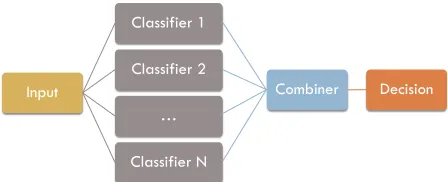
Such ensemble-based systems often use a paral-lel architecture, as illustrated in Figure 2, where the classifiers are run independently and their outputs are aggregated using a fusion method. For
exam-ple,Bagging(bootstrap aggregating) is a commonly
used method for ensemble generation (Breiman, 1996) that can create multiple base classifiers.
Input
Classifier 1
Classifier 2
Combiner Decision …
Classifier N
Ensemble Architecture
[image:3.612.73.297.566.657.2]2
Figure 2:An example of parallel classifier ensemble architec-ture whereNindependent classifiers provide predictions which are then fused using an ensemble combination method.
It works by creating multiple bootstrap training sets from the original training data and a separate classifier is trained from each one of these sets. The generated classifiers are said to be diverse because each training set is created by sampling with re-placement and contains a random subset of the orig-inal data.
Other, more sophisticated, ensemble methods that rely on meta-learning may employ a stacked archi-tecture where the output from a first set of classifiers is fed into a second level meta-classifier and so on.
The first part of creating an ensemble is generat-ing the individual classifiers. Various methods for creating these ensemble elements have been pro-posed. These involve using different algorithms, pa-rameters or feature types; applying different
prepro-cessing or feature scaling methods and varying (e.g.
distorting or resampling) the training data.
5 Systems
In this section we describe the two systems we cre-ated and entered in the shared task.
5.1 System 1
Our first system was based on decision tree classi-fier trained on data where the minimum threshold for
inter-annotator agreement was set to 3. Given that
the testing data was only annotated by a single rater, we did not want to pick a value that was too high, even though this could improve cross-validation per-formance on the training data.
Additionally, we converted this setup to an
en-semble by creating 100 randomized decision tree
Rank Team System Accuracy Precision Recall F-score G-score
1 PLUJAGH SEWDFF 0.922 0.289 0.453 0.353 0.608 2 LTG System2 0.889 0.220 0.541 0.312 0.672 3 LTG System1 0.933 0.300 0.321 0.310 0.478
4 MAZA B 0.912 0.243 0.420 0.308 0.575
5 HMC DecisionTree25 0.846 0.189 0.698 0.298 0.765 6 TALN RandomForest SIM.output 0.847 0.186 0.673 0.292 0.750 7 HMC RegressionTree05 0.838 0.182 0.705 0.290 0.766 8 MACSAAR RFC 0.825 0.168 0.694 0.270 0.754 9 TALN RandomForest WEI.output 0.812 0.164 0.736 0.268 0.772
[image:4.612.94.517.58.193.2]10 UWB All 0.803 0.157 0.734 0.258 0.767
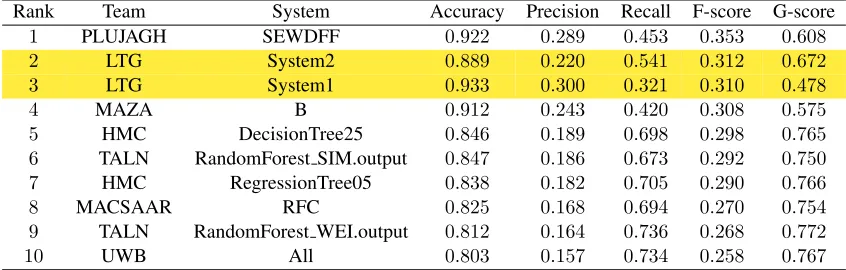
Table 1:The top 10 systems in task, ranked by their F-score.
5.2 System 2
For our second system we extended the threshold-based approach to an ensemble of decision trees trained on different data.
We created four individual classifiers, each
trained with a different minimum threshold5
rang-ing between1–4. The outputs of these classifiers, a
binary prediction, were then combined using a plu-rality voting combiner. It should also be noted that having an even number of base classifiers also intro-duces the possibility of ties occurring.
6 Results
The top10task submissions, ranked by the F-score,
are shown in Table 1 with our systems highlighted. Both of our systems achieved very competitive re-sults, ranking in second and third place overall.
Our second system, an ensemble of classifiers trained on distinct data derived using different lev-els of inter-rater agreement, performed slightly bet-ter than the first system. This could be inbet-terpreted as this evidence the second approach is slightly better, and we hypothesize that combining annota-tions from different combinaannota-tions of annotators may help the classifier learn reliable models of the phe-nomenon, since individual annotations (as well as the original combined annotation) were noisy. How-ever, determining this requires further experiments. This is due to the fact that with four classifiers in the
ensemble, voting resulted in a tie for some6%of the
testing data. These ties were broken arbitrarily, in-troducing an element of stochasticity to our results.
In hindsight this does not appear to have been the 5Setting the threshold to1is equivalent to using the original training data.
most intuitive or robust way of dealing with such ties since the distribution of classes is not balanced. In fact, this distribution is highly skewed, as we discuss in the next section.
6.1 Conclusion
We developed two ensemble-based systems for this task, both of which achieved competitive results in the final rankings. Our results indicate that the use of contextual features, as well as language models, are promising for this task.
Analysis of the gold standard labels release
af-ter the task shows that only4.7% of the 88k
sam-ples belonged to the positive class. This is a very highly skewed distribution that can make it hard to train effective classifiers. It also means that accuracy cannot be used as the sole evaluation metric here; a balanced measure of precision and recall like the F-score is required. Alternatively, the balanced accu-racy measure (Brodersen et al., 2010) could also be used. Such a high data imbalance can result in train-ing classifiers that are biased towards the majority class. This bias can be more problematic if the distri-bution of classes is different in the test set. Accord-ingly, future work in this area could look at the use of methods for dealing with unbalanced datasets (He and Garcia, 2009). The application of such methods, in conjunction with ensembles, could potentially re-sult in greater performance.
Acknowledgments
We would like to thank the CWI task organizers for managing the organization of this event. We also thank the anonymous reviewers for their insightful comments.
References
Valerie Adams. 2001. Complex words in English. Rout-ledge.
Sandra M Alu´ısio, Lucia Specia, Thiago AS Pardo, Er-ick G Maziero, and Renata PM Fortes. 2008. Towards brazilian portuguese automatic text simplification sys-tems. InProceedings of DocEng.
Leo Breiman. 1996. Bagging predictors. InMachine Learning, pages 123–140.
Kay H Brodersen, Cheng Soon Ong, Klaas E Stephan, and Joachim M Buhmann. 2010. The balanced accu-racy and its posterior distribution. In Proceedings of ICPR.
Haibo He and Edwardo A Garcia. 2009. Learning from Imbalanced Data. IEEE Transactions on Knowledge and Data Engineering,, 21(9):1263–1284.
Ludmila I Kuncheva and Juan J Rodr´ıguez. 2014. A weighted voting framework for classifiers ensembles.
Knowledge and Information Systems, 38(2):259–275. Shervin Malmasi and Mark Dras. 2014. Chinese Native
Language Identification. InProceedings of EACL. Shervin Malmasi and Mark Dras. 2015. Multilingual
Native Language Identification. InNatural Language Engineering.
Nikunj C Oza and Kagan Tumer. 2008. Classifier en-sembles: Select real-world applications. Information Fusion, 9(1):4–20.
Sarah E Petersen and Mari Ostendorf. 2007. Text sim-plification for language learners: a corpus analysis. In
Proceedings of SLaTE.
Luz Rello, Ricardo Baeza-Yates, Stefan Bott, and Hora-cio Saggion. 2013. Simplify or help?: text simplifi-cation strategies for people with dyslexia. In Proceed-ings of W4A.
Matthew Shardlow. 2013. A comparison of techniques to automatically identify complex words. InProceedings of the ACL Student Research Workshop.
Matthew Shardlow. 2014. A survey of automated text simplification. International Journal of Advanced Computer Science and Applications (IJACSA), (Spe-cial Issue on Natural Language Processing).