Learning to predict script events from domain-specific text
Rachel Rudinger1, Vera Demberg3, Ashutosh Modi3,Benjamin Van Durme1,2,Manfred Pinkal3 Center for Language and Speech Processing1 Human Language Technology Center of Excellence2
Johns Hopkins University, Baltimore, MD USA MMCI Cluster of Excellence3
Saarland University, Saarbr¨ucken, Germany
[email protected], {vera,pinkal}@coli.uni-saarland.de, [email protected], [email protected]
Abstract
The automatic induction of scripts (Schank and Abelson, 1977) has been the focus of many recent works. In this paper, we employ a variety of these methods to learn Schank and Abelson’s canonicalrestaurant script, us-ing a novel dataset of restaurant narratives we have compiled from a website called “Din-ners from Hell.” Our models learnnarrative chains, script-like structures that we evaluate with the “narrative cloze” task (Chambers and Jurafsky, 2008).
1 Introduction
A well-known theory from the intersection of psy-chology and artificial intelligence posits that humans organize certain kinds of general knowledge in the form of scripts, or common sequences of events (Schank and Abelson, 1977). Though many early AI systems employed hand-encoded scripts, more re-cent work has attempted to induce scripts with auto-matic and scalable techniques. In particular, several related techniques approach the problem of script in-duction as one of learningnarrative chainsfrom text corpora (Chambers and Jurafsky, 2008; Chambers and Jurafsky, 2009; Jans et al., 2012; Pichotta and Mooney, 2014). These statistical approaches have focused on open-domain script acquisition, in which a large number of scripts may be learned, but the ac-quisition of any particular set of scripts is not guar-anteed. For many specialized applications, however, knowledge of a few relevant scripts may be more useful than knowledge of many irrelevant scripts. With this scenario in mind, we attempt to learn
the famous “restaurant script” (Schank and Abel-son, 1977) by applying the aforementioned narrative chain learning methods to a specialized corpus of dinner narratives we compile from the website “Din-ners from Hell.” Our results suggest that applying these techniques to a domain-specific dataset may be reasonable way to learn domain-specific scripts.
2 Background
Previous work in the automatic induction of scripts or script-like structures has taken a number of dif-ferent approaches. Regneri et al. (2010) attempt to learn the structure of specific scripts by eliciting event sequence descriptions (ESDs) from humans to which they apply multiple sequence alignment (MSA) to yield one global structure per script. (Orr et al. (2014) learn similar structures in a probabilis-tic framework with Hidden Markov Models.) Al-though Regneri et al. (2010), like us, are concerned with learning pre-specified scripts, our approach is different in that we apply unsupervised techniques to scenario-specific collections of natural, pre-existing texts.
Note that while the applicability of our approach to script learning may appear limited to domains for which a corpus conveniently already exists, pre-vious work demonstrates the feasibility of assem-bling such a corpus by automatically retrieving rel-evant documents from a larger collection. For ex-ample, Chambers and Jurafsky (2011) use informa-tion retrieval techniques to gather a small number of bombing-related documents from the Gigaword cor-pus, which they successfully use to learn a MUC-style (Sundheim, 1991) information extraction
plate for bombing events.
Following the work of Church and Hanks (1990) in learning word associations via mutual informa-tion, and the DIRT system introduced by Lin and Pantel (2001), Chambers and Jurafsky (2008) pro-pose a PMI-based system for learning script-like structures callednarrative chains. Several follow-up papers introduce variations and improvements on this original model for learning narrative chains (Chambers and Jurafsky, 2009; Jans et al., 2012; Pi-chotta and Mooney, 2014). It is from this body of work that we borrow techniques to apply to the Din-ners from Hell dataset.
As defined by Chambers and Jurafsky (2008), a narrative chain is “a partially ordered set of narrative events that share a common actor,” where anarrative eventis “a tuple of an event (most simply a verb) and its participants, represented as typed dependencies.” To learn narrative chains from text, Chambers and Jurafsky extract chains of narrative events linked by a common coreferent within a document. For exam-ple, the sentence “John drove to the store where he bought some ice cream.” would generate two nar-rative events corresponding to the protagonist John: (DRIVE,nsubj) followed by (BUY,nsubj). Over these extracted chains of narrative events, pointwise mutual information (PMI) is computed between all pairs of events. These PMI scores are then used to predict missing events from such chains, i.e. the nar-rative clozeevaluation.
Jans et al. (2012) expand on this approach, intro-ducing an ordered PMI model, a bigram probabil-ity model, skip n-gram counting methods, corefer-ence chain selection, and an alternative scoring met-ric (recall at 50). Their bigram probability model outperforms the original PMI model on the narra-tive cloze task under many conditions. Pichotta and Mooney (2014) introduce an extended notion of nar-rative event that includes information about subjects and objects. They also introduce a competitive “un-igram model” as a baseline for the narrative cloze task.
To learn the restaurant script from our dataset, we implement the models of Chambers and Juraf-sky (2008) and Jans et al. (2012), as well as the unigram baseline of Pichotta and Mooney (2014). To evaluate our success in learning the restaurant script, we perform a modified version of the
nar-rative cloze task, predicting only verbs that we an-notate as “restaurant script-relevant” and comparing the performance of each model. Note that these an-notations are not used for training.
3 Methods
This section provides an overview of each of the dif-ferent methods and parameter settings we employ to learn narrative chains from the Dinners from Hell corpus, starting with the original model (Chambers and Jurafsky, 2008) and extending to the modifica-tions of Jans et al. (2012). As part of this work, we are releasing a program called NaChos, our inte-grated Python implementation of each of the meth-ods for learning narrative chains described in this section.1
3.1 Counting methods for PMI
Formally, a narrative event, e := (v, d), is a verb, v, paired with a typed dependency (De Marneffe et al., 2006), d, defining the role a “protagonist” (coreference mention) plays in an event (verb). The main computational component of learning narrative chains in Chambers and Jurafsky’s model is to learn the pointwise mutual information for any pair of nar-rative events:
pmi(e1, e2) := logC(eC(e1, e2)
1,∗)C(∗, e2) (1)
whereC(e1, e2)is the number of times that narrative
eventse1ande2“co-occur” and
C(e,∗) :=X
e0
C(e, e0) (2)
Chambers and Jurafsky define C(e1, e2) as “the
number of times the two eventse1ande2had a
core-ferring entity filling the values of the dependencies d1 and d2.” This is a symmetric value with respect
toe1ande2.
We implement the following counting variants: Skip N-gram By default, C(e1, e2) is
incre-mented ife1ande2occur anywhere within the same
chain of events derived from a single coreference chain (skip-all); we also implement an option to re-strict the distance betweene1 and e2 to 0 though 5
intervening events (skip-0throughskip-5). (Jans et al., 2012)
Coreference Chain Length The original model counts co-occurrences inallcoreference chains; we include Jans et al. (2012)’s option to count over only the longest chains in each document, or to count only over chains of length 5 or greater (long). Count Threshold Because PMI favors low-count events, we add an option to setC(e1, e2)to zero for
anye1,e2for whichC(e1, e2)is below some
thresh-old,T, up to 5.
3.2 Predictive Models for Narrative Cloze In order to perform the narrative cloze task, we need a model for predicting the missing narrative event,e, from a chain of observed narrative events,e1. . . en,
at insertion pointk. The original model, proposed by Chambers and Jurafsky (2008), predicts the event that maximizesunordered pmi,
ˆ
e= arg max
e∈V n
X
i=1
pmi(e, ei) (3)
whereV is the set of all observed events (the vo-cabulary) and C(e1, e2) is symmetric. Two
addi-tional models are introduced by Jans et al. (2012) and we use them here, as well. First, theordered pmimodel,
ˆ
e= arg max
e∈V k
X
i=1
pmi(ei, e) + n
X
i=k+1
pmi(e, ei)
(4) where C(e1, e2) is asymmetric, i.e., C(e1, e2)
counts only cases in whiche1occursbeforee2.
Sec-ond, thebigram probabilitymodel:
ˆ
e= arg max
e∈V k
Y
i=1 p(e|ei)
n
Y
i=k+1
p(ei|e) (5)
wherep(e2|e1) = CC((ee11,e,∗)2) and C(e1, e2) is
asym-metric.
Discounting For each model, we add an option for discounting the computed scores. In the case of the two PMI-based models, we use the discount score described in Pantel and Ravichandran (2004) and used by Chambers and Jurafsky (2008). For the bigram probability model, this PMI discount score would be inappropriate, so we instead use absolute discounting.
Document Threshold We include a document threshold parameter,D, that ensures that, in any nar-rative cloze test, any eventethat was observed dur-ing traindur-ing in fewer thanDdistinct documents will receive a worse score (i.e. be ranked behind) any evente0whose count meets the document threshold.
4 Dataset: Dinners From Hell
The source of our data for this experiment is a blog called “Dinners From Hell”2 where readers submit
stories about their terrible restaurant experiences. For an example story, see Figure 1. To process the raw data, we stripped all HTML and other non-story content from each file and processed the remain-ing text with the Stanford CoreNLP pipeline version 3.3.1 (Manning et al., 2014). Of the 237 stories ob-tained, we manually filtered out 94 stories that were “off-topic” (e.g., letters to the webmaster, dinners not at restaurants), leaving a total of 143 stories. The average story length is 352 words.
4.1 Annotation
For the purposes of evaluation only, we hired four undergraduates to annotate every non-copular verb in each story as either corresponding to an event “related to the experience of eating in a restaurant” (e.g.,ordered a steak), “unrelated to the experience of eating in a restaurant” (e.g.,answeredthe phone), or uncertain. We used the WebAnno platform for annotation (Yimam et al., 2013).
A total of 8,202 verb (tokens) were annotated, each by three annotators. 70.3% of verbs anno-tated achieved 3-way agreement; 99.4% had at least 2-way agreement. After merging the annotations (simple majority vote), 30.7% of verbs were labeled as restaurant-script-related, 68.6% were labeled as restaurant-script-unrelated, and the remaining 0.7% as uncertain.
Corresponding to the 8,202 annotated verb to-kens, there are 1,481 narrative events at the type level. 580 of these narrative event types were anno-tated as script-relevant in at least one token instance.
“A long time ago when I was still in college, my family decided to take me out for pizza on my birthday. We
decided to try the new location for a favorite pizza chain of ours. It was all adults and there were about 8 of us, so weordered3 large pizzas. Wegotto chatting and soon realized that the pizzas should’ve been ready quite a bit ago, so wecalledthe waitress over and she went to check on our pizzas. She did not come back. Wewaitedabout another 10 minutes, then called over another waitress, who went to check on our pizzas and waitress. It now been over an hour. About 10 minutes later, my Dad goes up to the check-out and asks the girl there to send the manager to our table. A few minutes later the manager comes out. He explainsto us that our pizzas got stuck in the oven and burned. They were out of large pizza dough bread, so they were making us 6 medium pizzas for the price of 3 large pizzas. We
had so many [pizzas] on our table we barely had
[room] to eat! Luckily my family is pretty easy going so we justlaughedabout the whole thing. We didtell
[image:4.612.316.535.56.218.2]the manager that it would have been nice if someone, anyone, hadsaid something earlier to us, instead of just disappearing, and he agreed. He even said it was his responsibility, but that he had been busy trying to fix what caused the pizzas to jam up in the oven. He went so far as to giveus 1/2 off our bill, which was really nice. It was definitely a memorable birthday!”
Figure 1: Example story from Dinners from Hell corpus. Bold words indicate events in the “we” coreference chain (the longest chain). Boxed words (blue) indicate best narrative chain of length three (see Section 5.2); underlined words (orange) are corresponding subjects and bracketed words (green) are corre-sponding objects.
5 Evaluation
5.1 Narrative Cloze
We evaluate the various models on the narrative cloze task. What is different about our version of the narrative cloze task here is that we limit the cloze tests to only “interesting” events, i.e., those that have been identified as relevant to the restaurant script by our annotators (see Section 4.1).
Because our dataset is small (143 documents), we perform leave-one-out testing at the document level, training on 133 folds total. (Ten documents are ex-cluded for a development set.) For each fold of train-ing, we extract all of the narrative chains (mapped directly from coreference chains) in the held out test document. For each test chain, we generate one nar-rative cloze test per “script-relevant” event in that
MODEL AVGRNK MRR R@50
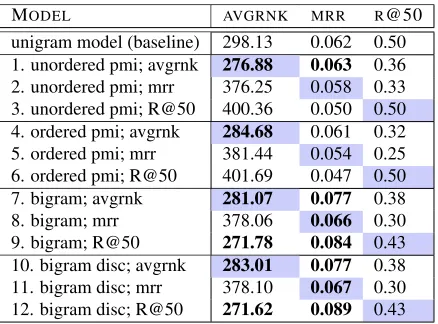
unigram model (baseline) 298.13 0.062 0.50 1. unordered pmi; avgrnk 276.88 0.063 0.36 2. unordered pmi; mrr 376.25 0.058 0.33 3. unordered pmi; R@50 400.36 0.050 0.50 4. ordered pmi; avgrnk 284.68 0.061 0.32 5. ordered pmi; mrr 381.44 0.054 0.25 6. ordered pmi; R@50 401.69 0.047 0.50 7. bigram; avgrnk 281.07 0.077 0.38 8. bigram; mrr 378.06 0.066 0.30 9. bigram; R@50 271.78 0.084 0.43 10. bigram disc; avgrnk 283.01 0.077 0.38 11. bigram disc; mrr 378.10 0.067 0.30 12. bigram disc; R@50 271.62 0.089 0.43
Figure 2: Narrative cloze evaluation. Shaded blue cells indi-cate which scoring metric that row’s parameter settings have been optimized to. Bold numbers indicate a result that beats the baseline. Row 12 representes the best model performance overall.
ROW SKIP T D COREF PMI DISC ABS DISC
1 0 1 3 all yes N/A
2 1 3 5 long no N/A
3 1 5 4 longest yes N/A
4 0 1 3 all yes N/A
5 3 5 5 long no N/A
6 0 3 4 longest yes N/A
7 all 1 3 all N/A no
8 3 5 5 long N/A no
9 all 1 5 all N/A no
10 all 1 3 all N/A yes
11 3 5 5 long N/A yes
12 all 1 5 all N/A yes
Figure 3: Parameter settings corresponding to each model in Fig 2.
chain. For example, if a chain contains ten events, three of which are “script-relevant,” then three cloze tests will be generated, each containing nine “ob-served” events. Chains with fewer than two events are excluded. In this way, we generate a total of 2,273 cloze tests.
Scoring We employ three different scoring met-rics: average rank (Chambers and Jurafsky, 2008), mean reciprocal rank, and recall at 50 (Jans et al., 2012).
[image:4.612.318.533.294.445.2]For each model and scoring metric, we perform a complete grid search over all possible parameter settings to find the best-scoring combination on a cloze tests from a set-aside development set of ten documents. The parameter space is defined as the Cartesian product of each of the following possible parameter values: skip-n (all,0-5), coreference chain length (all, long, longest), count threshold (T=1-5), document threshold (D=1-(T=1-5), and discounting (yes/no). Bigram probability with and without dis-counting are treated as two separate models.
Figure 2 reports the results of the narrative cloze evalutation. Each of the four models (unordered pmi, ordered pmi, bigram, and bigram with dis-counting) outperform the baseline on the average rank metric when the parameters are optimized for that metric. Both bigram models beat the baseline on mean reciprocal rank not only for MRR-optimized parameter settings, but for the average-rank- and recall-at-50-optimized settings. None of the param-eter settings are able to ouperform the baseline on recall at 50, though both PMI models tie the base-line. Overall, the model that performs the best is the bigram probability model with discounting (row 12 of Figure 2) which has the following parameter set-tings: skip-all, coref-all, T=1, and D=5.
The fact that several model settings outperform an informed baseline on average rank and mean recip-rocal rank indicates that these methods may in gen-eral be applicable to smaller, domain-specific cor-pora. Furthermore, it is apparent from the results that the bigram probability models perform better overall than PMI-based models, a finding also re-ported in Jans et al. (2012). This replication is futher evidence that these methods do in fact transfer. 5.2 Qualitative Example
To get a qualitative sense of the narrative events these models are learning to associate from this data, we use the conditional probabilities learned in the bigram model (Fig 2, row 12) to select the high-est probability narrative chain of length three out of the 12 possible events in the “we” coreference chain in Figure 1 (bolded). The three events selected are boxed and highlighted in blue. The bigram model selects the “deciding” event (selecting restaurant) and the “having” event (having pizza), both reason-able components of the restaurant script. The third
event selected is “having room,” which is not part of the restaurant script. This mistake illustrates a weak-ness of the narrative chains model; without consid-ering the verb’s object, the model is unable to distin-guish “have pizza” from “have room.” Incorporating object information in future experiments, as in Pi-chotta and Mooney (2014), might resolve this issue, although it could introduce sparsity problems.
6 Conclusion
In this work, we describe the collection and anno-tation of a corpus of natural descriptions of restau-rant visits from the website “Dinners from Hell.” We use this dataset in an attempt to learn the restaurant script, using a variety of related methods for learn-ing narrative chains and evaluatlearn-ing on the narrative cloze task. Our results suggest that it may be pos-sible in general to use these methods on domain-specific corpora in order to learn particular scripts from a pre-specified domain, although further exper-iments in other domains would help bolster this con-clusion. In principle, a domain-specific corpus need not come from a website like Dinners from Hell; it could instead be sub-sampled from a larger cor-pus, retrieved from the web, or directly elicited. Our domain-specific approach to script learning is poten-tially useful for specialized NLP applications that re-quire knowledge of only a particular set of scripts.
One feature of the Dinners from Hell corpus that bears further inspection in future work is the fact that its stories contain many violations of the restaurant script. A question to investigate is whether these vi-olations impact how the restaurant script is learned. Other avenues for future work include incorporat-ing object information into event representations and applying domain adaptation techniques in order to leverage larger general-domain corpora.
Acknowledgments
References
Nathanael Chambers and Dan Jurafsky. 2008. Unsu-pervised learning of narrative event chains. In Pro-ceedings of ACL-08: HLT, pages 789–797, Columbus, Ohio. Association for Computational Linguistics. Nathanael Chambers and Dan Jurafsky. 2009.
Unsuper-vised learning of narrative schemas and their partici-pants. InProceedings of the Joint Conference of the 47th Annual Meeting of the ACL and the 4th Interna-tional Joint Conference on Natural Language Process-ing of the AFNLP, pages 602–610, Suntec, Singapore. Association for Computational Linguistics.
Nathanael Chambers and Dan Jurafsky. 2011. Template-based information extraction without the templates. In Proceedings of the 49th Annual Meeting of the Asso-ciation for Computational Linguistics: Human Lan-guage Technologies, pages 976–986, Portland, Ore-gon, USA. Association for Computational Linguistics. Kenneth Ward Church and Patrick Hanks. 1990. Word association norms, mutual information, and lexicogra-phy.Computational linguistics, 16(1):22–29.
Marie-Catherine De Marneffe, Bill MacCartney, Christo-pher D Manning, et al. 2006. Generating typed de-pendency parses from phrase structure parses. In Pro-ceedings of LREC, volume 6, pages 449–454.
Bram Jans, Steven Bethard, Ivan Vuli´c, and Marie-Francine Moens. 2012. Skip n-grams and ranking functions for predicting script events. InProceedings of the 13th Conference of the European Chapter of the Association for Computational Linguistics, pages 336–344, Avignon, France. Association for Computa-tional Linguistics.
Dekang Lin and Patrick Pantel. 2001. Dirt - discov-ery of inference rules from text. In Proceedings of the seventh ACM SIGKDD international conference on Knowledge discovery and data mining, pages 323– 328. ACM.
Christopher D. Manning, Mihai Surdeanu, John Bauer, Jenny Finkel, Steven J. Bethard, and David McClosky. 2014. The Stanford CoreNLP natural language pro-cessing toolkit. InProceedings of 52nd Annual Meet-ing of the Association for Computational LMeet-inguistics: System Demonstrations, pages 55–60.
J Walker Orr, Prasad Tadepalli, Janardhan Rao Doppa, Xiaoli Fern, and Thomas G Dietterich. 2014. Learn-ing scripts as hidden markov models. In Twenty-Eighth AAAI Conference on Artificial Intelligence. Patrick Pantel and Deepak Ravichandran. 2004.
Auto-matically labeling semantic classes. In Daniel Marcu Susan Dumais and Salim Roukos, editors, HLT-NAACL 2004: Main Proceedings, pages 321–328, Boston, Massachusetts, USA. Association for Compu-tational Linguistics.
Karl Pichotta and Raymond Mooney. 2014. Statisti-cal script learning with multi-argument events. In Proceedings of the 14th Conference of the European Chapter of the Association for Computational Linguis-tics, pages 220–229, Gothenburg, Sweden. Associa-tion for ComputaAssocia-tional Linguistics.
Michaela Regneri, Alexander Koller, and Manfred Pinkal. 2010. Learning script knowledge with web experiments. InProceedings of the 48th Annual Meet-ing of the Association for Computational LMeet-inguistics, pages 979–988, Uppsala, Sweden. Association for Computational Linguistics.
Roger Schank and Robert Abelson. 1977. Scripts, plans, goals and understanding: An inquiry into hu-man knowledge structures. Lawrence Erlbaum Asso-ciates, Hillsdale, NJ.
Beth M. Sundheim. 1991. Third message understand-ing evaluation and conference (muc-3): Phase 1 status report. InProceedings of the Message Understanding Conference.