
Proceedings of NAACL-HLT 2018, pages 474–479
What’s in a Domain?
Learning Domain-Robust Text Representations
using Adversarial Training
Yitong Li and Timothy Baldwin and Trevor Cohn
School of Computing and Information Systems The University of Melbourne, Australia
[email protected], {tbaldwin,tcohn}@unimelb.edu.au
Abstract
Most real world language problems require learning from heterogenous corpora, raising the problem of learning robust models which generalise well to both similar (in domain) and dissimilar (out of domain) instances to those seen in training. This requires learning an underlying task, while not learning irrelevant signals and biases specific to individual do-mains. We propose a novel method to optimise both in- and out-of-domain accuracy based on joint learning of a structured neural model with domain-specific and domain-general compo-nents, coupled with adversarial training for domain. Evaluating on multi-domain lan-guage identification and multi-domain senti-ment analysis, we show substantial improve-ments over standard domain adaptation tech-niques, and domain-adversarial training.
1 Introduction
Heterogeneity is pervasive in NLP, arising from corpora being constructed from different sources, featuring different topics, register, writing style, etc. An important, yet elusive, goal is to produce NLP tools that are capable of handling all types of texts, such that we can have, e.g., text classifiers that work well on texts from newswire to wikis to micro-blogs. A key roadblock is application to new domains, unseen in training. Accordingly, training needs to be robust to domain variation, such that domain-general concepts are learned in preference to domain-specific phenomena, which will not transfer well to out-of-domain evaluation. To illustrate,Bitvai and Cohn(2015) report learn-ing formattlearn-ing quirks of specific reviewers in a re-view text regression task, which are unlikely to prove useful on other texts.
This classic problem in NLP has been tack-led under the guise of “domain adaptation”, also known as unsupervised transfer learning, us-ing feature-based methods to support knowledge
transfer over multiple domains (Blitzer et al., 2007; Daum´e III, 2007; Joshi et al., 2012; Williams,2013;Kim et al.,2016). More recently, Ganin and Lempitsky(2015) proposed a method to encourage domain-general text representations, which transfer better to new domains.
Inspired by the above methods, in this paper we propose a novel technique for multitask learn-ing of domain-general representations.1
Specifi-cally, we propose deep learning architectures for multi-domain learning, featuring a shared rep-resentation, and domain private representation. Our approach generalises the feature augmenta-tion method of Daum´e III (2007) to convolu-tional neural networks, as part of a larger deep learning architecture. Additionally, we use ad-versarial training such that the shared represen-tation is explicitly discouraged from learning do-main identifying information (Ganin and Lempit-sky, 2015). We present two architectures which differ in whether domain is conditioned on or gen-erated, and in terms of parameter sharing in form-ing private representations.
We primarily evaluate on the task of lan-guage identification (“LangID”:Cavnar and Tren-kle(1994)), using the corpora ofLui and Baldwin (2012), which combine large training sets over a diverse range of text domains. Domain adapta-tion is an important problem for this task (Lui and Baldwin, 2014; Jurgens et al., 2017), where text resources are collected from numerous sources, and exhibit a wide variety of language use. We show that while domain adversarial training over-all improves over baselines, gains are modest. The same applies to twin shared/private architec-tures, but when the two methods are combined, we observe substantial improvements. Overall, our
1Code, data and evaluation scripts available at
https://github.com/lrank/Domain_Robust_ Text_Representation.git
methods outperform the state-of-the-art (Lui and Baldwin, 2012) in terms of out-of-domain accu-racy. As a secondary evaluation, we use the Multi-Domain Sentiment Dataset (Blitzer et al., 2007), where we once again observe a clear advantage for our approaches, illustrating the potential of our technique more broadly in NLP.
2 Multi-domain Learning
A primary consideration when formulating mod-els of multi-domain data is how best to use the do-main. Basic methods might learn several separate models, or simply ignore the domain and learn a single model. Neither method is ideal: the for-mer fails to share statistics between the models to capture the general concept, while the latter dis-cards information that can aid classification, e.g., domain-specific vocabulary or class skew.
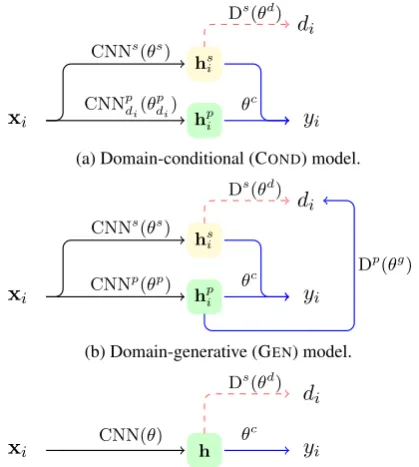
To address these issues, we propose two archi-tectures as illustrated in Figure1(a and b), param-eterised as a convolutional network (CNN) over the input instance, chosen based on the success of CNNs for text categorisation problems (Kim, 2014); note, however, that our method is general and can be applied with other network types. Both representations are based on the idea of twin rep-resentations of each instance,2denotedsharedand private representations, which are trained to cap-ture domain-general versus domain-specific con-cepts, respectively. This is achieved using various loss functions, most notably an adversarial loss to discourage learning of domain-specific concepts in the shared representations. The two architec-tures differ in whether the domain is provided as an input (COND) or an output (GEN). Below, we elaborate on the details of the two models.
2.1 Domain-Conditional Model (COND)
The first model, illustrated in Figure1a, includes a collection of domain-specificCNNs, and for each training instance x, the domain-specific CNNpd
i
is used to compute its private representation hp. In this manner, the model conditions on the do-main identifier. The COND model also computes a shared representation,hs, directly fromx, using a shared CNNs, and the two representations are concatenated together to form input to linear soft-max classification function c for predicting class
labely. Thus far, the approach resemblesDaum´e
2This differs from standard architectures, e.g., ‘baseline’ in Figure1c, which uses a single representation.
xi
CNNpdi(θpdi) CNNs(θs)
hpi hs i
yi Ds(θd)
di
θc
(a) Domain-conditional (COND) model.
xi CNN
p(θp)
CNNs(θs)
hpi hsi
yi Ds(θd)
di
Dp(θg) θc
(b) Domain-generative (GEN) model.
xi CNN(θ) h yi
Ds(θd) di
θc
[image:2.595.307.517.65.299.2](c) BaselineCNNmodel with adversarial loss. Figure 1: Proposed model architectures, showing a sin-gle training instance(xi, yi)with domaindi, and base-line model with domain adversarial loss.CNNdenotes a convolutional network,Dindicates a discriminator (d for domain adversarial andg for domain generation),
andred dashedandbluelines denote adversarial and
standard loss, resp.
III(2007), a method for multitask learning based on feature augmentation in a linear model, which works by replicating the input features to create both general shared features, and domain-specific features. Note that the approaches differ in that our method uses deep learning to form the two repre-sentations, in place of feature replication.
Adversarial Supervision A key challenge for the CONDmodel is that the ‘shared’ representation can be contaminated by domain-specific concepts. To address this, we borrow ideas from adversar-ial learning (Goodfellow et al.,2014;Ganin et al., 2016). The central idea is to learn a good general representation (suitable for the shared component) to maximize end task performance, yet obscure the domain information, as modelled by a discrimi-nator, Ds. This reduces the domaspecific in-formation in the shared representation, however note that important domain-specific components can still be captured in the private representation.
Overall, this results in the training objective:
LCOND= min
θc,θs,{θp
·} max
θd X(y|H
s,Hp,d;θc)
−λdX(d|Hs;θd)
where X denotes the cross-entropy classification loss,Hs = {hsi(xi)}ni=1 are the shared
represen-tations for the training set ofninstances, and
like-wise Hp = {hp
i(xi, di)}ni=1 are the private
rep-resentations, which are both functions of θs and {θp·}, respectively. Note the negative sign of the
adversarial loss (referred to as d), and the
max-imisation with respect to the discriminator param-eters θd. This has the effect of learning a
max-imally accurate discriminator wrtθd, while
mak-ing it maximally inaccuratewrtrepresentationHs, and is implemented using a gradient reversal step during backpropagation (Ganin et al.,2016).
Minimum Entropy Inference As COND condi-tions on the domain, this imposes the requirement that the domain of the test data is known (and cov-ered in training), which is incompatible with our goal of unsupervised adaptation. To deal with this situation, we consider each domain in the test set as belonging to one of the training domains, and then select the domain with the minimum entropy classification distribution. This is based on an as-sumption that a closely matching domain should be able to make confident predictions.3
2.2 Domain-Generative Model (GEN)
The second model is based on generation of, rather thanconditioningon, the domain, which al-lows the model to learn domain signals that trans-fer across some, but not all, domains. Most com-ponents are common with the CONDmodel as de-scribed in §2.1, including the use of private and
shared representations, their use in the classifica-tion output, and the adversarial loss based on dis-criminating the domain from the shared represen-tation. There are two key differences: (1) the pri-vate representation,hp, is computed using a single CNNp, rather than several domain-specificCNNs, which confers benefits of domain-generalisation, a more compact model, and simpler test infer-ence;4 and (2) the private representation is used
to positively predict the domain, which further en-courages the split between domain general and domain-specific aspects of the representation.
3The minimum entropy method is quite effective, trailing oracle selection by only0.8%accuracy.
4The domain need not be known for test examples, so the model can be used directly.
GENhas the following training objective,
LGEN = min
θc,θs,θp,θgmaxθd X(y|H
s,Hp;θc)
−λdX(d|Hs;θd) +λgX(d|Hp;θg)
(2)
where notation follows that used in§2.1, with the exception ofHp ={hpi(xi)}ni=1that is redefined,
withhpi(xi) a function ofθp, and the addition of
the last term to capture the generation lossg. The
same gradient reversal method from§2.1 is used
during training for the adversarial component.
3 Experiments
3.1 Language Identification
To evaluate our approach, we first consider the lan-guage identification task.
Data We follow the settings of Lui and Bald-win(2012), involving5training sets from5 differ-ent domains with97 languages in total: Debian,
JRC-Acquis, Wikipedia, ClueWeband RCV2,
derived fromLui and Baldwin(2011).5 We
evalu-ate accuracy on seven holdout benchmarks:
Eu-roGov, TCL, Wikipedia26 (all from Baldwin
and Lui (2010)),EMEA (Tiedemann,2009),
Eu-roPARL (Koehn,2005),T-BE(Tromp and
Pech-enizkiy,2011), andT-SC(Carter et al.,2013). Documents are tokenized as a byte sequence (consistent with Lui and Baldwin (2012)), and truncated or padded to a length of 1k bytes.7
Hyper-parameters We perform a grid search for the hyper-parameters, and selected the follow-ing settfollow-ings to optimise accuracy over heldout data from each of the training domains. All byte to-kens are mapped to byte embeddings, which are random initialized with size300. We use the filter sizes of2,4,8,16and32, with128filters for each, to capturen-gram features of different lengths. A
dropout rate of 0.5 was applied to all the repre-sentation layers. We set the factors λd and λg
to10−3. All the models are optimized using the Adam Optimizer (Kingma and Ba, 2015) with a learning rate of10−4.
5AsClueWebinLui and Baldwin(2012) is not publicly accessible, we used a slightly different set of languages but comparable number of documents for training.
Models EuroGov TCL Wikipedia2 EMEA EuroPARL T-BE T-SC ALLout baselineCNN 99.9 91.7 88.9 93.1 98.2 85.2 92.2 92.7
+d 99.9 92.4 88.4 90.2 98.2 87.7 93.1 92.8 +g 99.9 92.0 88.7 91.6 98.4 86.8 92.8 92.9 COND 99.9 91.3 88.2 92.0 98.7 91.5 94.5 93.7 +d 99.9 93.5 90.1 91.3 98.7 92.6 97.9 94.9 GEN 99.9 92.3 88.0 93.3 98.6 87.1 93.8 93.3 +d+g 99.9 93.1 88.7 92.5 99.1 91.2 96.1 94.4
[image:4.595.98.501.63.191.2]LANGID.PY 98.7 90.4 91.3 93.4 99.2 94.1 88.6 93.6 CLD2 99.0 85.0 85.3 90.7 98.5 85.0 93.4 91.0
Table 1: Accuracy [%] of the different models over the seven heldout datasets, and the macro-averaged accuracy out-of-domain over the 7 test domains (“ALLout”). The best result for each dataset is indicated inbold. Key:+d = domain adversarial,+g= domain generation component.
3.1.1 Results and Analysis
Baseline and comparisons For comparison, we implement aCNN baseline8 which is trained us-ing all the data without domain knowledge (i.e. the simple union of the different training datasets). We also employ adversarial learning (d) and
gen-eration (g) of domain to the baseline model to
bet-ter understand the utility of these methods. Note that the baseline +d is a multi-domain variant of Ganin and Lempitsky(2015), albeit trained with-out any text in the testing domains. For our mod-els, we report results of configurations both with and without the d and g components. We also
report the results for two state-of-the-art off-the-shelf LangID tools: (1) LANGID.PY9 (Lui and Baldwin,2012); and (2) Google’sCLD2.10
Out-of-domain Results Our primary concern in terms of evaluating the ability of the differ-ent models to generalise, is out-of-domain perfor-mance. Table1 provides a breakdown of out-of-domain results over the 7 holdout domains. The accuracy varies greatly between test domains, de-pending on the mix of languages, length of test documents, etc. Both our models, COND and GEN, achieve competitive performance, and are further improved bydandg.
For the baseline, applying either dorg results
in mild improvements over the baseline, which is surprising as the two forms of supervision work in opposite directions. Overall the small change in performance means neither method appears to be a viable technique for domain adaptation.
8The baseline here used a double capacity hidden repre-sentation, in order to better match the increased expressivity of the shared/private models.
9https://github.com/saffsd/langid.py 10https://github.com/CLD2Owners/cld2
Overall, the raw COND and GEN perform bet-ter than the baseline. Specifically, for COND, we observed performance gains onEuroPARL,T-BE
andT-SC. These three datasets are notable in con-taining shorter documents, which benefit the most from shared learning. However, as discussed ear-lier, multi-domain data can introduce noise to the shared representation, causing the performance to drop over TCL, Wikipedia2 and EMEA. This observation demonstrates the necessity of apply-ing adversarial learnapply-ing to COND. On the other hand, it is a different story for GEN: vanilla GEN achieves accuracy gains relative to the baseline over 5 domains, but is slightly below COND for 4domains, a result of parameter-sharing over the private representation.
In terms of the adversarial learning, we see that by adding an adversarial component (+d or
+d+g), CONDand GENrealises substantial im-provements out of domain, with the exception of
EMEA. As we motivated, the domain adversar-ial part dcan obscure the domain-specific
infor-mation in the shared representation, which helps CONDhave better generalisation to other domains. Additionally, applyinggto GENhelps the private representation to generalize better. These results demonstrate that bothdandgare necessary
com-ponents of multi-domain models. EMEAis note-worthy in that its pattern of results is overall differ-ent to the other domains, in that applyingdhurts
lan-Models Deb JRCA Wiki ClWb RCV2 ALLin baselineCNN 96.6 99.8 97.8 90.7 97.9 96.6
baseline+d 96.5 99.8 97.8 90.7 97.0 96.4
COND 97.0 99.9 97.8 90.9 98.0 96.7
COND+d 97.0 99.9 98.4 90.8 98.1 96.8
GEN+d+g 97.8 99.9 98.0 91.1 97.9 96.9
LANGID.PY 97.4 99.8 97.6 91.3 99.3 97.1 CLD2 92.2 99.8 92.3 92.3 89.8 93.3
Table 2: Accuracy [%] of different models over five in-domain datasets using cross-validation evaluation and macro-averaged accuracy (“ALLin”).
guages, further complicating the task.
Overall, our best models (COND +dand GEN +d+g) outperform both LANGID.PYand CLD2 in terms of average out-of-domain accuracy.
In-domain Results Table 2 reports the in-domain performance over the5training domains, using5-fold cross validation, as well as the macro-averaged accuracy. Our proposed methods (COND +dand COND +d+g) consistently achieve
bet-ter performance than the baseline. Both COND and GEN achieve competitive performance with the state-of-the-art LANGID.PY in the in-domain scenario. AlthoughLANGID.PYperforms slightly better on average accuracy, our best model outper-formsLANGID.PYfor three of the five datasets.
3.2 Product Reviews
To evaluate the generalization of our methods to other tasks, we experiment with the Multi-Domain Sentiment Dataset (Blitzer et al., 2007).11 We
select the 20 domains with the most review in-stances, and discard the remaining 5 domains.
For model parameterization, we adopt the same basic hyper-parameter settings and training pro-cess as for LangID in §3.1, but change the filter sizes to 3, 4and5, use word-based tokenisation, and truncate sentences to 256 tokens, for better compatible with shorter documents.
We perform a out-of-domain evaluation over four target domains, “book” (B), “dvd” (D), “elec-tronics” (E) and “kitchen & housewares” (K), as used in Blitzer et al. (2007). Our experimental setup differs from theirs, in that they train on a single domain and then evaluate on another, while we train over16domains, then evaluate on the four
11From https://www.cs.jhu.edu/˜mdredze/
datasets/sentiment/, using the positive and negative files from unprocessed, up to 2,000 instances per do-main. For the four test domains we automatically aligned the reviews in theprocessedandunprocessed, such that we can compare results directly against prior work.
Models B D E K
baselineCNN 79.6 81.2 86.3 87.2 baseline+d 78.7 81.6 86.6 87.1 COND 79.2 81.8 85.8 87.2 COND+d 79.8 82.3 86.8 87.4 GEN+d+g 80.2 82.4 87.3 87.8 SCL MI♣ 76.0 78.5 77.9 85.9 DANN♦ 72.3 78.4 84.3 85.4 IN DOMAIN♣ 82.4 80.4 84.4 87.7
Table 3: Accuracy [%] of different models over4 do-mains (B, D, E and K) under out-of-domain evalua-tions on Multi Domain Sentiment Dataset. Key: ♣
fromBlitzer et al.(2007);♦fromGanin and Lempitsky
(2015).
test domains.
Table 3 presents the results. Overall, our pro-posed methods consistently outperform the base-lines, with the GEN +d + g approach a
con-sistent winner over all other techniques. Note also the lacklustre performance when the base-line is trained with the adversarial loss, mirror-ing our findmirror-ings for language identification in§3.1. For comparison, we also report the best results of SCL-MI and DANN, in both cases using an oracle selection of source domain. Our method consistently outperform these approaches, despite having no test oracle, although note that we use more diverse data sources for training.
4 Conclusions
We have proposed a novel deep learning method for multi-domain learning, based on joint learn-ing of domain-specific and domain-general com-ponents, using either domain conditioning or do-main generation. Based on our evaluation over domain language identification and multi-domain sentiment analysis, we show our models to substantially outperform a baseline deep learning method, and set a new benchmark for state-of-the-art cross-domain LangID. Our approach has po-tential to benefit other NLP applications involving multi-domain data.
Acknowledgments
References
Timothy Baldwin and Marco Lui. 2010. Language identification: The long and the short of the mat-ter. InProceedings of Human Language Technolo-gies: Conference of the North American Chapter of the Association of Computational Linguistics. pages 229–237.
Zsolt Bitvai and Trevor Cohn. 2015. Non-linear text re-gression with a deep convolutional neural network. In Proceedings of the 53rd Annual Meeting of the Association for Computational Linguistics and the 7th International Joint Conference on Natural Lan-guage Processing Short Papers.
John Blitzer, Mark Dredze, and Fernando Pereira. 2007. Biographies, bollywood, boom-boxes and blenders: Domain adaptation for sentiment classi-fication. In Proceedings of the 45th Annual Meet-ing of the Association of Computational LMeet-inguistics. pages 440–447.
Simon Carter, Wouter Weerkamp, and Manos Tsagkias. 2013. Microblog language identification: Overcoming the limitations of short, unedited and idiomatic text. Language Resources and Evaluation
47(1):195–215.
William B Cavnar and John M Trenkle. 1994. N-gram-based text categorization. In Proceedings of the Third Symposium on Document Analysis and In-formation Retrieval.
Hal Daum´e III. 2007. Frustratingly easy domain adap-tation. In Proceedings of the 45th Annual Meet-ing of the Association for Computational LMeet-inguis- Linguis-tics. pages 256–263.
Yaroslav Ganin and Victor Lempitsky. 2015. Unsuper-vised domain adaptation by backpropagation. In In-ternational Conference on Machine Learning 2015. pages 1180–1189.
Yaroslav Ganin, Evgeniya Ustinova, Hana Ajakan, Pascal Germain, Hugo Larochelle, Franc¸ois Lavi-olette, Mario Marchand, and Victor Lempitsky. 2016. Domain-adversarial training of neural net-works. Journal of Machine Learning Research
17:59:1–59:35.
Ian J. Goodfellow, Jean Pouget-Abadie, Mehdi Mirza, Bing Xu, David Warde-Farley, Sherjil Ozair, Aaron C. Courville, and Yoshua Bengio. 2014. Gen-erative adversarial nets. InAdvances in Neural In-formation Processing Systems 27. pages 2672–2680.
Mahesh Joshi, Mark Dredze, William W. Cohen, and Carolyn Penstein Ros´e. 2012. Multi-domain learn-ing: When do domains matter? InProceedings of the 2012 Joint Conference on Empirical Methods in Natural Language Processing and Computational Natural Language Learning. pages 1302–1312.
David Jurgens, Yulia Tsvetkov, and Dan Jurafsky. 2017. Incorporating dialectal variability for socially
equitable language identification. InProceedings of the 55th Annual Meeting of the Association for Com-putational Linguistics. pages 51–57.
Yoon Kim. 2014. Convolutional neural networks for sentence classification. InProceedings of the 2014 Conference on Empirical Methods in Natural Lan-guage Processing. pages 1746–1751.
Young-Bum Kim, Karl Stratos, and Ruhi Sarikaya. 2016. Frustratingly easy neural domain adaptation. In Proceedings of COLING 2016, the 26th Inter-national Conference on Computational Linguistics: Technical Papers. pages 387–396.
Diederik P. Kingma and Jimmy Ba. 2015. Adam: A method for stochastic optimization. InProceedings of the International Conference on Learning Repre-sentations.
Philipp Koehn. 2005. Europarl: A parallel corpus for statistical machine translation. InMT Summit 2005. pages 79–86.
Marco Lui and Timothy Baldwin. 2011. Cross-domain feature selection for language identification. InFifth International Joint Conference on Natural Lan-guage Processing. pages 553–561.
Marco Lui and Timothy Baldwin. 2012. langid.py: An off-the-shelf language identification tool. In
Proceedings of ACL 2012 System Demonstrations. pages 25–30.
Marco Lui and Timothy Baldwin. 2014. Accurate lan-guage identification of Twitter messages. In Pro-ceedings of the 5th workshop on language analysis for social media. pages 17–25.
J¨org Tiedemann. 2009. News from OPUS – a collec-tion of multilingual parallel corpora with tools and interfaces. InRecent Advances in Natural Language Processing. volume 5, pages 237–248.
Erik Tromp and Mykola Pechenizkiy. 2011. Graph-based n-gram language identification on short texts. InProceedings of the 20th Machine Learning Con-ference of Belgium and The Netherlands. pages 27– 34.
![Table 1: Accuracy [%] of the different models over the seven heldout datasets, and the macro-averaged accuracyout-of-domain over the 7 test domains (“ALLout”)](https://thumb-us.123doks.com/thumbv2/123dok_us/1397479.674534/4.595.98.501.63.191/accuracy-different-heldout-datasets-averaged-accuracyout-domains-allout.webp)
