
Measuring Term Informativeness in Context
Zhaohui Wu
Computer Science and Engineering The Pennsylvania State University
University Park, PA 16802, USA
C. Lee Giles
Information Sciences and Technology Computer Science and Engineering
The Pennsylvania State University University Park, PA 16802, USA
Abstract
Measuring term informativeness is a funda-mental NLP task. Existing methods, mostly based on statistical information in corpora, do not actually measure informativeness of a term with regard to its semantic context. This pa-per proposes a new lightweight feature-free approach to encode term informativeness in context by leveraging web knowledge. Given a term and its context, we model context-aware term informativeness based on semantic similarity between the context and the term’s most featured context in a knowledge base, Wikipedia. We apply our method to three ap-plications: core term extraction from snippets (text segment), scientific keywords extraction (paper), and back-of-the-book index genera-tion (book). The performance is state-of-the-art or close to it for each application, demon-strating its effectiveness and generality.
1 Introduction
Computationally measuring importance of a word in text, or “term informativeness” (Kireyev, 2009; Rennie and Jaakkola, 2005), is fundamental to many NLP tasks such as keyword extraction, text catego-rization, clustering, and summacatego-rization, etc. Various features derived from statistical and linguistic infor-mation can be helpful in encoding term informative-ness, whereas practical feature definition and selec-tion are usually ad hoc, data-driven and applicaselec-tion dependent. Statistical information based on term frequency (TF) and document frequency (DF) tend to be more effective in finding keywords in large corpora, but can have issues with small amounts of
text or small corpora. Linguistic information such as POS tag patterns often require manual selection based on prior applications. We contend that few methods actually measure the informativeness of a term to the discourse unit it contains. For example, given a context such as“A graph comprises nodes (also called vertices) connected by links (also known as edges or arcs)”, it is difficult to measure the term informativeness of “graph”, “nodes”, or “links” based on any statistical or linguistic information.
This raises many issues. Is there a fundamental and less ad hoc way to measure the term informa-tiveness of a word within a discourse unit? Can we actually find a general approach based on compre-hensive and high-level “knowledge” and not have to nitpick over features? Can this new metric be effectively applied to real world applications? To answer these questions, we develop a new term in-formativeness metric, motivated by query-document relevance in information retrieval. The higher the relevance score a query-document pair is, the more informative the query is to the document. If a sim-ilar principle also exists between word and con-text and there is an effective search engine return-ing ranked contexts for a given word, then we con-tend that word is more informative in the higher rank contexts. To see the term informativeness of three words “graph”, “nodes” and “links” in context, we manually check the search results from Wikipedia, Google, and Bing. We found that very similar con-texts are among the top 5 ranked results of “graph” while no such contexts appear in that of the other two words. Thus, we define a context-aware term informativeness based on the semantic relatedness
between the context and the term’s featured contexts (or the top important contexts that cover most of a term’s semantics).
We apply the context-aware term informativeness (CTI) to three typical NLP applications: core term extraction in snippets, keyword extraction and back-of-the-book index generation. Experiments show that the method is effective and efficient. Moreover, the metric can be easily combined with other meth-ods, or as a feature for learning algorithms.
The remainder of this paper is organized as fol-lows. Section 2 reviews the literature of term infor-mativeness measurements. Section 3 proposes the formal definition of the context-aware term informa-tiveness as well as its practical implementation using Web knowledge. Section 4 studies the three appli-cations. Finally, we conclude with discussion and future work.
2 Related Work
Most known approaches to measure term informa-tiveness fall into basically two categories: statistics-based and semantic-statistics-based.
Statistics-based methods, such asTFIDF (Salton and Buckley, 1988),ResidualIDF(RIDF),Variance,
BurstinessandGain, are based on derivations from term frequency (TF) and document frequency (DF). Sprck Jones defines IDF or inverse document fre-quencyas:
IDF(w) =−log2(dfw/D) (1)
where D is the size of the corpus (Jones, 1972; Jones, 1973). Based on a finding that informative words tend to have large deviation between IDF
and collection frequencyfw(the total number of
oc-currence of a word), many other informativeness scores have been proposed. Bookstein and Swan-son (Bookstein and SwanSwan-son, 1974) introduced the xI as:
XI =fw−dfw
Church and Gale (1995) introduced
variance(w) = 1 D−1
D
∑
d=1
(tdw−t¯w) (2)
wheretdwdenotesw’s TF indandt¯w =fw/D
indi-cates its mean expected word rate. Another measure
suggested by them is
burstiness(w) = fw dfw
(3)
which tends to compare collection frequency and document frequency directly. Informative words were found to have IDFscores that are larger than what would be expected according to the Poisson model;residual IDF(RIDF) was introduced to mea-sure this deviation
RIDF(w) =IDF(w)−IDFd(w) (4)
where IDFd(w) = −log2(1−e−t¯w). In addition,
Papineni (2001) introduced the notion ofgainas
gain(w) = dfw D
(
dfw
D −1−log( dfw
D )
)
(5)
More recently, Rennie and Jaakkola (2005) intro-duced an informativeness score based on the fit of a word’s frequency to a mixture of 2 Unigram dis-tribution and applied it to named entity detection. It is worth noting that term necessity, which measures the probability that a term occurs in documents rel-evant to a given query, has been well studied in In-formation Retrieval community (Zhao and Callan, 2010; Yang and Callan, 2010). Though our CIT is not designed for probabilistic retrieval models, we may apply it to measure the term necessity in a query by considering it as a context.
Previous methods, all corpus-based, might be ef-fective in identifying informative words at the doc-ument or corpus level, but do not the ability to cap-ture term informativeness in a particular context due to their absence of semantics and obliviousness of context. Our method measures the term informative-ness within a context in a semantic-based approach, regardless of the absence of statistical information.
3 Context-aware Term Informativeness
3.1 Context
A context of a word or phrase may refer to a few words nearby (He et al., 2010), a sentence or para-graph (Soricut and Marcu, 2003), or even a set of documents containing it (Cilibrasi and Vitanyi, 2007). Here we define context as a syntactic unit of discourse such as a sentence or paragraph, for ex-ample, “PL/SQL is one of three key programming languages embedded in the Oracle Database”, or “There are two types of functions in PL/SQL”. The universal context setU(t)of a wordtis defined as all the contexts containing it in the web. Different contexts vary in their authority just like web pages vary. For the two examples, we could argue that the first context is much more “authoritative” than the second. This can be verified by their popular-ity on Google; (all results from actual search en-gines were at the time of this publication) the first retrieves approximately 302,000 exact matching re-sults while the second retrieves only one. We con-sider this as the number of citations of a context, which, to some extent, indicates its “authority”. We define thesourceof a context as the set of all docu-ments citing it. Here “citing” instead of “containing” is used because some documents may not literally contain an exact copy of the context.
Given a term t, define its universal context set U(t) = {ci}and the source ofci isS(ci) = {dij}.
Ideally, the authority of a context will be contributed by every document citing it. Therefore, we define the authority score of a context as
CA(ci) =
∑
j
DA(dij) (6)
whereDA(dij)denotes the authority contributed by
dij. It is very difficult to acquire the universal
con-text set of a term. Considering that usually we only
care about the top few results of a query returned by search engines and ignore a large faction of less im-portant ones, it is reasonable to assume that a term’s semantics will be well covered by a few important contexts. We therefore define the featured context set of term t, orUf(t), as the top k contexts with
the highest authority scores, wherek is an applica-tion dependent parameter. In our experiments, the defaultkfor the Wikipedia based implementation is 20.
3.2 Term Informativeness
We now consider how to measure the term informa-tiveness in context. Using the context “PL/SQL is one of three key programming languages embedded in the Oracle Database” (denoted byCp) as an
ex-ample, for its term “PL/SQL”, the top three contexts returned by Google are
1. PL/SQL (Procedural Language/Structured Query Language) is Oracle Corporation’s procedural extension language for SQL and the Oracle relational database.
2. PL/SQL is Oracle’s procedural extension to industry-standard SQL. PL/SQL naturally, efficiently, and safely extends SQL.
3. This Oracle PL SQL tutorial teaches you the basics of program-ming in PL/SQL like cursors, stored procedures, PlSQL func-tions.
Those contexts, though being diverse in actual meaning, all have semantic relatedness toCp. Even
someone who does not completely understand them can gain some meaning by observing common words such as “Oracle”, “database” and “program-ming”. However, checking the Google results for “Oracle Database” or “programming languages”, we will find little relatedness between them and Cp.
This suggests that if termtain contextcis more
in-formative thantb, then most likely the contexts from
ta’s featured context set will be more related to c
than will tb. Thus, given a termtand its featured
context setUf(t) ={c1, ..., ck}, we define the term
informativeness oftin contextcias
I(t, ci) =
∑
cj∈Uf(t)
κ(ci, cj)·CA(cj) (7)
where κ(ci, cj) is the semantic relatedness of
ci and cj, which can be computed by various
and Popescu-Belis, 2012), Wordnet based (Agirre et al., 2009; Budanitsky and Hirst, 2006), or simple co-sine similarity and Jaccard similarity based (Zobel and Moffat, 1998).
The context-aware term informativeness (CTI) in-troduced above is a formal and general definition. As such the definition in Equation (7) includes sev-eral features such as context authority score, fea-tured context set, semantic relatedness, and knowl-edge base, any or all of which could be flexible for different applications.
3.3 Implementation
Here, we present a simple practical implementation using Wikipedia as the knowledge base and the con-text authority estimated by the discounted rank of the Wikipedia document. Note that the problem is how to computeCA(cj)for each context inUf. We
rewrite Equation (6) as
CA(ci) =DA(di0) +
∑
j̸=0
DA(dij) (8)
wheredi0 is the original document ofci and all the
others are further derivatives of “citing”ci. For
ex-ample, the Wikipedia page of “PL/SQL” will be con-sidered as the original document of Cp while all
other documents citingCp are its derivatives.
Intu-itively, the authority of a context will mainly rely on the authority of its original document. Here, we sim-ply assume that the context authority depends only on its original document, or
CA(ci)≈DA(di0) (9)
We then take the top ranked document returned by the web knowledge base as the original document. We present a practical implementation of CTI in Algorithm 1. The discounted rank is used to rep-resent the relative context authority score of each context in Uf. We use Wikipedia as our
knowl-edge base to implement the metric since it is cur-rently one of the largest and most readily available knowledge repositories and, more importantly, pro-vides free, unlimited and fast query APIs1. Given any keyword, the Wikipedia query API will return the ranked Wikipedia entries along with the contexts containing the keyword. We set the default value 20
1
http://www.mediawiki.org/wiki/API:Query
for k, or len(Uf). Note that there could be other
variations of this implementation. For example, we could rule out duplicate or very similar results in the Uf. Search engines such as Google and Bing are
also potential sources since they return high qual-ity web pages along with the contexts containing the query keyword.
In terms of scalability, the proposed method is inherently parallelizable, not only at the document level, but also a the context level, since computing CTI does not depend on any other context in the doc-ument. In addition, we do not need to issue the same query more than once. Our strategy is to locally cache the returned results of every seen query. For a new term seen in a previous query, we can directly access the local cached file. If we have built a large local pool, the queries will rarely go to a search en-gine or other source. Given a corpus size N (words in total), the number of actual issued queries will be at most the number of unique terms, which is far less than O(N). Of course, new terms never seen will have to be processed, but there will be fewer of these over time.
Algorithm 1:Wikipedia-basedI(t, ci)
1 Input: t,ci
2 Output:I(t, ci)
3 begin
4 I ←−0;
5 Uf ←−queryW ikipedia(t);
6 forj∈range(len(Uf))do
7 s←−κ(ci, Uf[j]); 8 ifj >0then
9 I ←−I+s/log(j+ 1);
10 elseI ←−I+s
11 returnI;
4 Applications
Exemplary snippets of computer science terms Top 5 terms ranked by CTI
Acrobat, a document exchange software from Adobe Systems, provides a platform-independent means of creating, viewing, and printing documents. Acrobat can convert a DOS, Windows, UNIX or Macintosh documents into a Portable Document Format (PDF) which can be displayed on any computer with an Acrobat reader. The Acrobat reader can be downloaded free from the Adobe website.
Acrobat:3.19 Acrobat reader:2.94
Portable Document Format:2.08 Adobe website:2.03
Adobe Systems:1.82 Data mining (DM), also known as Knowledge-Discovery in Databases (KDD) or Knowledge-Discovery
and Data Mining (KDD), is the process of automatically searching large volumes of data for patterns. Data mining uses automated data analysis techniques to uncover previously undetected relationships among data items. Data mining often involves the analysis of data stored in a data warehouse. Three of the major data mining techniques are regression, classification and clustering.
data mining:3.77
data mining techniques:3.64 KDD:1.79
Knowledge-Discovery:1.66 data analysis techniques:1.20 Firefox, also known as Mozilla Firefox, is a free, open source, cross-platform, graphical web browser
developed by the Mozilla Corporation and hundreds of volunteers. Firefox includes an integrated pop-up blocker, tabbed browsing, live bookmarks, support for open standards, and an extension mechanism for adding functionality. Although other browsers have some of these features, Firefox became the first such browser to include them all and achieve wide adoption.
Mozilla Firefox:3.89 firefox:3.13 web browser:2.44 browser:2.39
[image:5.612.82.540.66.221.2]graphical web browser:2.35
Table 1: Term ranked by CTI from exemplary snippets
processes requiring this information”, can CTI iden-tify “database” as the most informative term in this context? To construct the term-context pairs, we could use the Wikipedia title and the top ranked context returned by searching the title using the Wikipedia API. Then we could test our metric based on other search engines such as Google or Bing. Testing manually, we found the results compare well to the search engine results, since both Google and Bing give top ranks to Wikipedia pages if the query keyword is a Wikipedia title. For further analy-sis, we need a collection of term-context pairs from other sources different from Wikipedia. Fortunately, we found a list of 1255 computer science terms with its definition snippets manually created by Web users 2. The snippets are literally different from those contexts in Wikipedia and some of the terms are even not Wikipedia titles, e.g. bBlog, BetBug, etc. These can be part of an “initial” evaluation. The core term extraction algorithm works in the follow-ing steps for each term-context pair:
1. Extract all n-grams (1≤n≤ 4) in the context as candidates
2. For each candidate, calculate its CTI using Wikipedia based implementation
3. Return the topKhighest CTI as core terms
We used the top 20 returned Wikipedia contexts as a featured context set Uf and apply the cosine
similarity forκ. We show some exemplary snippets
2
http://www.labautopedia.org/mw/index.php/List of programming and computer science terms
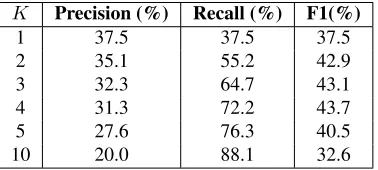
K Precision (%) Recall (%) F1(%)
1 37.5 37.5 37.5
2 35.1 55.2 42.9
3 32.3 64.7 43.1
4 31.3 72.2 43.7
5 27.6 76.3 40.5
10 20.0 88.1 32.6
Table 2: Results on computer science term extrac-tion from descriptive snippets
with its top 5 core terms and their CTI scores in Ta-ble 1. The overall performance is shown in TaTa-ble 2, in terms of precision, recall and F1 scores based on the only one titled term of each snippet as the ground truth. CTI can correctly find the core term for 37.5% snippets. If we take the top 5 results, then the recall increase to 76.3%.
Though the algorithm can be easily parallelized, sequentially runtime on all snippets took only slightly more than a minute on a 2.35GHz Intel(R) Xeon(R) 4 processors, 23GB of RAM, and Red Hat Enterprise Linux Server(5.7) machine. However, the time could vary due to network conditions.
Though these results look promising, but it could be due to the high lexical similarity between this dataset and Wikipedia content. To test on a more general corpora, we explore more real world tasks.
4.2 Keyword Extraction
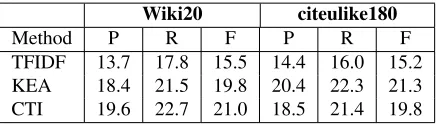
[image:5.612.331.520.255.340.2]Wiki20 citeulike180
Method P R F P R F
TFIDF 13.7 17.8 15.5 14.4 16.0 15.2
KEA 18.4 21.5 19.8 20.4 22.3 21.3
[image:6.612.79.300.64.127.2]CTI 19.6 22.7 21.0 18.5 21.4 19.8
Table 3: Results on Wiki20 and citeulike180
Mihalcea and Tarau, 2004; Medelyan and Witten, 2008; Liu, 2010), most of which is treated as a clas-sification or ranking problem with corresponding machine learning algorithms that use statistical and linguistic features in a corpus. Here, we consider the task as finding the most informative keywords in a document. Given a documentd = {ci}, our
key-word extraction algorithm based on CTI works as follows.
1. For each contextciin a document, compute the
semantic relatednesss(ci, d)betweenciandd
2. For each n-gram (1≤ n≤ 4)tinci, calculate
I(t, ci)using Wikipedia based implementation
3. Select the top keywords with the highest
∑
iI(t, ci)∗s(ci, d)
Note that for the last step keywords are selected based on a summarized weighted informativeness score over a document. Obviously, the pure co-sine or Jaccard similarity is not a good choice to measure semantic relatedness between two text segments of very low lexical similarity. We thus use the Wikipedia based ESA (Gabrilovich and Markovitch, 2007) to compute the semantic relat-edness s(ci, d) and κ(ci, cj). To make the
cal-culation more efficient, only the Wikipedia pages whose title is contained in the dataset are used to build the concept space. We ran the algorithm on several datasets including Wiki20 (Medelyan et al., 2008), citeulike180 (Medelyan et al., 2009) and Se-mEval2010 (Kim et al., 2010)3.
Though keyword extraction as a research topic has a rich literature, to the best of our knowledge there is no large scale datasets publicly available. The Wiki20 dataset contains 20 computer science articles each with around 5 terms labeled by 15 different teams. Every term is a Wikipedia title.
3
http://code.google.com/p/maui-indexer/downloads/list
Method Precision (%) Recall (%) F1(%)
TFIDF 14.9 15.3 15.1
HUMB 27.2 27.8 27.5
CTI 19.3 20.1 19.7
[image:6.612.322.529.64.128.2]CTI+ 25.3 26.2 25.7
Table 4: Results on SemEval2010
The citeulike180 contains a set of 180 papers each tagged with around three tags by 332 users. For each dataset, the collection of all labeled keywords by dif-ferent taggers are considered as the gold standard for a document. We use the set of all keywords for evaluation; otherwise a more complicated evaluation metrics for each dataset will be needed. It would be better to investigate other weighting schemes. However, the datasets here are relatively small and the number of tags on which at least two annota-tors agreed is significantly small; weighting the key-words might not make too much difference. KEA4 builds a Naive Bayes model using features TFIDF, first occurrence, length of a phrase, and node de-gree (number of candidates that are semantically re-lated to this phrase) (Witten et al., 1999). First oc-currence is computed as the percentage of the doc-ument preceding the first occurrence of the term in the document. We compute the node degree as the textrank (Mihalcea and Tarau, 2004) degree in a doc-ument by simply relating two candidate terms with each other if they are in the same context. KEA uses 5 fold cross validation. All precision P, re-call R and F1 F results are over the top 10 candi-date keywords and the micro-averaged results of the first two datasets are shown in Table 3. The CTI-based algorithm works better than KEA on Wiki20 but slightly worse on citeulike180. We argue that the reason might be two-fold. First, CTI does not use any inter-document or corpus information while KEA learns from the corpus. As such, CTI might not perform as well as supervised learning methods for a domain dependent large corpus. Second, the labeled keywords in Wiki20 are all Wikipedia titles while those in citeulike are general tags labeled by volun-tary web users. CTI would give more preference to Wikipedia titles since their featured context set re-turned from Wikipedia is more semantically repre-sentative than other non-Wikipedia title words.
4
Dataset #Books #Words #Contexts Main domains
Gutenberg 55 7,164,463 301,581 History, Art, Psychology, Philosophy, Literature, Zoology
Open Book 213 22,279,530 1,135,919 Computer Science, Engineering, Information Science
Table 5: Datasets for book index generation evaluation
The SemEval2010 dataset contains a set of 284 scientific papers with 15 keyphrases assigned by readers and authors. 144 of them are selected as training set while the other 100 are for testing. A comparison of CTI to the results from TFIDF and the best reported results HUMB (Lopez and Romary, 2010) is shown in Table 4. It achieves 19.8% by micro-averaged F1 score, ranking 11th out of the 19 systems submitted to the competition (Kim et al., 2010). However, by adding the structural features used by HUMB into CTI, we can improve the per-formance by around 6%, making our results close to that of HUMB. The structural information is en-coded as weights for context that is located in ti-tle, abstract, section titles and general content. Each weight can be regarded as the prior probability that a keyword will appear in the corresponding location, whose value can be set according to the fraction of the number of keyword occurrences of this type of location with respect to the number of all keyword occurrences in the entire training set. Here they are set to be 0.3, 0.4, 0.25, and 0.05.
4.3 Back-of-the-book Index Generation
A back-of-the-book index (or book index) is a col-lection of words or phrases, often alphabetically ar-ranged as an index, created to give readers impor-tant location of imporimpor-tant information in a given book. Usually indexing is done by freelancers hired by authors or publishers, namely professional in-dexers 5. Csomai and Mihalcea first evaluated the performance of different informativeness measure-ments for selecting book index terms (2007) and then investigated automatic book index generation in a supervised learning framework (2008) using syntactic features, linguistical features, encyclope-dic features, etc., as a keyword extraction problem rather than building a actual book index.
A set of keywords is not a back-of-the-book in-dex. What really matters for such an index is that
5
http://www.asindexing.org/
an index term or phrase points to its proper loca-tion in the text. For example, in “pattern recogniloca-tion and machine learning” by Bishop, “hidden Markov model” appears in more than 20 pages while the actual index entry has only 2 pages as its locators. Thus the actual problem is to identify a index term with its context. As such, learning a robust and ef-ficient model for real book indexes is challenging. First, books from different domains vary in vocabu-lary composition and structure style, requiring vari-ous indexing specialties. There are different index-ing guides for medicine (Wyman, 1999), psychol-ogy (Hornyak, 2002), and law (Kendrick and Zafran, 2001). Second, book indexing is a highly subjec-tive work and indexes of different books are always created by different professional indexers who have their own preferences and background (Diodato and Gandt, 1991; Diodato, 1994). Third, the training set is extremely unbalanced. As we found in our dataset, the index size is only 0.42% of the length of book on average. All these motivate us to explore the automatic creation of index terms that are aware of the context at the term’s locations (locators). To do so we propose the following efficient training-free and domain independent approach:
1. For each context ci in a book, compute its
weightwibased on structural features
2. For each candidate term t in ci, calculate
I(t, ci)using Wikipedia based implementation
3. Select term-context pairs with the highestwi∗
I(t, ci)as index entries
The weight in step 1 represents the relative im-portance of a context in a book. w(c) = 1 −
cid(c)−cid(titlec)
Ntitlec measures the weight based on the
normalized distance from the context to its direct chapter or sub-chapter title, wherecid(c)denotes the
id of contextc,titlecthe title of contextcandNtitlec the number of contexts undertitlec. To select
based on POS patterns using the Standard POS Tag-ger (Toutanova et al., 2003). We then select multi-word keyphrases based on Pointwise Mutual Infor-mation (PMI) (Church and Hanks, 1990), which was shown to be the best metric to measure word associ-ations (Terra and Clarke, 2003).
To evaluate our back-of-the-book index gener-ation method, we conduct extensive experiments on books in various domains, from the Gutenberg dataset and the open book dataset described in Ta-ble 5. The first one was created by (Csomai and Mihalcea, 2006), containing 55 free books collected from Gutenburg6. Since the dataset does not pro-vide the locators of index terms, we can only serve the evaluation as a keyword extraction task. The sec-ond dataset was collected from CiteSeer repository, most of which are in computer science and engineer-ing. We extracted the paged body text and the back index using Pdfbox7. Having each index term asso-ciated with its locators (page numbers), we can per-form an evaluation for different methods, not based solely on keyword extraction.
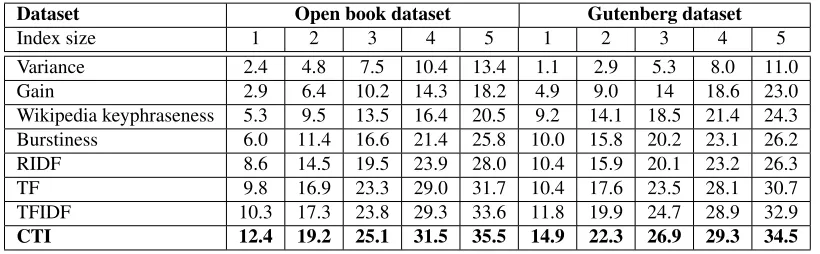
We first compare CTI with other metrics on both datasets for keywords extraction since all other met-rics are context-oblivious. CTI selects index terms based on the sum of a term’s CTI scores over all its contexts, the same as the algorithm used in Section 4.2. The results are shown in Table 6, where the in-dex size =nindicates the number of output terms is ntimes of the true book index size for each book. The scores are the average recall over a dataset. The CTI outperforms all other 7 metrics in the two datasets as the output index size increases. More-over, results show that TF and TFIDF are better than RIDF in identifying book index terms, which seems contradictory to previous findings (Church and Gale, 1995). A possible reason is that a book is much longer than a regular document thus enhancingT F as a better indicator of keywords but weakening the role ofIDF. We believe this is whyVariance,Gain, andBurstiness, which relies onDF, are less effec-tive here.Wikipedia keyphraseness(Csomai and Mi-halcea, 2008) can only find a small fraction of index terms because it emphasizes Wikipedia titles that have high in-degree in hyper-link network formed
6www.gutenberg.org/ 7
pdfbox.apache.org/
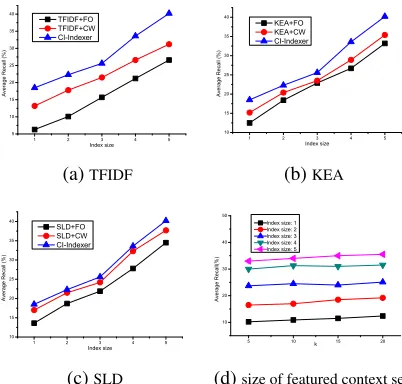
1 2 3 4 5
5 10 15 20 25 30 35 40 A ve r a g e R e ca ll (% ) Index size TFIDF+FO TFIDF+CW CI-Indexer (a)TFIDF
1 2 3 4 5
10 15 20 25 30 35 40 A ve r a g e R e ca ll (% ) Index size KEA+FO KEA+CW CI-Indexer (b)KEA
1 2 3 4 5
10 15 20 25 30 35 40 A ve ra g e R e ca ll ( % ) Index size SLD+FO SLD+CW CI-Indexer (c)SLD
5 10 15 20 10 20 30 40 50 A ve ra g e R e ca ll(% ) k Index size: 1 Index size: 2 Index size: 3 Index size: 4 Index size: 5
[image:8.612.321.522.71.263.2](d)size of featured context set
Figure 1: Results for book index generation
by Wikipedia terms. However, a book index covers much broader terms not titled in Wikipedia.
Dataset Open book dataset Gutenberg dataset
Index size 1 2 3 4 5 1 2 3 4 5
Variance 2.4 4.8 7.5 10.4 13.4 1.1 2.9 5.3 8.0 11.0
Gain 2.9 6.4 10.2 14.3 18.2 4.9 9.0 14 18.6 23.0
Wikipedia keyphraseness 5.3 9.5 13.5 16.4 20.5 9.2 14.1 18.5 21.4 24.3
Burstiness 6.0 11.4 16.6 21.4 25.8 10.0 15.8 20.2 23.1 26.2
RIDF 8.6 14.5 19.5 23.9 28.0 10.4 15.9 20.1 23.2 26.3
TF 9.8 16.9 23.3 29.0 31.7 10.4 17.6 23.5 28.1 30.7
TFIDF 10.3 17.3 23.8 29.3 33.6 11.8 19.9 24.7 28.9 32.9
[image:9.612.102.512.64.191.2]CTI 12.4 19.2 25.1 31.5 35.5 14.9 22.3 26.9 29.3 34.5
Table 6: Average recall(%) comparisons as the output index size increases
performance in different index size settings.
4.4 Discussion
The three applications are (incrementally) designed for different goals. The first is a toy applica-tion to show the potential capability of this ap-proach, regardless of syntactic or statistical informa-tion. Clearly, there are simple heuristics that can work very well for this task, e.g. the first term of the context. TF or TFIDF also performs quite well. We can rewrite each context (by reordering the terms, changing sentence structures, or substituting the core terms with pronouns) to make them inef-fective. However, this will not effect our method, because what it essentially measures is a term’s in-formativeness among a list of terms appearing in the same context. However, for keyword extraction, a topic with a rich literature, to the best of our knowl-edge, has no publicly available large scale datasets, which makes SemEval2010 the best available. We believe our application on back-of-the-book index generation showed how CTI can scale real world large corpora and will scale to millions of books since each book can be processed separately.
Based on the applications we explored, we can see that the practical utility of CTI used alone could be limited, especially for context-oblivious tasks. It seems reasonable that this method does not out-perform supervised learning methods designed for keyword extraction. However, our method shows what simple but elegant methods can achieve with-out the overhead of machine learning, especially for context-aware scenarios such as finding book index terms.
5 Conclusion and Future Work
We developed a new web knowledge based method for encoding informativeness of terms within a unit of discourse. It is totally feature-free, corpus-free, easy to implement, and inherently parallelizable. Three typical applications on text snippets, scien-tific papers and non-fiction books show its effec-tiveness. The segmentation of context, the size of featured context set, the semantic relatedness met-ric κ, and the knowledge base might more or less affect the final performance of CTI in terms of ac-curacy or efficiency. For all applications, we treat a paragraph as an individual context, which is not nec-essary a complete discourse unit. However, it may not be fair to set the same number for all context terms. In addition, selection of semantic relatedness and knowledge bases need further investigation. The Wikipedia-based implementation might be a good choice for the definitional snippets, scientific arti-cles and text books since they are all “educational” resources sharing a similar concept space. However, it is an open question as whether it works for corpora such as tweets, online reviews, and forum posts.
Based on the proposed methods and encouraging results, it would be interesting to build an online in-dexing tool which automatically finds informative terms in generic text and generates a back-of-the-book index for a sets of papers, back-of-the-books, theses and other collections.
6 Acknowledgments
References
E. Agirre, E. Alfonseca, K. Hall, J. Kravalova, M. Pasca,
and A. Soroa. 2009. A study on similarity and
relatedness using distributional and WordNet-based
approaches. In Proceedings of NAACL-HLT 2009,
pp. 19–27.
A. Bookstein and Don R. Swanson. 1974. Probabilistic
models for automatic indexing. Journal of the
Ameri-can Society for Information Science, 25(5):312–316. A. Budanitsky and G. Hirst. 2012. Evaluating
WordNet-based measures of semantic distance. Computational
Linguistics32:13–47.
K. W. Church and W. A. Gale. 1995. Inverse document frequency(IDF): A measure of deviation from poisson. InProceedings of the Third Workshop on Very Large Corpora1995, pp. 121–130.
K. W. Church and P. Hanks. 1990. Word association
norms, mutual information and lexicography.
Compu-tational Linguistics, 16:22–29.
Rudi L. Cilibrasi and Paul M.B. Vitanyi. 2007. The
Google similarity distance. IEEE Transaction on
Knowledge and Data Engineering, 19(3):370–383. A. Csomai and R. Mihalcea. 2006. Creating a testbed for
the evaluation of automatically generated
back-of-the-book indexes. InProceedings of the 7th international
conference on Computational Linguistics and Intelli-gent Text Processing2006, pp. 429–440.
A. Csomai and R. Mihalcea. 2007. Investigations in
unsupervised back-of-the-book indexing. In
Proceed-ings of the Florida Artificial Intelligence Research So-ciety2007, pp. 211–216.
A. Csomai and R. Mihalcea. 2008. Linguistically Moti-vated Features for Enhanced Back-of-the-Book
Index-ing. InProceedings of ACL2008, pp. 932–940.
S. Deerwester, S. T. Dumais, G. W. Furnas, T. K. Lan-dauer, and R. Harshman. 1990. Indexing by Latent
Semantic Analysis. Journal of the American Society
for Information Science41:391-407.
V. Diodato and G. Gandt. 1991. Back of book indexes and the characteristics of author and nonauthor
index-ing: Report of an exploratory study. Journal of the
American Society for Information Science, 42:341– 350.
V. Diodato. 1994. User preferences for features in back
of book indexes. Journal of the American Society for
Information Science, 45:529–536.
E. Frank, G. W. Paynter, I. H. Witten, and C. Gutwin.
1999 Domainspecic keyphrase extraction. In
Pro-ceedings IJCAI1999, pp. 668-673.
E. Gabrilovich and S. Markovitch. 2007. Computing mantic relatedness using Wikipedia-based explicit
se-mantic analysis. InProceedings of IJCAI2007, pp. 6–
12.
Q. He, J. Pei, D. Kifer, P. Mitra, and C. L. Giles. 2010.
Context-aware citation recommendation. In
Proceed-ings of WWW2010, pp. 421–430.
B. Hornyak. 2002. Indexing Specialties: Psychology. Medford, NJ : Information Today, Inc.
A. Hulth. 2003. Improved automatic keyword extraction
given more linguistic knowledge. InProceedings of
EMNLP2003, pp. 216-223.
Karen Sprck Jones. 1972. A statistical interpretation of
term specificity and its application in retrieval.
Jour-nal of Documentation, 28(1):11–21.
Karen Sprck Jones. 1973. Index term weighting.
Infor-mation Storage and Retrieval, 9(11):619–633. P. Kendrick and E. L. Zafran. 2001. Indexing Specialties:
Law. Medford, NJ : Information Today, Inc.
Su Nam Kim, Olena Medelyan, Min-Yen Kan, and Tim-othy Baldwin. 2010. Semeval-2010 task 5 : Auto-matic keyphrase extraction from scientic articles. In
Proceedings of the 5th SIGLEX Workshop on Seman-tic Evaluation.2010, pp. 21–26.
K. Kireyev. 2009. Semantic-based Estimation of
Term Informativeness. InProceedings of NAACL-HLT
2009, pp. 530–538.
Z. Liu, W. Huang, Y. Zheng, and M. Sun. 2010. Au-tomatic keyphrase extraction via topic decomposition. InProceedings of EMNLP2010, pp. 366–376. P. Lopez and L. Romary. 2010. HUMB: Automatic Key
Term Extraction from Scientic Articles in GROBID. In Proceedings of the 5th SIGLEX Workshop on Se-mantic Evaluation.2010, pp. 248-251.
O. Medelyan and I. H. Witten. 2008.
Domain-independent automatic keyphrase indexing with small
training sets. J. Am. Soc. Inf. Sci. Technol.
59:1026-1040.
O. Medelyan, I. H. Witten, and D. Milne. 2008. Topic
indexing with Wikipedia. InProceedings of AAAI08
Workshop on Wikipedia and Artificial Intelligence: an Evolving Synergy2008, pp. 19–24.
O. Medelyan, E. Frank, and I. H. Witten. 2009. Human-competitive tagging using automatic keyphrase
extrac-tion. InProceedings of EMNLP2009, pp. 1318–1327.
R. Mihalcea and P. Tarau. 2004. TextRank: Bringing
Order into Texts. In Proceedings of EMNLP 2004,
pp. 404-411.
L. Page, S. Brin, R. Motwani, and T. Winograd. 1998. The PageRank Citation Ranking: Bringing Order to
the Web. Technical Report. Stanford InfoLab.
K. Papineni. 2001. Why inverse document frequency? InProceedings of NAACL-HLT2001, pp. 1–8. J. D. M. Rennie, and T. Jaakkola. 2005. Using Term
Informativeness for Named Entity Detection. In
G. Salton, and C. Buckley. 1988. Term-weighting
ap-proaches in automatic text retrieval. Information
Pro-cessing & Management24(5):513–523.
R. Soricut and D. Marcu. 2003. Sentence level
dis-course parsing using syntactic and lexical information. InProceedings of NAACL-HLT2003, pp. 149–156. E. Terra and C. L. Clarke. 2003. Frequency estimates for
statistical word similarity measures. InProceedings of
NAACL-HLT2003, pp. 165–172.
T. Tomokiyo and M. Hurst. 2003. A language model
ap-proach to keyphrase extraction. InProceedings of the
ACL 2003 workshop on Multiword expressions: anal-ysis, acquisition and treatment, 2003, pp. 3340. K. Toutanova, D. Klein, C. Manning, and Y. Singer.
2003. Feature-Rich Part-of-Speech Tagging with a
Cyclic Dependency Network. In Proceedings of
NAACL-HLT2003, pp. 252-259.
P. D. Turney. 2000. Learning Algorithms for Keyphrae
Extraction.Information Retrieval2:303-336.
I. H. Witten, G. W. Paynter, E. Frank, C. Gutwin, and C. G. Nevill-Manning. 1999. Kea: practical automatic
keyphrase extraction. In Proceedings of the fourth
ACM conference on Digital libraries, 1999, pp. 254– 255.
L. P. Wyman. 1999. Indexing Specialities: Medicine. Medford, NJ : Information Today, Inc.
M. Yazdani and A. Popescu-Belis. 2012. Computing text semantic relatedness using the contents and links
of a hypertext encyclopedia. Artificial Intelligence
194:176–202.
J. Zobel and A. Moffat. 1998. Exploring the similarity
space.ACM SIGIR Forum32(1):18–34.
Le Zhao and Jamie Callan. 2010. Term necessity
predic-tion. InProceedings of the 19th ACM international
conference on Information and knowledge
manage-ment, 2010, pp. 259–268.
Hui Yang and Jamie Callan. 2009. A metric-based
framework for automatic taxonomy induction. In
![4 {(2,4 Dichlorophenyl)[5 hydroxy 1 phenyl 3 (trifluoromethyl) 1H pyrazol 4yl]methyl} 1 phenyl 3 (trifluoromethyl) 1H pyrazol 5 ol monohydrate](data:image/gif;base64,R0lGODlhAQABAIAAAP///wAAACH5BAEAAAAALAAAAAABAAEAAAICRAEAOw==)