Shift-Reduce Constituency Parsing with Dynamic Programming
and POS Tag Lattice
Haitao Mi†
†T.J. Watson Research Center
IBM
Liang Huang‡†
‡Queens College & Graduate Center
City University of New York [email protected]
Abstract
We present the first dynamic programming (DP) algorithm for shift-reduce constituency parsing, which extends the DP idea of Huang and Sagae (2010) to context-free grammars. To alleviate the propagation of errors from part-of-speech tagging, we also extend the parser to take a tag lattice instead of a fixed tag sequence. Experiments on both English and Chinese treebanks show that our DP parser significantly improves parsing quality over non-DP baselines, and achieves the best accu-racies among empirical linear-time parsers.
1 Introduction
Incremental parsing has gained popularity in both dependency (Nivre, 2004; Zhang and Clark, 2008) and constituency parsing (Zhu et al., 2013; Wang and Xue, 2014). However, the greedy or beam search algorithms used in these parsers can only ex-plore a tiny fraction of trees among exponentially many candidates. To alleviate this problem, Huang and Sagae (2010) propose a dynamic programming (DP) algorithm, reducing the search space to a poly-nomial size by merging equivalent states. This idea has been extended by Kuhlmann et al. (2011) and Cohen et al. (2011) to other dependency parsing paradigms.
In constituency parsing, however, DP has not yet been applied to incremental parsing, and the big-ger search space in constituency parsing suggests a potentially even bigger advantage by DP. However, with unary rules and more-than-binary branchings, constituency parsing presents challenges not found in dependency parsing that must be addressed be-fore applying DP. Thus, we first present an odd-even
shift-reduce constituency parser which always fin-ishes in same number of steps, eliminating the com-plicated asynchronicity issue in previous work (Zhu et al., 2013; Wang and Xue, 2014), and then de-velop dynamic programming on top of that. Sec-ondly, to alleviate the error propagation from POS tagging, we also extends the algorithm to take a tag-ging sausage lattice as input, which is a compromise between pipeline and joint approaches (Hatori et al., 2011; Li et al., 2011; Wang and Xue, 2014).
Our DP parser achieves state-of-the-art perfor-mances on both Chinese and English treebanks (at 90.8% on PTB and 83.9% on CTB, the latter being the highest in literature).
2 Odd-Even Shift-Reduce CFG Parser
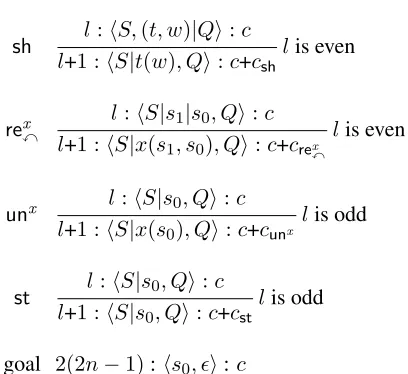
One major challenge in constituency parsing is unary rules. Unlike dependency parsing where shift-reduce always finishes in2n−1steps, existing incre-mental constituency parsers (Zhu et al., 2013; Wang and Xue, 2014) reach the goal state (full parse tree) in different steps due to different number of unary rules. So we propose a new, synchronized, “odd-even” system to reach the goal in the same4n−2 steps. Astateis notated p = hS, Qi, whereS is a stack of trees..., s1, s0, andQ is a queue of
word-tag pairs. At even steps (when step index is even) we can choose one of the three standard actions
• sh: shift the head ofQ, a word-tag pair (t, w), ontoSas a singleton treet(w);
• rex
x: combine the top two trees on the stack and replace them with a new treex(s1, s0),xbeing
the root nonterminal, headed ons0;
• rex
y: similar torexxbut headed ons1;
input (t1, w1)... (tn, wn)
axiom0 :h,(t1, w1)... (tn, wn)i: 0
sh l+1 :l:hhSS,|t((t, ww), Q)|Qii::c+cc
shlis even
rex
x l+1 :hlS:|xhS(s|s1|s0, Qi:c
1, s0), Qi:c+crex
x
lis even
unx l:hS|s0, Qi:c
l+1 :hS|x(s0), Qi:c+cunx lis odd
st l+1 :l:hhSS|s|s0, Qi:c
0, Qi:c+cstlis odd
[image:2.612.76.280.109.296.2]goal 2(2n−1):hs0, i:c
Figure 1: Shift-reduce system, omitting rex
y. c is the model score, andcsh,crex
x, etc. are the action scores.
• unx: replaces0 with a new treex(s0) with x
being the root nonterminal; • st: no action.
Figure 1 shows the deductive system. Note that we alternate between standard shift-reduce actions in even steps and unary actions (unx or st) in odd
steps, and the first action must besh, followed by a
unx orst, and followed by another sh. Continuing
this procedure, we can always achieve the goal in 2(2n−1)steps.
In practice, we have larger than two-way rules and multi-level unary rules, so we binarize them and col-lapse multi-level unary rules into one level, for ex-ample,
NP S VP
PP NP V
=⇒
NP+S VP
PP VP0
NP V
Following Huang and Sagae (2010), we represent feature templatesas functionsf(·,·)on stackSand queueQ. Table 1 shows the 43 feature templates we use in this paper, all adopted from Zhu et al. (2013). They are combinations of the 32 atomic features ˜f(S, Q)(e.g. s0.tands0.cdenote the head tag and
sh l:hS,(t, w)|Qi: (c, v)
l+1 :hS|t(w), Qi: (c+csh,0)lis even
rex
x
statep:
l0:hS0|s0
1, Q0i: (c0, v0)
stateq:
l:hS|s1|s0, Qi: (c, v)
l+1 :hS0|x(s0
1, s0), Qi: (c0+v+δ, v0+v+δ)
landl0 are even,p∈π(q)
unx l:hS|s0, Qi: (c, v)
[image:2.612.92.247.565.635.2]l+1 :hS|x(s0), Qi: (c+cunx, v+cunx)lis odd
Figure 2: DP shift-reduce, omittingrex
yandst. candv are prefix and inside scores, andδ = csh(p) +crex
x(q). State equivalence is defined below in Section 3.
syntactic category of trees0, resp., ands0.lc.wis the
head word of its leftmost child).
3 Dynamic Programming
The key idea towards DP is the merging of equiva-lent states, after which the stacks are organized in a “graph-structured stack” (GSS)(Tomita, 1988). Fol-lowing Huang and Sagae (2010), “equivalent states” ∼in a same beam are defined by the atomic features ˜f(S, Q)and the span ofs0:
hS, Qi ∼ hS0, Q0i ⇔˜f(S, Q) =˜f(S0, Q0)ands0.span=s00.span.
Similarly, for each statep,π(p)is a set ofpredictor states, each of which can be combined withp in a
rex
xorrexy action. For each action, we have differ-ent operations onπ(p). If a statepmakes ashaction and generates a statep0, thenπ(p0) = {p}. If two shifted statesp0 andp00are equivalent, p0 ∼ p00, we mergeπ(p0)andπ(p00). If a statepmakes a reduce (rex
x or rexy) action, p tries to combine with every
p0 ∈π(p), and each combination generates a stater withπ(r) =π(p0). If two reduced states are equiva-lent, we only keep one predictor states, as their pre-dictor states are identical. If a statepfires anunx or
astaction resulting in a stateu, we copy the predic-tor statesπ(u) =π(p). Similar to reduce actions, if two resulting states after applying anunx or ast
feature templatesf(S, Q)
unigrams s0.t◦s0.c s0.w◦s0.c s1.t◦s1.c s1.w◦s1.c s2.t◦s2.c s2.w◦s2.c
s3.t◦s3.c q0.w◦q0.t q1.w◦q1.t q2.w◦q2.t q3.w◦q3.t s0.lc.w◦s0.lc.c
s0.rc.w◦s0.rc.c s0.u.w◦s0.u.c s1.lc.w◦s1.lc.c s1.rc.w◦s1.rc.c s1.u.w◦s1.u.c
bigrams s0.w◦s1.w s0.w◦s1.c s0.c◦s1.w s0.c◦s1.c s0.w◦q0.w s0.w◦q0.t
s0.c◦q0.w s0.c◦q0.t q0.w◦q1.w q0.w◦q1.t q0.t◦q1.w q0.t◦q1.t
s1.w◦q0.w s1.w◦q0.t s1.c◦q0.w s1.c◦q0.t
s0.c◦s0.lc.c◦s0.rc.c◦s1.c s0.c◦s0.lc.c◦s0.rc.c◦s1.c
trigrams s0.c◦s1.c◦s2.c s0.w◦s1.c◦s2.c s0.c◦s1.w◦q0.t
s0.c◦s1.c◦s2.w s0.c◦s1.c◦q0.t s0.w◦s1.c◦q0.t
s0.c◦s1.w◦q0.t s0.c◦s1.c◦q0.w
Table 1: All feature templates (43templates based on32atomic features), taken from Zhu et al. (2013).si.c,si.wand si.tdenote the syntactic label, the head word, and the head tag ofsi.si.lc.wmeans the head word of the left child of si.si.u.wmeans the head word of the unary rootsi.qi.wandqi.tdenote the word and the tag ofqi.
input (T1, w1)...(Tn, wn)
axioms0 :h,(t, w1)...(Tn, wn)({</s>},</s>)i: 0,∀t∈T1
sh l+1 :l:hhSS,|t((wt, w),)(|(t0T, w0, w0)|0Q)|Qi: (i: (c+c, vc )
sh,0)
t0∈T0,
[image:3.612.332.521.255.397.2]lis even
Figure 3: Extended shift-reduce deductive system with tagging sausage lattice, only showingsh.
In order to compute all the scores in GSS, for each statep, we calculate the prefix score,c, which is the total cost of the best action sequence from the initial state to the end of state p, and the inside score v, which is the score since the last shift (Figure 2).
The new mechanism beyond Huang and Sagae (2010) is the non-trivial dynamic programming treatment of unary actions (unx andst), which is not
found in dependency parsing. Note that the score calculation is quite different from shift in the sense that unary actions are more like reduces.
4 Incorporating Tag Lattices
It is easy to extend our deductive system to take tag-ging sausage lattices as input. The key difference is that the tag t associated with each word in the input sequence becomes a set of tags T. Thus, in theshaction, we split the state with all the possible tags t0 in the tagset T0 for the secondword on the queue. Figure 3 shows the deductive system, where we only change theshaction, input and axiom. For simplicity reasons we only present one word look
87.5 88 88.5 89 89.5 90
2 4 6 8 10 12 14 16 18
F1 on the dev set
iteration
11th
15th
DP non-DP
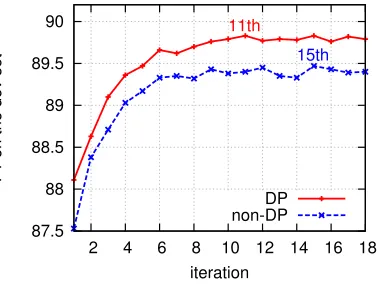
Figure 4: The learning curves of non-DP and DP parsers on the development set. DP achieves the best perfor-mance at 11th iteration with 89.8%, while non-DP gets its optimal iteration at 15th with a lower F1 89.5%.
ahead (we just need to know the tag of the first word on the queue), but in practice, we use a look ahead of 4 words (q0..q3, see Table 1), so each shift actually
splits the tagset of the 5th word on the queue (q4).
5 Experiments
We evaluate our parsers on both Penn English Tree-bank (PTB) and Chinese TreeTree-bank (CTB). For PTB, we use sections 02-21 as the training, section 24 as the dev set, and section 23 as the test. For CTB, we use the version of 5.1, articles 001-270 and 440-1151 as the training data, articles 301-325 as the dev set, and articles 271-300 as the test set.
Besides training with gold POS tags, we add
86 86.5 87 87.5 88 88.5 89 89.5 90
16 32 48 64
F1 on the dev set
[image:4.612.314.538.63.201.2]beam size DP train, DP test non-DP train, non-DP test
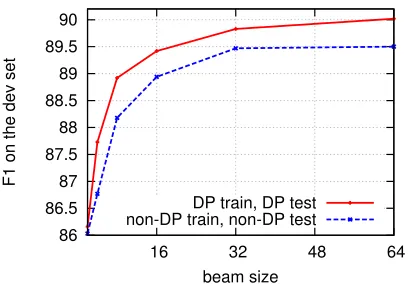
Figure 5: The F1 curves of non-DP and DP parsers (train and test consistently) on the dev set.
ing the MaxEnt POS tagger (at 97.1% accuracy on English, and 94.5% on Chinese) trained on the train-ing set. We setkto 20 for English. And we run two sets of experiments,1-best vs. 20-best, for Chinese to address the tagging issue. We train our parsers us-ing “max-violation perceptron” (Huang et al., 2012) (which has been shown to converge much faster than “early-update” of Collins and Roark (2004)) with minibatch parallelization (Zhao and Huang, 2013) on the head-out binarized and unary-collapsed train-ing set. We finally debinarize the trees to recover the collapsed unary rules.
We evaluate parser performance withEVALB in-cluding labeled precision (LP), labeled recall (LR), and bracketing F1. We use a beam size of 32, and pick the optimal iteration number based on the per-formances on the dev set.
Our baseline is the shift-reduce parser without state recombination (henceforth “non-DP”), and our dynamic programming parser (henceforth “DP”) is the extension of the baseline.
5.1 Learning Curves and Search Quality Figure 4 shows the learning curves on the PTB dev set. With a same beam width, DP parser achieves a better performance (89.8%, peaking at the 11th it-eration) and converges faster than non-DP. Picking the optimal iterations for DP and non-DP models, we test each with various beam size, and plot the F1 curves in Figure 5. Again, DP is always better than non-DP, with 0.5% difference at beam of 64.
LR LP F1 comp.
Collins (1999) 88.1 88.3 88.2 O(n5)
Charniak (2000) 89.5 89.9 89.5 O(n5)† Carreras (2008) 90.7 91.4 91.1 O(n4)‡ Petrov (2007) 90.1 90.2 90.1 O(n3)† Ratnaparkhi (1997) 86.3 87.5 86.9
O(n) Sagae (2006) 87.8 88.1 87.9
Zhu (2013) 90.2 90.7 90.4 non-DP 90.3 90.4 90.3 O(n)
[image:4.612.74.278.69.211.2]DP 90.7 90.9 90.8
Table 2: Final Results on English (PTB) test set (sec23).
†The empirical complexities for Charniak and Petrov are O(n2.5)andO(n2.4), resp.,‡but Carreras is exactO(n4).
LR LP F1 POS Charniak (2000) 79.6 82.1 80.8
-Petrov (2007) 81.9 84.8 83.3 -Zhu (2013) 82.1 84.3 83.2 -Wang (2014)(1-best POS) 80.3 80.0 80.1 94.0
[image:4.612.318.534.269.392.2]Wang (2014)(joint) 82.9 84.2 83.6 95.5 non-DP(1-best POS) 80.7 80.5 80.6 94.5 non-DP(20-best POS) 83.3 83.2 83.2 95.5 DP(20-best POS) 83.6 84.2 83.9 95.6
Table 3: Results on Chinese (CTB) 5.1 test set.
5.2 Final Results on English
Table 2 shows the final results on the PTB test set. The last column shows the empirical time com-plexity. Our baseline parser achieves a competitive score, which is higher than Berkeley even with a lin-ear time complexity, and is comparable to Zhu et al. (2013). Our DP parser improves the F1 score by 0.5 points over the non-DP, and achieves the best F1 score among empirical linear-time parsers.
5.3 Sausage Lattice Parsing
To alleviate the propagation of errors from POS tag-ging, we run sausage lattice parsing on both Chinese and English, where Chinese tagging accuracy signif-icantly lag behind English.
tags for each word in the20-best list is 1.1.
The joint tagging and parsing approach of Wang and Xue (2014) improves the F1 score from 80.1% to 83.6% (see lines 4 and 5). We instead use sausage lattices, a much cheaper way. The non-DP (1-best POS) and non-DP (20-best POS) lines show the ef-fectiveness of using sausage lattices (+1.1 for tag-ging and +2.6 for parsing). As Wang and Xue (2014) is a non-DP model, it is comparable to our non-DP results. With the help of20-best tagging lattices, we achieve the same tagging accuracy at 95.5%, but still 0.4 worse on the F1 score than the joint model. It suggests that we need a largerkto catch up the gap. But our DP model boosts the performance further to the best score at 83.9% with a similar set of features. The last two lines (non-DP and DP) in Table 2 show our English lattice parsing results. So we run another baseline with the non-DP English parser on 1-best POS tags, and the baseline achieves a tagging accuracy at 97.11 and an F1 score at 90.1. Com-paring to the tagging accuracy (97.15) and F1 score (90.3) of our non-DP lattice parser, sausage lattice parsing doesn’t help the tagging accuracy, but helps parsing a little by 0.2 points. The statistics show that 2 percent of POS tags in the lattice parsing result are different from the baseline, and those differences lead to a slight improvement on parsing.
6 Conclusions
In this paper, we present a dynamic programming al-gorithm based on graph-structured stack (GSS) for shift-reduce constituency parsing, and extend the al-gorithm to take tagging sausage lattices as input. Ex-periments on both English and Chinese treebanks show that our DP parser outperforms almost all other parsers except of Carreras et al. (2008), which runs in a much higher time complexity.
Acknowledgment
We thank the anonymous reviewers for comments. Haitao Mi is supported by DARPA HR0011-12-C-0015 (BOLT), and Liang Huang is supported by DARPA FA8750-13-2-0041 (DEFT), NSF IIS-1449278, and a Google Faculty Research Award. The views and findings in this paper are those of the authors and are not endorsed by the DARPA.
References
Xavier Carreras, Michael Collins, and Terry Koo. 2008. Tag, dynamic programming, and the perceptron for ef-ficient, feature-rich parsing. InProceedings of CoNLL 2008.
Eugene Charniak. 2000. A maximum-entropy-inspired parser. InProceedings of NAACL.
Shay B. Cohen, Carlos G´omez-Rodr´ıguez, and Giorgio Satta. 2011. Exact inference for generative probabilis-tic non-projective dependency parsing. InProceedings of the Conference on Empirical Methods in Natural Language Processing.
Michael Collins and Brian Roark. 2004. Incremental parsing with the perceptron algorithm. InProceedings of ACL.
Michael Collins. 1999. Head-Driven Statistical Models for Natural Language Parsing. Ph.D. thesis, Univer-sity of Pennsylvania.
Michael Collins. 2000. Discriminative reranking for nat-ural language parsing. InProceedings of ICML, pages 175–182.
Jun Hatori, Takuya Matsuzaki, Yusuke Miyao, and Jun’ichi Tsujii. 2011. Incremental joint pos tagging and dependency parsing in chinese. InIJCNLP. Liang Huang and Kenji Sagae. 2010. Dynamic
program-ming for linear-time incremental parsing. In Proceed-ings of ACL 2010.
Liang Huang, Suphan Fayong, and Yang Guo. 2012. Structured perceptron with inexact search. In Proceed-ings of NAACL.
Marco Kuhlmann, Carlos Gmez-Rodrguez, and Giorgio Satta. 2011. Dynamic programming algorithms for transition-based dependency parsers. InProceedings of ACL.
Zhenghua Li, Min Zhang, Wanxiang Che, Ting Liu, Wen-liang Chen, and Haizhou Li. 2011. Joint models for chinese pos tagging and dependency parsing. In Pro-ceedings of EMNLP, pages 1180–1191.
Joakim Nivre. 2004. Incrementality in deterministic dependency parsing. InIncremental Parsing: Bring-ing EngineerBring-ing and Cognition Together. Workshop at ACL-2004, Barcelona.
Slav Petrov and Dan Klein. 2007. Improved inference for unlexicalized parsing. In Proceedings of HLT-NAACL.
Adwait Ratnaparkhi. 1997. A linear observed time sta-tistical parser based on maximum entropy models. In Proceedings of EMNLP, pages 1–10.
Masaru Tomita. 1988. Graph-structured stack and natu-ral language parsing. InProceedings of the 26th an-nual meeting on Association for Computational Lin-guistics, pages 249–257, Morristown, NJ, USA. Asso-ciation for Computational Linguistics.
Zhiguo Wang and Nianwen Xue. 2014. Joint pos tag-ging and transition-based constituent parsing in chi-nese with non-local features. InProceedings of ACL. Yue Zhang and Stephen Clark. 2008. A tale of
two parsers: investigating and combining graph-based and transition-based dependency parsing using beam-search. InProceedings of EMNLP.
Kai Zhao and Liang Huang. 2013. Minibatch and paral-lelization for online large margin structured learning. InProceedings of NAACL 2013.