
Unsupervised Entity Linking with Abstract Meaning Representation
Xiaoman Pan1, Taylor Cassidy2, Ulf Hermjakob3, Heng Ji1, Kevin Knight3 1Computer Science Department, Rensselaer Polytechnic Institute
{panx2,jih}@rpi.edu
2IBM Research & Army Research Laboratory
3Information Sciences Institute, University of Southern California
{ulf,knight}@isi.edu
Abstract
Most successful Entity Linking (EL) meth-ods aim to link mentions to their referent en-tities in a structured Knowledge Base (KB) by comparing their respective contexts, of-ten using similarity measures. While the KB structure is given, current methods have suf-fered from impoverished information repre-sentations on the mention side. In this paper, we demonstrate the effectiveness of Abstract Meaning Representation (AMR) (Banarescu et al., 2013) to select high quality sets of en-tity “collaborators” to feed a simple similar-ity measure (Jaccard) to link entsimilar-ity mentions. Experimental results show that AMR captures contextual properties discriminative enough to make linking decisions, without the need for EL training data, and that system with AMR parsing output outperforms hand labeled tradi-tional semantic roles as context representation for EL. Finally, we show promising prelimi-nary results for using AMR to select sets of “coherent” entity mentions for collective en-tity linking1.
1 Introduction
The Entity Linking (EL) task (Ji et al., 2010; Ji et al., 2011; Ji et al., 2014) aims at automati-cally linking each named entity mention appearing
in a sourcetext document to its unique referent in
a target knowledge base (KB). For example,
con-sider the following sentence posted to a discussion forum during the 2012 U.S. presidential election:
1The web service of this EL system is at:
blender02.cs.rpi.edu:3300 and some related AMR tools are at: github.com/panx27/amr-reader
“Where would McCain be without Sarah?”. An
Entity Linker should link the entity mentions “ Mc-Cain” and “Sarah” to the entities John McCain
and Sarah Palin, respectively, which serve as unique identifiers for the real people.
A typical EL system works as follows. Given a mentionm (a string in a source document), the top N most likely entity referents from the KB are enu-merated based on prior knowledge about which en-tities are most likely referred to usingm. The can-didate entities are re-ranked to ultimately link each mention to the top entity in its candidate list. Re-ranking consists of two key elements: context
rep-resentation and context comparison. For a given
mention, candidate entities are re-ranked based on a comparison of information obtained from the con-text ofmwith known structured and/or unstructured information associated with the top N KB entities, which can be considered the “context” of the KB en-tity2. The basic intuition is that the entity referents ofmand related mentions should be similarly con-nected in the KB.
However, there might be many entity mentions in the context of a target entity mention that could po-tentially be leveraged for disambiguation. In this pa-per, we show that a deeper semantic knowledge rep-resentation - including the Abstract Meaning Rep-resentation (AMR) (Banarescu et al., 2013) - can capture contextual properties that are discriminative enough to disambiguate entity mentions that current state-of-the-art systems cannot handle, without the need for EL training data. Specifically, for a given
2Most work uses Wikipedia and related resources to
de-rive the KB, prior link likelihood, and entity information (e.g., Wikipedia article text and infoboxes).
entity mention, using AMR provides a rich context representation, facilitating the selection of an opti-mal set of collaborator entity mentions, i.e., those co-occurring mentions most useful for disambigua-tion. In previous approaches, collaborator sets have tended to be too narrow or too broad, introducing noise. We then use unsupervised graph inference for context comparison, achieving results compa-rable with state-of-the-art supervised methods and substantially outperforming context representation based on traditional Semantic Role Labeling.
In addition, most state-of-the-art EL approaches now rely oncollective inference, where a set of
co-herent mentionsare linked simultaneously by
choos-ing an “optimal” or maximally “coherent” set of named entity targets - one target entity for each men-tion in the coherent set. We show preliminary results suggesting that AMR is effective for the partitioning of all mentions in a document into coherent sets for collective linking.
We evaluate our approach using both human and automatic AMR annotation, limiting target named entity types to person (PER), organization (ORG), and geo-political entities (GPE)3.
2 Related Work
In most recent collective inference methods for EL (e.g., (Kulkarni et al., 2009; Pennacchiotti and Pan-tel, 2009; Fernandez et al., 2010; Radford et al., 2010; Cucerzan, 2011; Guo et al., 2011; Han and Sun, 2011; Ratinov et al., 2011; Chen and Ji, 2011; Kozareva et al., 2011; Dalton and Dietz, 2013)), the target entity mention’s “collaborators” may sim-ply include all mentions which co-occur in the same discourse (sentence, paragraph or document) (Rati-nov et al., 2011; Nguyen et al., 2012). But this ap-proach usually introduces many irrelevant mentions, and it’s very difficult to automatically determine the scope of discourse. In contrast, some recent work exploited more restricted measures by only choos-ing those mentions which are topically related (Cas-sidy et al., 2012; Xu et al., 2012), bear a relation from a fixed set (Cheng and Roth, 2013), coreferen-tial (Nguyen et al., 2012; Huang et al., 2014), so-cially related (Cassidy et al., 2012; Huang et al.,
3The mapping from AMR entity types to these three main
types is at: amr.isi.edu/lib/ne-type-sc.txt
2014), dependent (Ling et al., 2014), or a combi-nation of these through meta-paths (Huang et al., 2014). These measures can collect more precise collaborators but suffer from low coverage of pre-defined information templates and the unsatisfying quality of state-of-the-art coreference resolution, re-lation and event extraction.
In this paper, we demonstrate that AMR is an ap-propriate and elegant way to acquire, select, repre-sent and organize deeper knowledge in text. To-gether with our novel utilization of the rich struc-tures in merged KBs, the whole framework carries rich enough evidence for effective EL, without the need for any labeled data, collective inference, or sophisticated similarity.
3 Knowledge Network Construction from Source
Abstract Meaning Representation (AMR) (Ba-narescu et al., 2013) is a sembanking language that captures whole sentence meanings in a rooted, di-rected, labeled, and (predominantly) acyclic graph structure. AMR utilizes multi-layer linguistic anal-ysis such as PropBank frames, non-core semantic roles, coreference, named entity annotation, modal-ity and negation to represent the semantic structure of a sentence. AMR strives for a more logical, less syntactic representation. Compared to traditional dependency parsing and semantic role labeling, the nodes in AMR are entities instead of words, and the edge types are much more fine-grained4. AMR thus captures deeper meaning compared with other rep-resentations more commonly used to represent men-tion context in EL.
We use AMR to represent semantic information about entity mentions expressed in their textual con-text. Specifically, given an entity mention m, we use a rule based method to construct a Knowledge Network, which is a star-shaped graph withmat the hub, with leaf nodes obtained from entity mentions reachable by AMR graph traversal fromm, as well as AMR node attributes such as entity type. A sub-set of the leaf nodes are selected asm’s collabora-tors using rules presented in the following
subsec-4AMR distinguishes between entities and concepts, the
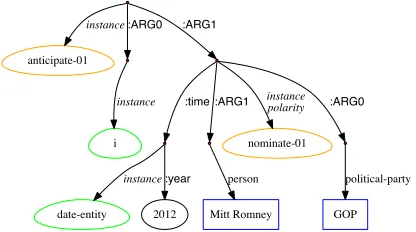
tions. Note that while we only evaluate linking of PER, ORG, and GPE entities, collaborators may be of any type. We also outline preliminary efforts to use AMR to create sets of coherent entity mentions. In each of the following subsections we describe elements of AMR useful for context representation in EL. For each element we explain how our cur-rent system makes use of it (primarily, by using it to add entity mentions to a particular entity mention’s set of collaborators). In doing so, we mainly refer to several examples from political discussion forums about “Mitt Romney”, “Ron Paul” and “Gary John-son”. Their AMR graphs are depicted in Figure 1.
3.1 Entity Nodes
Each AMR node represents an entity mention, and contains its canonical name as inferred from senten-tial context. This property is called name expan-sion. Consider the following sentence: “Indonesia
lies in a zone where the Eurasian, Philippine and
Pacificplates meet and occasionally shift, causing
earthquakes and sometimes generating tsunamis.”.
Here, the nodes representing the three plates will be labeled as “Eurasian Plate”, “Philippine Plate” and “Pacific Plate” respectively, even though these strings do not occur in the sentence. Note that these labels may be recovered primarily by ap-pealing to syntactic reasoning, without consulting a KB. In our implementation we consider these ex-panded names as mentions (these strings supersede raw mentions as input to the salience based candi-date enumeration (Section 5.2)). Because the ini-tial enumeration of entity candidates depends heav-ily on the mention’s surface form, independent of context, name expansion will help us link “ Philip-pine” to “Philippine Sea Plate” as opposed to the country.
An AMR node also contains an entity type. AMR defines 8 main entity types (Person, Organization, Location, Facility, Event, Product, Publication, Nat-ural object, Other) and over one hundred fine-grained subtypes. For example, company, govern-ment organization, military, criminal organization, political party, school, university, research institute, team and league are subtypes of organization. The fine-grained entity types defined in AMR help us restrict KB entity candidates for a given mention by encouraging entity type matching. For
exam-anticipate-01
instance:ARG0 :ARG1
i
instance :time :ARG1
nominate-01 instance polarity :ARG0
date-entity instance
2012
:year
Mitt Romney person
GOP political-party
(a) I am cautiously anticipating the GOP nominee in 2012 not to beMitt Romney.
governor
instance
Massachusetts state
:ARG2 :ARG1
have-org-role-91
instance
:ARG0-of
Romney person
(b)Romneywas the Governor of Massachusetts...
great :mod
grandson instance
pioneer instance :mod
Mormon religious-group :ARG2 :ARG1
have-rel-role-91 instance :ARG0
Romney person
(c) Romneyis the great-great-grandson of a Mormon pioneer...
candidate
instance:mod :example
Republican
political-party :op2 :op1 :op3
and
instance
Paul person
Romney person
Johnson person
[image:3.612.333.541.61.177.2](d) Republican candidates like Romney, Paul, and Johnson...
Figure 1: AMR for the Walk-through Example
year but the bulava nuclear-armed missile devel-oped to equip the submarine has failed tests and the
deployment prospects are uncertain.”, AMR labels
“Yuri dolgoruky” as a product instead of a person.
We manually mapped AMR entity types to equiva-lent DBpedia types to inform type matching restric-tions5. However, to make our context comparison algorithm less dependent on the quality of this map-ping, and on automatic AMR name type assignment, we add a mention’s type to its collaborators 6. In future work we plan to investigate the effects of dif-ferent type matching techniques, varying degrees of strictness.
3.2 Semantic Roles
AMR defines core roles based on the OntoNotes (Hovy et al., 2006) semantic role layer. Each predicate is associated with a sense and frame description. If a target entity mention
m and a context entity mentionn are both playing core roles for the same predicate, we considern as a collaborator of m. Consider the following post:
“Did Palin apologize to Giffords? He needs to
conduct a beer summit between Palin andNBC.”.
We add “Giffords” and “NBC” as collaborators of
“Palin”, because they play core roles in both the
“apologize-01” and “meet-03” events.
AMR defines new core semantic roles which did not exist in PropBank (Palmer et al., 2005), Nom-Bank (Meyers et al., 2004), or Ontonotes (Hovy et al., 2006). Intuitively, the following special roles should provide discriminative collaborators:
• The ARG2 role of thehave-org-role-91frame in-dicates the title held by an entity (ARG0), such as President and Governor, within a particular orga-nization (ARG1).
• ARG2 and ARG3 ofhave-rel-role-91are used to describe two related entities of the same type, such as family members.
AMR defines a rich set of general semantic rela-tions through non-core semantic roles. We choose the following subset of non-core roles to provide collaborators for entity mentions: domain, mod,
5The mapping from three main types and AMR entity types
to Dbpedia types is at: nlp.cs.rpi.edu/amrel/dbtype.txt
6A more strict approach might disallow type mismatches
be-tween entity mentions and their target KB entities outright.
cause, concession, condition, consist-of, extent,
part,purpose,degree,manner,medium,instrument,
ord,poss,quant,subevent,subset,topic.
3.3 Background Time and Location
AMR provides rich temporal and spatial informa-tion about entities and events. Types instantiated in AMR include time, year, month, day, source, destination, path and location. We exploit time and location entities as collaborators for entity mentions when they each play a role in the same predicate. For example, in the following post, the time role of the “die-01” event is “2008”: “I just Read of
Clark’s death in 2008”. We can link “Clark” to
Arthur C Clark in the KB, which contains the triple: ăArthur C Clark, date-of-death, 2008-03-19ą (see Section 4). Similarly, it’s very challenging to link the abbreviation “BMKG”, in the following sentence, to the correct target entity
Indonesian Agency for Meteorology, Climatology and Geophysics, whose headquarters are listed as Jakarta in the KB:
“It keeps on shaking. Jakarta BMKG spokesman
Mujuhidin said”. Here, “Jakarta” is added as a
collaborator of “BMKG” since AMR labels it as the location of the organization, which facilitates the correct link because in DBpediaJakartais listed as its headquarter.
Authors often assume that readers will infer im-plicit temporal information about events. In fact, half of the events extracted by information extrac-tion (IE) systems lack time arguments (Ji et al., 2009). Therefore if an AMR parse includes no time information, we use the document creation time as an additional collaborator for mention in question. For example, knowing the document creation time
“2005-06-05” can help us link “Hsiung Feng” in
the following sentence “The BBC reported that
Tai-wan has successfully test fired the Hsiung Feng,
its first cruise missile.” to Hsiung Feng IIE,
which was deployed in 2005. Similarly, we include document creation location as a global collaborator.
3.4 Coreference
collabo-rator sets. From here on we refer to a coreferential chain of mentions as simply a “mention”.
AMR currently only represents sentence-level coreference resolution. In order to construct a knowledge network across sentences, we use the fol-lowing heuristic rules. If two names have a substring match (on a token-wise basis with stop words re-moved), or one name consists of the initials of an-other in all capital letters, then we mark them as coreferential. We replace all names in a corefer-ential chain with their canonical name, which may have been derived via name expansion (Section 3.1): full names for people and abbreviations for organi-zations.
3.5 Knowledge Networks for Coherent Mentions
AMR defines a rich set of conjunction relations:
“and”, “or”, “contrast-01”, “either”, “compared
to”, “prep along with”, “neither”, “slash”, “
be-tween” and “both”. These relations are often
ex-pressed between entities that have other relations in common. We therefore group mentions connected by conjunction relations into sets of coherent men-tions. This representation is used only in preliminary experiments on collective entity linking.
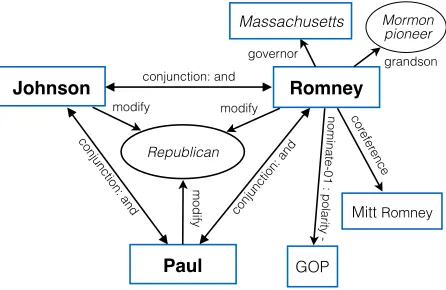
Figure 2 shows the expanded knowledge net-work that includes results from individual netnet-works for each of the coherent mentions from the walk-through example. For each coherent set, we merge the knowledge networks of all of its mentions7.
Johnson Romney
Paul
grandson
cor efer
ence nominate01 : polarity -governor
Republican
modify modify
modify
conjunction: and
conjunction: and
conjunction: and Massachusetts
GOP
Mitt Romney
[image:5.612.74.297.496.641.2]Mormon pioneer
Figure 2: Knowledge Network for Mentions in Source
7recall that by mention, we mean a coreferential chain of
mentions that may extend across sentences
4 Knowledge Network Construction from KB
We combine Wikipedia with derivative resources to create the KB. The KB is a single knowledge net-work in which nodes are entities (Wikipedia arti-cles) or constant values (e.g. a dollar amount or date), and the edges represent relations. We use this structure for context representation for entities, which together with context representation for men-tions (Section 3) feeds re-ranking based on context comparison.
The KB is formally represented by triples: ăEntity, EdgeLabel, Nodeą
whereEntityis the entity’s unique identifier,
Edge-Labelis relation type, andNodeis the corresponding
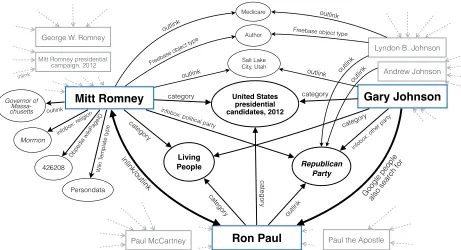
relation value - either another Entity or a constant. These triples are derived from typed relations ex-pressed within Wikipedia infoboxes, Templates, and Categories, untyped hyperlinks within Wikipedia article text, typed relations within DBpedia (db-pedia.org) and Freebase (www.freebase.com), and Google’s “people also searched for” list8. Figure 3 shows a portion of the KB pertaining to the example in Figure 1.
In order to merge nodes from multiple KBs, we use the Wikipedia title as a primary key, and then use DBpediawikiPageIDand FreebaseKeyrelations. 5 Linking Knowledge Networks
5.1 Overview
In this section we present our detailed algorithm to link each mention to a KB entity using a simple simi-larity measure over knowledge networks. Recall that a rule-based method has already been employed to construct star-shaped knowledge networks for indi-vidual mentions and entities (see sections 3 and 4; A KB knowledge network is the subnetwork of the entire KB centered at a candidate entity).
For each mention to be linked, an initial list of candidate entities are enumerated based on entity salience with respect to the mention, independent of mention context (Section 5.2)9. Context
collabora-tor re-ranking proceeds in an unsupervised fashion
8In response to a query entity Google provides a list of
en-tities that “people also search for” - we add them to the entity’s network.
Mitt Romney Gary Johnson
Ron Paul United States presidential candidates, 2012
category category
categor
y
Living
People Republican
Party
inlink/outlink
Salt Lake City, Utah
outlink outlink
Lyndon B. Johnson Author
outlink
outlink
Freebase object type
Freebase object type
Paul the Apostle
Mormon
Persondata
outlink
infobox: religion
Wiki T emplate type
Paul McCartney
Andrew Johnson
George W. Romney
Google people also sear ch for
outlink outlink
categor y
categor
y
categor y
Medicare
infobox: political par
ty
infobox: other par ty
outlink
Mitt Romney presidential campaign, 2012
Dbpedia wikiPageID
426208
[image:6.612.77.538.61.311.2]Governor of Massa- chusetts inlink
Figure 3: Knowledge Network for Entities in KB
agnostic to knowledge network edge labels using the Jaccard similarity measure computed between the mention and each entity, by taking their collabora-tor sets as inputs (Section 5.3).
We also describeContext Coherencere-ranking in terms of KB knowledge networks only, which con-stitutes preliminary steps toward unsupervised col-lective entity linking in section 5.4 based on the no-tion of coherence described in secno-tion 3.5. We leave a combination of the two re-ranking approaches to future work.
5.2 Salience
We use commonness (Medelyan and Legg, 2008) as a measure of context independent salience for each mention m, to generate an initial ranked list of candidate entities E “ pe1, ..., eNq where N is the cutoff for number of candidates. In all experiments, we used N = 15 which can give us an oracle accuracy score 97.58%.
Commonnesspm, eq “ řcountpm, eq
e1countpm, e1q
Here, countpm, eq is the number of hyperlinks with anchor text m and entity e within all of Wikipedia. As illustrated in Figure 3, using this salience measure “Romney” is successfully linked to
Mitt Romney. For the mention “Paul”, the politi-cianRon Paulis ranked at top 2 (less popular than the musician Paul McCartney). For the men-tion “Johnson”, the correct entityGary Johnson
is ranked at top 9, after more popular entities such as
Lyndon B. JohnsonandAndrew Johnson.
5.3 Context Collaborator Based Re-ranking
Context collaborator based re-ranking is driven by the similarity between mention and entity knowl-edge networks. We construct knowlknowl-edge network gpmqfor each mentionm, and knowledge network gpeiq for each entity candidate ei in m’s entity candidate listE. We re-rankEaccording to Jaccard Similarity, which computes the similarity between gpmqandgpeiq:
Jpgpmq, gpeiqq “ |gpmq Xgpeiq| |gpmq Ygpeiq|
more token in common. Due to the support from their neighbor Republicanin the KB (Figure 3) which matches the neighbor “Republican” of men-tions “Paul” and “Johnson” (Figure 2),Ron Paul
and Gary Johnson are promoted to top 1 and top 3 respectively. Gary Johnsonis still behind two former U.S. presidents Andrew Johnson
and Lyndon B. Johnson who also shares the neighborRepublicanin the KB.
5.4 Context Coherence Based Re-ranking
Context coherence based re-ranking is driven by the similarity among KB entities. Let Rm be a set of
coherent entity mentions, andREbe the set of
corre-sponding entity candidate lists, which are generated according to salience. GivenRE, we generate every
combination of possible top candidate lists for the mentions inRm, and denote the set of these
combi-nationsCm. Formally,Cm is the Cartesian product
of all candidate listsE P RE. In the walk-through
example, Rm contains [“Romney”, “Paul”, “ John-son”], and Cm contains [Mitt Romney, Ron
Paul, Gary Johnson], [Mitt Romney, Paul McCartney, Lyndon Johnson], etc. We compute coherence for each combination c P Cm as Jaccard Similarity, by applying a form
of Equation 5.3 generalized to take any number of arguments to the set of knowledge networks for all entities inc, i.e.,tgpeq|ePcu. The highest similar-ity combination is selected, yielding a top candidate for each m P Rm. For example, compared to
Andrew Johnson and Lyndon Johnson,
Gary Johnson is more coherently connected with Mitt Romneyand Ron Paul, therefore it is promoted to top 1 with the coherence measure.
6 Experiments
6.1 Data And Scoring Metric
For our experiments we use a publicly available AMR R3 corpus (LDC2013E117) that includes manual EL annotations for all entity mentions (LDC2014E15)10.
For evaluation we used all the discussion forum posts (DF), and news documents (News) that were
10EL annotations are available to KBP shared task
regis-trants (nlp.cs.rpi.edu/kbp/2014) via Linguistic Data Consortium (www.ldc.upenn.edu).
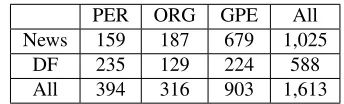
sorted according to alphabetic order of document IDs and taken as a tenth. The detailed data statis-tics are presented in Table 111.
PER ORG GPE All
News 159 187 679 1,025
DF 235 129 224 588
[image:7.612.339.511.112.164.2]All 394 316 903 1,613
Table 1: Total # of Entity Mentions in Test Set
For each mention, we check whether the KB en-tity returned by an approach is correct or not. We compute accuracy for an approach as the proportion of mentions correctly linked.
6.2 Experiment Results
We focus primarily on context collaborator based re-ranking results. We compare our results with several baseline and state-of-the-art approaches in Table 2. In Table 3 we present preliminary results for collec-tive linking.
Our Unsupervised Context Collaborator Ap-proach substantially outperforms the popularity based methods. More importantly, we see that AMR provides the best context representation for collabo-rator selection. Even system AMR outperformed not only baseline co-occurrence based collaborator se-lection methods, but also outperforms the collabora-tor selection method based on human annotated core semantic roles. Figure 4 depicts accuracy increases as more AMR annotation is used in selecting collab-orators. From the commonness baseline, additional knowledge about individual names leads to substan-tial gains followed by additional gains after incorpo-rating links denoting semantic roles. Note that coref-erence here includes cross-sentence co-refcoref-erence not based on AMR (Section 3.4). Furthermore, the re-sults using human annotated AMR outperform the state-of-the-art supervised methods trained from a large scale EL training corpus, which rely on collec-tive inference12. These results all verify the impor-tance of incorporating a wider range of deep knowl-edge. Finally, Table 2 presents results in which our
11The list of document IDs in the test set is at:
nlp.cs.rpi.edu/amrel/testdoc.txt
12Note that the ground-truth EL annotation for the test set
Approach Definition News DF Total Popularity CommonnessGoogle based on the popularity measure as described in section 5.2. 89.76 68.99 82.20 Search use the top Wikipedia page returned by Google search using themention as a key word. 88.10 77.17 84.12 Supervised
State-of-the-art supervised re-ranking using multi-level linguistic features forcollaborators and collective inference, trained from 20,000 en-tity mentions from TAC-KBP2009-2014. We combined two systems (Chen and Ji, 2011; Cheng and Roth, 2013) using rules to highlight their strengths.
93.07 87.41 91.01
Unsupervised Context Collaborator
Approach
Sen. Level
Cooccurrence sentence-level co-occurrence based collaborator selection(collaborators limited to human AMR-labeled named entities) 93.1790.77 73.2570.31 85.9283.31 Doc. Level
Cooccurrence document-level co-occurrence based collaborator selection(collaborators limited to human AMR-labeled named entities) 90.0587.51 69.8669.37 82.6980.90 Human AMR using human annotated AMR nodes and edges. 93.56 86.88 91.13
System AMR using AMR nodes and edges automatically generated by an
AMR parser (Flanigan et al., 2014). 90.15 85.69 88.52 Human SRL using human annotated core semantic roles defined in
Prop-Bank (Palmer et al., 2005) and NomProp-Bank (Meyers et al., 2004): ARG0, ARG1, ARG2, ARG4 and ARG5.
93.27 71.21 85.24
Unsupervised Combined Approach
Human AMR coherence approach used where possible (215 mentions), col-laborator approach elsewhere (remaining 1398 mentions), using human annotated AMR nodes and edges.
[image:8.612.75.540.58.314.2]94.34 88.25 92.12
Table 2: Accuracy (%) on Test Set (1613 mentions)
context coherence method is used where possible (i.e., those 215 mentions that are members of co-herent sets according to our criteria as described in Section 3.5), and the context collaborator approach based on human AMR annotation is applied else-where.
Figure 4: AMR Annotation Layers Effects on Accuracy
Table 3 focuses on the 215 mentions that met our narrow criteria for forming a coherent set of men-tions. We applied the context coherence based re-ranking method (Section 5.4) to collectively link those mentions. This approach substantially forms the co-occurrence baseline, and even outper-forms the context collaborator approach applied to those 215 mentions, especially for discussion forum
Approach Description News DF All Coherence: coherence set built from
within-sentence collaborators limited to human AMR-labeled Named Entities.
72.64 76.85 75.47
Coherence: coherence set built from
hu-man AMR conjunctions (Sec. 3.5) 96.73 95.16 96.28 Collaborator: used coherent set based on
[image:8.612.73.299.442.550.2]human AMR as collaborators. 91.50 82.26 88.84
Table 3: Context Coherence Accuracy (%) on 215 Men-tions which Can Form Coherent Sets
6.3 Remaining Error Analysis and Discussion
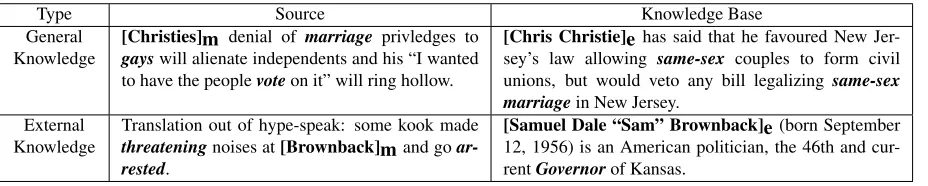
A challenging source of errors pertains to the
knowl-edge gap between the source text and KB. News
Type Source Knowledge Base General
Knowledge [Christies]gayswill alienate independents and his “I wantedm denial of marriage privledges to to have the peoplevoteon it” will ring hollow.
[Chris Christie]ehas said that he favoured New
Jer-sey’s law allowing same-sex couples to form civil unions, but would veto any bill legalizingsame-sex marriagein New Jersey.
External
Knowledge Translation out of hype-speak: some kook madethreateningnoises at[Brownback]mand go ar-rested.
[Samuel Dale “Sam” Brownback]e(born September
[image:9.612.78.542.59.152.2]12, 1956) is an American politician, the 46th and cur-rentGovernorof Kansas.
Table 4: Examples of Knowledge Gap
that our system does not correctly link. In the first example, if we don’t already know that Christie is the topic of discussion, as humans we might use our general knowledge that “governors veto bills” to pick the correct entity. Using this type of knowl-edge presents interesting challenges (e.g., governors don’t always veto bills, nor are they the only ones who can do so). In the second example, the rumor about this politician is not important enough to be re-ported in his Wikipedia page. We might first figure out, using cross-document coreference techniques, that a news article with the headline “Man Accused Of Making Threatening Phone Call To Kansas Gov.
Sam Brownback May Face Felony Charge...” is
talking about the same rumor. Then we might use biographical facts (e.g., Brownback is the governor of Kansas) from the article to enrich Brownback’s knowledge network on the source side.
Sometimes helpful neighbor concepts are omitted because the current collaborator se-lection criteria are too restricted. For exam-ple, “armed” and “conflicts” are informative words for linking “The Stockholm Institute”
to Stockholm International Peace
Research Institute in the following sen-tence “The Stockholm Institute stated that 23 of 25 major armed conflicts in the world in 2000
occurred in impoverished nations.”, but they were
not selected as context collaborators. In addi-tion, our cross-sentence coreference resolution is currently limited to proper names. Expanding it to include nominals could further enrich context collaborators to overcome some remaining errors. For example, in the sentence, “The first woman to
serve onSCOTUS”, if we know “The first woman”
is coreferential with “Sandra Day O’Connor” in the previous sentence, we can link “SCOTUS” to
Supreme Court of the United States
instead ofScotus College.
7 Conclusions and Future Work
EL requires a representation of the relations among entities in text. We showed that the Abstract Mean-ing Representation (AMR) can better capture and represent the contexts of entity mentions for EL than previous approaches. We plan to improve AMR representation as well as automatic annotation. We showed that AMR enables EL performance compa-rable to the supervised state of the art using an unsu-pervised, non-collective approach. We plan to com-bine collaborator and coherence methods into a uni-fied approach, and to use edge labels in knowledge networks for context comparison (note that the last of these is quite challenging due to normalization, polysemy, and semantic distance issues). We have only applied a subset of AMR representations to the EL task, but we aim to explore how more AMR knowledge can be used for other more challenging Information Extraction and Knowledge Base Popu-lation tasks.
Acknowledgments
References
L. Banarescu, C. Bonial, S. Cai, M. Georgescu, K. Grif-fitt, U. Hermjakob, K. Knight, P. Koehn, M. Palmer, and N. Schneider. 2013. Abstract meaning
representa-tion for sembanking. InProc. ACL 2013 Workshop on
Linguistic Annotation and Interoperability with Dis-course.
T. Cassidy, H. Ji, L. Ratinov, A. Zubiaga, and H. Huang. 2012. Analysis and enhancement of wikification for
microblogs with context expansion. In Proc.
In-ternational Conference on Computational Linguistics (COLING 2012).
Z. Chen and H. Ji. 2011. Collaborative ranking: A case
study on entity linking. InProc. Empirical Methods in
Natural Language Processing (EMNLP 2011). X. Cheng and D. Roth. 2013. Relational inference for
wikification. In Proc. Empirical Methods in Natural
Language Processing (EMNLP 2013).
S. Cucerzan. 2011. Tac entity linking by performing full-document entity extraction and disambiguation. In
Proc. Text Analysis Conference (TAC 2011).
J. Dalton and L. Dietz. 2013. A neighborhood relevance
model for entity linking. InProc. Open Research
Ar-eas in Information Retrieval (OAIR 2013).
N. Fernandez, J. A. Fisteus, L. Sanchez, and E. Martin. 2010. Webtlab: A cooccurence-based approach to kbp
2010 entity-linking task. InProc. Text Analysis
Con-ference (TAC 2010).
J. Flanigan, S. Thomson, J. Carbonell, C. Dyer, and N. A. Smith. 2014. A discriminative graph-based parser for
the abstract meaning representation. InProc.
Associa-tion for ComputaAssocia-tional Linguistics (ACL 2014). Y. Guo, W. Che, T. Liu, and S. Li. 2011. A graph-based
method for entity linking. InProc. International Joint
Conference on Natural Language Processing (IJCNLP 2011).
X. Han and L. Sun. 2011. A generative entity-mention model for linking entities with knowledge base. In
Proc. Association for Computational Linguistics: Hu-man Language Technologies (ACL-HLT 2011). E.d Hovy, M. Marcus, M. Palmer, L. Ramshaw, and
R. Weischedel. 2006. Ontonotes: The 90% solution. In Proc. Human Language Technology conference -North American chapter of the Association for Com-putational Linguistics (HLT-NAACL 2006).
H. Huang, Y. Cao, X. Huang, H. Ji, and C. Lin. 2014. Collective tweet wikification based on
semi-supervised graph regularization. InProc. Association
for Computational Linguistics (ACL 2014).
H. Ji, R. Grishman, Z. Chen, and P. Gupta. 2009. Cross-document event extraction and tracking: Task,
eval-uation, techniques and challenges. In Proc. Recent
Advances in Natural Language Processing (RANLP 2009).
H. Ji, R. Grishman, H. T. Dang, K. Griffitt, and J. Ellis. 2010. Overview of the tac 2010 knowledge base
pop-ulation track. InProc. Text Analysis Conference (TAC
2010).
H. Ji, R. Grishman, and H. T. Dang. 2011. Overview of the tac 2011 knowledge base population track. In
Proc. Text Analysis Conference (TAC 2011).
H. Ji, J. Nothman, and H. Ben. 2014. Overview of
tac-kbp2014 entity discovery and linking tasks. InProc.
Text Analysis Conference (TAC 2014).
Z. Kozareva, K. Voevodski, and S. Teng. 2011. Class
label enhancement via related instances. In Proc.
Empirical Methods in Natural Language Processing (EMNLP 2011).
S. Kulkarni, A. Singh, G. Ramakrishnan, and
S. Chakrabarti. 2009. Collective annotation of
wikipedia entities in web text. In Proc. Knowledge
Discovery and Data Mining (KDD 2009).
X. Ling, S. Singh, and D. S. Weld. 2014. Context
rep-resentation for named entity linking. InProc. Pacific
Northwest Regional NLP Workshop (NW-NLP 2014). O. Medelyan and C. Legg. 2008. Integrating cyc
and wikipedia: Folksonomy meets rigorously defined
common-sense. In Proc. AAAI 2008 Workshop on
Wikipedia and Artificial Intelligence.
A. Meyers, R. Reeves, C. Macleod, R. Szekely, V. Zielin-ska, B. Young, and R. Grishman. 2004. The nombank
project: An interim report. InProc. HLT-NAACL 2004
Workshop on Frontiers in Corpus Annotation. H. Nguyen, H. Minha, T. Cao, and T. Nguyenb. 2012.
Jvn-tdt entity linking systems at tac-kbp2012. InProc.
Text Analysis Conference (TAC 2012).
M. Palmer, D. Gildea, and P. Kingsbury. 2005. The proposition bank: An annotated corpus of semantic
roles.Computational Linguistics, 31(1):71–106.
M. Pennacchiotti and P. Pantel. 2009. Entity extraction
via ensemble semantics. InProc. Empirical Methods
in Natural Language Processing (EMNLP 2009). W. Radford, B. Hachey, J. Nothman, M. Honnibal, and
J. R. Curran. 2010. Cmcrc at tac10: Document-level
entity linking with graph-based re-ranking. In Proc.
Text Analysis Conference (TAC 2010).
L. Ratinov, D. Roth, D. Downey, and M. Anderson. 2011. Local and global algorithms for
disambigua-tion to wikipedia. In Proc. Association for
Compu-tational Linguistics: Human Language Technologies (ACL-HLT 2011).
J. Xu, Q. Lu, J. Liu, and R. Xu. 2012. Nlpcomp in tac
2012 entity linking and slot-filling. InProc. Text

![2 Methyl 6 (trifluoromethyl)imidazo[1,2 a]pyridine 3 carbonitrile](data:image/gif;base64,R0lGODlhAQABAIAAAP///wAAACH5BAEAAAAALAAAAAABAAEAAAICRAEAOw==)