Evaluating Embeddings using Syntax-based Classification Tasks as a
Proxy for Parser Performance
Arne Köhn
Deparment of Informatics Universität Hamburg
Abstract
Most evaluations for vector space models are semantically motivated, e.g. by mea-suring how well they capture word similar-ity. If one is interested in syntax-related downstream applications such as depen-dency parsing, a syntactically motivated evaluation seems preferable. As we show, the choice of embeddings has a noticeable impact on parser performance. Since eval-uating embeddings directly in a parser is costly, we analyze the correlation between the full parsing task and a simple linear classification task as a potential proxy.
1 Introduction
Many complex tasks in NLP are solved using em-beddings as additional features. In some pipelines, pre-trained embeddings are used as-is, in oth-ers they are learned as an integral part of train-ing the pipeline (examples for this would be e. g. RNNLMs(Mikolov et al., 2010) or parsers that learn their own embeddings (e. g. Chen and Man-ning (2014))). We focus on the first type. If we want to run a system that can be enhanced using pre-trained embeddings, the question arises which embedding actually works best.
Since it is computationally infeasible to evalu-ate all embeddings on all pipelines, usually simple tasks are used to demonstrate the strengths of em-beddings and an embedding for use in a pipeline is picked based on these proxy tasks. Most of these tasks are semantically motivated and English domi-nates as language of choice for the tasks. Last year, we proposed a more syntactically motivated eval-uation tasksyneval, which uses morpho-syntactic information across a variety of languages (see Sec-tion 2).
Morphological information helps syntactic parsers, but usually there is no gold-standard infor-mation available during parsing (with the exception of parser evaluation). Using embeddings that are good predictors of the missing morphological in-formation should alleviate the problem of missing morphology.
It is reasonable to assume that the classification problems in syneval are a good proxy for syntax-related tasks because they describe how well an embedding is able to capture morphological in-formation which is helpful to the parser. To test this assumption, we evaluate the performance of RBGParser (Lei et al., 2014; Zhang et al., 2014) using different embeddings as additional features. The parser performance using a specific embed-ding should then reflect the embedembed-ding’s perfor-mance on the classification tasks. We know that embeddings yield only marginal improvements if the parser also has access to gold standard morpho-logical information but benefits significantly if no morphological information is present (Lei et al., 2014; Köhn et al., 2014). Therefore, we experi-ment with stripping the information that is used as classification target in syneval.
2 Syneval
In previous work, we proposed to make use of treebanks to extract simple syntactic evaluation tasks (Köhn, 2015) but somehow didn’t assign a catchy name. We now make up for this and call this approachsynevalthroughout this paper. For a given syntactic feature typeF(e.g. tense or case), a classification task is created as follows: LetW be the set of words forms andV ⊆Rnthe vector space of a given embedding W → V. Using a treebank where some words1 are annotated with
1Some words are not annotated with features of certain types, e. g. nouns are usually annotated without tense markers.
20 30 40 50 60 70 80 90 100
pos label headpos case gender tense number
B E F G H P S B E F G H P S B E F G H P S B G H P S F G P S B F G H P S B F G H P S dimensionality 10
[image:2.595.77.524.85.218.2]dep cbow glove baseline approx-up
Figure 1: Accuracies for the proxy tasksynevalevaluated onBasque,English,French,German,Hungarian, Polish, andSwedish. Note that dep was not evaluated on French. All results are from Köhn (2015). Results for embeddings not discussed in this paper have been omitted.
a syntactic feature of the given type f ∈ F, we combine the syntactic information with the word vectorv ∈V of the word, obtaining a pair(v, f)
for each word. In other words, we perform an inner join of the embedding and the syntactic annotation on the word and project onV andF.
Note that there is no functional dependence W → F because the same word form can have different syntactic features depending on the con-text. Therefore, there is also no functional depen-dence between the word vectors and the syntactic features.
A linear classifier is trained on (v, f) pairs to predict the syntactic feature given the word embed-ding. If the classifier yields a high accuracy, the embeddings encode structure with respect to the syntactic feature type. The vector space is parti-tioned by the classifier into convex polytopes which each represent one syntactic feature (such as NN for the PoS classification task) and if the classifier has a high accuracy, these polytopes accurately de-scribe the features. Since the classifier does not use any context features and a word vector can be paired with different syntactic features, the upper bound for classification accuracy can be approx-imated by classification based on the word form. The lower bound is the majority baseline, i.e. using no features at all.
The syntactic features used in syneval are: pos (the PoS of the word), label(the dependency la-bel),headpos(the PoS of the word’s head) as well as the morphological featurescase,gender,tense, andnumber. Syneval results for a selected set of embeddings are depicted in Figure 1.
Syneval has several advantages over other
em-bedding evaluation methods: First of all, it uses several languages instead of being centered on En-glish. It does not need manually generated data such as similarity judgments as the treebanks used for evaluation have already been built for other pur-poses. Syneval covers much more lexical items than other evaluations: SimLex-999 (Hill et al., 2015, one of the larger word similarity corpora) contains 1030 word forms whereas syneval per-forms an evaluation on nearly 30.000 word per-forms for English.
3 Data and Embeddings
To limit the amount of computation, we select four languages out of the seven evaluated by Köhn (2015), namely Basque, German, Hungarian, and Swedish, and three embeddings out of six. Even with these reductions, the experiments for this pa-per needed about 500 CPU-days. All expa-periments are performed on data from the SPMRL 2014 (Sed-dah et al., 2014), using the full training set for each language and the dev set for evaluation.
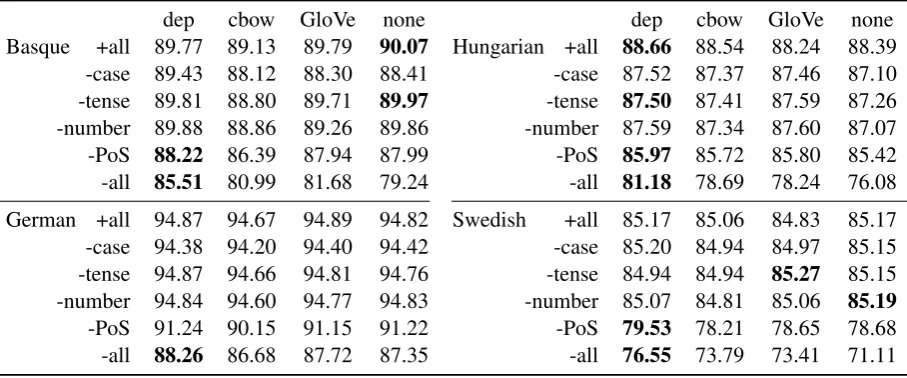
Fig-dep cbow GloVe none dep cbow GloVe none Basque +all 89.77 89.13 89.79 90.07 Hungarian +all 88.66 88.54 88.24 88.39
[image:3.595.75.529.63.252.2]-case 89.43 88.12 88.30 88.41 -case 87.52 87.37 87.46 87.10 -tense 89.81 88.80 89.71 89.97 -tense 87.50 87.41 87.59 87.26 -number 89.88 88.86 89.26 89.86 -number 87.59 87.34 87.60 87.07 -PoS 88.22 86.39 87.94 87.99 -PoS 85.97 85.72 85.80 85.42 -all 85.51 80.99 81.68 79.24 -all 81.18 78.69 78.24 76.08 German +all 94.87 94.67 94.89 94.82 Swedish +all 85.17 85.06 84.83 85.17 -case 94.38 94.20 94.40 94.42 -case 85.20 84.94 84.97 85.15 -tense 94.87 94.66 94.81 94.76 -tense 84.94 84.94 85.27 85.15 -number 94.84 94.60 94.77 94.83 -number 85.07 84.81 85.06 85.19 -PoS 91.24 90.15 91.15 91.22 -PoS 79.53 78.21 78.65 78.68 -all 88.26 86.68 87.72 87.35 -all 76.55 73.79 73.41 71.11
Table 1: Unlabeled parsing accuracies using different embeddings as well as no embeddings with varying amounts of gold-standard morphological information available. Results better than the second best by a margin of at least .1 are highlighted.
ure 1). For some tasks, GloVe barely outperforms the majority baseline, i.e. it does not contain much information that can be extracted with a linear clas-sifier.
4 Using Embeddings in a Parser
To evaluate the benefit of using the embeddings mentioned in the previous section in a parser, the parser needs to fulfill several requirements: The parser needs to work both with and without embed-dings, it needs to use pre-trained embedembed-dings, and it should make use of morphological features. If all these requirements are fulfilled, it is possible to measure the benefit of different embeddings as well as using embeddings at all, and whether mor-phological information supersedes such benefits.
Based on the requirements, we chose RBGParser for the evaluation. RBGParser uses embeddings for scoring edges using low-rank tensors. To score edges, the function uses the embedding, form, lemma, pos, and morphological information of the words as well as arc length and direction. In ad-dition to the low-rank tensor, it uses the same fea-tures as TurboParser (Martins et al., 2013) as well as some features encoding global properties. Both components are weighted using a hyperparameter which we keep fixed at the default value. Since the embeddings are only used in the tensor compo-nent, the quality of the embeddings only affect this component.
Nevertheless, we chose to use the whole parser including all features instead of just measuring the
impact on the low-rank tensor component because it is possible that improvements in this component don’t translate to an improvement of the whole parser.
5 Experiments
The basic idea is as follows: If an embedding en-codes a morphological feature well, it should be a good drop-in replacement of that feature. There-fore, if we strip a morphological feature from the data, using a well-performing embedding should yield higher parsing accuracies than using a worse performing one.
We use the following setups with each embed-ding (as well as without embedembed-dings):
• no case information (-case) • no tense information (-tense) • no number information (-number) • no PoS information (-PoS)
• morphology (including PoS) completely stripped (-all)
• all gold standard information as-is (+all)
gold-standard annotations (the +all rows), which is consistent with previous findings.
Even when stripping morphological information, the embeddings only yield relevant improvements with respect to not using embeddings in -PoS and -all settings. In both these cases, dep clearly
outper-forms the other embeddings, which is consistent with the syneval results (Figure 1). In contrast, cbow, which performs better than GloVe in syneval, yields worse results than GloVe on average. Both differences are significant (two-sided sign test; dep
6
=glove: p < 0.05; GloVe 6=cbow: p < 0.01). The absolute difference between dep and GloVe is much larger than the absolute difference between GloVe and cbow. The difference between GloVe and cbow is especially striking in the -PoS case where cbow outperforms GloVe by a large margin in syneval but is consistently beaten in the parsing task for every language, even those where cbow outperforms GloVe in the +all case.
Stripping a single morphological feature (other than PoS) has little impact on parsing accuracy. On the other hand, stripping all morphological infor-mation leads to much worse accuracies than just parsing without PoS. This hints at some redundancy provided by the morphological annotations.
6 Conclusions
Syneval and the downstream parser evaluation both reveal large differences between the different em-beddings. dep outperforms all other embeddings in syneval for all tasks except number-Polish and number-Spain and also is most helpful to the parser with considerable margin. The embeddings are only consistently helpful to the parser if no PoS-tags are provided.
Despite the consistency of the dep result between syneval and the parsing task, our findings are inconclusive overall. On the one hand, the by far best performing approach on the proxy task also performed best for parsing, on the other hand cbow performed worse than GloVe in the parsing task despite performing better in the proxy task. This indicates that there is helpful information encoded that is not captured by the proxy task, but which interestingly can not be realized when parsing with full gold-standard morphological annotation.
Code and data for this work is available under
http://arne.chark.eu/repeval2016.
References
Danqi Chen and Christopher Manning. 2014. A fast and accurate dependency parser using neural
net-works. InProceedings of the 2014 Conference on
Empirical Methods in Natural Language Process-ing (EMNLP), pages 740–750, Doha, Qatar, October. Association for Computational Linguistics.
Felix Hill, Roi Reichart, and Anna Korhonen. 2015. Simlex-999: Evaluating semantic models with (gen-uine) similarity estimation. Computational Linguis-tics, 41(4):665–695, Sep.
Arne Köhn, U Chun Lao, AmirAli B Zadeh, and Kenji Sagae. 2014. Parsing morphologically rich languages with (mostly) off-the-shelf software and
word vectors. In Proceedings of the 2014 Shared
Task of the COLING Workshop on Statistical Pars-ing of Morphologically Rich Languages.
Arne Köhn. 2015. What’s in an embedding? ana-lyzing word embeddings through multilingual
eval-uation. In Proceedings of the 2015 Conference on
Empirical Methods in Natural Language Processing, pages 2067–2073, Lisbon, Portugal, September. As-sociation for Computational Linguistics.
Tao Lei, Yu Xin, Yuan Zhang, Regina Barzilay, and Tommi Jaakkola. 2014. Low-rank tensors for
scor-ing dependency structures. In Proceedings of the
52nd Annual Meeting of the Association for Compu-tational Linguistics (Volume 1: Long Papers), pages 1381–1391, Baltimore, Maryland, June. Association for Computational Linguistics.
Omer Levy and Yoav Goldberg. 2014.
Dependency-based word embeddings. In Proceedings of the
52nd Annual Meeting of the Association for Compu-tational Linguistics (Volume 2: Short Papers), pages 302–308, Baltimore, Maryland, June. Association for Computational Linguistics.
André Martins, Miguel Almeida, and Noah A. Smith. 2013. Turning on the turbo: Fast third-order non-projective turbo parsers. InProceedings of the 51st Annual Meeting of the Association for Computa-tional Linguistics (Volume 2: Short Papers), pages 617–622, Sofia, Bulgaria, August.
Tomáš Mikolov, Martin Karafiát, Lukáš Burget, Jan ˇCernocký, and Sanjeev Khudanpur. 2010. Re-current neural network based language model. In
Proceedings of INTERSPEECH-2010, pages 1045– 1048.
Tomáš Mikolov, Kai Chen, Greg Corrado, and Jef-frey Dean. 2013. Efficient estimation of word
representations in vector space. arXiv preprint
arXiv:1301.3781.
Jeffrey Pennington, Richard Socher, and Christo-pher Manning. 2014. GloVe: Global vectors
2014 Conference on Empirical Methods in Natu-ral Language Processing (EMNLP), pages 1532– 1543, Doha, Qatar, October. Association for Com-putational Linguistics.
Djamé Seddah, Reut Tsarfaty, Sandra Kübler, Marie Candito, Jinho Choi, Matthieu Constant, Richárd Farkas, Iakes Goenaga, Koldo Gojenola, Yoav Goldberg, Spence Green, Nizar Habash, Marco Kuhlmann, Wolfgang Maier, Joakim Nivre, Adam Przepiorkowski, Ryan Roth, Wolfgang Seeker, Yan-nick Versley, Veronika Vincze, Marcin Woli´nski, Alina Wróblewska, and Eric Villemonte de la Clérg-erie. 2014. Overview of the SPMRL 2014 shared task on parsing morphologically rich languages. In
Notes of the SPMRL 2014 Shared Task on Parsing Morphologically-Rich Languages, Dublin, Ireland. Yuan Zhang, Tao Lei, Regina Barzilay, Tommi
Jaakkola, and Amir Globerson. 2014. Steps to ex-cellence: Simple inference with refined scoring of
dependency trees. In Proceedings of the 52nd