Proceedings of the First International Workshop on Spatial Language Understanding (SpLU-2018), pages 53–62
Anaphora Resolution for Improving Spatial Relation Extraction from Text
Umar Manzoor∗ Parisa Kordjamshidi∗†
∗Tulane University, Computer Science Department, New Orleans, LA, USA †Florida Institute for Human and Machine Cognition (IHMC), Pensacola, FL, USA
{umanzoor,pkordjam}@tulane.edu
Abstract
Spatial relation extraction from generic text is a challenging problem due to the ambiguity of the prepositions spatial meaning as well as the nesting structure of the spatial descriptions. In this work, we highlight the difficulties that the anaphora can make in the extraction of spa-tial relations. We use external multi-modal (here visual) resources to find the most proba-ble candidates for resolving the anaphoras that refer to the landmarks of the spatial relations. We then use global inference to decide jointly on resolving the anaphora and extraction of the spatial relations. Our preliminary results show that resolving anaphora improves the state-of-the-art results on spatial relation extraction.
1 Introduction
Spatial relation extraction is the task of determin-ing the relations that can exist among the spatial roles extracted from the text (D’Souza and Ng,
2015). In the recent years, significant progress has been made in spatial language understanding (i.e. mapping natural language text to a formal spa-tial meaning representation) (Kordjamshidi et al.,
2017a; Kordjamshidi and Moens, 2015a). As a basic example consider the sentence, ”A car is parked in front of a house.” In this sentence car
is atrajector,houseis alandmarkandin front of
is a spatial indicator. Spatial indicators indicate the existence of spatial information in a sentence. Trajector is an entity whose location is described and landmark is a reference object for describing the location of a trajector.
Extraction of the spatial relations with a good accuracy is still challenging (Pustejovsky et al.,
2015). Particularly, our investigation on the er-rors of the previous models shows that when in a sentence the landmark is expressed as a pro-noun like (”it”, ”them”, ”him”,..), the extrac-tion of spatial relaextrac-tions becomes more difficult.
For example, in the sentence, ”A narrow, rising street with colourful houses on both sides, among them a green house with balconies and a white car parked in front of it, and a blue-and-white church on the right”, some of the spatial relations for this sentence will contain a landmark which is a pronoun such as hR1 ←[a green house]tr,
[among]sp, [them]lmi and hR2 ←[a white car]tr,
[in front of]sp, [it]lmi. This issue is related to the
well-known anaphora resolution problem which is also problematic for our goal of spatial relation extraction.
Anaphora Resolution which mostly appears as pronoun resolution, is the linguistic phenomenon by which the given pronoun is interpreted with the help of earlier or later items in the dis-course (Mitkov,2005). The pronoun word/phrase is referred as anaphor whereas the word/phrase to which it is referring is called antecedent, as both anaphor and antecedent are referring to the same object in the real world, they are termed co-referential (Mitkov et al.,2007). It might be pos-sible that for some anaphor, the antecedent is not mentioned in the same sentence, for example, con-sider a sentence, ”there are a couple of trees in front of it”, here ”it” is referring to some object
which is not mentioned in the sentence, however, the referring object might have been mentioned in another sentence of the document. Anaphora Res-olution generally is recognized as a difficult prob-lem in Natural Language Processing (Lee et al.,
2017a;Marasovic et al.,2017).
The main research questions that we aim to address in this paper are, 1) whether the exter-nal knowledge from multimodal resources can help anaphora resolution in text. 2) whether the anaphora resolution can help in the spatial relation extraction from text (especially the relations in the form of triplet - Trajector, Spatial Indicator, Land-mark). To answer these questions, we
Figure 1: Image Textual Description: ”A narrow, rising street with colourful houses on both sides, among them a green house with balconies and a white car parked in front of it, and a blue-and-white church on the right”
rated anaphora resolution for the pronouns in the sentence and proposed a global machine learning model to exploit the resolved pronouns. In the first step, we find the list of possible landmarks that can replace a pronoun in a relation (under considera-tion) with a specific candidate trajector and can-didate spatial indicator. We used Visual Genome (Krishna et al.,2017) (an external) dataset for this purpose.
Visual genome dataset provides us a list of pos-sible landmarks which can be used to resolve the anaphora by filtering them based on their similar-ity with the candidate landmarks that appear in the sentence. This information is used in the global inference model for joint prediction. We improve the spatial relation extraction from text by incor-porating anaphora resolution to recognize land-marks in spatial relations which distinguishes our work from other works on anaphora resolution. The contribution of this paper includes a) exploit-ing external visual relation datasets to inject exter-nal knowledge into our models b) forming a joint model that imposes the consistency between the decisions made by separate relation classifiers that decide on a candidate spatial relation with pronoun landmark and candidate spatial relations with that pronoun replaced by candidate noun resolvants. c) obtaining state-of-the-art results on spatial infor-mation extraction by exploiting the anaphora res-olution. This paper shows our preliminary efforts in the sense that we have not applied the existing work on anaphora resolution. We do not aim at im-proving the current techniques in that area but only show that such resolutions using visual resources can help spatial relation extraction.
The rest of this paper is organized as follows,
first we describe the problem setting in Section2; our proposed model for this problem is described in Section3. The dataset used in tests, and evalu-ation results, are presented in Section 4. In Sec-tion5, we briefly point to the related work in this area. Finally, Section 6summarizes the conclu-sions and outlines directions for future work.
2 Problem Definition
The goal is to improve the extraction of spatial information from text by incorporating anaphora resolution for landmark candidates. We briefly de-fine the spatial role labeling (SpRL) task which is based on a previous formalization of ( Kord-jamshidi et al., 2017b, 2011; Kordjamshidi and Moens, 2015b). Given a sentence S, segmented
into phrases P = [P1, P2, P3, ...Pn]where Pi is the identifier of ith phrase in the sentence, the goal of spatial role labeling is to find the phrases which carry spatial roles (i.e. trajector (Tr), spatial indicator (Sp), landmark (Lm)), as intro-duced in Section1and identify the links between them to form spatial realtion,R = [T r, Sp, Lm].
Moreover, each Spatial relation is further clas-sified into coarse-grained type - (region, direc-tion, distance) and fine-grained types based on their coarse-grained types (e.g. (region,EC), (re-gion,DC), (direction,left), (direction,right)).
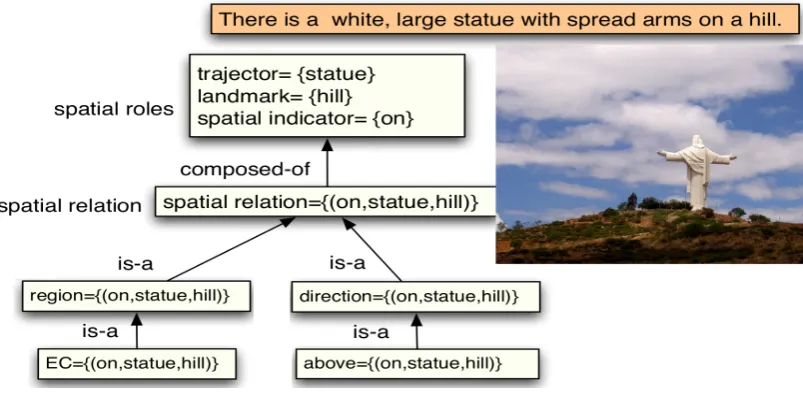
Figure2shows an example of spatial roles, spa-tial relations and spaspa-tial relation type extracted from a given text. In this example, the loca-tion of statue (trajector) is described with re-spect to thehill (landmark)using the preposition
Figure 2: An Example of Spatial Roles and Relation Types.
house]tr, [among]sp, [them]lmi, hR2 ←[a white car]tr, [in front of]sp, [it]lmi,hR3 ←[a
blue-and-white church]tr, [on the right]sp, [None]lmi and
hR4 ←[colorful houses]tr, [on]sp, [both sides]lmi)
where R1, R2 have pronoun landmark, and R3, R4 have implicit landmarks (i.e. not
men-tioned in the given sentence). R1→landmark
([it]lm), andR2→landmark ([them]lm) are referring
to [colorful houses], and [a green house] respec-tively. R1,R2 belongs to a well known anaphora
resolution problem where the given pronoun is in-terpreted with the help of earlier or later items in the discourse whereas R3, R4 belongs to
co-reference resolution problem (Lee et al., 2017b;
Ng,2010;Martschat and Strube,2015) that aims at finding all expressions in the document that re-fer to the same entity.
The hypothesis of this paper is that how anaphora resolution for landmark candidates might help the inference for the extraction of roles as well as the relations from sentences. In this work, we proposed a model to address anaphora resolution for landmark candidates with the aim of improving the spatial relation extraction. In this paper, we assume that the antecedent (if any) of the anaphora (landmark here) is men-tioned within the same sentence, therefore, cross-sentence anaphora resolution is not performed in this work.
3 Architecture
Depending on the description of the sentence, the spatial relations can contain pronoun
land-marks (such as ”it”, ”them”, ”him”, ”her”). Con-sider the aforementioned spatial relationsR1 and R2 extracted from sentence T, R1→landmark
([them]lm) andR2→landmark ([it]lm) are referring
to[colorful houses]and[a green house]phrases of the sentence T respectively. The components of
computing the anaphora resolution for pronoun landmark spatial relations is described in the fol-lowing subsections.
3.1 Exploiting External Knowledge
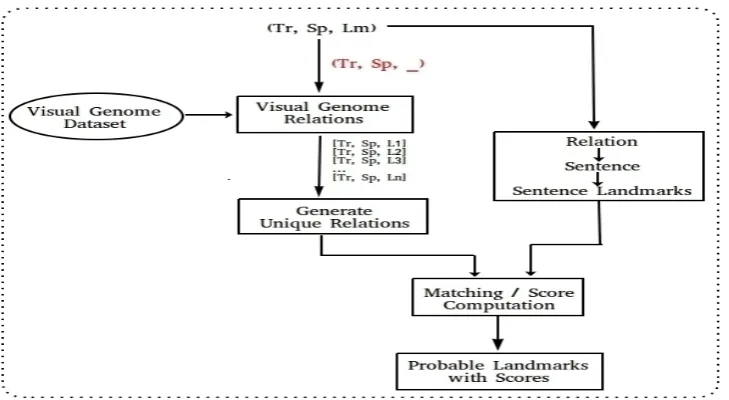
Given a candidate spatial relation R with a pro-noun landmark, we are interested in finding the possible landmark objects which can occur with the given trajector and spatial indicator. For this purpose, we used an external resource, that is Visual Genome relationship dataset (VG). This dataset contains the relation (preposition) between various subjects and objects – for details see sec-tion 4.1. GivenR, similar relations are extracted
from visual genome datasetV by matching prepo-sition and subject with R → spatialIndicator
andR→trajector−headwordrespectively, that
is the candidate words for thespandtrroles. In this way, we obtain the list of possible landmark objects and their frequencies in the VG dataset. We compute the frequency ratio per object and this ratio is interpreted as the possibility score of a relation containing that landmark. In other words, the score RS is computed as RS ← ORi/TVR where ORi is
Figure 3: Probable landmark extraction model
total relations frequency for given trajector-spatial indicator pair in VG dataset. This will yield the set of possible triplets given the trajector-indicator pair with a score assigned to each triplet. We denote this set as, UR =
[(UR1, SUR1),(UR2, SUR2), ...,(URn, SURn)]
whereURi andSURi is thei
thunique relation and
its score respectively.
3.2 Scoring Landmark Candidate Resolvants
For each sentence we perform a pre-processing step based on the previous works and obtain a set of noun phrases that serve as the landmark can-didates denoted by SL. The aforementioned re-trieved triplets from visual genome,UR, can con-tain many landmarks which don’t exist in our land-marks candidates set, therefore, in this step, we compute the similarity (using Google Word2Vec) score between each landmark in SL with all UR landmarks. The final score for each candidate landmark in the sentence will be the maximum score that is computed by averaging the similarity score and occurrence score of that landmark with respect to allURcandidates. In this way we obtain a score for each candidate landmark inSL.
3.3 Learning Model
We formulate this problem as a structured out-put prediction problem where given a set of inout-put- input-output pairs as training examples,E={(xi, yi)∈ X × Y : i = 1..N}, an objective function
g(x, y;W) = hW, f(x, y)i is learned. This
func-tion is a linear discriminant funcfunc-tion defined over combined feature representation of inputs and out-puts denoted byf(x, y). However, in this work,
independent classifiers are trained per role and relations and only the predication is performed based on the global inference as in (Kordjamshidi et al.,2017a;Rahgooy et al.,2018) .
We construct a graph using the phrases
{p1, ..., pn} (i.e. each phrase is a node in the graph) and link these nodes to make composed concepts such as relations. A classifier is asso-ciated with each concept in the graph and the do-main knowledge is encoded over these concepts by global constraints. Global reasoning is im-posed over these classifiers to produce the final outputs by using these constraints. Furthermore, we used binary classifiers to classify the spatial roles and relations where trajector, landmark, spa-tial indicator are denoted by tr, sp, lm
respec-tively and sp.tr.lm, sp.tr.lm.γ, sp.tr.lm.λ
de-notes spatial relations, coarse-grained relations, and fine-grained relations. Additionally, we de-note the new-relation-classifier described in sec-tion3.5bysp.tr.lmN RC.
Each phrase in the sentence is described by a vector of linguistic features denoted by:
ψphrase(pi) (e.g. word form, POS tag, headword POS tag, dependencyRelation, subCategorization, etc), these features are used by spatial role clas-sifiers. The spatial relation is composed of three phrases (pi, pj, pk), therefore, the combination of these phrases along with their descriptive vectors are used in the spatial relation feature set referred as: φtexttriplet(pi, pj, pk)(e.g. distance between jector and spatial indicator, concatenation of tra-jector, spatial indicator, and landmark). These fea-tures are proposed by (Roberts and Harabagiu,
1 PiPkspitrjlmk ≥trj Eachtrcandidate at least should appear in one relation
2 PiPjspitrjlmk ≥lmk Eachlmcandidate at least should appear in one relation
3 PjPkspitrjlmk=spi Eachspcandidate should appear in one relation
4 Pjtrj ≥spi For eachspwe should have at-least onetr
5 Pklmk≥spi For eachspwe should have at-least onelm
6 spitrjlmkγ ≤spitrjlmk is-a constraints between relations and coarse-grained types
7 spitrjlmkλ≤spitrjlmkγ λ∈Λγ
is-a constraints between coarse-grained and corresponding fine-grained types where Λγ denotes the candidate fine-grained types related to coarse-fine-grained typeγ.
8 spitrjlmkNRC ≤spitrjlmk Spatial relation with pronoun candidate should be classified as true if anyone in topN of the anaphora-resolved triplets is
classified as true.
Table 1: Model Constraints.
3.4 Constraints
The global constraints used in our proposed model is combination of previously proposed constraints (1-7) (Rahgooy et al., 2018) and new one (con-straint 8) described in Table3.3. In fact, the global inference is performed using integer linear pro-gramming techniques subject to these constraints.
3.5 Global Prediction Model
We obtain the output of each classifier in the model holistically by global reasoning that is by considering global correlations among classifiers, when calculating outputs. This goal is achieved by optimizing an objective function that is the sum-mation of classifiers’ discriminant functions. The global objective function for our model is on the basis of our previous work as follows,
X
i∈Csp
hWsp, φspii.spi+ X
i∈Ctr
hWtr, φtrii.tri+
X
i∈Clm
hWlm, φlmii.lmi+
X
i∈Csp X
j∈Ctr X
k∈Clm
hWsptrlm, φspitrjlmki.spitrjlmk+
X
γ∈Γ
X
i∈Csp X
j∈Ctr X
k∈Clm
hWsptrlm, φspitrjlmkγi.spitrjlmkγ+
X
λ∈Λ
X
i∈Csp X
j∈Ctr X
k∈Clm
hWsptrlm, φspitrjlmkλi.spitrjlmkλ+
X
τ∈Υ
X
i∈Csp X
j∈Ctr X
k∈Clm
hWsptrlm, φspitrjlmk N RCγi.spitrjlmk N RC.
Each classifier is shown as a binary variable and Λ, Γ, Υ are the candidates for fine-grained
relations, coarse-grained relations, and pronoun-landmark spatial relations respectively. The fol-lowing model variations are designed to evalu-ate the performance of the proposed model. Fur-thermore, in all model variations, the CLEF 2017 mSprl dataset described in4.1is used for the train-ing and evaluation of the classifiers.
• Anaphora-Replacement (A-Replacement):
In this model, we replace the landmark phrase text of spatial relation where the land-mark is a pronoun with the highest scored probable landmark (see 3.2), this approach is used for both training and testing. Fur-thermore, we train independent classifiers for spatial roles and relations classification. This is a learning only model where each classifier makes independent predictions. This model doesn’t use any constraints, and is compared with similar (Rahgooy et al.,2018) baseline model in section4.
• Anaphora-Inference (A-Inference): In this
A-Replacement M0
Precision Recall F1 Precision Recall F1
T rajector 53.24 67.66 59.59 54.22 62.05 57.87
Landmark 73.49 81.23 77.17 74.29 78.60 76.38
[image:6.595.118.482.61.134.2]SpatialIndicator 94.60 96.98 95.78 94.60 96.98 95.78
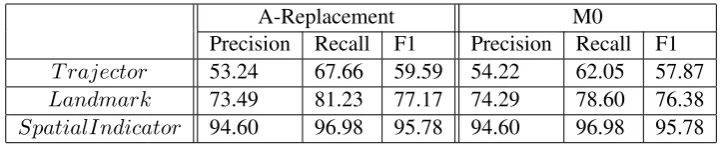
Table 2: Spatial Roles - Comparison of A-Replacement with M0
A-Inference M0+C
Precision Recall F1 Precision Recall F1
T rajector 65.79 65.39 65.59 64.20 60.98 62.55
Landmark 84.69 78.60 81.53 79.09 82.28 80.65
SpatialIndicator 94.70 96.60 95.64 95.08 94.84 94.96
Table 3: Spatial Roles - Comparison of A-Inference with M0+C
3.4 to optimize the global objective func-tion explained in secfunc-tion3.5 which includes thenew-relation-classifier. This implies that both relation classifier and the new-relation-classifier are assigned values jointly and should agree. For training the new-relation-classifier, we generate additional examples by replacing the pronoun landmarks in the ground-truth with the highest scored land-mark from our candidate set,SL. The orig-inal spatial relations with pronoun landmarks are also retained in the training. The training mechanism of remaining classifiers remains unchanged (i.e. trained on original spatial re-lations). In testing phase, we take the top N candidates from the scored landmarks gener-ated in3.2for spatial relations with pronoun landmarks. In this way, we regenerate a set of candidate triplets by replacing the pronoun with the top probable landmarks. Our global inference decides jointly with using the orig-inal triplet classifier in a way that it satisfies the constraint that if anyone of these triplets is predicted as true, spatial relation classifier is forced at inference time to predict the spatial relation with the anaphora as true. See con-straint number8 in section3.4. The
experi-ments show that this simple idea can promote the relation extraction when anaphora occurs in the triplet candidates.
4 Experiments 4.1 Datasets
CLEF 2017 mSpRL dataset: Our model is eval-uated on this dataset which is a subset of IAPR
TC-121Benchmark and annotated specifically for
the SpRL task. The training set contains761and whereas test set contains939spatial relations
re-spectively (Kordjamshidi et al., 2017b). The to-tal number of spatial relations containing pronoun landmark in train and test is 44 and 129
respec-tively.
Visual Genome dataset (VG): Visual Genome dataset has seven main components (Krishna et al., 2017), one of it is ‘relationships‘ which contains the relationships between pairs of objects in the images. Each relation has two arguments, the first one is referred as subject whereas the lat-ter one is referred as object. These relationships can be actions, spatial, prepositions, verbs, com-parative or prepositional phrases. Visual genome dataset contains 108077images whereas its
rela-tionships part contains2316104relation instances.
This dataset is used to obtain the possible land-marks that can occur in a relationship with a given subject.
4.2 Experimental Results
In this section, we experimentally show the effec-tiveness of our proposed model in improving the spatial role/relation extraction. We useSaul( Ko-rdjamshidi et al., 2015, 2016) to implement the models and solve the global inference of Section
3.5. The code is publicly available here2.
We compare our approach with the state-of-the-art (Rahgooy et al.,2018). However, in the men-tioned paper, the authors use visual data from the accompanying images to improve the models. In
Precision Recall F1
M0 65.64 60.23 62.82
M0 +C 70.04 66.55 68.25
A-Replacement 78.47 56.84 65.92
A-Inf erence 70.23 68.25 69.23
Table 4: Model Comparison - Spatial Relation Extraction
A-Replacement M0
Precision Recall F1 Precision Recall F1
Region 70.90 54.24 61.52 78.37 47.83 59.41
[image:7.595.175.421.61.134.2]Direction 79.22 43.57 56.22 83.56 43.57 57.28
Table 5: Coarse-grained Spatial Relations - Comparison of A-Replacement with M0.
this paper, we use their best model (referred here asM0-Baseline andM0 +C-Baseline plus
con-straints) which is trained on text only and we ig-nore the visual information which is aligned with the text. The experimental results in Table4show that our baseline model (A-Replacement) is sig-nificantly better as compared to the state-of-the-art baseline model (M0). This shows that re-placing the pronoun landmark candidates with our proposed model probable landmark has positive impact on extraction of spatial roles (as shown in Table 2) and relations. The improvement in the results is because the spatial roles predication is improved, which gives a more confidence to the model to classify the triplets as spatial rela-tions which leads to more positive predicrela-tions and higher recall of the relations.
Furthermore, our second model (A-Inference) in which we train an additional new-relation-classifier by generating additional examples and perform joint inference further improves the re-sults over the state-of-the-art model with con-straints (M0+C). The experimental results in Ta-ble 3 show that adding constraints to our sec-ond model (A+Inference) significantly improves the classification of spatial roles (i.e. trajectors and landmarks), although the spatial indicators is slightly improved. Also these constraints help improving the coarse-grained spatial relations as shown in table6, although it doesn’t have any im-pact on distance category because the number of examples in test set is very small (i.e. three in-stances only).
Our results improve the state-of-the-art mod-els for spatial relation extraction. Both proposed models significantly improves the extraction of spatial roles and relations (when compared with
independent learning and with constrained mod-els). However, the results of some of the cate-gories in the fine-grained relations drops which are not reported here. These results are at the prelimi-nary stage and we further analyze our models. Par-ticularly, we will use existing anaphora resolution models to see how those could help and provide a more reasonable baseline. This baseline will help us to evaluate the advantage of the external visual knowledge more clearly. It will be interesting to investigate what caused this drop in fine-grained relation types. In addition to such further analysis, this work can be extended into two possible direc-tions, 1) incorporate cross-sentence anaphora res-olution for landmark candidates, and 2) incorpo-rate co-reference resolution in general for all spa-tial relations.
5 Related Work
Our proposed model is a joint model for consider-ing anaphora resolution to help spatial information extraction. Anaphora resolution is a fundamental problem in natural language processing and exist-ing techniques can broadly be categorized into two types 1) Rule based models: apply rules to reduce candidate antecedents and resolve anaphora and 2) statistical models: use probabilistic models for the resolution of anaphora (Lee et al.,2017a). Early work (Hobbs,1978;Asher and Wada,1988; Lap-pin and Leass, 1994; Morton, 2000) focused on designing rule-based systems for anaphora reso-lution (the target was finding antecedents of pro-nouns only), however, these systems relied heavily on handcraft rules/weights. In early 2000, (Soon et al., 2001; Yang et al., 2003; Ng and Cardie,
com-A-Inference M0+C Precision Recall F1 Precision Recall F1
Region 72.99 60.82 66.35 76.07 57.79 65.68
[image:8.595.134.462.61.120.2]Direction 76.26 46.67 57.90 75.75 48.33 59.01
Table 6: Coarse-grained Spatial Relations - Comparison of A-Inference with M0+C.
mon strategy, that is, train a statistical model to measure the likeness of a pair as corefer. How-ever, each candidate is resolved independently of the others which means how good a candidate an-tecedent is relative to others is not considered. To address this problem, (Denis and Baldridge,2009) proposed a model by combining machine learning with global inference for performing the resolu-tion jointly. Recently, (Park et al.,2016) proposed an mention pair model using deep learning and a system that combines both rule-based and deep learning-based systems using a guided MP model for co-reference resolution.
According to (Lee et al.,2017a), machine learn-ing based models for anaphora resolution are rel-atively easy to build as compared to rule based models, however, a huge amount of handcrafted feature design is required in order to build a suc-cessful anaphora resolution model. Furthermore, the authors highlighted four key features of a ideal anaphora resolution system one of which is an-tecedent features should be learned automatically (i.e. minimum human design effort should be re-quired). The proposed model doesn’t require any handcrafting features or rules to implement the anaphora resolvers.
Join models have been proposed for resolving co-references with mention head detection using underlying integer linear programming as we do here (Peng et al., 2015). The main difference of our work compared to the above mentioned research works is that here we do not directly solve the anaphora resolution problem, but we use a kind of indirect supervision from an external multi-modal resource to help anaphora resolution and by means of that we solve our specific tar-get problem. Our tartar-get problem of spatial infor-mation extraction has not been jointly performed with neither anaphora nor co-reference resolution tasks before. However, resolving co-references in the multi-modal setting has been investigated re-cently (Huang et al.,2017) in which text and video refer to the same scene and help each other in the resolution. As pointed above, this is different from
using the vision modality as a source of distant su-pervision which is our aim in this work.
6 Conclusion
In this paper, we investigated the challenging is-sues of the extraction of spatial relations, that is, the triplets of (spatial indicator, trajector, land-mark) from generic text. Particularly, We high-lighted one important problem that is the issue of anaphoras accruing in the text that make recogniz-ing landmarks and consequently recognizrecogniz-ing the spatial relations difficult. In the presence of the anaphora recognizing the right link between the described objects in the text and extracting the re-lations correctly for any arbitrary pair of object be-comes more challenging. Our proposed solution has been to use the external visual resources that can help to find out the most probable landmarks for a specific object and obtain the possible reso-lutions with a score. Using the scored resoreso-lutions we perform global inference to decide on both the anaphora resolution and spatial relation extraction jointly. Our best model improves the state-of-the-art results in all precision, recall and F1 metrics while having a more positive (about +2%) influ-ence on the recall of the spatial relations extrac-tion. While our preliminary experimental results show the advantage of anaphora resolution in spa-tial relation extraction, we will investigate more sophisticated baselines in the future to evaluate the advantage of external knowledge resources (that we used in this work) versus using the existing ap-proaches for anaphora resolution in our models.
References
Nicholas Asher and Hajime Wada. 1988. A comput-tional account of syntactic, semantic and discourse principles for anaphora resolution. Journal of Se-mantics, 6(1):309–344.
Jennifer D’Souza and Vincent Ng. 2015. Sieve-based spatial relation extraction with expanding parse trees. In Proceedings of the 2015 Conference on Empirical Methods in Natural Language Process-ing, pages 758–768.
Jerry R. Hobbs. 1978. Resolving pronoun references. Lingua, 44(4):311 – 338.
De-An Huang, Joseph J. Lim, Fei-Fei Li, and Juan Car-los Niebles. 2017. Unsupervised visual-linguistic reference resolution in instructional videos. CoRR, abs/1703.02521.
P. Kordjamshidi, D. Roth, and H. Wu. 2015. Saul:
To-wards declarative learning based programming. In
Proc. of the International Joint Conference on Arti-ficial Intelligence (IJCAI).
Parisa Kordjamshidi, Daniel Khashabi, Christos Christodoulopoulos, Bhargav Mangipudi, Sameer Singh, and Dan Roth. 2016. Better call saul: Flex-ible programming for learning and inference in nlp. In Proceedings of COLING 2016, the 26th Inter-national Conference on Computational Linguistics: Technical Papers, pages 3030–3040.
Parisa Kordjamshidi and Marie-Francine Moens. 2015a. Global machine learning for spatial ontol-ogy population. Web Semantics: Science, Services and Agents on the World Wide Web, 30:3–21.
Parisa Kordjamshidi and Marie-Francine Moens. 2015b. Global machine learning for spatial
ontol-ogy population. Web Semant., 30(C):3–21.
Parisa Kordjamshidi, Taher Rahgooy, and Umar Man-zoor. 2017a. Spatial language understanding with multimodal graphs using declarative learning based programming. InProceedings of the 2nd Workshop on Structured Prediction for Natural Language Pro-cessing, pages 33–43.
Parisa Kordjamshidi, Taher Rahgooy, Marie-Francine Moens, James Pustejovsky, Umar Manzoor, and Kirk Roberts. 2017b. Clef 2017: Multimodal spa-tial role labeling (msprl) task overview. In Inter-national Conference of the Cross-Language Evalu-ation Forum for European Languages, pages 367– 376. Springer.
Parisa Kordjamshidi, Martijn van Otterlo, and Marie-Francine Moens. 2011. Spatial role labeling: to-wards extraction of spatial relations from natural language. ACM - Transactions on Speech and Lan-guage Processing, 8:1–36.
Ranjay Krishna, Yuke Zhu, Oliver Groth, Justin John-son, Kenji Hata, Joshua Kravitz, Stephanie Chen, Yannis Kalantidis, Li-Jia Li, David A Shamma, et al. 2017. Visual genome: Connecting language and vision using crowdsourced dense image anno-tations. International Journal of Computer Vision, 123(1):32–73.
Shalom Lappin and Herbert J. Leass. 1994. An
algo-rithm for pronominal anaphora resolution. Comput.
Linguist., 20(4):535–561.
Changki Lee, Sangkeun Jung, and Cheon-Eum Park. 2017a. Anaphora resolution with pointer networks. Pattern Recognition Letters, 95:1 – 7.
Kenton Lee, Luheng He, Mike Lewis, and Luke Zettle-moyer. 2017b. End-to-end neural coreference reso-lution.CoRR, abs/1707.07045.
Ana Marasovic, Leo Born, Juri Opitz, and Anette Frank. 2017. A mention-ranking model for abstract
anaphora resolution.CoRR, abs/1706.02256.
Sebastian Martschat and Michael Strube. 2015. Latent structures for coreference resolution. TACL, 3:405– 418.
Ruslan Mitkov. 2005. The Oxford Handbook of Com-putational Linguistics (Oxford Handbooks). Oxford University Press, Inc., New York, NY, USA.
Ruslan Mitkov, Richard Evans, Constantin Or˘asan, Le An Ha, and Viktor Pekar. 2007. Anaphora resolution: To what extent does it help nlp
ap-plications? In Proceedings of the 6th Discourse
Anaphora and Anaphor Resolution Conference on Anaphora: Analysis, Algorithms and Applications, DAARC’07, pages 179–190, Berlin, Heidelberg. Springer-Verlag.
Thomas S. Morton. 2000. Coreference for nlp appli-cations. InProceedings of the 38th Annual Meeting on Association for Computational Linguistics, ACL ’00, pages 173–180, Stroudsburg, PA, USA. Associ-ation for ComputAssoci-ational Linguistics.
Vincent Ng. 2010.Supervised noun phrase coreference research: The first fifteen years. InProceedings of the 48th Annual Meeting of the Association for Com-putational Linguistics, ACL ’10, pages 1396–1411, Stroudsburg, PA, USA. Association for Computa-tional Linguistics.
Vincent Ng and Claire Cardie. 2002. Improving ma-chine learning approaches to coreference resolution. In Proceedings of the 40th Annual Meeting on As-sociation for Computational Linguistics, ACL ’02, pages 104–111, Stroudsburg, PA, USA. Association for Computational Linguistics.
Cheoneum Park, Kyoung-Ho Choi, Changki Lee, and Soojong Lim. 2016. Korean coreference resolution with guided mention pair model using deep learning. ETRI Journal, 38(6):1207–1217.
Haoruo Peng, Kai-Wei Chang, and Dan Roth. 2015. A joint framework for coreference resolution and men-tion head detecmen-tion. InCoNLL.
James Pustejovsky, Parisa Kordjamshidi, Marie-Francine Moens, Aaron Levine, Seth Dworman, and Zachary Yocum. 2015. Semeval-2015 task 8:
Association for Computational Linguistics (ACL), pages 884–894. ACL.
Taher Rahgooy, Umar Manzoor, and Parisa Kord-jamshidi. 2018. Visually guided spatial relation extraction from text. In Proceedings of the 2018 Conference of the North American Chapter of the Association for Computational Linguistics on Hu-man Language Technology. Association for Compu-tational Linguistics.
Kirk Roberts and Sanda M Harabagiu. 2012. Utd-sprl: A joint approach to spatial role labeling. In Pro-ceedings of the First Joint Conference on Lexical and Computational Semantics-Volume 1: Proceed-ings of the main conference and the shared task, and Volume 2: Proceedings of the Sixth International Workshop on Semantic Evaluation, pages 419–424. Association for Computational Linguistics.
Wee Meng Soon, Hwee Tou Ng, and Daniel Chung Yong Lim. 2001. A machine learning
ap-proach to coreference resolution of noun phrases.
Computational Linguistics, 27(4):521–544.
Xiaofeng Yang, Guodong Zhou, Jian Su, and Chew Lim Tan. 2003. Coreference resolution
us-ing competition learnus-ing approach. InProceedings