A Fine-grained Large-scale Analysis of Coreference Projection
Michal Nov´ak Charles University
Faculty of Mathematics and Physics Prague, Czech Republic
{mnovak}@ufal.mff.cuni.cz
Abstract
We perform a fine-grained large-scale analysis of coreference projection. By projecting gold coreference from Czech to English and vice versa on Prague Czech-English Dependency Treebank 2.0 Coref, we set an upper bound of a proposed projection approach for these two languages. We undertake a detailed thorough analysis that combines the analysis of projec-tion’s subtasks with analysis of performance on individual mention types. The findings are accompanied with examples from the corpus.
1 Introduction
Projection has been for a long time seen as an alternative way to build a linguistic tool for resource-poor languages. Coreference projec-tion has been no excepprojec-tion. Despite its mostly mediocre results, only some works perform a proper error analysis.
In this work, we conduct a fine-grained large-scale analysis of coreference projection. We adopt a corpus-based projection approach and ap-ply it on Czech-English parallel texts in Prague Czech-English Dependency Treebank 2.0 Coref (Nedoluzhko et al., 2016) in both projection di-rections. We project manually annotated corefer-ence links within texts enriched with mainly man-ually annotated linguistic annotation. Results ob-tained on manual (i.e. gold) annotation can be then considered as an upper bound for projection tech-niques where the gold annotation is replaced by the one obtained automatically.
We took inspiration from two works that have previously focused on projection of gold coref-erence. Even though both of them provided an analysis of collected projections, they treated it in a completely different way. Postolache et al.
(2006) concentrated on factorized analysis. They split the task of projection into subtasks, such
as mention matching, mention span overlapping and antecedent selection, and inspected their ef-fect on the final result separately. Alternatively, in their multilingual projection approachGrishina and Stede (2017) carried out an analysis across mention types. They split all mentions to cate-gories such as noun phrases, named entities and pronouns, and evaluated projection on these men-tion types separately.
Our work combines both these views on anal-ysis, providing a factorized fine-grained analysis of projected coreference. In addition, we include new categories of mentions – zeros. These have been often neglected as they are not expressed on the surface. However, by ignoring them we would lose valuable information, especially in pro-drop language such as Czech and Spanish. Further-more, our analysis is based on about 100-times bigger corpus than in the two related works, which makes the findings and conclusions more reliable. The paper is structured as follows. In Section2
we describe two main projection approaches with a special emphasis on corpus-based projection of gold coreference. Section 3 presents the corpus that we use for making projections and Section4
describes the projection method we propose. The main projection experiments and its results are presented in Section 5 and analyzed in detail us-ing a factorized view in Section 6. Finally, we conclude in Section7.
2 Related Work
Approaches to cross-lingual projection are usu-ally aimed to bridge the gap of missing resources in the target language. So far, they have been quite successfully applied to part-of-speech tag-ging (T¨ackstr¨om et al., 2013), syntactic parsing (Hwa et al., 2005), semantic role labeling (Pad´o and Lapata,2009), opinion mining (Almeida et al.,
2015), etc. Projection techniques are generally grouped into two types with respect to how they obtain the translation to the source language, which is usually a resource-rich language. MT-based approachesapply a machine-translation ser-vice to create synthetic data in source language.
Corpus-based approaches take advantage of the human-translated parallel corpus of the two lan-guages.
MT-based approaches. The workflow of these approaches is as follows. Starting with a text in the target language to be labeled with coreference, it first must be machine-translated to the source language. A coreference resolver for the source language is then applied on the translated text and, finally, the newly established coreference links are projected back to the target language. Flexibility of this approach lies in the fact that it can be ap-plied in both train and test time, and no linguis-tic processing tools for the target language are re-quired. To the best of our knowledge, this ap-proach has been applied to coreference only twice, byRahman and Ng(2012) on projection from En-glish to Spanish and Italian, and byOgrodniczuk
(2013) on projection from English to Polish.
Corpus-based approaches. In these ap-proaches, a human-translated parallel corpus of the two languages is available and the projection mechanism is applied within this corpus. Coref-erence annotation in the source-language side of the corpus may be both labeled by humans or a coreference system. The target-language side of the corpus then serves as a training dataset for a coreference resolver. This approach thus must be applied in train time and, moreover, it requires a coreference resolver trainable on the target-language data. As a consequence, linguistic processing tools should be available for the target language as most of the resolvers depend on some amount of additional linguistic information. On the other hand, human translation and gold coref-erence annotation, if available, should increase the quality of the projected coreference. This approach has been used to create a coreference
resolver by multiple authors, e.g. de Souza
and Or˘asan (2011), Martins (2015), Wallin and Nugues(2017), andNov´ak et al.(2017). However, since the present work employs the corpus-based approach on gold annotations of coreference, we offer more details on works of Postolache et al.
(2006) andGrishina and Stede(2015,2017).
Postolache et al.(2006) followed corpus-based approach using a small English-Romanian cor-pus of 638 sentence pairs in order to create a bilingually-annotated resource. They projected manually annotated coreference, which was then post-processed by linguists to acquire high qual-ity annotation in Romanian. Based on the gold coreference annotation of the Romanian side of the corpus, they evaluated the F-scores of men-tion heads’ matching, menmen-tion spans’ overlapping, and coreference clusters on all as well as only cor-rectly projected mentions. A factorized error anal-ysis they carried out shows that the majority of er-rors in coreference projection stems from a lower recall (around 70%) caused by missing alignment due to alignment errors or language differences in-troduced in the translation.
Yulia Grishina with her colleagues also investi-gate possibilities of corpus-based coreference pro-jection. In (Grishina and Stede, 2015), they in-troduced a “generalizable” annotation schema that they tested on parallel texts of three languages (English, Russian and German) and three genres (newswire articles, short stories, medical leaflets). Using this dataset consisting of less than 500 sen-tence triples, they conducted experiments on pro-jection from English to the two other languages. In (Grishina and Stede,2017), they pursue a goal of multi-source projection of manual coreference an-notation. They propose several strategies of com-bining projections from multiple languages, with some of them slightly improving the F-score of the best-performing projection source. They also pro-vide a qualitative analysis on individual mention types suggesting that pronouns have much higher projection accuracy1 than nominal groups. They
justify their unsatisfactory results especially for German nominal groups by problems with inclu-sion of an unaligned German determiner in defi-nite descriptions.
3 Data Source
We employ a slightly modified version of the Prague Czech-English Dependency Treebank 2.0 Coref (Nedoluzhko et al., 2016, PCEDT 2.0
Coref) for our projection experiments.
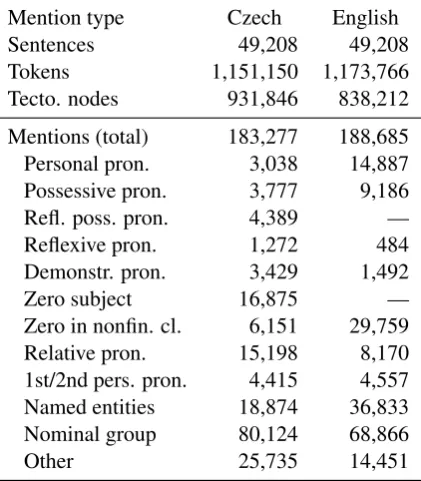
PCEDT 2.0 Coref is a coreferential extension to the Prague Czech-English Dependency Tree-bank 2.0 (Hajiˇc et al.,2012). It is a Czech-English parallel corpus, consisting of almost 50k sentence pairs (more on its basic statistics is shown in the upper part of the Table1). The English part origi-nally comes from the Wall Street Journal collected in the Penn Treebank (Marcus et al.,1999) and the Czech part was manually translated. It has been annotated at multiple layers of linguistic represen-tation up to the layer of deep syntax (or tectogram-matical layer), based on the theory of Functional Generative Description (Sgall et al., 1986). The tectogrammatical representation of a sentence is a dependency tree with semantic labeling, corefer-ence, and argument structure description based on a valency lexicon. The nodes of a tectogrammat-ical tree comprise merely auto-semantic words. Furthermore, some surface-elided expressions are reconstructed at this layer. They include anaphoric zeros (e.g. zero subjects in Czech, unexpressed ar-guments of non-finite clauses in both English and Czech) that are introduced in the tectogrammatical layer with a newly established node.
The coreference annotation of PCEDT 2.0 Coref takes place on the tectogrammatical layer to allow for marking zero anaphora. Coreference is technically annotated as links connecting two mentions: the anaphor (the referring expression) andthe antecedent(the referred expression). The coreference links then formchains, which corre-spond to coreference entities. In tectogrammat-ics, the mention is determined only by its head. No mention boundaries are specified. Therefore, a coreference link always connects two nodes on a tectogrammatical layer.
In order to provide a fine-grained qualitative analysis, we divide mentions into multiple cate-gories in this paper: (1) personal pronouns, (2) possessive pronouns, (3) reflexive possessive pro-nouns, (4) reflexive propro-nouns, all four types of pronouns in the 3rd or ambiguous person, (5) demonstrative pronouns, (6) zero subjects, (7) ze-ros in non-finite clauses, (8) relative pronouns, (9) the pronouns of types (1)-(4) in the 1st or 2nd per-son, (10) named entities, (11) common nominal groups, and (12) other expressions. Note that cat-egories (3) and (6) are defined only in Czech. The last category contains coordination roots, verbs, adjectives, but the majority is formed by other
Mention type Czech English
Sentences 49,208 49,208
Tokens 1,151,150 1,173,766
Tecto. nodes 931,846 838,212
Mentions (total) 183,277 188,685
Personal pron. 3,038 14,887
Possessive pron. 3,777 9,186
Refl. poss. pron. 4,389 —
Reflexive pron. 1,272 484
Demonstr. pron. 3,429 1,492
Zero subject 16,875 —
Zero in nonfin. cl. 6,151 29,759
Relative pron. 15,198 8,170
1st/2nd pers. pron. 4,415 4,557
Named entities 18,874 36,833
Nominal group 80,124 68,866
[image:3.595.312.523.64.305.2]Other 25,735 14,451
Table 1: Basic and coreferential statistics of PCEDT 2.0 Coref.
nodes restoring ellipsis, e.g. zeros in other than subject positions or missing arguments in recipro-cal relation. We do not focus on this category in the rest of the paper. The statistics of coreferential mentions is collected in the bottom part of Table1. The treebank is aligned on the level of tec-togrammatical nodes. The alignment is based on
unsupervised word alignment by GIZA++ (Och
and Ney, 2000), augmented with a supervised method (Nov´ak and ˇZabokrtsk´y, 2014) for se-lected coreferential expressions. The supervised alignment has been trained on a section of PCEDT 2.0 Coref comprising 1,078 sentence pairs with manual annotation of alignment. To ensure that the whole PCEDT 2.0 Coref is aligned in the same way for our experiments, we make a slight modi-fication to it and replace the manual alignment in this particular section with the supervised one, ob-tained by 10-fold cross-validation.
4 Coreference Projection
adopted by multiple previous works (Postolache et al., 2006;de Souza and Or˘asan, 2011;Wallin and Nugues,2017;Grishina,2017, i.a.). Neverthe-less, there is a substantial difference of our work compared to the others: our projection system op-erates on tectogrammatical representation. It leads to the two following consequences.
Firstly, our system is able to address zero anaphora. Thorough cross-lingual analysis by
Nov´ak and Nedoluzhko(2015) showed that many counterparts of Czech or English coreferential ex-pressions are zeros. This likely holds for the other pro-drop languages, too. It is thus surprising that the previous work on projection to Spanish ( Rah-man and Ng,2012;Martins,2015) or Portuguese (de Souza and Or˘asan, 2011; Martins, 2015) did not accent this problem at all. In tectogrammatics, generated nodes serve this purpose instead.
Secondly, mention spans are not specified in tectogrammatical trees, as mentioned in Sec-tion 3. Concerning projection, many of the pre-vious works (Rahman and Ng, 2012; Postolache et al., 2006;Wallin and Nugues, 2017, i.a.) de-vote considerable space to answering the question of the proper strategy for determining boundaries of a projected mention. If a mention is solely de-fined by its head as in the present work, this ques-tion does not need to be answered.
The projection algorithm is schematized in Al-gorithm 1. An input of the algorithm are two aligned lists of tectogrammatical trees represent-ing the same text in the source and the target lan-guage. First, a list of coreferential chains must be extracted from source trees (line1). Every coref-erence chain is projected independently (lines 2
-18) mention by mention, starting with the first one, the one that has no outcoming link. For each mention, at the moment viewed as an anaphor, its counterpart in the target language is returned us-ing the alignment (line5). In case there are several nodes aligned to the anaphor, those which do not yet participate in a different chain are interlinked and only the very last mention is returned by the
function GetAlignedAndInterlink. If no
aligned counterpart to the anaphor is found, the anaphor is skipped and its outgoing coreference link thus remains unprojected. Otherwise (lines6
-16), counterparts of anaphor’s direct antecedents are retrieved (lines 7-8) and the algorithm adds a link between the anaphor’s and antecedents’ coun-terparts in the target language (line 10). If there
are no antecedents’ counterparts, the last success-fully projected anaphor from any of the previous iterations is used instead (line13).
5 Experiments and Results
In the following experiment, we project gold coreference between gold trees in two directions: from English to Czech and vice versa. The ex-periment is carried out on the dataset presented in Section 3, PCEDT 2.0 Coref with supervised alignment in all its sections.
One of the objectives of this work is to analyze performance of coreference projection for individ-ual mention types. Standard evaluation metrics (e.g. MUC (Vilain et al., 1995), B3 (Bagga and
Baldwin,1998)) are not suitable for our purposes, though, since they do not allow for scoring only a subset of mentions. Instead, we use a measure similar to scores proposed by (Tuggener, 2014) that we denote asanaphora score.
LetK ={K1, . . . , Km}be the set of true and
S = {S1, . . . , Sn} the set of predicted corefer-ential chains. From K andS we derive sets of
true anaphors ANAPH(K)and predicted anaphors ANAPH(S)using the following definition:
ANAPH(Z) ={x|∃i:x∈Ziand∃y:y∈ANTEZi(x)}
where the set ANTEZi(x) contains all direct an-tecedents ofxin chainZi. We also define an
indi-cator functionboth(a, K, S)as follows:
both(a, K, S) =
1
if∃i, j:a∈Ki∩Sj
and∃e∈Ki:e∈ANTEKi(a) and∃f∈ANTESj(a) :f∈Ki
0 otherwise
In other words, it fires only ifahas an antecedent
in both the truth and the prediction and the pre-dicted antecedent of anaphora belongs to a true
coreferential chain associated with a. Precision
(P), Recall (R) are then computed by averaging
the function both(a, K, S) over all predicted and true anaphors, respectively, and F-score (F) tradi-tionally as a harmonic mean ofP andR:
P=
P
a∈ANAPH(S)
both(a, K, S)
|ANAPH(S)| R= P
a∈ANAPH(K)
both(a, K, S)
|ANAPH(K)|
F = 2P R
P+R
Input:SrcT rees= source language trees with coreference,T rgT rees= target language trees Output:T rgT rees= target language trees with projected coreference
1 AllSrcChains←GetCorefChains(SrcT rees); 2 forSrcChain∈AllSrcChainsdo
3 T rgLastAnte← ∅;
4 forSrcM ention∈SrcChaindo
5 T rgM ention←GetAlignedAndInterlink(SrcM ention,T rgT rees); 6 if∃T rgM entionthen
7 SrcAntes←GetCorefNodes(SrcM ention); 8 T rgAntes←GetAligned(SrcAntes,T rgT rees); 9 ifT rgAntes6=∅then
10 AddCorefNodes(T rgM ention,T rgAntes);
11 end
12 else
13 AddCorefNodes(T rgM ention,T rgLastAnte);
14 end
15 T rgLastAnte←T rgM ention;
16 end
17 end
18 end
Algorithm 1:Algorithm for coreference projection
Mention type EN→CS CS→EN Personal pron. 81.92
52.0563.65 86.5267.4575.80
Possessive pron. 72.85
59.8765.73 89.3360.8872.41
Refl. poss. pron. 80.21
68.4273.85 —
Reflexive pron. 87.36
11.9621.04 89.1722.2035.55
Demonstr. pron. 57.43
35.1943.64 55.8142.7348.40
Zero subject 78.71
59.0667.49 —
Zero in nonfin. cl. 78.75
52.9663.33 83.7834.3448.71
Relative pron. 74.71
51.1860.75 85.0270.0076.78
1st/2nd pers. pron. 67.97
57.0862.05 83.2158.5568.73
Named entities 38.04
62.0747.17 80.2939.0452.54
Nominal group 50.15
37.8043.11 61.7047.2753.53
Other 20.73
17.6819.09 22.8226.9024.69
Total 53.86
[image:5.595.75.529.65.356.2]44.8648.95 71.3146.4756.27 Table 2: Anaphora scores of gold coreference projected on PCEDT 2.0 Coref with thorough supervised align-ment.
type. In the following tables, we useP
RF to format the three components of the anaphora score.
Table 2shows results of gold coreference pro-jection. The main observation is that with the overall F-scores around 50%, coreference projec-tion between EN and CS seems to be a difficult problem. Moreover, let us emphasize that this ex-periment is supposed to set an upper bound for our projection approach since most of the annotation it exploits is manual. Comparing the two directions, the CS→EN projection appears to be a bit easier, yet still not reaching 60% F-score. Although pre-cision rates are rather low, it is even lower recall rates that seem to have a more important effect on the weak performance of projection.
Note that our absolute projection scores are not easy to be directly compared with the numbers reported in other works performing projection of gold coreference (e.g. byPostolache et al.(2006) andGrishina and Stede(2017)). There are several factors affecting the score values, in which these experiments certainly differ: a target language, a range of expressions annotated with coreference, quality of alignment, evaluation measure, etc.
[image:5.595.74.287.439.658.2](ex-cept for basic reflexives). It agrees with find-ings by Grishina and Stede (2017), where they observed higher precision for pronouns than for nominal groups. They suggest that inferior per-formance for nominal groups may be a result of errors in mention matching. To find out if our re-sults can be justified in this way, we undergo a de-tailed analysis of factors influencing the projection score.
6 Analysis of Factors
There are three main factors that contribute to the quality of coreference projection: quality of (1) alignment, (2) mention matching, and (3) an-tecedent selection. Every projection error can be associated with a factor that caused it. Table 3
shows the results of the analysis of factors that are elaborated in more details in the following para-graphs.
Proportion of aligned mentions. No corefer-ence link can be projected to an unaligned tion. Missing alignment on target-language men-tions thus causes errors of the first type. The left-hand side of Table 3 shows the proportion of aligned target-language mentions. Extremely low proportion of aligned mentions is observed for Czech basic reflexive pronouns. In the vast ma-jority of cases, unaligned Czech basic reflexives are a result of not expressing the corresponding argument of the proposition in English. For in-stance, the Czech translation of the verbto rentin Example 1 requires explicit reflexive pronoun to signal the meaning that Exxon will pay for using the tower, not that Exxon will receive money as its owner.
(1) Exxon
Exxon si[to it] pronajmewill rent partˇc´ast v´yˇskov´e budovy.of a tower. Do dokonˇcen´ı stavby si spoleˇcnost Exxon pronajme ˇc´ast st´avaj´ıc´ı kancel´aˇrsk´e v´yˇskov´e budovy.
Until the building is completed, Exxon will rent part of an existing office tower.
Surprisingly, Czech personal pronouns are also less frequently aligned than the other mention types. Similarly to the previous case, the reason is often that some arguments of the English proposi-tion are not explicitly menproposi-tioned (see Example2). In general, missing English counterparts are a re-sult of compact formulation of English sentences, like in Example 5. Compact language is, in our view, an inherent property of English as well as a feature of the specific journalistic style used in
Wall Street Journal (WSJ). Moreover, one should not neglect the factor of the so-calledExplicitation Hypothesisas formulated byBlum-Kulka(1986): the redundancy expressed by a rise of cohesive explicitness in the target-language text might be caused by the nature of the translation process it-self.
(2) pocity,
feelings kter´e je od pr´ace odrazuj´ı.[which discourage them from working]. Pro prodejce nen´ı ´uplnˇe snadn´e vypoˇr´adat se s pocity, kter´e je od pr´ace odrazuj´ı.
It can be hard for a salesperson to fight off feelingsof discouragement.
As for English, we can see lower scores for ze-ros in non-finite clauses and reflexive pronouns, again. The non-finite clauses mainly consist of past and present participles. All the missing Czech counterparts of zeros in the past participle are due to the participle being represented as an adjective in Czech, thus having no valency arguments anno-tated. The reasons behind a missing Czech coun-terpart of a zero in the present participle are more diverse. The counterpart is often missing even for the governing verb, not just for its zero argument (see Example3). As opposed to the previous case of explicitation, this is an example of implicitation in the EN→CS translation.
(3) ˇRada
A number of makl´eˇrsk´ychbrokerage firemfirms se vzdalapulled back from
—
using t´etothis strategie.strategy.
Program traders were publicly castigated following the 508-point crash Oct. 19, 1987, and a number of brokerage firms pulled back from using this strategy for a while.
Programov´ı obchodn´ıci byli po propadu burzy o 508 bod˚u dne 19. ˇr´ıjna 1987 veˇrejnˇe k´ar´ani a ˇrada makl´eˇrsk´ych firem se naˇcas t´eto strategie vzdala.
Missing alignment for English reflexives stems from three prevailing reasons. In the first group, there is no counterpart at all. The second group has surface counterparts, however they are not repre-sented in the tectogrammatical tree. This concerns Czech basic reflexive pronouns, which are often hard to distinguish whether they are tightly bound to a verb or they fill an argument of the verb. The last group are English reflexive pronoun in its em-phatic use. As shown in Example4, they are often translated as words samotn´y or s´am (alone), for which the automatic alignment often fails.
(4) the ringers
zvon´ıc´ı themselvessamotn´ı will bebudou drawnvtaˇzeni intodo the life
Mention type aligned (%) ment. match. (P R) ante. sel. (PRF)
CS EN CS EN CS EN
Personal pron. 68.30 85.46 99.69 93.88 98.68 94.02 95.34
93.9294.63 95.2090.5992.83
Possessive pron. 84.06 75.42 99.78 98.24 99.80 94.66 95.64
94.7695.20 95.4590.6192.97
Refl. poss. pron. 87.08 — 100.00 98.56 — 97.25
96.5396.89 —
Reflexive pron. 17.69 69.21 100.00 79.56 100.00 37.31 95.60
92.6894.12 93.8689.9291.85
Demonstr. pron. 79.29 87.47 91.76 70.87 81.76 71.11 84.79
82.4083.58 91.4188.2589.81
Zero subject 84.31 — 99.76 89.37 — 95.71
94.7895.25 —
Zero in nonfin. cl. 80.15 49.90 100.00 85.07 99.84 85.06 94.96
93.4094.17 92.9489.2491.05
Relative pron. 86.88 91.62 99.05 80.48 97.29 90.26 95.43
91.9593.66 97.3593.8095.54
1st/2nd pers. pron. 85.14 84.46 88.42 88.53 94.20 79.73 91.77
87.3489.50 94.2689.0191.56
Named entities 79.60 96.83 50.09 87.51 91.24 48.61 95.82
94.1594.98 95.0391.8893.43
Nominal group 72.99 95.35 75.08 72.76 79.22 59.27 90.52
87.4688.96 90.6084.3787.38
Other 53.43 73.54 32.90 54.14 41.81 53.24 80.08
78.4279.24 70.7270.0570.38
Total 73.88 84.49 70.86 77.51 83.51 65.20 92.91
[image:7.595.84.520.62.284.2]90.6991.79 92.7388.3190.47
Table 3: Results of the analysis of the three factors directly affecting projection quality. The scores are always measured from a target-language perspective.
I live in hopes that the ringers themselves will be drawn into that fuller life.
ˇZiji v nadˇeji, ˇze i samotn´ı zvon´ıc´ı budou vtaˇzeni do tohoto plnˇejˇs´ıho ˇzivota.
Mention matching. A coreference relation can-not be correctly projected unless both the anaphor and the antecedent match a mention in the target language. Not matching a target-language men-tion is an error of the second type. To check what is the impact of mention matching, we measure it solely on aligned target language mentions and show the results in the middle part of Table3.
In agreement with findings of (Grishina and Stede, 2017), we observe that pronouns and ze-ros in the top part of the table clearly approach matching precision of 100% in both projection di-rections. At the same time, named entities, nomi-nal and other coreferential expressions in the bot-tom part of the table exhibit drops in precision. We presume that the precision score grows with de-creasing length of the mention span.2
An interesting behavior is displayed by named entities. Whereas in Czech their precision is much lower than recall, these rates are very similar but swapped in English. A closer insight to the data gives us a clear explanation illustrated in Exam-ple5. A modifier, such asspoleˇcnost(company),
firma (firm), trh (market) etc., is added to many named entities in Czech. It sounds more natural
2Note that even if the tectogrammatical theory does not predetermine the mention span, it still exists.
and is easier to comprehend, especially if you are not familiar with the WSJ domain. This modifier is in fact a head of the complete named entity and, more importantly, it is the node that may corefer with others. Since it has no counterpart in English, no coreference is transferred to English, which re-sults in recall errors for corresponding named enti-ties. In the opposite projection, the English coref-erence link that is connected directly to one of the words in a given named entity finds its Czech counterpart, which is not a head of the mention, though. Hence, the Czech counterpart is in fact not coreferential, which causes a precision error. And because the head of the mention, the true coref-erential node, is a word likespoleˇcnost, the recall error incurred by not covering it falls into the cat-egory of nominal groups, not named entities.
(5) stake
pod´ılu, thato kter´em Burmahspoleˇcnost Burmah announcedprohl´asila, –[that it]
ˇze ho SHVspoleˇcnost SHV helddrˇzela
The holding of 13.6 million shares is up from a 6.7% stake that Burmah announced SHV held as of last Monday.
Vlastnictv´ı 13.6 milionu akci´ı je n´ar˚ust oproti 6.7% pod´ılu, o kter´em spoleˇcnost Burmah prohl´asila, ˇze ho spoleˇcnost SHV drˇzela k minul´emu pondˇel´ı. (6)
Moreover, English reflexives see a dramatic fall in recall. These errors are again incurred for in-stances that translate to the Czech expressionss´am
coreference annotation. Therefore, no links can be projected.
Antecedent selection quality. If both the anaphor and the antecedent are correctly matched to some target-language mentions but these mentions belong to distinct chains, an error of the third type is incurred. The right-hand side of Table 3 shows the anaphora scores calculated on the same data as used until now, but only on correctly matched mentions. It accounts for around 49% of all coreferential links in Czech and 53% in English.
All F-scores move around 90% and more. The only exception is a category of Czech demonstra-tive pronouns. The reasons behind the errors re-lated to them are various, including annotators’ errors and alignment errors. But they are of-ten caused by relatively free nature of demonstra-tives, which can refer to nominal groups, predi-cates, larger segments as well as entities outside the text. The free nature then allows the annotators to mark different (but somehow related) mentions as antecedents, especially when a different syn-tax structure of the languages encourages it. For instance, in Example7both expressions “the ex-change” and “volume” are in some sense possible as the antecedent of “it”. The same holds for the Czech translation.
(7) the exchange
burza run updos´ahla volumeobjemu of X contracts.X smluv. later,
pozdˇeji itto wasbylo Y.Y.
. . . and the options exchange had run up volume of 1.1 million contracts. A year later, it was 5.7 million. . . . a opˇcn´ı burza dos´ahla objemu 1.1 milionu smluv. O rok pozdˇeji to bylo 5.7 milionu.
7 Conclusion
Coreference projection performs poorly in both in-vestigated directions. And since the experiments were undertaken on gold data, it is doubtful that performance with automatic links would be better. The analysis confirmed the conclusions drawn in the related literature. First, the bottleneck of coreference projections seems to be alignment and mention-matching, incurring mostly recall errors. Second, precision of projection on pronouns is much better than for nominal groups and named entities, which leads us to the belief that shorter mentions are easier to project. However, to con-firm it we would need to define span boundaries for tectogrammatical mentions.
Our analysis revealed also some more detailed findings. Reflexive pronouns seem to be very problematic. Not only are they difficult to align, but they neither excel at mention matching. Sur-prisingly, a relatively high proportion of Czech personal pronouns remain unaligned. The reason for this cannot be clearly generalized from the cur-rent corpus and thus should be verified on data that consist of various domains and translation direc-tions.
8 Acknowledgments
The authors gratefully acknowledge support from the Grant Agency of the Czech Republic (project GA16-05394S). The research reported in the present contribution has been using language re-sources developed, stored and distributed by the LINDAT/CLARIN project of the Ministry of Ed-ucation, Youth and Sports of the Czech Republic (project LM2015071). We also thank three anony-mous reviewers for their instructive comments.
References
Mariana S. C. Almeida, Cl´audia Pinto, Helena Figueira, Pedro Mendes, and Andr´e F. T. Martins. 2015. Aligning Opinions: Cross-Lingual Opinion Mining with Dependencies. In Proceedings of the 53rd Annual Meeting of the Association for Compu-tational Linguistics and the 7th International Joint Conference on Natural Language Processing of the Asian Federation of Natural Language Processing, ACL 2015, Volume 1: Long Papers, pages 408–418, Stroudsburg, PA, USA. The Association for Com-puter Linguistics.
Amit Bagga and Breck Baldwin. 1998. Algorithms for Scoring Coreference Chains. InIn The First In-ternational Conference on Language Resources and Evaluation Workshop on Linguistics Coreference, pages 563–566.
Shoshana Blum-Kulka. 1986. Shifts of Cohesion and Coherence in Translation. In Interlingual and in-tercultural communication, pages 17–35, T¨ubingen, Germany. G˝unter Narr.
Yulia Grishina. 2017. Combining the Output of Two Coreference Resolution Systems for Two Source Languages to Improve Annotation Projection. In Proceedings of the Third Workshop on Discourse in Machine Translation, pages 67–72, Copenhagen, Denmark. Association for Computational Linguis-tics.
on Building and Using Comparable Corpora, pages 14–22, Beijing, China. Association for Computa-tional Linguistics.
Yulia Grishina and Manfred Stede. 2017. Multi-Source Annotation Projection of Coreference Chains: As-sessing Strategies and Testing Opportunities. In Proceedings of the 2nd Workshop on Coreference Resolution Beyond OntoNotes (CORBON 2017), pages 41–50, Valencia, Spain. Association for Com-putational Linguistics.
Jan Hajiˇc, Eva Hajiˇcov´a, Jarmila Panevov´a, Petr Sgall, Ondˇrej Bojar, Silvie Cinkov´a, Eva Fuˇc´ıkov´a, Marie Mikulov´a, Petr Pajas, Jan Popelka, Jiˇr´ı Semeck´y, Jana ˇSindlerov´a, Jan ˇStˇep´anek, Josef Toman, Zdeˇnka Ureˇsov´a, and Zdenˇek ˇZabokrtsk´y. 2012. Announcing Prague Czech-English Depen-dency Treebank 2.0. InProceedings of the 8th In-ternational Conference on Language Resources and Evaluation (LREC 2012), Istanbul, Turkey. Euro-pean Language Resources Association.
Rebecca Hwa, Philip Resnik, Amy Weinberg, Clara Cabezas, and Okan Kolak. 2005. Bootstrapping Parsers via Syntactic Projection Across Parallel Texts. Natural Language Engineering, 11(3):311– 325.
Mitchell Marcus, Beatrice Santorini, Mary Ann Marcinkiewicz, and Ann Taylor. 1999. Penn Tree-bank 3.
Andr´e F. T. Martins. 2015. Transferring Coreference Resolvers with Posterior Regularization. In Pro-ceedings of the 53rd Annual Meeting of the Associ-ation for ComputAssoci-ational Linguistics and the 7th In-ternational Joint Conference on Natural Language Processing of the Asian Federation of Natural Lan-guage Processing, ACL 2015, Volume 1: Long Pa-pers, pages 1427–1437, Stroudsburg, PA, USA. As-sociation for Computational Linguistics.
Anna Nedoluzhko, Michal Nov´ak, Silvie Cinkov´a, Marie Mikulov´a, and Jiˇr´ı M´ırovsk´y. 2016. Coref-erence in Prague Czech-English Dependency Tree-bank. In Proceedings of the 10th International Conference on Language Resources and Evaluation (LREC 2016), pages 169–176, Paris, France. Euro-pean Language Resources Association.
Michal Nov´ak and Anna Nedoluzhko. 2015. Corre-spondences between Czech and English Coreferen-tial Expressions. Discours: Revue de linguistique, psycholinguistique et informatique., 16:1–41.
Michal Nov´ak, Anna Nedoluzhko, and Zdenˇek ˇZabokrtsk´y. 2017. Projection-based Coreference Resolution Using Deep Syntax. In Proceedings of the 2nd Workshop on Coreference Resolution Be-yond OntoNotes (CORBON 2017), pages 56–64, Stroudsburg, PA, USA. Association for Computa-tional Linguistics.
Michal Nov´ak and Zdenˇek ˇZabokrtsk´y. 2014. Cross-lingual Coreference Resolution of Pronouns. In Pro-ceedings of COLING 2014, the 25th International Conference on Computational Linguistics: Techni-cal Papers, Dublin, Ireland. Dublin City University and Association for Computational Linguistics.
Franz J. Och and Hermann Ney. 2000. Improved Sta-tistical Alignment Models. In Proceedings of the 38th Annual Meeting on Association for Computa-tional Linguistics, pages 440–447, Stroudsburg, PA, USA. Association for Computational Linguistics.
Maciej Ogrodniczuk. 2013. Translation- and Projection-Based Unsupervised Coreference Reso-lution for Polish. InLanguage Processing and In-telligent Information Systems, 7912, pages 125–130, Berlin / Heidelberg. Springer.
Sebastian Pad´o and Mirella Lapata. 2009. Cross-lingual Annotation Projection of Semantic Roles. Journal of Artificial Intelligence Research, 36(1):307–340.
Oana Postolache, Dan Cristea, and Constantin Or˘asan. 2006. Transferring Coreference Chains through Word Alignment. In Proceedings of the Fifth In-ternational Conference on Language Resources and Evaluation, pages 889–892, Genoa, Italy. European Language Resources Association.
Altaf Rahman and Vincent Ng. 2012. Translation-based Projection for Multilingual Coreference Res-olution. InProceedings of the 2012 Conference of the North American Chapter of the Association for Computational Linguistics: Human Language Tech-nologies, pages 968–977, Stroudsburg, PA, USA. Association for Computational Linguistics.
Petr Sgall, Eva Hajiˇcov´a, and Jarmila Panevov´a. 1986. The Meaning of the Sentence in Its Semantic and Pragmatic Aspects. D. Reidel Publishing Company, Dordrecht, Netherlands.
Jos´e G. C. de Souza and Constantin Or˘asan. 2011. Can Projected Chains in Parallel Corpora Help Coref-erence Resolution? In Proceedings of the 8th International Conference on Anaphora Processing and Applications, pages 59–69, Berlin, Heidelberg. Springer-Verlag.
Oscar T¨ackstr¨om, Dipanjan Das, Slav Petrov, Ryan T. McDonald, and Joakim Nivre. 2013. Token and Type Constraints for Cross-Lingual Part-of-Speech Tagging. TACL, 1:1–12.
Marc Vilain, John Burger, John Aberdeen, Dennis Con-nolly, and Lynette Hirschman. 1995. A Model-theoretic Coreference Scoring Scheme. In Proceed-ings of the 6th Conference on Message Understand-ing, pages 45–52, Stroudsburg, PA, USA. Associa-tion for ComputaAssocia-tional Linguistics.