422
SpaceRefNet: a neural approach to spatial reference resolution in a real
city environment
Dmytro Kalpakchi
Division of Speech, Music and Hearing KTH Royal Institute of Technology
Stockholm, Sweden [email protected]
Johan Boye
Division of Speech, Music and Hearing KTH Royal Institute of Technology
Stockholm, Sweden [email protected]
Abstract
Adding interactive capabilities to pedestrian wayfinding systems in the form of spoken di-alogue will make them more natural to hu-mans. Such an interactive wayfinding sys-tem needs to continuously understand and in-terpret pedestrian’s utterances referring to the spatial context. Achieving this requires the system to identify exophoric referring sions in the utterances, and link these expres-sions to the geographic entities in the vicin-ity. Thisexophoric spatial reference resolution
problem is difficult, as there are often several dozens of candidate referents. We present a neural network-based approach for identifying pedestrian’s references (using a network called
RefNet) and resolving them to appropriate geo-graphic objects (using a network called Space-RefNet). Both methods show promising results beating the respective baselines and earlier re-ported results in the literature.
1 Introduction
Remember yourself being lost in a completely un-familiar city without knowing the local language or acquaintances that can help? Being close to desperate, you ask a passerby for a help and get an answer similar to the following:
Just go forward until you see a McDon-ald’s on the corner. There you turn right and keep straight until the old Gothic style church. A tall glass building near it is exactly what you need.
Such wayfinding instruction is a typical example of how humans guide each other in a city, rely-ing mostly on landmarksin the vicinity (Cornell and Greidanus,2006;Goodman et al.,2004;May et al.,2003;Denis,1997;Lynch,1960).
On the contrary, a current generation of naviga-tion systems aiding pedestrian wayfinding gener-ally makes use of quantitative information based
on GPS signals, e.g. distances, cardinal directions and street names. The same instruction rephrased by such system would sound as follows:
Head north on West Avenue. Turn right
at the corner. Continue 150 meters
straight until East Avenue 29. You’ve reached your destination.
Such instructions are presented to a pedestrian as a sequence on a screen (possibly voiced as well) supplemented by a map with a moving marker in-dicating pedestrian’s position.
The approach presented above, referred to as turn-by-turn navigation, does not resemble a hu-man wayfinding process and thus can be perceived as unnatural and more complicated than it should. In our opinion, making pedestrian’s experience more natural should be based on the following two observations.
First, a wayfinding is an inherently interactive process, e.g. we need to know if a person is lost, if the instruction is not clear enough, etc. Human guide guarantees such interactivity, since wayfind-ing happens in a dialogue, hence a wayfindwayfind-ing sys-tem should interact with a pedestrian by means of a spoken dialogue.
the guide, such as “Yes, I can see a tall glass build-ing that you’ve mentioned before”, or describbuild-ing the proximal surroundings when got lost (“I be-lieve I’m lost, but I see a pizzeria to my right”).
A prerequisite for providing such interaction ca-pabilities is being able to identify the landmarks referred to by phrases as “a tall glass building” or “a pizzeria to my right”. Such kind of phrases is calledreferring expressions(RE) and the land-marks these phrases refer to are called referents. A task of matching a referring expression with its referent(s) is calledreference resolution (RR). Guiding humans in a real city environment re-quires resolving exophoric spatial references, i.e. those referring to spatial objects outside of the dis-course. The focus of this paper is on designing the method for solving this task.
The main contribution of this paper is a new method for resolving exophoric spatial REs, con-sisting of two substeps:
• a method for identifying exophoric spatial REs in spoken utterances;
• a method for resolving exophoric spatial REs to the appropriate referents, represented as 0, 1, or more geographic entities.
2 Background
Pedestrian wayfinding is an interactive, problem-solving process by which people use environmen-tal information to locate themselves and navigate from place to place (Vandenberg et al.,2016). De-spite the ubiquity of wayfinding for pedestrians, the navigation systems aiding the process, usually mobile applications, generally use methods offer-ing a turn-by-turn navigation, described in the previous section. Such approach limits possibili-ties for interaction with the system along the route and forces the user to pay constant attention to the map on the screen. Such design can also lead to an increasing spatial anxiety (an anxious feel-ing when navigatfeel-ing in unfamiliar environments),
which was shown by several studies (Hund and
Minarik,2006;Lawton and Kallai,2002) to neg-atively influence pedestrian’s wayfinding perfor-mance.
In this paper we suggest to remove pedestrian’s dependency on the digital maps by interacting with a pedestrian by means of a spoken dialogue offering a landmark-by-landmark navigation. In fact, a number of studies (Cornell and Greidanus,
2006;Goodman et al.,2004;May et al.,2003; De-nis, 1997;Lynch, 1960) have confirmed that hu-mans reason about a spatial environment in qual-itative terms, mostly relying on landmarks. As stated in (May et al.,2003), pedestrians were ob-served to use distances and street names much less frequently than landmarks when describing a city environment. Such approach have been observed to be more efficient for older people, who tend to find a way quicker when using a landmark-based navigation aid (Goodman et al., 2004). Pedestri-ans with cognitive impairment have been observed to rely on landmarks during navigation as well (Sheehan et al.,2006).
As previously stated, a landmark-based naviga-tion requires being able to resolve exophoric spa-tial references. Exophoric reference resolution is not a new task in itself, but it has primarily been explored in unrealistic environments containing distinct objects that can be described by a rela-tively small number of visual features, e.g. recog-nizing one of 36 Pentomino puzzle pieces in ( Ken-nington and Schlangen,2015), one of 7 Tangram puzzles in (Funakoshi et al.,2012) or an object in a 3D treasure-hunt game in (Engonopoulos et al.,
2013). Only recently the research started to focus on resolving references to objects in real environ-ments. (Schlangen et al.,2015) try to identify ob-jects in the images taken from different locations around the world. (G¨otze and Boye, 2017) deal with reference resolution in a complex city envi-ronment. (Chen et al.,2019) present a TOUCH-DOWN dataset, where the agents navigate in a real-life visual urban environment trying to find a hidden object based on a number of cues formu-lated in a natural language. The presented task is then called spatial description resolution, i.e. given a set on instructions find the referred place, whereasreference resolutionaims at resolvingall references mentioned in the given instructions as well.
A number of research papers on exophoric ref-erence resolution (eRR) decompose the problem into three subtasks: identifying referring expres-sions (RE), constructing a search space of candi-date referents and resolving the found references. Hence, the descriptions of the existing eRR meth-ods are decomposed in the same way.
identi-fied manually, as in (Engonopoulos et al.,2013), (Funakoshi et al., 2012) or (Kennington and Schlangen, 2015). (Schlangen et al., 2015) and (G¨otze and Boye, 2017) addressed RR in a re-alistic domain, but all REs were manually anno-tated as well. (Schutte et al.,2010) worked on re-solving REs in simple manipulation instructions, e.g. “hit that red button”, and identified REs us-ing a set of simple regular expressions. (Prasov and Chai,2010) used syntactic parsing on a word confusion network, constructed out of n-best list of alternative speech recognition hypotheses. All non-pronominal NPs were then detected and said to be a set of exophoric REs.
In most research studies, the search space of candidate referents is the same for all utterances and consists of a limited number of objects, e.g. (Kennington and Schlangen, 2015), (Funakoshi et al., 2012), (Engonopoulos et al., 2013), ( Ma-tuszek et al., 2014). In these studies all candi-date referents (candicandi-date set) have a limited num-ber of distinct properties (color, shape, size, etc) and hence each object in the search space is ei-ther represented as a combination of such prop-erties or simply as a numeric identifier (as the search spaces are very small). (Schlangen et al.,
2015) worked with resolving references to a much more diverse real-life objects in images containing object segmentations. The referred objects come from over 80 different categories and only around 2% of the objects comprise geographical entities, e.g. benches, traffic lights, fire hydrants, etc., that are of interest in the present article. The candi-date set for every referring expression was set to contain all object segmentations of the given im-age and every candidate is encoded using a deep convolutional neural network augmented with a number of extra features. Similarly, (G¨otze and Boye,2017) have dealt with a constantly changing candidate set of diverse geographical objects in a pedestrian’s vicinity. Each geographical object was then represented by a pedestrian’s position and a number of properties inferred from Open-StreetMap (OSM) (Haklay and Weber,2008).
In most of the studies, eRR itself is solved by taking the stochastic approach by training a gener-ative probabilistic model to estimate the distribu-tion over a set of candidate objects and then find the most probable intended referent as:
O∗= arg max
O P(O|U, S), (1)
where U is a representation of an utterance con-stituting RE, S is the search space of possible referents, O is an object in the search space, O∗ is the predicted referent. Such a stochastic approach is pursued, for instance, in ( Kenning-ton and Schlangen, 2015), (Engonopoulos et al.,
2013), (Matuszek et al.,2014), (Funakoshi et al.,
2012), (Schlangen et al.,2015), (G¨otze and Boye,
2017).
3 Approach
Also in this paper, spatial reference resolution is seen as a three-stage problem. First, referring ex-pressions should be identified in the utterances and encoded into a numerical representation. We refer to this stage asspatial referring expressions iden-tification (sREI). This is achieved by a neural net-work, referred to as RefNet. Then the candidate set of referents should be constructed (described further in Sect. 4). Finally, the found referring expressions should be resolved to the appropriate referents, which we call aspatial reference resolu-tion (sRR) stage. This adds a spatial dimension to the first task, hence a method name SpaceRefNet (also a neural network).
sREI (Sect.3.1) is seen as a classification prob-lem, where each word is to be assigned one of the three labels,B-REF(beginning of RE),I-REF
(inside of RE),O(outside of RE), inspired by the BIO labeling strategy for named entity recognition (NER).
sRR (Sect. 3.2) is seen as a set of binary clas-sification problems, each assigning a pair of an RE and a candidate object to either the positive class, if the candidate is predicted as a referent for the RE, or to the negative class, otherwise. Both stages use the same dataset, described further in Sect.4, pre-processed in different ways.
3.1 Referring expression identification
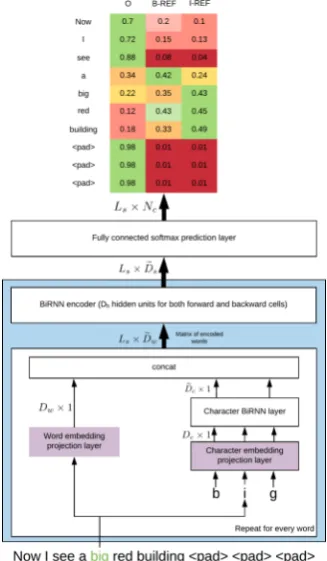
using the Random Indexing technique (Kanerva et al.,2000) for a character level. These character embeddings are then fed into a bidirectional recur-rent neural network (BiRNN) with gated recurrecur-rent units (GRUs), having rectifier activation functions (ReLUs) andHc-dimensional hidden states. This
BiRNN produces (Dc = 2 × Hc)-dimensional
[image:4.595.99.263.208.489.2]character-level word embeddings by concatenat-ing the hidden states of forward and backward GRUs.
Figure 1: RefNet architecture diagram. The purple blocks specify the pre-trained layers; thick arrows em-phasize that 2D tensors of dimensionality specified to the left of arrows are passed; the blue block denotes RefNet encoder. (Best viewed in color)
The motivation behind taking character-level embeddings into account is that some words in an RE will inevitably lack word vectors. In such cases, the corresponding word embeddings are as-signed to be zero vectors, leaving character-level embeddings as the only source of information. This amendment should be particularly helpful in at least the following two cases:
• if an RE is a proper name of a geographical object, pronounced in the language, different from the dominant language of the utterance, e.g. “Bahnstraße”, “ ¨Ostv¨agen”;
• if an RE is a composite name with one of the
constituents being recognized as a valid RE, e.g. “supermegamarket”.
The final word encoding is then a concatena-tion of the word embedding and the
character-level word embedding, resulting in a (Dw +
Dc)-dimensional vector. These word encodings are then collected into a sentence representation, which is a Ls ×Dw matrix. This sentence rep-resentation is fed row-wise as a sequence into an-other BiRNN (with forward and backward GRUs with ReLUs havingHshidden units).
In order to incorporate the contextual infortion, we want to represent a sentence as a ma-trix, the ith row of which contains the informa-tion about the sub-sentence up until, and includ-ing, theithword. To clarify, let us say the sentence “I see a building” is being processed (the padding step is omitted for the sake of brevity), then we are interested in vectorizing all its sub-sentences in the forward direction, i.e. “I”, “I see”, “I see a”, “I see a building”, and in a backward direction, i.e. “building”, “building a”, “building a see”, “building a see I”. To achieve that, we concate-nate forward and backward memory cells (which are equivalent to hidden states in case of GRUs) at each time stepi. This results in(Ds = 2×Hs) -dimensional sub-sentence representations, which are concatenated intoLs×Dsmatrix, referred to assub-sentence encoding. The sub-network used for obtaining such encoding will be referred to as RefNet encoder(blue block in Fig.1).
The rationale behind using sub-sentence encod-ing is that the same word can be either a part of RE or not, depending on the preceding and succeeding words. Consider the following two passages:
1. “You can see a train station to the right, it
is for commuter trains and is called
City’s Eastern.”
2. “You can see a train departing from the sec-ond track. It one of the city’s eastern parts.”
3.2 Reference resolution
[image:5.595.80.285.155.408.2]The resolution step implies matching a textual re-ferring expression with a candidate geographical object. For performing such reference resolution (sRR) we employ another neural network archi-tecture, dubbed asSpaceRefNet(see Fig.2).
Figure 2: SpaceRefNet architecture diagram. The pur-ple block is the pre-trained layer; the dashed arrows denote optional connections (Best viewed in color)
SpaceRefNet takes as an input a referring ex-pression (RE) and a candidate geographical
ob-ject, denoted as the candidate. The RE is
en-coded using the ptrained RefNet encoder, re-sulting in a Ls×Ds matrix, containing forward and backward Ds
2 -dimensional encodings for ev-ery sub-sentence. The final RE encoding is then the concatenation of the vectors containing for-ward and backfor-ward sub-sentence encodings for the whole sentence excluding paddings (the se-lected vectors are shown in a dark red in Fig. 2), resulting inDs-dimensional vector. The input can-didate is fed as only an OSM representation, or together with the distance and/or sweep features (see details in Sect.4). The vectors obtained after encoding both RE and candidate are then concate-nated and passed to the fully connected layer with Nh hidden units having rectifier activation func-tions. The final fully connected softmax prediction layer produces the probability of a match between the RE and the candidate.
SpaceRefNet is trained by optimizing the
weighted cross-entropy loss using the Adam op-timization method. Weights for the loss function are introduced, because the SpaceRef dataset has a high class imbalance – it has much more nega-tives (when a candidate and an RE mismatch) than positives (when a candidate and an RE match). To counteract this, a contribution of each data point (a candidate and an RE) to the global loss is adjusted using class-dependent multiplication factors (neg-atives receive lower weights than positives), allow-ing us to penalize the network more for the mis-takes made on positive data points.
Such an architecture allows handling the cases when an RE has any number of referents (0, 1, or more) in the candidate set, which is an advan-tage compared to previously developed methods that required more ad-hoc solutions, e.g. setting an experimentally selected probability threshold in (G¨otze and Boye,2017).
4 Data and processing
The utilized data consists of three datasets:
• a slightly corrected version of a publicly availableSpaceRef dataset (G¨otze and Boye,
2016) (used for RefNet and SpaceRefNet
training);
• a number of walks, containing the subjects’ descriptions of their vicinity, which is re-ferred to as WalksRef dataset1 (used for RefNet training);
• a number of dialogues with manually anno-tated REs, referred to as DialogsRef, taken from the publicly available Cornell Movie-Dialogs Corpus (Danescu-Niculescu-Mizil and Lee, 2011) and DailyDialog corpus (Li et al.,2017) (used for RefNet training only).
The SpaceRef dataset contains descriptions of immediate geographical environment given by pedestrians following predefined routes. REs in the spoken utterances were manually annotated. GPS information representing a physical context is also available.
Referring expressions (REs) in SpaceRef are mostly noun phrases (NPs). Some example utter-ances with the referring expressions (underlined) include:
1is publicly available at https://traktor.csc.
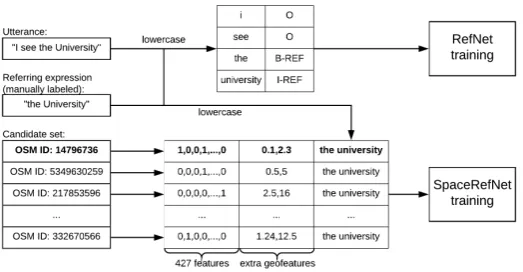
Figure 3: Data processing for training. The rows inbolddenote a positive data point for SpaceRefNet training, i.e. the one where RE describes the given OSM entity.
• indefinite and definite NPs, e.g. “...
walking down some stairs”, “there is
a fountain to my left”;
• NPs with interjections, which should be ex-cluded from an RE, e.g. “I am near eh the red eh brick building”;
• demonstratives, e.g. “... standing to the right of this building”;
• proper names, e.g. “... I am now passing 7-Eleven store”.
However, not all NPs in these categories are REs, for instance,
• in the utterance “Do you know if there is a subway station nearby?”, “a subway station” is not an RE, since it has no intention of re-ferring to a specific geographic object;
• in the utterance “This architectural style I like the most”, a demonstrative “this architectural style” is not an RE;
• in the utterance “The statue in front of the li-brary portrays Carl Linnaeus”, a proper name “Carl Linnaeus” is not an RE either.
SpaceRef and WalksRef contain mostly the ut-terances with at least one RE in them. Hence, the number of negative examples (NPs that are not REs), was not sufficient for training the neural net-work. With this in mind, the DialogsRef corpus was annotated providing more negative examples to improve the robustness of the trained models.
The candidate sets were regenerated for each referring expression by first computing lines-of-sight around the pedestrian location in 1 degree
steps using a “visibility engine”, inspired by (Boye et al.,2014). The lines-of-sight were computed in every direction between -100 and 100 degrees with respect to the pedestrian’s walking direction. The closest OSM nodes and ways, intersecting with these lines-of-sight, were included into the candi-date set as OSM identifiers.
Each candidate referent is then encoded using the following features:
• 427 binaryOSM type features, as described in (G¨otze,2016, Subsection 4.3.2).;
• the distance feature: the logarithm of a dis-tance between pedestrian’s and object’s loca-tions;
• the sweep feature: a number of lines-of-sight intersecting with an object divided by 360.
The last two features are referred to asextra geo-featuresand a numeric vector consisting of these 429 features – asgeoencoding.
The available data were transformed differently for training RefNet and SpaceRefNet (see Fig.3). RefNet training requires the data to be labeled us-ing BIO-REF labelus-ing strategy (as mentioned be-fore), i.e. each word in an utterance is either at the beginning of an RE and gets a labelB-REF, or in-side an RE and gets a labelI-REF, or is not a part of an RE and gets a labelO. SpaceRefNet training requires labeling of tuples (RE, OSM entity) with a binary label (1 if RE describes this OSM entity, 0 otherwise).
most cases all of them but one are not the referent the user intended. Thus, there will always be many more negative examples than positive examples in any dataset.
5 Models for comparison
5.1 Referring expression identification baseline
The REs are mostly represented by the noun phrases (NP), so the natural baseline is just return-ing every found NP as a candidate RE. The base-line was implemented as follows:
• a part-of-speech (POS) tag was defined for each word in an utterance using the Stan-ford POS tagger for English (Toutanova et al.,
2003), to be more specific, the wsj-0-18-bidirectional-distsimversion was used;
• the POS-tagged utterance is then parsed us-ing NLTK RegexpParser (Bird et al.,2009), supplied with the following grammar:
NP: {
(<DT>?(<RB.*>*<JJ>*)*<NN.*>+<IN>*)+ }
• all found NPs are returned as REs.
5.2 Reference resolution baseline
The natural RR baseline is just querying the OSM database and checking for geographical objects with an OSM property containing at least one word from the utterance (except stop words) ei-ther in a property key or value. For example, con-sider two utterances, (1) “a very nice big park” and (2) “a huge green area”, are being matched with the geographical object “Stanford Arbore-tum” (see Fig. 4). The utterances are first split by space and then all the stop words are removed. The result would be as follows: (1) {very, nice, big, park}and (2){huge, green, area}.
Each word is then checked against all proper-ties of the OSM object (both keys and values are checked). The first utterance will then be matched with “Stanford Arboretum”, because the “leisure” tag has value “park”, which is part of the utter-ance. The second utterance will not be matched, since none of the words matches any of the prop-erty keys or values.
Figure 4: OpenStreetMap (OSM) representation of “Stanford Arboretum”
6 Experimental results
In all experiments the networks were trained for a maximum of 100 epochs with the early stopping (patience of 5 epochs).
6.1 Spatial RE identification
A RefNet was trained on the SpaceRef, Walks-Ref and DialogWalks-Ref corpora. The data was split into training set (around 90% of the data con-taining around 90% of REs) and a test set (the remaining data). RefNet has a large number of hyper-parameters making a grid search computa-tionally infeasible. Instead, some of the hyper-parameters were fixed to the values found through manual experiments and the others were found us-ing a random search (Bergstra and Bengio,2012). The hyper-parameter space was searched during 60 random trials evaluating RefNet’s performance for each of hyper-parameter’s combination using 5-fold cross-validation.
[image:7.595.315.520.61.221.2]expression.
During the experiments the batch size was fixed to 128, the maximum sentence length set to 100
and maximum word length to 30. The
best-performing RefNet model found after the per-formed hyper-parameter search had 24 hidden units on the character-level BiRNN layer, 51 hid-den unit on the sentence-level BiRNN layer, a learning rate of 0.002. A regularization in the form of dropout was applied with the probabilities of keeping the input, the state and the output being 0.7, 0.75, 0.95 for the character-level BiRNN and 0.8, 0.95, 0.95 for the sentence-level BiRNN re-spectively. The found RefNet model achieved the following performance (averaged over 5 folds):
• a precision of 0.7846 (partial precision of 0.8083);
• a recall of 0.6608 (partial recall of 0.784).
Evaluating the same model on the test set re-sulted in a better performance compared to the baseline (see Table1).
Metric Baseline RefNet
Correct sentences (%) 21.02 77.08
Precision 0.1204 0.5457
Recall 0.2997 0.5531
Partial precision 0.1663 0.7204
[image:8.595.79.286.382.467.2]Partial recall 0.4142 0.7302
Table 1: Performance of different methods for solving spatial referring expression identification (sREI) task on the test set
6.2 Spatial reference resolution
SpaceRefNet was trained exclusively on the SpaceRef corpus. The data were split into train-ing set (around 80% of the data), validation set (around 10% of the data) and a test set (the re-maining data). SpaceRefNet has a smaller num-ber of hyper-parameters than RefNet, but a higher-dimensional input data (429 dimensions + RE en-coding size). Hence, the combination of random search with cross-validation becomes computa-tionally infeasible. Given the nature of SpaceRef data, i.e. the subjects walking along the routes in the same vicinity, the datapoints are more ho-mogeneous compared to DialogRef and WalksRef used for RefNet training. Keeping in mind ev-erything mentioned above, hyper-parameter space was searched using a combination of random and
manual search relying on the performance on the held-out validation set.
During random search, the batch size was fixed to 256. The best found SpaceRefNet model had 32 hidden units, negatives weighted with 0.25 and positives – with 1 in the loss function, a learning rate of 0.001 and used both distance and sweep
features. The model’s performance was
evalu-ated by computing precision, recall and F1-score for positives (matches between an RE and a can-didate) and negatives (mismatches). The perfor-mance on the validation set was:
• for positives, precision of 0.5854, recall of 0.4444, F1-score of 0.5053;
• for negatives, precision of 0.9860, recall of 0.9748, F1-score of 0.9804;
Evaluating the same model on the test set re-sulted in a better performance compared to the baseline and previously reported results in the lit-erature (see Table 2). Additionally a percentage of completely correctly labeled sentences is pro-vided.
Metric Baseline WAC SpaceRefNet
Prec. (p) 0.5588 0.40 0.6105
Rec. (p) 0.2043 0.45 0.6237
F1 (p) 0.2992 0.42 0.6170
Prec. (n) 0.9757 0.98 0.9883
Rec. (n) 0.995 0.98 0.9876
F1 (n) 0.9853 0.98 0.9879
Table 2: Performance of different methods for solving spatial reference resolution (sRR) task on the test set (“(p)” stands for positives, “(n)” stands for negatives), “WAC” stands for words-as-classifiers method (results reported in (G¨otze and Boye,2017)).
7 Discussion
The designed methods have shown promising re-sults in solving exophoric spatial reference reso-lution (sRR) beating the respective baselines and earlier reported results in the literature. It should be noted that sRR is a complicated task with non-trivial subproblems. Identifying REs in spoken utterances gets complicated because of multiple challenges:
• unclear sentence segmentationin spoken ut-terances results in the utut-terances like “I am
there is a bank”, the phrase “on my left” de-scribes the RE “the shop”, whereas the phrase “on my right” describes “the bank”;
• ASR errors can lead to the utterances like “I’m crossing the street on myrights”;
• interjections and self-correctionsresult in ut-terances like “there is another shop eh called ehm jer- jersey shop”.
A problem arises because of the possible differ-ences in the interpretation. Consider the utterance “on my right is the embassy of Poland in an old fantastic villa”. Depending on the interpretation, one might find either two REs “the embassy of Poland” and “an old fantastic villa” referring to the same geographic object or only one RE “the em-bassy of Poland in an old fantastic villa” referring to the same object. Such interpretation differences have not been considered while evaluatingRefNet. Resolving spatial references is even more tricky, since each found RE has mostly only one correct referent out of 30 candidates on average, making data very unbalanced. Furthermore, one RE can have multiple referents, e.g. the streets often con-sist of many different parts in OSM, or have no referents, e.g. some specifics about the geographi-cal objects (“a big clock on the wall of the univer-sity”), or outdated information.
Ongoing work includes incorporating this refer-ence resolution model into our wayfinding spoken dialogue system and collecting more data to im-prove the model.
Acknowledgements
This work was supported by Vinnova (Swe-den’s Innovation Agency) within the project 2018-01672, and by PTS (The Swedish Post and Tele-com Authority) within the project 17-10324.
References
James Bergstra and Yoshua Bengio. 2012. Random search for hyper-parameter optimization. Journal of Machine Learning Research, 13(Feb):281–305.
Steven Bird, Ewan Klein, and Edward Loper. 2009.
Natural language processing with Python: analyz-ing text with the natural language toolkit. ” O’Reilly Media, Inc.”.
Johan Boye, Morgan Fredriksson, Jana G¨otze, Joakim Gustafson, and J¨urgen K¨onigsmann. 2014. Walk this way: Spatial grounding for city exploration.
In Natural interaction with robots, knowbots and smartphones, pages 59–67. Springer.
Howard Chen, Alane Suhr, Dipendra Misra, Noah Snavely, and Yoav Artzi. 2019. Touchdown: Natural language navigation and spatial reasoning in visual street environments. In Proceedings of the IEEE Conference on Computer Vision and Pattern Recog-nition, pages 12538–12547.
Edward H Cornell and Elaine Greidanus. 2006. Path integration during a neighborhood walk. Spatial Cognition and Computation, 6(3):203–234.
Cristian Danescu-Niculescu-Mizil and Lillian Lee. 2011. Chameleons in imagined conversations: A new approach to understanding coordination of lin-guistic style in dialogs. In Proceedings of the 2nd Workshop on Cognitive Modeling and Compu-tational Linguistics, pages 76–87. Association for Computational Linguistics.
Michel Denis. 1997. The description of routes: A cognitive approach to the production of spatial dis-course.Cahiers de Psychologie, 16:409–458.
Nikos Engonopoulos, Martin Villalba, Ivan Titov, and Alexander Koller. 2013. Predicting the resolution of referring expressions from user behavior. In Pro-ceedings of the 2013 Conference on Empirical Meth-ods in Natural Language Processing, pages 1354– 1359.
Kotaro Funakoshi, Mikio Nakano, Takenobu Toku-naga, and Ryu Iida. 2012. A unified probabilistic approach to referring expressions. InProceedings of the 13th annual meeting of the special interest group on discourse and dialogue, pages 237–246. Associ-ation for ComputAssoci-ational Linguistics.
Joy Goodman, Phil Gray, Kartik Khammampad, and Stephen Brewster. 2004. Using landmarks to sup-port older people in navigation. In International Conference on Mobile Human-Computer Interac-tion, pages 38–48. Springer.
Jana G¨otze. 2016. Talk the walk: Empirical studies and data-driven methods for geographical natural language applications. Ph.D. thesis, KTH Royal In-stitute of Technology.
Jana G¨otze and Johan Boye. 2016. Spaceref: A corpus of street-level geographic descriptions. InLREC.
Jana G¨otze and Johan Boye. 2017. Reference resolu-tion for pedestrian wayfinding systems. In Interna-tional Conference on Geographic Information Sci-ence, pages 59–75. Springer.
Mordechai Haklay and Patrick Weber. 2008. Open-streetmap: User-generated street maps. IEEE Per-vasive Computing, 7(4):12–18.
Alycia M Hund and Jennifer L Minarik. 2006. Get-ting from here to there: Spatial anxiety, wayfinding strategies, direction type, and wayfinding efficiency.
Pentii Kanerva, Jan Kristoferson, and Anders Holst. 2000. Random indexing of text samples for la-tent semantic analysis. In Proceedings of the An-nual Meeting of the Cognitive Science Society, vol-ume 22.
Casey Kennington and David Schlangen. 2015. Simple learning and compositional application of perceptu-ally grounded word meanings for incremental refer-ence resolution. InProceedings of the 53rd Annual Meeting of the Association for Computational Lin-guistics and the 7th International Joint Conference on Natural Language Processing (Volume 1: Long Papers), volume 1, pages 292–301.
Diederik P Kingma and Jimmy Ba. 2014. Adam: A method for stochastic optimization. arXiv preprint arXiv:1412.6980.
Carol A Lawton and Janos Kallai. 2002. Gender dif-ferences in wayfinding strategies and anxiety about wayfinding: A cross-cultural comparison.Sex roles, 47(9-10):389–401.
Yanran Li, Hui Su, Xiaoyu Shen, Wenjie Li, Ziqiang Cao, and Shuzi Niu. 2017. Dailydialog: A manually labelled multi-turn dialogue dataset. arXiv preprint arXiv:1710.03957.
Kevin Lynch. 1960. The image of the city, volume 11. MIT press.
Cynthia Matuszek, Liefeng Bo, Luke Zettlemoyer, and Dieter Fox. 2014. Learning from unscripted deictic gesture and language for human-robot interactions. InAAAI, pages 2556–2563.
Andrew J May, Tracy Ross, Steven H Bayer, and Mikko J Tarkiainen. 2003. Pedestrian naviga-tion aids: informanaviga-tion requirements and design im-plications. Personal and Ubiquitous Computing, 7(6):331–338.
Ian Moar and Gordon H Bower. 1983. Inconsis-tency in spatial knowledge. Memory & Cognition, 11(2):107–113.
Jeffrey Pennington, Richard Socher, and Christopher Manning. 2014. Glove: Global vectors for word representation. InProceedings of the 2014 confer-ence on empirical methods in natural language pro-cessing (EMNLP), pages 1532–1543.
Zahar Prasov and Joyce Y Chai. 2010. Fusing eye gaze with speech recognition hypotheses to resolve ex-ophoric references in situated dialogue. In Proceed-ings of the 2010 Conference on Empirical Methods in Natural Language Processing, pages 471–481. Association for Computational Linguistics.
Tracy Ross, Andrew May, and Simon Thompson. 2004. The use of landmarks in pedestrian navigation in-structions and the effects of context. In Interna-tional Conference on Mobile Human-Computer In-teraction, pages 300–304. Springer.
David Schlangen, Sina Zarrieß, and Casey Kenning-ton. 2015. Resolving references to objects in pho-tographs using the words-as-classifiers model. arXiv preprint arXiv:1510.02125.
Niels Schutte, John Kelleher, and Brian Mac Namee. 2010. Visual salience and reference resolution in sit-uated dialogues: A corpus-based evaluation.
Bart Sheehan, Elizabeth Burton, and Lynne Mitchell. 2006. Outdoor wayfinding in dementia. Dementia, 5(2):271–281.
Kristina Toutanova, Dan Klein, Christopher D Man-ning, and Yoram Singer. 2003. Feature-rich part-of-speech tagging with a cyclic dependency network. InProceedings of the 2003 Conference of the North American Chapter of the Association for Computa-tional Linguistics on Human Language Technology-Volume 1, pages 173–180. Association for Compu-tational Linguistics.