Davide Girolami,1,∗ Tommaso Tufarelli,2 and Cristian E. Susa3,†
1Department of Atomic and Laser Physics, University of Oxford, Parks Road, Oxford OX1 3PU, UK 2School of Mathematical Sciences, The University of Nottingham, University Park, Nottingham NG7 2RD, UK 3Departamento de F´ısica y Electr´onica, Universidad de C´ordoba, Carrera 6 No. 76-103, Monter´ıa, Colombia
(Dated: September 16, 2017)
We propose an information-theoretic framework to quantify multipartite correlations in classical and quantum systems, answering questions such as: what is the amount of seven-partite correlations in a given state of ten particles? We identify measures of genuine multipartite correlations, i.e. statistical dependencies which cannot be ascribed to bipartite correlations, satisfying a set of desirable properties. Inspired by ideas developed in complexity science, we then introduce the concept of weaving to classify states which display different correlation patterns, but cannot be distinguished by correlation measures. The weaving of a state is defined as the weighted sum of correlations of every order. Weaving measures are good descriptors of the complexity of correlation structures in multipartite systems.
PACS numbers: 03.65., 03.65.Yz, 03.67.-a, 05.65.+b, 89.70.-a, 89.75.-k
Introduction – Statistical relations in measurement out-comes, i.e. correlations, are powerful tools to investigate multipartite systems, employed in (quantum) information theory, statistical mechanics, condensed matter theory, network theory, neuroscience, and complexity science [1–4]. Correlations describe global properties which cannot be inferred from the features of the system parts, e.g. phases of many-body systems [5]. They are also resources. Entan-glement, a kind of quantum correlation, enables speed-up in quantum information processing [6].
Yet, the very notion of genuine multipartite correlations still generates discussion [7]. There is no consistent way to quantify dependencies which do not manifest bipartite correlations, encoding joint properties of k > 2 particles instead, while witnesses of multipartite entanglement of at least order khave been proposed [8–15]. A further problem is that computing correlations is not always sufficient to fully describe multipartite correlation patterns. Equally correlated networks of multivariate variables can display different structures and properties [16,17]. Also, quantum states can be correlated in inherently inequivalent ways [18–20]. Here we propose a framework to describe genuine multi-partite correlations in classical and quantum systems. We identify distance-based measures which satisfy a set of desirable properties when parts of the systems are added or discarded, and local operations are performed. We show that adopting the relative entropy allows for simplifying computations and meeting even stronger constraints. We then introduce the notion ofweavingto classify multipartite states by studying how correlations scale with their order. The weaving of a state is given by the weighted sum of genuine multipartite correlations of any order, inheriting the properties of correlation measures. We compute the weaving of correlated classical and quantum states. In such cases, states which have equal total correlations or highest order correlations, but display a different correlation pattern, take different weaving values.
Quantifying Genuine Multipartite Correlations – A finite dimensional N-partite quantum system
SN = {S[1],S[2], . . . ,S[N]}, is described by a
den-sity matrix ρN, being ρ[i] the states of the subsystems
S[i],i = 1,2, . . . ,N. In this framework, classical
prob-ability distributions pα1,...,αN of N-variate discrete vari-ables are embedded in density matrices of the form
P
α1,...,αNpα1,...,αN|α1, . . . , αNi hα1, . . . , αN|, P
α1,...,αN pα1,...,αN = 1, where{αi} are orthonormal basis elements in the Hilbert spaces of each subsystemS[i]. The correlations inSNdepend
on the tensor product structure of its Hilbert space, induced by the partition{S[i]}. This is usually dictated by physical constraints, e.g. spatial separation of the subsystems. Indeed, even maximally entangled states are factorizable by changing the system structure [21, 22]. The total correlations in the system represent the information encoded in ρN which is
unaccessible to an observer knowing the states of each subsystem, ρ[i]. We extend the argument to define genuine multipartite correlations of order higher thank,2≤k≤N−1, as the missing information to a more informed observer, who knows the states ρkj of clusters forming a coarse grained partition {Sk1,Sk2, . . . ,Skm},Pmj=1kj = N,kj ≤ k,
where each cluster Skj includes up to k subsystems, e.g. Sk1 = {S[1],S[2], . . . ,S[k1]}. GenuineN-partite correlations, the highest order, are the information that is still missing when clusters including subsets of up toN−1 subsystems are accessible,kj≤N−1. The set of states describing clusters of
up toksubsystems is
Pk:=
σN =⊗mj=1σkj, m X
j=1
kj=N,k=max{kj}
. (1)
For example, givenN = 3, the setP1 consists of the prod-uct states⊗3
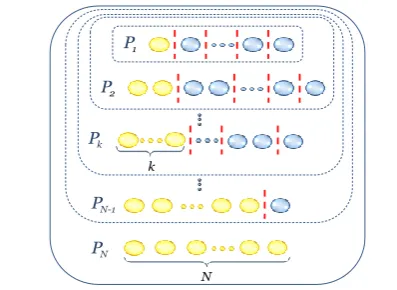
j=1σ[j], P2 includes P1 and the products of bi-partite and single-site states, i.e. σ2 ⊗σ1 and their permu-tations, whileP3containsP2and the non-factorizable density matricesσ3. The complete chain reads P1 ⊂ P2 ⊂ . . . ⊂ PN−1 ⊂PN, wherePN is the Hilbert space of the global
P 2
P 1
P k k
P N-1
[image:2.595.78.277.50.195.2]N P N
FIG. 1: Multipartite correlation hierarchy. Given a system ofN par-ticles (blue spheres), the setsPk,k = 1,2, . . . ,N,consist of states
displaying up tok-partite correlations. The yellowkspheres identify the largest subset of a coarse grained partition (the dashed red lines separate each cluster). The amount of genuinek-partite correlations in a state is the difference between the distance to the setsPk−1and
Pk.
[23]. Genuine multipartite correlations of order higher thank are then quantified by the distance of the global state to the set Pk,
Dk→N(ρN) :=min
σ∈Pk
D(ρN, σ), (2)
where the functionDis non-negative,D(ρ, σ)≥0,D(ρ, σ)= 0 ⇐⇒ ρ = σ, and contractive under completely positive and trace preserving (CPTP) maps Φ,D(ρ, σ) ≥
D(Φ(ρ),Φ(σ)),∀ρ, σ. Then, any distance identifies a measure ofk-partite correlations,
Dk(ρN) :=Dk−1→N(ρN)−Dk→N(ρN). (3)
As expected, the total correlations are given by the distance to the set of statistically independentN-partite states, which equals the sum of the correlations of any order: D1→N(ρN)=
min
σ∈P1
D(ρN, σ) =PkDk(ρN). For example, the genuine
bipar-tite correlations in a triparbipar-tite state are computed as the dif-ference between total correlations and genuine tripartite cor-relations,D2(ρ3)=D1→3(ρ3)−D2→3(ρ3), which are non-zero if and only if the state is not factorizable with respect to any bipartite cut.
The minimization in Eq.2is cumbersome for a generic dis-tanceD, but significantly simplified by employing the rela-tive entropyS(ρ||σ)=−S(ρ)−Tr(ρlogσ),∀ρ, σ: suppρ⊆ supp σ, ∞otherwise,S(ρ) = −Tr(ρlogρ). In such a case, the closest product state to the global state is the product of its marginals, min
⊗m i=1σki
S(ρN|| ⊗mi=1σki) = S(ρN|| ⊗ m i=1 ρki) = Pm
i=1S(ρki)−S(ρN),TrN−kρN = ρk [13,24]. Correlations of order higher than kare then given by the distance to ˜Pk ⊂
Pk,P˜k := n
⊗m j=1ρkj,
Pm
j=1kj=N,k=max{kj} o
. Therefore, the genuinek-partite correlations are measured by
Sk(ρN)=Sk−1→N(ρN)−Sk→N(ρN). (4)
For systems invariant under subsystem permutations, the sub-additivity of the von Neumann entropy,S(ρi)+S(ρj)≥S(ρi j),
makes the closest product state ˜ρk
Nto be the most “compact”
one, being the tensor product state ofbN/kcclusters ofk sub-systems and a cluster ofN− bN/kck=Nmodksubsystems, Sk→N(ρN)=bN/kcS(ρk)+(1−δNmodk,0)S(ρNmodk)−S(ρN).
We now verify the consistency of the framework. We iden-tify reasonable properties characterizing measures ofk-partite correlations, applicable for any orderk, by generalizing the ones proposed forN-partite correlations [7]. We show that the quantities in Eqs. (2,3), for any distance D, satisfy the criteria 0D-4D of invariance and monotonicity under local operations and changes in the system partition. We also prove that, by adopting the relative entropy, stronger yet desirable constraints 0S-5S are met:
0D-0S)The measures of k-partite correlations are faithful. They are non-negative,Dk(ρN)≥0, and vanish if and only if
the state does not havek-partite correlations.
1D)Adding a disjoint n-partite system,S0
N+n :=SN ∪ Sn,
cannot create correlations of order higher than n.If the state ofSN does not have correlations of order higher thann, ρN = ⊗m
j=1σkj, Pm
j=1kj = N,n ≥ max{kj}, then the state ofS0N+n is
ρN⊗ρn, which does not have correlations of order higher than
n, the largest factor of the product being still a state ofn or fewer subsystems. Thus,Dn→N+n(ρ
N+n)=Dn→N(ρN)=0.
1S) Adding a disjoint n-partite system cannot in-crease correlations of order higher than n. One has Sn→N(ρ
N) = S(ρN||ρ˜nN) = S(ρN ⊗ ρn||ρ˜nN ⊗ ρn) ≥
S(ρN ⊗ ρn||ρ˜nN+n) = Sn→N+n(ρN+n). For example, given
N =3, adding a bipartite system,n=2,cannot increase the tripartite correlations.
2D-2S)Local CPTP mapsΠiΦ[i],Φ[i] =I1⊗. . .Φi⊗. . .⊗IN,
cannot create correlations of any order k, and cannot increase the amount of correlations higher than any order k. Local op-erations do not change the tensor product structure of a state,
ρN ∈ Pk ⇒ ΠiΦ[i](ρN) ∈ Pk, ρN < Pk ⇒ ΠiΦ[i](ρN) < Pk,
so they cannot create correlations of any order, Dk(ρN) =
0⇒ Dk(ΠiΦ[i](ρN))=0,∀k. Contractivity under CPTP maps
guarantees Dk→N(ρN) ≥ Dk→N(⊗iΦ[i](ρN)),∀k. This also
implies monotonicity of the highest order of non-zero correla-tions,D˜k(ρN)≥D
˜
k(Π
iΦ[i](ρN)),k˜=max{k}:Dk→N(ρN)=0.
Note that an operation on a cluster ofnsubsystemsΦn,n>1,
can create correlations of order up tok+n−1 from already existingk-partite correlations. A state with non-zerok-partite correlations reads⊗m
j=1σkj, Pm
j=1kj =N,max{kj} ≥k. A map
Φn jointly applied to one subsystem of the largest cluster Smax{kj}and othern−1 subsystems generates correlations of order up to max{kj}+n−1. For example, thek-qubit state |aki=a|0i⊗k+
√
1−a2|1i⊗k,a∈(0,1),has genuinek-partite
correlations Sk(|aki) = 2(a2loga2 +(1 −a2) log(1−a2)).
Correlating the state with an ancillary target qubit by a CNOT gate creates the state|ak+1i = a|0i⊗(k+1)+
√
which hask+1-partite correlations,Sk(|a
k+1i)=Sk(|aki).
3D)Partial trace of n subsystems cannot increase correla-tions of order higher than k < N−n. Let ˜ρkN be the closest N-partite state with up tok-partite correlations. Then, by con-tractivity of the distance function, Dk→N(ρN) = D(ρN,ρ˜kN) ≥
D(ρN−n,Trnρ˜kN)≥D k→N−n(ρ
N−n).
3S) Partial trace of N − k subsystems can create up to k-partite correlations from existing N-partite cor-relations. Let us consider the classical N-bit state
ρc
N=(|0i h0|
⊗N+|1i h1|⊗N)/2,which hasN-partite correlations.
The marginal state TrN−kρcN = (|0i h0| ⊗k +|
1i h1|⊗k)/2,∀k, has genuine k-partite correlations. Contractivity ensures SN(ρN) ≥ Sk(ρk). The property is then proven, as k-partite
correlations are not necessarily present in ρc
N. One has
Sk(ρc
N) = bN/(k−1)c − bN/kc+δNmodk,0 −δNmod (k−1),0 =
dN/(k − 1)e − dN/ke. For example, given N = 5, the global state does not have genuine 4-partite correlations, S2(ρc
5) = 2,S 3(ρc
5) = S 5(ρc
5) = 1,S 4(ρc
5) = 0. Indeed, the stateρc
3⊗ρ
c
2 has more information about the global stateρ
c
5 thanρc
2⊗ρ
c
2⊗ρ
c
1, thus there are genuine 3-partite correlations, but the stateρc
4⊗ρ
c
1 is not more informative than the 3-vs-2 product (the relative entropy distance to the global state is equal). Genuine 4-partite correlations are distilled by tracing away one subsystem,S4(ρc4)=1.
4D-4S) Distilling n subsystems by fine graining cannot create correlations of order higher than k +n, for any k. Fine graining a subsystem into a cluster of n subsystems, S[i]→ Si0={S[i
j]},j=1, . . . ,n+1, changes the system parti-tion intoS0
N+n ={S[1],S[2], . . . ,S[i−1],{Sij},S[i+1], . . . ,S[N]}. If the state of the system SN has correlations of
or-der up to k, ρN = ρk≤N ⊗ (⊗lj≤kρlj), P
jlj = N − k,
the fine-graining map creates at most correlations of order k + n, ρN+n = ρk+n≤N+n ⊗ (⊗l≤kρl). Hence,
Dk+n→N+n(ρN+n)=Dk→N(ρN)=0.
5S) Total correlations are superadditive. It is given a coarse grained partition {Sk1,Sk2, . . . ,Skl},Plj=1kj =
N. The total correlations in each cluster Skj = {S[Pj−1
m=1km+1],S[Pj
−1
m=1km+2], . . . ,S[Pj
−1
m=1km+kj]} are quantified by the multi-information between the single subsystems forming the cluster,S1→kj(ρ
kj)= Pkj
n=1S(ρ[Pj−1
m=1km+n])−S(ρkj), a non-negative extension of the bipartite mutual information [25–27]. Exploiting subadditivity, one hasPlj=1S1→kj(ρ
kj)= PN
i=1S(ρ[i])−Plj=1S(ρkj)≤ PN
i=1S(ρ[i])−S(ρN)=S1→N(ρN),
where the inequality is saturated for product statesρN =⊗jρkj. That is, the sum of the total correlations in each cluster is upper bounded by the total correlations in the global system. For product states, subadditivity also implies additivity for correlations higher than k, for every k,
ρN=⊗jρkj ⇒ρ˜ k N =⊗jρ˜
k kj ⇒S
k→N(ρ
N)=PjSk→kj(ρkj).
While being intuitive and simple to phrase, the discussed properties are not met by heavily employed measures and
indicators of multipartite correlations. Covariances of local observables O[i], hΠiO[i]iρN −ΠihOiiρN, do not satisfy such criteria. They can vanish, for any choice of{O[i]}, in presence of classical and quantum multipartite correlations [7,28,29]. An alternative correlation witness measures the ability of multipartite systems to extract work from local environments [7], yet being still unproven whether the quantity satisfies properties 0D-4D. Another measure of correlations above orderkis the (relative entropy) distance of the global state to the state with maximal von Neumann entropy, among the ones with the same marginal states of k subsystems, S(ρN||σ¯kN),σ¯
k
N := σ max N:TrN−kσN=ρk
S(σN) [30–34]. Remarkably,
independent lines of thinking converged to the very same definition. However, such measure, as well as a related one given by the trace norm of the cumulant of the state [29,35], violates contractivity under local operations in both classical and quantum scenarios [17,36]. This happens because local operations do change a state whilst preserving its tensor product structure, thus changing the set of states with the samek-marginals.
Ranking correlation patterns by weaving – Having deter-mined how to quantify genuine multipartite correlations, one observes that equally correlated states, in terms of total corre-lations, can display different values of correlations for some order k, and thus different properties. Assuming N even, a product of N/2 Bell states, e.g. |ψN/2i = [1/√2(|00i + |11i)]⊗N/2, has the same total correlations of the N-partite GHZ state |GHZNi = √1
2(|0i
⊗N +|1i⊗N), as measured by
the relative entropy, S1→N(|ψN/2i) = S1→N(|GHZNi) = N,
whilst the latter exhibits correlations of higher order. On the same hand, the highest order of correlations is not sufficient to describe multipartite states. Both the GHZ and the N/ 2-excitation Dicke state q1
(N N/2)
P
iPi(|0i⊗N/2⊗ |1i⊗N/2), where
the sum is over the permutations{Pi}of the group Sym(N),
have two bits ofN-partite correlations. Yet, they have diff er-ent uses for information processing [37,38], and it is impossi-ble to transform them into each other by local operations and classical communication [18].
We introduce the concept of weaving to rank classical and quantum multipartite states by a single index, overcom-ing such ambiguities. The idea is to construct a consis-tent information-theoretic descriptor of correlation patterns by counting well-defined genuine multipartite correlations of ev-ery order. A weaving measure is built as the weighted sum of multipartite correlations,
WD(ρN)= N X
k=2
ωkDk(ρN)= N−1
X
k=1
ΩkDk→N(ρN), (5)
whereωk = k−1
P
i=1Ω
i, ωk ∈ R+. For any function D, a weav-ing measure is contractive under local operations and par-tial trace, WD(ρN) ≥ WD(ΠiΦ[i](ρN)),WD(ρN) ≥ WD(ρk),
ρN,N even Sk,k<N SN S1→N WS, ωk=k−1 [(|00i h00|+|11i h11|)/2]⊗N/2 N/2δ
k,2 0 N/2 N/2
(|0i h0|⊗N+|1i h1|⊗N)/2 dN/(k−1)e − dN/ke 1 N−1 ∼1.13NlogN−N [√1
2(|00i+|11i)]
⊗N/2 Nδ
k,2 0 N N
1
√
2(|0i
⊗N+|1i⊗N) dN/(k−1)e − dN/ke 2 N ∼1.13NlogN
1
q (N
1) P
iPi(|0i⊗(N−1)⊗ |1i) fD,1k 2/N(h(N)−h(N−1))∼0 h(N)−h(N−1)∼logN ∼2.61N
1
q (N
N/2) P
iPi(|0i⊗N/2⊗ |1i⊗N/2) fD,kN/2 2 N ∼0.01N2
Pd i=1|ii hi|
⊗N/d (dN/(k−1)e − dN/ke) logd logd (N−1) logd ∼(1.13NlogN−N) logd
(Pd i=1|iii/
√
[image:4.595.78.540.51.181.2]d)⊗N/2 Nlogdδk,2 0 Nlogd Nlogd
TABLE I: Genuinek-partite correlations,N-partite correlations, total correlations, and weaving (asymptotic scaling forN→ ∞) for: product ofN/2 maximally correlated two-bit states; maximally correlatedN-bit state; product ofN/2 Bell states;N-partite GHZ state (the expressions hold forN odd as well); N-partite Dicke states with one andN/2 excitations, beingh(x) = xlogx, and the functions fD,1,fD,N/2 given in
Ref. [39]; maximally correlatedN-partite classical state of dimensiond; product ofN/2 maximally entangled two-qudit states.
The relative entropy of weaving WS(ρN) is also additive,
WS(⊗jρkj)= P
jWS(ρkj), being a sum of additive terms (prop-erty 5S). Weaving is then easy to compute too, being obtained by global and marginal entropies.
The choice of the weights determines the meaning of a weaving measure. For ωk = 1,∀k, it is a measure of total
correlations. For ωl = δkl,∀l,it quantifies genuinek-partite
correlations. As observed, computing correlations is not suf-ficient to discriminate different multipartite states. Thus, we study correlation scaling. That is, how the information about the global system scales by accessing partitions containing clusters of increasing size. This is captured, for example, by choosing weights proportional to the correlation order. We calculate the relative entropy measures of genuine multipartite correlations and weaving, selectingωk =k−1⇒Ωi=1,∀i,
for highly correlated classical and quantum states of N particles (TableI). The quantity unambiguously ranks states with equal total correlations, or N-partite correlations. As expected, the weaving of states in tensor product form, e.g. the Bell state products, scales linearlyO(N) with the number of particles. Indeed, the correlations in the global state are the sum of the correlations in each product factor. The GHZ state shows super-linear scaling O(NlogN) instead. However, the highest asymptotic value O(N2) for N qubits is found in the N/2 excitation Dicke state. Such state has non-zero correlations at any order, fDk,N/2 ,0,∀k[39], while the GHZ state has zero correlations whenever dN/(k−1)e = dN/ke. Weaving is proportional to the logarithm of the subsystem dimensiond.
The concept of weaving solves issues emerged in previous studies. A measure of “neural complexity” was proposed to study correlation scaling between binary variables [40]. The quantity, which we generalize to the quantum scenario, readsC(ρN)= PNk=−11k/N S1
→N(ρ
N)− hS1→k(ρk)i, where the
average term is calculated over theNkclusters of k subsys-temsSk. A geometric lower bound is given by the weighted distances to the entropy maximisers with samek-marginals, C(ρN) ≥ Cg(ρN) = Pkk/NS(ρN,σ¯kN) [16, 17, 34, 41–43].
The interest in complexity measures was spurred by the
association with enhanced neuronal activity, evaluating the functionality of equally correlated neural networks. This generated a debate about whether complexity is the resource governing information transmission in the brain [44]. Such quantities have been also applied to study chaotic systems and cellular automata [17]. Yet, complexity measures fall short as benchmarks of multipartite correlations. The neural complexity is not additive under tensor products, e.g. C(ρ2 ⊗ρ1) = 4/3C(ρ2), while the geometric complexity is not contractive under local operations, nor under partial trace, requiring non-analytical methods to be computed [17,43,45].
Conclusion – We proposed a consistent information-theoretic definition of genuine multipartite correlations, and described how to quantify them. While we did not discuss the distinction between classical and quantum correlations, our result suggests a strategy to characterize genuine multi-partitequantumcorrelations, an open question despite recent progresses [10,24,46,47]. Having definedk-partite correla-tions as in Eq.2, classical and quantum contributions can be identified via the method employed for total correlations [24], then studying quantum correlations on their own.
We also introduced weaving, a descriptor of correlation pat-terns. Weaving is an alternative to complexity measures, i.e. a measure of how hard is to determine the properties of a sys-tem from knowing its parts [48], which satisfies desirable con-straints. An important question to address is its operational meaning. Specifically, the quantum contribution to the weav-ing of a state may be a further computational resource. This would confirm the intuition that interplaying complexity sci-ence and (quantum) information theory can advance both dis-ciplines [49].
Acknowledgments
No. EP/L01405X/1) and the Wolfson College, University of Oxford. T. T. is supported by the Foundational Questions In-stitute (fqxi.org), Physics of the Observer Programme (Grant No. FQXi-RFP-1601). C. E. S. Thanks Colciencias for a fel-lowship, CIBIOFI and Universidad de C´ordoba.
∗
Electronic address: [email protected] †
Electronic address: [email protected] [1] T. Cover and J. Thomas,Elements of Information Theory, Wiley
(1991).
[2] R. Badii and A. Politi,Complexity: Hierarchical Structure and Scaling in Physics.Cambridge University Press (1997). [3] J. P. Sethna,Statistical Mechanics: Entropy, Order Parameters,
and Complexity, Oxford University Press (2006).
[4] M. Wilde,Quantum Information Theory, Cambridge University Press (2013).
[5] L. Amico, R. Fazio, A. Osterloh, V. Vedral, Rev. Mod. Phys. 80, 517 (2008).
[6] R. Horodecki, P. Horodecki, M. Horodecki, and K. Horodecki, Rev. Mod. Phys.81, 865 (2009).
[7] C. H. Bennett, A. Grudka, M. Horodecki, P. Horodecki, and R. Horodecki, Phys. Rev. A83, 012312 (2011).
[8] O. Guehne, G. T´oth, Phys. Rep.474, 1 (2009).
[9] M. Huber, F. Mintert, A. Gabriel, and B. C. Hiesmayr, Phys. Rev. Lett.104, 210501 (2010).
[10] F. Levi and F. Mintert, Phys. Rev. Lett.110, 150402 (2013). [11] L. Pezz´e and A. Smerzi, Phys. Rev. Lett.110, 163604 (2013). [12] K. Schwaiger, D. Sauerwein, M. Cuquet, J. I. de Vicente, and
B. Kraus, Phys. Rev. Lett.115, 150502 (2015). [13] S. Szalay, Phys. Rev. A92, 042329 (2015). [14] D. Girolami and B. Yadin, Entropy19, 124 (2017).
[15] I. Apellaniz, M. Kleinmann, O. Guehne, and G. T´oth, Phys. Rev. A95, 032330 (2017).
[16] N. Ay, E. Olbrich, N. Bertschinger, and J. Jost, Chaos 21, 037103 (2011).
[17] T. Galla and O. Guehne, Phys. Rev. E85, 046209 (2012). [18] W. D¨ur, G. Vidal, and J. I. Cirac, Phys. Rev. A 62, 062314
(2000).
[19] A. Ac`ın, D. Bruss, M. Lewenstein, and A. Sanpera, Phys. Rev. Lett.87, 040401 (2001).
[20] F. Verstraete, J. Dehaene, B. De Moor, and H. Verschelde, Phys. Rev. A65, 052112 (2002).
[21] P. Zanardi, D. Lidar and S. Lloyd, Phys. Rev. Lett.92, 060402 (2004).
[22] H. Barnum, E. Knill, G. Ortiz, R. Somma, and L. Viola, Phys. Rev. Lett.92, 107902 (2004).
[23] O. Guehne, G. T´oth, and H. J. Briegel, New J. Phys.7, 229 (2005).
[24] K. Modi, T. Paterek, W. Son, V. Vedral, and M. Williamson, Phys. Rev. Lett.104, 080501 (2010).
[25] S. Watanabe, IBM J. of Res. and Dev.4, 66 (1960). [26] G. Lindblad, Commun. Math. Phys.33, 111 (1973). [27] R. Horodecki, Phys. Lett. A187, 145 (1994).
[28] D. Kaszlikowski, A. Sen, U. Sen, V. Vedral, and A. Winter, Phys. Rev. Lett.101, 070502 (2008); Z. Walczak, Phys. Rev. Lett.104, 068901 (2010); D. Kaszlikowski, A. Sen, U. Sen, V. Vedral, and A. Winter, Phys. Rev. Lett.104, 068902 (2010); C. Schwemmer, L. Knips, M. C. Tran, A. de Rosier, W. Laskowski, T. Paterek, and H. Weinfurter, Phys. Rev. Lett. 114, 180501 (2015).
[29] Z. Walczak, Phys. Lett. A374, 3999 (2010). [30] S. Amari, IEEE Trans. IT47, 1701 (2001).
[31] N. Linden and W. K. Wootters, Phys. Rev. Lett.89, 277906 (2002).
[32] E. Schneidman, S. Still, M. J. Berry II, and W. Bialek, Phys. Rev. Lett.91, 238701 (2003).
[33] D. L. Zhou, Phys. Rev. Lett.101, 180505 (2008).
[34] E. Olbrich, T, Kahle, N. Bertschinger, N. Ay, and J. Jost, Eur. Phys. J. B77, 239 (2010).
[35] D. L. Zhou, B. Zeng, Z. Xu, and L. You, Phys. Rev. A74, 052110 (2006).
[36] D. L. Zhou, Phys. Rev. A80, 022113 (2009).
[37] J.K. Stockton, J.M. Geremia, A.C. Doherty, and H. Mabuchi, Phys. Rev. A67, 022112 (2003).
[38] G. T´oth, J. Opt. Soc. Am. B24, 275 (2007). [39] See Supplementaries.
[40] G. Tononi, O. Sporns, and G. M. Edelman, Proc. Natl. Acad. Sci. USA91, 5033 (1994).
[41] N. Ay , E. Olbrich, N. Bertschinger, J. Jost, Proceedings of ECCS06 (European Complex Systems Society, 2006).
[42] T. Kahle, E. Olbrich, J. Jost, and N. Ay, Phys. Rev. E79, 026201 (2009).
[43] S. Niekamp, T. Galla, M. Kleinmann, and O. Guehne, J. Phys. A: Math. Theor.46, 125301 (2013).
[44] G. Tononi, G. M. Edelman, and O. Sporns, Trends Cogn. Sci. 2, 474 (1998).
[45] In Ref. [17], the authors propose a complexity measure for clas-sical systems which is contractive under local operations, but harder to compute.
[46] G. L. Giorgi, B. Bellomo, F. Galve, and R. Zambrini, Phys. Rev. Lett.107, 190501 (2011).
[47] F. M. Paula, A. Saguia, Thiago R. de Oliveira, M. S. Sarandy, Europhys. Lett.108, 10003 (2014).
[48] To date (30 July 2017), the term “complexity” appeared 24472 times in APS journals, with different means and meanings. To avoid further ambiguities, we adopt the termweavingto de-scribe correlation patterns.
Appendix
Genuinek-partite correlations of Dicke states
The Dicke states with one andN/2 excitations read
|D,1i = 1 q N
1
X
i Pi
|0i⊗(N−1)⊗ |1i, (A.1)
|D,N/2i = 1 q
N N/2
X
i
Pi|0i⊗N/2⊗ |1i⊗N/2. (A.2)
Since they are invariant under subsystem permutations, we can employ the compact expression given in the main text:
Sk→N(ρN)=bN/kcS(ρk)+(1−δNmodk,0)S(ρNmodk)−S(ρN). (A.3)
Then, the amount of genuinek-partite correlations of the Dicke states is given by
fDk,1: = Sk−1→N(|D,1i)−Sk→N(|D,1i),
Sk→N(|D,1i) =
jN
k k
(k−N) log1− k N
−k
log
kbN kc N
−log
1−kbNkc N
+logNk
−Nlog
1−kbNkc N
N , (A.4)
fDk,N/2: = Sk−1→N(|D,N/2i)−Sk→N(|D,N/2i),
Sk→N(|D,N/2i) =
N
k
Xk
i=0
− k
i N−k
N 2−i
log ( k i)(
N−k N 2−i)
(N N 2)
!
N N 2
+
N−kbN kc X
i=0
− kbNkc
N 2−i
N−kbN kc i
log
(kbNkc N 2−i
)(N−kbN kc i ) (N
N 2)
N N 2
. (A.5)
One can verify that the Dicke state withN/2 excitations displays correlations at any order, for arbitraryN,fk