Exploring the acceptability of innovative technology: a pilot study using LENA with parents of young deaf children in the UK.
Abstract
Early intervention is widely recommended for children at risk of difficulties with speech, language and communication. Evidence for effective practice remains limited due in part to inherent difficulties in defining complex interventions and measuring change.
The innovative Language Environment Analysis (LENA) system has exciting potential for early intervention and for evaluating outcomes. LENA is used widely in the United States; however there is little to guide the introduction of this new technology in the UK.
Successful implementation of new technology is predicted by its perceived acceptability and usefulness. This qualitative pilot study aimed to explore the acceptability of LENA for UK families with a
young deaf child. Four families used LENA to record for one day. They received and discussed LENA feedback reports with a specialist
a pragmatic epistemology, semi-structured interviews were conducted and the data explored using Thematic Analysis. Three families were positive about using LENA; they identified
benefits of the feedback, suggested important factors for future use and would recommend it to other families. One family chose not to complete the recording. Key to acceptability is parental
understanding of LENA’s purpose and the need for a trusted professional to facilitate interpretation and change.
LENA is acceptable for some UK families with a young deaf child suggesting there is potential for successful implementation. Further study to explore LENA’s usefulness is recommended.
Key Words
I Introduction
Hearing is essential for the development of spoken language;
permanent hearing loss (defined as an average of more than 40 dB HL over 0.5, 1, 2 and 4 kHz) affects about 900 children born each year in the UK and has long-term implications, not only for speech, language and communication, but also for social interaction,
educational attainment, employment opportunities and quality of life (Davis et al., 1997; Stacey et al., 2006). Early diagnosis of hearing loss followed by prompt intervention is recommended to minimise the risk of speech, language and communication difficulties and to
maximise spoken language potential (Davis et al., 1997; Pimperton and Kennedy, 2012).
child. There is an expectation that with early and appropriate
intervention, listening and spoken language development is attainable for many children with hearing loss (Yoshinaga-Itano, 2003).
Demonstrating the effectiveness of interventions such as these is essential to justify their value to those commissioning services. However, these complex interventions present methodological challenges both in terms of their definition and in capturing their outcomes; consequently, there is limited evidence for the most
effective practice. To address this, Dunst and Trivette (2009) suggest evaluating the “desired outcomes” of intervention rather than the intervention itself. A desired outcome of early intervention with young deaf children is change in those factors, which are thought to be
beneficial to communication development. A measure of these beneficial factors may be an appropriate method of demonstrating
the effectiveness of an intervention.
1 Beneficial factors for spoken language development
control of clinicians. However, several other key factors are widely held to be important and form the basis of many early communication interventions. They include
Achieving adequate audibility: Although hearing loss may be
diagnosed early, achieving optimal hearing for speech is still not straightforward. Factors such as noisy listening environments and inconsistent use of hearing technology impair the child’s exposure to language (Van Dam et al., 2012).
Quantity of language spoken to the child: The amount of language
spoken by parents to their hearing children from birth to three years has been shown to partially predict their IQ, language abilities and academic achievement at ages 9 and 10 years (Hart and Risley, 1995).
Active parent-child interaction: The importance of parent-child
communication for language development has been widely
demonstrated. For many children with hearing loss however, reduced responsiveness as well as poor linguistic ability can create
Intervention and support to facilitate language development: Parents
are typically the biggest influence in their baby’s life; current clinical guidelines recommend working through parents as the most
appropriate approach with young deaf children (Muse et al., 2013; Royal College of Speech and Language Therapists, 2009).
2 Language Environment Analysis system (LENA)
The Language Environment Analysis (LENA) system is a recent technological innovation, which potentially provides a way to
demonstrate these described “beneficial factors” to parents as a basis for intervention and to capture the “desired outcomes”. LENA enables exploration of the child’s natural language environment by capturing a daylong recording of the speech and environmental sounds
occurring throughout the day (LENA, 2015). The child wears a small recording device, the Digital Language Processor (DLP), which is held securely on his/her chest in the pocket of a T-shirt specially designed to minimise acoustic interference. The resulting audio file is
of the Audio Environment and counts of Adult Words, Child Vocalisations and Conversational Turns. These primary LENA
measures reflect the key beneficial factors described above: Achieving Audibility: Uniquely, LENA captures the daily Audio
Environment of the child in terms of meaningful and distant speech, silence and background noise, including TV and electronic sound. Quantity of input: Adult Word Count counts the number of adult words spoken that are audible to the child.
Active parent-child interaction: Conversational Turns demonstrate the number of spoken alternations between adult and child.
Intervention: Clinicians use the LENA information to support parents/ carers in making changes to facilitate their child’s communication development.
In the USA, LENA is already used for both research and clinical
practice with deaf children, for example Aragon and Yoshinaga-Itano (2012). Conversely, in the UK there is little awareness of LENA and limited published information to guide its introduction. Whilst audio and video recording are common in UK practice, LENA’s unique
parents. The introduction and effective implementation of any new technology or intervention requires that it should be seen as
“acceptable” (Holden and Karsh, 2010); whilst there is no consensus on the definition of or for a measure of acceptability, the Medical Research Council guidance (Craig et al., 2008) also describes the need for acceptability to be established during the development of new complex interventions. Levels of acceptability for using LENA are difficult to ascertain from current literature; although drop-out rates are reported in some studies, these seem to be related to non-LENA issues, such as family re-location (Suskind et al., 2013). Future use of LENA with young deaf children in the UK initially rests on whether it is perceived as acceptable by their parents and the professionals who work with them. Additionally, introduction of LENA technology in the UK requires consideration of important issues, such as cost and NHS information governance. Consequently, in order to make
recommendations about potential implementation, there is firstly a need to explore its acceptability with UK families.
This pilot study was undertaken to begin to address this issue by asking the research question: Is LENA acceptable to parents of young children with hearing loss in the UK?
Key objectives of the study were to
Investigate parental interest in and concerns around using LENA through a focus group.
Provide parents with the experience of using LENA with their child and explore their views using individual semi-structured interviews.
Determine if further study is justified and make
recommendations regarding appropriate development and future implementation.
II Method
The study consisted of three stages
1) Focus group: to introduce LENA, explore parents’ initial impressions, concerns and interest.
2) A LENA “trial”
3) Semi-structured qualitative interview
All aspects of the study were conducted by the researcher/first author, who is also a specialist Speech and Language Therapist with extensive experience of working with deaf children and their families; this was explained to participants.
Having reviewed and discussed all aspects of the study protocol with the researcher, the University of Nottingham Medical School Ethics Committee was satisfied that it fully addressed all ethical
requirements and granted approval.
1 Participants
sensori-neural hearing loss (SNHL) of greater than 40dB. All forms of hearing technology (hearing aid(s), cochlear implant(s) and bone conduction hearing device(s)) and communication mode were
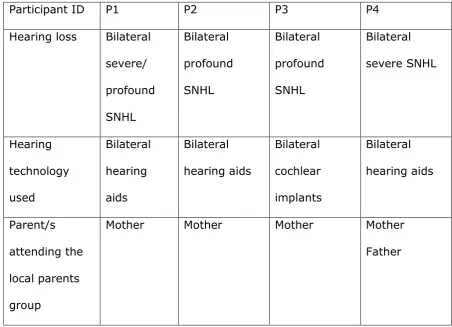
included. Potential participants were approached through an existing local parents group run by The Ear Foundation, a Nottingham-based voluntary sector organisation bridging the gap between clinic-based hearing technology services and their use in daily life. Details of participants are presented in Table 1.
Table 1 about here.
2 Focus group
about using it. During the focus group, they were shown a brief video explaining the background to LENA and given opportunity for hands-on experience of the Digital Language Processor and LENA T-shirts. The researcher used a schedule of two open-ended questions, “What are your initial thoughts about this?” and “Is this something you would be interested in using with your child?” followed up with opportunity to ask questions and prompts such as “Can you tell me more about that?” to facilitate group discussion. Subsequently, the families were invited to participate in a “LENA trial” and provided with Research Volunteer Information sheets. All four families provided consent to participate in this next stage of the study.
2 LENA “trial”
Using LENA with families consisted of three steps: Record, Return, Review.
Record
described, these tops have a specifically designed pocket on the chest, which provides minimal acoustic interference and safely holds the DLP in a suitable position to record sounds around the child. The researcher explained the instructions and answered any questions. The researcher’s phone number was provided in case of additional queries.
The researcher reminded and reassured families that the recording would be uploaded contemporaneously to the LENA software for computer analysis; this would never involve a person listening to the recording. If at any time during the day they felt uncomfortable, they should simply remove the DLP, switch it off and the recording would be deleted.
The family recorded a whole day of their choosing by switching on the DLP in the morning, securing it inside the T-shirt pocket and leaving it to record all day. They were advised to remove the DLP during bath time and also during periods of sleeping or when the child was in a harness or car seat to ensure child safety; placing the DLP near to the child allowed it to continue recording at these times.
The researcher collected the DLP at an agreed time and location after the recording day and a date was booked for the Review session. The DLP was connected to a password-protected computer in a secure location and the audio file of the recording uploaded to the LENA software for automatic analysis. The DLP was then free to be used by other participants. Processing takes several hours; once completed, “reports” of the data were available to be printed and shared with the family in the Review session.
Review
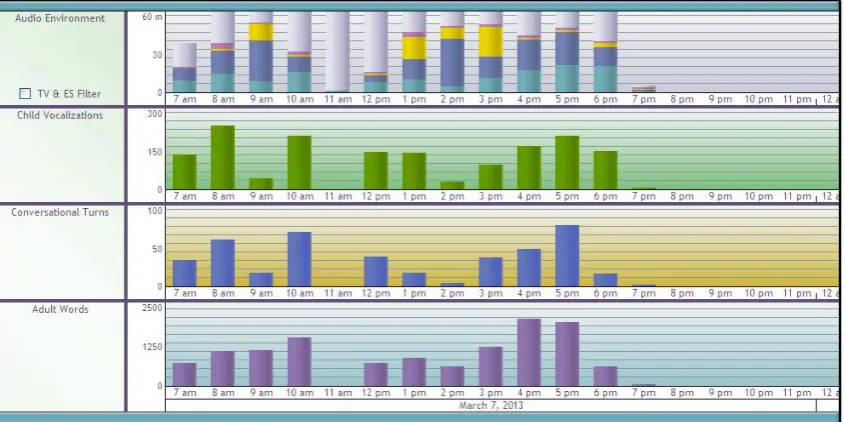
Several levels of analysis are possible with LENA; only the Core Reports were used in this study. These include:
Adult Words: the total number of adult words spoken near or to the
child.
Conversational Turns: the number of adult-child conversational
interactions.
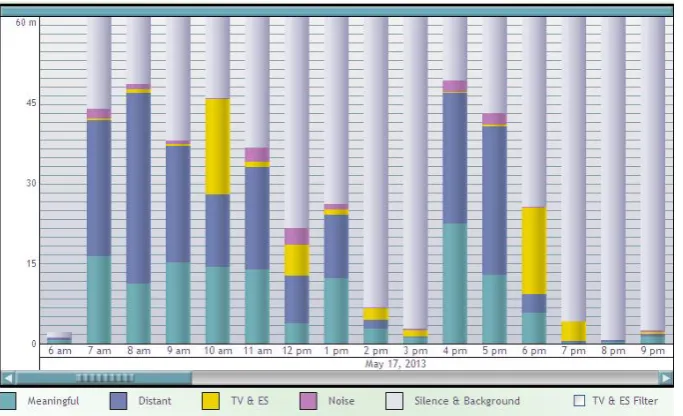
Audio environment: showing the mix of audio components in the
TV and electronic sounds (including radio and tablets), Noise (for example, toys rattling) and Silence.
Child Vocalisations: speech sounds produced by the child, which may
include canonical syllables (such as “baba” “dada”), proto-phones (such as squeals or raspberries) and words. They do not include cries or vegetative sounds (such as sneezing).
LENA reports are simple, colourful graphs displaying a breakdown of these results across different time frames (see Figures 1 and 2); for this study, the Hourly display was used. From the time the DLP is switched on in the morning until turned off at night, each hour of the day is displayed as a vertical bar representing the total for that
measure, for example, the total number of Adult words spoken during that hour. The Audio environment bar is broken into the components described above, for example, one vertical bar may consist of 30% silence, 10% TV and electronic, 5% Noise, 25% Distant and 30% Meaningful speech.
During a Review session, these reports are shared with parents, each of the measures are explained and discussion is facilitated around the findings, exploring areas of interest, for example considering specific times of the day when conversational turns are relatively high or when TV noise is particularly low.
3 Parental interview
For this study, the individual semi-structured interview was conducted during the Review session, using a pre-determined
schedule in part based on the focus group findings. The interview was carried out in two parts: pre- and post-sharing of the reports. The first part covered issues such as quality of information received prior to use, confidence using LENA, their choice of recording day. The second part following the review of reports asked about the
experience of receiving the reports and thoughts about future LENA use. In three families only the mother was present for the review and interview (P1,3, 4); for P2, both mother and father participated.
Individual interview data was transcribed and analysed inductively by the researcher using Thematic Analysis (Braun & Clarke, 2006).
III Results
During the focus group, all the participants expressed a high level of interest in using LENA; whilst this may be anticipated as a first
response to the exciting technology, for most of these parents the interest was maintained after having hands-on experience,
suggesting that they perceived LENA as acceptable.
All participants mentioned the recording process and how it made them feel. For three participants, they acknowledged an initial feeling of awareness, but that this passed, for example:
“I was expecting to be constantly aware that it was there, but no you forget all about it pretty quickly.” (P1)
The parent who had anticipated that she would feel conscious of the recording and be unable to act naturally, reported that in fact it wasn’t a problem at all.
Despite reassurance that they would not be listened to, handing over a recording of your day creates some sense of vulnerability. Whilst all participants accepted the assurance that this recording would not be listened to; it was still referred to by them all, for example, “I was singing then [….] I hope you didn’t listen to that!” (P4)
Trust in the person dealing with the recording seemed to help participants in this study;
In other words, a known professional may be more trusted than an unknown researcher (Suskind et al., 2013).
All the mothers commented that using the DLP was or would have been easier when they were alone with the child and related this directly to the recording process, feeling more aware of their adult interactions being recorded than of those with the child.
One of the four families (P2) felt so uncomfortable with being recorded that they chose to remove the DLP and discontinue recording, commenting:
“I just didn’t like it at all.” “It’s like being spied on.”
“It’s just the thought of being in your own home and you can’t talk normal knowing you’re getting recorded.”
These parents were concerned not only about perceived intrusion into their own conversations, but also the potential impact on other
parents want to try out a new strategy to see how their child responds.
A proposed benefit of LENA’s daylong recording is its ability to reflect natural communication in everyday life. However, choosing a “good day” to record was an issue for all families. A good day seemed to be one in which they could best demonstrate positive behaviours and strategies, for example plenty of individual contact with their child and situations in which their child was likely to be most vocal. For each family, this “good day” turned out to be different than they had planned and three families wanted another opportunity to record.
Underpinning some of the issues of acceptability seems to be that of the understanding and involvement of both parents. For three
families, only one parent received the introductory LENA information and provided consent (P1,2,3). One suggested that:
both people feel about it, you know under the same roof.” (P2, Mother)
This parent also pointed out:
“cos I went to all those groups every week, to all those sessions so you learn a lot more from the sessions […] (he) never went so he was only hearing off me.” This reflects common everyday practice of
professionals providing home visits with only one parent present.
The families all expressed some level of anxiety before receiving the feedback reports, which seemed to be related to the novelty of the tool, but also to concerns about their own competence, for example, “Am I doing enough?” (P1)
The process of sharing the reports facilitated active parental involvement, engaging parents in several ways:
Asking questions: “Do you think there’s enough meaningful speech there?” (P1)
Reflecting on their own behaviours: “I talk to him a lot at these times.” (P3)
Discussing their child’s development openly: “I just want to know the truth…. cos if it were really low then I’d just be like let’s do what we can to help the situation.” (P1)
Demonstrating their current knowledge: “I try to keep the TV off so I’m glad that’s showing on there…when the TV is on I really do notice it if I’m doing anything like talking, I really don’t get a response from him at all.” (P1)
Parents found the visual reports accessible,
“Yeh I’m not smart that way with maths but I did understand the bar chart…how much there is in a bar just says it all doesn’t it?” (P3) “I think it’s useful cos you’re used to percentiles from the growth charts and things.” (P1)
“10 till 11, that’s why there’s a lot going on then …he was quite vocal, singing and copying them, yeh that’s probably why.” (P4)
Most parents thought it would be useful to repeat the LENA process, for example to observe progress and check if it was being
maintained, observe different environments, such as nursery or to provide “evidence” for audiological decisions by using the reports to supplement audiological findings and parental report.
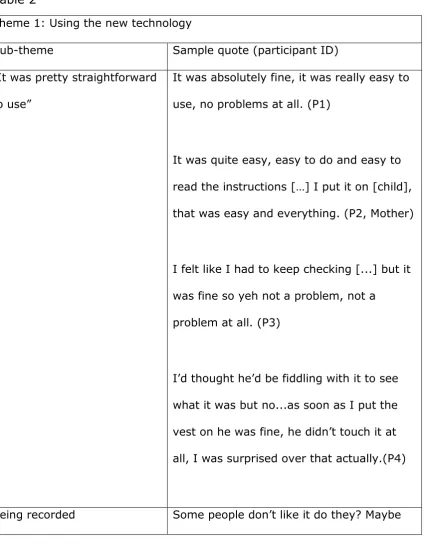
Themes identified from the thematic analysis are presented in Table 2.
Table 2 about here IV Discussion
encountered in this pilot study; these concerns were significant enough for one family out of four to refuse.
Practical changes may address these concerns; improving participant information, requesting consent from both parents, providing home visits to actively involve all primary carers and the option of using LENA in a limited way, such as for targeted recordings. However, the family in this study reported that there was little that could be offered to improve their aversion to LENA and it may be that for some
families LENA will never be acceptable.
change over time seem to be a powerful incentive (Suskind et al., 2012). Whilst using LENA as a “one-off” experience for this study was interesting, further study into its usefulness should reflect the more likely clinical practice of repeated use.
Sharing LENA reports generated active parent involvement; nevertheless, parents strongly expressed the need for help with interpretation to add meaning, relevance and application for their individual family. This indicates that dialogue between parent and professional is still required to facilitate discussion, help parents interpret and act upon LENA findings. Additionally, for the
participants, having a known professional seemed to provide an important element of trust, which has implications for acceptable implementation. Suskind et al. (2013) also found that parents wanted reassurance that they could repeat the recording if they were
unhappy with it in any way; this sense of having total control seemed to improve their acceptance.
functions, which may provide this “missing” information requested by parents; however only the core LENA reports were used in this study. Additionally, some of the unfulfilled expectation directly reflects the one-off nature of LENA use in this pilot study and again demonstrates the need to investigate acceptance and utility in a more extended application, which better reflects likely use.
V Conclusions & Implications
Early diagnosis and intervention are widely recommended to maximize the spoken language potential of deaf babies. Limited
evidence for best practice highlights the difficulties of evaluating such complex interventions; however delivering effective interventions and demonstrating their value is vital in modern healthcare when
resources are stretched.
The LENA system provides a possible solution to this dilemma; LENA shows change in the important factors beneficial to communication development as a basis for intervention and to demonstrate
Although relatively unknown in the UK, promising initial findings from this qualitative pilot study suggest that UK parents consider LENA to be acceptable, an important first step in developing a complex
intervention. Acceptability seemed to be primarily affected by parental understanding of LENA’s purpose, concerns of privacy and perceived appraisal of parenting skills.
Successful implementation of any new technology is predicted not only by acceptability but also by perceived usefulness; findings on usefulness were restricted by the single LENA use in this study. Further study is underway to explore repeated LENA use, which is more typical of clinical practice.
LENA’s innovative system has exciting potential for both UK research and clinical practice with a broad range of children, not only those with hearing loss.
Funding
Conflict of Interest Statement
The Authors declare that there is no conflict of interest.
References
Braun V and Clarke V (2006) Using thematic analysis in psychology. Qualitative Research in Psychology 3(2): 77-101.
Craig P, Dieppe P, Macintyre S et al. (2008) Developing and
evaluating complex interventions: the new Medical Research Council guidance. British Medical Journal 337(1): a1655-a1665.
Davis A, Bamford J, Wilson I et al. (1997) A critical review of the role of neonatal hearing screening in the detection of congenital hearing impairment. Health Technology Assessment 1(10): i-iv, 1-176.
Hart B and Risley TR (1995) Meaningful differences in the everyday experience of young American children. Baltimore: Paul H Brookes Publishing.
Holden RJ and Karsh BT (2010) The Technology Acceptance Model: its past and its future in health care. Journal of Biomedical
Informatics 43(1): 159-72.
LENA (2015) LENA Research Foundation. Available at: http://www.lenafoundation.org (Accessed: 22 June 2016).
Moeller MP (2009) Consistency of hearing aid use in infants with
early-identified hearing loss. American Journal of Audiology 18 14-23.
Muse C, Harrison J, Yoshinaga-Itano C et al. (2013) Supplement to the Joint Commissioning on Infant Hearing (2007) position
statement: principles and guidelines for early intervention after
NHS Newborn Hearing Screening Programme (2015) National Newborn Hearing Screening Programme. Available at:
http://hearing.screening.nhs.uk/nationalprog (accessed: 22 June 2016).
Pimperton H and Kennedy CR (2012) The impact of early
identification of permanent childhood hearing impairment on speech and language outcomes. Archives of Disease in Childhood 97(7): 648-53.
Royal College of Speech and Language Therapists (2009) Resource manual for commissioning and planning services for speech, language and communication needs. Available at:
http://www.rcslt.org/speech_and_language_therapy/commissioning/ deafness_plus_intro (accessed: 26 January 2016).
communication skills, educational achievements, quality of life, and cochlear implantation. Ear and Hearing 27(2): 161-86.
Suskind D, Leffel KR, Hernandez MW et al. (2013) An exploratory study of “quantitative linguistic feedback” effect of LENA feedback on adult language production. Communication Disorders Quarterly
34(4): 199-209.
Van Dam M, Ambrose SE and Moeller MP (2012) Quantity of parental language in the home environments of hard-of-hearing 2-year-olds. Journal of Deaf Studies and Deaf Education 17(4): 402-20.
Table 1: Participant information
Participant ID P1 P2 P3 P4
Hearing loss Bilateral
severe/ profound SNHL Bilateral profound SNHL Bilateral profound SNHL Bilateral severe SNHL Hearing technology used Bilateral hearing aids Bilateral hearing aids Bilateral cochlear implants Bilateral hearing aids Parent/s attending the local parents group
Mother Mother Mother Mother
Table 2
Theme 1: Using the new technology
Sub-theme Sample quote (participant ID)
“It was pretty straightforward
to use”
It was absolutely fine, it was really easy to
use, no problems at all. (P1)
It was quite easy, easy to do and easy to
read the instructions […] I put it on [child],
that was easy and everything. (P2, Mother)
I felt like I had to keep checking [...] but it
was fine so yeh not a problem, not a
problem at all. (P3)
I’d thought he’d be fiddling with it to see
what it was but no...as soon as I put the
vest on he was fine, he didn’t touch it at
all, I was surprised over that actually.(P4)
feels like it’s all a bit staged. Doesn’t bother
me really [...] I was quite confident that
nobody was going to be listening to it.(P1)
I think you couldn’t have a conversation
[...] straight away I didn’t like it. I think
everybody’s different, obviously (mother)
feels different to the way I reacted...she
thought it was a good idea. I’m just one of
those people definitely you know...I won’t
like it. It doesn’t matter how many ways
you explain it the answer would still be no.
(P2, father)
it was just more the uncomfortable bit of
thinking that someone’s listening to your
conversation and it made us uncomfortable
as well...if I was in on my own with [child]
it probably would have been different.(P2,
When you’ve got your partner here you talk
to I probably would have felt a little bit
conscious of what WE were talking about.
(P3)
It was fine actually, not as bad as what I
thought cos I was expecting to be
constantly aware that it was there but no
you forget all about it pretty quickly. (P4)
A good day I don’t know what the results will be like; it
wasn’t that typical a day. (P1)
It probably wasn’t the best day to do it
actually […] we were out a lot of the day
so...I wish I’d done it the day before. […]
we was in most of the day that day playing
Understanding It boils down to how both people feel about
it you know under the same roof. Maybe
it’d be best to get more information first
before you sign a contract and tell your
partner” (P2, mother)
Cos I went to all those groups every
week[...] he never went so e was only
hearing off me. (P2, mother)
Theme 2: The reports
Anticipation & Future use Seeing the results is quite nerve
wracking!(P1)
I just want to do it again! (P1)
Am I doing enough? (P4)
Feedback:
Visual feedback &
numbers
Active parental
involvement
Yeh I talk to him a lot at those times. I try
to keep the TV off so I’m glad that’s
showing on there [...] when the TV is on I
really do notice it if I’m talking, I really
Role of the feedback
provider I did understand the bar chart[...] how
much there is in a bar just says it all
doesn’t it? (P3)
Well I mean I see it differently now […] I
mean I’m surprised he is vocalising a lot.
I’m pleased it was better than what I was