Procedia Engineering 155 ( 2016 ) 1 – 7
1877-7058 © 2016 Published by Elsevier Ltd. This is an open access article under the CC BY-NC-ND license (http://creativecommons.org/licenses/by-nc-nd/4.0/).
Peer-review under responsibility of the TensiNet Association and the Cost Action TU1303, Vrije Universiteit Brussel
doi: 10.1016/j.proeng.2016.08.001
ScienceDirect
International Symposium on "Novel Structural Skins: Improving sustainability and efficiency
through new structural textile materials and designs"
Editorial to the proceedings of the TensiNet - COST Action TU1303
Symposium 2016
John Chilton
*a, Peter Gosling
b, Marijke Mollaert
c, Bernd Stimpfle
da
University of Nottingham, Department of Architecture and Built Environment, University Park, Nottingham, NG7 2RD, United Kingdom b
Newcastle University, School of Civil Engineering and Geosciences, Drummond Building, Newcastle-upon-Tyne, NE1 7RU, United Kingdom c
Vrije Universiteit Brussel, Architectural Engineering Department, Pleinlaan 2 , B - 1050 Brussel, Belgium d
formTL, ingenieure für tragwerk und leichtbau GmbH, Kesselhaus, Güttinger Straße 37, 78315, Radolfzell, Germany
Abstract
The TensiNet Association, in collaboration with the COST Action TU1303 “Novel structural skins: Improving sustainability and efficiency through new structural textile materials and designs” and the Newcastle University organized the TensiNet - COST Action TU1303 Symposium 2016 held in Newcastle upon Tyne, UK, from Wednesday 26th to Friday 28th October 2016. This paper presents the 3-day event introducing the topics selected for the sessions, the keynote lectures and speakers and the sponsors which supported the organization of the symposium.
© 2016 The Authors. Published by Elsevier Ltd.
Peer-review under responsibility of the TensiNet Association and the Cost Action TU1303, Vrije Universiteit Brussel.
Keywords: TensiNet Association; COST Action TU1303, novel structural skins
* Corresponding author. Tel.: +44 (0)115 951 3171 E-mail address: [email protected]
© 2016 Published by Elsevier Ltd. This is an open access article under the CC BY-NC-ND license (http://creativecommons.org/licenses/by-nc-nd/4.0/).
1. Introduction
1.1. The TensiNet Association
TensiNet is an association or platform for all parties interested in tensioned membrane structures. It is a multi-disciplinary association, conforming to the initial objectives of the EU-funded thematic network (G1RT-CT-2000-05010) on Tension and membrane structures (2001-2004), which culminated in the publication of the European Design Guide for Tensile Surface Structures [1]. The association supports developments in the field of tensioned membrane and foil construction with a series of activities which include publication of the TensiNews newsletter twice a year, workshops, regular symposia (Brussels 2003 [2], Milan 2007 [3], Sofia 2010 [4] and Istanbul 2013 [5] and Newcastle 2016), student competitions and working groups The latter contribute to the further development and augmentation of the European Design Guide, for instance, Annex 5: Design Recommendations for ETFE Foil Structures [6] and future implementation of a Eurocode [7].
TensiNet maintains the website www.tensinet.com [8], containing a projects database as well as articles and links to members’ websites - manufacturers, fabricators, material producers, coaters, weavers, architecture and engineering offices, distributors of machinery, steelwork and cables, software companies, academic and research institutes active in the field.
1.2. COST Action TU1303 “Novel structural skins”
Since it was created in 1971, the longest-running European framework COST (European Cooperation in Science and Technology) has supported cooperation among researchers across Europe, increasing their mobility and furthering the establishment of scientific excellence. It is considered to play an important role in building a European Research Area (ERA) by stimulating advanced multidisciplinary research [8].
By facilitating and encouraging researcher mobility, COST Action TU1303 “Novel structural skins. Improving sustainability and efficiency through new structural textile materials and designs” [9] facilitates networking between its partners and provides mobility opportunities. Through its five working groups, it aims to “harmonize the research on membrane and foil structural skins, to standardise testing and analysis approaches within Europe, and to stimulate and deliver innovation and development of new and energy efficient structural skin products and applications in the urban environment.” [10] Although the COST Action does not directly fund research, it supports a range of networking activities, including working group meetings, short-term scientific missions for early career researchers, training schools, and this symposium.
1.3. The host institution: Newcastle University
The University of Newcastle participates in COST Action TU1303 as co-chair of Working Group 4, is member of the TensiNet Association and coordinator of the TensiNet working group on analysis and materials.
[image:2.544.52.493.543.604.2]It is the hosting academic institution for the TensiNet - COST Action TU1303 Symposium 2016, chaired by Prof Peter Gosling, and organized by the Professional Development Unit (School of Civil Engineering and Geosciences). The symposium will be held at the Great North Museum: Hancock on the University’s city centre campus. Attendees will also have the opportunity to visit the University’s building, known as The Key, which is claimed to be the first fabric structure to be used as a heated work space in the UK.
2. Structure of the symposium, topics and keynote lectures
The urban built environment is being transformed by building skins derived from textile architecture. Working from a basis of tensioned membranes, these highly efficient structural forms are now being integrated with multi-disciplinary technologies to form new multi-functional systems that address the needs and global challenges of the urban built environment. The rapid emergence of lightweight building skins is in response to factors associated with climate change, energy, and workplace health and well-being, and is directly linked to advances in material development, analysis tools, and skills in design.
The three-day symposium is divided into six main topics, five of which relate directly to the themes of the COST Action working groups [11]. Generally these are introduced by a keynote speaker. A total of 53 papers are presented.
2.1. New applications of structural skins and new concepts
COST Action Working Group 1, which has three sub-groups (adaptables, bending active and fabric formwork), is focused on the investigation of structural textile and foil in a broad range of applications, such as the integration of multi-functional properties, the use as formwork and reinforcement, the application in reliable inflatable systems, Tensairity structures and novel adaptable structures. Results from textile machinery improvements, material developments and prototyping are considered to increase the efficiency of a structural skin and to take advantage of the full lightweight potential.
This session is introduced by Jan Knippers from the Institut für Tragkonstruktionen und Konstruktives Entwerfen, University of Stuttgart, who will present the invited lecture “Fibres Rethought - Towards Novel Constructional Articulation” about the application potentials of novel computational design, simulation and fabrication processes in architecture investigated through several building prototypes such as the 2012 ICD/ITKE research pavilion.
2.2. Sustainability and Life Cycle Analysis of structural skins
This session is focused on novel structural skins in which structural membranes, foils and advanced textiles are the pivotal elements of the eco-innovation processes. The papers submitted investigate the embodied energy, the recycling of membrane materials, the lifetime of temporary and removable buildings, their easy removal after their useful life and their end of life treatment.
The session is opened by the contribution of Carl Maywald, from Vector Foiltec, entitled “Sustainability - The Art of Modern Architecture” about the environmental benefits of ETFE foils as a new transparent building material substituting for glass. The invited lecture presents the results of a comparative study between glass and ETFE solutions on two projects in Germany, Dom Aquareé in Berlin and Kapuzinergraben in Aachen, based on a life cycle analysis. In addition, the research analyses the social benefits of two case studies based in London (Kingsdale School) and Kuwait (Kuwait Avenues).
2.3. Building physics and energy performance of structural skins
2.4. Materials and analysis
This session deals with the characterisation and advanced simulation of membrane and foil materials and investigation of their structural application. Different experimental methodologies and results from ‘round robin’ exercises are discussed and compared with the outcomes from numerical simulations that partners are currently conducting. A key objective is to establish the coupling between simulation and material characterisation so as to enhance the optimal application of membrane and foil materials for buildings.
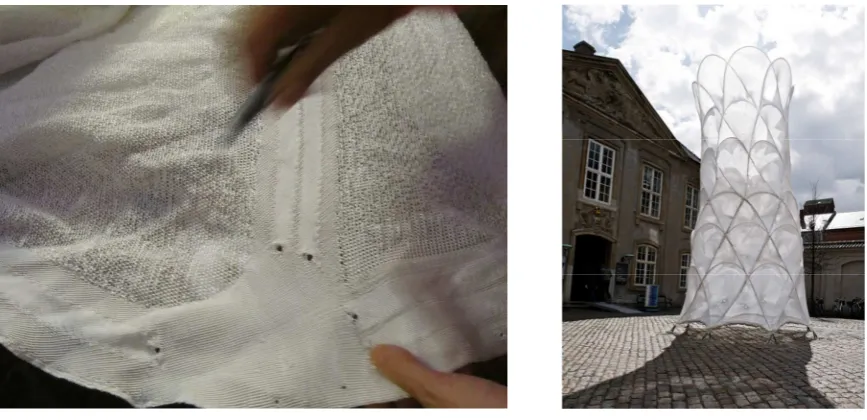
The topic is introduced by Raul Fangueiro, University of Minho, and Martin Tamke, School of Architecture, Royal Danish Academy of Fine Art, with a lecture about “Bespoke Materials for Bespoke Textile Architecture”, and by Gordon Mungall from Arup with a presentation entitled “Unlocking the Potential of Insulated Fabric”.
Fig. 2. (left) Example of knitted material used for ‘The Tower’ and (right) ‘The Tower’ in the courtyard of the Danish Design Museum - April 2015. Design: Martin Tamke (Photo by Anders Ingvartsen)
2.5. From material to structure and limit states: codes and standardization
The session collects the contributions that aim to develop a common framework of design guides and best practice for the development of a Eurocode on tensile membrane structures. The topics investigated by the papers include design rules based on a semi-probabilistic approach, dealing with the integration of uncertainties of tools and parameters such as for models and materials, the scale effects between materials and structures, the uniformity of limit states and the definition and study of specific limit states where not yet existing. In addition, research results concerning load characterisation (wind loading on complex shapes, interaction with snow deposition etc.), accurate material representation, numerical structural models, comparison with experimental data, time dependency, reduction factors for joints, safety coefficients etc. are collected and compared.
[image:4.544.63.497.187.397.2]2.6. Open session /Built Projects
To reflect the TensiNet Association’s remit to disseminate technical information about realized projects and COST Action’s to bridge the gap between science, policy makers and society, the open session includes presentations by prominent experts in the membrane architecture and engineering world. They show their inspiring built projects to demonstrate to a wider audience the potential of lightweight structures.
The list of invited keynote speakers includes:
• Patrik Schumacher: Zaha Hadid Architects, London. “Formfinding and Tectonic Articulation – Making
Performative Logics Speak”
• Julian Lienhard: str.ucture GmbH, Stuttgart. “Pushing the Boundaries of Textiles in Architecture”
• Tim Lucas: Price & Myers, London. “Full Metal Jacket”
• Al Fisher: BuroHappold Engineering, London. “How to Build Lightweight - Advances in Computational
[image:5.544.55.503.230.502.2]Engineering”.
Fig. 3. Serpentine Sackler Gallery presented by Patrik Schumacher, Zaha Hadid Architects, London.
3. Scientific Committee
Ass. Prof Paolo Beccarelli (University of Nottingham, UK)
Prof Kai-Uwe Bletzinger (Technische Universität München, Germany) Prof Philippe Block (ETH Zurich, Switzerland)
Prof Lars De Laet (Vrije Universiteit Brussel, Belgium)
Prof Heidrun Bögner-Balz (Institute for Membrane and Shell Technologies, DEKRA, Germany) Dr Jean-Marc Bourinet (Institut Français de Mécanique Avancée, France)
Dr Ben Bridgens (Newcastle University, UK)
Prof John Chilton (University of Nottingham, UK) (Chair) Prof Jan Cremers (Hochschule für Technik Stuttgart, Germany) Prof Christoph Gengnagel (Universität der Kunste Berlin, Germany) Prof Peter Gosling (Newcastle University, UK)
Prof Joost Hartwig (Frankfurt University of Applied Sciences, Germany) Prof Tim Ibell (University of Bath, UK)
Arch. Benson Lau RIBA (Nottingham University, UK) Dr Julian Lienhard (str.ucture GmbH, Germany)
Prof Josep Llorens (Universitat Politecnica de Catalunya, Spain) Prof Marijke Mollaert (Vrije Universiteit Brussel, Belgium) Prof Eija Nieminen (Tampere University of Technology, Finland)
Dr Monica Rychtáriková (KU Leuven, Belgium / STU Bratislava, Slovakia) Prof Franck Schoefs (Université de Nantes, France)
Prof Natalie Stranghöner (Universität Duisburg-Essen, Germany)
Ass. Prof Martin Tamke (Royal Danish Academy of Fine Arts, School of Architecture, Denmark) Assoc. Prof. Vatyu Tanev (University of Architecture, Civil Engineering and Geodesy, Bulgaria) Dr Jean-Christophe Thomas (Université de Nantes, France)
Dipl.-Ing. Jörg Uhlemann (Universität Duisburg-Essen, Germany) Prof Alessandra Zanelli (Politecnico di Milano, Italy)
4. Sponsors
Fig. 4. Sponsors of the COST Action TU1303 Symposium 2016.
5. Conclusions
This symposium is the fifth in the series instigated in Brussels in 2003, as part of the EU-funded thematic network (G1RT-CT-2000-05010) which had the theme Designing Tensile Architecture [2]. The range and content of the papers presented in this current symposium indicates how the technology, architectural and engineering design and realization of tensile membrane and foil structures has developed and matured over the last 13 years, as the materials are increasingly used as permanent building enclosures of greater sophistication.
The presentations have highlighted the main benefits of lightweight structures, which are the design flexibility, aesthetic appeal, the endless possibilities in form and appearance, structural efficiency, appropriateness to cover large spans, the potential in the domain of renovation, convenient prefabrication and fast erection. However, these structures still have some limitations, like their poor acoustic and thermal performance as well as the limited lifespan of the structural fabrics. Further, improved strategies with respect to recycling and insulation, energy harvesting on large surfaces and the integration of ‘green’ roofs and walls are new trends yet to be explored.
Current applications are just a tip of the iceberg of possibilities.
Acknowledgements
The organizers would like to thank the industrial sponsors and acknowledge the financial support provided by COST Action TU1303.
The organizers, chairs and guest editors of this Special Issue would like to express their sincere gratitude to the Scientific Committee and all of the authors who have contributed to this Special Issue. We also thank colleagues who have kindly assisted with organizing the review process. We hope that this Special Issue will form a valuable contribution to the development of novel structural skins incorporating new structural textile materials and designs.
References
[1] Foster B, Mollaert M (eds), European design guide for tensile surface structures. TensiNet, Brussels, 2004
[2] Mollaert M, Haase J., Chilton J.C., Moncrieff E., Dencher M. and Barnes M. (eds) Designing Tensile Architecture, VUB, Brussels, 2003 [3] Bögner-Balz H. and Zannelli A. (eds), Ephemeral Architecture – Time and Textiles, Libreria CLUP, Milan, 2007
[4] Bögner-Balz, H. and Mollaert, M., (eds) TensiNet Symposium 2010 - Tensile Architecture: Connecting Past and Future, University of Architecture, Civil Engineering and Geodesy (UACEG), Sofia, Bulgaria,GSP 1900 Ltd, Sofia, 2010
[5] Bögner-Balz, H. Mollaert, M Pusat E. (eds), [RE]THINKING Lightweight Structures, TensiNet, Brussels,, 2013
[6] Houtman R. (ed.) , Design Recommendations for ETFE Foil Structures, Annex 5: European design guide for tensile surface structures. TensiNet, Brussels, 2013
[7] Stranghöner N., Uhlemann J., Bilginoglu F., Bletzinger K., Bögner-Balz H., Corne E., Gibson N., Gosling P., Houtman R., Llorens J., Malinowsky M., Marion J., Mollaert M., Nieger M., Novati G., Sahnoune F., Siemens P., Stimpfle B., Tanev V., Thomas J., Mollaert M., Dimova S., Pinto Vieira A., Denton S. (2016), Prospect for European Guidance for the Structural Design of Tensile Membrane Structures Support to the implementation, harmonization and further development of the Eurocodes, Publications Office of the European Union. [8] TensiNet Association, http://www.tensinet.com (Accessed 30th June 2016)
[9] COST European Cooperation in Science and Technology, http://www.cost.eu/about_cost (Accessed 30th June 2016) [10] COST Action TU1303 Novel structural skins, http://www.novelstructuralskins.eu/ (Accessed 30th June 2016)