Usability of the Think Aloud Method: link
between verbalizing and a second language
Eline Albers (s1354566)
University of Twente P.O. Box 217, 7500AE Enschede
The Netherlands
This Bachelor thesis focuses on to what extent can people from different
countries who face second-language problems, different verbalization skills and
different communication styles still make use of the Think Aloud method. To
investigate whether participants are inconvenienced by verbalizing in a second
language during the Think Aloud method, this could determine the usability of
the method in these circumstances. This Bachelor thesis reviews the literature on
the Think Aloud Method and the complications that can arise when applying the
Think Aloud Method. I will try to explain if there is a difference between the
number of words, the number of interruptions and the number of occurrences of
the sentence “keep think aloud” used between different protocols. To investigate
this protocols from Dutch people and protocols from Vietnamese people are
compared to look at the differences that can exist when someone has to verbalize
in a second language. These protocols were contained by Entrepreneurial
Processes in Cultural Context. Entrepreneurial Processes in Cultural Context
used a case of opening a coffee company at a University. The participants had to
verbalize their thoughts aloud. Every single word was written down by the
instructor to create protocols. Eventually the differences between the number of
words, the number of interruptions and the number of occurrences of the
sentences
keep thinking aloud in the Dutch protocols and the Vietnamese
protocols were tested on significance. The findings suggest that there is only a
significant difference between the number of interruptions that are used in
Dutch protocols and Vietnamese protocols.
Supervisors University of Twente: MSc. Dr. M.R. Stienstra
Prof. Dr. R. Harms
Keywords
Think Aloud Method, complications, second language, verbalization skills, communication styles, protocols,
usability. .
Permission to make digital or hard copies of all or part of this work for personal or classroom use is granted without fee provided that copies are not made or distributed for profit or commercial advantage and that copies bear this notice and the full citation on the first page. To copy otherwise, or republish, to post on servers or to redistribute to lists, requires prior specific permission and/or a fee.
5th IBA Bachelor Thesis Conference, July 2nd, 2015, Enschede, The Netherlands.
1.
INTRODUCTION
Despite the fact that the majority of the workforce in the Netherlands is in paid employment, some people see starting a business as an opportunity. Starting a business is thought to involve freedom, self-reliance and self-development—not only in the Netherlands, but also on a larger international scale (Brummelkamp, January 2011).
People often think of starting a business. Many think of starting a business in their home country, but people increasingly find adventure in setting up a business abroad. This increased need to go abroad is partly made possible by increasing globalization. Before globalization, it was not easy or even possible to go abroad and set up a business (Whittington and Mayer, 2002; Scholte 2005). Globalization has led to many changes in the world: borders are opened, which makes transport easier; and everyone around the world can communicate with everyone else. But what is particularly important about this development is that people are not tied to their home countries when it comes to setting up a business (Crane and Matten, 2010). Sadly, every advantage comes with disadvantages. Accordingly, the ability to start a business at home and abroad brings along some difficulties and challenges (Hessels, Overweel and Prince, 2005).
The difficulties and challenges one must encounter when going abroad include different languages, cultures, habits, norms and values (Lechner, 2003). Can people have a good conversation in English? Do people only speak in a native language? If so, it is very difficult to communicate and get things done, because colleagues may not understand exactly you want to do. One of the most important challenges that people face when abroad is communication (Dijkstra, 2008). In my daily life, I experience the difficulty of speaking two or more languages with my father. He owns a company in Germany. When he comes home and starts talking about his day in Dutch, he often uses German words in his sentences. This phenomenon has to do with speech dominance; one language is being developed better and faster than the other (Muller, Kupisch, Schmitz and Cantone, 2006).That is why a person will never speak a foreign language as well as a native language. No one knows all aspects of a language (Jan Blommaert, 2010). Native speakers are not perfect speakers due to the fact that partial competence plays a role in the language a person speaks (Blommaert, 2010). This is also the case with a native language. If someone cannot think or speak in their native language, it is difficult for them to verbalize everything. One can only develop an understanding of numbers and abstract matters when one has mastered the language to talk about it (Nortier, 2009). The question then arises what the major complications are when we are facing a foreign language. Are we able to cope with these challenges? Do we face difficulties?
In order to investigate the difficulties and challenges of going abroad and starting a business, one can employ usability testing. The aim of usability testing is to measure the ease of use or the usability of specific products or objects (Nielsen, 1994). Techniques that could be used for this aim include the Think Aloud method, Co-discovery learning and eye tracking (Nielsen, 1994). A technique that makes use of languages is the Think Aloud method. A search was conducted within Scopus, scholar.google and other databases to find literature on the Think Aloud method and the usability of this method for different languages. The vast majority of the papers are about the Think Aloud method and the complications of this method, but there were only three papers in which language played a role in the research on this method. Because of the research gap on this topic, it is interesting to determine whether people face
difficulties because they speak a second language or if problems also arise when they have to think aloud in their native language. Consider again the example of my father. If he used the Think Aloud method in his native language, some problems would arise because he has a better recollection of German words than Dutch words. This is because he works more with German than with Dutch terminology. This is why I am interested in investigating this subject and why I want to know more about the Think Aloud method. I want to know how it works and what the major complications are when someone has to verbalize thoughts in a non-native language. What is the definition of the Think Aloud method? How can the Think Aloud method be used in research, and what are the major complications of applying this method?
The Think Aloud method is a research method that is used when subjects verbalize what they think while executing specific tasks or solving problems. It is all about encouraging a subject to tell what is going on in their mind. It can be applied to expose differences between people in solving problems (Van Someren, Barnard and Sandberg, 1994). It can involve people in the same country who speak the same language or a different language. One can also examine people from different countries to determine whether there are differences between people in different continents. Examples of this kind of research can be found in the works of Van Someren et al. (1994) and Norenzayan, Nisbett, Smith and Kim (2000) on differences between Europe and in Asia based on the verbalization and the language they speak.
There are advantages and disadvantages to employing the Think Aloud method (Van Someren et al., 1994). By looking at the disadvantages of the Think Aloud method one can set up indicators to research whether actual differences exist between verbalizing in a native language and verbalizing in a second language. This will be discussed in the next chapter.
Problems which occur in using the Think Aloud method can be divided into problems that are more general and problems that depend on the language the subject speaks. There are general problems regarding to the degree of verbalization of different persons (Nisbett and Wilson, 1973; Penney, 1975) that determine the eventual quality of the reports (Van Someren et al., 1994). There are problems with how tiring the Think Aloud method is (Rubin, 1994). There are also problems with regard to short-term and long-term memory (Ericsson and Simon, 1993). These can be seen as general complications regarding the Think Aloud method. It is interesting to look at this method. Why do these complications exist? Do these complications have to do with the Think Aloud method, or do they arise because a person cannot verbalize well in the language in which the questions are asked? This study will look closely at the complications regarding which language the subject speaks while using the Think Aloud method.
weaker. In addition, Asian peoples are less verbal and rely more on indirect and non-verbal communication than Western people (Norenzayan, Nisbett, Smith and Kim, 2000; Azuma, 1986).
1.1 The Research Question
Now that we know something about the Think Aloud method, we can ask whether complications are encountered when applying this method. One might ask whether verbalizing thoughts has an influence on the thinking process. The difference between performing a silent task and the Think Aloud method was investigated by Ericsson et al. (1980). This study showed that there were no differences in the relation between the methods used and the success ratio. Some differences exist between the speed of execution of thoughts that are easy to put into words and thoughts that are hard to verbalize. In processes in which a person is confronted with thoughts that are hard to verbalize, the verbalising process is delayed. When thoughts are not complete, an uncompleted verbal report results (Van Someren et al., 1994).
It is harder to verbalize in a foreign language than in one’s native language. An individual who is trying to verbalize in a foreign language might have to exercise a lot; and one can imagine that difficulties will remain even after training. Those who face difficulties in this particular case will be more numerous than those who can verbalize themselves even before training (Van Someren et al., 1994).
It is important to focus on whether there really are complications when someone cannot verbalize well. Does the difficulty arise because people cannot express themselves in their native languages, or are there other causes for this complication?
The important question that informs this study is the following:
To what extent can people from different countries who face second-language problems, different verbalisation skills and different communication styles still make use of the Think Aloud method?
To investigate this research question and to come to appropriate conclusions about it, this study will be structured as follows. In chapter 2, which is about theory, more information is given about the Think Aloud method. Chapter 2 considers its use, the major complications, and the indicators for these complications. The third chapter describes the method used for this research. The analysis will follow in chapter 4. The discussion and conclusion are presented in chapter 5.
2.
LITERATURE
Think Aloud protocols were first subjected to decision-process analysis by Montgomery and Svenson in 1970. After that, there was a continual development of this research method. Eventually, this method became a valuable contribution to research (Schulte-Mecklenbeck, Kühberger, and Ranyard, 2011). Though time-consuming, one of the main advantages of the Think Aloud method is that it provides rich data sets (Cotton and Gresty, 2006). However, there are also some possible biases to be considered when using a Think Aloud method: e.g., hindsight bias and representativeness bias (Jonathan Baron, 2000). Some results can seem quite predictable if one looks at the behaviour of people. When one knows what the future looks like, one can overestimate the ability to predict the outcome (Blank, Musch and Pohl, 2007; Bradfield and Wells, 2005; Fischhoff, 2007; Sanna and Schwarz, 2007). For example, entrepreneurs who started their business some time ago might not have the right recollection when it comes to decisions made. This is hindsight bias.
2.1 The Think Aloud Method
When using the Think Aloud method, a person states out loud what is thought (Ericsson et al, 1980). This creates “verbal reports” that can be analysed to give explanations for any statement that came out during the cognitive process (Van Someren et al, 1994). During the process, the person performs certain tasks, thoughts arise when these tasks are performed, and these thoughts are then expressed aloud. As a result, a researcher gets insight into all the thought processes that are produced during the execution of a task by a particular subject (Ericsson et al, 1980). The subject can use both personal information and information from the environment during this process. One uses the working memory of the person (Van Someren et al, 1994).
Both Ericsson et al. (1980) and Van Someren et al. (1994) conclude that the Think Aloud method must be carried out without intervention of the evaluator. The examiner may only encourage the tested subject to keep verbalizing thoughts and actions. Further communication between the evaluator and the subject is not considered reliable and relevant.
In addition, the selection of subjects is also very important. The subjects must be chosen so that the disruptive effects of thinking aloud are minimized. Working memory overload must also be considered, as discussed later. Because it is difficult to find experts, and because choices are limited, it is important that one take into account the degree of expertise and the verbalization skills of the subject (Van Someren et al., 1994).
2.2 The Indicators
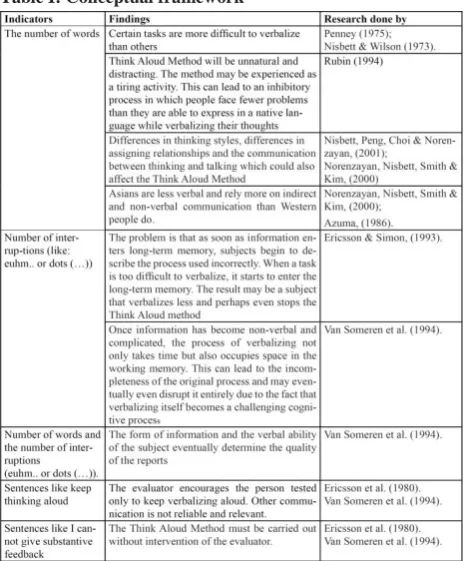
The Think Aloud method includes different actions and tasks, but some tasks are harder to verbalize than others (Penney, 1975; Nisbett and Wilson, 1973). People often find it unnatural and distracting to verbalize what they think, with the result that the Think Aloud method may be experienced as a tiring activity. This can lead to an inhibitory process in which people face fewer problems than they are able to express in a native language while verbalizing their thoughts (Rubin, 1994). Problems that arise sometimes have to do with short- and long-term memory. Data from short-long-term memory is preferable to data from long-term memory, because data from long-term memory is often influenced by the process of perception. The problem is that as soon as information enters long-term memory, subjects begin to describe the process used incorrectly (Ericsson and Simon, 1993). When a task is too difficult to verbalize, it starts to enter the long-term memory. The result may be a subject that verbalizes less and perhaps even stops the Think Aloud method (Ericsson and Simon, 1993).
This is also mentioned by Van Someren et al. (1994). Once information has become non-verbal and complicated, the process of verbalizing not only takes time but also occupies space in the working memory. This can lead to the incompleteness of the original process, and may eventually even disrupt it entirely due to the fact that verbalizing itself becomes a challenging cognitive process. Here too, the process of verbalizing for people who cannot express themselves in their native language is even more complex. As stated earlier, this can lead to an incomplete process or even to the disruption of the overall process (Van Someren et al., 1994).
affect the Think Aloud method (Norenzayan, Nisbett, Smith and Kim, 2000).
In Western cultural contexts, there is a strong link between talking and thinking (Whorf 1956; Wierzbicka, 1992). The skill of debate was once considered one of the most important skills a man could have (Nisbett, Peng, Choi and Norenzayan, 2001). In contrast, the link between talking and thinking is much weaker in the East Asian cultural traditions.
According to East Asians, talking damages higher-level thinking. It is considered disturbance that hinders people from understanding the truth (Markus, Kitayama and Heiman, 1996; Nakamura, 1964; Needham, 1962). In addition, Asians are less verbal and rely more on indirect and non-verbal communication than Western people do (Norenzayan, Nisbett, Smith and Kim, 2000; Azuma, 1986).
These cultural differences lead to the lower verbalization performance of Asians who participate in the Think Aloud method (Norenzayan, Nisbett, Smith and Kim, 2000). This study from Nesbitt et al. (2000) proves that talking disturbs thinking less for Western people than for Asian people.
For different reasons, people may be limited in their verbalizing process. The Think Aloud method is not suitable for use in this context (Norenzayan, Nisbett, Smith and Kim, 2000). The form of information and the verbal ability of the subject eventually determine the quality of the reports (Van Someren et al., 1994). You can imagine that this is an important point in this study, since someone has to deal with people from different countries. If subjects lack the ability to verbalize in their native languages, problems can arise when they must think out loud and verbalize what they think. People often think in their native languages whether they know other languages very well or not. Individuals always find it harder to answer a question in a non-native language than in their non-native language. Moreover, the use of words and phrases in each language is different. When someone says out loud what is thought in English when the person’s native language is Spanish, for example, the person may use a particular word with an intention that is quite different from the listener’s interpretation (Langeveld, 2012). Differences always exist between people in verbalizing thoughts. To get more fluent, a person can follow training; but differences between people will remain even after this training. Some protocols will be more complete than others for this reason (Van Someren et al., 1994).
Indicators were retrieved by studying literature in the field of second-language problems, different verbalisation skills and different communication styles in general. A special focus was placed on complications that can arise when applying the Think Aloud method with people from different countries.
One of the most important things reflected in all cases is the number of words that are used to answer the questions asked in a case. From existing literature, the conclusion can be made that the number of words that are used to give answers on questions asked in the protocols can be a good indicator for a few complications mentioned earlier. These complications can include the following: certain tasks are more difficult to verbalize than others (Penney, 1975; Nisbett and Wilson, 1973). Other complication that can occur are in thinking styles, differences in assigning relationships, and the communication between thinking and talking, which could also affect the Think Aloud method(Nisbett, Peng, Choi and Norenzayan, 2001; Norenzayan, Nisbett, Smith and Kim, 2000). Also the link between talking and thinking in Asia compared to that of Europe (Nisbett, Peng, Choi and Norenzayan, 2001; Norenzayan, Nisbett, Smith and Kim, 2000); and the less verbal ability of Asian people (Norenzayan, Nisbett, Smith and Kim,
2000; Azuma, 1986) can be investigated with this indicator. For example, if something is hard to verbalize, then a person will probably need more words to verbalize it. By comparing the verbal ability of Asians with that of Europeans, one can see that the number of words indicates verbal ability. It is assumed that Asian people would use fewer words than people from Europe, because in Asian cultures it is believed that talking disturbs thinking.
That is not the only thing to look at. The number of unnecessary words or/and interruptions that arise if someone has to think before giving an answer can be seen as indicators. Ericsson and Simon (1993) showed that when the task itself was too hard to verbalize, verbalizing lessened and the Think Aloud method even stopped in some cases. One can also look at the number of words to investigate.
When a question is too difficult, a less comprehensive response will be given. If the Think Aloud method really stops, there will be a void in that case. The person must first think about what one is willing to say before verbalisation can start. Such issues can be observed by looking at interruptions in the reports. The interruptions may take the form of words like euhm, for example. Dots may also indicate such circumstances. Cases also occur in which a subject does not understand a question or does not understand what is meant by the question. Verbalization by a non-native speaker will be of lower quality than that of someone who hears the questions in a native language (Van Someren et al., 1994). The question will be answered in a different way. It may be less fluent or include more unnecessary words and many interruptions, which can lead to answering the question incompletely (Kim, 2002).
Table I: Conceptual framework
2.3 Hypotheses
This study investigates if there are significant differences between the number of words, the number of interruptions and the numbers of occurrences of the sentence keep thinking aloud
used in Dutch and Vietnamese protocols.The hypotheses used in this study are:
- The number of words:
H0 The number of words used in Dutch protocols will be the same as the number of words used in the Vietnamese protocols
H1 The number of words used in Dutch protocols will be higher than the number of words used in Vietnamese protocols.
-The number of interruptions:
H0 The number of interruptions used in the Dutch protocols will be the same as the number of interruptions used in the Vietnamese protocols H1. The number of interruptions used in the Dutch
protocols will be higher than the number of interruptions used in Vietnamese protocols.
-The number of occurrences of the sentence keep thinking aloud:
H0 The number of occurrences of the sentence, Keep thinking aloud in Dutch protocols will be the same as the number of occurrences of the sentence keep thinking aloud in Vietnamese protocols
H1. The number of occurrences of the sentence, Keep thinking aloud in Dutch protocols will be lower than the number of occurrences of the sentence,
Keep thinking aloud in Vietnamese protocols
3.
METHOD
The data used in this research was collected by Entrepreneurial Processes in Cultural Context. EPICC conducted a fictitious
business case in which student entrepreneurs from different countries participated. Sarasvathy (2001b) used the Think Aloud method for such cases first. Sarasvathy (2001b) presented this case to 30 expert entrepreneurs who started companies that later had a turnover of 200 million USD (United States dollar). The expert entrepreneurs had to perform a specific case. Everything the participant says or does is written down by the instructor, to create verbal reports. These reports were reviewed in the research done by Sarasvathy (2001). This was also done by EPICC, only there was a different case. In this case, EPICC facilitated a case in which student entrepreneurs verbalized the process whereby they would set up a coffee company by using the Think Aloud method. All student entrepreneurs were of the same age. In the beginning, the student entrepreneurs were exposed to a case in which they had to pretend that they were entrepreneurs with five years or more experience in the coffee shop branch and had little money to start their own business. A fictional coffee shop should be opened at the university. The student entrepreneurs were confronted with ten issues on which several decisions had to be made. The case used for this research can be found in appendix I. Every student entrepreneur was asked to use the Think Aloud method and to verbalize thoughts aloud to create a verbal report. Everything that was said by the participants was recorded, and the recordings were transcribed to create these reports. When a participant is not thinking out loud at a particular moment, the instructor tells the person to keep thinking out loud. Such moments are indicated with ellipses (…) in reports. The instructor also uses ellipses to indicate moments in which participants got stuck in problem solving or did not finish the sentences. Everything the participant says or does is written down by the instructor to avoid the possibility that the interpretation of the instructor will play a role in the established reports. The Think Aloud method is carried out under the conditions established by Ericsson et al. (1980) and Van Someren et al. (1994), as stated in Chapter 2. The impact of differences between certain cultures can be examined correctly in this way. By looking at these reports, it can be determined whether there are differences between entrepreneurs from different countries. It can also be determined whether they have to do with different thinking styles or with differences that are caused by speaking in a second language.
To investigate this, protocols must be compared from different countries in which participants have to think out loud first in their native language and then in a in a second language. This is done to determine whether the Think Aloud method can be applied in every situation or not. The usability of this method can be reduced when a person verbalizes in a second language.
3.1 Compared Cases
In this study, two different protocols are analysed: namely, protocols from Dutch people and protocols from Vietnamese people. The Netherlands is part of Western Europe and therefore Dutch people are considered to be Westerners. Vietnam is part of Asia and therefore Vietnamese people are considered to be Asians. For these two countries, the protocols which will be compared were complete. In these protocols, a subject is confronted with a case, as described previously, through which the person must work. Subjects think out loud with every step, and that is reported. For the Dutch student entrepreneurs, the case is in Dutch, so they will verbalize in Dutch. For the student entrepreneurs from Vietnam, the case about the coffee company is in English, so they will verbalize in English.
minorities. About 85 percent of the Vietnamese people have Vietnamese as their native language. Most of their words come from Cantonese. English is taught at school in Vietnam; that is why Vietnamese people should at least have a basic knowledge of the English language, though it differs from one person to another (Getaway Travel, 2015). People from Vietnam can have difficulty verbalizing in English, because English is not their native language. The ability to speak English may vary, but people tend to think in a native language (Muller, Kupisch, Schmitz and Cantone, 2006). In some cases, use was made of common vocabulary that is known to people from the same business area. This is called idiosyncratic expressions. An example of an idiomatic expression is the wine is fruity. No one without experience in the wine industry knows what is meant by fruity (Van Someren et al., 1994). Vietnamese people are asked to think aloud about a business model in English. It may be that these people always work in the Vietnamese language; business related things are also known in Vietnamese. If they have to verbalize in English, it will be harder for them to express their thoughts without first thinking about it carefully. This could also lead to the possibility that Vietnamese people have more difficulties verbalizing than Dutch people who can verbalize in their native language. It could be that Vietnamese people are inconvenienced by verbalizing in a second language. A second language is not as well developed as a native language (Muller, Kupisch, Schmitz and Cantone, 2006). This is why Vietnamese people face more difficulties when using the Think Aloud method.
To investigate if differences between Dutch and Vietnamese protocols can be distinguished and if this will influence the Think Aloud method, there will be a comparison between the reports conducted of Dutch people and reports conducted of Vietnamese people. To compare the findings of the reports, this case was presented to 22 Dutch participants and 19 Vietnamese participants. Each report contained the same questions. For the Dutch transcripts, they used S.L. Mannes as the instructor in comparison to Ronald van den Ham for the Vietnamese transcripts. They first had training about the Think Aloud method and al the principles that must be followed, stated by Ericsson et al. (1980) and Van Someren et al. (1994). For the Vietnamese protocols, was first tested if the English skills of the Vietnamese student entrepreneurs were sufficient for applying this method. Two Vietnamese student entrepreneurs were first asked to do the Think Aloud method in both the native language and the second language. The first person had to verbalize first in Vietnamese and after that in English. The second person first has to verbalize in English and after that in Vietnamese. The two reports of each person are compared to see if the level of their second language is sufficient to use. This proved to be true, so it was assumed that this applies for each Vietnamese student entrepreneur.
The reports from Dutch people in this business case were compared with reports from Vietnamese people. A comparison can be made by looking at the different indicators stated in the previous chapter.
These topics go beyond the scope of this thesis. Therefore, they will not be analysed. Future research should focus on such topics:
-If a question is too difficult, there will be a less comprehensive response, because it is very difficult to give a proper answer to such a question. Consequently, this study will not focus on the number of words used as an indicator for information entering long-term memory, which eventually leads to the abandonment of the Think Aloud method. The difficulty of a question will still be analysed while looking into the number of interruptions.
- The Think Aloud method must be carried out without intervention of the evaluator. The evaluator encourages the person tested only to keep verbalizing aloud. Indicators like, “keep thinking aloud” and “I cannot give substantive feedback” will also not be investigated. The data at this point is complete in the Dutch protocols, but there is a lack of this data in the Vietnamese protocols. Therefore, based on the data available, a conclusion cannot be given that is valid and reliable on this subject. Instead, a closer look at this will be taken in the discussion of this research.
4.
FINDINGS
The principles of the Think Aloud method as described by Ericsson et al. (1980) and Van Someren et al. (1994) are taken into account. That is why it can be assumed that the protocols that are analysed are only subjected to cultural differences and that no other surrounding issues have influenced them. From Chapter 2, the indicators for analysing the possible limitations of the Think Aloud method include the number of words used, the number of interruptions, and sentences like “keep thinking aloud” and sentences like “I cannot give substantive feedback” that are used during the method of Thinking Aloud. The last two indicators will not be covered in this chapter, but will instead be covered during the discussion session.
It is very important to define exactly how these indicators are interpreted. For example, how will the number of words be analysed? Is this understood by the total number of words used in the whole case, or as the number of words used in just one question of the case? These things have to be considered in the investigation.
4.1 The number of words
This variable will be obtained by comparing and counting the number of words per problem in every case. The case consists of ten problems. Counting the number of words will be done for both Dutch protocols and Vietnamese protocols. The number of words that each question contains is not included. Consider the following, for example:
Questioner: Het is vandaag maandag 8 april en ik noem het even voor het gemak interview nr 1. Probleem 1 marktidentificatie. De volgende 5 vragen ga ik 1 voor 1 stellen. Wie zouden potentiële klanten kunnen zijn voor de koffiecorner?
Dutch person 1: uhh potentiële klanten zijn studenten, werknemers van.. van de universiteit, gasten van de universiteit.. misschien zijn er wel mensen in de omgeving die daar wonen die uhh die ook nog wel behoefte hebben aan een lekkere bak koffie..
In this case, the number of words used by “Dutch person 1” will be counted. In total, “Dutch person 1” has used 61 words.
4. 2 The number of interruptions
interruptions in this research. The protocols from Dutch persons and Vietnamese persons have also been searched for these indicators. These protocols are compared with each other to find interesting facts about the way people use interruptions when they are thinking.
4.3 The sentences Keep Thinking Aloud
The sentence, Keep thinking aloud, indicates that the participant stops thinking aloud, which is very important for the Think Aloud method. Every time the examiner says, “keep thinking aloud”, this will be counted so that it is possible later to compare the number of times this sentence has been used in the Dutch and Vietnamese protocols.4.4 Analysis
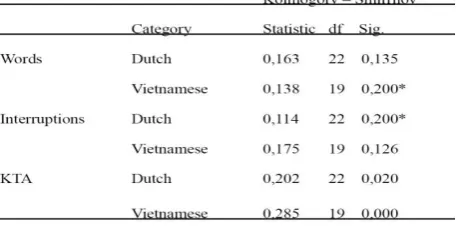
To start the analyses, it is important to know whether there is a normal distribution of the three indicators: number of words, number of interruptions and sentences like “keep thinking aloud”. This will be done together for these three indicators. The data obtained is scale numeric and divided into groups. For every indicator, two groups of variables will be looked at which are not related. This study uses a Kolmogorov-Smirnov method, because it is very important for this research to specify the mean and variance. To see whether the data of the indicators are normally distributed, one can look at the significance level. If the significance level is below 0.05, one can conclude that there is a significant difference. If this is the case, then one can say that the data is not normally distributed. Table II shows that the significance level for the number of words is 0.135 for the Dutch protocols and 0.200 for the Vietnamese protocols. 0.135 > 0.05 and 0.200 > 0.05. In other words, there are no significant differences. It can be assumed that there is a normal distribution for the number of words. These table can also be found in appendix III.
Table II: Test of Normality
When looking at the significance level of the number of interruptions for the Dutch and Vietnamese protocols, there is a significance of 0.200 and 0.126, respectively. For these significance levels, the rule that 0.200 and 0.126 are both > 0.05 also applies. It can also be assumed that there is a normal distribution for the number of interruptions used. When looking at the significance levels of the sentence, Keep thinking aloud, the results show 0.020 and 0.000. Both are below 0.05. It is not a normal distribution.
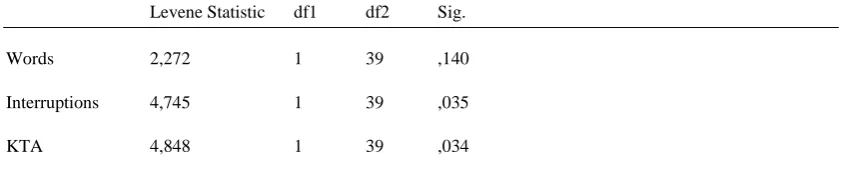
For testing the assumption of a significant difference, a test must be chosen that is appropriate in this case. Both the number of words and the number of interruptions have a normal distribution. The question is whether the number of words and the number of interruptions both have the same variance. This can be tested with SPSS. If there is homogeneity of variances,
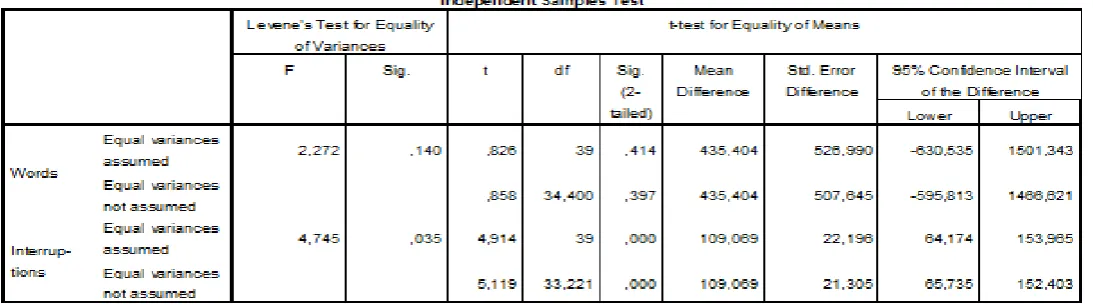
then an independent sample t-test can be used. If there is no homogeneity of variances, the independent sample t-test cannot be used. In this case, the data will be interpreted differently. In this case, it can also be said with 95% confidence (<0.05) that there is no homogeneity of variance, so the null hypothesis will be rejected. The null hypothesis indicates that there is not a significant difference between the homogeneity of variances. The significance level (0.140) of the number of words shows that the null hypothesis is not rejected, which means that there is homogeneity of variances for the number of words. For the number of interruptions this is not the case, because 0.035 < 0.05. Both indicators can be tested with the independent sample t-test. This results from the fact that one used scale-numeric data that is divided into groups. Specifically, there are two groups that must be compared. These groups are unrelated. The question is whether there is a normal distribution or not. In the case of a normal distribution, an independent samples t-test can be used. When the data is not normally distributed, the Mann-Whitney-U test offers an outcome. (The decision model for comparing groups can be found in appendix VI.)
For the indicator for the sentence, Keep thinking aloud, there is a rejection of the null hypothesis. This means that there is no homogeneity of variances (0.034 < 0.05) for this indicator. The heterogeneity of variance and the fact that the data is not normally distributed constitute reasons to choose a different test than one did in the two previous cases. Because the data is not normally distributed, the Mann-Withney-U test is used. (The test of homogeneity can be found in appendix III, table II.)
[image:7.595.54.283.460.573.2]4.4.1 The number of words
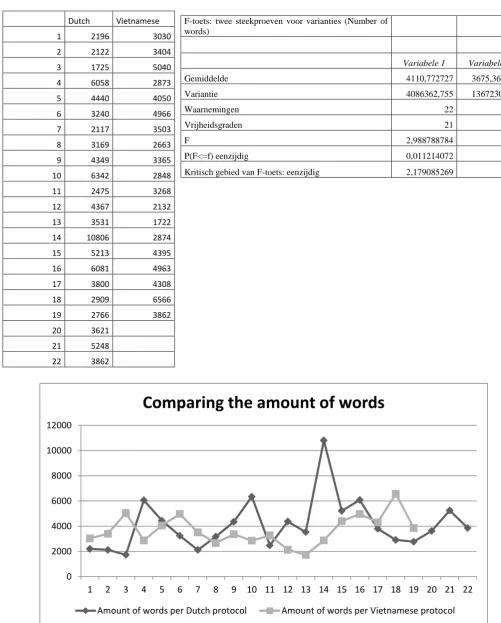
Table III: Data of the number of words in Dutch/Vietnamese protocols
If we compare the number of words used in the Dutch protocols with the number of words used during the Vietnamese protocols, one notices that the minimum number of words is almost the same as in the Dutch protocols: namely, 1722 words (Table I). The maximum for the Vietnamese protocols, however, is quite different from that of the Dutch protocols. The maximum for the Vietnamese protocols is 6566 words compared to the maximum of 10806 words for the Dutch protocols. The average number of words for the Vietnamese protocols is 3675.37, which is also quite different from that of 4110.77 for the Dutch protocols. Looking at the number of outliers present in the Vietnamese protocols, only protocol 18 differ significantly. This protocol contains about 6566 words. If this number of words can be labelled as an outlier, can we calculate as follows: 1.5 * (Q3 - Q1) = 1.5 * (4395 - 3404) = 2283. All values that can be seen as outliers are outside the range of Q1 - 2283 and Q3 + 2283. The number of words (6566) cannot be marked as an outlier (4395 - 2873 = 6678), but it is close.
The question is if the number of words significantly differs between the Dutch protocols and the Vietnamese protocols. To determine whether there is a significant difference, an independent sample t-test was used (analyse, compare means, independent-samples t-test). If this is the case, then rejecting the null hypothesis is the only option.
H0: The number of words used in Dutch protocols will be the same as the number of words used in Vietnamese protocols.
This can be done through looking at the significance level. When the significance level is lower than 0.05, one may conclude with 95% confidence that there is a significant difference between the number of words used in Dutch protocols and the number of words used in Vietnamese protocols. Looking at the significance level of the assumed equal variances, one can see that there is a significance level of 0.414. 0.414 > 0.05. The T-test (table VIII) can be found in appendix V. The null hypothesis fails to reject, so there is not a significant difference between the number of words used in Dutch protocols and the number of words used in Vietnamese protocols. It can be assumed that Dutch people will not differ from Vietnamese people in the number of words they use to answer questions. Dutch people use the same number of words as Vietnamese people.
4.4.2 The number of interruptions
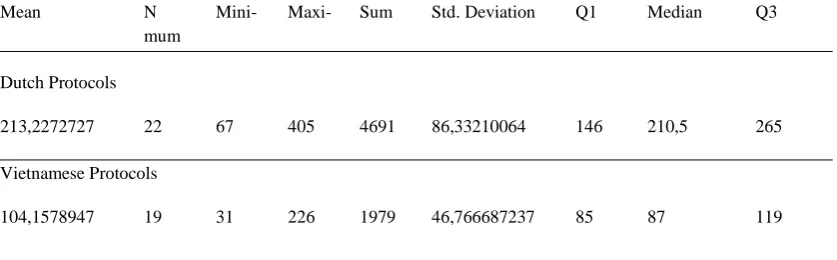
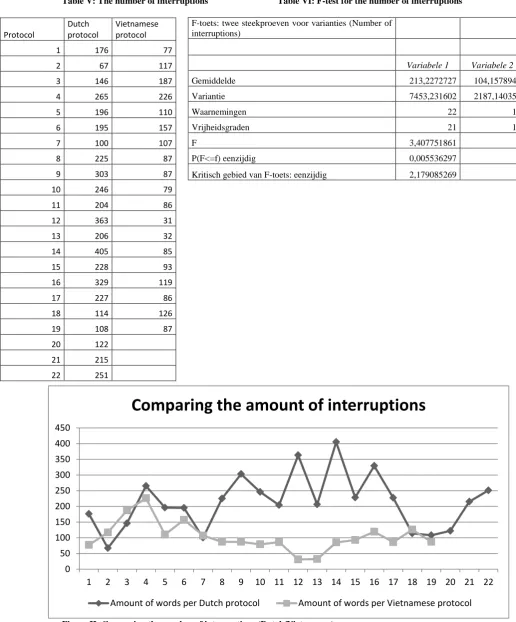
Table IV: The number of interruptions in Dutch/Vietnamese protocols
It is interesting to note that the minimum and maximum number of interruptions differs highly between the Dutch protocols and the Vietnamese protocols. Dutch protocols have a minimum of 67 and a maximum of 405 interruptions when verbalizing. Vietnamese protocols have a minimum of 31 and a maximum of 226 interruptions. This is considerably lower than the number of interruptions used in Dutch reports. It may mean, as previously indicated in chapter 2, that Asian people believe that talking disturbs thinking. The use of unnecessary words is a bit lower in the Vietnamese reports than in comparison the Dutch
reports. The Vietnamese reports also contain more ellipses. Almost every interruption consists more of ellipses than of euhm, uhmm, oh, etc. In the Dutch protocols, the use of euhmm, uhmm, oh, etc. was much greater than the use of ellipses in Vietnamese protocols. But is this difference significant or not? This can be determined with the independent samples t-test. Firstly, a null hypothesis will be formulated:
H0: The number of interruptions used in the Dutch protocols will be the same as the number of interruptions used in Vietnamese protocols.
There are two options: 1. Consider the significance level of independent samples t-test in which the variance is assumed to be equal, or 2. consider the significance level of independent-samples t-test in which the variance is not assumed equal. The variance of the number of interruptions is apparently not equal. When one considers the significance level of the Levene’s test for equality of variances, one can see that the significance level is 0.035, which is below 0.050. This means that one must consider point 2: the significance level of the independent samples t-test in which the variance is not assumed equal. Consider the significance level of the independent samples t-test in which the variance is not assumed equal. There is a significance level of 0.000. That means that the null hypothesis will be rejected (0.000 < 0.050). The T-test (table VIII) can be found in appendix V. As a result, it can be concluded that there is a significant difference between the number of interruptions used in Dutch protocols and the number of interruptions used in Vietnamese protocols. This can be explained by the fact that people from the Netherlands who can be viewed as Europeans do not believe that talking will disturb thinking and therefore use more words to explain things and give good answers to questions. Generally, people from Vietnam who live in Asia will be less able to verbalize than people from Europe. This is another reason to assume that our results will confirm this. Asian people give shorter answers than people from Europe. The sum of the number of words can indicate this a little bit, but there is more to say about the number of interruptions that are used. Considering these results, one can assume that people from Asia answer on the questions asked and no more, because they believe that talking will disturb thinking. People from Europe will give a lot of information because they think that talking has a positive effect on thinking. This is also why they use more interruptions in their sentences.
There may be a correlation between the number of words and the number of interruptions used during every protocol. When someone is talking a lot, there may be more interruptions. It may be assumed that when people use more words to explain what they think, they will also use more interruptions. The number of words is in that case higher and the opportunity to use interruptions is accordingly greater.
4.4.3. The sentence keep thinking aloud
A null hypothesis will be formulated.
H0: The number of occurrences of the sentence, keep thinking aloud in Dutch protocols will be the same as the number of occurrences of the sentence, keep thinking aloud in Vietnamese protocols
To Test this assumption, one requires the Mann-Withney-U test, also known as the Wilcoxon rank sum test, because there is not a normal distribution and there is not an equal variance. The Mann-Withney-U test will be used when it is assumed that the differences between samples are not normally distributed. This test requires two groups that are independently sampled and randomly drawn from the target group (Nachar, 2008). In SPSS, the Mann-Withney-U test came with a significance level of 0.935. The null hypothesis fails to reject, because 0.935 > 0.050 so it cannot be said that there is a significant difference between the number of occurrences of the sentence, Keep thinking aloud. The data of the Mann-Withey-U test can be found in appendix V table XI.
5.
DISCUSSION
This study has some limitations that have to do with the data-set chosen. The Dutch data sets were complete with respect to the indicators which are used. However, this was not the case for the Vietnamese protocols. Every Dutch protocol consists of sentences like, Keep thinking aloud, and I could not give substantive feedback. Every Dutch protocol also includes questions that were asked after the case. The data from the Dutch protocols is complete, but this was not the for the Vietnamese protocol data. Especially with respect to these questions, it can be investigated further whether someone has encountered limitations with the Think Aloud method. For this research, the questions may be a very good indicator that can be used to consider the differences that exist between verbalizing in a native language or in a second language if the data was complete. There is a limitation. The answers to questions like, “Do you feel that you have been able to express your thoughts properly and completely?” involve a perception of process by a
participant. All of the questions can be found in appendix II. In addition, when the participant faced some difficulties that were caused by the Think Aloud method, one could say that no difficulties were faced. Such questions can be manipulated because of sensitivity for lies, because of the perception of a participant, and because it is possible that subjects do not want to say that there are difficulties in the method used. The answers given to these questions may also involve personal opinion, which can make the questions inappropriate.
Another limitation in this study is that all the cases performed by the evaluators were recorded. With recordings, one can investigate how long it takes to complete the case. This length can be compared with the number of words that are used. Normally, it can be assumed that the number of words used will be proportional to the length of time taken. However, one can also use the recordings to determine whether someone was silent for a long period. This could provide some insight into whether subjects experienced difficulty verbalizing their thoughts. Do these difficulties have to do with the difficulty of a question? Do people simply not know how to answer? Or is it a general problem, because it feels unnatural to think out loud? This problem could be compared with the number of times the sentence, Keep thinking aloud, occurs. When the number of occurrences of this sentence is approximately equal between Dutch and Vietnamese protocols, and when the time of silence in such cases is also equal, then it can be assumed that silence is
a general problem that has to do with the Think Aloud method itself.
The time of completion can also be compared between the Dutch and Vietnamese protocols. Is the time of completion longer for Dutch people? Does it have to do with the number of words that one uses? It is also possible that a person from Vietnam uses fewer words but is very quiet sometimes. Silence may indicate that people in Asia believe that there is a negative link between talking and thinking. If they do not know an answer to a question, they do not start talking but instead remain quiet. Europeans, on the other hand, may think that there is a positive link between talking and thinking. When such a person does not know how to answer a question, it is possible that one will start talking about the subject thinking that things will thereby become clearer. Time of completion could not be investigated because the recordings could not be found at the University of Twente. Comparing the time of completion is therefore impossible.
Indicator sentences such as, I cannot give substantive feedback, are not evaluated in the results. Such sentences are present in Dutch protocols but not in Vietnamese protocols. Such sentences can indicate whether a participant faces difficulties during the Think Aloud method. It is possible that the participant does not understand the question correctly because the question is asked in a second language. However, it is possible that the participant does not really know what is meant by such a question or what to do in a particular case. That is why they ask a substantive question. Dutch participants sometimes have difficulties understanding questions even when they appear in their native language. What about getting asked the question in a second language? That is even more difficult. A subject in that case must first think about what is meant by the question. Then the thought process begins about answering the question correctly. If this data was also available in the Vietnamese protocols, then the data could be compared between the Dutch and Vietnamese protocols. Suppose that in the Vietnamese protocols this sentence occurs much more frequently than in the Dutch protocols. This could mean that Vietnamese participants have more trouble understanding questions than Dutch participants do. This would be a good reason to investigate whether participants are inconvenienced by verbalising in a second language during the Think Aloud method, which could determine the usability of the method in these circumstances.
When looking at the results from chapter 4—in particular, at the number of words used in every protocol—some results stand out. In Dutch protocols, there are a few notable values. Consider especially protocols 4, 10 and 14. Only protocol 4 can be marked as a real outlier, but the other two are close. In protocol 4, it is notable from the name of the participant that the person is not a real Dutchman. The name Petrignani suggests that a person originally comes from France or Italy. It is possible that, for this participant, verbalizing in Dutch actually means verbalizing in a second language. This may explain the high number of words in this protocol. This is of course an assumption that has to be investigated if one wants to conclude something meaningful about this case. In protocol 10, the participant verbalises in English. A possible explanation for this is that the participant lives in the Netherlands but came from another country and has to verbalize in English (second language) because one cannot verbalise in Dutch. The number of words is higher than in other Dutch protocols, which can be explained in this way.
number of words. Nothing indicates that this person would have verbalised in a second language, so how can the large number of words be explained? It is almost impossible to say something reasonable about this. Perhaps the person became enthusiastic and verbalised all the creative ideas that came to mind. This can unfortunately not be supported by literature.
5.1 Future Research
A comparison was made between East Asian Americans and European Americans in the research which was done by Kim (2002). This study investigated only what influence the culture in which someone is raised has on the link between talking and thinking. In this case, all participants could verbalise in English because it was the native language of everyone who participated (Kim, 2002). Our question about the effects a second language may have on the Think Aloud method remains after the investigation from Kim (2002). Everybody knows what the effect was on the Think Aloud method when the participant has other cultural habits; but the culture in combination with the language was not investigated in this study. For future investigation, it is important to know what the effect of a second language is on the Think Aloud method so that the usability of this method in such circumstances can be determined.
Finally, a study like this can be improved for the future by not comparing protocols from two different countries. One country must be chosen: for example, the Netherlands. There should be two similar cases. In the first case, the participants have to verbalize in their native language (Dutch); and in the second case, the participants have to verbalize in a second language (English). These protocols can be compared with each other using the same indicators that are used in this study. Then it will be possible to compare the differences that exist between the protocols. By comparing these differences, it is possible to determine whether a Dutch person has difficulties verbalizing in a second language or if differences between a native language and a second language do not really exist or cause difficulties.
In this research, there was only access to Dutch protocols in which participants verbalized in Dutch and Vietnamese protocols in which participants verbalized in English. This is why we could not determine the true effect of verbalizing in a second language. In this case, not only the languages spoken by the participant play a role, but so do differences between the level of verbalization and the belief in a positive/negative relationship between talking and thinking. All these issues affect this process.
5.2 Conclusion
This study was performed to get information about the difficulties that someone can have when verbalizing in a second language. It is known that upon facing another language, but what are these difficulties and when does someone face them? The ultimate question is this:
To what extent can people from different countries who face second-language problems, different verbalisation skills and different communication styles still make use of the Think Aloud method?
The Think Aloud method will be used to investigate the difficulties that could exist when employing a second language. The main disadvantages of the Think Aloud method will provide insight into the indicators that can be established during this research. These indicators lead us to compare the number of words, the number of interruptions, and the number of occurrences of the sentence, Keep thinking aloud. To determine whether these indicators will result in significantly different data, protocols of Dutch people who verbalized in Dutch (their
native language) were compared with protocols of Vietnamese people who verbalized in English (a second language).
Results of this research show that there is not a significant difference between the number of words used in Dutch protocols and the number of words used in Vietnamese protocols. The investigation shows that Dutch people do not verbalize more than people from Vietnam. In contrast to this, it was assumed that people from Vietnam who are Asian people uses fewer words than Dutch people, who live in Europe. Dutch people do not use significantly more words than Vietnamese people. It can be concluded that hypothesis 1 is not true. H1 The number of words used in Dutch protocols will
be higher than the number of words used in Vietnamese protocols.
However, a significant difference was found between the number of interruptions used in Dutch protocols and the number of interruptions used in Vietnamese protocols. Hypothesis 1 in this case is true.
H1. The number of interruptions used in the Dutch protocols will be higher than the number of interruptions used in Vietnamese protocols. Based on this data, it can be assumed that the negative link between talking and thinking, in which Asians believe, has an effect on the number of interruptions used by Vietnamese people. Words like euhm, for example, indicate that a person is thinking. Vietnamese people do not use such words. On the contrary, Vietnamese people use more interruptions. This means that Vietnamese people are more silent. Dutch people are European people who believe that the link between talking and thinking is much weaker. Dutch people use more interruptions than Vietnamese people. Moreover, Dutch people use words like euhm as often as they use interruptions. It might be that Dutch people spend more time talking than being silent while thinking.
Based on the data concerning the number of occurrences of the sentence, Keep thinking aloud, it can be concluded that there is no significant difference between Dutch and Vietnamese protocols. It can be concluded that hypothesis 1 is not true in this case.
H1. The number of occurrences of the sentence, Keep thinking aloud in Dutch protocols will be higher than the number of occurrences of the sentence,
Keep thinking aloud in Vietnamese protocols It might be possible that both Dutch and Vietnamese participants experience some difficulties with the Think Aloud method because of the unnatural feeling of verbalizing thoughts (Rubin, 1994). This could be an indicator for problems with the Think Aloud method in general. It might feel unnatural to verbalize thoughts, and it may lead to people start thinking in their mind again.
different countries with different languages. It is possible that, given a larger sample, another difference was more significant. This must be investigated in a study where more protocols can be tested to give an appropriate and valid conclusion about the differences that could exist when one has to verbalize in a second language.
6.
ACKNOWLEDGMENTS
Lastly, I want to thank several people for their guidance and support during the writing of my Bachelor thesis. Without them completing this Bachelor thesis would not have been possible for me. A special thanks to Martin Stienstra, MSc and Dr. Rainer Harms for their guidance and feedback during this project. Also very special thanks to my best friend Anne Hoekman for helping me out with my English. She helped me even though she also had to study for her own exams. For this, I am very grateful. I would also like to thank my family and friends for their moral support and enthusiasm.
7.
REFERENCES
Azuma, H. (1986). Why study child development in Japan? In H. Stevenson, H. Azuma, & K. Hakuta (Eds.), Child development and education in Japan (pp. 3 12). New York: Freeman.
Baron, J., (2000), Thinking and Deciding, Cambridge University Pr.
Blank, H., Musch, J., & Pohl, R. (2007). Hindsight bias: On being wise after the event. Social Cognition, 25, 1 9. doi:10.1521/ soco.2007.25.1.1
Blommaert, J., (2010), Repertoires and competence, Sociolingustics of Globalizations, Cambridge University
Bradfield, A., & Wells, G. L. (2005). Not the same old hindsight bias: Outcome information distorts a broad range of retrospective judgments. Memory & Cognition, 33, 120 –130.
Brummelkamp, G. (2011), Startende ondernemers, ontwikkelingen, betekenis en beleid,
programmaonderzoek MKB en Ondernemerschap
Cotton, D. and Gresty, K., (2006), Reflecting on the think-aloud method for evaluating e-learning, British Journal of Educational Technology, Vol 37 No 45-54
Crane, A. and Matten, D., (2010), Business ethics: Managing corporate citizenship and sustainability in
the age of globalization, Oxford University Press.
Dijkstra, T., (2008), Met andere woorden: over taal en meertaligheid, Universiteit Nijmegen.
Ericsson, K. A., and Simon, H. A. (1993). Protocol analysis: Verbal reports as data (Revised
edition). Cambridge, MA: MIT Press.
Fischhoff , B., (2007) Non-persuasive communication about matters of greatest urgency: Climate change. Environ Sci Technol 41:7204–7208
Getaway Travel, (2015), Vietnam – Aziё.nl, Taal Vietnam, Accessed at 18-05-215, retrieved from: http://www.azie.nl/vietnam/praktische-informatie/taal/
http://www.azie.nl/vietnam/praktische-informatie/taal/ Gudykunst, W. B., Gao, G. and Franklyn-Stokes, A. (1996).
Self-monitoring and concern for social Appropriateness in China and England. In J. Pandey, D. Sinha, & D. P. S. Bhawuk (Eds.), Asian contributions to crosscultural psychology (pp.255–267). New Delhi, India: Sage
Hessels, S.J.A., Overweel, M.J., Prine, Y.M., (2005), internationalisering van het Nederlands MKB, programmaonderzoek MKB en Ondernemerschap.
Kim, H.S.,(2002) We Talk, Therefore We Think? A Cultural Analysis of the Effect of Talking on Thinking,
Journal of Personality and Social Psychology, Stamford University.
Kim, H. S., and Markus, H. R. (2002). Freedom of speech and freedom of silence: An analysis of talking as a cultural practice. In R. Schweder, M. Minow, & H. R. Markus (Eds.), Engaging cultural differences: The multicultural challenge in liberal democracies
(pp. 432–452). New York: Russell Sage Foundation
Langeveld, A., (2012), Vertalen wat er staat, Atlas contact.
Lechner, F. J., (2003), The Globalization Reader, Blackwell Publishing Ltd.
Markus, H.R., Kitayama, S. and Heiman, R.J. (1996), Culture and Basic Psychological Principles, In Social Psychlogy: Handbook of Basic Principles, edited by E. Tory Higgins and Arie W. Kruglanski, New York: Guilford.
Marsella, A. J. (1993). Counseling and psychotherapy with Japanese Americans: Cross cultural considerations.
208.
Minami, M. (1994). English and Japanese: A cross-cultural comparison of parental styles of narrative elicitation. Issues in Applied Linguistics, 5, 383 407.
Müller, N., Kupisch, T., Schmitz, K. and Cantone, Katja (2006): Einführung in die
Mehrsprachigkeitsforschung.Tübingen: Gunter Narr Verlag.
Nachar, N. (2008): The Mann-Whitney U: a test for assessing whether two independent samples come from the same distribution. Tutorials in Quantitative Methods of Psychology 4(1): 13-20.
Nakamura, H., (1964), Ways of thinking of Eastern Peoples,
Honolulu: University of Hawaii Press.
Needham, J., (1962), Science and Civilization in China, Physics and Physical Technology, Cambrige: Cambridge University Press.
Nielsen, J., (1994), Usability Engineering, Academic Press Inc, p 165
Nisbett, R. E., Peng, K., Choi, L., and Norenzayan, A. (2001). Culture and systems of thought: Holistic versus analytic cognition. Psychological Review, 108, 291-310
Nisbett, R. R., and Wilson, T. D. (1973). Telling more than we can know: verbal reports on mental processes. Psychological Review,84, 231 – 259.
Norenzayan, A., Nisbett, R. E., Smith, E. E., and Kim, B. J. (2000), Rules vs. Similarity as a basis for reasoning and judgement in East and West,
Unpublished manuscript, University of Illinois.
Nortier, Jacomine (2009): Nederlands meertalenland. Feiten, perspectieven en meningen over meertaligheid. Amsterdam: aksant.
Penney, C. G. (1975). Modality effects in short-term verbal memory. Psychological Bulletin, 82, 68 & 84.
Read, S., Song, M., and Smit, W. (2009). A meta-analytic Review of effectuation and venture performance. Journal of Business Venturing, 24(6), 573-587.
Rubin, J. (1994). Handbook of Usability Testing. How to plan, design, and conduct effective tests. New York: Wiley.
Sanna, L. J., and Schwarz, N. (2007). Metacognitive experiences and hindsight bias: It’s not just the
thought (content) that counts! Social Cognition, 25,
185-202.
Sarasvathy, S. D. (2001). Causation and Effectuation: Toward a Theoretical Shift from Economic Inevitability to Entrepreneurial Contingency. The Academy of Management Review, 26(2), 243-263.
Sarasvathy, S.D. (2001). What makes entrepreneurs
entrepreneurial?, Working paper. Charlottesville : Darden Graduate School of Business
Administration, University ofVirginia.
Scholte, J.A. (2005), Globalization: a critical introduction (2nd edn.), Basingstoke: Palgrave.
Schulte-Mecklenbeck, M., Kühberger, A. and Ranyard, R. (Eds.), (2011). A Handbook of Process Tracing Methods for Decision Research: A Critical Review and User's Guide. New York: Taylor & Francis.
Shweder, R.A., Minow, M. and Markus, H.R., (2002),
Engaging Cultural Differences, the Multicultural Challengein Liberal Democracies, Russell Sage Foundation.
Smith, P. B., and Bond, M. H. (1999). Social psychology across cultures. Needham Heights, MA: Allyn and Bacon.
Steen, G.J., (1991), The empirical study of literary reading: methods of data collection, Poetics, 20:559-575.
Tobin, J. J., Wu, D. Y. H., and Davidson, D. H. (1989).
Preschool in three cultures: Japan, China andthe United States. New Haven, CT: Yale University Press.
Van Someren, M. W., Barnard, Y. F., and Sandberg, J. A. C. (1994). The think-aloud method: Apractical guide to modelling cognitive processes. San Diego, CA: Academic Press Ltd.
Whittington, R. and Mayer, M. (2002), The evolving European Corporation: strategy, structure and social science, In K. Williams (ed.), Challenges for European management in a global context: 19-41, Basingstoke: Palgrave.
Whorf, B. L. (1956), Language, thought and reality, Mass.: M.I.T. Press.
Wierzbicka, A., (1992), Semantics, Culture and Cognition,
8.
APPENDIX
8.1 Appendix I
De case
Introductie
In dit experiment gaat u tien beslissingsproblemen oplossen. Deze problemen komen voort uit de context van het opzetten van een nieuw bedrijf met een denkbeeldig product. Een meer gedetailleerde beschrijving van dit product volgt na deze introductie.
Voordat u zich in de productbeschrijving en de problemen gaat verdiepen vraag ik u om enige mate van creativiteit. Zie uzelf in de rol van de hoofdondernemer die het bedrijf opzet. U heeft erg weinig geld om het eigen bedrijf te starten, maar u heeft 5 jaar ervaring op het gebied van koffie verkoop.
Beschrijving
Sinds enige tijd heeft u lopen denken aan het starten van een eigen koffiecorner op uw universiteit. Uw inspiratie kwam voort uit het feit dat u als student op het moment dat u een verse bak koffie wilde hebben, dit niet mogelijk was. U hield niet van de automatenkoffie die aanwezig was in de gebouwen van de universiteit. U moest voor deze kwalitatief mindere koffie een bedrag betalen wat niet in relatie stond met wat u voor dat geld mocht verwachten. U weet wat er wel mogelijk zou kunnen zijn omdat u al 5 jaar ervaring heeft in het werken in een koffiecorner in het dorp waar u oorspronkelijk vandaan komt.
U zag dat er andere koffiecorners bestonden die erg succesvol waren, maar die waren vaak gerelateerd aan erg dure franchiseconcepten. Daarom heeft u bedacht dat het mogelijk moet zijn om een eigen koffiecorner te beginnen. U heeft in diverse media gezien dat er een groeiende vraag is naar koffie in uw thuisland.
Probleem 1; marktidentificatie
Voordat we gaan kijken naar gegevens over de markt wil ik u vragen de volgende vragen 1 voor 1 te beantwoorden:
1. Wie zouden potentiële klanten kunnen zijn voor uw koffiecorner?
2. Wie zouden uw potentiele concurrenten kunnen zijn?
3. Welke informatie zou u uit willen zoeken over uw klanten en concurrenten? Maak een lijstje van vragen die u in dit kader zou willen stellen.
4. Hoe zou u deze vragen beantwoord willen zien? Wat voor soort marktonderzoek zou u willen uitvoeren?