The Usual Suspects
Decision-making in proactive
policing
Psychology of Conflict, Risk and Safety
Master Thesis
J.B. van Wakeren 30-06-2016
Supervisors
B.S. Böing Police unit Amsterdam
Dr. Ir. P.W. de Vries University of Twente
i
Abstract
ii
Samenvatting
De discussie omtrent proactief politiewerk is de afgelopen jaren door verschillende incidenten opgelaaid. De politie wordt er dikwijls van beschuldigd zich voornamelijk op etnische minderheden te richten tijdens proactieve controles. Wanneer deze controles plaatsvinden op grond van iemands etniciteit, zonder dat daar een objectieve rechtvaardiging voor is, spreekt men van etnisch profileren. Dit onderzoek is een poging om de selectiecriteria die agenten tijdens proactief politiewerk gebruiken te identificeren. Daarbij is de theorie van sociale categorisatie als uitgangspunt gebruikt.
Er is een analyse gemaakt van 421 proactieve controles van 106 voertuigen, uitgevoerd in de politie eenheid Amsterdam in 2015. Daarbij is gekeken naar kenmerken van de personen die gecontroleerd zijn en hun gedrag, de betrokken voertuigen en de tijd en locatie van de controles. Ook zijn de redenen die agenten zelf voor de controle hebben aangegeven geanalyseerd. Tot slot is gekeken naar de resultaten van de controles. De steekproef is niet zonder meer representatief. Het onderzoek focust zich op de 4% van kentekens die in 2015 het meest in de politiesystemen zijn nagetrokken. Daarnaast zijn uitsluitend de controles die zijn vastgelegd zichtbaar. Het is aannemelijk dat dit slechts de controles zijn waarvan agenten vinden dat ze de moeite van het vastleggen waard zijn.
Het blijkt dat controles van delinquente personen het meest worden geregistreerd. Het overgrote deel van de gecontroleerde personen waarvan een registratie is gemaakt heeft een strafblad. Daarvan valt een groot deel onder projecten met een persoonsgerichte aanpak, zoals het Top600 project van jonge gewelddadige criminelen. In dit opzicht lijkt het erop dat agenten voornamelijk aandacht hebben voor personen die al bekend zijn, de ‘usual suspects’. Regelmatig wordt aan deze personen gerefereerd als de ‘doelgroep’. Deze personen zijn overwegend jonge mannen met een immigrantenafkomst die vaak in luxe auto’s rijden. Personen die werden onderworpen aan een proactieve controle vielen dikwijls op door een agressieve rijstijl of een vreemde reactie op de aanwezigheid van de politie. In de meeste gevallen zorgden combinaties tussen factoren voor extra verdenkingen. 10% van de controles heeft geleid tot een boete, 2% tot de inbeslagname van de auto of andere goederen en 1% tot een aanhouding. Opvallend is dat controles die geen tastbare uitkomst hebben toch worden geregistreerd. Ogenschijnlijk gebeurt dit vanuit een perspectief van informatieverzameling. Over de effectiviteit hiervan kunnen geen uitspraken worden gedaan. Ook andere effecten, zoals het afschrikken van potentiële misdadigers, zijn niet meetbaar.
Uitspraken over de omvang van etnisch profileren kunnen niet aan deze studie ontleend worden. Wel zorgt het gebrek aan verantwoordingsmechanismen, de grote vrijheid van agenten op straat en de focus op jonge criminele mannen met een immigrantenachtergrond mogelijk voor risico’s wanneer deze focus verbreedt wordt naar jonge immigranten zonder strafblad.
iii
Preface
When I started working on my thesis in January 2016, most people in my environment had no idea what ethnic profiling meant. Six months later, I only have to mention the topic of my thesis to start extensive discussions. I think it is a good sign that a phenomenon that is perceived as problematic by many countrymen is finally being transformed into an active discussion. However, although a fierce discussion can often be beneficial, the discussion on proactive policing is heavily polarized and only seldom based on a strong (scientific) foundation. Hopefully, this thesis may serve to bring some nuance into the discussion. I feel the term ethnic profiling often does not serve justice to the complex decisions police officers have to make during proactive policing. However, at the same time, many citizens do feel as if the policing acts in a discriminatory way. Whether or not this is true, the police is forced to adapt to these complaints to safeguard her legitimacy. I hope my analyses and suggestions can be of benefit to the Dutch police.
Several people have made a major contribution to my thesis. First of all, I want to thank Bas Böing, my police supervisor. I cannot imagine a more enthusiastic and devoted supervisor. Second, I want to thank Peter de Vries and Elze Ufkes, supervisors from the University of Twente, for their valuable feedback. Last but not least, I am grateful to Janine for her unconditional support and valuable feedback.
Jurriaan van Wakeren
Table of contents
Abstract i
Samenvatting ii
Preface iii
1. Introduction 1
1.1 Background and context 1
1.2 Research question 3
1.3 Theoretical and practical relevance 3
2. Theory 4
2.1 Social categorization 4
2.2 The effects of social categorization 4
2.3 Social categorization and proactive policing: 2 frameworks 5
2.4 Outcomes of proactive policing 9
2.5 The current study 10
3. Methodology 11
3.1 Research design 11
3.2 Units of analysis and case selection 11
3.3 Data collection method 12
3.4 Data analysis 12
3.5 Limitations to the current design 15
4. Results 16
4.1 The person 16
4.2 The vehicle 19
4.3 Behaviour 20
4.4 Time and location 20
4.5 Combinations and discrepancies 21
4.6 Patterns in proactive policing 22
4.7 Legitimacy of proactive policing 23
4.8 Interactions during stops 23
4.9 Outcomes 24
5. Conclusion and discussion 25
5.1 Reflection on results 25
5.2 Implications for the discussion on ethnic profiling 27
5.3 Methodological limitations 27
5.4 Suggestions for future research 28
6. Recommendations 29
1
1.
Introduction
The public debate on the relation between the police and ethnic minorities has intensified in the past years. Incidents such as the deaths of Michael Brown1 in Ferguson in 2014 and Mitch Henriquez2 in The Hague in 2015, resulted in riots and led to a vigorous debate on police racism. Proactive policing plays an important role in this discussion. Proactive policing entails that police officers proactively stop citizens to subject them to a control. As will be discussed in more detail below, the police face allegations of discrimination during such stops. Very recently, Dutch rapper Typhoon further sparked the debate3. After being pulled over for a control, he was told that the combination of his expensive car and the colour of his skin attracted suspicion. Although the incident has been used by various parties to argue that discrimination by the police is both structural and incidental4, actual evidence remains very limited. This study is an attempt to contribute to the debate by identifying the selection mechanisms that police officers use during proactive stops.
1.1 Background and context
1.1.1 Proactive policing
Traditionally, police officers have long used a reactive style of policing, responding to crimes that have already been committed, solving these crimes and subsequently waiting for new crimes that have to be solved. In the 1970s and 1980s, however, the idea of proactive policing (see Goldstein, 1977) became popular, which posits that the police should try to prevent crimes from taking place at all. Emphasis is put on the deterrence of criminal activity by showing police presence and by disturbing potential crimes. In the Netherlands, too, police forces use proactive policing strategies (Das, Huberts, & Van Steden, 2007). In proactive policing, police officers have a large amount of discretionary freedom (Lipsky, 1980) in the execution of their daily work. This entails that police officers, to a large extent, are free to determine which individuals require police interference, and should therefore be stopped to be questioned and possibly searched. It should be noted that proactive stops can either be called ‘stop and account’, focused on asking a citizen a few questions, or ‘stop and search’, in which a citizen and/or his or her car is searched for e.g. prohibited goods such as drugs (note that in the Netherlands, it is only possible to search a person under special circumstances). In this study, both practices will be referred to as ‘stops’.
1.1.2 Controversies surrounding proactive policing
Despite the popularity of proactive policing, it faces criticism. Since it is possible that proactive police powers are employed in a prejudiced and discriminatory manner, several organizations regard proactive policing with suspicion. The Open Society Justice Initiative and Amnesty International (2013), for example, have called the discretionary freedom of police officers, combined with a lack of accountability, a recipe for discrimination. When allegations are made that proactive policing powers are used to discriminate against citizens of ethnic minorities,
1
http://www.vox.com/2014/8/11/5993609/michael-brown-ferguson-shooting-protests-riots-police-violence-unarmed
2 See for example: http://www.volkskrant.nl/binnenland/is-mitch-henriquez-slachtoffer-van-institutioneel-
racisme~a4091790/
3 https://www.instagram.com/p/BGCaWb6vkOc/?taken-by=mctyphoon
2 the term ethnic profiling is often used. Amnesty international (2013) defines the term as “the use of criteria or considerations based on ethnicity, skin colour, nationality, language or religion, in law enforcement and investigations without an objective justification for using these criteria”.
Police forces often have been alleged to mainly target ethnic minorities in for example traffic law enforcement. Once stopped, subject ethnic minorities are said to be subjected to more invasive investigations, surpassing reasonable suspicions of traffic law infractions (Gates, 1995). In the United States, for example, some argue that minorities are being targeted for traffic stops so frequently that the term “driving while black” is used for being subjected to a traffic stop based on the colour of one’s skin (Harris, 1997). Not surprisingly, allegations of ethnic profiling can have profound consequences on the relation between the police and the communities they are policing. Being stopped by the police merely for the colour of one’s skin may produce feelings of fear, anger, humiliation, or even rage (Harris, 1997). These feelings may result in community resentment and mistrust towards the police, hurting police legitimacy (Bowling & Philips, 2002; Tomaskovic-Devey, Mason, & Zingraff, 2004). The police is dependent on the cooperation of the communities they police. Losing trust may therefore be very harmful to police effectiveness.
1.1.3 The benchmark problem
Ethnic profiling suggests some form of disproportionality. The point is that ethnic minorities are being stopped and searched more often in comparison to members of the ethnic majority. In some definitions of ethnic profiling, this disproportionality is even seen as a necessary element: without a form of disproportionality it is not possible to speak of ethnic profiling (Batton & Kadleck, 2004). The question in this case is how to determine this disproportionality: with whom should the controlled persons be compared? For example, they can be compared to the make-up of the total population, the population in the streets (the available population), the distribution of vehicle ownership among ethnic groups, or the spread of different ethnic groups in crime figures (Batton & Kadleck, 2004). This is called the benchmark problem. It makes it hard to make statements about the extent of ethnic profiling. Furthermore, as will be discussed in Chapter 3, the sample analysed in this study is not necessarily representative of the general population of citizens subjected to a stop in 2015. This means that it is not possible to make any comparisons, meaning that this study cannot be used to make statements on the extent of discrimination by the police in Amsterdam.
1.1.4 Evidence on ethnic profiling
3 (2014) who in a study did not find evidence for structural ethnic profiling in The Hague5. Although they did find that ethnic minorities are targeted more often by the police, only very few cases were found where ethnicity seemed the only reason for targeting civilians.
However, the study does also conclude that many ethnic minority members in The Hague do feel as if the police is practicing ethnic profiling. Police officers often provide little explanation when they stop civilians and act rude or unfair. Similar results were found by Andriessen, Fernee and Wittebrood (2014), who report that 26% of Moroccan males believe that they are being discriminated by the police. For Turkish, Surinamese and Antillean males, these numbers are lower: 19%, 17% and 15%. In contrast, only 1% of ethnic Dutch males suspect they may have been discriminated. Their study also found that ethnic minorities have the perception that they are more likely to be fined than ‘white’ citizens. Svensson, Sollie and Saharso (2012) also could not find any evidence for structural ethnic profiling, but did conclude that youngsters often doubt the honesty and fairness of the police. Therefore, not only real ethnic profiling, but also perceptions of it, may strain the relations between the police and the community.
1.2 Research question
Apart from the studies earlier mentioned and the research performed by Çankaya (2012), little research has been performed into the nature and character of proactive police stops in the Netherlands. Research into the decision-making process during proactive policing can be very valuable though. The first research question of this study is therefore formulated as follows: “What selection mechanisms do police officers use during proactive stops?”
Additionally, in a discussion of the topic, information on the effectiveness of proactive stops is important. Therefore, this study will also focus on the outcomes of proactive police stops, in order to make statements about the effectiveness of contemporary proactive policing in Amsterdam. The second research question is therefore formulated as follows:
“What are the outcomes of proactive stops in Amsterdam?”
1.3 Theoretical and practical relevance
An attempt to gain more insight into the selection mechanisms that police officers employ has both theoretical and practical relevance. As was mentioned, scientific research on the topic of proactive policing and ethnic profiling is limited. Therefore, the current study can provide valuable scientific insight into a topic that is relatively new. The results can furthermore be used to enhance the public debate, which is heavily polarized but seldom based on solid evidence. Finally, the results can be valuable to the police organization itself. Empirical data can be used to stimulate self-reflection and increase awareness. This in turn can increase police professionalization and, ultimately, enhance legitimacy and effectiveness.
5 Note that the objectivity of the study recently became controversial:
4
2.
Theory
As will be discussed below, it has often been argued that decision-making during proactive policing is influenced by the human tendency to think with the aid of (social) categories. These categories facilitate quick decision-making but may also facilitate discrimination. When applied to proactive policing, it turns out that social categorization may be a valuable foundation to analyse proactive policing.
2.1 Social categorization
One way to theoretically approach decision-making during proactive policing is by using Allport’s (1954) theory of prejudice. He describes ethnic prejudice as “an antipathy based upon a faulty and inflexible generalization. It may be felt or expressed. It may be directed toward a group as a whole, or toward an individual because he is a member of that group” (p. 10). Allport (1954) also states that other definitions may include that ethnic prejudice often is functional for the bearer of the prejudice as it may facilitate quick decision-making. When expressed, prejudice can have 3 stages: verbal rejection, discrimination, and physical attack. The second stage, discrimination, is most relevant to the current research and entails the denial of a desired treatment of equality to people or groups of people. Ethnic prejudice is a result of the human tendency to think with the aid of categories. Categories are clusters of ideas which can guide daily judgements. Categories enable people to quickly identify objects, and engender meaning upon the world. They may be more or less rational and tend to resist change. Classification of individuals into social categories may lead to the assumption that traits associated with a social category also apply to particular members of that category, either without individuating information (Darley & Gross, 1983) or in spite of it (Beckett & Park, 1995). Stereotypes create hypotheses about a certain individual which can then be used to predict his or her behaviour and intentions. Such stereotypes, which may be formed in earlier experiences or through socialization, may lead to a non-motivational and unintended, but biased police response to minority citizens (Smith & Alpert, 2007).
2.2 The effects of social categorization
5 Social categorization theory has also been applied to situation police officers may find themselves in. Payne (2001) first showed that, when primed with an African American face, participants were faster and more accurate in distinguishing guns from hand tools than when they were primed with a white face. However, when they were primed with a white face, participants were quicker and more accurate in their identification of hand tools. Judd et al. (2004), in an extension of Payne’s (2001) procedure, found out that African-American faces are associated with both handguns and sports-related objects, but not with insects or fruits. They additionally found that both handguns and sports objects are more likely to be miscategorised following a White face prime than an African-American one. Correll (2002) made participants play a videogame in which they acted as a police officer that had to decide to shoot or not to shoot at a suspect who was holding a gun or another object. Similar to the results mentioned above, white participants made the correct decision to shoot an armed target more quickly if the target was African American, but decided to not shoot an unarmed target more quickly if he was White. It was also found that police officers working in densely populated urban districts with high crime rates and a large black population, showed an even larger bias. While the above studies used laypersons, Correll et al. (2007) studied police officers using the same procedure. It was found that police officers were not immune to race either. Although no significant difference was found in police officers’ decision criteria, evidence was found for bias in officer’s response times. Comparable to laypersons, officers were faster to shoot armed targets when they were Black (rather than White), and they were faster to choose a don’t-shoot response if an unarmed target was White (rather than Black). Much of the research described above focusses on the presence of weapons and therefore is in a somewhat different context than the current study. However, the underlying finding is that police officers tend to interpret ambiguous behaviour more often as suspicious when the civilian belongs to a social category associated with deviance. This finding can probably be generalized to other situations in which officers have to interpret ambiguous behaviour.
2.3 Social categorization and proactive policing: 2 frameworks
Every day police officers have to differentiate the right from the wrong, especially in the context of proactive policing. In this context they interpret citizen’s behaviour and intentions which are often ambiguous and unclear, and often have to do this in a very short time to estimate whether or not an intervention is justified (Kuppens, Bremmers, Van den Brink, Ammerlaan, & Ferwerda, 2011; Plant & Peruche, 2005). Decisions often have to be made under time pressure (e.g. an officer has to determine whether or not a car driving by is suspicious) There is little room for reflection on impulses and implicit associations, so processes of social categorization may gain the upper hand in selecting situations that require police interference.
6 2.3.1. Çankaya’s model of the selection profile
Çankaya (2012) argues that social categorization plays an important role in proactive police work. He argues that police officers use different social categories to which they add various characteristics. In this respect, the term ‘target group’ is used by police officers as a general term for different social categories that tend to deviate from social norms. Those that tend to match the profile of the target group are more likely to be judged as suspicious. Çankaya (2012) developed a framework based on this idea. 4 variables, which will be elaborated upon below, determine whether or not individuals are seen as suspicious by police officers: the person, the vehicle, his/her behaviour and time and location. Van der Leun et al. (2012) in their study of the selection mechanisms used by police officers in The Hague came up with roughly the same variables.
The person
Regarding the person, Çankaya (2012) distinguishes biological, cultural and criminal features. Regarding the first, arguably most controversial feature, Çankaya (2012, p. 50) says: “In stereotyping, naturally, not only biological features play a role. However, it is incorrect to assume that the appearance of the target group is colourless”. Police officers use 3 categories to make a distinction between race: ‘white’ (ethnic Dutch and Polish people), ‘tinted’ (Moroccans, Turks, Romanians and Bulgarians) and ‘negroid’ (Surinamese, Antillean, Ghanaian and Nigerian people). According to Çankaya, police officers tend to see dark skinned and Moroccan youth, as well as Polish, Romanian and Bulgarian persons as those who commit most crimes. Other deviant groups include junkies, hobos and ‘show-offs’ or ‘boasters’: muscled gym types with tattoos and sports clothing. With the exception of street prostitutes and gypsy women, police officers predominantly see males as deviant. Numerous other studies conducted in the United States and other countries also found that minorities such as African Americans, gypsies and immigrants are overrepresented in police stop-and-search practices (e.g. Bowling & Philips, 2002; Harris, 1997; Meehan & Ponder, 2002; Miller et al., 2008; Moon & Corley, 2007; Novak & Chamlin, 2012; Roh & Robinson, 2009; Tomaskovic-Devey et al., 2004). It should be noted that most of the studies were executed in the United States and as such, may come up with different ethnic groups. The general finding that police officers pay more attention to groups that are perceived as deviant can still be expected to apply to the Dutch police, however. As mentioned, persons having a criminal record attract extra attention according to Çankaya (2012). The idea that people that have at one moment committed a crime will sooner or later reoffend contributes to this. Other researchers also argued that former criminals, in the eyes of police officers, are always busy with criminal activities, which makes them permanent suspects (e.g. Loftus, 2009).
The vehicle
7 are owned by malicious or questionable companies attract extra suspicion. Also, foreign number plates tend to attract suspicion, especially when the number plates are Bulgarian, Romanian or Polish as these countries are associated with robberies, burglaries, skimming practices and human trafficking.
Behaviour
Çankaya (2012) mentions several driving styles that attract police attention. First, driving in circles, seemingly without a goal, can indicate an attempt to pick out a victim for e.g. a robbery. Driving very slow is a known modus operandi for burglars while driving very fast may attract attention as traffic laws have to be enforced. Swaying over the road may cause suspicions of driving under influence. Van der Leun et al. (2012) also mention that suspected violations of traffic laws, such as driving through red lights, attract attention. Çankaya (2012) further argues that the way civilians look may attract attention, particularly in the case of aggressive, scared and nervous looks. Finally, the way citizens look at police officers can be suspicious. It should be noted that behaviour that is seen as suspicious or deviant in one area, can be seen as normal in another area (Punch, 1979).
Time and location
Regarding the last variable, time/location, Çankaya (2012) argues that time of day has a profound influence on officers’ interpretation of behaviour. Police officers tend to interpret behaviour more often as suspicious at night-time, which was also found in earlier research (Punch, 1979; Rubinstein, 1973). Behaviour in e.g. crime hotspots and certain neighbourhoods is also more often interpreted as suspicious.
Combinations and incongruences
8 males are seen in expensive cars. It is assumed that young men cannot afford such cars. Also, a mismatch between the driver and the registered owner (e.g. a young male driving a car of an elderly woman) may attract suspicion. In such cases, it is assumed that the car is either stolen or registered to e.g. a family member to increase the driver’s anonymity.
2.3.2 Landman’s patterns in proactive policing
Landman (2015) studied how police officers assess certain situations as relevant for their work. He distinguished 5 patterns. It should be noted that these patterns may be used simultaneously. There is overlap with the framework discussed above. The model that is developed by Çankaya (2012) can mainly be placed in the ‘profiling’ pattern discussed below.
Determining
During proactive policing, officers’ knowledge of the law is an important instrument. When officers come across a situation in which they suspect a law is violated, they come into action. Landman (2015) calls this determining. Landman and Kleijer-Kool (in press) found that this is the predominant pattern in proactive policing. They also found that, in the Randstad region, there is a strong orientation on the enforcement of traffic law as violations of such laws hinder the flow of traffic in the busy streets. Furthermore, there is an orientation on the enforcement of public order.
Coupling
Information that is available to officers is another instrument. Part of this information is gained through briefings that are held prior to each shift. Also, during the shift, much information can be attained through smartphones and devices installed in police cars. These devices can be used to look up any relevant information on civilians and vehicles. This information predominantly relates to legal offenses that are being or have been committed. Such information can justify police interference, for instance when it is found that an individual still has to pay a fine or is searched for committing a crime. When police officers decide to subject a civilian to a stop based on such information, Landman (2015) speaks of coupling.
Recognizing
During their work, police officers become more knowledgeable of the persons within their environment that, according to the police, require more attention. Over time, police officers will start to recognize deviant persons, ranging from young troublemakers to serious criminals. The recognition of a (former) criminal may be reason to initiate a proactive stop. The thought that someone who has committed crimes in the past is likely to commit more crimes in the future, and therefore requires more police attention, is the basis for this pattern.
Abnormalising
9 assessments lead to proactive stops, Landman (2015) speaks of abnormalising. Skolnick (1966) similarly calls it the policeman’s assessment of the unusual.
Profiling
Finally, police officers may use their knowledge of appearances that are associated with deviant behaviour as a reason for initiating proactive stops. In such cases, one can think of a supposed relation between skin colour, certain clothing or choice of vehicle and deviant behaviour. When proactive police stops are initiated based on such stereotypes, Landman speaks of profiling.
2.4 Outcomes of proactive policing
The results and outcomes of proactive police stops play an important role in any discussion of the topic. Çankaya (2012) identifies 5 possible outcomes of proactive stops.
2.5.1 Traditional and ‘new’ outcomes
Cankaya (2012) makes a distinction between traditional and more modern outcomes. Traditional results are that officers can give people fines for violations of the law, or in more severe violations of the law, can arrest people. As was already argued, in many cases there are several doubtful circumstances without any concrete suspicions. In those cases, officers will try to reach one of the less traditional goals. First, officers can, in police terms, ‘damage’ law-violating intentions. Officers can do this by being visibly present or by subjecting a citizen to a proactive stop, which can have a deterring effect. As Beerepoot & Van Soomeren (2004, p. 33) put it, the aim of such actions is to “strategically, structurally and in an as early phase as possible stop, disrupt or discourage potential perpetrators”. Another possible result of proactive stops is the registration of relevant information. With such stops, the focus shifts from the ‘catching of criminals’ to the collection of information (Ericson, 1994) and emphasis is placed on (future) criminal investigations. Finally, by proactively approaching citizens, the legitimacy of the police can be enhanced.
2.5.2 Distribution of the outcomes
10 someone to a stop. Unjustified or unsuccessful stops might therefore be marginalized and forgotten.
2.5 The current study
In the previous paragraphs, it has been argued that social categorization influences human behaviour and decision-making in numerous ways, including decision-making during proactive policing. However, as has been seen, in the Netherlands, evidence is limited and is mostly qualitative in nature. The current study is an attempt to, using collected data on proactive stops, determine what selection mechanisms are employed during proactive policing. To this end, a combination of quantitative and qualitative methods will be used.
This study has an explorative character. Based on the theories discussed above, some expectancies can be formulated. First, it is expected that persons that tend to resemble the profile of the ‘target group’ are more likely to be subjected to proactive police stops than persons who do not resemble such a profile. Second, it is expected that persons that drive cars that attract attention (i.e., because these cars are either very expensive or ‘rusty’) are more likely to be subjected to proactive police stops than persons who do not drive such cars. Third, it is expected that persons that show behaviour that stands out from the ordinary are more likely to be subjected to police stops than persons that show supposedly normal behaviour. Fourth, proactive stops that are conducted at night-time are expected to be more likely to take place based on ‘gut feeling’ than stops that are conducted during daytime. Fifth, persons or vehicles that are assessed as being ‘out of place’ in certain locations are expected to be more likely to be subjected to a proactive stop. Finally, it is expected that most stops do not result in the discovery of legal offenses.
11
3.
Methodology
3.1 Research design
The aim of this study is to identify the criteria, or selection mechanisms, that police officers use during their daily routine to determine which citizens require police interference. The question underlying the identification of selection mechanisms is why police officers perceive some citizens as suspicious. The study has an explorative research design (Babbie, 2010). Since existing theories are used as a starting point for the analysis of data, the study has a deductive character. Regarding the setting, the study is limited to the police unit of Amsterdam in 2015. The unit includes the municipalities of Aalsmeer, Amstelveen, Amsterdam, Ouder-Amstel and Uithoorn. As will be elaborated upon below, a combination of quantitative and qualitative methods will be used.
3.2 Units of analysis and case selection
In order to find out more about the selection mechanisms that police officers use, the police corps in Amsterdam collected information on number plate checks that were performed by police officers in 2015 within their jurisdiction. These checks could be performed using an in-car application, by using an application on a special smartphone or on request, by calling a police centralist to perform a check. Not all checks are performed during proactive policing. For example, detectives working on a case may also run checks on number plates. The number of checks that have been performed outside of a proactive policing context is unknown, but this can be seen as a contamination in the figures below. In other words, the number of checks does not necessarily say much about the focus of police officers on the street. To gain a more in depth understanding of this focus, more extensive analyses are required.
A method of stratified sampling was used to select the cases. From all number plates that were checked, 9 categories were extracted, ranging from those number plates that were checked the least (<3 checks in 2015) to those that were checked the most (>100 checks in 2015). The distribution of number plates in each category is shown below:
[image:16.595.68.531.567.620.2]All 9 categories have been filled with the 25 number plates that were checked most often in that category, totalling 225 number plates. In total, these 225 number plates were checked 12.744 times. Additional information on these number plates was subsequently found through the police information systems. Of these 225 vehicles, 106 were subjected at least once to a proactive police stop of which a registration was made in 2015, totalling 421 registered stops. In this sample, only 2 proactive stops were registered in the bottom 3 categories. This study therefore predominantly focusses on the 4% of number plates that were checked most often in 2015.
Table 1
Number plates per category as a percentage of total checked number plates per category
Number of checks
1-3 3-5 6-8 9-20 21-40 41-60 61-80 81-100 >100
% of number
plates 79% 13% 4% 3% 1% 0,2% 0,1%
12 3.3 Data collection method
All number plates are registered in a police database. This database is linked to several other databases for relevant information on e.g. a number plate or a person. 2 of those databases are particularly interesting for this study and were used to collect the required data to answer the research question. The first database is that of the Dutch vehicle authority (Rijksdienst voor het Wegverkeer, RDW), which stores information on the specifications of the vehicle and its (previous) owners. The second database is called Bluespot. This database can be used to search local police databases for relevant police information on persons and their vehicles. It can also be used to find registrations of proactive stops. Based on the theory described above, data on the following variables were collected from the police systems. With regard to privacy and to meet the requirements of the Dutch law on the protection of personal data, the dataset was anonymised after analysis and all personal names and number plates were erased. Per vehicle:
Number of times number plate is checked
Brand and type of the vehicle and whether the car can be classified as a ‘show-off car’
Registered owner (can be a person or a lease company)
Number of proactive stops of vehicle Per proactive stop:
Reasons for stopping
Time of the stop
Location of the stop
Ethnicity, number and number and type of registered offenses of the driver
Result of the stop
Any other relevant (qualitative) affairs mentioned in the registration 3.4 Data analysis
Using the data described above, it was attempted to identify the selection mechanisms that police officers employ. This has been be done by analysing the registrations that were made of proactive police stops and identifying the reasons for those stops that were given. The reasons for the stops that are registered were analysed both quantitatively and qualitatively to come to a deeper understanding of the findings (Babbie, 2010). However, it was expected that the exact reasons for the initiation of proactive stops were not always mentioned, especially since these often come down to ‘gut feelings’ (Çankaya, 2012). As an addition to the per-case analysis of selection mechanisms, a more general descriptive view of the commonalities between those persons that are stopped will also be given.
All reasons that police officers gave in their registrations of proactive stops were categorized in 27 different categories. The categories were drafted using the frameworks developed by Çankaya (2012) and Landman (2015) and using the findings in the data.
Specific information on person gathered through briefing or information systems
Specific information on vehicle gathered through briefing or information systems
Generic information on person’s deviance
ANPR hit on number plate due to problems with registered vehicle owner
ANPR hit on number plate due to problems with vehicle
13
Recognition of driver or passenger due to criminal record
Ethnicity of the vehicle’s driver
Clothing of the vehicle’s driver
Gender of the vehicle’s driver
Age of the vehicle’s driver
Vehicle defects
Expensive vehicle
Vehicle is a lease car
Vehicle attracts attention in another way
Aggressive driving behaviour
Swaying over the road
Other violations of traffic law
Violations of other laws than the traffic law
Driving slow
Driving a route that does not seem logical
Response to the presence of the police
Unusual way of looking around
Behaviour that stands out in other ways
Suspicions due to time of day
Suspicions due to location
Selection mechanisms could not be identified
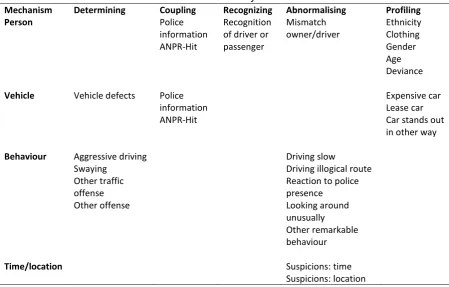
14 The categories can be filled into a table using the frameworks developed by Çankaya (2012) and Landman (2015), as below.
Table 2
Selection mechanisms in relation to the theoretical frameworks
Mechanism Determining Coupling Recognizing Abnormalising Profiling
Person Police
information ANPR-Hit
Recognition of driver or passenger
Mismatch owner/driver
Ethnicity Clothing Gender Age Deviance
Vehicle Vehicle defects Police information ANPR-Hit
Expensive car Lease car Car stands out in other way
Behaviour Aggressive driving Swaying
Other traffic offense Other offense
Driving slow
Driving illogical route Reaction to police presence
Looking around unusually Other remarkable behaviour
Time/location Suspicions: time
Suspicions: location
In addition, 2 new variables were created to further analyse each stop. First, as it was expected that police officers are more suspicious during night-time it was checked whether or not the stop took place during night-time. Although defining night-time is somewhat arbitrary, Kruize and Gruter (2015) argue that the police unit in Amsterdam generally views the hours between 23:00 and 07:00 as night-time, so this timeframe was used in this study as well.
Furthermore, a distinction was made between stops that took place based on (suspicions of) legal offenses and stops that took place based on other grounds (e.g. ‘gut feeling’).
The result of each stop was also registered and coded. 4 categories were used:
No results, other than the creation of a registration
A fine is issued
Seizure of the vehicle, driver’s license or goods in the vehicle
15 3.5 Limitations to the current design
16
4.
Results
Before discussing the results, some remarks should be made. As was already discussed in the previous chapter, most of the results are based on police officers’ registrations of events. These registrations are not intended to increase accountability and have no legal validity. Therefore, the registrations do not necessarily reflect what really happened during proactive police stops. Registrations of 421 stops of 106 vehicles were analysed. The remaining 119 vehicles were either not stopped or the stops were not registered. In 79 (19%) of those registrations, the selection mechanisms could not be identified. Quotations will be used to give a more qualitative support to the quantitative data. These cases are not necessarily representative. Where quotations are used, personal names are replaced with the letter X or Y.
4.1 The person
In all stops of which a registration was made, reasons that fall into the category ‘person’ were mentioned 185 times, or in 57% of all registrations in which a reason for the stop was given. In this respect, profiling is the predominant pattern. In the vast majority of cases (71 out of 85), this profiling focused on earlier registrations of deviant behaviour, such as the number of offenses a person has committed in the past. This process entailed that police officers checked a number plate, found in police systems that the owner of the vehicle had a criminal record, and subsequently decided to subject the individual to a proactive stop. An example of this is the following case: “In the police systems, it turned out that different persons use this vehicle. These persons have committed several offenses6”.
As was discussed in Chapter 2, police officers use the term target-groupers for citizens that deserve extra attention. They often use this term to describe citizens, as in "known target-groupers7”, “both cars are used by target-groupers8” or “the moped was at a place where many target-groupers come9”. Show-offs are another group that attracts extra police attention: “two remarkable, probably Antillean, men. Kind of show-off types10”
It appears that new police information applications are used extensively, as Landman and Kleijer-Kool (in press) also noted. This became clear in the numerous registrations which mentioned that persons were checked prior to subjecting them to a stop: “when checking the police systems our telephone almost crashed as X had so much registrations11”, or “we furthermore noticed that several persons that are not of good standing with the police were linked to this number plate12”. Thereby, a citizen’s criminal record was the most-cited reason for a proactive stop. In 13% of all cases, police officers coupled specific information they had on a citizen. In a couple of instances, this was because a citizen was recognized because he was mentioned in a briefing, but in most cases officers found relevant information through the information system, e.g. on fines that still had to be paid. Another citizen was marked as possibly being radicalized which led to 7 stops.
6 Seat Leon, Male, Age 23, Dutch, 3 offenses, control had no result 7 Piaggio C38, Male, Age 22, Moroccan, 12 offenses, control had no result 8 No control took place
17 It should be noted that the flow of information is two-directional. Officers do not only rely heavily on information but also add lots of information, presumably with the aim to aid detectives in (future) criminal cases. This became apparent from the large number of cases in which numerous details were added to the registration. These details could relate to the route someone was driving, other persons a driver was seen with, and other vehicles that were in the vicinity. In various cases, very detailed information on clothing and hairstyle was given. It seems that intelligence-led policing therefore is a management concept that gained profound influence on the daily practice of proactive policing.
It becomes clear that police officers have strong attention for deviant persons and persons that have a criminal record. This is mentioned in many registrations, as in the following example: "remarkable threesome considering their criminal record13”. As was already discussed, the finding that a person had a criminal record contributed to a stop in 71 cases. Additionally, in 46 cases (14%), the driver of the vehicle was directly recognized because he had a criminal record. It therefore seems that police officers are interested in those persons that are already known to the police, either because they are directly recognized or because it is found that they have a criminal record. This became particularly clear in a case where an officer recognized a person due to him having a criminal record, but was not able to perform a proactive stop due to more urgent tasks. The officer subsequently started a search which in the end resulted in a stop. It can be argued that these findings reflect police officers’ urge to ‘catch criminals’ as it was already argued that officers expect that persons who have committed crimes in the past, are likely to commit more crimes in the future. The urge to ‘catch criminals’ is supported by another finding. Of all 421 registered stops, only 39 stops were conducted with a person with a clean criminal record. Insofar the registrations can be used to determine the extent to which profiling occurs, it seems that profiling mostly focusses on those persons with a criminal record. These criminal records can be small or extensive: “We made this registration as the vehicle is armoured and is registered to X, who has a criminal record regarding the weapons and ammunition law, the opium law and trafficking of women14”. Furthermore, it turned out that a lot of the controlled persons are registered as belonging to criminal target groups deserving special attention such as burglars or street robbers. When a persons is checked in the police information system, such classifications are immediately visible, so this may attract extra attention. Of the 421 stops, 232 (55%) were conducted on vehicles used by persons with such classifications. Some of these groups have a special person-oriented approach (in Dutch ‘persoonsgerichte aanpak’) which can explain why these persons attract even more attention. An example of such a group is the Top600 project of youthful criminals15. Of the 421 stops, 172 (41%) are conducted on vehicles used by persons with such classifications.
However, it also turned out that stops of persons with a criminal record are more likely to be registered, as this was frequently mentioned in the registration, as in the following examples: “X and Y are known to us, therefore we made this registration16”, and “it turned out that X is not unknown to the police, therefore this registration was made17”. It also appears that registrations are only made when these seem useful or when the stop was seen as worthwhile:
13 Renault Clio, Male, Age 25, Dutch, 14 offenses, control had no result 14 BMW 760 Li, Male, Age 34, Dutch, 4 offenses, no control took place
15 https://www.amsterdam.nl/wonen-leefomgeving/veiligheid/openbare-orde/aanpak-top600/ 16 Mercedes CLA 180, Male, Age 20, Turkish, 1 offense, control had no result
18 “We have a gut feeling about this company and especially its visitors. Therefore, we made this registration18”. This makes sense, as the registration of every stop would lead to a pollution of the police information system. However, it also leads to a bias as this study is therefore only focused on those stops that are in one way or another of particular interest to police officers. It is unknown how many stops are not registered and what the characteristics of these stops are. It is therefore unknown to what extent the present study is representative of the total number of stops.
It was furthermore remarkable that in some registrations, officers urged each other to stop certain citizens again. In one case, in which a citizen acted very aggressively towards officers, it was registered that “X is a very annoying guy (…) every opportunity to give him a fine should be used19”.
An incongruence between the registered owner of a vehicle and the driver contributed to 12 (4%) stops. As one officer described it in a registration “we noticed that the driver of the vehicle was a male while the registered owner of the vehicle was a female. We know that criminals use vehicles that are registered to a female, to stay in anonymity”20.
Police officers furthermore have attention for luxurious clothing or accessories, as in the following example: “All boys had strikingly expensive clothing21”. In such cases, it may be assumed that the person has a lot of money that is obtained illegally: “I saw that the driver had expensive clothing. However, I could not see the brands. The driver had a silver watch of the brand Rolex on his left arm. I had a gut feeling that somewhere, something was not right22”. It appears that officers have special attention for the brand Gucci, as it was mentioned often when a stopped citizen had clothing or accessories of this brand.
The majority of the registrations (again, this sample predominantly represents the top 4% number plates that have been checked upon the most) were made of stops of persons that have a non-Western background. Stops of persons with a Moroccan appearance were registered most (±51%), followed by persons with a Negroid (predominantly Surinamese or Antillean) appearance (±20%), ethnic Dutch people (±12%) and Turkish people (±9%). Note that these are not all unique persons but the drivers that were involved in the 421 stops of 106 vehicles. 171 unique drivers were involved. The distribution of ethnicities is somewhat similar for the unique drivers: 51% had a Moroccan appearance, 16% had a Negroid appearance while Dutch and Turkish-Dutch citizens both amounted for 13% of the total. This does not necessarily mean that these people are stopped more often than other citizens, as these figures only refer to the registered stops. In contrast to what the theory predicted, a strong underrepresentation (1 person with the Albanian nationality, less than 0.5% of the total) of people from Eastern Europe was found. Several explanations for this finding are possible. The simplest explanation would be that officers just do not have attention for people with an Eastern European appearance, or at least not so much attention that they would end up in the top 4%. Other possible explanations are that the combination of an Eastern European person in a vehicle does not attract specific attention (while e.g. an Eastern European person on foot does) or that stops of these people are not registered. The latter explanation might
18 No proactive control took place 19 No control took place
20 Opel Corsa, Male, Age 28, Dutch, 1 offense, control had no result
21 Mercedes CLA 180, Male, Age 20, Turkish, 1 offense, control had no result
19 reflect a low desire to collect information about Eastern Europeans. The average age of the drivers involved in the 421 stops is 27. Finally, as was expected, gender plays an important role in the categorization during proactive policing: only 5 stops were conducted with a female driver. In some other cases, women were involved, but with the suspicion that these women were exploited by lover boys.
4.2 The vehicle
Reasons that fall into the category ‘vehicle’ were given 77 times, or in 23% of all registrations in which a reason for the stop was given. In a majority of cases, this was because the car attracted attention either because it looked very expensive or attracted attention in another way, because of e.g. its paint job or modifications to the car. Also, in some cases, a car that was armoured attracted suspicion. As registered by one officer: “X thought it was strange that we subjected him for a stop and that he is often subjected to such stops. We explained that this is the case because he drives in an armoured car23”. In 24 cases, it was mentioned that the fact that a car was leased made the situation more suspicious. As one officer stated it, “we know that criminals often lease cars24”. In another registration, it was mentioned that “during the stop we saw in the police systems that it was a lease car that is stopped frequently. It is often used by shady figures25”. Extra suspicion rises when the lease company is recognized as a ‘shady’ company that often leases cars to criminals. Furthermore, in 19 cases it was mentioned that the car had one or more defects and in only a small minority (4 cases) information from police systems on the vehicle was coupled, as in the following example: “after checking the central police systems it turned out that the vehicle is linked to burglaries and in the registrations, it was requested to search the vehicle26”.
Furthermore, of the 421 stops, in 106 (25%) stops a car of the brands Audi, BMW or Mercedes was involved. Again, these are not the unique vehicles as some vehicles were stopped more than once. 31 of the 106 (29%) unique vehicles were manufactured by the companies mentioned above. Another brand that was stopped often is Volkswagen. Cars of the model Golf and Polo amounted for 137 stops (28%). 35 of the 106 (33%) unique vehicles were a Golf or a Polo. These cars either attract much attention or are often driven by the persons that attract much attention. Furthermore it is striking that mopeds of the brand Piaggio amounted for 47 (11%) registered stops, while only 8 of the 106 (8%) stopped vehicles was a Piaggio. Furthermore, in all these 47 stops a Moroccan driver was involved: officers have special attention for this combination of vehicle and driver. It appears that this can be explained by knowledge of a modus operandi of street robbers: “considering the number of street robberies in this place performed on mopeds, we decided to subject both gentlemen to a stop27”.
23 Volvo S80, Male, Age 35, Moroccan, 17 offenses, control had no result 24 No control took place
20 4.3 Behaviour
In all stops of which a registration was made, reasons that fall into the category ‘behaviour’ were mentioned 182 times, or in 53% of all registrations in which a reason for the stop was given. In 107 (31%) of these cases, it was registered that the behaviour was (suspected to be) in violation of the law. In most of the cases traffic laws were violated, predominantly because the vehicle was driving aggressively. In a small number of cases, other laws were violated, e.g. when public order was disrupted or police officers were insulted. Citizens from ethnic minorities are not stopped significantly more often for a (suspected) violation of the law than ‘white’ Dutchmen: X²(1)=.043, p=.836.
In 75 (22%) cases, the behaviour attracted suspicion without breaking any laws. In this respect, the reaction to the presence of police officers predominantly aroused suspicions. Citizens that suddenly change their direction when police officers appear give the impression that they do not want to be stopped by the police, i.e. that they have something to hide. In other cases, citizens reacted to police presence in other remarkable ways: “We stopped the vehicle after the passengers reacted strangely to our presence. They drove away, stood still, turned on the alarm lights. We saw them again later and they did the exact same thing28”.
Furthermore, in 13 (4%) cases it was mentioned that the vehicle was driving a route that did not seem logical, for example when a citizen was seemingly driving in circles. This arouses suspicions that the driver is scanning for a target, e.g. a suitable house for a burglary. In a handful of cases, it was mentioned that a citizen was driving very slow, presumably also because they are scanning for a target. Other registrations included mentions of citizens sleeping in their car, placing a bag in a car under suspicious circumstances, or having very young girls in their car.
4.4 Time and location
Of the 421 examined stops, 111 (26%) took place between the hours of 23:00 and 07:00 and 310 (74%) stops took place between 07:00 and 23:00. Ethnic minorities were not stopped significantly more often during night-time than ethnic Dutch citizens: X²(1)=.1556, p=.212. Also, stops performed in daylight were not significantly more often based on (suspected) violations of the law than stops performed at night-time: X²(1)=.158, p=.691. In all stops of which a registration was made, reasons that fall into the category ‘time and/or location’ were mentioned 23 times, or in 7% of all registrations in which a reason for the stop was given. Thereby, this is the category that is mentioned the least in police registrations. An example is the following registration: “Considering these remarkable movements at these remarkable hours, we made a registration29”.
It can be expected that gut feeling plays an important role in determining what is out of the ordinary at night-time, as is demonstrated in the following case. It shows how behaviour that would probably be seen as normal in certain locations at certain times, can suddenly become suspicious at other times and/or locations. It appears that gut feeling plays an important role in such interpretations of situations.
“During our patrol, at 3:30 AM we saw the Citroën C5 at the parking place at sport park X. Next to the vehicle stood, as we would later find out, Y. We saw that he was using scissors and
21 tape to pack moving boxes. Y reacted strange and stubborn to our question what he was doing at this hour. Y first declared that he was moving, subsequently that there were kitchen tools in the car and finally that it was garden soil. We searched the car. It turned out that the boxes were filled with garden soil. According to google this was high-quality potting soil which is also sold in the grow shop. Y kept insisting that it was garden mold for his kitchen-garden. Strange to pack this mold into boxes at 3:30 at a deserted parking place30”.
The case above also shows the complexity of the decisions officers have to make during proactive policing. Due to recent changes in Dutch drugs law, the officers considered it debatable whether or not the activity described above was illegal based on this law, but decided not to issue any fine.
4.5 Combinations and discrepancies
In earlier studies it was already found that the factors on their own do not decide if someone is subjected to a stop or not, but that factors in a combination form selection mechanisms. Police officers call this ‘plus signs’. In many registrations, it became clear that officers note a certain number of plus signs before deciding to subject a citizen to a proactive stop. The number of plus signs can be extensive: “in the meantime we checked the driver and the vehicle and decided to search the vehicle, without the drivers’ permission. The reasons for this were the driving behaviour of the driver, his attitude, his criminal record and risk classifications, the type of vehicle in combination with the driver, and a registration mentioning that this vehicle is often used by criminals from neighbourhood X and Y31”. Remarkable but not prohibited behaviour may lead to a stop when additional interesting information is found: “I drove on street X and noticed a Volkswagen was driving in front of me, with a sticker of the FC Twente logo at the left backside. The boys inside slid downwards and averted their heads. We ran a check on the vehicle, it turned out that someone who was stopped in it earlier had a bulletproof vest. Considering the description, this was the same person32”. Of 3 young Moroccan men in an armoured car, one officer registered that it was “interesting33”.
As Çankaya (2012) already found, police officers have special attention for discrepancies. They become suspicious when they find one, especially with regard to expensive vehicles and drivers who supposedly cannot afford such vehicles: “three young guys in an expensive car, they understood that the police would want to check that34” or “a very expensive car for a young guy35”. The case discussed in the paragraph above is an example of a discrepancy between time, location, and behaviour.
The number of plus signs also can also determine the powers that officers will use during stops, i.e. whether or not citizens will be subjected to a more extensive stop such as a frisk: “considering the criminal record of this person, the time and the location, we searched the car and frisked both gentlemen”. When a request to search a vehicle was initially denied, one officer registered: “we told him that it works a bit different due to the plus signs (driver and
30 Citroën C5, Male, Age 34, Turkish, 7 offenses, control had no result
31 Volkswagen Polo, Male, Age 26, Moroccan, 15 offenses, control had no result
32 Volkswagen Golf TDI, Male, Age 33, Dominican Republic, 28 offenses, fine issued for driving without
license
22 passengers, vehicle, offenses, registrations, attitude etc.)36”. On the other hand, a lack of plus signs may impair police officers’ ability to use their powers, as became clear in the following case: “the vehicle he was driving was frequently used by our target group, but we could not find any plus sings to search the vehicle37”.
Police officers furthermore have attention for combinations of different nationalities, as became clear in the following case, in which a car is stopped which is used by 2 young men: “The composition could at least be called remarkable. The driver came from Switzerland and the passenger was “his friend”. He is born in Colombia, has the Spanish nationality and lives in Switzerland38”.
4.6 Patterns in proactive policing
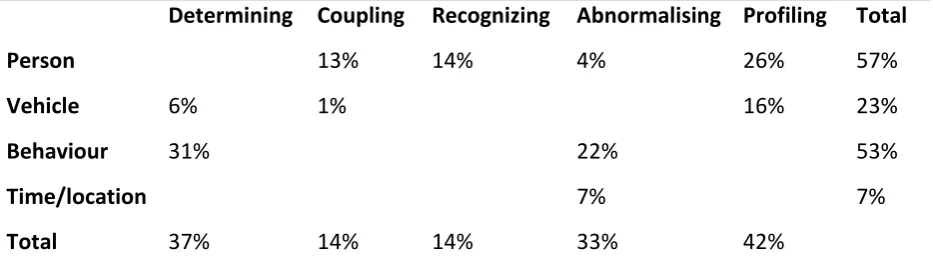
With respect to the patterns that Landman (2015) identified, 38% of all registered reasons can be placed under ‘determining’, 14% under ‘coupling’, 14% under ‘recognizing, 34% under ‘abnormalising’ and 42% under ‘profiling’. As Landman (2015) already noted, several patterns can be used simultaneously in the decision to subject a citizen to a stop. The most remarkable contrast with the results of Landman and Kleijer-Kool (in press) is with regard to the profiling pattern. They found that, in the urban regions, only 6-10% of all stops took place within the profiling pattern. The large share of profiling in this study is mostly due to the strong focus on persons with a criminal record.
36 Mercedes C220 CDI, Male, Age 22, Moroccan, 26 offenses, control had no result 37 BMW X6, Male, Age 23, Turkish, 0 offenses, control had no result
[image:27.595.73.540.423.558.2]38 Mercedes E220 CDI, Male, Age 20, Swiss, no offenses, control had no result
Table 3
Results in relation to the theoretical frameworks
Determining Coupling Recognizing Abnormalising Profiling Total
Person 13% 14% 4% 26% 57%
Vehicle 6% 1% 16% 23%
Behaviour 31% 22% 53%
Time/location 7% 7%
Total 37% 14% 14% 33% 42%
23 4.7 Legitimacy of proactive policing
It appears that in several stops, traffic law violations are used in order to achieve different goals than the enforcement of the traffic law. In one case39, for example, officers found out that the registered owner of a vehicle is a member of an Outlaw Motorcycle Gang, and subsequently stopped him on the basis of the traffic law. In another case, an expensive sports car was seen driven by three young Arabic looking males. It was already found that such a combination may increase suspicions, but a valid reason is needed to check whether these suspicions are true: “we saw a white Mercedes AMG cabriolet with open roof, with three North African youngsters in it. We saw that the driver ran the red light. We subsequently stopped them.40” In a comparable case, officers “stopped the vehicle because of gut feeling and controlled it based on the enforcement of traffic law41”.
4.8 Interactions during stops
In earlier research, attention was also given to the interactions police officers have with citizens during proactive stops. Interactions were not quantitatively analysed in the current study as in only a minority of cases, details on the interaction were given. However, some cases stand out in a qualitative sense and will therefore be discussed here. It was frequently registered that citizens had an uncooperative or a nagging attitude, as if some citizens like to defy police officers. Since such encounters are frequently registered, it seems that citizens with such attitudes attract extra attention and are therefore stopped more often, as in the following case, where a request to search a vehicle was denied: “I will not let you do this, I have nothing to hide. But even then I will not let you frisk me or search my car. I like to let you walk around with questions42”. Other interactions had a profoundly negative character: “Yesterday, I learned that I can call you a cockroach. Stupid cockroach. This was repeated a couple of times43”. In various other registrations, it was noted that remarks were made about police officers’ low salaries or that officers could e.g. not afford the expensive watch a citizen was wearing. In several cases, citizens made remarks about an assumed inability to effectively punish perpetrators. Examples in such cases are remarks to keep stealing to pay for a fine, or the remark that a citizen, after an arrest, will be back on the street in no-time. It seems that some young males see the interaction with police officers as a challenging ‘game’, which was also shown in a recent study (Hoogeveen, Van Burik, De Jong, & Klooster, 2016). Such interactions can lead to an increasing polarization between police officers and young males of (predominantly) ethnic minorities.
39 BMW 3 Series, Male, Age 41, Dutch, 18 offenses, control had no result 40 Mercedes E220 CDI, Male, Age 23, Moroccan, control had no result 41 Citroen C5, Male, Age 22, Turkish, 5 offenses, control had no result 42 Renault Clio, Male, Age 25, Dutch, 14 offenses, control had no result