A Thesis Submitted for the Degree of PhD at the University of Warwick
http://go.warwick.ac.uk/wrap/36070
This thesis is made available online and is protected by original copyright. Please scroll down to view the document itself.
ASPECTS OF THE PSYCHOLOGY OF SECOND LANGUAGE
VOCABULARY LIST LEARNING
GERARD F. GRIFFIN
THESIS SUBMITTED FOR THE DEGREE OF PH. D.
UNIVERSITY OF WARWICK
DEPARTMENT OF PSYCHOLOGY
TABLE OF CONTENTS
Acknowledgements 4
List of Tables and Figures 5
Summary 9
Chapter 1 Introduction 10
Assumptions 15
Methodology 18
Pattern of Experiments 21
Chapter 2 The effect of the order of presentation of Li and L2 items
on word-pair list learning 22
Experiment 1 30
Chapter 3 The transferability of list learning to testing in a simple context 48
Experiments 2 & 3 65
Chapter 4 Learning in a list versus learning in a context 82
Experiment 4 93
Chapter 5 List position and serial order effects and word-pair presentation 111
Experiments 5 & 6 120
Chapter 6 Word frequency and list position 135
Experiments 7 & 8 155
Chapter 7 The effects of word category on recall 171
Experiment 9 188
Chapter 8 The effect of embedded words on memory processes 194
Experiment 10 212
Index to appendices 229
Bibliography 230
Materials Appendix 283
Instructions to teachers 284
Experiment 1 286
Experiment 2 291
Experiment 3 297
Experiment 4 302
Experiment 5 317
Experiment 6 323
Experiment 7 328
Experiment 8 331
Experiment 9 334
Experiment 10 337
Results Appendix 342
Experiment 1 343
Experiment 2 345
Experiment 3 347
Experiment 4 349
Experiment 5 351
Experiment 6 352
Experiment 7 353
Experiment 8 354
Experiment 9 355
ACKNOWLEDGEMENTS
My thanks are due first of all to Trevor Harley. He introduced me to psycholinguistics in
the course of a very happy M.Sc. year at the University of Warwick and he has guided me through to the completion of this thesis with his usual mixture of erudition, enthusiasm,
and wit. I would also like to thank him and Siobhan MacAndrew for all their kindness and hospitality over the last seven years. Being a part-time student can be a isolated task; they
always made me welcome and gave me encouragement on the many occasions when I needed it. They are good friends.
I also wish to thank all my colleagues at Dorset Institute of Higher Education, Dorset Institute, Bournemouth Polytechnic, and Bournemouth University (the distinction is
logical rather than ontological). The Directorate, my Heads of Department, departmental colleagues (academic, administrative, and secretarial), and the library staff have all been
understanding, supportive, and helpful in many different ways. The same applies to the
staff in the Department of Psychology and in the library at the University of Warwick. Thanks are due to Wanda Arti, Tony Campolini, Nick Hobbs, and the children of
their respective schools for making the running of the experiments possible.
I want to thank my children, Joe, Lucy, and Ben who supported me through some
very difficult personal circumstances and who accepted my disappearance every evening to
slave over a hot Macintosh with equanimity. They have been most understanding.
Finally, I want to thank Linda Butcher, my friend and partner, who has made me
LIST OF TABLES AND FIGURES
Chapter 2
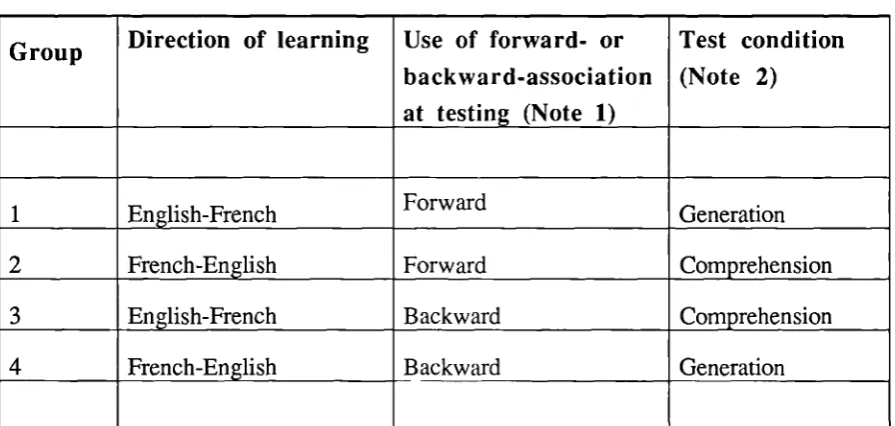
Table 2. 1. Experiment 1. Arrangement of groups. 33
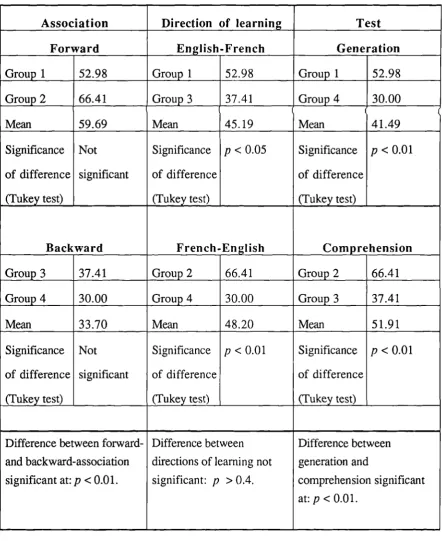
Table 2. 2. Experiment 1. School Al. Mean percentage scores for items 36
recalled: Forward- or backward-association, direction of learning,
and test condition.
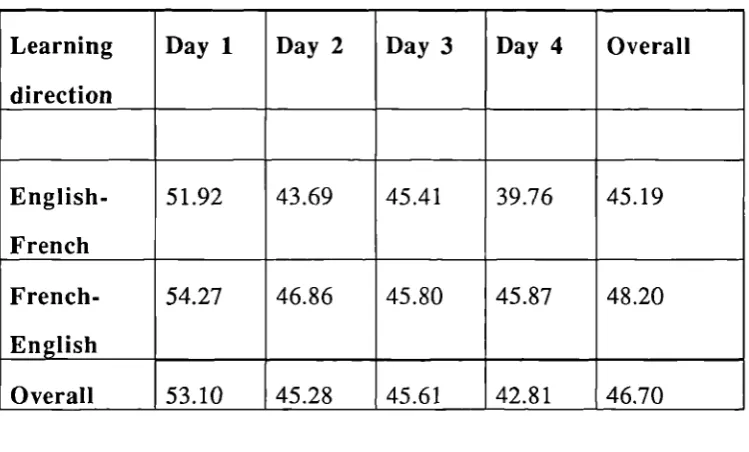
Table 2. 3. Experiment 1. School Al. Mean percentage scores for items 38
recalled: Direction of learning, day of testing.
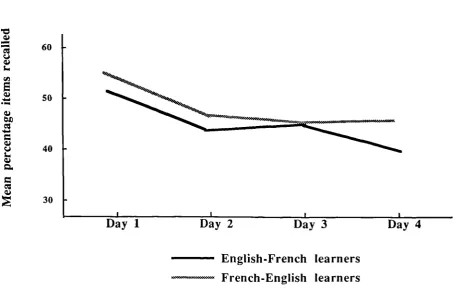
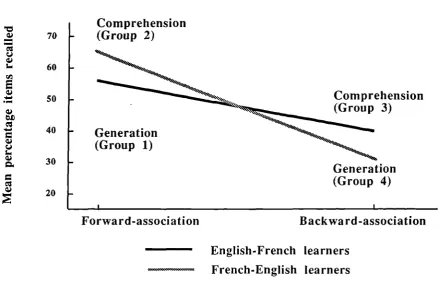
Figure 2. 1. Experiment 1. School Al. Mean percentage scores for items 39
recalled: Direction of learning, day of testing.
Figure 2. 2. Experiment 1. School Al. Mean percentage scores for items 40
recalled: Use of forward- or backward-association, direction of
learning, test condition.
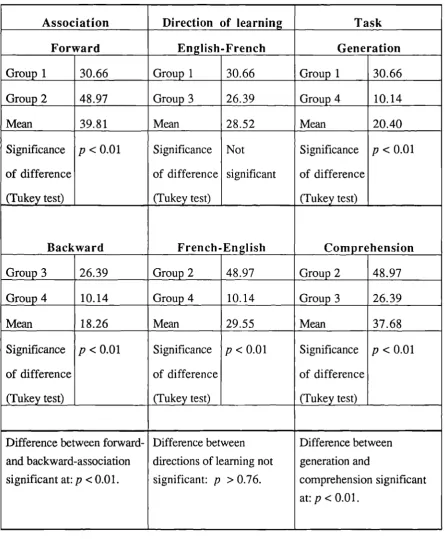
Table 2. 4. Experiment 1. School Bl. Mean percentage scores for items 42
recalled: Direction of learning, association, and task.
Table 2. 5. Experiment 1. School Bl. Mean percentage scores for items 43
recalled: Direction of learning, day of testing.
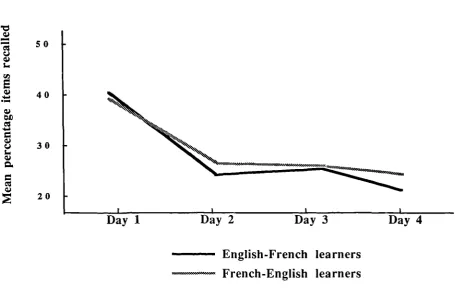
Figure 2. 3. Experiment 1. School Bl. Mean percentage scores for items 44
recalled: Direction of learning, day of testing.
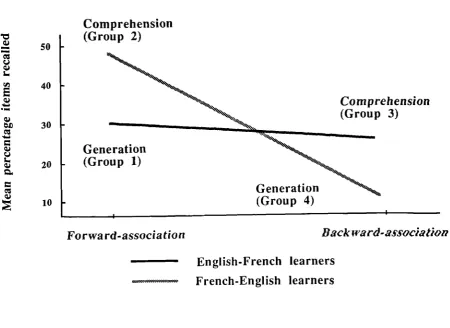
Figure 2. 4. Experiment 1. School Bl. Mean percentage scores for items 45
recalled: Use of forward- or backward association, direction of learning, test condition.
Chapter 3
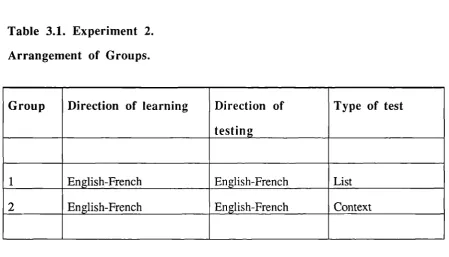
Table 3. 1. Experiment 2. Arrangement of groups. 67
Table 3. 2. Experiment 2. School B2. Mean percentage scores for items 69
Table 3. 3. Experiment 2. School A2. Mean percentage scores for items 71
recalled.
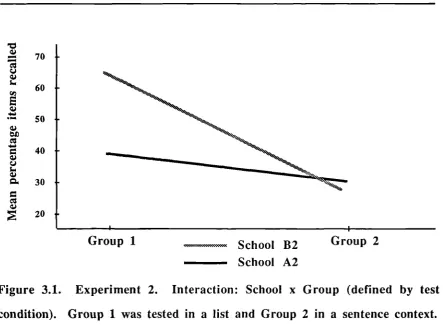
Figure 3. 1. Experiment 2. Interaction: School x Group (defined by test 72
condition).
Table 3. 4. Experiment 3. Arrangement of groups. 75
Table 3. 5. Experiment 3. School B3. Mean percentage scores for items 77
recalled.
Table 3. 6. Experiment 3. School A3. Mean percentage scores for items 79
recalled. Chapter 4
Table 4. 1. Experiment 4. Arrangement of groups. 96
Table 4. 2. Experiment 4. School B4. Mean percentage scores for items 98
recalled: List or context at learning and generation or
comprehension task.
Figure 4. 1. Experiment 4. School B4. Interaction: Learning condition x 99
Task.
Table 4. 3. Experiment 4. School B4. Mean percentage scores for items 100
recalled by group and day of testing.
Table 4. 4. Experiment 4. School A4. Mean percentage scores for items 102
recalled: List or context at learning and generation or
comprehension task.
Figure 4. 2. Experiment 4. School A4. Interaction: Learning condition x 103
Task.
Table 4. 5. Experiment 4. School A4. Mean percentage scores for items 105
recalled by group and day of testing.
Table 4. 6. Experiments 2, 3, 4. A summary of the performance of higher- 108 ability and lower-ability learners according to learning
Table 4. 7. Experiments 1-4. A summary of percentage decrement between 109
Day 1 and Day 2.
Table 4. 8. Experiments 1-4. A summary of percentage decrement between 110
Day 1 and Day 2. Rank order. Chapter 5
Table 5. 1. Experiment 5. Arrangement of groups. 124
Table 5. 2. Experiment 5. School A5 and School C5 pooled. Mean 125
percentage scores for items recalled.
Figure 5. 1. Experiment 5. Mean percentage scores for items recalled: 126
Learning condition x List position.
Figure 5. 2. Experiment 5. Mean percentage scores for iems recalled: School 127
x List position.
Table 5. 3. Experiment 6. Arrangement of groups. 130
Table 5. 4. Experiment 6. Mean percentage scores for items recalled. 131
Figure 5. 3. Experiment 6. Mean percentage scores for items recalled: 132 Learning condition x List position.
Chapter 6
Table 6. 1. Predictions of criterion bias models compared with 140
experimental evidence.
Table 6. 2. Predicted effects of format distortion on lexical decision 144
and naming.
Figure 6. 1. Three PDP architectures for lexical transcoding. 147
Table 6. 3. Survey of correlations between word frequency and 153
word knowledge. Graves, Ryder, Slater, and Calfee (1987).
Table 6. 4. Experiment 7. Arrangement of groups. 157
Table 6. 5. Experiment 7. Mean percentage scores for items recalled. 158 Table 6. 6. Experiment 7. Mean percentage scores for items recalled: 159
List position and word frequency.
Table 6. 7. Experiment 8. Arrangement of groups. 163 Table 6. 8. Experiment 8. Mean percentage scores for items recalled. 165
Table 6. 9. Experiment 8. Mean percentage scores for items recalled: 166 Word frequency and list position.
Figure 6. 3. Experiment 8. Interaction: Word frequency x List position. 167
Table 6. 10. Experiments 5, 6, 7, 8. Summary of word frequency and list 169 position data.
Chapter 7
Table 7. 1. Experiment 9. Mean percentage scores for items recalled by word 190 category and test condition.
Figure 7. 1. Experiment 9. Performance by word category and task. 191
Table 7. 2. Materials from Experiment 8. High-frequency words with 193 below average recall and low-frequency words with above average
recall arranged by word category.
Chapter 8
Table 8. 1. Experiment 10. Mean percentage scores for items recalled. 216 Table 8. 2. Experiment 10. Mean percentage scores for items recalled by 217
SUMMARY
The learning of second language vocabulary in lists of word-pairs is a widespread practice
despite the disapproval of many in the second language learning domain. There is an
acknowledged mismatch between psychological theories on the one hand and techniques of vocabulary learning on the other. Psychology does not address the relevant issues directly
and second language learning practice is often atheoretical and unprincipled. This thesis reviews aspects of psychology which appear to be relevant to second language vocabulary
learning and their applicability. A series of experiments is conducted with comprehensive
school students learning French, aged 11-13.
The first part of the study deals with the presentation of vocabulary items to be learned. Presenting items in the order First Language - Second Language is the more
versatile form of presentation if both generation and comprehension are required on the part
of the learner. The transferability of list learning to testing in a sentential context depends
on the ability of the learner and the task involved. Higher-ability list learners are inhibited in a generation task but not in a comprehension task; the opposite is true for lower-ability learners. Learning in a context improves the performance of higher-ability learners in
generation but makes little difference to lower-ability learners. An explanation is suggested
in terms of transfer-appropriate processing. The position of items in the list is not a reliable
indicator of learnability. Primacy, recency, and serial effects may be obtained but none of them is consistent. The same conclusion applies to different ways of presenting
word-pairs.
The second part of the study examines aspects of word learnability. Objective word frequency is not a reliable indicator of learnability in this context. Word category and the
presence of an English word embedded in a French word are promising indicators of
CHAPTER 1
Introduction
The purpose of this thesis is to investigate some aspects of the psychology of learning vocabulary items in a second language (1). This is to be understood as "sitting down to
learn vocabulary" as practised by students in schools, universities, and evening classes rather than in the sense of incidental learning of vocabulary as, for example, by so-called
immersion methods, or by being brought up bilingually. Second language vocabulary
learning, taken in this sense, is a rather odd phenomenon in that it is at the same time both "artificial" and "natural". It is artificial in the sense that it is a conscious and deliberate
attempt to learn items of language whereas most normals appear to learn items of their native vocabulary in an unconscious and trouble free manner (McKeown & Curtis, 1987,
passim). It is natural in the sense that it is something which many people undertake and indeed accomplish; when accomplished, the items learned function in much the same way
as first language items for such purposes as understanding and making oneself understood.
The thesis is directly concerned with examining those areas of psychology which appear to underpin the theory and practice of second language vocabulary learning and it
concentrates in particular on list learning by beginners in a foreign language, in this case
English students learning French. For many years, the study of second language vocabulary learning was designated a "neglected area" (Broadbent, 1967; Ellis, 1985;
Levenston, 1979; Meara, 1983). If this is no longer true in a general sense (see surveys by
Meara, 1987; Nation, 1987, 1990), it still seems to be true for the study of list learning of
second language vocabulary despite the widespread use of lists by language learners (see Carter & McCarthy, 1988; Nation, 1982).
Note (1). Although distinctions are made in the literature between foreign language
The reasons why the study of vocabulary has been somewhat neglected are many. Second language vocabulary acquisition was often seen as a by-product of the student's
attention to structure or to the process of communication (see Allen, 1983; McCarthy,
1984, for a discussion). According to Stern (1983), this notion goes back at least as far as Gouin (1880) and it is still found as late as Rivers (1981). There is an implied analogy between second language vocabulary learning and a child's acquisition of his/her first
language, the vocabulary for which is assumed to have been achieved effortlessly and
"naturally". Krashen's (1978, 1981, 1985) distinction between acquisition, "a subconscious process identical in all important ways to the process children utilize in acquiring their first language" (Krashen, 1985, p. 1), and learning, "a conscious process
that results in 'knowing about' language" (ibid.), with its preference for methods of acquisition as opposed to learning, formalised this analogy. Both the analogy and
Krashen's distinction have been seriously questioned in recent years (see, for example, McLaughlin, 1987). However, even if the analogy is accepted, there is no evidence to suggest that indirect learning cannot be complemented by direct learning (Nation, 1982)
and this is particularly true when time is limited.
Again, it is often felt that acquiring vocabulary in a second language (L2) is a
complex activity which cannot simply be reduced to learning an L2 equivalent for a first
language (L1) item. J. C. Richards (1976) argued that knowing a word involves knowing
not only its denotation but its frequency of use, the constraints on its use, its syntactic
behaviour, its forms and derivatives, and its network of associations. Balhouq (1976) stressed the difficulties associated with polysemy, homonyms, non-isomorphism,
connotations, taboo words, faux ands, idioms and clichés, and over-extension of collocations. However, the claim of Hughes (1968) that : "[No] English word is really the
equivalent of any foreign word" (p. 85), is surely too strong, as he himself implicitly acknowledges, and many writers have made the point that the use of an Li equivalent can
Even when vocabulary learning is accepted in principle, list learning is often seen as
an unsatisfactory learning method. This matter will be discussed in detail in subsequent chapters, but Hughes (1968), for example, is typical in claiming that list learning of
translations is soon forgotten and not readily available for use.
It is clear that there should be a reciprocal relationship between psychological theory
and the theory of second language vocabulary learning. A complete psychological theory must have something to say about the processes involved in second language vocabulary
learning and should be able to inform practice; conversely, theories associated with second language vocabulary learning must be compatible with general psychological theory, and empirical data from second language learning will constrain that theory to some extent. As
things stand, it is clear that this relationship is not as productive as it might be. First, this is
because the state of psychological theory is more satisfactory than the state of the theory of second language vocabulary learning. Second, because the use made of psychological
theory in the study of second language vocabulary learning appears to be inadequate.
These points will be discussed in turn.
Meara (1987) contrasted the development of psycholinguistic research, taking place
in a substantial theoretical framework, with that of applied linguistics which seems not to have established its theoretical underpinning in the same manner. Many writers have made
the point that research into second language vocabulary learning is unconvincing. The area
is described as not being genuine research at all but merely the reporting of new teaching
methods without adequate controls (Carroll, 1963); as falling short of "scientific standards of a purist psychologist" (Broadbent, 1967); as having been "largely atheoretical and
unsystematic" (Meara, 1980, p. 221); as having received "relatively little systematic attention" (Stern, 1983, p. 131); as needing to be directed to a "systematic and principled
basis" (Corder, 1973, p. 109 ); as being "quite old and rather patchy" (Meara, 1983, p. ii);
as being of "poor quality" (Meara, 1987, p. 3).
language acquisition is often not the point of experimentation. This means that any
findings need to be interpreted; that the experimentation underestimates the complexity of the process because relevant variables are ignored; that results are badly explained or
misleading in that averaging obscures important differences (Carroll, 1963; Nation, 1982).
On the other hand, it appears that the process for using psychological theory is somewhat ad hoc and often inaccurate, with theory "contributing little more than scientific
patter and an impressive-sounding new jargon" (Stern, 1983, p. 24). Thus, for example, it is questionable whether it is useful to state that: "Research also shows...that there is a
tight relationship between 'cognitive depth' and retention" (Nattinger, 1988, p. 65), unless the status of that research is indicated (as, for example, in Kolers and Roediger, 1984).
Research does not support the notion of cognitive depth in relation to retention because, as
will be discussed later, the notion of cognitive depth cannot satisfactorily be defined; at best the notion of cognitive depth has heuristic value. It is also questionable whether references
to "rote learning" (e.g., Carter & McCarthy, 1988, p. 12) serve much purpose unless it is made clear how it is established that subjects engage in this activity as opposed to some
more elaborated form of processing. As a final example, Richards (1970, pp. 90-91) among others quotes Michea (1964): "An available word is a word which though not
necessarily frequent, is always ready for use, and comes to mind when it is needed." It is
difficult to envisage what model of language processing such a concept could fit into. There appear to be two main tasks to be accomplished. The first is to review those
areas of psychological research which are relevant to the present domain. Psychological
theory is not static but dynamic, not simple but complex, therefore for use to be made of that body of theory a process of updating is always going to be necessary. It is doubtful
whether it will be adequate merely "to scan the field of psychology and psycholinguistics
so as to be cognizant of theories, concepts, studies, and research findings that appear
relevant" (Stern, 1983, p. 333). The second task is to evaluate the extent of their usefulness and applicability by a set of controlled experiments. A side-effect of the
Nation and Coady (1988) asked the question whether "research experiments still have a value for teachers, even when contradictory claims result" (p. 109). The answer would seem to be that experiments which result in contradictory claims may have a value
for practitioners provided an explanation is given for those conflicting results. In other words, it must be acknowledged that vocabulary learning is a complex activity; that slight
changes in materials, subjects, tasks, procedures may lead to different results (Jenkins,
1979); that concepts from psychology cannot be applied "neat" if only because sets of factors interact differently in different circumstances. It is probably more important for
practitioners to understand this than it is for them to be led to believe, for example, that a particular factor will lead to improved learning whatever the circumstances (McDonough,
1986). Subjects used in these experiments are all taken from a relatively homogeneous population. Over-generalisation is always a problem in psychological research and the
variability of results even within the sample used is a timely reminder of the difficulty of
applying theories in any straightforward manner.
It is clear that a number of disciplines, and subsets of those disciplines, impinge on the study of second language vocabulary learning and it is important at the outset to indicate
the limits of the research undertaken here. In general terms, it is not concerned directly with Applied Linguistics, with the literature on second language teaching, or with the
psychology of bilingualism (at least to the extent that bilingualism is taken to refer to more
or less fluent bilinguals; see Romaine, 1989).
Applied Linguistics in this context is taken to be "a mediating discipline between
theoretical developments in the language sciences and the practice of language teaching" (Stern, 1983, p. 35). It is concerned with issues such as the nature of language, the
description of language, the concept of difficulty, and contrastive analysis (Corder, 1973).
Although some of these issues will be touched on in the thesis, the line of enquiry followed is basically psychological and the wider interests of Applied Linguistics will not be of
concern here.
interlanguage (Selinker, 1972), contrastive analysis (Lado, 1957), linguistic universals, order of acquisition, and teaching methods. Useful surveys include Dulay, Burt, and
Krashen (1982), Klein (1986), Larsen-Freeman and Long (1991), McLaughlin (1987). The intention here is not to study teaching techniques as such but, in the phrase of Hamers
and Blanc (1989), "to analyse the psycholinguistic and psychological processes upon which sound teaching methodology should be based" (p. 215).
There is an extensive literature on bilingualism covering such issues as the social aspects of bilingualism; neuropsychological aspects; code-switching; the bilingual lexicon; the bilingual child (see Romaine, 1989, for a survey).
The over-riding reason for delimiting the thesis in this way is simply one of available space; each of the areas mentioned is a separate undertaking in its own right.
Even so, indirect reference will be made to these areas of study and this is particularly true
of some aspects of the literature on bilingualism. Meara (1983) argued that studies of bilingualism have much to offer in this field both because bilingualism is the goal of the undertaking and because many of the experiments on bilingualism are conducted with
subjects who are learners rather than fluent bilinguals and the results of these experiments
are of particular interest in the present context.
Assumptions
Although the thesis is concerned with issues in a specific domain, the domain does not
exist in isolation and at this stage some of the more important assumptions that lie behind the enquiry will be outlined since it will be a major concern throughout that local
explanations should be compatible with more general theories about language processes.
The first assumption is that any final explanation in psycholinguistics, as in psychology generally, must be a neurological explanation. In the present state of research
such a goal is unattainable. However, acknowledging this as the goal is a useful reminder that boxes with arrows can only ever be temporary explanations; even as temporary
avoided. An important corollary of this assumption relates directly to the domain of second language acquisition. The system as a whole, and the language system in particular, is not
"interested" in language as such, let alone in second, third, or fourth languages. The system is designed to process input and output; it is designed for a two-way process of
communication for purposes of survival and well-being. Discussions about second
language acquisition, therefore, must sit easily within wider explanations about memory and language processes. An example of where this point leads is related to the debate about
differences between compound and co-ordinate bilingualism (see Stern, 1983, for a
discussion). Ervin and Osgood (1954) envisaged an individual who can use two languages as fitting into one of two categories. Co-ordinate bilinguals handle their two languages as separate entities and they are considered to be "true bilinguals". Compound bilinguals on
the other hand have their languages linked and typically they may well interpret one
language through the medium of the other. This initial distinction has led to a great deal of
debate in subsequent years and whole teaching methodologies have been based on it, particularly since the original work was taken to endorse the co-ordinate approach as superior. Further research led to conflicting results (Macnamara, 1967) and eventually the
suggestion was made that the distinction be abandoned as no longer tenable or serving a
useful purpose (McLaughlin, 1987). The principle of seeking a neurological and
ecologically valid explanation could have cut through this debate by putting the burden of
proof on those who would argue for co-ordinate bilingualism and by assuming in the absence of such proof that all bilinguals are compound bilinguals. There is no obvious
reason for thinking that the system would benefit from having separate language systems, even if this were possible. The language of thought, often dubbed "mentalese", is
natural-language independent (Fodor, 1975). It is accessed by various means, natural natural-language
input being one of them. A bilingual's two languages come together at this semantic level at least. But access to the semantic system is achieved through the activation of memory.
If activation spreads, not only is a target "word" and its meaning activated by the input, but
priming (Ratcliff & McKoon, 1981). It is difficult to envisage how or why spreading
activation could be restricted to a particular language when the conceptual system is abstract
and language independent, and indeed Schwanenflugel and Rey (1986) showed that
cross-language priming can take place. This argument, of course, relies on yet another assumption, that of spreading activation. But spreading activation does have general explanatory power; the idea of co-ordinate bilingualism does not appear to have any general
theory of memory supporting it. In conclusion, those explanations will be preferred which are compatible with wider explanations of human language processes rather than
explanations which appear to relate only to a subset of those processes and to be
incompatible with them.
A second assumption is that the language process is more complex than a serial
process model can account for. One possibility is that the process is parallel, interactive, and compensatory (McClelland, 1987; Seidenberg, 1989). Without going into detail at this
stage, the process is envisaged as being carried out by multiple and simultaneous sources
of information; in the case of reading, for example, these sources include feature information, orthographic knowledge, lexical knowledge, syntactic knowledge, semantic
knowledge. The system is interactive because the output from lower level processes constrains the possibilities available to higher level processes. Conversely, higher level
processes influence the accessibility of data in lower level processes. Finally, the system is compensatory because shortage of information from one source can be compensated for by
contributions from other sources. Thus in the case of poorer readers or of degraded stimuli, there may well be reliance on higher level sources of information if the lower level
processes do not provide sufficient information for comprehension to be achieved. The
word "simultaneous" needs to be qualified in this context. It is intended to mean that
sources of information are simultaneously active, and receiving input, not that they output information at the same rate. The distinction is important. Automatic processes deliver
why adults appear not to suffer from incongruous context effects in the way that younger
readers do (Stanovich, 1981; West & Stanovich, 1978). The assumption is justified therefore because of its explanatory power.
A third assumption is that the language system is typified by few mechanisms and many strategies. Parallel systems, whether in the brain or in computing, are well-known
for being both powerful and difficult to control and predict and it is clear from the research
literature that experimental results are heavily task-dependent (Kolers & Roediger, 1984;
Postman & Schwartz, 1964; Smith, 1982). The system appears to adopt those strategies which are most appropriate to the task in hand. Thus Coltheart and Funnell (1987)
reported the case of HG whose strategy for reading words aloud was different (and more successful) when reading from a list of words only, than it was when reading from a list of
words and nonwords. This example could be multiplied many times from normals as well as from brain-damaged subjects. The corollary must be that parsimonious explanations
should normally be sought and new mechanisms should only be invoked when
explanations based on automatic process or strategies changed in response to task demands, are ruled out. (It should be noted that "strategy" in this context is used in a neutral sense; it does not necessarily imply conscious control on the part of the agent.)
This assumption is related to the first one made and precludes ad hoc explanations which,
although possibly convincing in themselves, are not compatible with wider explanations of mental processes.
Methodology
As mentioned previously, a number of writers have pointed out that a good deal of psychological research is of limited value to second language teaching practitioners. In
addition to Nation's (1982) arguments on interpretation, complexity, and averaging, there are concerns about materials, subjects, and tasks. Higa (1965) pointed out the care which
needs to be taken with materials. He suggested that there is a need to take into account the
Li, the part of speech, and item imageability. Where subjects are concerned, account must
be taken of learners' ability and the fact that subjects may not be employing techniques or
methods which the experimenter wishes and assumes them to be using (Gershman, 1970; Lado, Baldwin, & Lobo, 1967). Where tasks are concerned, the relationship of the
learning condition to the test condition must be taken into account (Bialystock, 1985;
Durgunoglu & Roediger, 1987; Fry, 1960; Kopstein & Roshal, 1955; Stoddard, 1929). With the above points in mind, several constraints have been adopted in the choice
of experimental procedures. First, the basic task is the list learning of English-French or French-English word-pairs. Second, materials have been controlled as far as possible for
frequency and syntactic category. Where more than one list has been used in an
experiment, lists have been controlled for frequency (checked by a t-test). Unless experimental requirements dictated otherwise, the same pattern of items from syntactic
categories (four concrete nouns, four abstract nouns, five verbs, seven "other words") has been maintained throughout; exceptions are noted in individual experiments. In addition, in Experiments 1-4, where lists were not sub-divided, an item or F2 analysis has been carried
out to ascertain whether effects are able to be generalised beyond the words sampled
(Clark, 1973). This was not possible in Experiments 5-10; when lists were sub-divided, the number of items in each category was insufficient for F2 analyses to be carried out.
All subjects used were in their first year of secondary education, aged between 11 and 13, and in their first year of learning French. This choice of subjects in one sense
represents a restriction, but it was a restriction deliberately imposed on the study. It was felt that the use throughout of a relatively homogeneous groups of subjects would make a
sound basis for comparing various methods of presentation and various aspects of word
difficulty; as far as subjects were concerned, like would be compared with like. In the event, from Experiment 1 onwards considerable variations were found even within this
sample. This unexpected outcome cast doubts on the usefulness of generalisations based
on more heterogeneous groups of subjects, at least at this stage in the development of the
Three schools from the same geographical area (Bournemouth) were used. School A was a mixed-sex state comprehensive school; School B was an all-girls state
comprehensive school; School C was a mixed-sex state comprehensive school. Different
cohorts from the three schools were used in different experiments and these are identified by a numerical indication of the experiment in which they took part (e.g., Al, B3....).
In the first five experiments, subjects from two schools were available. The
original intention was to pool results from the two schools because the similarity of age of subjects, their belonging to the same stage of foreign language learning, and the similarity
of the type of school involved pointed to the groups of subjects being of comparable ability. However a preliminary analysis of results in Experiment 1 revealed a significant
difference in performance between subjects from the two schools concerned. It was decided therefore that for each experiment where two schools were involved, a preliminary
analysis of the data would be carried out. If there was a significant difference in performance between the two schools, separate analyses would be carried out. Where
results from two schools are treated separately, subjects are identified as being of
"higher-ability" or of "lower-"higher-ability". The terminology refers merely to subjects' performance in the particular task under consideration; higher-ability subjects are those who performed
more successfully; lower-ability subjects are those who performed less successfully. The
terminology is not intended therefore to have any explanatory value and is used only for ease of identification.
All experiments were conducted in as "natural" a manner as possible which in this
case meant that learning and testing took place in the course of normal lessons. The
advantage of this constraint is that in avoiding highly artificial experimental environments there is less chance of artificial effects being obtained. The disadvantage is that certain
experimental techniques are ruled out and results are limited to a relatively high level of description. An appropriate next stage would be to move to a lower level of description
Instructions to teachers and subjects were kept to a minimum with the intention of maintaining consistency across groups and conditions. Examples can be found in the
Materials Appendix.
Pattern of experiments
In broad terms, the first six experiments are concerned with presentation issues.
Experiment 1 seeks to find out whether, for beginners, it is more effective to present listed vocabulary items in the order English-French, or vice versa. The issue addressed in
Experiments 2 and 3 is whether list learning successfully transfers to the demands on
vocabulary recall in more "normal" situations. Experiment 4 deals with the question of whether provision of a context at learning is more satisfactory than presentation of items in
a simple list. Experiments 5 and 6 look at alternative forms of word-pair presentation.
In addition to matters of presentation, another important aspect of vocabulary list learning is the effect of characteristics of the items themselves on the learning process; this
is the concern of Experiments 7-10. The characteristics examined relate directly to psychological research on memory and reading. Experiments 7 and 8 look at word
frequency in relation to list position and serial order. Experiment 9 examines the effect of word category on ease of learning. Experiment 10 considers the effect on the learning
process of English words embedded in French items.
It is hoped that the results of these experiments will add to the understanding of the
CHAPTER 2
The effect of the order of presentation of Li and L2 items on word-pair list
learning
A substantial amount of work was done, particularly in the 1960s, on list learning (e.g., Bower, Clark, Lesgold, & Winenz, 1969; Murdock, 1962; Segal & Mandler, 1967;
Tulving, 1968). After many years of neglect, there is a growing interest in second language vocabulary acquisition (Meara, 1983, 1987; Nation, 1982, 1987, 1990).
However, for various reasons which will be discussed in Chapter 3, an area which has
largely escaped attention has been the kind of list learning carried out by beginners in foreign language learning. Learners will often be presented with lists of vocabulary items arranged as word-pairs, either in the order First Language - Second Language, Ll -L2, or
in the order Second Language - First Language, L2-L1. (Since the first language referred to throughout this thesis is English and the second language is French the terms English
and French will be interchangeable with Li and L2 respectively). Additionally, students
will normally make their own vocabulary lists arranged in a similar manner.
The theoretical issues raised in this chapter have an immediate practical application
because it is not clear whether, for beginners, it is more effective to present listed
vocabulary items in the order English-French, or vice versa. A principled approach to this
matter would seem to be somewhat overdue and there is a need for answers to five questions: given a word-pair A-B, whether the association between the two components of
the word-pair is bi-directional; if it is bi-directional, whether the forward-association, A-B,
is stronger than the backward-association, B-A, in the sense that A is more likely to lead to recall of B than vice versa; given that one component is familiar and the other unfamiliar,
whether it is more effective to learn the familiar-unfamiliar association (L1-L2) or the
The directionality of the word-pair bond
The first question to be addressed is that of the directionality of the word-pair bond. When
subjects learn a word-pair, A-B, is the bond between A and B uni-directional or bi-directional? Historically, Behaviorism accounted for the association between A and B in
stimulus-response terms (see Voss, 1979, for a review). This meant, by definition, that
the bond was taken to be uni-directional. However, Asch (1968) and Asch and Ebenholtz (1962) showed that either A or B can serve as a recall cue for an A-B word-pair. They
argued that when a word-pair is learned, this involves the formation of both a
forward-association and a backward-forward-association of equal strength; this they designated associative symmetry. They saw the two associations as aspects of one entity, the relationship
between the two items, and therefore as logically rather than ontologically distinct. Johnston (1967) showed this not to be true. The associations must be independent because
the loss of the association in one direction does not necessarily entail the destruction of the
association in the other direction. Lockhart (1969) showed that with a word-pair made up of an adjective and a noun, the noun is the more effective cue whether it is in the stimulus or response position at learning. Wolford (1971), developing the point, argued that the
relationship is not one of associative symmetry, but of associative asymmetry. There are
two separate and distinct associations, A-B and B-A; the learned forward-association is
mainly responsible for recall and the learned backward-association for recognition. Finally, Voss (1972) argued that the word-pair is a complex entity involving not one bond
but at least five processes which relate the two elements of the word-pair. If the word-pair
is A-B, then given that A results in response r a, and that B results in response rb, and given
that response ra and response rb have attached a whole set of aspects or dimensions:
"It would seem that in order to have an adequate understanding of what happens when an association is acquired, it is necessary to have knowledge of at least five
processes. The first is the question of how A is encoded, ?1. The second is how B
a component of ra becomes related to a component of 1 43 that initiates a response, ?4,
that is, are these two aspects of rb the same or are they different and, if different,
how are they related. Finally, the last question is how the particular r i initiates certain responses." (Voss, 1972, pp. 171-2)
It seems safe to assume that the bond is bi-directional, although the nature of that relationship is a subject of debate. There is a certain amount of independence between the
forward- and the backward-association since one association can be lost without loss of the
other. They are not simply aspects of the same entity. The choice of what features of A are associated with what features of B in learning an A-B word-pair is subject to individual
differences. In other words, word-pair learning is not a question of simple association but is open to learner strategy. Indeed, mnemonic methods such as the loci method (Neisser,
1976), the keyword method (Atkinson, 1975; Merry, 1980), and the so-called Direct Method (Curran, 1976), all rely on strategies of association adopted by the learner.
Forward-association and backward-association
The second question concerns the relative relative strength of the forward- and
backward-association. Although conceptually this is a different question from the third question
concerning the effectiveness of learning when one component of the word-pair is familiar and the other unfamiliar, as is the case in learning L1-L2 word-pairs, in practice similar
arguments apply in both cases since effectiveness of learning is established by performance
at testing. Noble (1952) and Noble and McNeely (1957) reviewed evidence to show that
under certain circumstances response factors rather than stimulus factors can be a better predictor of recall; in other words, under certain conditions the backward-association may
be stronger. When stimulus and response meaningfulness (Noble, 1952) are manipulated, it is the meaningfulness of the response item which dictates recall whatever the
meaningfulness of the stimulus item. A similar conclusion was reached by Cieutat, Stockwell, and Noble (1958), Glanzer (1962), Postman (1962), and Underwood and
the meaningfulness of the stimulus as well as the response (see Rodgers, 1969) and
Gannon and Noble (1961) showed an effect derived from stimulus manipulation without an effect from response manipulation. Crothers and Suppes (1967) extended the scope of the
discussion by calling attention to the range of factors which can affect the performance of
stimulus or response. Using always L2-L1 learning, and following on from the work of
Gannon and Noble (1961) and Underwood and Schulz (1960), they argued that the relevant factors for the L2 stimulus (in this case Russian) are pronounceability and
association values, whereas syntactic class is the relevant factor for the Li (English) item in the response position. Given the L2-L1 order of learning, they also showed that the two
stimulus properties mentioned are more important indicators of performance than the effect of syntactic class in the response. They argued, however, that it is the degree of
unfamiliarity of the L2 item which is important rather than its being in the stimulus position;
thus a (difficult/unfamiliar L1)-(easy/familiar L2) word-pair would be easier to learn than an (easy/familiar L1)-(difficult/unfamiliar L2) word-pair.
Paivio (1969) made what was to become for him a characteristic distinction between association values and imageability values. He argued that where nouns are concerned, it
is the imageability of the word in the stimulus position which is important; he saw this conclusion as being in conflict with the "common empirical generalization" that it is
response factors which are crucial in paired-associate learning (Paivio, 1969, p. 245). He
pointed to the finding of, for example, Goss and Nodine (1965) and Underwood and
Schulz (1960) that meaningfulness (defined by the number of associations generated) in the response position is the important factor in learning paired nonsense-words and words.
However, when familiar words rather than nonsense-words are used his claim was that
imageability is a reliable indicator of performance whereas the effect of meaningfulness can range from slightly positive to slightly negative. Paivio (1971) returned to the issue
suggesting that imageability and meaningfulness might be indicators of different sorts of
mediation; where visual mediation is concerned, it is the stimulus position which is
range of experimental effects can be obtained by manipulation of variables such as the use
of children or adults as subjects, the use of words or nonwords, the use of concrete or abstract words, the relative imageability and association values of items in the stimulus or
response position, the frequency of words used, and the syntactic class of words used. On
the matter of the associative symmetry, Paivio argued that visual associations are symmetrical whereas verbal associations are directional with the forward-association being
stronger than the backward-association.
Wolford (1971) saw the question of the strength of the forward- and
backward-association as related to that of task demands. Where recall is concerned it is the forward-association which is going to appear to be stronger whereas the opposite is the case where
the task is recognition. Bower (1972), in arguing for the use of mediational imagery,
showed that image-evoking values varied on the stimulus and response sides of word-pairs are positively correlated with learning in both cases, but much more so on the stimulus than
on the response side.
There is, therefore, no reliable answer to the question of the relative strength of the
forward- and backward-association in isolation from a consideration of the task and materials involved. Either the item in the stimulus position at learning or the item in the
response position at learning can be the more effective cue depending on the particular
experimental conditions obtaining (Underwood, 1982). Horowitz and Gordon (1972)
specifically addressed associative symmetry in the context of second-language learning. They argued that when a word-pair, A-B, is learned, then in addition to the
forward-association, A-B, a latent backward-forward-association, B-A, is formed. Symmetry between the
two associations can be achieved by making the response to the backward-association, A,
more available through overt practice. They concluded from this that learning L2 items in the order L2-L1 will result in efficient learning of the forward-association because the Ll
item is relatively more available than the L2 item. Overt practice of the L2 item will then
discussion is questionable since the performance they report is dependent on additional learning, in the form of further practice of the B-A response, which would seem to present
motivational problems with respect to young learners.
Another aspect of the discussion was introduced by Jones (1976). He proposed that a remembered item is to be thought of as a fragment of a perceived situation, or an
all-or-none cluster of components of the original stimuli. If a cue overlaps with any aspect of
the fragment, then the whole fragment becomes available. Therefore, one component of the Li cue could cue the L2 item or vice versa. In this sense, memory traces are
symmetrical. However, he argued that reflexivity is not a corollary of the theory if multiple
cues are involved. In other words, if A can cue C, and B can cue C, this does not mean that B will necessarily activate A. In this sense, the relationship may be seen as
symmetrical or asymmetrical depending on the characteristics of the target item. Spyropoulos and Ceraso (1977) discussed the notion of limited access to memorised items
in terms of categorised and uncategorised attributes. They found that in the case of a
unitary to-be-remembered item, for example a red triangle, then the categorised aspect of the item is the most effective cue for recall of all aspects of the item. The categorised aspect
is taken to be the defining aspect of the item. Thus if subjects were instructed that x was a triangle (which was red) as compared with a red object (which was triangular), then its
being a triangle would be its categorised aspect. Following the reasoning of Asch and
Ebenholtz (1962), and Horowitz and Gordon (1972), it would be expected that the weaker
(non-categorised) attribute would be the better cue because in this situation the response (the categorised attribute) would be more available. The explanation offered by
Spyropoulos and Ceraso (1977) was that the unitary item forms a cohesive unit in memory
which is difficult to access except through its salient aspect. However, where the to-be-remembered item is non-unitary or poorly integrated, such as a word-nonword pair, then
the less salient aspect, presumably the nonword, will be the better cue because the word part of the item will be more available. The relationship between attended (categorised) and
reached that the idea of cue categorisation as a key to recall is not robust since its effect can
be varied by relatively slight changes in experimental design.
Generation and Comprehension
The fourth question concerns task demands. In this thesis, generation is defined throughout as the production of an L2 item in response to an Li cue, irrespective of the direction of learning. Comprehension is defined as the production of an Li item in
response to an L2 cue, again irrespective of the direction of learning. It could be argued that the comprehension task is not as difficult as the generation task. Stoddard (1929)
estimated that recall for comprehension was twice as easy as recall for generation; Horowitz
and Gordon (1972) similarly found comprehension to be the easier task, as did Magiste (1979). The target in the case of comprehension is a word which, presumably, is already
well integrated into the network of memory and which is therefore accessible in a variety of ways; the target in the case of generation is a word which has little "status" in memory and
means of access to it are for that reason restricted. In comprehension, then, subjects are
working towards the well known; if the provision of the French cue results in even a minimal activation of memory, then subjects are in a position to choose between candidate
responses, and those responses will be real English words; the task then becomes very
close to being a recognition task which is known to be easier than recall (see Eysenck,
1984, for a survey). In the case of generation, subjects are working from the known to the less well known or even the unknown. The provision of the English cue will result in the
activation of memory, but it is quite feasible that no French candidates for a response will
be automatically generated. If subjects set out to generate candidates, the set of potential candidate words is small where a beginner is concerned and there is a good possibility that
the candidates generated will not be words at all but pseudo-words, mere strings, or
attempts to "Gallicise" English words. The matter is of some practical importance to the main issue of whether presentation in the form English-French or French-English is to be
would make for the more successful completion of the more difficult task; the relative weakness of the backward-association would be offset by the relative ease of the comprehension task.
Trace persistence over time
The final question is concerned with whether there is any connection between direction of
learning (whether subjects learn Ll-L2 or L2-L1) and persistence of learning over time measured by the ability of subjects to recall items over a relatively extended period. As will be discussed more fully in Chapter 5, in list learning it is possible for vertical connections
to be set up as well as the desired horizontal word-pair associations. When learning is in
the direction L2-L1, the expected target words are English items. It would therefore be relatively easy for subjects to build on the vertical connections between the English items
which would already be primed by spreading activation. For French-English learners expecting to be tested in the same direction as learning, therefore, a reasonable strategy
would be to make use of the assistance which the list provides and to spend
correspondingly less time on the word-pair itself. Where learning takes place from English to French and the expected target words are French, the same strategy would not be
appropriate. Subjects are faced with forming associations between words which are new to
them, none of which would have much in the way of memory connections in their own
right (although, as discussed in Chapter 8, there is always the possibility that during the learning process individual French items become associated with orthographically similar
English words and that associations are formed between these English words). It could be,
then, that learning English-French is more difficult than learning French-English. However, there is evidence to suggest that more difficult learning can lead to better retention over time. Battig (1979), Heim, Watts, Bower, and Hawton (1966), Jacoby and
Craik (1979), and Jenkins (1979) all showed that initial learning difficulty can lead to better
long-term retention, although Bahrick and Phelps (1987) found no disadvantage attached to
brief, it is argued that any item has many facets, features, or dimensions along which it can
be processed and the more varied the processing that takes place, the stronger the bond between the word-pair items, and the more cues there are for retrieval. It is argued that
where initial learning is difficult, subjects may involve themselves in more varied
processing and will in consequence form a stronger word-pair link which is less dependent
on the list context. Another factor in these experiments is that the test list is in a different order from the learning list. This could be seen to favour the less list-dependent form of
learning of the English-French learners whose strategy prepared them better for the
randomised test list.
All of these issues are addressed in Experiment 1 which besides having practical
implications for vocabulary learning would influence the design of subsequent
experiments.
EXPERIMENT 1
The purpose of Experiment 1 was to examine the five questions discussed above. First,
whether L1-L2 word-pair associations are uni-directional or bi-directional (Asch &
Ebenholtz, 1962; Johnston, 1967; Lockhart, 1969; Wolford, 1971). Second, if word-pair
associations are bi-directional, whether the forward association is equal to the backward-association (Asch & Ebenholtz, 1962), stronger than the backward-backward-association (Bower,
1972; Paivio, 1969, 1971), or weaker than the backward-association (Cieutat, Stockwell,
& Noble, 1958; Goss & Nodine, 1965; Noble, 1952; Noble & McNeely, 1957; Underwood & Schulz, 1960). Use of the forward-association is defined as being tested in
the same direction as learning. Thus for the forward-association, English-French learners
will be tested English-French, being required to produce a French response to an English cue; French-English learners will be tested French-English being required to give an
English response to a French cue. Use of the backward-association means being tested in the opposite direction from learning; this would be French-English for English-French
familiar to subjects and L2 items unfamiliar, whether learning Ll-L2 is more effective than learning L2-L1 (Jones, 1976; Spyropoulos & Ceraso, 1977). Fourth, whether generation
or comprehension is the easier task. Generation in this context means giving an L2 item in
response to an Li cue, irrespective of the direction of learning. Comprehension in this context means giving an Li response to an L2 cue irrespective of the direction of learning.
Fifth, whether direction of learning has an effect on remembering over time (Battig, 1979;
Heim, Watts, Bower, & Hawton, 1966; Jacoby & Craik, 1979; Jenkins, 1979).
Method
Design
This experiment was a 2 x 2 x 4 design, with two between-subjects factors and one within-subjects factor. The between-within-subjects factors were: use of forward- or
backward-association at testing; direction of learning (English-French or French-English). The
within-subjects factor was time (the four test days). The first day was the same day as
learning; it was followed by tests on the third, seventh, and twenty eighth day.
Materials
There are some generalisations which can usefully be made about the materials used
throughout the following experiments. In all cases, there were 20 word-pair items to be learned. The length of lists was decided on the basis of an informal pilot study. As far as
could be ascertained after consultation with teachers concerned, none of the French items had been encountered by subjects in their studies prior to the experiments. Materials used
for all experiments are detailed in the Materials Appendix and identified by the number of
the experiment.
In Experiment 1, the same list was used for Group 1 and Group 2 and a different
significant difference between the overall frequency of the English items in the two lists.
The French components, by definition, were all equally unfamiliar to the subjects.
Word-pair ordering, English-French or French-English, was manipulated
appropriately. Thus, for example, the first item for Group 1 was a wardrobe - une armoire; for Group 2, une armoire - a wardrobe. The pattern of words was similar
for both lists; in each case there were four concrete nouns and four abstract nouns, five verbs, seven others.
Cue words on test papers were identical to the original but the order in which they
appeared was randomised across groups; this was designed to reduce possible effects of list dependency.
Subjects
In Experiment 1, 47 subjects were used from School Al, and 63 subjects from School Bl.
As stated in Chapter 1, all subjects were aged between 11 and 13 and were in their first year of learning French. Both schools were state comprehensive schools; however, School
Al was a mixed-sex school, the pool comprising 24 girls and 23 boys, and School B1 was an all-girls school.
Procedure
In general terms, the procedure followed was consistent across experiments. Subjects
were advised that the experiment was designed to aid language learning, in the long run,
and they were encouraged to do the test as well as possible and without communication with their companions. Being right or wrong was not as important as doing the tests as well as possible. The term "list" was not used and no instruction was given on either
learning technique or mode of testing. Examples of instructions are contained at the start of the Materials Appendix.
In all the experiments standard learning and testing times were used. Learning was
restricted to eight minutes and testing to two minutes. These times were established on the
Table 2.1. Experiment 1.
Arrangement of Groups.
Group Direction of learning Use of forward- or
backward-association
at testing (Note 1)
Test condition
(Note 2)
1 English-French Forward Generation
2 French-English Forward Comprehension
Comprehension
Generation
3 English-French Backward
4 French-English Backward
Note 1. Use of forward-association means being tested in the same direction as learning. Use of backward-association means being tested in the opposite direction from learning.
Note 2. Generation in this context means giving an L2 item in response to an Li cue
irrespective of the direction of learning. Comprehension in this context means giving an
Li response to an L2 cue irrespective of the direction of learning.
adequate learning to take place while engaging the attention of subjects. Two minutes was
an adequate amount of time for subjects to respond. It was assumed that the activity of
handing in learning lists and receiving test lists was sufficiently long and distracting to
preclude short-term memory effects such as rehearsal.
Experiment 1 took place over the Spring term and Summer term of the school year. Groups 1 and 2 were tested in the Spring term. Groups 3 and 4 were tested in the Summer
the experiment. Tests subsequent to the day of learning were not announced to subjects in
advance; this was intended to avoid encouraging relearning.
In Experiment 1, four experimental groups, numbered 1-4, were formed in each
school. The arrangement of the groups is shown in Table 2.1. Group 1 learned English-French and was tested English-English-French. Group 2 learned English-French-English and was tested
French-English. Group 3 learned English-French and was tested French-English. Group
4 learned French-English and was tested English-French. Membership of the four groups related to the between-subjects factors and the five questions posed in the following way.
Groups 1 and 2 used the forward-association at testing and Groups 3 and 4 used
the backward-association at testing. Therefore a comparison between the performance of Groups 1 and 2 on the one hand and Groups 3 and 4 on the other hand would provide
answers to the first two questions about the existence of a backward-association and its strength relative to the forward-association.
Groups 1 and 3 learned English-French; Groups 2 and 4 learned French-English.
Therefore a comparison between the performance of Groups 1 and 3 on the one hand and
Groups 2 and 4 on the other hand would provide an answer to the question of the relative
effectiveness of the two directions of learning.
Groups 1 and 4 were tested for generation; Groups 2 and 3 were tested for
comprehension. Therefore a comparison between Groups 1 and 4 on the one hand and Groups 2 and 3 on the other hand would provide an answer to the relative ease of the
generation and comprehension task.
The final question would be answered by a possible interaction between direction of
learning and ability to recall over time.
In School Al, Group 1 was comprised of 23 pupils (12 boys, 11 girls); Group 2, 23 pupils (11 boys, 12 girls); Group 3, 25 pupils (12 boys, 13 girls); Group 4, 22 pupils
(11 boys, 11 girls). In School B 1, Group 1 was comprised of 30 pupils; Group 2, 33
Results and Discussion
As discussed above, a preliminary analysis of variance was carried out to ascertain whether
there was a significant difference between the performances of subjects from the two
schools. The ANOVA revealed a significant difference in performance between subjects in School Al (percentage mean of correct responses, 46.70%) and subjects in School B1
(percentage mean of correct responses, 29.04%), F (1, 181) = 45.51, p < 0.01. There
was also a significant interaction between School x Day of testing, F (3, 543) = 5.52, p < 0.01. For these reasons separate analyses were conducted on the data for the two schools.
Results for School Al: Higher-ability subjects
An analysis of variance was performed. The ANOVA summary table for this and all
subsequent experiments is to be found in the Results Appendix and identified by the
number of the experiment. Between-subjects factors were: use of forward-association or backward-association at testing; direction of learning. The within-subjects factor was the four test times. Mean scores are contained in Table 2.2.
The first question concerned the directionality of the word-pair association. If the association were uni-directional presumably the performance of Group 3 and Group 4
would be nil, since subjects in these groups were tested in the opposite direction from
learning. It is clear that the association is bi-directional. Learning in one direction did not
preclude performance in the opposite direction, Group 3 averaging 37.41% items recalled
and Group 4 averaging 30.00% items recalled.
The second question concerned the relative strength of the forward-association and
the backward-association. It is clear that the forward-association is stronger than the backward-association. This can be determined by comparing the performance of Groups 1
Table 2.2. Experiment 1. School Al.
Mean percentage scores for items recalled: Forward- or
backward-association, direction of learning, and test condition.
Association Direction of learning Test
Forward English-French Generation
Group 1 52.98 Group 1 52.98 Group 1 52.98
Group 2 66.41 Group 3 37.41 Group 4 30.00
Mean 59.69 Mean 45.19 Mean 41.49
Significance of difference (Tukey test) Not significant Significance of difference (Tukey test)
p < 0.05 Significance
of difference
(Tukey test)
p < 0.01
Backward
Group 2
French-English
66.41 Group 2
Comprehension
66.41
Group 3 37.41
Group 4 30.00 Group 4 30.00 Group 3 37.41
Mean 33.70 Mean 48.20 Mean 51.91
Significance of difference (Tukey test) Not significant Significance of difference (Tukey test)
p < 0.01 Significance of difference
(Tukey test)
p < 0.01
Difference between forward-and backward-association significant at: p <0.01.
Difference between directions of learning not significant: p > 0.4.
Difference between generation and
and 2, using the forward-association, was 59.69%; the mean percentage correct score for Groups 3 and 4, using the backward-association, was 33.70%. This difference was
significant in relation to the subjects used, Fi (1, 89) = 44.26,p < 0.01. The analysis also suggests that the difference between the forward-association and backward-association is
able to be generalised beyond the words sampled, F2 (1, 76) = 46.61, p < 0.01 (see Clark, 1973).
The third question concerned the effectiveness of learning English-French or
learning French-English. Direction of learning did not have a significant effect, F (1, 89) = 0.59, p > 0.44. English-French learners (Groups 1 and 3) averaged 45.19% correct
responses and French-English learners (Groups 2 and 4) averaged 48.20%. Taking the
question in isolation, therefore, there is no reason for deciding to present materials in one direction rather than the other. There is nothing inherently more difficult about learning in
the direction English-French as compared with learning French-English. It appears that for School Al, at least, subjects were well motivated and learned in both directions equally
well.
The fourth question concerned the relative ease of generation and comprehension as tasks. This is effectively measured by the interaction between forward- and backward
association and direction of learning. The results show (Table 2.2) that the mean
percentage score for correct responses for generation (Groups 1 and 4) was 41.49% and for comprehension (Groups 2 and 3) was 51.91%; this difference was significant, F1 (1,
89) = 7.10, p < 0.01; F2 (1, 76) = 7.34, p < 0.01. Overall, therefore, comprehension is
an easier task than generation.
The possibility had been considered that although the French-English bond might appear to be easier to establish, the English-French bond might be stronger over time due to
initial difficulty of learning and due to its lack of list dependence. In general terms, day of testing had a significant effect, F1 (3, 267) = 23.60, p < 0.01; F2 (3, 228) = 28.84, p <
0.01. Performance on Day 1 was better than performance on all three subsequent days,p
Table 2.3. Experiment 1. School Al.
Mean percentage scores for items recalled: Direction of
learning, day of testing.
Learning
direction
Day 1 Day 2 Day 3 Day 4 Overall
English-French
51.92 43.69 45.41 39.76 45.19
French-English
54.27 46.86 45.80 45.87 48.20
Overall 53.10 45.28 45.61 42.81 46.70
memory trace remained relatively stable. However, there was no significant interaction
between the language-order of learning and day of testing, F (3, 267) = 1.68, p > 0.16.
The English-French bond and the French-English bond decayed at much the same rate. So far, then, it is clear that the forward-association is stronger than the
backward-association; there is no significant difference due to the direction of learning;
comprehension is an easier task than generation. In relating these findings to the domain in
question, it is necessary now to consider which direction of learning would be the more
versatile in the sense of being more suitable for both generation and comprehension. The results indicate that the best way of achieving equal fluency in the two processes would be
to learn vocabulary items in both directions. For purposes of comprehension learning in the direction French-English is the more effective, since it is the forward-association of