warwick.ac.uk/lib-publications
Permanent WRAP URL:
http://wrap.warwick.ac.uk/107535/
Copyright and reuse:
This thesis is made available online and is protected by original copyright.
Please scroll down to view the document itself.
Please refer to the repository record for this item for information to help you to cite it.
Our policy information is available from the repository home page.
Multiresolution Fourier Transform
Tao I Hsu B.Sc. MSEE
A thesis submitted to
The University of Warwick
for the degree of
Doctor of Philosophy
Tao I Hsu B.Sc. MSEE.
A thesis submitted to T he University of Warwick
for the degree of Doctor of Philosophy
September 1994 S u m m a ry
In this thesis, a new frequency domain approach to analysis of texture is presented, in which both the statistical and structural aspects o f the problem are combined in a unified framework, the Multiresolution Fourier Transform. (M FT). The analysis scheme consists of two main components: texture synthesis and texture segmentation.
The synthesis method works by identifying, for pairs of texture ‘patches’ o f a given size, the affine co-ordinate transformation which gives the best match between them. This allows the analysis to take account of the geometric warping which is typically found in images of natural textures. By variation of scale, using the M FT, it is possible to identify the scale of the texels giving the best results in the matching process. The technique has the potential to deal effectively with textures having varying amounts of structure and can be used both for segmentation and resynthesis of textures from a single prototype block.
The texture segmentation makes use o f the localisation properties o f the M FT to detect texture boundaries using the MFT coefficient magnitudes, which incorporate both boundary and region information, in order to place texture boundaries accu rately. A segmentation algorithm is described, starting with pre-smoothing to reduce texture fluctuations followed by an edge detection based on a Sobel operator to give an initial texture boundary estimate. Both boundary enhancement and region averaging are accomplished by adopting a 'link probability function’ to introduce dependence on neighbouring data, allowing the boundary to be refined successively to achieve segmentation. The method effectively uses the spatial consistency of boundary esti mates at larger scales to propagate more reliable information across scales to improve the accuracy of the boundary estimate.
Experimental results are presented for a number o f synthetic and natural images having varying degrees of structural regularity and show the efficacy o f the methods.
K e y W o rd s:
1 In tro d u c tio n 1
1.1 Introductory R e m a r k s ... 1
1.1.1 Visual Texture P e r c e p t io n ... 3
1.1.2 Texture Analysis P rob lem s... 4
1.1.3 Aims of This W o r k ... 12
1.2 Thesis O u tlin e... 13
2 R e p re se n ta tio n s for T e x tu r e A n a ly s is 15 2.1 In trod u ction ... 15
2.2 Requirements of a Texture Analysis M e th o d :... 16
2.2.1 Linearity... 16
2.2.2 In v ertib ility ... 16
2.2.3 S y m m e try ... 17
2.2.4 L o c a l it y ... 17
2.3 Approaches to Texture A n a ly s is ... 18
2.4 Fourier Based Texture A n a l y s is ... 19
2.4.1 Autocorrelation M e th o d s... 21
2.4.2 Energy Spectrum M e th o d s ... 22
2.5 Spatial and Spatial Frequency M e th o d s ... 25
2.5.1 Windowed Fourier T r a n s fo r m ... 25
2.5.2 Scale-space Representation... 30
2.5.3 Pyramid R ep resen ta tion ... 31
2.5.4 Wavelet T ra n sfo rm ... 34
2.5.5 S u m m a r y ... 37
2.6 The Multiresolution Fourier T r a n s fo r m ... 38
2.6.1 Definition of the M F T ... 39
2.6.2 M FT Properties... 42
2.7 Concluding R e m a r k s ... 43
3 T h e M F T im p le m e n ta tio n 44 3.1 In trod u ction ... 44
3.2 Interpretations of the M FT ... 44
O
'
O
'
3.3 Sampling S c h e m e ... 48
3.4 Choice of Window Function for the M F T ... 51
3.4.1 Finite Prolate Spheroidal Sequences... 52
3.4.2 Solution of the FPSS p r o b l e m ... 53
3.5 Im plem entation... 57
3.5.1 Spatial Implementation... 57
3.5.2 Frequency Im plem entation... 60
3.6 Preliminary R esu lts... 65
3.6.1 Synthetic Textured Im a g e s... 65
3.6.2 Natural Textured Im a g e s... 69
3.7 Conclusion... 69
4 T e x tu re analysis and synthesis 72 4.1 Introdu ction ... 72
4.2 Identification of Affine T r a n s fo r m ... 73
4.2.1 Representative Centroid V e c to r s ... 75
4.2.2 Estimation of Linear T r a n s fo r m ... 81
4.2.3 Correlation and Best F i t ... 85
4.3 Image Synthesis and Reconstruction... 87
4.4 Synthesis Fidelity Criterion ... 89
4.5 Choice of Synthesis S ca le ... 92
4.6 Experimental R e su lts... 93
4.6.1 Representative Centroid E stim a tion ... 95
4.6.2 Texture Image S y n th e sis... 95
4.7 S u m m a r y ... 100
5 T ex tu re S egm en ta tion 106 5.1 Introduction... 106
5.1.1 Problems in Texture S e g m e n ta tio n ... 107
5.1.2 Approaches to Texture S eg m en ta tion ... 108
5.2 Texture Segmentation using the M F T ... I l l 5.2.1 Outline of Segmentation A lg o r it h m ... 112
.3 Pre-smoothing P r o c e s s ... 114
.4 Gradient Vector E s t im a t e ... 116
5.4.1 Orientation Representation... 117
5.4.2 Gradient O peration ... 117
5.5 Boundary E n h a n cem en t... 120
5.5.1 Constrained E n h an cem en t... 120
5.6 Region Averaging P r o c e s s ... 122
5.6.1 Region L in k in g ... 122
5.8 Presentation and Description of R esults... 127
5.8.1 Gradient P yram id... 130
5.8.2 Boundary Link P robability... 133
5.8.3 Region Link P r o b a b ilit y ... 133
5.8.4 Segmentation R esu lts... 133
5.9 C o n clu s io n s... 136
6 C on clu sion 141 6.1 Thesis S u m m a r y ... 141
6.2 Limitations and Further W o r k ... 149
6.3 Concluding R e m a r k s ... 151
A C o n feren ce P a p e r 152
B C o n feren ce P a p e r 161
1.1 Different examples of textured image... 2.1 A reptile skin image illustrates the texture structure and the geometric transformation during the image generating process... 2.2 Real part of a Fourier basis function... 2.3 The Fourier transform is a global transform, (a) a single frequency
component is a linear combination of spatial information across the entire image, and (b) a single spatial value is a linear combination of spatial frequency information across the entire frequency domain. . . 2.4 Spatial/spatial frequency coefficients within the resolution cell have the
resolution limit o f the uncertainty principle... 2.5 Gabor functions, their Fourier transforms and spatial/spatial frequency plane tessellation by the Gabor function... 2.6 Hierarchical windowing allows a pyramid representation to tessellate the spatial/spatial frequency plane over a range o f scales... 2.7 W T decomposes the signal into nonuniform spatial/spatial frequency plane cells, high frequencies have high spatial resolution and low fre quencies have low spatial resolution... 2.8 2-D structure M F T ... 2.9 Tessellation of Multiresolution Fourier transform... 3.1 Representation o f the MFT at a given level can be interpreted as a conventional Fourier transform... 3.2 The M FT at a given level can be interpreted as a lowpass filter. . . . 3.3 The MFT at a given level can be interpreted as a bandpass filter. . . 3.4 The M FT combines analysis filters and synthesis filters corresponding
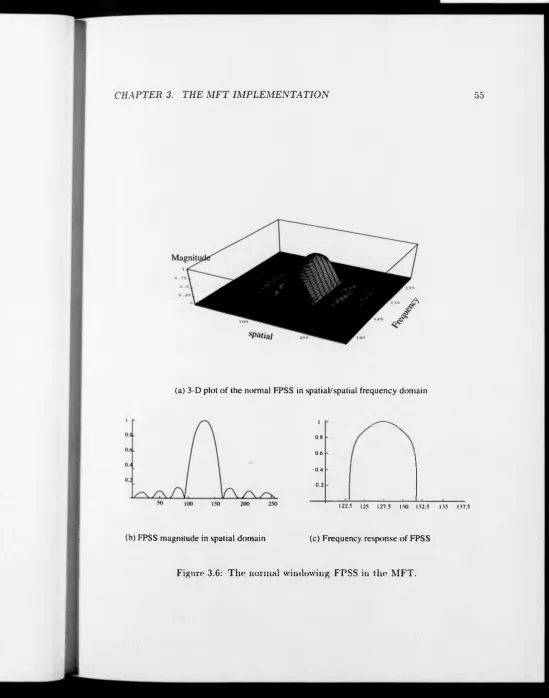
to forward transforms and inverse transforms respectively... 3.5 The analysis filters are disjoint for critical sampling scheme and over lapping 50% for the oversampling scheme... 3.6 The normal windowing FPSS in the M F T ... 3.7 The oversampled FPSS window... 3.8 The spatial implementation of the M F T ... 3.9 Exact reconstruction of the M FT using (3.17)... 3.10 The forward M FT implementation. (Note: M > N ) ...
3.12 The 2-D M FT is generated from convolution of analytic window spec
trum with frequency shifted version of input signal... 64
3.13 A synthetic texture field and its M F T ’s at different resolutions. . . . 66
3.14 The FM-Radial test pattern and its M F T ’s at different resolutions. . 68
3.15 The reptile skin and its M FT’s at different resolutions... 70
4.1 Texture warping is modelled via affine transform... 74
4.2 Outline of algorithm... 76
4.3 Representative centroid vectors; A] is coordinates between (0j, +#2), A2 is coordinates between (#1 + #2. 0\ + 7r), /T) is centroid in Ai and /¿^ is centroid in A2... 78
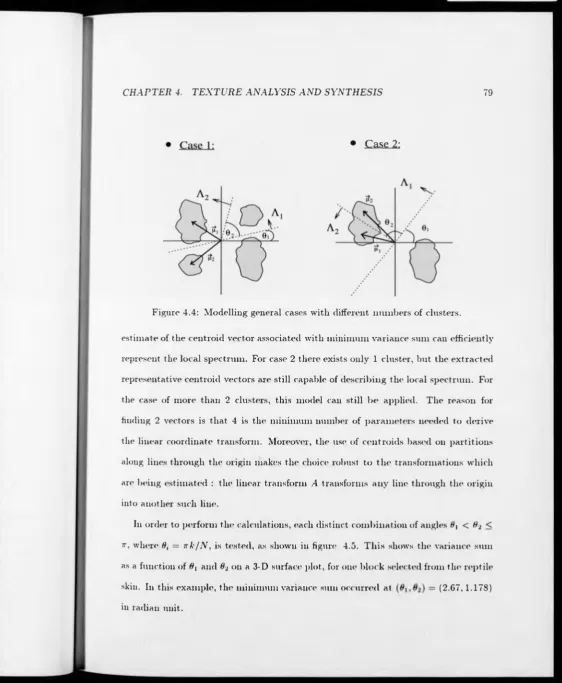
4.4 Modelling general cases with different numbers of clusters... 79
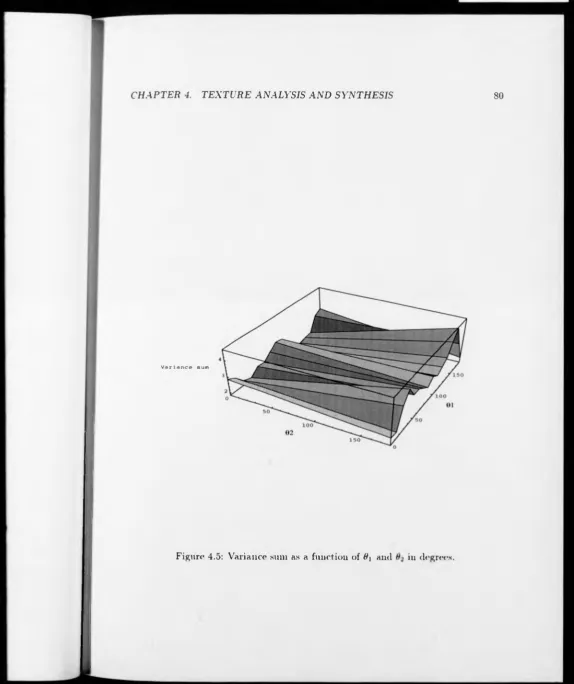
4.5 Variance sum as a function of 9\ and 82 in degrees... 80
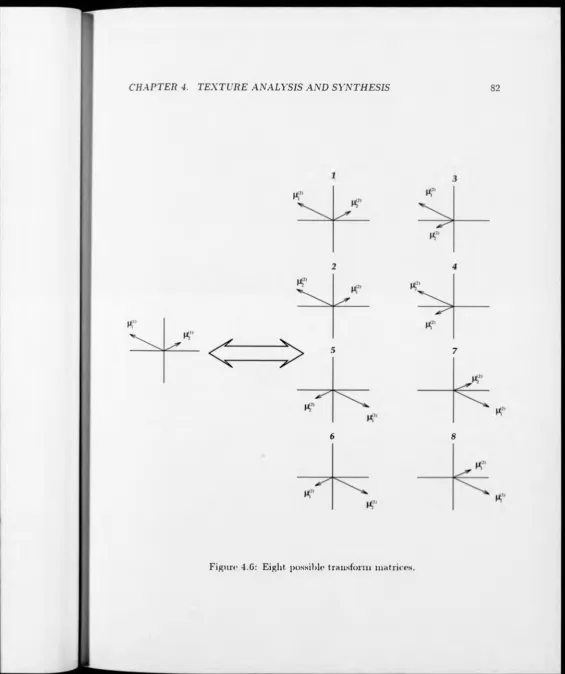
4.6 Eight possible transform matrices... 82
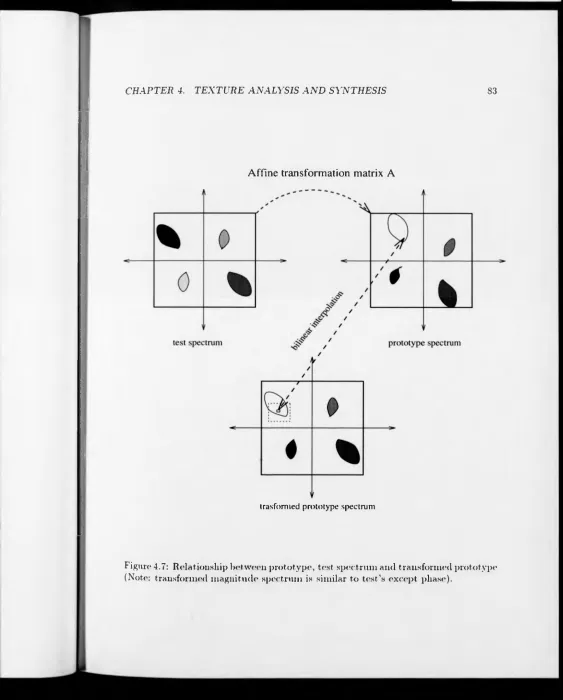
4.7 Relationship between prototype, test spectrum and transformed proto type (Note: transformed magnitude spectrum is similar to test’s except phase)... 83
4.8 Bilinear interpolation... 84
4.9 Correlation between prototype and the 8 transformed MFT blocks gives the best fit... 86
4.10 Reconstruction from the cosine square function... 89
4.11 Low pass portion removed in the beginning and combined with syn thesis result in the end, where a is the energy factor... 90
4.12 Lowpass image of the reptile skin reconstructed at M FT level 4. . . . 91
4.13 Relationship between the quality of synthesised image and the number of parameters used per pixel for synthesis... 92
4.14 FM-Radial Test Pattern and vector pair and the 8 possible spectra from the test block. The resynthesised prototype for each case is shown at the bottom right. Transform number 5 provides the best fit... 94
4.15 Natural textured image synthesised from a prototype... 97
4.16 FM-Radial test pattern and synthesis... 98
4.17 Reptile skin image synthesised at different levels... 101
4.18 Burlap image synthesised at different levels... 102
4.19 Grass image synthesised at different levels... 103
4.20 Normalised mean-square error as a function o f the number of parame ters used for synthesis... 104
O * O * O * C t O ' O i C n C i ü « C i C i O » O ’ O i ü i C n C n
horizontal direction; bottom figures show their amplitude spectra. . . 113
.2 Outline of the texture segmentation at single level...115
.3 One level of the orientation pyramid is created corresponding to the M FT block-based gradient operation... 119
.4 Boundary enhancement using 8 direct neighbour gradient vectors. . . 121
.5 Case where adjacent pixels have high region and boundary link prob abilities (cf. figure 5.15)... 123
.6 Consistency check among 4 neighbour gradient vectors against their father node... 125
.7 Synthetic structured texture pair... 128
.8 Synthetic random texture pair... 128
.9 Natural random texture pair... 129
.10 Natural structured texture pair... 129
.11 Synthesised colour reference map for orientation... 130
.12 Orientation pyramids of testing texture pairs, (a) Synthetic structured texture, (b) Synthetic random texture, (c) Natural random texture grass water, (d) Natural structured texture burlap reptile skin... 131
.13 Magnitudes o f orientation estimates correspond to those in figure 5.12. (a) Synthetic structured texture, (b) Synthetic random texture, (c) Natural random texture grass water, (d) Natural structured texture burlap reptile skin... 132
.14 Boundary estimate is enhanced via boundary link probability itera tively. (a) Boundary links at MFT block scale of size 16 x 16. (b) Boundary links after 3 iterations, (c) Boundary links at M FT block size 8 x 8 . (d) Boundary links after 3 iterations... 134
.15 Region connectivity is described via region link probability iteratively. 135 .16 The generating order of the segmentation results illustrated in the fol lowing figures (cf 5.17. 5.18 and 5.19)... 135
.17 Iteration results of orientation pyramid o f synthetic random texture. . 137
This work was supported by the Government o f the Republic of China on Taiwan and conducted within the Image and Signal Processing Research Group in the Department of Computer Science at Warwick University.
I would like to thank all the staff of the Computer Science Department. In partic ular, thanks go to all my friends and colleagues, past and present, of the Image and Signal Processing Group at Warwick: Abhir Blialerao, Simon Clippingdale, Nicola Cross, Andrew Davies, Wooi Boon Goh, Andy King, Peter Meulemans, Edward Pear son, Hugh Scott, Tim Shuttleworth, Martin Todd, and Horn-Chang Yang. They have made numerous contributions and have provided a stimulating environment in which to work. Thanks also to Jeff Smith for providing essential software support.
I would like especially to thank Dr. Andrew Calway for his enthusiasm and stim ulating discussions regarding to the work of texture synthesis.
I declare that, except where specifically acknowledged, the material contained in this thesis is m y own work and that it has neither been previously published nor submitted elsewhere for the purpose of obtaining an academic degree.
Introduction
1.1
Introductory Remarks
Texture is a ubiquitous property of visible surfaces, but there is no formal or pre
cise definition of texture. The term ‘texture’ generally refers to repetition of some
elemental unit over a region which is large compared to that of the elemental unit
[54]. This element contains several pixels, whose arrangement may follow certain
rules, which may be periodic, quasi-periodic or random. A large class of textures can
be covered by such a definition, ranging from structural texture (reptile skin) and
random texture (grass) to crop imagery, as shown in figure 1.1.
Texture is one of the important characteristics which exists for analysis in many
types of natural images, from satellite imagery in remote sensing, to microscopic
images of medical samples, to outdoor scenes and object surfaces. The problem of
texture description centres around both what precisely is meant by ‘texture’ , for there
is a large number of attributes of texture that may be defined, and how such textured
regions should be generated and analysed.
1.1.1
Visual Texture Perception
Visual textures have great variability. How human beings perceive texture and what
the crucial factors are that affect the discrimination of two texture fields are two
important issues in deciding the characteristics o f what we see. A large amount
of experimental evidence has shown that for detection of visual stimuli, the visual
system behaves as if it were composed o f a number of independent channels, each
sensitive to a limited range of spatial frequencies and orientations [62] [47]. From the
psychological and physiological view [87], an important determinant in the detection
of the stimulus by the human visual system is its spatial frequency content.
Two hypothesised mechanisms of the human visual system for texture perception
are ‘texton’ detection and texture filtering. The first class of models reported by
Julesz et al [61] [60] regard the fundamental texture elements as textons, which are
used to describe features of individual sub-patterns that render texture pairs with
identical second order statistics discrim inate. Discrimination is accomplished by the
comparison of the relative texton densities, which is claimed to be consistent with
the visual discrimination o f textures. However, the difficulty in using this approach
to the segregation o f textures is that no suitable mechanism was proposed for local
extraction of textons or the texture boundary.
Among models o f texture filtering, Caelli [15] advocated a Fourier model which is
able to simulate the human visual system on the basis of mechanisms which decom
pose an image into its frequency components, including both amplitude and phase
coding. A set of ‘ clam sin’ll' filters centering on different parts of the Fourier domain
fields. While these efforts have demonstrated that a filtering approach can explain
some phenomena that are not consistent with texton theory, a complete model has
not yet been presented. Such a model should be able to unify the solution of the con
flicting problems of determining local textural structures (texture element, texture
boundaries) and identifying the spatial extent of the textured regions contributing
significant spectral information.
1.1.2
Texture Analysis Problems
Most texture research can be characterised by the underlying assumptions made about
the texture formation process. These assumptions depend primarily on the type of
textures to be considered in the study. This leads to classification of the approaches for
texture analysis into either statistical approaches, considering the texture as defined
by a set of statistics extracted from a large ensemble of local image measurements,
or structural approaches, using the concept that a textured image is composed of
texture elements.
Statistical A p p ro a ch e s
The conventional statistical methods for texture analysis summarise the gray level dis
tribution into a finite number of statistics, among them the well-known co-occurrence
matrices [51], [110]. These methods are based on the estimation of the second-order
joint conditional probability density function, f(i,j\ d , 0). Each f(i,j\ d , 0) is the prob
ability of going from gray level i to gray level j , given the intersample spacing distance
d, and the direction given by the angle 0. The estimated values, x$(i,j\d), can be
occurrence matrices have been developed and their capability has been demonstrated
[23] [46]. In these methods, textural structures which can be described within a
neighbourhood are naturally limited to those which are observable within the size of
the neighbourhood. Thus a feature based on measurements within a neighbourhood,
fixed in size, has poor discrimination power when applied to a texture not observable
within the neighbourhood because it has the wrong scale. But in general the scale
information is not available. This is a fundamental limitation o f such methods.
Alternatively, a parametric model m ay be used for statistical modelling. The most
common stochastic models of texture are the autoregressive [58], or more generally
Markovian Random Field (M RF) m odels [25] [44]. Chellappa and Kashyap [18],
suggested the use of 2-D autoregressive, noncausal models for textures. In this model,
the gray level of a pixel is characterised as a linear combination of the gray levels at
neighbouring pixels and an additive linear combination of some noise field values. The
model parameters are estimated by approximating a maximum likelihood solution for
various possible neighbourhoods. One of these models is chosen, using a Bayesian
decision rule, to approximate the original noncausal model and then to synthesise
images. Chen [19] proposed a maximum entropy power spectrum estimation method,
which involves a parameteric way of estimating spectrum based on an autoregressive
model. These methods are widely used but are of limited applicability to images
because the causality restriction is significant: the autoregressive model is limited by
its inherent directionality, which introduces a degree of anisotropy.
An edge-based segmentation technique based on features derived from a simulta
neous autoregressive (SAR) random field was described by Khotanzad and Chen [2],
of the windows, the least squares estimates of the SAR model parameters are used as
texture features. Texture edges in each window are placed at positions where sudden
changes in the features of a neighbouring window occur. Enhancement of individual
feature edges is carried out via a block-based 3 x 3 Sobel operator to produce an
initial edge map. The enhanced texture changes are combined to construct a ‘tex
tural measure’ and thresholded to give a texture edge. This texture edge is further
thinned to give a one-pixel wide skeleton. It should be noticed that the accuracy of
the estimated edges is determined by the window, due to the use of block-based edge
detection. Although the result is thinned, significant misplacement may still occur
when an inappropriate scale of the window is used.
Stochastic image models based on the Gibbs distribution [45] are of great current
interest. In [31], Derin and Elliot use the Gibbs distribution for texture segmentation
via a dynamic programming method and maximum a posteriori (M A P ) criterion
which allows the use of standard least squares techniques iteratively. This work is
applicable only to noise-free textured images consisting of known textures and with
known Gibbs distribution parameters. This technique also requires a small enough
neighbourhood, so that equations can be determined for obtaining the least squares
solution.
Texture boundary detection incorporated by the introduction of a binary valued
line process described by Genian et al [44] is another notable use of this approach.
Two types of labels, partition and boundary labels, are used in a region partition
process and boundary detection respectively. The local blocks of the image in the
region process are augmented by line sites which are placed between each vertical and
include all possible pairs o f allowable block and line states. The distance between pairs
of neighbours is measured by the Kolmogorov-Smirnov distance and this is used to
detect discontinuities. Adopting the Gibbs representation, a form of energy function is
defined to place the boundary between regions and prohibit certain configurations that
are false edges or very small regions, resulting in a reduction of the number of model
parameters. Although the results shown are improved by introducing the line process,
the size of the line process neighbourhood is artificially set by the region assignment
process. As noticed in [1], in this modified MRF model, the model parameters cannot
be estimated by standard methods, such as maximum likelihood estimation, because
the solution of the likelihood equation compounds the problem of model parameter
identification, resulting in computational intractability.
Elfadel and Picard [36] examined a method which describes an explicit relation
ship between co-occurrence matrices and Gibbs random fields. An intermediate rep
resentation including an ‘ aura set’ and ‘aura measure’ is developed to establish the
connection with morphological dilation combined with co-occurrences. Based on the
concepts of the Gibbs energy and MAP estimation, the results of their method show
that their work is still in its initial stages.
More recently, the Gaussian Markov Random Field (G M R F ) [22], [21] and [17]
was applied in unsupervised texture segmentation. An image of interest is divided
into disjoint regions; over these regions the GMRF parameters are estimated. The
regions are merged via clustering based on the normalised Euclidean distance between
their parameter vectors. Following recomputing of the parameters over the merged
regions, a refined segmentation is carried out via pixel-based segmentation. The
One difficulty for these methods is that the texture elements in the stochastic
process are not highly structured and large data sets may be required to get good pa
rameter estimates [83] [38]. In general, statistical methods are well suited to textures
which are random in nature, such as sand, grass and perhaps water, whilst textures
such as tilings of the plane, brick wall and reptile skin are not appropriate for this
type of model.
S tru ctu ral A p p r o a c h e s
Unlike the stochastic models, structural approaches have not received much attention
recently [51] [53]. They include the development of a compact structural description of
texture by the minimum number of parameters needed to identify the placement rule
of the texture elements [82], In general, these methods first locate texture elements,
then analyse spatial arrangements. In natural images, texture fields may be degraded
during imaging and obscured by noise and blur. Even with complete knowledge of
texture types, it is more difficult to isolate the texture elements than it is to generate
them.
Matsuyama et al [71] resolved this difficulty by first estimating a pair o f spatial vec
tors from the Fourier energy spectrum representing the placement rule of the texture
elements. Then, following inverse Fourier transformation of the estimated vectors,
texture elements are extracted by a region growing method. The basic disadvantage
o f this method is its preliminary assumption of the completely periodic structure of
the texture field. The synthesis procedure is performed by placing ‘averaged' texture
elements according to the estimated placement rule, resulting in artificial looking
Similarly, the method described in Volet and Kunt [97] extracts the placement
rule first, based on a pair of linearly independent vectors derived from the local
autocorrelation function of the image. W ith the extracted placement rule, the texture
is transformed to a ‘normalised’ co-ordinate space via an affine transform and the
texture element is then extracted. A global average texture element is obtained by
averaging the normalised local texture elements and used with geometric warping in
order to reconstruct the image. McColl has applied this idea in texture coding [72].
Vilnrotter et al [96] examine the statistics of edge features to control texture ele
ment identification and isolation. From the isolated texture elements, a set of place
ment rules are computed. The reconstruction is performed by combining these into a
complete description. As in earlier structural methods, the results are acceptable only
in the case o f periodic textures. These structural methods have generally assumed
that the textures exhibit some degree of regularity, which is violated in many textures
[53].
S u m m a ry
Both of these types of methods depend highly on the texture type, which restricts
their applicability. Thus, while statistical techniques are generally good for random
textures and have poor performance on structural textures, the revers«* is the case for
the structural techniques. Ideally, a method which is capable of dealing with the full
spectrum of texture types is required.
Having defined textured images as composed of texture elements and rules which
describe the spatial arrangement of the texture elements, there are two basic questions
Texture element estimation is concerned with local property measurement. How
ever, textures occurring in natural images generally show randomness or variability
and exhibit fluctuations, ranging from the degradations occurring in the image for
mation process, surface irregularity and geometric warping caused by the 3-D to 2-D
projection. Inevitably, these intrinsic properties affect the local texture measures
used in analysis. Solutions often involve operations with local windows, which re
quires choosing the windowing function and window size. Choosing the right scale is
a fundamental problem because texture is an area property [52]. There is seldom a
systematic basis for choosing the window size. If the window is too big, for example,
it may be difficult to identify region boundaries or adapt to variations within regions,
while if it is too small it may give unsufficient discrimination o f the textures.
Apart from the above problem, the windowing function prevents an image being
considered at arbitrarily high resolution in both spatial and spatial frequency do
mains. This problem is a consequence of the uncertainty principle of signal analysis,
which states that the size of the regions of support of a windowing function in space
and frequency are inversely related - the smaller the window in frequency, the larger
will it be in space and vice versa [75] [108]. Uncertainty is a problem for any window
size used in spatial/spatial frequency representation. Daugman [28] shows that the
2-D Gabor function [40] can achieve simultaneous localisation in space and in spatial
frequency to resolve the uncertainty problem. A number of researchers have used Ga
bor functions as filters to establish a scheme of multichannel filtering, which involves
the decomposition o f images into multiple feature images of narrow spatial frequency
and orientation bandwidth [9] [59] [92] and [34]. Some issues exist in these approaches
over, to tune each channel to a specific narrow band of spatial frequencies generally
requires prior knowledge, which is unlikely to be available in the unsupervised mode
of analysis.
In analysing the spatial arrangement of elements, it would be useful to find a
method which is intermediate between the random placement o f stochastic methods
and the rigid rules of the simple structural approaches. This requires a method which
has sufficient flexibility to allow for the sort of variation exhibited in the textures
shown in figure 1.1 and in which the scale of the description can be matched to that
of the texture elements.
Finally, segmentation of textured images requires location o f the boundaries be
tween the textured regions. The task of boundary detection between textured regions
- texture segmentation - shares a common problem in vision, which Marr defines as
‘knowing what is where by looking’ [70]. ‘W hat’ is the element of texture, which
establishes the class property of the perceived image, while ‘where’ is the position
of the perceived texture in the spatial domain [108]. The main question in texture
segmentation regarding the texture properties and positions is raised by the fact that
identification of the texture type requires global information to yield a reliable de
scription, which reduces the precision of the local boundary detection. Similarly, the
texture boundary can be detected more accurately only at the cost of a loss of relia
bility of the classification. It implies that there is an incompatibility between texture
1.1.3
Aim s o f This Work
Central to the requirement o f a model which can both locally detect texture elements
and globally describe the density of the texture elements simultaneously, is the avail
ability of a framework allowing the image to be considered at different scales and the
information at these different scales to be combined or compared. A solution to this
is to use a multiresolution approach (e.g. [85] [14] [109] [67] and [73]). A number of
workers have employed such techniques in texture analysis [78] [91]. More recently, a
classification scheme for texture analysis in the context of multiresolution imagery was
described by Roan et al [84], In this work, the statistical features were derived from
the Fourier energy spectrum and co-occurrence matrices to study the relationship
between feature properties and image resolution, which provides a useful approach in
textured surface description. Unser and Eden [95] used the output of a filter bank
to estimate local statistics of texture iteratively, giving a multiresolution sequence of
feature planes. A feature reduction technique was proposed, allowing variety textures
to be analysed in a single reduced component, but the problem of unsupervised deter
mination of optimal window size remains unsolved. In [8], Bouman and Liu applied
a causal Gaussian autoregressive m odel to describe the statistics of the textures. A
coarse to fine segmentation was used in a multiresolution framework, requiring signif
icantly less computation than earlier work using single resolution methods. Mao and
Jain [69] suggested a multiresolution simultaneous autoregressive model (M R-SAR)
for texture classification and segmentation. The method shows MR-SAR can achieve
a substantial improvement over the single resolution SAR model. The multiresolution
researchers and will be discussed more in Chapter 2.
To summarise, the objectives of this work are:
1. To investigate the characteristics of texture features.
2. To devise a technique which allows for the modelling of global image structure
in the same framework as that used for the local texture estimate, making com
putation efficient, as well as providing a consistent interface between local and
global structure. This will allow analysis and synthesis of textures with varying
amounts of structure.
3. To create a boundary detection algorithm, which combines information of both
boundary position and texture properties at different scales and accommodates
neighbourhood information to achieve segmentation of textured images.
1.2
Thesis Outline
A multiresolution approach to the analysis of texture is presented in this thesis. The
multiresolution Fourier transform (M F T ) is used as a framework to derive a robust
algorithm which estimates textural features and detects texture boundaries over a
range of spatial scales, based on local frequency domain properties.
In particular, in Chapter 2, the requirements of an image texture description will
be discussed. The emphasis is piaceri on locality in representing the texture features.
A number of existing models which might provide such description are reviewed. How
ever, evidence will be given that these fail to provide sufficient locality in describing
texture features. This leads to the modelling of the texture using the multiresolution
Chapter 3 is devoted to considering the definition and implementation of the M FT.
The MFT characteristics and properties will be discussed. T w o different interpreta
tions of the MFT suggest two corresponding implementations. The implementations
can be accomplished efficiently using the FFT algorithm. Initial experiments and
examples are presented for both synthetic and natural images.
Chapter 4 introduces a new texture ‘synthesis and analysis’ algorithm based on
the MFT framework. This algorithm models textures by the use of affine co-ordinate
transformation of a single, representative texture element. It extends the earlier work
reported by Spann and Wilson [104] to model the structure in textures in a way
which allows for variation o f the texture structure. Results are presented o f texture
synthesis based on this approach.
In Chapter 5, a texture segmentation algorithm is described, which is designed
using a cooperative algorithm within the M FT framework. The detection of tex
ture boundaries uses a combination of boundary information and region properties.
Results are presented that illustrate the effectiveness o f the scheme.
The thesis is concluded in Chapter 6 with a synopsis and a discussion of some
Representations for Texture
Analysis
2.1
Introduction
Texture can be used in image analysis in several ways, such as classification and dis
crimination of surface patterns, computation of the geometric structure of perceptual
objects and segmentation of the scene into different homogeneous regions [108]. It
was shown in Chapter 1 that the analysis o f textures is one of the oldest problems
in image processing, but continues to generate interest and a degree of controversy
because of the limited success with which most of the methods of analysis have met
[51] [46] [83],
The purpose of this chapter is to present and evaluate the characteristics of differ
ent texture analysis approaches which have been proposed, particularly the Fourier
related approaches. To overcome limitations in those approaches, a general signal
representation for texture analysis is set forth.
2.2
Requirements of a Texture Analysis Method:
The problem of obtaining useful texture measures is difficult because of the multi
plicity of texture properties and their variation with parameters such as illumination,
shading and surface reflectance. There is the question o f finding an adequate descrip
tion of texture - of selecting features which are sufficient to allow discrimination of
the types of texture encounted in a given application. Furthermore, the perspective
projection of 3-D textured surfaces into 2-D images causes distortions in the area,
orientation, shape and coarseness of the texture elements, and many natural textured
images exhibit a combination of regularity, such as approximate periodicity, and vari
ation which is hard to model using either straightforward repetition or traditional
statistical techniques [51, 25, 112].
In order to find an adequate description of texture, it is possible to formulate
the requirements of a representation for texture analysis as linearity, invertibility,
symmetry and locality:
2.2.1
Linearity
Linearity can provide the conditions to ensure the predictable response of the pos
sible addition and filtering operations on the signal. If the descriptor is linear, the
computation can be simplified and filtering operations can be more easily applied.
2.2.2
Invertibility
Image processing consists of a number of operations performed on the image. These
operations transform the original image to another feature space and in this trans
ations usually cause a loss of information in passing from the original image to its
feature-space representation. Very often, the dimensionality of the feature-space is
lower than that o f the image space, and only an approximation o f the original image
based on this partial information is reconstructed. An invertible operation preserves
information, and in principle allows the original image to be recovered, while also
providing an error measurement between the approximation and the original image.
2.2.3
Sym m etry
The processes which produce the 2-D texture can in many cases be approximated
by affine transforms. These processes include the biological or mechanical process
by which the structure originated and the perspective transformation resulting from
the projection onto 2-D. The 2-D affine transform is a linear co-ordinate transform
followed by a shift and is given by
T (? ) = A £ + 7 (2.1)
where A is a matrix dealing with the rotation, scaling and shear, 7 is the translation
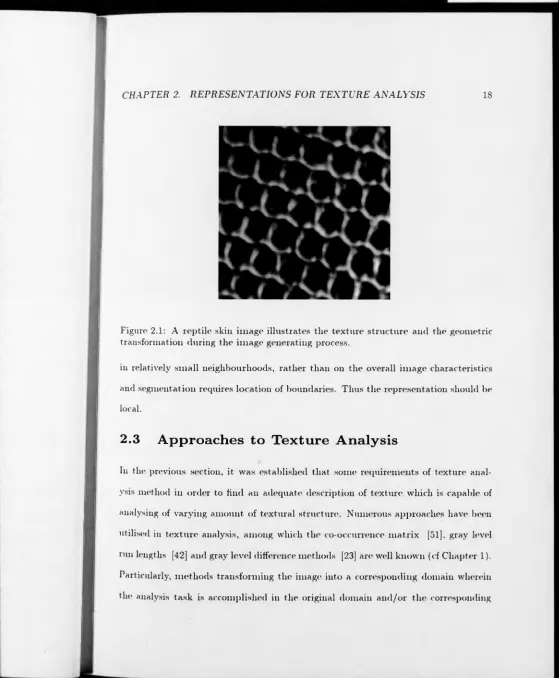
and £ is the co-ordinate. For example, in the reptile skin of figure 2.1 [11], the image
can be interpreted as a texture element associated with a geometric placement rule
which is approximately a 2-D affine transform. This geometric structure must be
embedded in the descriptor, which is the essence of symmetry.
2.2.4
Locality
Figure 2.1: A reptile skin image illustrates the texture structure and the geometric transformation during the image generating process.
in relatively small neighbourhoods, rather than on the overall image characteristics
and segmentation requires location of boundaries. Thus the representation should be
local.
2.3
Approaches to Texture Analysis
[image:31.626.25.584.14.692.2]domain have received considerable attention in the literature [46] [83]. The purpose
of this section is to discuss and evaluate their characteristics.
2.4
Fourier Based Texture Analysis
Many of the traditional texture features have explicit interpretations in the frequency
domain such as ‘fineness’ corresponding to high frequency components, and ‘regular
ity’ corresponding to peaks in the spectrum. Physiological and psychological evidence
suggest that the human visual system is capable of performing a form o f spatial fre
quency analysis [29].
The chief properties of texture are periodicity and directionality, so that a suitable
texture analysis description has to be able to characterise these two features [15].
In Fourier analysis, a 2-D signal g ( x , y ) is decomposed into a linear combination of
complex exponential functions of the form eJ(-r"*+v--'i/) an(j w ith coefficients given by
% , « , ) =
J g(x,y)e-^-+^ )dxdy
(2
.2
)The complex exponential has interesting properties. Consider the case
that for a given frequency co-ordinate (u>T,wy) and for some n
XijJjr + yu>„ = 2 7Til (2.3)
then
e+j(xM,+u^v ) _ e+j2irn _ j (2.4)
In other words, the basis function with frequencies (uix,uju) is a wave in a specific
orientation, with a real part as in figure 2.2. From (2.3) we know that
<jjz 2mi
y
= ---x +
That is, the slope of each line is — jj^, and the normal to all o f them is a line oriented
at an angle 0 = a rcta n (^ ). The spatial period (i.e. the distance between zero phase
lines) is given by
Thus the Fourier transform is a natural choice for texture analysis, which underlies
many of the methods described in the literature [4] [5] [37]. The Fourier transform
defined in (2.2) leads to a rich mathematical structure associated with the transform
operation. These mathematical properties such as linearity, invertibility and symme
try have ensured that the Fourier transform provides a general texture representation.
In the aspect of locality, however, the Fourier transform has to be enhanced in order
to become a general texture analysis tool. This will be addressed in the following
sections.
In addition to the secure mathematical structure, the Fourier transform is conve
nient for handling noise. If there is noise within the textural image, the noise process
will alter the image representation dramatically in the spatial domain, but uniformly
in the frequency domain. Hence, frequency domain measures should be less sensi
tive to the noise than those in the spatial domain. Fourier based analysis is of most
relevance to this work. Traditional Fourier based texture analysis uses the energy
spectrum, which is the Fourier transform of the image autocorrelation function [75].
2.4.1
Autocorrelation Methods
Texture is an extended, spatially nonlocal or region property. Since texture is defined
in relation to a neighbourhood, it is meaningless at an isolated pixel. The relationship
suggests the autocorrelation function r(ra,n ) as a texture descriptor defined as
^ N - 1 N - l
rg(m, n ) = — J2 $(*> 0 » (" * + « + 0 (2.7) ■‘V *r=0 /=0
where m and n are known as the ‘lag’ . For the sake of efficient computation, the
autocorrelation may be calculated using Fourier transforms [75]. There are two types
of information contained in rg( m, n) . If the peak of the autocorrelation function
falls off quickly as the lag departs from zero, this corresponds to a finer texture. A
high-energy peak associated with rg( m, n ) for nonzero lag also reveals a regularity in
the spacing of texture elements in patterns such as wall paper. In terms of these two
useful texture measurements, the autocorrelation is able to measure the directionality
and coarseness of the texture.
The autocorrelation methods are based on spatial averages o f second-order inter
actions. Methods which involve higher order statistics [41] require more memory
space and are computationally expensive. The autocorrelation function, however, is
not sufficient to describe a texture completely, since many natural textures have sim
ilar autocorrelation functions. Furthermore, its estimation often requires a large data
window. In such cases, the description loses the locality of the texture identification
and the computational cost increases dramatically.
2.4.2
Energy Spectrum M ethods
Bajcsy [4] first used the Fourier energy spectrum to compute the sample energy
spectrum with radial and wedge segments in analyzing texture. She also reported
that phase information does not appear to yield useful texture measures. Rosenfeld
S
p
a
ti
a
l
frequency
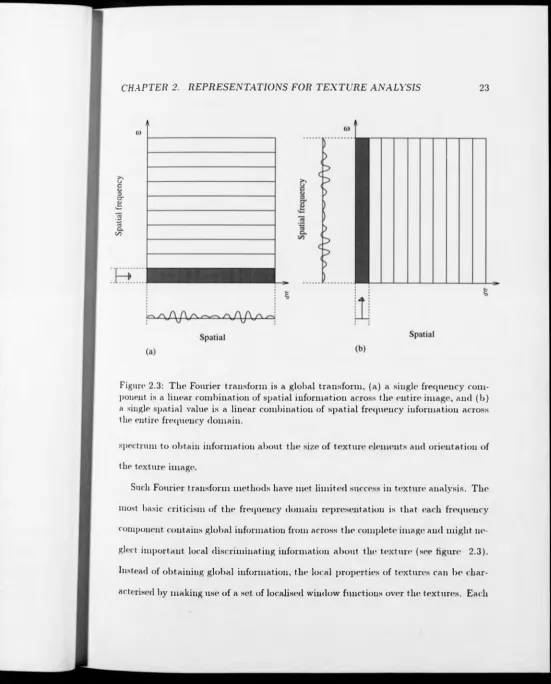
Figure 2.3: The Fourier transform is a global transform, (a) a single frequency com ponent is a linear combination of spatial information across the entire image, and (b) a single spatial value is a linear combination of spatial frequency information across the entire frequency domain.
spectrum to obtain information about the size of texture elements and orientation of
the texture image.
Such Fourier transform methods have met limited success in texture analysis. The
most basic criticism of the frequency domain representation is that each frequency
component contains global information from across the complete image and might ne
glect important local discriminating information about the texture (see figure 2.3).
Instead of obtaining global information, the local properties of textures can be char
[image:36.623.26.577.21.705.2]localised window function highlights a particular property of the texture element or
the response of the human visual system.
There are some difficulties associated with these measures:
1. The ring and wedge shaped functions used to com pute the texture features were
essentially a windowed Fourier transform (cf. section 2.5.1). Spatial locality is
introduced by windowing the data prior to the integration of the energy of the
transformed windowed data. However, this involves a loss in spatial frequency
resolution, as the spectrum of the image is now convolved with that of the spatial
window.
2. One consequence o f windowing is that it destroys symmetry under co-ordinate
transformations since windowing and co-ordinate transformations do not com
mute. That is, some features of an image within a window might disappear after
co-ordinate transformation of that image. This raises the uncertainty problem
of signal analysis. Uncertainty will be a problem for any window size used in
spatial/spatial frequency representation (cf. section 2.5.1).
3. Coarseness in textural features is always scale dependent. This scale characteris
tic should be resolved in the feature descriptor to allow the image to be analysed
at different scales. The selection of the appropriate processing scale is essen
tially context-dependent. Some of the texture element extraction has assumed
that the processing scale is known a priori.
4. Feature information in both the spatial domain and frequency domain is required
2.5
Spatial and Spatial Frequency Methods
Combined spatial and spatial frequency representations are useful in classifying non-
stationary signals like textured images. Features which have identical or similar spa
tial or spectral characteristics may have very different characteristics in the comple
mentary domain, which allow them to be distinguished. In addition, physiological and
psychological experiments have shown that the human visual system processes visual
information at different frequencies separately and is highly orientationally selective
[37] [15]. For the purpose o f texture segmentation, perceptual grouping is dependent
on both the spatial and spectral structure. All these factors point to the need for high
resolution and a conjoint representation of the spatial and spatial frequency domains.
This conjoint representation is known as a phase-space representation [27].
Recently, then* has been much work based on phase-space analysis in which meth
ods have become ever more sophisticated. Representations that provide information
about a texture locally over various scales have received considerable attention in
the literature. The best known of these approaches fall broadly into four classes:
windowed Fourier transform, scale-space transform, pyramid transform, and wavelet
transform.
2.5.1
Windowed Fourier Transform
The windowed Fourier transform (W F T ) is the best known of the methods which
provide intermediate representations o f the signal both in spatial and frequency do
mains. The windowed Fourier transform or short-time Fourier transform (STFT) has
windowed Fourier transform of a discrete-time signal x(£) is given by
OO
£ ( £ > /) = — m ) x ( m ) e ~ j ™fm 0 < / < M (2.8) m = — oo
where w(() is a window function and ‘ ’ is used to denote the Fourier transform.
The WFT can resolve nonstationary signals which have distinct frequency content at
different instants into ‘quasi-stationary’ signals by windowing the input. The scale
of the window will decide the corresponding frequency resolution. To increase the
frequency resolution, one has to increase the size of the spatial window, which causes
nonstationarities which might occur within this duration to be blurred: the spatial
resolution decreases.
Ring and wedge shaped analysis windows discussed in section 2.4.2 are inherently
a windowed Fourier transform, but suffer from infinite spread in the spatial domain
because of the discontinuous windows used. One of the best known W FT methods
in image analysis is the Gabor transform [40]. The standard Gabor representation
is given by
x(£,u;) = f u>(£ — m)x(m)e~**m dm (2.9)
J — OO
where w({) is a windowing function, which in the original Gabor scheme is a Gaussian
function.
Denoting the windowing function, shifted in space and spatial frequency, as
= (
2
.10
)gives its Fourier transform as
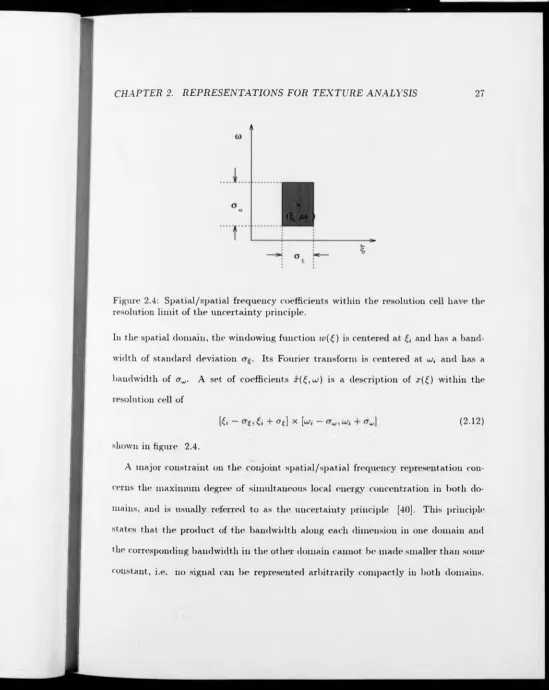
Figure 2.4: Spatial/spatial frequency coefficients within the resolution cell have the resolution limit of the uncertainty principle.
In the spatial domain, the windowing function w(£) is centered at and has a band
width of standard deviation Its Fourier transform is centered at u>, and has a
bandwidth of <rw. A set of coefficients .r(£, to) is a description of ,r(£) within the
resolution cell of
[Î. - + 0{] x [u>, - (2.12)
shown in figure 2.4.
A major constraint on the conjoint spatial/spatial frequency representation con
cerns the maximum degree o f simultaneous local energy concentration in both do
mains, and is usually referred to as the uncertainty principle [40]. This principle
states that the product of the bandwidth along each dimension in one domain and
the corresponding bandwidth in the other domain cannot be made smaller than some
[image:40.624.32.581.14.704.2]Hence, the resolution cell has to obey the inequality [40] [27]
^ (2.13)
Given this constraint, Gabor claimed that the Gaussian windowing function is a
suitable filter to provide maximum simultaneous locality in both spatial and spatial
frequency domains.
One approach, proposed by Spann and Wilson [104], uses the joint spatial and
spatial frequency space in texture analysis. A number of interesting and important
features reported in this work has motivated other image analysis work [102]. Jain
and Farokhnia [59] used even-symmetric Gabor filters to measure the local energy.
Du Buf [32] applied a least-squares approximation to measure the local Gabor energy
spectrum in terms of visually relevant texture attributes such as directionality and
coarseness. Bovik et al [9] used 2-D Gabor functions as localised filters to encode
images into multiple narrow spatial frequency and orientation channels. By analyzing
the responses of the filters, it was possible to segregate textural regions of different
spatial frequency, orientation or phase characteristics.
The Gabor representation provides a local description in the conjoint spatial/spatial
frequency domain, and preserves the symmetry property o f translation in the spa
tial/spatial frequency domain. However, the spatial/spatial frequency resolution cell
is of fixed size, as is shown by applying the Fourier transform to equation (2.9) with
different frequencies; different cells have the same bandwidth but different spatial
frequency position. The limitation of a fixed resolution cell of the Gabor represen
tation leads to the rectangular quantisation of the conjoint spatial/spatial frequency
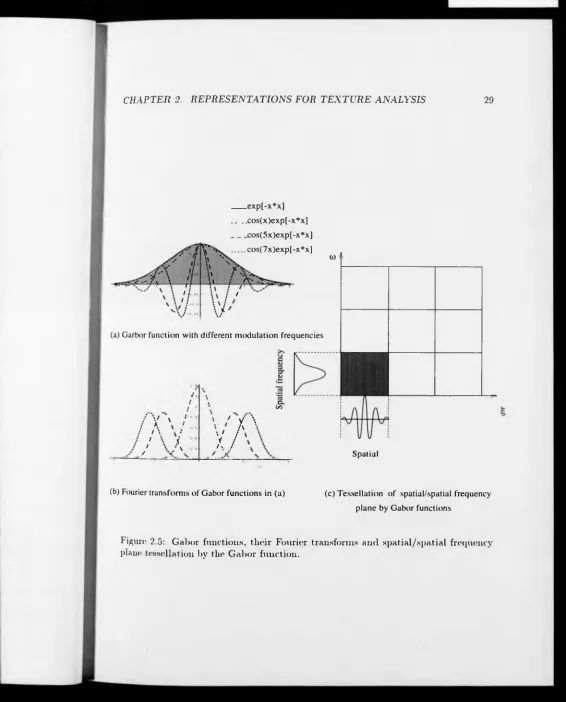
____ exp[-x*x ]
. . . .cos(x)ex p[-x*x ]
____ cos(5 x )exp [-x*x ]
cos(7 x )exp [-x*x ] (0
(a) Garbor function with different modulation frequencies
/ \/ / A, / / \
/ / /
\ ;
O’
J
o. CO * y \
V A
/ !
Spatial
(b) Fourier transforms o f Gabor functions in (a) (c ) Tessellation o f spatial/spatial frequency
plane by Gabor functions
[image:42.626.25.591.8.710.2]of three different frequencies and (b) shows the corresponding Fourier transforms.
That the Fourier transforms have the same shape but different positions indicates
that the Gabor function has a fixed bandwidth, (c) depicts the spatial/spatial fre
quency plane tessellation in terms o f these elementary Gabor functions; note again
that the resolution cell is of fixed size and shape.
The local structure of a texture is hard to characterise by a single scale. An im
portant requirement of such representations is that over the range of possible features
the locality in each domain should not be fixed. The texture features should have
various degrees of locality and extend over different sized areas of the other domain.
In order to combine locality at various scales, a multiresolution framework has to
be used in the analysis. Multiresolution approaches can be divided into scale-space
methods and hierarchical frameworks.
2.5.2
Scale-space Representation
In a scale-space representation, a signal is convolved with Gaussian functions of in
creasing width. For the signal f ( x ) , with scale <7, spatial co-ordinate £, the scale-space
representation is defined as
(2.14)
where
<7 (2.15)
is the filter kernel. Marr [70] used image features at different resolutions to represent
an image. By matching zero-crossing locations of second derivatives through these
on these estimates, the image can be segmented into primitive regions upon which
object recognition may be performed. Within applied similar ideas to propose a scale-
space filtering function [109]. This method is based on smoothing the signal with
a filter of continuously increasing scale. The resulting blurred signal is processed
by a second derivative operator. This is equivalent to convolution with the second
derivative of the Gaussian function, given as
where a is the standard deviation o f the Gaussian function. Koenderink has developed
the scale-space representation further into a general approach to vision [64]. Its main
weaknesses for texture are that it is computationally expensive and does not provide
a natural set of features for analysis.
2.5.3
Pyramid Representation
Normally, a given image and particularly a textured image will have different structure
at different resolutions. A pyramid representation of an image uses a hierarchy o f
regularly spaced resolution levels [79]. Images of different resolution are formed by
lowpass filtering, then subsampling to the new Nyquist frequency. At the top level
of the pyramid is the most lowpass version of the image, which may be as small as
l x l . At the bottom level of the pyramid is the image of the highest resolution - the
original image. A basic pyramid representation can be used in image decomposition
and is defined as a function of a logarithmic scale [85], as follows
M M
* ( 6 , 6 , 0 = £ £
wU, k)x (2^- j , 2i 2 - k , l - l )
j=-M k=-Mwhere / denotes the scale and w(£i,£2) is a lowpass kernel defining the transformation
function between the different scales. The pyramid representation has been applied
to different fields of image analysis and particularly coding because most of the image
energy is contained in the high levels of the pyramid, which have fewer pixels. Burt
[12] has defined a multiresolution representation consisting of regularly spaced resolu
tion levels. He has applied the transform to many aspects of machine vision including
texture analysis. Larking and Burt [65] computed local energy spectral estimates
upon each of the bandpassed image of the multiresolution bandpass transform, and
pixels are classified by energy to perform texture segmentation. Burt [13] suggests
the use of edge density instead o f spectral density as a texture measure.
Multiresolution pyramid processing is computationally effective, especially for low
level image analysis. The computational advantage of performing processing on sev
eral resolution levels has been studied in detail by Rabiner et al [24]. The main
difference from the windowed Fourier transforms is that in a pyramid, the frequency
domain is split into regions having constant relative bandwidth. That is, the ratio of
bandwidth to centre frequency is fixed, whereas in the windowed Fourier transform
the tessellation is in terms of absolute bandwidth. Figure 2.6 show's a pyramid repre
sentation where each square in the frequency plane is the region corresponding to one
basis vector. The pyramid representation is invertible and deals properly with scale.
In order to process structural differences over scale, the pyramid representation [14]
utilised the multiresolution framework to extract the difference information between
the approximation of an image at two different resolutions [85]. The extraction of
the difference is a bandpass filtering function, and Burt and Adelson called this a
resem-□
Pyramid frequency plane Spatial tessellation window
bles the action o f Laplacian-of-Gaussian bandpass filters [14]. The Laplacian of the
lowpass Gaussian filter is an isotropic function. In such cases, the transform not only
removes the possibility of introducing bias but also reduces the artefacts caused by
the rectangular nature of the sampling grid. On the other hand, because it is an
isotropic function, the Laplacian-of-Gaussian bandpass filter has restricted utility in
estimating orientational features. Moreover, the Laplacian pyramid representation
is overcomplete, because the whole representation contains 4/3 times the number of
samples in the original image, all of which are needed for the perfect reconstruction.
2.5.4
Wavelet Transform
The wavelet transform is a signal representation which decomposes the signal by
expanding the signal into a family of functions having the same bandwidth on a
logarithmic scale, obtained by the dilation and translation of a unique function the so
called motherlet. In the 1 — D case, the wavelet transform o f a signal f ( x ) is defined as
= ~7= f f ( x ) w ( - — - ) d x (2.18)
\J (7 J (7
where u>(£) is the wavelet function, which satisfies some admissibility conditions [49].
The 2-D discrete wavelet transform originates from the Laplacian pyramid. The
simplest discrete wavelet transform coefficients are derived by successive decimation
and translation operators, using one lowpass filter li and one highpass filter </ to
retain the same sample count as that of the original image. Since the decimation will
introduce aliasing terms, the general trend so far has been to seek an orthogonal set
is a pair of quadrature mirror filters defined in terms of the Z-transform as [100]
G(z) = - z - ' H i - z - 1) (2.19)
where G (z) and H(z) are the Z-transforms of the lowpass and highpass filter respec
tively. In this manner, the aliasing terms caused by the subsampling will be cancelled
so that exact reconstruction can be achieved and the redundancy of the representation
minimised.
The wavelet frame can be well localised in both time and frequency domains. In
phase-space, their time/frequency spread is low and they have good conjoint resolu
tion. Therefore, by representing a signal with such bases, each coefficient corresponds
to the magnitude of the motherlet at that location (in time or frequency). The discrete
wavelet transform is fast to compute, using a tree-based algorithm.
The basic concept of using two filters in the wavelet transform is that the high-pass
filter is used to extract ‘ details’ at a given scale, while the low-pass filter is used to
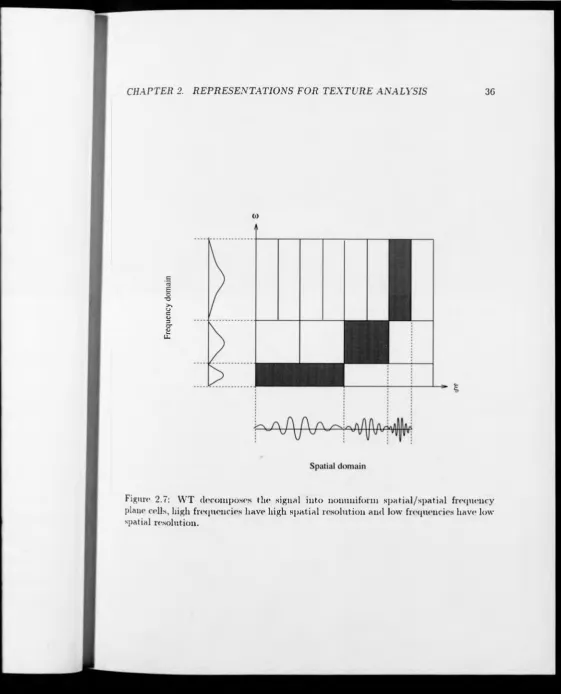
smooth the signal to allow the next scale to be explored. As an illustration, figure
2.7 demonstrates the tessellation of the conjoint spatial/spatial frequency domain by
the wavelet transform. The spatial co-ordinate £ and spatial frequency co-ordinate u>
m the wavelet transform are related in such a way that cells at high frequencies have
low frequency resolution and vice versa. Further reading ran be found in Daubechies
[26] and Mallat [67].
The conventional wavelet transform appears not to possess a rich enough basis to
give a general way of modelling and analysing images. This is because each scale
m a 2-D wavelet transform contains only 4 frequency bands [100]. An alternative
F
req
uen
cy d
o
m
a
in
[image:49.621.19.581.15.710.2]