!
""""""""""!
!
Exploring the relationship
between enablers and motivators
for successful online knowledge
sharing
!"#$"%&
Credits
""""""!
THIS THESIS IS WRITTEN BY
Tanya Gelici
""""""!
WITH THE SUPPORT OF
Bas Kollöffel, and
Jeroen Meijerink
""""""!
IN ASSIGNMENT OF
University of Twente
Behaviourial, Management and Social Sciences
Educational Science and Development
Human Resource Development
""""""!
AND PUBLISHED ON
02 May 2018
""""""!
CONTACT
[email protected]
[email protected]
Abstract
Due to today’s competitive market, organizations are ought to continuously develop their business. Organizations depend on employees’ productivity and knowledge for continuous innovation practices. Thus, knowledge sharing among employees has been recognized as a valuable tool for organizational growth. Technological
advances have enabled organizations to change traditional communication activities to continuous, dynamic online knowledge sharing activities. Merely providing online knowledge sharing tools does not imply for actual online knowledge sharing among employees. Therefore, academic research has identified various success factors of online knowledge sharing. However, despite the growth in its importance and popularity among modern day organizations, previous research has shown that online knowledge sharing activities remain low. For a deeper understanding of the success factors, this research has not only identified the success factors (i.e., enablers and motivators) of online knowledge sharing, but also examined their inter-relation. Since online knowledge sharing is a social practice, a qualitative research has been performed. Managers, consultants and experts working in the field of online knowledge sharing have been interviewed and results have shown the importance of the facilitating conditions (i.e., job design and technology use), online knowledge sharing intentions and intention motivators (i.e., contextual factors, individual motivation, explicit motivation and characteristics of online communities). Also, for a better understanding of the relationships among the factors, a research model is developed to explain the inter-connectedness of the facilitating conditions, online knowledge sharing intentions and motivators.
""""""!
Foreword
This research serves as the graduation project for the master Educational Science and Technology, with a specialization in Human Resource Development at the University of Twente.
This journey, up until my graduation, has been an opportunity for self-development. Content-wise, I have learned about the field of online knowledge sharing. Coming from a background in education, learning about online knowledge sharing was a new and exciting experience. Socially, I have met many professionals and learned to think critically and always think a step ahead. This journey gave me the opportunity to recognize my abilities, knowledge and the many possibilities ahead of me. With much pleasure, I have worked on this study the past two years. Although a lot has happened the past year and a half, I look back upon my thesis as a time and place of rest. Furthermore, writing my thesis has brought me great joy and (almost afraid to say) I am sorry it has come to an end.
Throughout this journey I have had great support. First of all, from God. Through faith I have had the strength to always continue this journey with persistence and dedication. Secondly, my fiancé. He has pushed me through the past years, has helped me when I could no longer. He has been my number one supporter, teacher and friend when I needed it the most. Thank you, I greatly appreciate it. Of course, my family. My mother and father for reminding me to eat whilst writing my thesis (since writing my thesis was sort of a therapy for me, I often forgot to eat). My siblings and friends for distracting me with all sorts of amusing nonsense.
Of course, I could not conduct this study without the help of my supervisors. Bas, thank you for your feedback and for being there when I needed advice and direction. Thank you for your time and effort. Jeroen, even though we haven’t had many feedback sessions, thank you for your constructive feedback and reminding me to think more critically.
Contents
""""""""""""
1 INTRODUCTION 7
1.1 Importance of the research 8
1.2 Previous research 9
1.3 Research question 10
1.4 Research outline 11
""""""""""""
2 THEORETICAL FRAMEWORK 13
2.1 Defining knowledge 14
2.2 Defining knowledge sharing 16
2.3 Facilitating online knowledge sharing 18
2.4 Characteristics of knowledge sharing in online communities
20
2.5 Enablers of online knowledge sharing 21
2.6 Motivators of online knowledge sharing 26
2.7 An integration of theories 28
""""""""""""
3 RESEARCH DESIGN 33
3.1 Respondents 34
3.2 Instrumentation 35
3.3 Data analysis 37
""""""""""""
4 RESULTS 38
4.1 Definition of online knowledge sharing 39
4.2 Enablers 40
4.3 Motivators 42
""""""""""""
5 DISCUSSION 48
5.1 Definition of online knowledge sharing 49
5.2 The success factors of online knowledge sharing 50
5.3 Presenting a new research model 54
""""""""""""
6 PRACTICAL IMPLICATIONS 58
""""""""""""
7 LIMITATIONS AND FUTURE RESEARCH 60
""""""""""""
References 63
Tables and figures
""""""""""""
Figure 1-1 The research outline 12
""""""""""""
Table 2-1 A classification of knowledge 16
Figure 2-1 Theory of planned behaviour 22
Figure 2-2 The Triandis model 24
Figure 2-3 The AMO model 26
Table 2-2 An overview of theories 28
Figure 2-4 The base of the research model 30
Figure 2-5 The research model 32
""""""""""""
Table 3-1 An overview of participants 35
Table 3-2 Example questions of the performed
interviews 36
""""""""""""
Figure 5-1 The new research model 56
Table 5-1 Overview of motivators and facilitating
1
Introduction
""""""!
Online technological
advances have made dramatic
changes in organizations’
knowledge management
activities and employees’
learning processes.
Traditional knowledge management systems do not allow for this form of
communication. Online technological advances enabled organizations to expand their knowledge management activities by transforming traditional system
implementations into a more dynamic and communication-based approach, where knowledge is associated with the knowledge bearer and online knowledge sharing communities are encouraged (Paroutis & Al Saleh, 2009; Riemer et al., 2012). While earlier collaboration technologies were merely for explicit knowledge sharing through data and databases, new approaches focus on the communicative aspects and take a ‘knowledge-in-action’ perspective (Mathiesen & Fielt, 2013). Because modern day organizations become more global, workforces are more dispersed and co-worker relationships will be less local. Due to these characteristics of modern-day organizations, collaborative online tools will become more valuable in modern- day-to-day work processes such as inter-communication and cooperation among employees (Thomas & Akdere, 2013).
According to Antonius, Xu and Gao (2015), enterprise social software has
transformed organizations into ‘extended networked enterprises’, where knowledge is associated with social practice (Riemer et al., 2012). Employees can communicate, collaborate and innovate in ways traditional knowledge management systems would not allow. The informal characteristic of enterprise social software makes natural information distribution possible, enables employees to debate, (co-)create knowledge and learn from each other. With this innovative approach, the use of social media for knowledge management has made the practice more people-centered. Because of this new approach, knowledge can be captured, disseminated and reused. By sharing knowledge, its value can be increased, cause change and foster innovation (Antonius et al., 2015). Allowing employees to work more
effectively and efficiently, organizations will have to facilitate the online efficient flow of knowledge by not only implementing online collaborative tools, but also by stimulating employee engagement in online knowledge sharing and in usage of the online tools (Thomas & Akdere, 2013).
1.1 Importance of the research
In the ever-evolving knowledge intensive age, knowledge management has developed into an important source of economic growth, innovation and competitive advantage (Jeon, Kim & Koh, 2011; Hau, Kim, Lee & Kim, 2013). In today’s organizational environment in which outstanding performance is expected and has become the norm, organizations need to engage in knowledge
management activities such as knowledge sharing and in on-going development, as well as continuous learning of their members to prevent the loss of the
organization’s knowledge (Amidi, Jusoh, Abdullah, Jabar & Khalefa, 2015). Knowledge management has gained its popularity by its added value for responding to
With today’s mobile workforce and high turnover, organizational knowledge is easily lost unless the knowledge is disseminated and shared among organizational
members (Amidi et al., 2015). Knowledge sharing provides a link between the employee and the organization by moving knowledge from individual level to the organizational level. Thus, converting individual value into economic and competitive value for the organization (Hendriks, 1999). The new generation of online knowledge management systems are designed to encourage the development of communities of practice (CoPs) (Riemer et al., 2012). Online CoPs can function as a vehicle for organizational learning. In these online communities, free communication is encouraged (and possible, due to its ease of use and social characteristics). The externalization process requires deeper processing and clarification of own
knowledge in order to explain or share knowledge with others. This leads to better understanding of possessed knowledge and therefore, knowledge sharing does not only lead to organizational growth, but also to an individual learning process (Sigala & Chalkiti, 2015). Thus, not only the transfer of knowledge is facilitated through online collaborative tools, understanding and deepening of knowledge is stimulated as well. Both on individual and organizational level, knowledge sharing can be highly valuable for growth and innovation.
Why online knowledge sharing? The importance of knowledge sharing is clear. Since organizations are growing and becoming more global, co-worker relationships are becoming less local (Akdere, 2013). With today’s fast pace of innovation, knowledge needs to be quickly shared and used. Online knowledge sharing offers the
opportunity to share and retrieve knowledge without limitations of time or space (Akgün, 2006). Thus, knowledge is quickly and easily accessible. Therefore, this study will look into the success factors of online knowledge sharing (i.e., success factors are factors that will lead employees into performing online knowledge sharing). In the context of this study; success is achieved when employees share their
knowledge in an online environment.
1.2 Previous research
Salvador, 2009; Wang & Noe, 2010). Results have shown that the organization’s knowledge sharing strategy, beliefs and norms are valuable for fostering knowledge sharing but have not shown the effect of the context on employees’ behaviour in online environments. Al-Alawi, Al-Marqoozi & Mohammed (2007) showed that management and support as well as social interaction are determining factors in the behaviour of online knowledge sharing. Employees are more willing to share their personal possession in case of trust, shared goals and when employees know about each other’s capabilities (Yi, 2006).
Due to the self-organizing characteristic of online CoPs as well as online knowledge sharing often being an extra-role task, employees decide whether to engage in sharing their personal knowledge (Fang and Chiu, 2009). Employees are less willing to share personal and unique knowledge because of the fear to lose their valuable intellectual property (Dhanaraj, 2004). Sharing tacit knowledge depends on an individual’s commitment and involvement in the context (Lam, 1998). Therefore, beside the context, willingness and personal motivations are important matters in online knowledge sharing (Wang & Wang, 2012; Wasko & Faraj, 2000; Xiang et al., 2013).
1.3 Research question
Despite the growth of the popularity of online knowledge sharing and tools used for the activity, actual usage and participation remains low. A research conducted in 2016 has shown recognition of the value of online tools within daily activities of employees among Dutch organizations but merely two percent of the targeted audience participates in online communities (Evolve, 2016). Since online knowledge sharing remains strikingly low despite the number of research performed and many success factors (i.e., enablers and motivators) have been identified, but perhaps overlook important factors that play a role in online knowledge sharing. Besides identifying success factors of online knowledge sharing, the relationships among the factors may explain their role in online knowledge sharing and different
relationships might have different effects online knowledge sharing. Since online knowledge sharing is a situated process embedded in social practice and who’s development depends on outside factors, as well as a learning process (Hendrinks, 1999; Chouikha & Dakhli, 2012), there might be several factors that can influence online knowledge sharing and those factors might strengthen of weaken each other in the process of online knowledge sharing. Factors might be interdependent or certain factors may moderate the effects of other factors on online knowledge sharing.
theories explaining relationships between factors leading to behaviour (online knowledge sharing). To meet the challenges of organizations with the participation of employees in online knowledge sharing, research is needed with maximum utility and usability in mind (Thomas & Akdere, 2013). Despite the fact that qualitative studies provide a rich and in-depth examination of context in which knowledge sharing occurs, little qualitative research has been carried out to investigate success factors of online knowledge sharing, let alone the interplay of the factors (Wang & Noe, 2010). This qualitative research will combine theoretical knowledge and practical expertise and experience to clarify what factors influence employee participation in online knowledge sharing and will explore the relationship between the identified factors by presenting a framework in which both objectives are combined (Wang & Noe, 2010). To examine this social approach to organizational growth and learning and to deepen the understanding of online knowledge sharing, the aim of this study is to identify success factors and the interplay between the success factors leading to employee participation in online knowledge sharing. The following objectives are developed:
""""""!!
1 EXPLORING ONLINE KNOWLEDGE SHARING AND SUCCES FACTORS The field of knowledge sharing in online communities and the interplay of its success factors will be explored through analyzing relevant academic literature as well as comparing it to and analyzing professional practical experience and
expertise which is obtained by performing several interviews with online knowledge sharing experts, managers and consultants.
""""""!!
2 AN INTEGRATED ONLINE KNOWLEDE SHARING MODEL
A research model will be presented in which theory and practice are integrated into a framework for a better understanding of success factors and their interplay for participation in online knowledge sharing within organizations. Aiming to identify what factors and how these factors influence participation in online knowledge sharing.
Based on the aforementioned, the following research question has been formulated:
What is the relationship between the enablers and motivators for successful online knowledge sharing?
1.4 Research outline
In order to address to research problem and answer the research question, the key concepts of the research question will be analyzed. Relevant literature will be analyzed by answering the following questions. Foremost, to have a better
outcomes of knowledge sharing will be reviewed and outlined. To put the research into its perspective, characteristics of online knowledge sharing will be outlined (Q2). Thirdly, it is learned how online knowledge sharing can be facilitated (Q3). The following chapters will identify success factors (enablers and motivators) that bring online knowledge sharing to a success. Several theories to learn how factors lead to behaviour (online knowledge sharing) will be analyzed (Q4 and Q5).
""""""!!
Q1 WHAT IS KNOWLEDGE?
1.1!What is the difference between tacit and explicit knowledge? 1.1.1 What is the role of explicit/tacit knowledge in knowledge sharing? 1.2!What is the difference between individual and collective knowledge?
""""""!!
Q2 WHAT IS KNOWLEDGE SHARING
2.1!What are the types of outcome of organizational knowledge sharing? 2.2!What are the key characteristics of online knowledge sharing communities?
""""""!!
Q3 HOW CAN ORGANIZATIONS FACILITATE KNOWLEDGE SHARING?
""""""!!
Q4 WHAT ARE THE KEY ENABLERS OF KNOWLEDGE SHARING?
""""""!!
Q5 WHAT ARE THE KEY MOTIVATORS OF KNOWLEDGE SHARING?
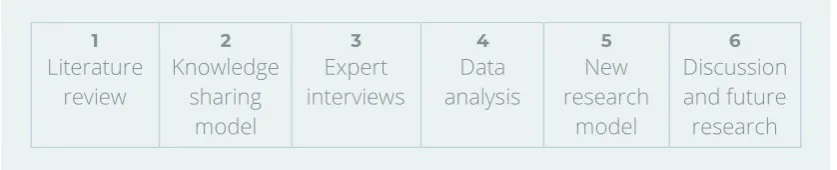
Finally, after learning and reviewing literature about the key concepts of the research problem and outlining key enablers and motivators for successful knowledge sharing, the factors and reviewed literature will be analyzed and integrated into a model for online knowledge sharing. In the following chapter the methods and procedures for the data collection will be outlined and explained. The findings will be presented and analyzed. A new research model will show an
integrated framework of theory, expertise and practice. Finally, practical implications and new discussion points for future research will be presented (Figure 1-1).
1
Literature review
2
Knowledge sharing
model
3
Expert interviews
4
Data analysis
5
New research
model
6
[image:12.595.89.508.608.693.2]Discussion and future research
2 Theoretical
framework
""""""!
This chapter will discuss and
analyze relevant theories to
the research’s concepts,
aimed to build a theoretical
foundation whereupon this
research is based.
Foremost, to have a better understanding
of knowledge, it will be defined and
categorized by their characteristics and
usage (2.1). After exploring categorizations
of knowledge, knowledge sharing will be
defined, and the beneficial outcomes of
knowledge sharing will be reviewed and
outlined. To put the research into its
perspective, characteristics of online
knowledge sharing will be outlined (2.2) and
facilitators of online knowledge sharing will
be described (2.3). The following
After learning and reviewing literature about the key concepts of the research problem and outlining success factors for participation in knowledge sharing, the reviewed literature will be analyzed and integrated into a research model depicting the success factors for online knowledge sharing and explore their interplay (2.6).
2.1 Defining knowledge
Information is often linked to knowledge when discussed in scientific research. Information is seen as the preliminary stage to knowledge. When information is integrated with experiences and a certain context, it becomes knowledge (Hoe, 2006). Nonaka and Takeuchi (1995) state that knowledge, in comparison to information, is put into perspective, is more complex and carries a higher level of understanding. Due to its value, it is this context-specific knowledge that can lead to better organizational performance. For a better understanding of knowledge, the following paragraph will aim to discuss classifications of knowledge as well as the role of these classifications in knowledge sharing.
2.1.1 Tacit and explicit knowledge
The often-used classification of explicit and tacit knowledge is used to deepen our understanding of the nature of knowledge shared among employees. Most scholars have classified knowledge into two types: (1) tacit knowledge, and (2) explicit
knowledge (Hau et al., 2013; Dyer & Nobeoka, 2000). Explicit knowledge is known as information that can be easily captured, codified and transmitted in formal,
systematic language (Dhanaraj, Lyles, Steensma & Tihanyi, 2004; Xiang et al., 2013). Sharing this factual knowledge seems to be more common because it is embedded in standardized procedures, easy to acquire and can be exploited quickly (Dhanaraj et al., 2004; Dyer & Nobeoka, 2000).
Tacit knowledge however, is more abstract and thus related to more complex ways of acquiring and sharing. It consists of the employee’s experiences and skills and can only be communicated through active involvement of other employees. Although tacit knowledge is more complex to share because of its difficulty to be codified or articulated, it is more valuable to organizations since this knowledge is often unique and personal. Tacit knowledge is defined as work-related, context-specific, practical knowledge learned and developed informally on the job. It has an important cognitive element, beliefs and perspectives that are not easily articulated (Dhanaraj, 2004; Hau, et al., 2013; Sigala & Chalkiti, 2015).
2.1.2 Sharing tacit and explicit knowledge
processes. However, due to the growth and globalization of organizations,
communication between employees is often challenged by separation of time and space (Akgün et al., 2006). Such organizations often depend on online tools for communication and are challenged with facilitating informal communication, creating a shared understanding and creating trust between employees due to the separation of time and space. Therefore, sharing tacit knowledge online is often challenged. Also, employees are less willing to share tacit knowledge because they fear to lose their unique and personal intellectual property. (Dhanaraj, 2004; Wang & Wang, 2012; Wasko & Faraj, 2000; Xiang et al., 2013). Thus, organizations are challenged with creating an environment for knowledge sharing, in which separation of time and space are no barriers and where employees feel safe and free to share their knowledge, without the feeling of losing personal value.
2.1.3 Individual or collective knowledge
Despite the often-used classification by Polanyi (1962), Wasko & Faraj (2000) have proposed a new classification of knowledge. Explicit and tacit knowledge are both shared for self-interest, while their third classification is motivated by moral
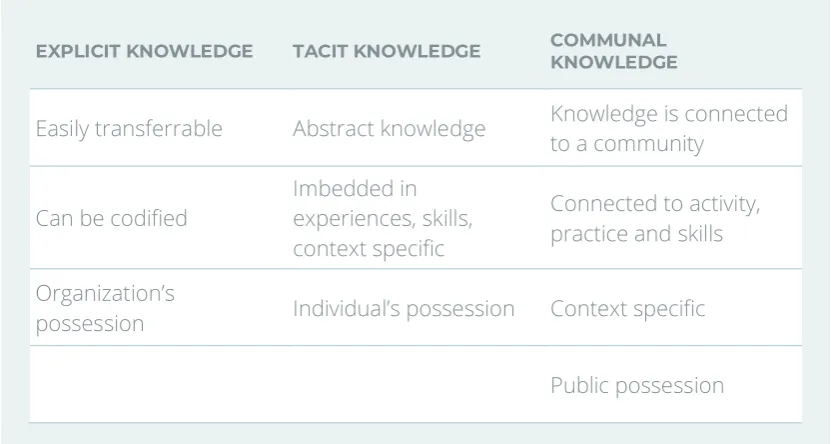
obligations. Wasko and Faraj (2000) have classified three perspectives (Table 2-1) of knowledge. (1) Knowledge as an object: the idea that knowledge can exist
independently of human action and perceptions. It can be codified and separated from the minds of people and is viewed as a property of the organization. This knowledge is similar to explicit knowledge. (2) Knowledge embedded in individuals: this kind of knowledge is inseparable from people, difficult to articulate and can be increased through organization learning. This knowledge is similar to tacit
knowledge. (3) Knowledge embedded in community (communal knowledge): this perspective states that knowing and learning is connected to activity and practice. Knowledge is embedded in a community; thus, this public good can be maintained, by open discussion through for example, s. Knowledge is seen as a public good and created in the community. Knowledge is shifted from personal value to the
possession and value of the community/organization (Hendriks, 1999). The latter classification indicates that knowledge is created and maintained in the community through active communication and knowledge sharing.
Since both tacit and communal knowledge are unique and context-specific knowledge that both need (informal) communication and interaction for its
EXPLICIT KNOWLEDGE TACIT KNOWLEDGE COMMUNAL KNOWLEDGE
Easily transferrable Abstract knowledge Knowledge is connected to a community
Can be codified Imbedded in experiences, skills,
context specific
Connected to activity, practice and skills
Organization’s
possession Individual’s possession Context specific
[image:16.595.89.505.80.302.2]Public possession
Table 2-1. A classification of knowledge
2.2 Defining knowledge sharing
To fully utilize the knowledge base, organizations need to exploit already existing knowledge-based resources and need to consider how to transfer expertise from one employee to another (Wang & Noe, 2010). Knowledge does not add any value, unless it is shared and/or put to use (Xiang, Lu & Gupta, 2013). According to Gaál et al. (2015), knowledge sharing is the process by which knowledge of individuals is converted into a form that can be understood and used by other individuals (Ipe, 2003). Through knowledge sharing, employees can contribute to knowledge
application, innovation, and ultimately the competitive advantage of the organization (Wang & Noe, 2010).
2.2.1 The outcomes of knowledge sharing
By sharing knowledge, employees convert possessed knowledge into a form that is understandable by others and therefore go through a process of understanding and learning. Knowledge sharing leads to individual learning as well as
organizational growth. The following paragraph will describe the outcomes of knowledge sharing and explain why knowledge (sharing) is beneficial to the organization and employee.
""""""!!
1 KNOWLEDGE SHARING AND ORGANIZATIONAL GROWTH
growth lies in the companies’ people, the capabilities and knowledge they have to offer. Studies have shown that organizational growth depends on the efficiency and effectiveness of knowledge management practices. With greater knowledge
management skills, of which knowledge sharing is a key element, companies are able to use and apply knowledge better to increase organizational performance (Yusof, 2012). A learning and growing organization is an organization skilled at creating, transferring and retaining knowledge and more importantly, learn from new insights resulting from online knowledge sharing and subsequently change behaviour of employees aiming at continuous growth (Garvin, 2000). Standardized processes such as products and services can be copied, but an organization that is able to learn and develop more rapidly than the competition, can innovate, endure and remain its leading market share. To build a knowledge driven-organization, organizations needs to not only share but also actively apply new knowledge, by creating concrete steps to knowledge sharing and implementation (Garvin, 1993).
""""""!!
2 KNOWLEDGE SHARING AND LEARNING
Besides organizational growth, learning and development is a core element of knowledge sharing. Organizations that are effective at learning have developed routines for effectively developing, sharing, storing and applying new knowledge on a systematic and daily basis. Organizational learning has been viewed as routine based and is defined as a regular pattern of interactions among individuals that permits the transfer, recombination, or creation of specialized knowledge (Dyer & Nobeoka, 2000). These routines are known as the capability to manage knowledge flows (Dyer & Nobeoka, 2000). Organizational learning has been seen as the goal and outcome of knowledge management. By motivating knowledge sharing, knowledge management systems can help to continuously embed knowledge into the organization, leading to economic and competitive growth (King, 2009). Also, knowledge sharing enables organizations to keep the individual learning flowing (Yang, 2007). Although knowledge sharing has been recognized as an important element of organizational learning, the individual learning process of knowledge sharing has noticeably received less attention in research. According to Antonova and Gurova (2006), there are two types of individuals in the process of knowledge sharing: knowledge seekers, those who are searching for knowledge and knowledge sources, and knowledge sharers; those who own the knowledge and are willing to share. Not only do employees engage in a learning process when receiving
knowledge, the act of sharing knowledge leads to an individual learning process as well (Wang & Noe, 2010).
""""""!!
3 THE LEARNING PROCESS IN KNOWLEDGE SHARING
externalization causes deepening of own knowledge. By sharing and receiving knowledge and the interconnections between old (possessed) and new (received) knowledge, employees are able to expand their own and the organization’s
knowledge base by creating new ideas and insights (Sigala & Chalkiti; 2015; Wang & Noe, 2010). For knowledge sharing to take place, there must be an exchange. The received knowledge is information that is framed and formulated by the original knowledge owner. Although this knowledge comes from the original knowledge owner, the received knowledge is not the same as it goes through a process of interpretation and is then framed by the receiver’s knowledge and identity. Thus, new insights and ideas are created (Sharratt & Usoro, 2003). Knowledge is
developed in the community through active communication and thus, communal knowledge is developed (Wasko & Faraj, 2000).
2.3 Facilitating online knowledge sharing
Online collaboration between employees is challenged with the efficient and effective flow of communication since they depend on online technologies that make communication possible (Akgun et al., 2016). CoPs have not only played a role in knowledge sharing and organizational learning on the work floor, organizations have started to use them for online, dispersed communities as well. Different members of the organization with various backgrounds, status, expertise, ideas, skills and motivations can collaborate, share and create new knowledge. Of course, these communities do not run without any challenges. The following part will describe, define and discuss CoPs.
2.3.1 Defining communities of practice
In the dominant work of Wegner (2000), CoPs have been described as the basic building blocks of a social learning system. CoPs are first defined as ‘an activity system about which participants share understandings concerning what they are doing and what that means in their lives and for their community’ by Lave and Wenger as cited in Matusov, Bell and Rogoff (1994). The researchers have
According to Wegner (2000), CoPs exist of three elements. (1) Joint enterprise: members are bound together by their collectively developed understanding of what the community is about. To successfully contribute to the community, members need to know the organization well enough. (2) Mutual engagement: a community is built through mutual engagement. Members need to establish norms and
relationships through interaction. To engage in these communities, members need to trust and be trusted as a partner. (3) Shared repertoire: members need to have a shared repertoire of communal resources. For example, common language,
routines, styles etc. Also, members need to be able to use it properly. These factors are needed to participate in a community in which knowledge is shared.
2.3.2 Types of communities of practice
As is mentioned before, CoPs are not only ‘traditional’ communities that are formed on the workplace to learn and work together, online CoPs are now used for
communication, discussion, as well as for cooperation and the coordination of dispersed employees. The existence of these online communities is enabled with the help of enterprise social networks, online programmes that are used by
organizations or they are enabled by a more general form of online communication media: social media.
""""""!!
1 SOCIAL MEDIA
The Internet enabled employees to exchange information and knowledge inexpensively and changed the scope, boundaries and dynamics of social
interaction (Chang & Chuang, 2011). The Internet created new opportunities and worked as support for existing work practices and created new business
possibilities. Also, it enhances employee productivity since it supports individual communication that is unrestricted by time or space (Cheung, Chang & Lai, 2000). There has been a change in internal communication. To publish organizational content online and communicate with employees, social and digital communication technologies such as blogs, forums and social networking sites are used (Kline & Alex-Brown, 2013). Large organizations such as Intel, Dell and Starbucks have taken on such tools for employee engagement. According to Mantymaki and Riemer (2016), enterprise social networking allows employees to communicate messages with particular employees, point out particular employees as communication partners, post texts and view messages. It can bring benefits to knowledge management and sharing through increased communication. Social network systems have moved beyond the realm of personal applications and are becoming fully integrated with organizational and collaboration practices (Mathiesen & Fielt, 2013). As knowledge sharing creates value for organizations, many organizations have chosen enterprise social software as an approach to knowledge sharing (Amidi et al., 2015). While earlier collaboration technologies were merely for explicit
""""""!!
2 ENTERPRISE SOCIAL NETWORKS
Web 2.0 applications have found their way into corporate practice. The demand for corporate social software to support knowledge sharing and collaboration has increased (Riemer, Overfeld, Scifleet & Richter, 2012). Enterprise social networks such as Yammer and Chatter are private, internal networks and are developed with the aim of enabling collaboration across different structures within an organization (Awolusi, 2012). These informal networks make effective collaboration possible by promoting employee’s visibility and enabling open discussion. Through these networks, management of knowledge is possible as well (Awolusi, 2012). Employees can communicate, post and edit messages, and view other’s contribution. Forums will enhance communication and discussions (Leonardi, 2014). Merely the
implementation of technology and social software does not precipitate its usage. True usage only manifests when employees make sense of and incorporate them in daily work routines (Riemer et al., 2012). The higher the perceived usefulness, the stronger the intention for knowledge sharing will be (Behringer & Sassenberg, 2015). Despite the large amount of research on social networks and its adoption, there has been a tendency to de-contextualize individual adoption of enterprise social network (Riemer et al., 2012). Thus, influences from the context are neglected when researching individual adoption. Indicating that the adoption process is not only influenced by personal drivers but also by pressures from the organizational context (management) and from other individuals (colleagues, group members).
The rise of enterprise social software has added greater flexibility to CoPs.
Enterprise social software stands apart from conventional systems through its ease of usage and usefully relevant features (Antonius et al., 2015). Social networking sites such as Facebook, Twitter and Linked-in gained popularity among
organizations due to its increased usage by employees and organizations are experimenting with the implementation of such networks for business operations (Awolusi, 2012). However, unlike these public social media sites, where a user’s online connections are mostly associated with their offline connections, enterprise social software enables connections between users who do not interact offline (Leonardi, 2014). The wide reach of connections beyond direct work group members enables knowledge sharing, communication and learning with various colleagues. Thus, connecting organizational members from all levels and
backgrounds makes a wider reach for knowledge sharing possible enabling integration of different point of views, levels, cultures etc. (Leonardi, 2014).
2.4 Characteristics of knowledge sharing in online
communities
network-effectiveness, high performance and it is cost reducing. Online
environments can extend resources and knowledge by connecting people with a diversity of experiences and skills and is not restricted by time or physical
separation (Gera, 2013). Online discussions are more accessible to the community and therefore knowledge can reach more employees (Sharratt & Usoro, 2003).
Despite these advantages, online communication does not contain the frequency and depth, as does face-to-face communication. Organizational members interpret shared knowledge through personal biases that may lead to miscommunication or misinterpretations. This becomes more complex as online communication lacks the opportunity to utilize verbal and non-verbal feedback or confirmation (Gera, 2013). Individual struggles such as misinterpretations of meaning or emotions of others may lead to conflict and negatively influence knowledge-sharing intentions. Also, to participate in online knowledge sharing, members of the organizations need to know and understand technology. Learning how to express oneself professionally and emotionally and to understand other’s emotions via technology takes time and effort (Heller, Laurito, Johnson, Martin, Fitzpatrick and Sundin, 2010).
2.5 Enablers of online knowledge sharing
After exploring and discussing all relevant constructs to the research problem, the following paragraphs will look at several theories that have been adapted to understand the enablers and motivators of knowledge sharing and their inter-relationships. This chapter begins with explaining how performance takes place and what leads employees to performing a certain behaviour by discussing the theory of planned behaviour, the Triandis model and the AMO model. Both the theory of planned behaviour and the Triandis model explain behaviour by including the construct intention/willingness. These theories are chosen because online
knowledge sharing is characterized as an extra-role task and self-organizing (Fang and Chiu, 2009), therefore employees’ willingness/intention to share knowledge takes an important role in the development of a research model for online knowledge sharing. The AMO model explains the inter-relationships of the
constructs. Thus, the following question will be answered: what are the enablers of online knowledge sharing?
2.5.1 Theory of planned behaviour
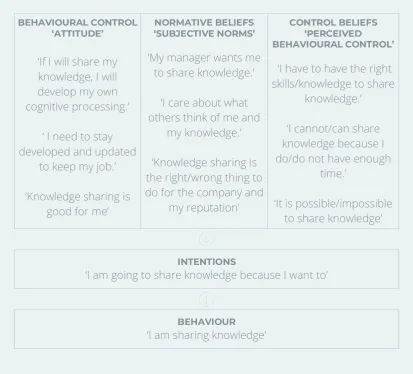
social influences are, the stronger the intentions to perform behaviour will be. Also, the employees must perceive that it is possible to act. Perceived behavioural control refers to people’s perception of the ease or difficulty to perform the behaviour. Their personal confidence will strongly influence the perceived behavioural control. Both intentions and perceived behavioural control can be used to directly predict behaviour. Similar to intentions, perceived behavioural control can be used to predict the probability of successful behaviour. Even with high intentions, a person with low behaviour control is less likely to perform the behaviour (Ajzen, 1991; McDonald, 2014).
BEHAVIOURAL CONTROL ‘ATTITUDE’
‘If I will share my knowledge, I will develop my own cognitive processing.’
‘ I need to stay developed and updated
to keep my job.’
‘Knowledge sharing is good for me’
NORMATIVE BELIEFS ‘SUBJECTIVE NORMS’
‘My manager wants me to share knowledge.’
‘I care about what others think of me and
my knowledge.’
‘Knowledge sharing is the right/wrong thing to do for the company and
my reputation’
CONTROL BELIEFS ‘PERCEIVED BEHAVIOURAL CONTROL’
‘I have to have the right skills/knowledge to share
knowledge.’
‘I cannot/can share knowledge because I do/do not have enough
time.’
‘It is possible/impossible to share knowledge’
INTENTIONS
‘I am going to share knowledge because I want to’
BEHAVIOUR
[image:22.595.90.504.223.597.2]‘I am sharing knowledge’
Figure 2-1. Theory of planned behaviour
2.5.2 The Triandis model
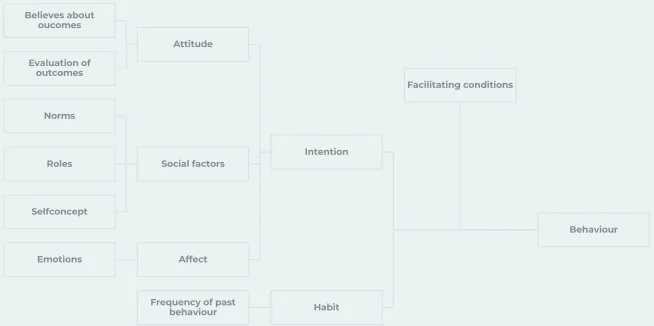
do. An employee’s attitude is rational thoughts and beliefs about the outcomes of the behaviour. Affect is un-conscious responses toward a particular behaviour (McDonald, 2014). This theory extends the theory of planned behaviour as it
Behaviour Intention
Attitude Believes about
oucomes
Evaluation of outcomes
Social factors Norms
Roles
Selfconcept
Affect Emotions
Habit Frequency of past
behaviour
[image:24.842.95.749.134.460.2]Facilitating conditions
2.5.3 The AMO model
Although these theories explain how people come to performing behaviour, they do not explain how the constructs motivations, intention and behaviour can have various relationships and thus have different effects on behaviour. The Ability, Motivation and Opportunity model (AMO) (Figure 2-3) addresses the constructs’ relationships in several ways (Hughes, 2007). According to Subramony (2009), bundles of HRM practices that are synergistic and lead to one specific behaviour or performance have a greater influence on performance of organizations than practices alone. This is because individual practices to enhance knowledge sharing can support each other and create combined synergistic effects. Small bundles of HRM practices focused on enhancing or enabling a specific workforce characteristic, in this case knowledge sharing ,might have more advantages than multiple
practices. Examples of these advantages are; lower costs and sufficient time for integration. According to the theory, most HRM practices have synergistic and performance enhancing effects when they are combined into three categories: ability enhancing bundles, motivation enhancing bundles and opportunity enhancing bundles.
The AMO model discusses that all employee performances are a function of the ability and the opportunity to perform, and the motivation to do so. This theory is used to address factors that influence people’s choices about performing
behaviour. The theory, designed by studies of behaviour, can be applied across various disciplines due to the generality of the three concepts. Its validity lays on the internal structure of the theory self. The usage and theories attached to it will determine its usefulness (Hughes, 2007). As cited in Sterling and Boxall (2013), Blumberg and Pringle (1982) demonstrated the importance of opportunity in the model of motivation and ability. To perform, employees need resources such as technology and time. These factors are now accepted as mediators in any model of HRM (Sterling & Boxall, 2013).
considered as moderating factors. These two constructs will then address situational (opportunity) and individual differences (ability) among employees.
Motivation
Opportunity Performance Ability
Figure 2-3. The AMO model
2.6 Motivators of online knowledge sharing
To elaborate on the motivational aspects of online knowledge sharing, the following chapter will outline external influencers. As is shown by Wegner (2000) and Riemer et al. (2012), external aspects are considered to be highly influential for sharing knowledge in online communities. Employees can share context specific and appropriate knowledge when they are aware of each other’s knowledge and capabilities and have a common interpretation of goals. Therefore, The Transactive Memory System will be explained and its role in online communities will be
discussed. Such a system is created through social interaction (Chen, Li, Clark & Dietrich, 2013; Xiang et al., 2013). The social capital theory explains what and how relational, structural and cognitive aspects influence intentions toward the
behaviour. Thus, this chapter will answer the following question: what are the motivators of online knowledge sharing?
2.6.1 Transactive memory system
TMS. By communicating and exchanging knowledge, patterns of interactions and information networks are created. Increased coordination within the team reduces uncertainties about interactions. Employees will feel more confident in their ability to utilize their information network and share their knowledge when they
experience that shared knowledge is utilized effectively. However, online
communities are challenged with developing such TMS. Due to the lack of face-to-face communication in online communities, misunderstandings about the team, task or technology are more likely to happen, challenging the development of a TMS (Akgun et al., 2006). Also, when shared knowledge is utilized effectively, employees may feel valued or recognized for their expertise. However, in an online community, it is hard to learn whether shared knowledge is used or implemented outside the virtual community. Thus, when team members are familiar with each other, personal knowledge is more likely to become part of their communication (Ellis, Porter & Wolverton, 2012).
2.6.2 Social capital theory
Online communities are social networks in which people interact to share information and knowledge and engage in social interactions. It is these social interactions and relations that sustain such communities (Chiu et al., 2006). The Social Capital theory has been used to explain the role of relational resources in knowledge sharing activities (Hau et al., 2013). It has emerged as a popular concept and its value has been recognized since it inspires firms to stimulate coordination among employees (Widén-Wulff & Ginman, 2004). The social capital, which is the sum of the actual and potential resources of knowledge throughout the network of relationships, consists of structural, cognitive and relational dimensions (Hau et al., 2013). (1) The structural dimension deals with the pattern of relationships and connections found within the organization. (2) The cognitive dimension describes to what extent employees within the organization share the same perspective or understanding of the tasks and goals. A shared language is of importance in this dimension. (3) Lastly, the relational dimension concerns the nature of the relations and connections. Trust, norms and identification are important aspects (Chang & Chuang, 2011). An organization’s social capital can promote knowledge sharing among employees through common values and by enabling them to build trust (Hung, Durcikova, Lai & Lin, 2011). According to Chiu et al. (2006), an individuals’ behaviour is a product of their social network: through close interactions,
employees are able to increase the depth of knowledge exchange. Wei, Zheng & Zhang (2011) showed that the employee’s network position, such as social distance and sharing the same social environment affect their knowledge transfer.
cognitive dimension positively influences the knowledge quality. When shared language and vision are present, employees may be more concerned about the quality of their contribution.
Social capital is important for online communities; yet, it is hard to develop in online communities. Stable relationships, norms and trust may be difficult to develop due to the variation in communication partners and communication goals. Participants constantly change over time. Important antecedents for creating a social capital are stability of the group, interdependence and interaction between participators. Yet, these antecedents are challenged by the changing characteristic of online
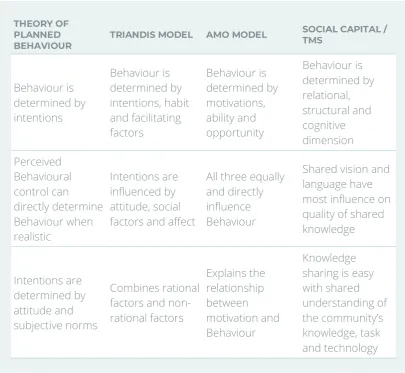
communities (Wagner, 2014). An overview of the previously discussed theories is given in Table 2-2.
THEORY OF PLANNED
BEHAVIOUR TRIANDIS MODEL AMO MODEL
SOCIAL CAPITAL / TMS Behaviour is determined by intentions Behaviour is determined by intentions, habit and facilitating factors Behaviour is determined by motivations, ability and opportunity Behaviour is determined by relational, structural and cognitive dimension Perceived Behavioural control can directly determine Behaviour when realistic Intentions are influenced by attitude, social factors and affect
All three equally and directly influence Behaviour
[image:28.595.93.499.266.639.2]Shared vision and language have most influence on quality of shared knowledge Intentions are determined by attitude and subjective norms Combines rational factors and non-rational factors Explains the relationship between motivation and Behaviour Knowledge sharing is easy with shared understanding of the community’s knowledge, task and technology
Table 2-2. An overview of theories
2.7 An integration of theories
Finally, after learning and reviewing literature about the key concepts of the
research problem and outlining success factors (enablers and motivators) for online knowledge sharing, the factors and reviewed literature will be analyzed and
theories will be divided into the intention towards online knowledge sharing, as well as enablers and motivators of knowledge sharing. Enablers and motivators are then divided into sub-categories.
2.7.1 Enablers
Comparing the theory of planned behaviour, the Triandis model and the AMO model, all three explain factors leading to performing behaviour. The theory of planned behaviour and the Triandis model both explain that intentions leading to behaviour must be motivated and that behaviour must be enabled. The Triandis model identifies the enablers as employees’ skills and environmental constraints (or environmental enablers), while the theory of planned behaviour mentions them as perceived behavioural control. Which means that despite it is realistic or nor, employees must perceive the behaviour is possible to perform and not difficult. Therefore, in both cases, it must be enabled by enhancing the ability (enhancing talent and skills) to share knowledge and the possibility (providing time and
technology) to do so. Building upon this, the AMO model shows the importance of the enablers (opportunity and ability) beside motivations and indicates that the higher these factors are, the better the performance will be. However, also shown is that the explanatory power of the AMO model increases when ability and
opportunity are considered as moderating factors instead of direct influences on performance: they will address situational (opportunity) and individual differences (ability) among employees. These individual characteristics are highly important in online knowledge sharing (Wang & Noe, 2010). Also, compared to the Triandis model, the AMO model does not capture the intention construct explicitly but includes them as willpower in the motivation construct. Motivations are considered to directly influence a particular behaviour (Hughes, 2007). However, since
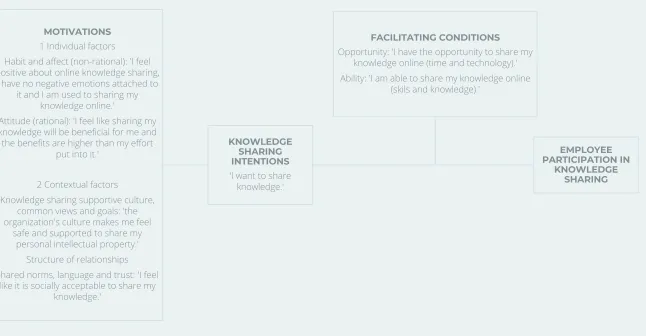
knowledge is stored in an individual’s brain, sharing can only occur when the knowledge owner is motivated to do so (Xiang et al., 2013). Knowledge belongs to the individuals; therefore, knowledge sharing in virtual communities is far from spontaneous (Chang & Chuang, 2011). Knowledge sharing is mostly a voluntarily and extra-role task, therefore, the intention (willingness) to share knowledge is a prerequisite and must be influenced by motivators. Therefore, intentions and motivations will be approached as two separate constructs in the research model and facilitating conditions will be a moderator to increase the explanatory power of the research model. The base of the model will be as follows:
—! Intentions lead to actual behaviour and must be influenced by motivations.
Knowledge sharing must be enabled through ability and opportunity (facilitating conditions) (Figure 2-4 and 2-5).
Moderating enablers
01
Motivators
02
Intentions
03
[image:30.595.90.505.74.202.2]Knowledge sharing
Figure 2-4. The base of the research model
2.7.2 Motivators
The following paragraphs will describe the motivators of the research model. The analyzed theories indicated the importance of two factors: individual motivators and contextual motivators. This explains that motivation comes from the surrounding and context in which knowledge is shared, as well as personal factors of employees.
"
!!!!!!""
1 INDIVIDUAL (RATIONAL AND NON-RATIONAL)
As is mentioned in the Triandis model and the theory of planned behaviour,
employees’ attitude toward knowledge sharing play a role in their intentions toward the behaviour and depend on the perception or expectation of profits and losses of their contribution. Individuals will participate in a virtual community when the perceived benefits outweigh the loss of knowledge (Chang & Chuang, 2011). Employees are less willing to share personal knowledge when they fear to lose unique intellectual property (Dhanaraj, 2004; Wang & Wang, 2012; Wasko & Faraj, 2000; Xiang et al., 2013). The Triandis model than adds non-rational constructs to the rational construct attitude to indicate that behaviour is not fully rational. By adding the habit and emotion constructs, it shows that behaviour is not fully deliberative (choices are led by emotions and habits one has), nor automatic. Therefore, individual motivators are important in improving participation in online knowledge sharing:
—! The model must contain (portray) individual motivators that are rational
(perceived benefits) and non-rational (habit and emotions) to portrait a realistic view of how employees perform behaviour (Figure 2-5).
!!!!!!""
2 CONTEXTUAL
their information network and tacit knowledge becomes part of their
communication. Because of the dispersed characteristic of time and space of online communities where face-to-face interaction is limited, as well as the diversity of members in expertise, status and cultural background, online communities are often challenged with establishing a shared understanding for efficient flow of knowledge. To meet these challenges, structure and clarification is needed by establishing common views and goals by the managerial department of the organization (Akgun et al., 2006; Zakaria, Amelinckx & Wilemon, 2004). The social capital theory shows the importance of relationships among employees, shared language, common value and norms to build trust for enabling knowledge sharing. According to Law & Ngai (2008), organizations that aim to facilitate a learning organization need to create supportive environments in which learning and
exchanging knowledge can take place. Organizations’ cultural norm can encourage employees to participate in knowledge sharing (Wasko & Faraj, 2000). True
participation in online communities only manifests when it is fully incorporated into daily processes (Behringer & Sassenberg, 2015; Riemer et al., 2012)
—! Organizations need to encourage employees’ common context (common goals,
views, norms and language) to increase quantity and depth of knowledge sharing (Figure 2-5).
—! Organizations must create a supportive environment in which online knowledge
sharing and take place and in which online knowledge sharing is integrated in daily work processes (Figure 2-5).
—! Individual behaviour is a product of their social network: through close interaction, employees are able to increase the depths of their knowledge
EMPLOYEE PARTICIPATION IN
KNOWLEDGE SHARING KNOWLEDGE
SHARING INTENTIONS
'I want to share knowledge.'
MOTIVATIONS
1 Individual factors
Habit and affect (non-rational): 'I feel positive about online knowledge sharing,
I have no negative emotions attached to it and I am used to sharing my
knowledge online.'
Attitude (rational): 'I feel like sharing my knowledge will be beneficial for me and the benefits are higher than my effort
put into it.'
2 Contextual factors
Knowledge sharing supportive culture, common views and goals: 'the organization's culture makes me feel
safe and supported to share my personal intellectual property.'
Structure of relationships shared norms, language and trust: 'I feel
like it is socially acceptable to share my knowledge.'
FACILITATING CONDITIONS
Opportunity: 'I have the opportunity to share my knowledge online (time and technology).' Ability: 'I am able to share my knowledge online
[image:32.842.107.753.133.469.2](skils and knowledge).'
3 Research
design
!!!!!!"
This chapter will explain the
design of the research, how
the research is carried out
and the reasoning behind the
approach.
The purpose of this study is to clarify
the success factors and to explore
their interplay for employee
participation in online knowledge
sharing
.
The study aims to develop practical knowledge to support organizational
management in understanding how to successfully manage, enable and motivate the flow of knowledge in an online community to create value for both the
organization and its members: organizational growth and learning through constant circulation of knowledge. The research question is an open and exploratory
question. Therefore, a qualitative research method will be applied to answer the question. A qualitative approach to this study can cater for an in-depth view in online knowledge sharing practices. The desire for better understanding of triggers for the knowledge sharing efforts and their interplay of employees, has led to an exploratory research design (Babbie, 2007).
3.1 Respondents
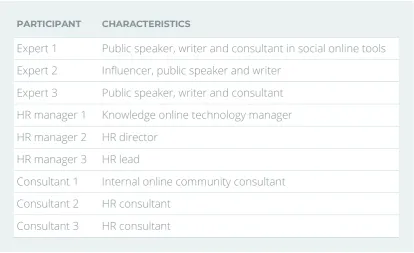
To gain an improved understanding of the motivators and enablers of participating in online knowledge sharing, knowledgeable and experienced experts of online knowledge sharing will be interviewed. These interviewees (Table 3-1) are chosen for their practical knowledge and experience, for which their knowledge can be
combined with academic theory to develop a research model. By doing so, the research model provides new theory from an academic and practical point of view.
The respondents are HR-managers of firms that have adopted knowledge sharing practices and of which their HR-managers are experienced with guiding,
implementing or managing online knowledge sharing, knowledge sharing tools or online communities for internal communication. Also interviewed are consultants knowledgeable and experienced with online knowledge sharing as well as
knowledgeable influencers and writers on the field of knowledge sharing, knowledge management and knowledge sharing tools.
Respondents are personally contacted via phone or e-mail, during which the interview’s reasoning is shared with the respondents. Depending on the
PARTICIPANT CHARACTERISTICS
Expert 1 Public speaker, writer and consultant in social online tools
Expert 2 Influencer, public speaker and writer
Expert 3 Public speaker, writer and consultant
HR manager 1 Knowledge online technology manager HR manager 2 HR director
HR manager 3 HR lead
Consultant 1 Internal online community consultant
Consultant 2 HR consultant
[image:35.595.90.505.86.339.2]Consultant 3 HR consultant
Table 3-1. An overview of participants
3.2 Instrumentation
Little amount of qualitative research has been conducted to investigate influencing factors of participation in knowledge sharing in online communities (Wang & Noe, 2010). Belief-based measures can provide insight into the cognitive foundation underlying perceptions. Semi-structured interviews are performed and allowed for possibility for probes: requesting elaboration of answers when needed (Babbie, 2007). Meaning that the interviews are flexible and have the ability to adapt the interview’s direction when new insights appear. As face-to-face interviews were preferred, it can deal with the context in which respondents are thinking and acting (Babbie, 2007). In the literature review, critical success factors were found. A model was developed which showed the inter-relationships of the factors leading to participation in online knowledge sharing. With the performed interviews for this study, the success factors are tested and therefore validated (Babbie, 2007).
However, to avoid bias, during the interviews, the interviewer’s presence should not affect the respondent’s perception of the question and the interviewer must be neutral when questions and answers are transmitted. To increase reliability, the interviewer must avoid random error, by for example misreading question (Babbie, 2007).
A questionnaire is developed for gaining an improved understanding of employee participation in online knowledge sharing. The research model showed the
explored (example question 2). To explore the field of enablers of and intentions towards online knowledge sharing, bare minimum prerequisites for online knowledge sharing are asked (example question 3), as well as the difference between enabling and motivating online knowledge sharing in practice (example question 4). Also, questions about the motivators (contextual and individual) were asked (example question 5, 6, 7 and 8). Lastly, questions about the role of the organization in online knowledge sharing is asked for a better understanding of this factor and the context (example question 9) (appendix 1). On average, each
interview took 60 minutes to complete. This depended on the length and the interviewees’ answers. The face-to-face interviews are recorded with a voice-recorder and the skype-interviews via software to record sound and image. The recorded interviews were digitally transcribed.
# TOPIC QUESTION
1 General view of OKS How does online knowledge sharing differ
from face-to-face knowledge sharing in practice?
2 General view of
successful OKS
What is your view on successful online
knowledge sharing? What does this look like?
3 Enablers of OKS What factors are most important in enabling
OKS?/ How is OKS enabled in practice?
4 Difference between
enablers and motivators In practice, how does enabling OKS differ from motivating OKS?
5 Motivations How is motivation built in OKS among
employees?
6 Motivations - contextual What factors play a role in contextual motivation to participate in OKS?
7 Motivations - Individual How do individual factors play a role in OKS intentions?
8 Motivations - individual What individual factors influence online knowledge sharing intentions the most?
9 Context / role of
organization What is the role/responsibility of the organization in online knowledge sharing?
3.3 Data analysis
4 Results
!!!!!!"
This chapter is organized
according to the first
objective of this study, which
is to create a better
understanding of the field of
online knowledge sharing, its
success factors and the
interplay among the factors.
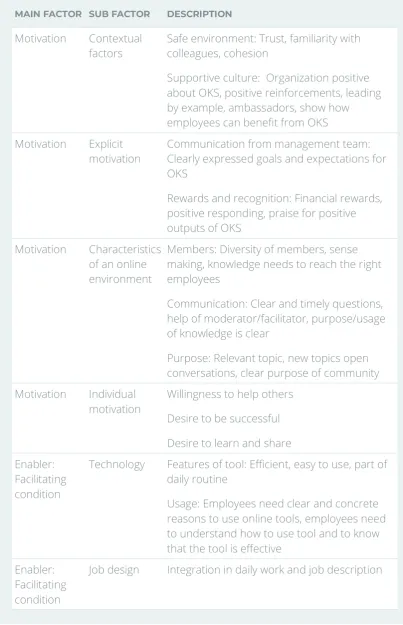
Then, section 4.2 will show why and how online knowledge sharing has advantages compared to face-to-face knowledge sharing. In line with the theoretical framework, paragraph 4.3 will point out analysis’ resulting enabling factors for online knowledge sharing. Lastly, 4.4 will elaborate on the identified motivators after analyzing the results of the interviews.
4.1 Definition of online knowledge sharing
The results of the performed interviews showed that the definition of online knowledge sharing, unlike in academic works, is unclear among the organizations that have participated in this study. While academic works showed different categorizations of knowledge and knowledge sharing, it appears that a clear definition is still unidentified by the HR managers and consultants. Analysis of the interviews performed with managers of the participated organizations (HR
managers 1, 2 and 3), exposed that online knowledge sharing is accepted as an important tool for business creation and organizational development. Organizations show that they have recognized employees’ knowledge and communication as valuable assets for innovation. Yet, online knowledge sharing is and remains an extra-role activity as “employees are losing themselves in work” and their agenda’s do not allow for “online chatting sessions” (HR manager 3) since their main goal is to create profit in as little time as possible. Therefore, managing and exploitation of this field remains low as theory (the known benefits of online knowledge sharing and the wish for it to be practiced) and actual daily practice remain inconsistent.
Even though the value of online knowledge sharing appears to be clear, a grey area that remains among the organizations that have participated in this study is the definition of online knowledge sharing. As literature describes knowledge sharing as the process in which knowledge of individuals is converted into a form that can be understood and used by other individuals (Ipe, 2003), actual understanding of the conceptual term of online knowledge sharing remains undecided. A frequently asked (or perhaps reflecting) question after participants explain online activities of their employees is; “what actually is online knowledge sharing?” While organizations are still unraveling the true definition of online knowledge sharing, the experts participating in this study are far beyond this phase as becomes apparent from the following example: as expert 3 states that “knowledge comes to die in email
conversation”, actual practice shows that organizations are very accepting toward creating email groups and using email conversation for online knowledge sharing and mention this as an example of a successful form of online knowledge sharing. Strikingly, experts describe online knowledge sharing as a much more complex ‘phenomena’. “Online is where knowledge has a life beyond the individual person and for which communities, processes and strategies have to be created (expert 3).” Active management, engagement and stimulation are key factors in online
knowledge sharing. Analysis showed different views and approaches toward facilitating, enabling and motivating the flow of online knowledge sharing. The