University of Warwick institutional repository: http://go.warwick.ac.uk/wrap
A Thesis Submitted for the Degree of PhD at the University of Warwick
http://go.warwick.ac.uk/wrap/49168
This thesis is made available online and is protected by original copyright. Please scroll down to view the document itself.
First observation of the
charmless decay
B
+
→
K
+
π
0
π
0
and study of the Dalitz plot structure
Eugenia Maria Teresa Irene Puccio
Thesis
Submitted to the University of Warwick for the degree of
Doctor of Philosophy
Department of Physics
University of Warwick
Contents
Acknowledgements xxiii
Declaration xxv
Introduction 1
1 Theoretical Motivations 3
1.1 Flavour mixing and the CKM formalism . . . 4
1.1.1 The unitarity triangle . . . 5
1.2 CP violation . . . 8
1.2.1 CP violation in mixing . . . 9
1.2.2 CP violation in decay . . . 10
1.2.3 CP violation in interference between mixing and decay . . . . 11
1.3 New Physics inCP asymmetries . . . 12
1.3.1 The “Kπ puzzle” . . . 12
1.4 Three-body kinematics . . . 19
1.4.1 The Dalitz Plot . . . 19
1.4.2 The square Dalitz plot . . . 20
2 The BABAR Experiment 22 2.1 The PEP-II accelerator . . . 23
2.2 The BABAR detector . . . 25
2.3 The Silicon Vertex Tracker (SVT) . . . 26
2.4 Drift Chamber (DCH) . . . 29
2.5 The Detector of Internally Reflected Cerenkov Light (DIRC) . . . 31
2.6 Electromagnetic Calorimeter (EMC) . . . 33
2.7 Instrumented Flux Return (IFR) . . . 35
2.8 Trigger and data acquisition . . . 38
3 Analysis Techniques 40 3.1 Data sample and Monte Carlo simulation . . . 41
3.1.1 Event Generators . . . 41
3.1.2 Full Detector Simulation . . . 41
3.1.3 Data sample . . . 42
3.2 Discriminating Variables . . . 44
3.2.1 Kinematic Variables . . . 45
3.2.2 Topological Variables . . . 45
3.3 Extended Maximum Likelihood Fit . . . 47
3.3.1 Error in Likelihood Estimates . . . 49
3.3.2 Fitting packages . . . 49
3.4 The sPlot Technique . . . 50
3.4.1 The sPlot Formalism . . . 50
3.4.2 ExtendedsPlots for fixed yields . . . 52
4 Event Selection 54 4.1 Particle identifications . . . 55
4.1.1 Neutral selections . . . 55
4.1.2 Kaon PID . . . 56
4.2 Continuum background rejection . . . 57
4.2.1 Ratio of Legendre polynomials . . . 58
4.2.2 Angular Variables of B Decay . . . 59
4.2.3 Flavour tagging . . . 60
4.2.4 Neural Network training and output selection . . . 61
4.3 Selection Optimisation . . . 63
4.3.1 Final Candidate Selection . . . 63
4.3.2 Vetoed Regions . . . 64
4.3.3 Signal Efficiency . . . 64
4.4 Classification of Misreconstructed Events . . . 67
4.4.1 SCF Definition . . . 67
5 The Fitting Model 72
5.1 Fitting Regions . . . 73
5.1.1 ∆E signal region optimisation . . . 75
5.1.2 Definitions of fitting and sideband regions . . . 75
5.2 Signal and background PDFs . . . 78
5.2.1 Signal PDF . . . 78
5.2.2 Continuum background PDFs . . . 84
5.2.3 BB Background PDFs . . . 87
5.3 Expected yields . . . 89
5.3.1 Expected signal yield . . . 89
5.3.2 Background yields . . . 90
5.4 Determination of SCF fraction . . . 91
5.5 Determining the resonant branching ratios . . . 96
6 Results: Branching Fractions 101 6.1 Toy tests for inclusive branching fraction . . . 102
6.1.1 Pure toys . . . 102
6.1.2 Embedded signal toys . . . 103
6.1.3 Embedded signal and BB toys . . . 106
6.2 Testing the fit to data . . . 106
6.3 Inclusive branching fraction of B+→K+π0π0 . . . 107
6.3.1 Fit results . . . 109
6.3.3 Determination of the inclusive branching fraction . . . 111
6.4 The branching ratio of the resonant decays . . . 114
6.4.1 Validation of the method . . . 115
6.4.2 Results from onpeak data . . . 120
7 Results: CP Asymmetries 122 7.1 Toy tests forACP of inclusive mode . . . 122
7.1.1 Pure toy studies . . . 123
7.1.2 Embedded toy study . . . 124
7.2 InclusiveCP asymmetry of B+→K+π0π0 . . . 125
7.3 CP asymmetry in the resonant decays . . . 125
8 Systematic Errors Evaluation 129 8.1 Systematic uncertainties associated to the model . . . 129
8.1.1 Uncertainties in signal PDF shapes . . . 130
8.1.2 Uncertainties in BB background PDFs . . . 133
8.1.3 Correcting for fixed parameters and biases . . . 134
8.1.4 Summary of fit model systematics . . . 135
8.2 Systematic uncertainties due to efficiency . . . 135
8.2.1 The π0 efficiency systematic . . . 136
8.2.2 Efficiencies due to selection criterias . . . 136
8.2.3 Summary of efficiency systematics . . . 137
8.3.1 Detector and selection induced asymmetry . . . 138
8.3.2 Background asymmetries . . . 139
8.3.3 Fit biases . . . 140
8.3.4 Summary of systematic uncertainties for ACP . . . 140
8.4 Systematic uncertainties for the resonances . . . 141
8.4.1 Variations from inclusive systematics . . . 141
8.4.2 Additional systematics for the quasi-two body decays . . . 142
8.4.3 Summary of systematics for the resonances . . . 143
9 Discussion and Conclusion 144 9.1 Final results . . . 145
9.2 Discussion of the results . . . 146
9.3 Improvements using future experiments . . . 148
A Effect of Punzi bias in fit model 151 B Neutral pion efficiency study 157 B.1 Measuring the π0 efficiency usingτ decays . . . 158
B.2 Data sample and selections . . . 160
B.3 Single/Double ratio results and efficiency extraction . . . 162
List of Figures
1.1 The unitarity triangle with three mixing angles and sides as a function
of the elements in the CKM matrix. . . 6
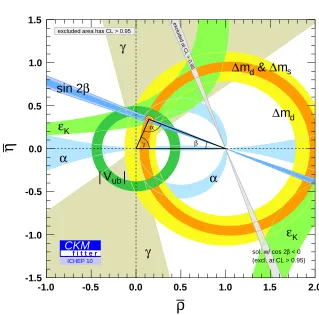
1.2 Constraints in the (¯ρ,η¯) plane including recent measurements of α
and γ in the global CKM fit. The red hashed region of the global
combination corresponds to 68% confidence level (CL) [19]. . . 7
1.3 Box diagram forB0B0 mixing via the exchange of two W bosons. . . 9
1.4 Feynman diagrams forB →Kπ: (a) tree and (b) penguin. . . 13
1.5 Feynman diagrams for the decay processes in B+ →K∗+π0 . . . 17
1.6 Relation between the four K∗π decays and the six Kππ decays. . . . 18
1.7 Illustration of a sample Dalitz plot (left) and square Dalitz plot
(right) obtained from toy MC events and showing B+ →K+π0π0
non resonant (black) and the resonances B+ →K∗(892)+π0 (red),
B+→K∗+
2 (1430)π0(cyan),B+ →f0(980)K+(green),B+ →f2(1270)K+
(magenta) andB+ →χ
c0K+ (blue). . . 21
2.1 A schematic of the PEP-II rings and the collision region. The blue
2.2 Schematic of the PEP-II interaction region. The pink areas around
the interaction point represent the dipole magnets used to bring the
beams together and the regions with a Q label indicate the positions of
the various quadrupole magnets. (Graphic source: SLAC Accelerator
Systems Division via Ref. [44]) . . . 24
2.3 Luminosity distribution over the experiment running period [47]. . . . 25
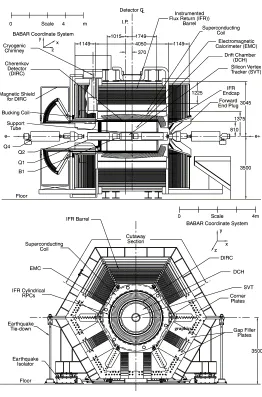
2.4 Longitudinal section and front end view of the BaBar detector. [48] . 27
2.5 The SVT (a) fully assembled with visible outer layers and carbon
fibre frame and (b) schematic view of the transverse section with the
various layers around the beam pipe [48]. . . 28
2.6 Longitudinal cross section of the DCH with the principal dimensions
in mm and offset with respect to interaction point (IP) [48]. . . 30
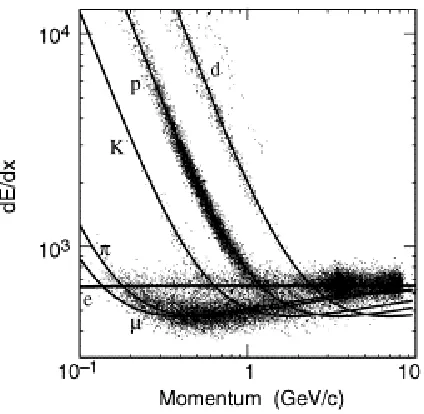
2.7 Measurement of the average dE/dx as a function of track momenta
from the DCH. The curves superimposed to the data show the
Bethe-Bloch predictions for energy loss of a sample of particles of different
masses [48]. . . 31
2.8 Schematics of the DIRC fused silica radiator bar [48]. . . 32
2.9 Expected K/π separation as a function of track momentum [48]. . . . 33
2.10 A longitudinal cross-section of the EMC indicating the arrangements
of the 56 crystal rings. All dimensions are given in mm [48]. . . 34
2.11 Overview of the IFR showing barrel sectors and forward and backward
end doors. The shape and dimensions of the RPC modules are also
shown. [48] . . . 36
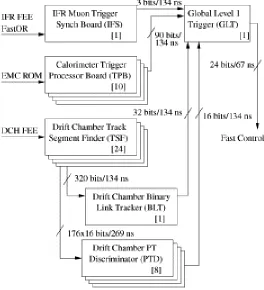
2.13 Simplified L1 trigger schematic. Indicated in the figure are the
num-ber of components and the transmission rates between them in terms
of signal bits. [48] . . . 38
3.1 Layout of a Multilayer Perceptron with one hidden layer [56]. . . 47
3.2 An example ∆E sPlot (data points) for signal (left) and background
(right) obtained from a maximum likelihood fit to the sample mES
distribution only. Overlayed is the distribution generated from the
Gaussian and linear PDFs (blue line). . . 52
4.1 Distributions for signal MC (blue line) and offpeak data (red line)
of the ratio of Legendre polynomials, L2
L0. Both distributions were
normalised to unity. . . 59
4.2 Absolute value of the cosine of theB direction on the left and the B
thrust to the right with respect to the beam axis for signal MC (blue
line) and offpeak data (red line). Both distributions were normalised
to unity. . . 60
4.3 Absolute value of the output of the flavour tagging NN for signal MC
(blue line) and offpeak data (red line) . . . 61
4.4 Comparison of the performance of three MVAs using the same
vari-ables. The MLP Neural Network gives the best performance for this
mode. . . 61
4.5 Correlation matrices between the five event shape variables for signal
MC and offpeak data. . . 62
4.6 Neural Network distribution for signal Monte Carlo and offpeak data.
The green arrow indicates the position of the selection applied on the
4.7 π0π0 invariant mass distribution inB+ →K0 SK
+, K0 S →π
0π0 Monte
Carlo before the veto is applied. The arrows indicate the vetoed region. 64
4.8 Variation of signal efficiency over the conventional Dalitz plot (left)
and square Dalitz plot (right). . . 66
4.9 Difference between generated and reconstructed momenta divided
by reconstructed momentum error plotted against reconstructed
mo-menta for lowest momentumπ0 candidate (left), highest momentum
π0 candidate (centre), kaon candidate (right). . . 67
4.10 mES and ∆E distributions for different ranges ofxi, wherexi is ppull
for all three final state particles. . . 69
4.11 mES (left) and ∆E (right) distributions for TM (red histogram) and
SCF (blue histogram) events based upon a definition of SCF from
ppull >5.0. Both TM and SCF histograms have been normalised. . . 70
4.12 Fraction of self cross feed events as a function of Dalitz plot position
in conventional (left) and square (right) Dalitz plot form. . . 70
5.1 Variation of the signal mES, ∆E and NNout distributions over the
Dalitz plot in terms of the mean and rms of the distributions. These
Dalitz plots were constructed from nonresonant signal MC events that
lie in the signal region ofmES and ∆E (see Section 5.1.2). The events
were selected as described in Chapter 4 except that the K0
SK
+ veto
was not applied. . . 74
5.2 mES and ∆E distributions for signal MC (black line), continuum
background (red line), generic B+B− MC (green line) and generic
B0B0 MC (blue histogram). The black dashed arrows indicate the
5.3 Signal PDF distributions (red line) overlaid on nonresonant MC (black
data points) for TM mES (left) and NNout histogram (right). . . 79
5.4 Control channel, B+ → D0ρ+ → (K+π−π0) (π+π0), PDF
distribu-tions (red line) overlaid on MC (black data points) formES (left) and
NNout histogram (right). . . 80
5.5 (Left)mES and (right) NNout projection distributions from the fit to
the control channelB+→D0ρ+ →(K+π−π0) (π+π0). Black markers
are the data points with fit overlaid (blue line), green dashed lines
are theBB background, red dotted lines the continuum background
and black dashed lines the signal. . . 81
5.6 Signal (left) and continuum (right) sPlot distributions for mES
ob-tained from a fit to the control channelB+ →D0ρ+→(K+π−π0) (π+π0).
Black dots show thesPlotdistributions and the red lines show the fit
results. . . 82
5.7 Signal PDF distributions (red line) overlaid on nonresonant MC (black
data points) for SCF signal mES (left) and NNout (right). . . 84
5.8 qqPDF distributions (red line) overlaid on: offpeak data formES(left)
and USB and GSB onpeak data withBB background subtracted for
NNout (right). . . 85
5.9 Distributions of mES (left), NNout (centre) and ∆E (right) for: (a)
category 1 BB backgrounds, (b) category 2 BB backgrounds, (c)
category 3 BB backgrounds, (d) category 4 BB backgrounds. . . 88
5.10 Gaussian fits to the distributions of fitted SCF fractions and signal
yields. The toy experiments are generated from: nonresonant MC –
expected SCF fraction 5.3 % (left);K∗(892)+π0 MC – expected SCF
5.11 Signal Dalitz plot distributions calculated from the signal MC (right)
and from thesWeights (left) for the nonresonant mode. The Dalitz
plot distribution to the left is obtained by running a toy experiment
of 100 times the number of expected signal events. . . 95
5.12 (Top)mK+π0
min distribution in theK
∗+(892) region from K∗(892)+π0
(left) and nonresonant (right) MC; (Middle)mπ0π0 distribution in the
f0(980) region, from f0(980)K+ (left) and nonresonant (right) MC;
(Bottom)mπ0π0 distribution in theχc0 region, fromχc0K+ (left) and
nonresonant (right) MC. The arrows in the left plots indicate the
selection requirements of signal (red) and sidebands (green) used for
the sideband subtraction. The blue line represents the fit to the MC
data. . . 100
6.1 Pull and fitted uncertainties distributions for B+→K+π0π0
nonres-onant, B+ →K∗(892)+π0 and B+→f
0(980)K+ obtained from 500
pure toy experiments. . . 104
6.2 Projections ofmES (left) and NNout (right) for the fit to: (a) offpeak
data and (b) blind fit to onpeak. The data points (black) show the
sPlot distribution for the continuum background and the line
(ma-genta) is the background PDF generated from the fit. . . 108
6.3 Projection distributions for mES (left) and NNout (right) after
im-plementing the additional requirements on the other fit variable to
enhance the signal visibility. Points with error bars show the data,
the solid (blue) line represent the total fit result, the dashed (green)
curves show the total background contribution and the dotted (red)
curve is theqq component of the background. The dash-dotted curve
6.4 Signal sPlot distributions (black data points) with PDF (red line)
overlaid, where appropriate, for mES (top left), NNout (top right),
∆E (bottom center). . . 110
6.5 Negative log likelihood distribution versus signal yield. . . 111
6.6 Signal Dalitz plot distribution, obtained usingsWeights, for
conven-tional (left) and square (right) Dalitz plots for uncorrected (top) and
corrected for efficiency using the signal MC efficiency from Figure 4.8
(bottom). . . 112
6.7 Signal sPlot distributions for mKπ0
min (a) over all mass range, (b)
zoomed into mass range 0.5< mKπ0
min <2.0GeV /c
2. . . 114
6.8 SignalsPlotdistributions formπ0π0 (a) over all mass range, (b) zoomed
into mass range 0.5 < mπ0π0 < 2.0 GeV /c2, (c) zoomed into mass
range 3.0< mπ0π0 <4.0GeV /c2. . . 115
6.9 Typical sPlot distributions obtained from one experiment in each
cocktail mixtures for: (left to right)mK+π0
mindistribution in theK
∗+(892)
region, mπ0π0 distribution in the f0(980) region; and mπ0π0
distribu-tion in the χc0 region. χc0, K∗(892)+ and f0(980) are missing from
one cocktail in this order. Red (green) arrows indicate the signal
(sidebands) region. . . 117
6.10 Distribution of branching fractions from each cocktail for: (from left
to right)K∗(892)+π0,f
0(980)K+ andχc0K+. The distributions were
6.11 Mass region distributions for K∗(892)+ (top left), f
0(980) (top right)
and χc0 (bottom) from data with fit result overlaid. The black data
point show the sPlot data, the blue continuous line is the overall
fit and the red dashed the nonresonant contribution. The red and
green arrows indicate the signal and sideband regions used in the
subtraction method. . . 121
7.1 Pull distributions for the signal asymmetry with error distributions on
the right obtained from generated samples with asymmetries −40%
(top row), 0% (middle row) and 40% (bottom row). . . 124
7.2 Projection plots onmESand NNout from the fit to data for the positive
charged decay,qB = 1 (left plot) and negative charged decay,qB=−1
(right plot). Points with error bars show the data, the solid (blue)
line represent the total fit result, the dashed (green) curves show the
total background contribution and the dotted (red) curve is the qq
component of the background. The dash-dotted curve represents the
signal contribution. . . 126
7.3 Result of fit in the mass region of K∗(892)+ (top), f
0(980) (middle)
andχc0(bottom) forB+decay (left) andB−decay (right). The black
points show the sPlot data, the blue continuous line is the overall fit
and the red dashed line the NR contribution. Red (green) arrows
indicate the signal (sidebands) region. . . 127
8.1 Linear correlations coefficients obtained from the fit to the mES
dis-tribution of theB+ →D0ρ+→(K+π−π0) (π+π0) MC control sample. 131
8.2 Ratio of the NNout sPlot distribution and the MC based PDF for the
8.3 Distributions of SCF events in mES and NNout for nonresonant and
resonant decay modes. Refer to Table 3.1 to match the MC number
to a specific decay. . . 133
8.4 Projection plots onmES and NNout from the fit to the control sample
for the positive charged decay (left plot) and negative charged decay
(right plot). Points with error bars show the data, the solid (blue)
line represent the total fit result, the dashed (green) curves show the
total background contribution and the dotted (red) curve is the qq
component of the background. The dash-dotted curve represents the
signal contribution. . . 139
A.1 Dalitz plot dependences of the mean and width of the distributions
for ∆E, |σ∆t|
∆t, the NNout, as a consequence of the dependence in
|∆t| σ∆t,
and finally ∆σ E
∆E. . . 153
A.2 Migration of (a) TM and (b) SCF events within the Dalitz plot,
plot-ted at their MC truth coordinates. Note the different scales on the
z-axes. . . 155
A.3 Signal yield distributions from embedded signal MC toy with 500
experiments. The red arrow indicated the expected yield with a loose
∆E signal region of 673 events. Biases range from 40 events to as
high as 171 for resonances decaying to π0π0. . . 156
B.1 Single ratio momentum distributions of (left) charged pions in the
zero bump sample and (right) neutral pions in the one and two bumps
samples. The red line is the distribution obtained from MC and black
line data. The blue data points with blue axis to the right show the
B.2 Double ratio as a function of π0 momentum using additional
require-ments from the Pi0AllLoose list. The black data points show the
ratio of the π0 momentum of 1 and 2 bump events to pion
momen-tum for events with no bumps. The green line indicates the first order
polynomial fit to the double ratio. . . 164
B.3 Double ratio as a function of π0 momentum using additional
require-ments from the Pi0AllLoose list. The black data points show the
nominal double ratio distribution with statistical errors and the red
extended error bars the additional uncertainty from the
systemat-ics. The green line is the linear fit to the double ratio that includes
List of Tables
1.1 Experimental results [33] and theoretical fit predictions for the
branch-ing fractions and CP asymmetries for all B → Kπ and ∆ACP,
ob-tained using the diagrammatic approach. C(K0
Sπ
0) andS(K0
Sπ
0) are
the parameters of the time-dependent amplitude in Eq. 1.20. The fit
prediction of ∆ACP is obtained by removing both ACP(K+π0) and
ACP(K+π−) from the fit [1]. . . 14
1.2 Branching ratios (in units 10−6) and direct CP asymmetries (in units
10−2) obtained from the QCDF method [35]. . . 15
1.3 Amplitudes, branching fractions and asymmetries for B → Kπ and
B →K∗π modes, includingB0 →π+π−and B0 →ρ+π−. Branching
fraction and ACP averages are taken from Ref. [33]. . . 18
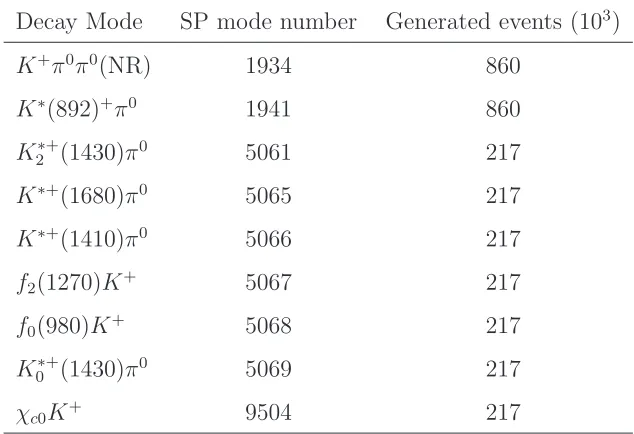
3.1 List of nonresonant and resonant MC modes. The “SP” followed by
the mode number is a unique identifier for each signal decay. . . 43
3.2 The “R24a3-v03” dataset . . . 44
4.1 PID selector performance for B+ →K+π0π0. . . 58
4.2 Selection cut summary and efficiencies for the NR modeK+π0π0 and
4.3 Summary of veto efficiency, average efficiency and SCF fraction for
all nonresonant and resonant signal modes. . . 71
5.1 An overview of the fitting model giving a description of the PDFs
including if the parameters are fixed or floated in the fit. . . 73
5.2 Correlations with Dalitz plot coordinates ofmES, ∆E and NNout
dis-tributions. . . 75
5.3 Optimisation of the ∆E cut. For each set of cut values, the total
sig-nal efficiency, expected number of background events, the Punzi FOM
and the ∆E cut efficiency based on nonresonant MC. The coloured
row indicates the signal selection used. . . 76
5.4 Signal mES PDF parameters obtained from fit to control sample in
MC and data, together with the obtained data/MC calibration
fac-tors. . . 83
5.5 The uncorrected values of the parameters for the TM signal mES
Cruijff, obtained from a fit toB+→K+π0π0 nonresonant MC with
errors, together with the values calibrated using the data/MC
correc-tion factors and errors obtained from the control sample Table 5.4. . 83
5.6 Parameters of the signal SCFmES PDF (a 3rd order Chebychev
poly-nomial). Values and their uncertainties are obtained from a fit to the
nonresonant MC distributions. All of these parameters are fixed in
the fit to data. . . 84
5.7 Parameters for the qq mES PDF. The initial value given is obtained
from the fit to offpeak data. . . 85
5.8 Initial values of the parameters for the qq NNout PDF obtained from
a fit to the sideband regions (USB and GSB) in onpeak with BB
5.9 Expected numbers of events used in the generation process in each
signal and background category and their status in the fit.
Uncer-tainties on the measured values are given for the fixed yields. . . 91
5.10 Table of branching fractions and CP asymmetry (if known) for each
B background mode along with the expected number of events in the
signal region. The “DP” next to the mode description indicates that
the Dalitz plot model is used and therefore MC includes nonresonant
and resonant contributions. The values listed are found using the
world averages taken from HFAG [33] and PDG [38]. A decay with†
indicates that the full or part of the branching fraction was estimated
using isospin relations. . . 92
5.11 Table of values of fSCF, calculated using sWeights, and signal yields
after each iteration, up to convergence, of the fit to single toy
experi-ments generated using MC for each nonresonant (NR),K∗(892)+π0,
K∗+
2 (1430)π0, K∗+(1410)π0 and f2(1270)K+. . . 93
5.12 Selection requirements used to isolate resonances in the relevant MC
samples. Units of GeV/c2 have been suppressed. . . 97
5.13 Parameters obtained from an unbinned fit to the signal MC mass
distributions. These are all fixed in the fit to the mass sPlot. . . 98
5.14 Fit parameters obtained from the nonresonant MC in the resonance
mass region. These parameters are allowed to float in the fit to the
mass sPlot. . . 99
6.1 Mean and width of the pull distributions together with the mean of
the signal yield uncertainties and their errors obtained from pure toy
experiments forB+→K+π0π0 nonresonant, B+ →K∗(892)+π0 and
B+→f
6.2 List of signal yields and biases for the embedded toy experiments
using nonresonant and all resonant signal MC. . . 105
6.3 Results for the signal yield in one toy experiment embedding
sig-nal and BB backgrounds with 3× the statistics for nonresonant,
K∗(892)+ and f
0(980). . . 106
6.4 Yield results for the fit to offpeak data allowing for a signal component
including the errors. . . 107
6.5 Results at each iteration for fSCF and signal yield of the fit to data
up to convergence. . . 109
6.6 Number of events for each signal MC used to reproduce the total yield
and preserve the overall SCF fraction. This mixture also reproduces
the broad features of the Dalitz plot. . . 113
6.7 Composition of the cocktail Monte Carlos. Events are drawn from
large samples – the numbers quoted are the average numbers of events
from each SP mode in each cocktail experiment. The corresponding
branching fractions (in units of 10−6) for the Q2B decays are also
given. . . 116
6.8 Efficiencies of mass cut selections of the signal region and (signal+sidebands)
regions obtained from the MC samples of each resonance. . . 118
6.9 Validation of the method to determine quasi-two-body branching
frac-tions. The values given are the measured branching fractions (in units
of 10−6) for each cocktail and are taken from Gaussian fits to the BF
distributions in Figure 6.10. The uncertainty is the width of the
Gaussian, which we use as an estimate of the statistical uncertainty
of the result of one experiment. . . 118
6.11 Mean branching fractions and bias obtained for each resonance from
a cocktail reflecting the number of events observed in data. These
results were obtained using the subtraction method. . . 120
7.1 List of values for theACP used in toy MC generation and their status
in the fit. . . 123
7.2 List of signal asymmetries and biases on the asymmetry obtained
from fits. . . 125
7.3 B+ and B− yields for each resonance obtained using the background
subtraction method. . . 128
8.1 Results of the fits made by varying theBB background yields within
their uncertainties. This table lists the differences between signal
yields obtained in these fits and the nominal value. . . 134
8.2 Summary of systematic uncertainties associated to the fit model for
the inclusive branching fraction measurement ofB+→K+π0π0. . . . 135
8.3 Summary of systematic uncertainties due to PID and selection
effi-ciencies in the inclusive branching fraction measurement ofB+ →K+π0π0.138
8.4 Variation in the fitted signalACP with varyingBBbackground
asym-metries. . . 140
8.5 Summary of systematic uncertainties for asymmetry measurement. . 141
8.6 Variations in the nominal result using reduced sidebands. . . 142
8.7 Variation of the signal cut efficiency in the MC with fSCF. . . 143
8.8 Summary of systematic uncertainties on the branching fraction
9.1 Comparison of our results to previous measurements [33, 38]. The
world averages of the branching fraction andCP asymmetry ofB+ →K∗(892)+π0
come from a sole prior measurement byBABAR[3] and are superceded
by our results. Note that the decayB+ →χ
c0K+andACP ofB+→f0(980)K+
have been studied in theK+π−π+ final state, giving more precise
re-sults. . . 147
B.1 Branching fractions forτ leptons to final states containing one charged
track with or without additional neutral particles (γ, π0 or η), from
Acknowledgements
I would like to thank the Particle Physics Group at the University of Warwick for
giving me the opportunity to work with them; it was a pleasure to be a part of
this group and learn from such amazing people. In particular I would like to thank
Dr. Tim Gershon for all his support, advice and encouragement in what turned
out to be quite a tricky and challenging analysis. I also would like to thank STFC
for providing the funding for my Ph.D and my long term attachment in California,
which allowed me to become more involved within the Collaboration.
A particular thanks to the amazing people I met along the way both at Warwick
and in California who have contributed to make these four years so enjoyable. To
Andy Bennieston, Nicola McConkey, Nikola Chmel, Leigh and Mark Whitehead for
always being there for me and keeping me company in the essential coffee breaks.
To everyone at SLAC: Mark Tibbetts, Sudan Paramesvaran, Michael Sigamani,
Jen Watson and in particular Kim Alwyn, Graham Jackson, Jasmine Hasi, Manuel
Franco and Aidan Randle-Conde for making my life experience in America so fun
and every Collaboration Meeting interesting! A very special thanks to Aidan and
Jelena Ilic for their friendship and support in overcoming the hardest and most
difficult time of my life. I would not have been able to finish this work without you!
To Jean Sutherland and George Lafferty for their support while on LTA and for
making those dinner parties in California so special.
A very special thanks to Tom Latham who taught me so much, not only about
Particle Physics and programming, but also about life. You have been there for me
partner in life.
Finally to my family, to whom I dedicate this thesis, because without your love and
faith in me this thesis would have never happened. In particular to my mother who
gave me all her support and encouragement even in the final moments of her life
Declaration
I declare that the work in this thesis was carried out in accordance with the
Regu-lations of the University of Warwick. No part of this thesis has been submitted for
any other academic award at this or any other university.
The data used in this analysis was recorded by the BABAR detector run by the
BABAR Collaboration. The author contributed to the running of the detector by
taking general shifts, being Run Quality Manager for the reprocessing of the final
dataset, used in this analysis, and performing the neutral pion efficiency study in
Appendix B. The event reconstruction uses code developed by the Collaboration,
with packages for 3-bodyB meson decay reconstruction and final selection (QnBUser
and CharmlessFitter) written by Dr. Fergus Wilson and Dr. Thomas Latham
respectively. The software used for the likelihood fit (Laura++) was first developed
by Prof. Paul Harrison, Dr. John Back and Dr. Thomas Latham, further extended by
the author to incorporate the PDF needed for misreconstructed signal modelling.
The π0 efficiency study code in Appendix B was mostly written by Dr. Thomas
Latham with significant contributions from the author and Dr. Tim Gershon. The
likelihood scan (Figure 6.5) used to determine the statistical signal significance and
the final calculation of the π0 efficiency corrections (part of Section 6.3.3) was done
by Dr. Thomas Latham. The remainder of the work described in this document
(Chapters 4–8 and all Appendices) was carried out solely by the author with support
from Dr. Tim Gershon, Dr. Thomas Latham and the Charmless 3-body Analysis
Working Group from BABAR. All views expressed are those of the author.
Abstract
Results for the first measurement of the inclusive branching and CP asymmetry of
the charmless 3-body decayB+ →K+π0π0 are presented. The analysis uses a data
sample with an integrated luminosity of 429.0 fb−1, recorded by theBABAR detector
at the PEP-II asymmetricBFactory. This sample corresponds to 470.9±2.8 million
BBpairs. Measurements of the branching fractions (B) andCP asymmetries (ACP)
of some of the intermediate resonances in theK+π0π0Dalitz plot are also presented.
The results are summarised here:
⋄ B(B+ →K+π0π0) = (16.2±1.2±1.4)×10−6
⋄ B(B+ →K∗(892)+π0;K∗0(892)→K+π0) = (2.72±0.50±0.34)×10−6
⋄ B(B+ →f
0(980)K+;f0(980)→π0π0) = (2.77±0.56±0.43)×10−6
⋄ B(B+ →χ
c0K+;χc0 →π0π0) = (0.51±0.22±0.09)
⋄ ACP(B+ →K+π0π0) = (−6±6±4) %
⋄ ACP(B+ →K∗(892)+π0) = (−4±26±4) %
⋄ ACP(B+ →f0(980)K+) = (17±18±4) %
Introduction
This thesis presents the first study of the charmless 3-body decay, B+ →K+π0π0.
It includes the inclusive measurement of the branching fraction andCP asymmetry.
Additionally a study is performed on the Dalitz plot to obtain the branching fractions
and CP asymmetries of the following intermediate quasi-two-body decays: B+ →
K∗(892)+(→ K+π0)π0, B+ → f
0(980)(→ π0π0)K+ and B+ → χc0(→ π0π0)K+.
The ACP measurement of B+ →K∗(892)+π0 is particularly interesting in the light
of new theoretical approaches to study the “Kπ” puzzle in theK∗π system [1,2]. A
previous measurement of the quasi-two-body decay ofB+ →K∗+π0was published in
Physics Review Letters by theBABARCollaboration. This analysis used 232 million
BB pairs and obtained a branching fraction of B(B+ →K∗(892)+π0) = [6.9 ±
2.0(stat.)±1.3(sys.)]×10−6, with a statistical significance of 3.6 standard deviations,
and an asymmetry ofACP(B+ →K∗(892)+π0) = 0.04±0.29(stat.)±0.05(sys.) [3].
The large statistical error associated to the asymmetry measurement makes it hard
to extract conclusive results and a more precise measurement is needed. This thesis
makes use of the fullBABARdataset of 470.9 millionBBevents collected at theΥ(4S)
resonance, more than double the dataset available in the previous measurement.
Since the asymmetries forB+→f
0(980)K+andB+→χc0K+are already measured
in theK+π+π−final state [4,5], these results serve as a cross-check of the procedure.
The branching fractions of the decays B+→K∗(892)+π0 and B+ →χ
c0K+ serve
mainly as a cross-check from previous world average measurements, correcting for
K∗(892)+ → K+π0 and χ
c0 → π0π0 assuming isospin conservation. However it is
2
this mode the ratio of product branching fractions is quoted instead:
B(B+ →f
0(980)K+)× B(f0(980)→π0π0)
B(B+→f
0(980)K+)× B(f0(980)→π+π−)
= B(f0(980)→π
0π0)
B(f0(980)→π+π−)
(1)
The prediction from isospin symmetry is that the ratio of these two decays should
1
Theoretical Motivations
Until 1964, the weak interaction was known to violate both charge conjugation
and parity transformation individually. However in that year evidence of violation
of the combination of these two transformations, known as CP, was found in the
decay channel KL → π+π− at Brookhaven National Laboratory [11]. CP violation
is one of the three Sakharov conditions required to explain the matter-antimatter
asymmetry in the Universe [12]. The primary goal of the BABAR experiment is
the study of CP asymmetries and the measurement of CP violation parameters in
the B meson system. This chapter introduces the concept of CP asymmetry and
the Standard Model formalism. It also introduces the primary motivations for this
measurement,i.e. the study of the equivalent of the so called “Kπ puzzle” in K∗π
1.1. Flavour mixing and the CKM formalism 4
1.1
Flavour mixing and the CKM formalism
This chapter gives a brief overview of the theory behind the CKM matrix and its
formulation in the Standard Model. For a more detailed derivation of the CKM
formalism refer to Refs. [13–16]. In the Standard Model, all matter is made up of
quarks and leptons each of which comes in six different types or “flavours”. Quark
flavours change under the charged current weak interaction. These flavour changing
quark transitions are described by the following Lagrangian:
L(CC)=−√g
2(J
µ
(CC)Wµ(+)+J
†µ (CC)W(
−)
µ ) (1.1)
whereW±
µ represents the charged vector boson field,g is the weak coupling constant.
The operatorJ(µCC) is the weak charged quark current operator and takes the form:
J(µCC) = ¯uLγµdL (1.2)
where (uL, dL) is the notation for the left-handed SU(2) quark doublet and γµ the
Dirac matrices. To represent fully the mass eigenstates that propagate through
space and time, it is useful to transform the Lagrangian to the mass basis. Denoting
the unitary basis transformation S, the quark flavour basis is rotated to states of
definite mass,um
L and dmL, by writing:
umL =SLuuL dmL =SLddL (1.3)
Using the transformation in the expression for the charged weak currents coupling
uL todL, becomes:
J(µCC) = ¯umLγµ(SLuSLd†)dmL (1.4)
This expression shows the origin of the unitary matrix V ≡ Su
LS d†
L also known as
the CKM matrix, which was named after the theorists Cabibbo, Kobayashi and
Maskawa [17, 18]. Each up-type quark couples to a mixture of down-type quarks so
that the CKM matrix defines the rotation from the down-type quark states produced
1.1. Flavour mixing and the CKM formalism 5
“seen” by the weak interaction (d′,s′ and b′):
d′
s′
b′
=
Vud Vus Vub Vcd Vcs Vcb Vtd Vts Vtb
d s b
(1.5)
The origin of the CKM matrix is related to the fermion masses via the Yukawa
interaction. The Lagrangian of the Yukawa interaction takes the form:
LY =−Yijuq¯LiφuRj−Yijdq¯Liǫφ∗dRj (1.6)
where Yu,d are 3×3 complex matrices, ǫ is a 2×2 antisymmetric tensor, φ is the
Higgs field and indices run over the flavour generations. Whenφ acquires a vacuum
expectation value, the Yukawa interaction yields non-diagonal mass matrices for
the quarks. To determine the quark masses, Yukawa terms have to be diagonalised
by different transformations for left-handed up and down quarks. As a result the
charged current interactions couple to um
L and dmL states shown in Eq. 1.3 with
couplings given by the elements of the CKM matrix.
1.1.1
The unitarity triangle
The CKM matrix has four independent parameters, which can be thought of as three
mixing angles between the three pairs of quark generations and a complex phase.
The unitarity requirement of the CKM matrix places the following constraint on its
elements:
VudVub∗ +VcdVcb∗ +VtdVtb∗ = 0 (1.7)
This is only one of six orthogonality constraints and each can be represented as a
triangle in the complex plane. Eq. 1.7 is known by theB Factories as “the unitarity
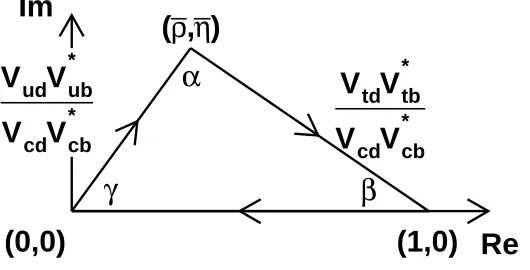
triangle” and is shown in Figure 1.1. Each angle of the triangle is given by ratios of
1.1. Flavour mixing and the CKM formalism 6
Re
Im
cb *V
cdV
ub *V
udV
cb *V
cdV
tb *V
tdV
γ
α
β
)
η
,
ρ
(
(0,0)
(1,0)
Figure 1.1: The unitarity triangle with three mixing angles and sides as a
function of the elements in the CKM matrix.
α=−arg VtdV
∗
tb VudVub∗
!
(1.8)
β =−arg VcdV
∗
cb VtdVtb∗
!
(1.9)
γ =−arg VudV
∗
ub VcdVcb∗
!
(1.10)
and can be experimentally determined via specific decay modes. A few examples
include the time dependent analysis ofB0 →J/ψ K0
S, also known as the golden mode
for measuring β, and Cabibbo suppressed modes like B → DD. Measurements of
the angles and sides have to be made through as many independent decay modes
as possible to overconstrain the triangle and to be able to probe for contributions
from physics beyond the Standard Model. All measurements are then combined into
a fit, an example of which is shown in Figure 1.2. The area of the triangle gives
a convention independent measure of the amount of CP violation in the Standard
1.1. Flavour mixing and the CKM formalism 7
γ
γ α
α
d
m
∆
K
ε
K
ε
s
m
∆
&
d
m
∆
ub
V
β
sin 2
(excl. at CL > 0.95) < 0
β
sol. w/ cos 2
excluded at CL > 0.95
α
β γ
ρ
-1.0 -0.5 0.0 0.5 1.0 1.5 2.0
η
-1.5 -1.0 -0.5 0.0 0.5 1.0 1.5
excluded area has CL > 0.95
ICHEP 10
CKM
[image:36.595.165.484.258.573.2]f i t t e r
Figure 1.2: Constraints in the (¯ρ,η¯) plane including recent measurements of
α andγ in the global CKM fit. The red hashed region of the global combination
1.2. CP violation 8
1.2
CP
violation
This section gives a brief overview of the different types ofCP violation observed in
meson decays. For a more detailed description refer to Refs. [20, 21]. In quantum
theory a transformation maps a state to another through a unitary operator U
where the unitarity condition is required to maintain normalisation. This can be
generalised by:
|Ψi → |Ψ′
i=U|Ψi (1.11)
The symmetry properties of a physical system arise by the invariance of the measured
quantities when performing a transformation. A symmetry violation occurs when a
symmetry, well-established in a class of physical processes, is broken under certain
circumstances. The discrete transfomations of interest here in particle physics are
listed below.
⋄ Charge conjugation: this is the process associated with the exchange of
particles and antiparticles under the transformation of all charges into their
opposite sign by the unitary operator, C. Charge conjugation symmetry
re-quires that for every particle, an antiparticle exists which behaves in exactly
the same way except with all its internal charges reversed.
⋄ Parity: the effect of parity transformation is defined as the inversion of spatial
coordinates with respect to an origin via the unitary operator, P. The most
common interpretation of this transformation is a process under which a
right-handed reference system becomes a left-right-handed system.
⋄ Time reversal: this is the transformation corresponding to the inversion of
the time coordinate. Time reversal invariance is simply the statement that two
processes related to one another by a reversal of all momenta and angular
mo-menta have equal rates. Since momo-menta and angular momo-menta are derivatives
with respect to time, reversing these quantities is mathematically equivalent
1.2. CP violation 9
While there is no evidence of violation of these transformations in electromagnetic
and strong interaction processes, charge conjugation and parity are found to be
max-imally violated by the weak interaction. The CP T theorem states that the product
of the three transformations is a valid symmetry and is the only combination of
C,P and T which is at, this time, believed to be an exact symmetry of Nature. CP
symmetry is the discrete symmetry which attracted the most attention
experimen-tally and theoretically, the reason being that despite its fundamental significance
and connection to time reversal symmetry through CP T, it has been found to be
violated, first in the kaon system and later on in theB meson system. In addition to
this, T symmetry violation has been observed in the neutral kaon decays as expected
as a corollary of CP violation if CP T is to be conserved [22]. CP violation can be
classified in three categories which are detailed in the following subsections.
1.2.1
CP
violation in mixing
The spontaneous oscillation of neutral mesons into their antiparticles was first
ob-served in the kaon system [23], then in the B system [24] and most recently in the
Dmeson system [25, 26]. A typical Feynmann diagram forB0B0 mixing is shown in
Figure 1.3.
b
d 0 B
d
b 0 B
W W
q=u,c,t
t , c , u = q
1.2. CP violation 10
A generic neutral mesonM0 and its antiparticle ¯M0 are defined by the
transforma-tions
CP M
0E
=ηCP
M¯
0E CP
M¯
0E=η∗
CP M 0E (1.12)
where ηCP has an arbitrary phase. The mass and lifetime eigenstates of the mixing
of M0 and ¯M0 are written in full generality as:
|Mai=pa
M
0E
+qa
M¯
0E |M
bi=pb
M
0E
−qb
M¯
0E (1.13)
CP T symmetry requires the composition of each flavour eigenstate to be symmetric
in terms of the two physical states hence the ratios of the complex parameters pa,b
andqa,b respect the following relation qpaa = pqb
b = q
p. Adopting a phase convention we
obtain the following generic relation for mixing:
|Mai=p
M 0E +q M¯
0E |M
bi=p
M 0E −q M¯
0E (1.14)
with the normalisation |p|2 +|q|2 = 1. CP violation in mixing occurs when the
physical states do not correspond to the CP eigenstates, i.e.
q p 6
= 1. (1.15)
1.2.2
CP
violation in decay
This type of CP violation occurs when the decay amplitudes of two CP conjugate
processes into two generic final states f and ¯f differ in modulus. If several
ampli-tudesAj contribute to the decay then the total amplitudeAf and its CP conjugate
amplitude ¯Af¯ can be defined in terms of the weak phase term, eiφj, and strong
phase term, eiδj, of the contributing amplitudes. The convention independent ratio
is given by:
¯
Af¯ Af = P
j|Aj|ei(δj−φj)
P
j|Aj|ei(δj+φj)
. (1.16)
CP violation in decay occurs when the physical decay amplitudes for CP conjugate
processes into final statesf and ¯f are different in modulus,
¯ Af¯
Af
1.2. CP violation 11
the presence of at least two contributing amplitudes with different weak and strong
phases. CP violation in decay can be observed by comparing the decay rates Γ(P →
f) and Γ( ¯P →f¯), where P is a generic particle decaying to a final statef. TheCP
asymmetry, ACP is then defined as:
ACP =
Γ(P →f)−Γ( ¯P →f¯)
Γ(P →f) + Γ( ¯P →f¯) (1.17)
or in terms of the decay amplitudes as follows:
ACP =
1−
A/A¯ 2
1 +
A/A¯
2. (1.18)
This is the only type of CP violation that can occur in both neutral and charged
mesons. Charged mesons are forbidden to mix due to conservation of charge and
hence exhibit only directCP violation. The measurement of directCP asymmetries
is particularly important for this analysis.
1.2.3
CP
violation in interference between mixing and decay
This type of CP violation occurs from a phase mismatch between mixing and
de-cay amplitudes for neutral mesons. When dealing with dede-cays into a final state f
that can be reached by both flavour eigenstates, a complex quantity is introduced
combining the physical states from the mixing and the decay amplitudes in:
λf = q p
¯
Af Af
=ηfCP q p
¯
Af¯ Af
(1.19)
whereηfCP is theCP eigenstate of final statef. Some of the most interesting decays
involve final states that are common to B0 and B0. This form of CP violation can
be observed using the time-dependent asymmetry of neutral meson decays into final
CP eigenstates, f, given by:
Af(t) = Sf sin (∆mdt)−Cfcos (∆mdt) (1.20)
where ∆md is the difference in the mass eigenstates of B0 meson and
Sf =
2Im(λf)
1 +|λf|
, Cf =
1− |λf|
1 +|λf|
1.3. New Physics in CP asymmetries 12
From the definitions of mixing-induced and direct CP violation, it follows that the
coefficient Sf is not zero when there is mixing-induced CP violation, while Cf not
equal to zero indicates the presence of directCP violation.
1.3
New Physics in
CP
asymmetries
Interesting results were obtained in the measurement of B →Kπ decays by the B
factories where, as the data became more and more precise, phenomenological
anal-yses could not reproduce it. The direct CP violation in the charged B± → K±π0
was observed to be different from its neutral counterpart (B0 →K+π−)
contradict-ing current theoretical predictions. This is referred to as the “Kπ puzzle” and,
although these measurements are susceptible to strong interaction effects needing
further clarifications [1], large deviations inCP violation between these charged and
neutralB meson decays could indicate the presence of new sources ofCP violation.
1.3.1
The “
Kπ
puzzle”
The decayB →Kπ occurs via two major processes: tree and strong QCD penguin
(see Figure 1.4). The interference between these two processes leads to differences
in the decay amplitudes between B and B decays. In the neutral B decay, the B
factories observed that the rate of B0 → K+π− is 10% larger than the equivalent
antiparticle decay [27]. It is expected that charged B mesons would produce the
same asymmetry. However experimental results have shown that the decays B± →
K±π0 have asymmetry of opposite sign [28, 29]. This effect is measured with a
significance larger than five standard deviations showing that it is indeed real and
was therefore referred to as the “Kπ puzzle”. Of particular interest is the difference
∆ACP which is defined as:
1.3. New Physics in CP asymmetries 13
a)
b u u s u u + W + B + K 0 πb)
b u s u u u + W + B + K 0 πFigure 1.4: Feynman diagrams for B →Kπ: (a) tree and (b) penguin.
where ACP(K+π0) and ACP(K+π−) are the CP asymmetries measured in B± →
K±π0 and B0 →K+π− respectively [30].
Decay amplitudes for B → Kπ can be described in a model independent way by
using the topological contributions involved [2],
−A(K+π−) = Vtb∗Vts(Ptc+2 3P
C
EW) +Vub∗Vus(Puc+T), (1.23)
A(K0π+) = Vtb∗Vts(Ptc−
1 3P
C
EW) +Vub∗Vus(Puc+A), (1.24)
−√2A(K+π0) = Vtb∗Vts(Ptc+PEW + 2 3P
C
EW) +Vub∗Vus(Puc+T+C+A),(1.25)
√
2A(K0π0) = Vtb∗Vts(Ptc−PEW − 1 3P
C
EW) +Vub∗Vus(Puc+C), (1.26)
The notation used in the amplitude relations represent each of the following type
of processes [31]:
⋄ T is the “colour-favoured” tree amplitude associated with the transition ¯b →
¯
uu¯s where theus¯forms one pseudoscalar meson and the ¯u combines with the
spectator quark to form the other,
⋄ Ptc and Puc are the QCD penguin amplitudes associated with the transitions
¯b → s¯ and are defined using the magnitudes of the CKM matrix elements
which multiply them, i.e. Pqc≡
V
∗
qbVqs
( ˜Pq−P˜c) [32],
⋄ PEW and PEWC are the electroweak penguin and the “colour-suppressed”
1.3. New Physics in CP asymmetries 14
⋄ C is the “colour-suppressed” tree amplitude with transition ¯b → uu¯ s¯ where
the uu¯ forms the π0 meson and the ¯s combines with the spectator quark to
form the kaon,
⋄ Ais the annihilation process contributing only to charged B decays by means
of the exchange of a W boson.
The theoretical results shown in Table 1.1 follow from a diagrammatic approach,
which makes use of existing measurements and SU(3) flavour to predict decay rates
and asymmetries. This method is based on the principle that a certain hierarchy
between amplitudes can exist [34]. The theoretical fit is performed using
theoreti-cal input parameters, such as form factors and CKM parameters, and experimental
observables. By removing one of the inputs from the fit, a prediction of the
corre-Table 1.1: Experimental results [33] and theoretical fit predictions for the
branching fractions andCP asymmetries for allB →Kπ and∆ACP, obtained
using the diagrammatic approach. C(K0 Sπ
0) and S(K0 Sπ
0) are the parameters
of the time-dependent amplitude in Eq. 1.20. The fit prediction of ∆ACP is
obtained by removing both ACP(K+π0) and ACP(K+π−) from the fit [1].
Decay Mode HFAG average fit prediction
B(K+π−) [
×10−6] 19.4±0.6 19.7±1.0 B(K+π0) [×10−6] 12.9±0.6 12.4±0.7 B(K0π+) [×10−6] 23.1±1.0 24.9±1.2 B(K0π0) [×10−6] 9.8±0.6 8.7±0.6
ACP(K+π−) [%] −9.8±1.2 3.9±6.8
ACP(K+π0) [%] 5.0±2.5 −6.2±6.0
ACP(K0π+) [%] 0.9±2.5 6.2±4.5
C(K0 Sπ
0) 0.01±0.10 0.10±0.03
S(K0 Sπ
0) 0.57±0.17 0.74±0.04
1.3. New Physics in CP asymmetries 15
sponding experimental observable is obtained.
An alternative approach obtains the decay rates andCP asymmetries of these decays
within the framework of QCD factorisation (QCDF). QCDF formalism allows to
compute systematically the matrix elements of the effective weak Hamiltonian for
b → s transitions and therefore extrapolate the decay amplitudes for B → πK
and πK∗ from first principle. The strength of this method is that it also allows
estimates of some suppressed contributions such as the annihilation corrections.
The QCDF results together with the current experimental world averages are given
in Table 1.2 [35]. As expected in the SM, the CP asymmetry of B+ → K+π0 is
predicted also by this method to be very close toB0 →K+π− so that ∆A
CP ≈1.6.
This prediction agrees with the theoretical fit value of ∆ACP in Table 1.1.
Table 1.2: Branching ratios (in units 10−6) and direct CP asymmetries (in
units 10−2) obtained from the QCDF method [35].
Decay Mode BF (×10−6) A
CP (%)
B+ →K+π0 12.5±1.6 −10.8±0.8
B0 →K+π− 22.7
±3.3 −12.4±0.7
Both of these methods contribute to show that it is very hard to accomodate a
large value of ∆ACP in the SM with the methods available for hadron-dynamics
in B decays. An explanation for this effect is that other processes that
preferen-tially produce u quarks rather than d quarks might affect the asymmetry, such as
electroweak penguins. Alternatively the difference could be due to exotic particles
entering the loop diagrams and altering the decay rates of charged B mesons [36].
All of the above amplitudes involve unknown strong phases limiting the accuracy
of the prediction for the amplitudes of B → Kπ decays. Given this, New Physics
1.3. New Physics in CP asymmetries 16
1.3.2
The “
Kπ
” puzzle in the
K
∗π
system
B → K∗π decays via identical tree and penguin processes as B → Kπ but with
different weights associated to the contributing processes. The amplitudes for the
K∗π decays follow easily from Eqs. 1.23–1.26. Figure 1.5 shows all the processes
contributing to B+ → K∗+π0. The method described below uses broken flavour
SU(3) and existing measurements to calculate ratios of tree (T) to penguin (P)
amplitudes and infer the maximal potentialCP asymmetry of B →K∗π compared
to B → Kπ. The values of these ratios are estimated by relating within SU(3)
flavour the amplitudes of these processes to those forB0 →π+π− and B0 →ρ+π−.
This method is presented in detail in Ref. [2]. Table 1.3 shows the dominant terms
in the amplitudes of these decay modes, with branching fraction andCP asymmetry
averages, where the extra terms in the dominant amplitudes ofπ+π− andρ+π− are:
⋄ ˜λ= 0.232 – a constant term dependent on the Wolfenstein parameter, λ [37],
⋄ two ratios of meson decay constants fπ/fK = 0.84 and fρ/fK∗ = 0.96 [38].
An estimate of the amplitude ratios is then given by:
|TKπ| |PKπ| ≃
˜
λ fK fπ
!vu u t
rτB(π+π−)
B(K0π+) (1.27)
|TK∗π|
|PK∗π| ≃
˜
λ fK∗ fρ
!vu u t
rτB(ρ+π−)
B(K∗0π+) (1.28)
whererτ is the ratio of the lifetimes of the charged and neutral B mesons. Including
quadratic corrections in the estimates for the strong phase difference betweenP and
T, the following bounds are obtained for the ratios in Kπ and K∗π:
0.09≤ |TKπ|
|PKπ| ≤
0.16 0.28≤ |TK∗π|
|PK∗π| ≤0.35 (1.29)
The conclusion is that the ratio of the amplitudes in B → K∗π is between two to
three times larger than the corresponding ratio in B → Kπ. The decay B+ →
1.3. New Physics in CP asymmetries 17 b u u u s u + B *+ K 0 π b u u u s u + B 0 π *+ K
“Colour-favoured” Tree (T) “Colour-suppressed” Tree (C)
b u s u u u +
B K*+
0 π b u s u u u + B *+ K 0 π
“Colour-favoured” EW penguin (PEW) “Colour-suppressed” EW penguin (PEWC )
b u s u u u + B *+ K 0 π b u s u u u + B + W 0 π *+ K
[image:46.595.127.555.192.660.2]QCD penguin (Pqq) Annihilation (A)
1.3. New Physics in CP asymmetries 18
Table 1.3: Amplitudes, branching fractions and asymmetries for B → Kπ
and B → K∗π modes, including B0 → π+π− and B0 → ρ+π−. Branching
fraction and ACP averages are taken from Ref. [33].
Mode Amplitude B(10−6) A
CP
B+→K0π+ P 23.1±1.0 0.009±0.025
B0 →K+π− −(P +T) 19.4±0.6 −0.098+0.012
−0.011 B+→π+π− λP˜
−λ˜−1T fπ fK
5.16±0.22 0.38±0.06
B+ →K∗0π+ P 9.9+0.8
−0.9 −0.038±0.042 B0 →K∗+π− −(P +T) 8.6+0.9
−1.0 −0.18±0.08 B+ →ρ+π− ˜λP
−˜λ−1T fρ fK∗
15.7±1.8 0.11±0.06
hence the asymmetry in this mode could potentially be two to three times larger
then the corresponding processes in Kπ. Because of the non-negligible width of
the K∗ resonance, these quasi-two-body modes are best studied via the analysis
of the three body decay. Figure 1.6 shows the four K∗π decays together with the
corresponding three body decays where they can be studied.


![Figure 2.9: Expected K/π separation as a function of track momentum [48].](https://thumb-us.123doks.com/thumbv2/123dok_us/9683621.469882/62.595.234.431.134.288/figure-expected-k-p-separation-function-track-momentum.webp)