P
OWERED BY THE POLIS
How post materialistic values in consumers enable usage of renewable energy sources in a consumption economyTom van Eerde master thesis
MSc Philosophy of Science, Technology, and Society - PSTS
University of Twente,
Faculty of Behavioural, Management, and Social Sciences. Enschede, the Netherlands.
First supervisor: Prof. dr. P.A.E. Brey
Second supervisor: Dr. J.H. Søraker
S
UMMARY
It has been argued for several decades that the fossil-fuel powered methods of generating energy are causing environmental degradation and should therefore be replaced by other means of energy generation which do not suffer from these problems. This argument has so far not led to a word wide switch towards renewables, as at present about 10 per cent of global energy is generated in a
sustainable fashion. This has to do with the fact that negative future consequences of using fossil-fuel powered methods of energy generation are presently not accounted for in their price, which mean that they are considered as cheaper in use compared to renewables.
In this thesis I apply insights into the changes which have taken place in values which people hold dear in present western-style societies. These insights have been developed – in empirical fashion – by Inglehart and Schwartz, and show that values in western-style publics have consistently moved from those values which are considered as ‘materialist’ to those which are considered as ‘post materialist’.
I argue that post materialist values lend themselves ideally in a role as motivating reasons for consumers in western-style consumer economies to invest or participate in the acquirement of renewables; despite of their economic disadvantage. This repositions renewables as a means for consumers to be able to acquire value-congruent products and services, which increase their
subjective well-being as well. In this way renewables add value for those consumers, instead of ‘take’ value, because such products are being acquired based upon their added value, instead of individual responsibility by a consumer.
In order to further support this argument I present two perspectives on respectively the constraints which technological artefacts have and their social contexts, in order to provide two concrete methods for producers of sustainable products and services to derive characteristics of their
products. These characteristics could then be assessed as being value (in)congruent with a particular position in Schwartz’ value model. This provides concrete directions for either design changes or marketing and framing efforts designed to optimize the fit between renewables and post materialistic values.
Finally I discuss the extent to which consumers are able to concretely ‘act’ upon their values, and provide two strategies, based upon empirical research, for persuading consumers to behave according to their values.
Contents
Summary ...
Chapter one: Introduction ... 1
Chapter two: The need for sustainable energy generation, associated technological challenges and proposed solutions ... 3
2.1 Energy and power ... 4
2.2 Energy-intensive technologies and electrical power ... 5
2.2.1 Internal and external energy sources... 6
2.3 (sustainable) energy generation methods ... 7
2.3.1 Required energy production ... 7
2.3.2 Current electrical energy production mix ... 9
2.3.3 Environmental impact of producing the current electrical energy production mix ... 9
2.3.4 Technological solutions for addressing environmental impact of current electrical energy production mix ... 10
2.4 When and why energy becomes sustainable: a systematic approach ... 12
2.4.1 Current approaches for addressing environmental degradation... 13
2.4.2 Future practices for addressing environmental degradation: The next industrial revolution ... 14
2.5 economic future of renewable energy sources... 15
2.5.1 A Technological future of renewable fuel sources ... 15
2.5.2 A economic future for renewable energy sources ... 16
2.6 Conclusion ... 17
Chapter three: Post materialistic values as motivational reasons for consumers ... 19
3.1 Values and value systems: Inglehart ... 20
3.1.1 Research into values ... 20
3.1.2 Value systems ... 22
3.2 values, Value systems & relationship to behaviour: Schwartz (reason three) ... 29
3.2.1 The schwartz value model ... 30
3.2.2 Schwartz and Inglehart... 31
3.2.3 Schwarz’ model and criticisms ... 32
3.3 Conclusion ... 34
Chapter four: Renewable energy technologies situated in the contemporary consumption economy ... 36
4.1 Classic producer’s economic approach of product and value ... 36
4.1.1 Determining production factor value – a matter of (in)clusion ... 36
4.1.2 Secondary production factor values for non-renewables ... 37
4.1.3 Secondary production factor values for non-renewables ... 38
4.2 Classic consumer’s economic approach of product and price ... 38
4.2.2 Utility ... 39
4.2.3 Utility and well-being ... 40
4.2.4 Diminishing marginal utility, well-being and values ... 40
4.3 Design and marketing for post materialist consumers ... 41
4.3.1 A decision model of consumers ... 41
4.4 Conclusion ... 42
Chapter five: Post materialistic values applied as a motivational tool for fostering adoption of sustainable energy ... 44
5.1 Development of a producer’s method to include post materialist values ... 45
5.2 Post materialist values ... 46
5.2.1 Market research in audience characteristics ... 46
5.2.2 Define a target audience/market segment ... 47
5.2.3 A value research method ... 48
5.3 Establishment of characteristics of artefacts and services ... 50
5.3.1 Artefacts and their relation with the world ... 50
5.3.2 A perspective from the artefact ... 52
5.3.3 Perspective from the artefact’s environment ... 54
5.3.4 A combination of both perspectives ... 57
5.4 practically linking qualities of artefacts and their social contexts to values ... 58
5.4.1 Design & marketing and perspectives from the artefact as well as its social context ... 58
5.4.2 A consumers’ decision ... 62
5.5 Values and behaviour revisited ... 62
5.6 Decide upon design and marketing or framing alternatives ... 63
5.7 Conclusion ... 64
Chapter six: Conclusion and further research ... 65
Further research ... 66
1
C
HAPTER ONE
:
I
NTRODUCTION
Ever since the club of Rome’s “Limits to growth”-report came out in the early seventies it has been evident that the sustainability of western societies’ consumption economy is limited. In this report the issue of environmental degradation and possible consequences has been put to the fore, however with few concrete implications in day-to-day practice. Scientists and climatologists are in agreement that issues such as pollution, climate change and resource depletion are serious and will have to be addressed at a certain point in time in which earlier action is easier than later action. However, so far insufficient urgency has been raised for the issue, with the lack of concrete action after the ratification of the Kyoto-protocol being the negative ‘cherry on the pie’. It remains to be seen whether the latest Paris climate accord will change this practice in reality.
In order to address the situation that renewables are considered desirable, however are not having the uptake which is deemed necessary as of the 1970s I have formulated the following main research question:
“How could renewable energy generation technologies be designed and marketed in such a way that they fit optimally with post materialist values in consumers”
I depart from the position that this lack of action is largely due to two reasons:
Firstly (1), responsibility for environmentally degrading practices is shared among many different actors causing difficulty in assigning concrete restorative action towards those responsible.
Secondly (2) the large separation both in time and space between causes and effects of
environmental degrading practices limits our ability for sensing urgency for addressing the problem. This means that no pressure is applied onto relevant actors for coming up with a solution towards stopping environmental degradation.
In order to address both issues regarding how to limit environmental degradation this thesis proposes a single approach for addressing both issues.
In order to do so I have broken up my main research question into four sub-questions which taken collectively answer the main research question.
Firstly, I answer the fundamental question about what sustainable energy generation is, and what are its associated technologies. Furthermore, I discuss how are they are situated in the (future) economic market. Here I conclude that technological limitations are not the main reason for the lack of uptake for renewables.
Secondly, I discuss post materialistic values, how their historical development is characterized, and how they are related to behaviour. Here I conclude that the prevailing values in western economies have slowly shifted in a particular direction, namely those values which are considered as post materialistic.
Thirdly, I use economic theory in order to answer what design and marketing issues are of
2 depletion and pollution, meaning that for the time being renewables will be more expensive when viewed in economic terms.
Finally, and I combine the conclusions from the previous chapters to theorise as to how producers and marketers of sustainable electricity technologies could exploit design and marketing efforts in their products and services. This in order to let their products and services appeal to post
3
C
HAPTER TWO
:
T
HE NEED FOR SUSTAINABLE ENERGY GENERATION
,
ASSOCIATED
TECHNOLOGICAL CHALLENGES AND PROPOSED SOLUTIONS
Technologies play a vital role in enabling the spectacular growth and survival of the human population in the past two centuries. As of about 1750 extensive usage of energy-hungry technologies start to take off. Mechanized food production, water treatment and the heating or cooling of our shelter by technological means have enabled our species to grow their numbers considerably while increasing lifespan; health and comfort.
Interdependence between growth of western societies and technological developments which support it could be considered as a socio-technical system in which both technologies and humans thrive and co-evolve into a shared future. It is however not free of problems, among one in particular is the problem of environmental degradation associated with the production and usage of
technologies.
Resource depletion, climate change and loss of biodiversity in particular are important undesirable aspects of environmental degradation. These issues need to be addressed if we are to continue to build a thriving society which relies on the extensive usage of energy-hungry technologies which support it. This becomes especially important if we consider the needs of future generations (Gardiner, 2004).
Most of the technologies used in western societies on a day-to-day basis, such as fridges and telephones, require energy in order to be able to function. This means that a certain amount of energy has to be produced in a particular timeframe for powering them. The activity of producing energy is an example of a technological practice which is extensively used and which has particular degrading effects on the environment. That is why I have selected power generation technologies, and electrical power generation technologies in particular, as the technology of focus in this thesis.
It has been argued that one solution for addressing environmental degradation by usage of energy-intensive technologies could be to lower their usage or stop their usage altogether. This solution, which is probably effective in diminishing environmental degradation, does however have at least one problematic drawback. Technologies which are associated with causing environmental
degradation are the same which are responsible for improving western-societies’ quality-of-life in the first place. It is hard to argue that a life without disease control, mechanized food production and water treatment is desirable, or even possible for that matter, with current population numbers. That is why I will focus my attention upon technological solutions for generation large amounts of sustainable electrical energy, instead of changing energy consumption levels.
4
2.1
E
NERGY AND POWERThe concept of energy is abstract and difficult to define without losing some of its meaning. Effectively it is a description of a characteristic in a thermodynamic system, and in practice this means that politicians and theoretical physicists are not talking about the same concept (Dincer, 2002; Dincer et al., 2001). Politicians usually refer to the ‘power’ when they say ‘energy’, which is confusing and therefore I will elaborate it here.
What I am about to elaborate could be seen as simplistic by engineers. Knowledge about thermodynamic concepts such as enthalpy, entropy and exergy would be needed in order to provide an adequate analysis. However, for my line of reasoning it is unnecessary to delve into the specifics of how exactly to determine power usage and discuss ways to determine it or optimize it. That is why I will stick to energy in the applied form of power – for fridges and telephones - for specifying and clarifying practical issues regarding using technologies on a large scale.
Energy can be characterized as the potential of a system to deliver useful work (for us). For physicists it is the result of a force acting over a distance, as evident in the description of the unit of measure for energy: the joule (for a definition of which I quote the SI):
“The joule is the work done when the point of application of 1 MKS [Metre, Kilogram or Second] unit of force [newton] moves a distance of 1 metre in the direction of the force” (Page et al., 1974, P. 21).
A certain amount of joules is thus representative for an amount of work necessary in order to perform a certain task. For example, it takes 1 joule to lift a mass of 100 grams one metre upwards on Earth, and when such a mass falls downwards one metre, 1 joule of energy has been moved. Important to mention at this point is that de dimension of time does not – yet - play a role in this concept of work. For example, if a person would lift the apple in one, two or three seconds, still the same amount of energy would be required for this task. This characteristic is important to consider because it is related to the environmental impact of energy-intensive technologies. I will explain this with an example:
Suppose one would want to move a 100-gram apple one metre upwards, 1 joule of energy would be required. If the amount of time would be limitless, one could spend an infinite amount of time for moving the apple; because the amount of work (1 joule) remains constant. However, in practice time is limited, which means that the work will have to be performed in a certain limited amount of time. This requires a certain amount of energy moved per unit time: this is called ‘power’. If one would for example spend no more than 300 seconds (five minutes) for moving 1 apple; at least 1/300=0.003 joules should be available per second. Energy related to time is thus what defines power in practice. This amount of joules per unit time is relevant because it specifies power usage of a certain process at a certain speed.
5 of supportive technologies is that they enable us to perform tasks at a much faster pace compared to performing such tasks without them. This brings energy in relation to time, and the amount of energy delivered per unit time is as such a more relevant unit for us both on a day-to-day basis. The SI-unit for measuring power is the number of joules per second, or watts.
In order to provide some perspective, a healthy well-fed labourer can deliver a continuous mechanical power output of about 75 watts over an eight-hour shift. This means that for every hour this worker is working, 75 watts of useful energy will have been moved. A trained cyclist can manage a sustained power output of about 400 watts in the course of an hour, after which such a cyclist would have moved 0,4kWh of energy (Avallone, 2007). In comparison; the average electrical car uses about 20 to 25 kWh for driving 100 kilometres (fueleconomy.gov, 2015), and the average Dutch household (2.2 persons) energy usage for electricity amounts to about 3500 kWh a year (Milieucentraal, 2015).
This means that in order to produce such an amount of energy (3500kWh) in one year by an average human workforce, you would need roughly 26 persons in a fulltime “40-hours a-week for 45 weeks a year” working pattern, just to produce the energy to power one household’s amount of electrical energy.
The orders of magnitude at stake leave us with the conclusion that:
- If we continue to make use of energy-intensive technologies in order to continue present societal models.
- And desire to address environmental degrading practices associated with fossil fuel use.
The practice of saving energy or creating more efficient energy-intensive technologies will at best only be a part of the solution.
In other words, although important in preventing environmental degradation, lowering energy consumption is not a viable long-term alternative for addressing the side-effects of large-scale energy generation. This is because even when we would put power consumption levels at one tenth of current levels; we would still need technologies with which we are able to deliver power.
Finally, the usage of the terms ‘energy’ and ‘power’, where ‘power’ seems to be the most appropriate is omnipresent. Within the scope of this thesis it is safe to assume that energy and power can be used interchangeably, and for stylistic reasons I will do so.
2.2
E
NERGY-
INTENSIVE TECHNOLOGIES AND ELECTRICAL POWERScientific debate about the relationship between human (technological) activities and environmental degradation has shifted focus in the late twentieth and early twenty-first century (Brown, 2002). The issue has moved from the question of whether this influence exists, towards the extent of it and ways to address it (Gardiner, 2004). Either way, the – perhaps long-term - necessity of changing towards an economic model, and associated technological practice, which causes less environmental degradation can be considered as a given. Especially if western-style consumer societies continue to expand and develop into the future similarly to the way they have in the past centuries.
6 al., 2009; Williams et al., 2012). Examples of electrically powered technologies which are able to help address environmental degradation issues are heat pumps, electrical vehicles and IT hardware. All of which require large amounts of electrical energy. Therefore, it is reasonable to assume that
developing an answer to the question of how to generate electricity in a sustainable fashion will aid in addressing environmental degradation on a substantial level.
In the previous sections I have established that energy-intensive technologies are necessary in order to run present western-style societies. In order to clarify further when energy usage can be
considered as causing environmental degradation I will distinguish ‘external’ and ‘internal’ energy in order to clarify when energy usage becomes problematic in the sense of it being sustainable on the long run.
2.2.1
I
NTERNAL AND EXTERNAL ENERGY SOURCESTechnologies such as those mentioned in the previous section require more energy than can reasonably be delivered by ancient power sources. Before the industrial revolution commenced, technological artefacts were applied as well in transportation systems or agriculture, however they relied on power sources such as human labour, beasts of burden and natural sources of energy such as wind (e.g. sailing) and sun (e.g. drying and growing crops). This is what I label as ‘internal energy sources’, or sources of energy in which the process of extracting energy takes place at roughly the same pace as it is generated.
These power sources can be characterized by them drawing power from renewable long-term energy sources in the same pace as their sources were able to provide energy (such as the sun).
Furthermore, they have a relatively low energy density, which mean that they do not consume or transfer energy in a rate which is close to technologies developed during the industrial revolution in which energy was required in much larger quantities.
This development is important because it has necessitated us to generate energy from sources which are able to deliver power at a (much) faster pace compared to the past, it is these sources which I label as ‘external energy sources’. External energy sources are those which are able to provide usable power at a rate which is much higher than the rate it has taken them to develop. This increase in pace is of specific importance if we take environmental degrading practices into account because generating large amounts of power by renewable sources is difficult due to the sheer quantity of power required.
The technological solution applied for this large power demand has been the usage of fossil fuel sources which have been naturally stockpiled in the past. These have a high energy density and do not require effort to develop due to them being effects of long ongoing natural processes. They are therefore preferred as a power source. These fossil power sources have at least two fundamental issues:
1. In the end every stockpile is limited, and fossil fuels are no exception. This means that the availability of such fuels will become problematic at some point in time, perhaps on the (very) long run.
7 Preventing resource depletion and pollution are therefore two important reasons for the desirability of moving towards other means of power generation, namely those who do not suffer from the above drawbacks.
Energy sources which comply with the characteristic of internal energy and are also able to deliver power on the rate which modern societies require are available in the form of renewables.
They have the same qualities as those used in the past regarding using energy from a long-term (and thus sustainable) source. Furthermore, technological developments have lead them to be a viable alternative for fossil fuels in the foreseeable future as I will explain below.
2.3
(
SUSTAINABLE)
ENERGY GENERATION METHODSGiven the fact that we need to produce energy to power our societies’ technology, several options are available to us for meeting this need. Below I will explain what our current energy needs are, with which methods we are currently meeting this need and why this fosters environmental degradation. Also I will further narrow my focus on a specific types of energy production, namely electricity. Finally, I will present methods which address the issue of generating power while taking into account the issue of environmental degradation.
2.3.1
R
EQUIRED ENERGY PRODUCTIONCurrent energy needs could be seen as a benchmark for which to design an energy production system. It is unfeasible to discuss the energy usage of the entire planet due to limitations in datasets, therefore I will limit my discussion to energy usage in the Netherlands. It is my expectance that energy usage of the Netherlands per capita is comparable to other western EU-countries due to similar lifestyles and technological development levels, however this remains merely an assumption.
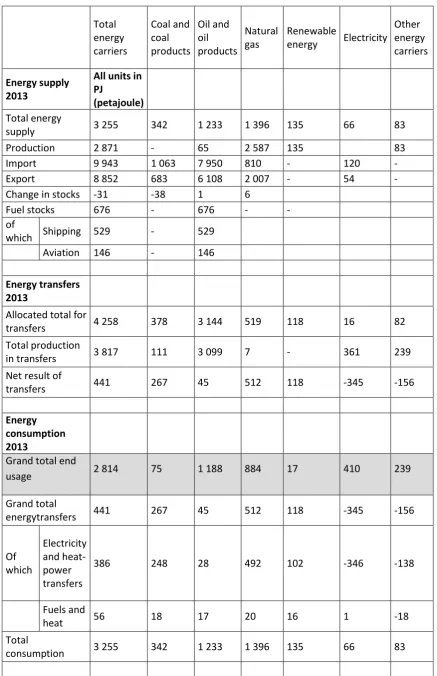
Measuring the power used in a geographical area such as a country is difficult because not all energy is generated and used in the same spot. Also, different countries have different net energy usages compared to what they import or export. The statistics office in the Netherlands has however provided figures which roughly estimate the energy usage in the Netherlands.
8 Total energy carriers Coal and coal products Oil and oil products Natural gas Renewable
energy Electricity Other energy carriers
Energy supply 2013
All units in PJ
(petajoule)
Total energy
supply 3 255 342 1 233 1 396 135 66 83
Production 2 871 - 65 2 587 135 83
Import 9 943 1 063 7 950 810 - 120 -
Export 8 852 683 6 108 2 007 - 54 -
Change in stocks -31 -38 1 6
Fuel stocks 676 - 676 - -
of
which Shipping 529 - 529
Aviation 146 - 146
Energy transfers 2013
Allocated total for
transfers 4 258 378 3 144 519 118 16 82
Total production
in transfers 3 817 111 3 099 7 - 361 239
Net result of
transfers 441 267 45 512 118 -345 -156
Energy consumption 2013
Grand total end
usage 2 814 75 1 188 884 17 410 239
Grand total
energytransfers 441 267 45 512 118 -345 -156
Of which Electricity and heat-power transfers
386 248 28 492 102 -346 -138
Fuels and
heat 56 18 17 20 16 1 -18
Total
[image:12.595.69.507.65.742.2]consumption 3 255 342 1 233 1 396 135 66 83
9 Total production of energy results in 3255PJ (petajoule), of which the vast majority is derived from oil (1233PJ) and natural gas (1396PJ), accounting for over 80 per cent of energy production.
Consumption wise the row labelled ‘grand total end usage’ is relevant for my purposes (marked green). Given the fact that electricity is generated using several energy sources the direct consumption of electrical energy ‘directly as electricity’ is 66PJ (and thus depends on the form in which this energy enters the country, usually imports). Total electricity consumption amounts to 410 PJ (petajoule), or roughly 113 billion kWh.
2.3.2
C
URRENT ELECTRICAL ENERGY PRODUCTION MIXEnergy sources for producing the total amount of 410PJ of electrical energy consumed are found primarily in natural gas (492PJ of which is allocated for combined electricity and heat production) and coal (248PJ of which is allocated for combined electricity and heat production). 102PJ of present energy production (all types of energy) is renewable and allocated for the production of electricity and heat.
According to the statistics office, 43PJ of electricity production in the Netherlands is produced using sources which are renewable (CBS, 2015). This means that in the Netherlands, 43PJ out of 410PJ (10,5%) of electrical energy is produced using renewable production methods.
In the Netherlands, most electrical energy is produced by making use of either coal or natural gas. Both of which result in resource depletion and cause pollution (primarily in the form of CO2, which
itself is harmless but is believed to indirectly cause global warming). This means that almost 90% of electricity presently consumed in the Netherlands contributes to resource depletion and pollution.
If oil and gas are no longer applied as an energy source in a direct form, such as for powering vehicles and heating systems, a substitute will have to be implemented. Present alternatives for oil and gas usually rely on using electricity as an energy carrier, stored in batteries (vehicles) or consumed directly using efficient systems (heat pumps). This means that the total amount of 410PJ is going to be much larger in the future, given that the clean characteristics of electricity will lead it to substitute oil and natural gas as an energy carrier.
2.3.3
E
NVIRONMENTAL IMPACT OF PRODUCING THE CURRENT ELECTRICAL ENERGY PRODUCTION MIX Environmental degradation as a problem is usually understood as being a prudent one. This means that environmental degradation has something to do with the quality of our environment for us. When and to what extent the quality of our environment has intrinsic quality is an ongoingphilosophical discussion, it is however not necessary to engage in this discussion in order to properly assess the possible negative consequences of continued use of fossil fuels.
Other, more mundane, reasons are sufficient for motivating the necessity for a different
technological practice for generating energy. Here I argue in favour of two of the most powerful.
(1) Large-scale energy production using fossil fuels causes resource depletion, which mitigates possible negative consequences now by moving them towards the future.
10 First (1) I will argue for the former by using (again) the Netherlands as an example. The Netherlands are in possession of a large field of natural gas located in the northern part of the country. Currently it is estimated that the gas field originally contained roughly 2750 billion cubic metres of usable natural gas, which has led to the development of a national natural gas grid and extensive
dependence un natural gas for heating and selling to other countries. It is estimated that the current energy reserve of the field is roughly 1075 billion cubic metres of natural gas, the remainder of 1675 billion cubic metres has either been sold to foreign countries or used for heating and electricity production. Natural gas is a resource which has a high energy density and requires relatively little treatment in order to be practically used. Natural gas is formed through processes in which remains of early life are compressed and heated in natural processes which result in large deposits of high-quality energy stored as natural gas. Developing energy systems dependent on this gas suffer particularly from the problem of having a faster pace of consumption compared to the rate to which they could be replenished, and as such can be considered as being a form of ‘external energy’ which is not replenish able. On average it takes about 60 million years for natural gas to form, and it will (probably) take less than a hundred years to deplete the Dutch reserve, over half of which has already been consumed.
Furthermore, regarding the second (2) issue, large-scale combustion of natural gas aids to the problem of global warming through increased levels of CO2-gas in the atmosphere. Climate change is
expected to have dramatic effect on the lives of many people, especially those who are poor and living in areas which are prone to floods due to rising sea levels.
Both of the above effects are characterized by having short-term advantages at the expense of long-term disadvantages. A particularly troublesome aspect of such practices is that they might be considered as being unjust to future generations; whom are no party in deciding what to do with current resources; however it could be argued that in principle they have similar rights to such resources(Gardiner, 2004). That means that it would be prudent and logical to develop or start using resources which can be replenished by the same generation that has benefited from its production, and have no long-term ill effects. The desirability for switching towards more sustainable forms in which to organize our society has been evident since at least the club of Rome report in the early seventies. However, many barriers prevent its widespread adoption which I will discuss in section 2.4 and 2.5.
2.3.4
T
ECHNOLOGICAL SOLUTIONS FOR ADDRESSING ENVIRONMENTAL IMPACT OF CURRENT ELECTRICAL ENERGY PRODUCTION MIXIn the history of electricity production, a large array of technologies has been proposed and applied, of which only a small part of is to be considered as being sustainable. A sustainable energy source is one which can be replenished in the same amount of time it is used, or does not require
replenishment.
A source of energy which does not contribute to environmental degradation and is readily available is the sun. Energy sources which extract their energy from the sun – either directly or indirectly – can therefore be considered as fundamentally - as I will explain further in section 2.4 - sustainable.
11 technological issue. Instead adoption is impeded by other barriers such as political or economic commitments or requires systematic changes necessary to implement them. Three technologies which adhere to the above characteristics and produce electricity are:
- Solar PV-panels, which are able to convert energy from the sun directly into electricity. o If one would want to generate 410PJ of electrical energy, roughly 475 million
standard-size solar PV panels would be necessary.
Discrepancies in time between supply and demand have not been taken into account.
o If one would want to power the entire Dutch electricity demand by using current 15% efficient solar PV panels, when laid out flat they would take roughly two times the surface area of the Netherlands.
- Wind turbines, which convert wind directly into electricity. This is a derivative of solar energy because wind is powered by pressure differences in the air which in turn develop because of solar irradiation.
o Large wind turbines have a shaft height of about 100 metres, have a blade radius of about 35 metres and deliver a peak power of about 3MW. Their production factor (percentage of time when operating at peak capacity) is roughly 22 for the
Netherlands, which means that such a turbine delivers about 5782mWh/year. o If wind power was to be used to produce 410PJ of electrical energy, roughly 20.000
3MW wind turbines would be necessary.
Discrepancies in time between supply and demand have not been taken into account.
- Biogas combustion for electricity which is generated through fermentation processes (biomass).
o Fermenting for biogas requires input which to ferment. This can be a large variety of organic materials such as animal waste, landfill waste or industrial by-products. o It is also possible to use crops which have been grown with the purpose of being
used to generate energy, so-called energy crops. They could be considered as unsustainable because of ‘food-for-fuel’-issues; in which some opponents argue that using arable land for the production of energy crops is unethical because food prices will rise, which for some parts of the world is clearly a problem. However, it is a technological solution to the question of how to generate sustainable energy
Maize is often used as a bio crop due to favourable characteristics. Though yields vary significantly, roughly 284031MJ per acre can be
generated in the form of biogas from maize as an energy crop.
Using biogas as a source for electricity production is roughly 37% efficient, which means that 284031MJ of biogas is transformed into 105000 MJ of electricity; which amounts to 29192kWh.
12 Taken together the above three technologies could be applied in order to replace current fossil fuel based power plants. The energy requirements of western societies are tremendous, and therefore it is important that these requirements are reduced significantly in order to let sustainable energy sources be a viable alternative. This thesis is however not primarily concerned with the technological specifics of a sustainable economy; much more emphasis is placed on the way in which fossil-fuel technologies and humans co-evolved into what it is now. Even more important is to develop a model in which this human-technology relationship could develop into one which is sustainable.
2.4
W
HEN AND WHY ENERGY BECOMES SUSTAINABLE:
A SYSTEMATIC APPROACH In the previous sections I have argued that:1. As the industrial revolution took off our energy consumption levels necessitated us to apply what I have labelled as ‘external’ energy sources. These are sources which take (much) more time to replenish their energy than the time to extract it.
2. Energy production by technological means is necessary if we are to continue our present way-of-life as a society.
3. Reducing current levels of energy consumption is useful, however at best only part of the solution towards realising a completely ‘internal’ energy system.
4. Side-effects of the current production methods of energy should be addressed, and the most important issues to address are fossil fuel resource depletion and preventing pollution.
Current practices for addressing environmental degradation effects associated with power generation are often focused on reducing power consumption. I argue, following McDonough & Braungart, that reduction only can never amount to a serious long-term solution for stopping environmental degradation (McDonough et al., 1998).
Given the fact that we are able to generate more power than we are able to supply with our bodies – or other forms of ‘internal’ energy for that matter - means that our societies have been able to use more power than they are able to produce in their lifetime. According to the second law of
thermodynamics energy cannot be produced as such; it is merely transformed in its appearance and potential and as such energy is never lost. This means that the activity of energy generation,
transformation, transportation and storage is what we are discussing when the issue of power generation is at stake.
As such a discussion about power generation is necessarily about the activity of converting energy from one form to the other and stockpiling it, often into a relatively compact form depending on desired technological application. The question about what exactly is sustainable energy generation is important to consider in order to be able to answer the main research question. Therefore, the relevant subject of analysis with regards to the activity of energy generation are its associated technologies. Current methods of energy generation rely on stored energy from the sun; mostly in the form of oil, natural gas or concentrated pockets of carbon deposits (Drobinski, 2012).
13 data about energy generation practices in clarifying the distinction between sustainable and
unsustainable practices. Finally, I will discuss a possibility of a fundamentally sustainable economy as discussed by McDonough and Braungart (1998). This leaves us with a technological option for fundamental change in energy generation methods; the way in which such a technological option could actually be adopted is further discussed in chapter 3, 4 and 5.
A generic definition of the word ‘sustainable’ is: “pertaining to a system that maintains its own viability by using techniques that allow for continual reuse” (Dictionary.com, 2013). This definition is not compatible with current policies by governments and businesses which are being labelled as ‘environmentally friendly’ or ‘sustainable’. This is because current approaches by companies and governments towards sustainability are being described as the approach of reduce, reuse and recycle (the ‘three R’s-approach’) by William McDonough and Michael Braungart (McDonough & Braungart, 1998). Such approaches focus on the reduction of energy consumption of industrial processes, reusing of artefacts and recycling waste products. The net result is that the process of environmental degradation is slowed down; instead of halted and as such this does not address the issue of
environmental degradation effectively. Therefore, I have introduced the term ‘fundamentally sustainable’ in order to be able to make a distinction between general popular use of the word ‘sustainable’ and its proper meaning.
The ‘three R-approach’ is potentially dangerous because of several reasons, of which some have consumer and producer behavioural effects and others are located in the practical domain.
2.4.1
C
URRENT APPROACHES FOR ADDRESSING ENVIRONMENTAL DEGRADATIONThe three R-approach is potentially dangerous because it can lead to a situation known as Jevon’s paradox (Alcott, 2005). This paradox, although very difficult to prove empirically; holds that with increased efficiency of products and services, they will also be used more and as such damage the environment even more by consuming more net energy. A practical example of this paradox is the increase in distance driven in an energy-efficient car, in which the additional distance travelled outweighs the energy efficiency gains of the vehicle. This practice leaves the environment in a more degraded state compared to the alternative less environmentally friendly vehicle.
Furthermore; the publicity related to the three R’s approach allows both governments as well as the consumer to think that the problem of environmental degradation is being adequately dealt with (Peattie et al., 2005). This is predominantly due to marketing practices using terms as ‘green’,
‘environmentally friendly’ and ‘sustainable’. Packaging solutions which are less polluting, and as such labelled as ‘environmentally friendly’, and marketing fuel efficient cars as ‘green’ is a misleading practice. This is dangerous because these practices decrease environmental concern in the consumer by providing only a partial solution to the problem; herewith lowering the urgency of action.
14 stimulated by providing producer’s opportunities for generating profit from fundamentally
sustainable products. A word of caution is however necessary with regards to this practice; because it can easily lead to a situation of inequality in which only wealthy are able to afford fundamentally sustainable products. (An example would be the tax-exemption for purchases of ‘green’ vehicles; which are only applicable to those who can afford a new vehicle in the first place)
These practices call for change. McDonough & Braungart refer to this change as the next industrial revolution.
2.4.2
F
UTURE PRACTICES FOR ADDRESSING ENVIRONMENTAL DEGRADATION:
T
HE NEXT INDUSTRIAL REVOLUTIONThe concept of the next industrial revolution is an excellent proposition for change towards the fundamentally sustainable energy production methods necessary for addressing environmental degradation properly (McDonough & Braungart, 1998). Instead of pursuing a strategy of reduce, reuse and recycle a more fundamentally sustainable strategy of equity, economy and ecology (the three E-approach) is proposed. This necessitates a strict separation of biological and industrial metabolisms; in which great care must be taken to avoid cross contaminations of the spheres on each other.
The basis of the three E-approach notes that many industrial products are designed to be durable and avoid natural degradation. This fact, which may sound obvious and logical, is important to note because when an ecological perspective is taken it shows itself as a harmful practice. Transforming fossil resources towards energy and waste is an example of a process which is by its design are incompatible with natural degradation and regeneration processes. Current energy generation technologies which are being labelled as fundamentally sustainable largely do not take into account this ecological perspective. Solar panels for example are still manufactured using materials which are not biodegradable.
Natural processes are unable to deal with the rising portion of greenhouse gasses in the atmosphere, neither are they able to deal with soot from diesel vehicles or nuclear waste. It is therefore necessary to start designing an energy generation process which is comprised of either biological ingredients, industrial ingredients or a clear cut combination of both (McDonough & Braungart, 1998). In order to maintain ecological balance, necessary to achieve fundamental sustainability, it is of vital importance to design more intelligent artefacts. They should be designed in such a way that after their lifecycle it is possible to put its biological parts back into nature (the biological metabolism), and its industrial products back into the industrial system (the technical metabolism). This assures fundamental sustainability because both systems remain ecologically neutral in over the lifecycle of artefacts. When taken in an ethical philosophical stance, this approach has an additional advantage; when both producers and consumers are engaged in the transition towards a fundamentally sustainable
economy it might make them happier because of it. This is because empirical research into subjective well-being has shown that a contribution towards a meaningful activity is correlated with well-being (Dasgupta, 2001; May et al., 2004).
A second principle is the respect for diversity of environment. Contemporary design practices are universal and impose and extract their requirements from the environment; McDonough and
15 not take into account local materials and requirements. Designs should be adapted to fit into their surroundings and as such should not impose unreasonable demands on their environment. This practice does not only have an environmental advantage; it can be argued that in this fashion their aesthetic value is improved as well. Berleant, in his ‘aesthetics and the environment’, has proposed several models for appreciating the environment. Here he has argued that contemporary aesthetic insight is too much focused on artefacts themselves instead of their aesthetic value in relation to the environment (Berleant, 2005).
As a third and final principle, and by far most important given the notion of fundamentally
sustainable electricity, energy required for these conversion processes should be extracted from the sun as directly as possible. Current reliance on fossil fuels for energy usage is both wasteful (natural oil reserves are a rich resource and a waste to use for combustion) and polluting (exhaust emissions of combusting fossil fuels are known to harbour health-degrading effects) (Jaccard, 2005).
Furthermore, technology available for extracting energy from the sun is already available; as I have discussed before.
In this way; McDonough and Braungart’s ideas provide a general theoretical proposal on the
question as to where a sustainable economy should be headed, and places a dash on the horizon for the future.
2.5
ECONOMIC FUTURE OF RENEWABLE ENERGY SOURCESIn the past sections I have argued that a few centuries ago pre-industrialized societies relied on internal power sources in order to be able to function. After the industrial revolution took off these power sources were slowly replaced by external sources, in which larger power delivery was gained at the cost of introducing pollution and resource depletion.
Also I have argued that, although important for easing the transition towards renewable fuels, power saving initiatives can at best only be a partial solution towards ‘internalizing’ power sources. This is because our present society cannot function without energy-hungry technologies in a similar way that previous societies were able to.
This means that the technological challenge we are facing now, and especially in the future, is the provision of large amounts of power which will have to be delivered by making use of similar internal power sources which were used before the industrial revolution.
It has often been argued that the sheer quantity of required power will be impossible to deliver by Renewable sources due to both technological as well as economic reasons. In this chapter I aim to provide a short overview of why – at least in the very long run – it is still to be expected that renewable energy sources have both a technological as well as an economical future.
2.5.1
A
T
ECHNOLOGICAL FUTURE OF RENEWABLE FUEL SOURCES16 reasons for arguing that it would still be technologically feasible to use these three technologies as the sole power source for electrical energy generation.
It seems logical that the issue of generating sufficient sustainable electrical energy could be addressed on at least three points:
1. The required amount of electrical energy could be lowered. For example, by addressing technological inefficiencies in electricity users which have low efficiency. This could mean that incandescent lighting and poorly insulated cooling appliances should be replaced and more intelligent control over energy usage should become design practice.
2. It could be possible to increase the amount of land mass available for Dutch electricity generation, for example by buying sustainable energy from abroad. Given that the
Netherlands has a relatively high population density, it is feasible to allocate foreign soil for the purpose of supplying necessary goods towards the Netherlands. This practice is
considered normal in the case of, for example, coffee or tropic fruits which are imported towards the Netherlands.
3. Finally, it is theoretically possible to improve the efficiency of the three technologies at hand. This could be done by, for example, increasing the efficiency of solar-PV panels. Present commercially available solar-PV panels have an efficiency of about 16 per cent, which means that in a certain surface only 16% of its energy potential is presently harvested by solar PV-panels. High-tech appliances such as space vessels have led to extensive research into high-efficiency solar power solutions which in some cases have increased high-efficiency to over 40 per cent ("New World Record For Solar Cell Efficiency Set At 46%," 2014).
Furthermore, examples already exist of developed western societies which have extensively invested in sustainable electricity generation and have had considerable success as well, such as Germany and Denmark. Both of these countries have already experienced situations in which the sustainable electricity supply exceeded the required amount in specific circumstances (Neslen, 2015; Shankleman, 2016).
All of the above leads me to conclude that; at least for the present electricity demand for the Netherlands, no fundamental technological obstacles exist which impede the desire to renew electricity supply towards sustainable sources.
2.5.2
A
ECONOMIC FUTURE FOR RENEWABLE ENERGY SOURCESThe vast majority of methods for electricity generation applied in the Netherlands rely on the
consumption of fuels, such as coal and natural gas, in order to generate a desired output. This means that for every kilowatthour of electrical energy generated, a certain amount of costs will have to be made in the aquirement of fuels required for generation of it. This method of electricity generation has specific economic and practical implications:
1. The consumption of such fuels leads to depletion of the fuel stock, because the fuel stock is a limited quantity.
2. Although a sensible difference can be made between the entire fuel stock (theoretically) available, and the portion of it which is economically competitive to apply for electricity generation, the fact that the grand total amount of fuel stocks is limited holds.
17 specific costs associated with it – such as causing draughts or additional financial investment for securing portions of land – which at some point will become a costly affair.
4. For every kilowatthour of electricity generated, certain costs will have to be made in aquirement of the fuels required.
Now, sustainable sources of energy such as solar-PV panels and wind energy have a different set of characteristics which lead them to have a different set of practical as well as economic
consequences:
1. Renewables do not suffer from resource depletion because they do not depend upon a fixed amount of fuel stock.
2. The electrical energy delivered by present sustaianable sources has a lower degree of control than the fossil fuel sources in that the exact amounts of delivery are unknown beforehand. This needs them to – in practice – delived more power compared to fossil fueled alternatives because of allocation and storage issues.
3. Each additional extra amount of electricity generated has no costs, because renewable energy sources require no fuel – which will have to be bought - in order to operate.
4. Especially in comparison with fossil fuel alternatives, renewables have a negligable impact on climate change due to then being unreliant on combustion in order to function. They have therefore – at least – much lower costs associated with external impacts of their usage.
The short and crude comparison between renewable energy sources and fossil fueled sources above mean that, inevitably, a point will exist at some point in the future in which the costs of renewable fuels will match those of fossil fuels. This mainly due to the fact that fossil fuels are limited in
quantity and at some point will be either technolgically – due to increasingly more difficult extraction - or economically - due to expensive side-effects of their usae - unattractive to apply as the main source of electrical energy.
Given the fact that this point in time which renewbles become more economically attractive than fossil fuels – popularily known as ‘grid parity’ – will exist at some point in the future, it seems risky to invest in fossil fuels longer than strictly necessary.
2.6
C
ONCLUSIONIn this first chapter I have explained what sustainable energy generation is by demarcating a difference between external and internal energy sources.
External energy sources are those which exploit natural phenomena, such as high pressures on carbon-rich deposits in the earth’s crust leaving oil and natural gas, in order to use a past stockpile of fuel in order to generate large amounts of power in a short amount of time. This practice is however theoretically limited due to the limited amount of fuels available for this process, as well as a limited capacity of our planet of dealing with the consequences of large-scale combustion processes.
Furthermore, specific usecases such as usage of natural gas in the Netherlands show that the depletion of these resources is a practical matter at present.
Internal energy sources are those which are able to replenish themselves in roughly he same time it takes them to be depleted; hence putting them in the category of ‘sustainable energy sources’. Three technologies which adhere to the criterion of being an internal energy source have been presented: Solar-PV panels, wind turbines and biomass processes.
18 Finally I have shortly assessed both a technological as well as a economical dimension of the future of renewables in the Netherlands, in which no theoretical barriers were established which could
19
C
HAPTER THREE
:
P
OST MATERIALISTIC VALUES AS MOTIVATIONAL REASONS FOR
CONSUMERS
Environmental degradation issues associated with widespread usage and generation of power have been discussed in chapter two, as well as possible technological solutions for its prevention. Given that humans rely on their environment for continued survival, environmental quality is related to our well-being. This also implies that practices which affect the quality of our environment could be considered as having at least a prudential moral dimension, herewith not claiming that the
environment does not have a particular value in its own right. The question of how to develop future energy generation methods is thus – given their direct relationship with environmental quality - more important for us than evident at first sight. Or, as Dale Jamieson puts it:
“The questions that such possibilities pose are fundamental questions of morality. They concernhow we ought to live, what kinds of societies we want, and how we should relate to nature and other forms of life.” (Jamieson, 1992, p. 147).
This implies that choices regarding the selection of means of power generation also gain a moral dimension. Moral decisions can be regarded as those which are about what is good, what is bad, what is right and what is wrong. Different strategies for answering these questions are available, and usually they have something to do with determining what ‘good’ or ‘bad’ entails or when something is ‘right’ or ‘wrong’ (depending on which ethical theory is applied in order to make a deliberation). It is not my aim to determine whether such practices would be either of those, I merely argue that the usage of certain energy generation methods have moral implications.
Problematic about environmental issues is, as Gardiner has argued, that even if some sort of consensus could be established among the relevant actors it would not be enough to motivate concrete action (Gardiner, 2004). Consensus about the presumed ‘rightness’ or ‘wrongness’ of causing environmental degradation is simply insufficient as a motivator for concrete action. In terms of logic, it might be a necessary condition for taking action, it is however not sufficient.
This is because other barriers, such as commercial interests or insufficient theoretical knowledge about environmental degradation, impede the establishment of concrete policy change or collective action. These issues are at present more important as a barrier for realising a switch towards fundamentally sustainable energy generation in comparison to the mere technological challenges.
That is why I have decided to put forward the role of the consumer as an important market pull-factor in creating increased demand for sustainable energy generation technologies. This chapter is focused on arguing for a theoretical case in which consumers could be motivated to choose for sustainable energy (technologies) explicitly because the choice itself is suited to particular values within such consumers. This is a different strategy compared to most other incentives for consumers for engaging into sustainable energy, which usually appeals to some sort of - often individual - responsibility. I argue, following Gardiners’ position on ‘problems of many hands’, that this strategy is doomed to fail because consumers are only partly responsible for causing environmental
20 In order to sketch a scenario in which sustainable energy generation methods become viable for such a consumer – situated in a consumer economy - I will argue for a different approach. Namely that sustainable energy generation technologies such as solar energy and wind power have specific characteristics which allow them to ‘fit’ with particular human values which are becoming more important in the present consumer. Concrete examples of these values, often labelled as being ‘postmodern’, are the importance of environmental protection, social participation and engaging in meaningful activities. This approach is – at least partly - in opposition of current strategies for getting consumers to change their behaviour regarding the environment which are often focused on
financial incentives.
Using financial incentives as a basis for changing environmental behaviour by consumers has at least two problems. Firstly, using sustainable as an energy source is often considered as expensive
compared to using fossil fuels as a source. I will discuss this position further in chapter four. Secondly, literature about the issue of how to foster environmentally friendly behaviour suggests that a mere financial approach would only work on the short term. This is because financial incentives do not contribute towards changes of norms in consumers, norms which are expected to have a much more permanent effect on consumers’ behaviours (Steg et al., 2014).
This chapter will discuss what values are, how these could be organized in a value system and discusses empirical evidence about changes in such value systems over time. After this elaboration I will discuss implications of changing value systems with regards to application of sustainables in chapter four and five. This in order to sketch a scenario in which the fit between sustainable energy generation methods and post materialistic consumers is optimized, or at least improved upon compared with the current situation.
3.1
V
ALUES AND VALUE SYSTEMS:
I
NGLEHARTIn order to motivate how values in consumers are linked to sustainable energy generation I will commence with introducing values, in this case perceived as a more concrete model of morality in consumers, and discuss how these values could be organized in a value system. Values can be seen as a representation of concrete issues which relate to morality, and to some extent, moral behaviour.
A value (as suggested by the word) is something that is important to an individual, or to be desired by an individual or a society. Examples of values are security, benevolence and equality and those are useful to grasp moral decisions in language and help in guiding the reflection process on why a certain decision could have been - or should have been - taken. Values will help me to explain on what specific grounds sustainable energy generation technologies could be construed as morally desirable. Also theories about value systems combined with empirical research provide insight on the question of how to apply knowledge about values in practice to influence behaviour.
3.1.1
R
ESEARCH INTO VALUES21 “A value is a conception, explicit or implicit, distinctive of an individual or characteristic of a group, of the desirable, which influences the selection from available modes, means, and ends of action.”
This definition supposes a concrete link between values and behaviour and was as such desirable because of the supposed normative link between values held by individuals and concrete behaviour. Perhaps the underlying expectations in this definition were a bit optimistic, however a direct link between values an behaviour would enable psychologists to predict behaviour in various value-laden settings which was desirable nonetheless.
Experiments designed to trigger concrete actions based upon values (as suggested by this definition) have however not been very convincing, as evident by classic experiments performed upon the relationship between values and behavior (Darley et al., 1973). This supposes the existence of other items related to concrete behaviour which could explain the apparent gap between values held and concrete action observed. It has for example been theorized that the distance between values and concrete action is simply too big, necessitating an intermediate step such as attitudes or valences in theoretical behavioural models (Homer et al., 1988). Other research, such as by Maio et al. and Torelli et al. discussed below, is theoretically linking values directly to behaviour. This research explains the lack of empirical success by proposing that certain – yet to be proven - barriers prevent people from acting in congruence with their held values.
Particular barriers, of which I name a few relatively recently researched examples, could be the apparent ‘mundaneness’ of day to day decisions which do not allow a careful consideration of one’s values in the process (Bardi et al., 2003). Or the role which one’s mind-set has on the relationship between values-as-truisms and behaviour (Torelli et al., 2009). Furthermore it has been suggested that communicating explicit motivational reasons for holding certain values dear aids people in deciding in congruence with their held values (Maio et al., 2001). Given the problematic relationship between values and behaviour a different definition of values was developed at a later point in time which I will use as a definition of values in this thesis:
(Values are) “(a) concepts or beliefs, (b) about desirable end states or behaviours, (c) that transcend specific situations, (d) guide selection or evaluation of behaviour and events, and (e) are ordered by relative importance.” (Schwartz et al., 1987, p. 551)
Despite theoretical and practical problems in the relationship between values and behaviours in my view they form the best entry point into the relationship between desires in consumers and
characteristics of sustainable energy generation technologies. This is due to three reasons:
VALUES AND SUSTAINABLE ENERGY GENERATION TECHNOLOGIES
22 Secondly, research into emerging values suggests that prevailing values are moving towards those which link up with moral characteristics provided by sustainable energy generation technologies for a large portion of society alive today. Either by aspects of the technologies themselves; or by societal impacts which such technologies have. As such this is a possibility to allow consumers to behave or act in such a way that their state-of-affairs in general is more congruent with their values. (Maio et al., 2006).
Thirdly, despite the (empirical research) problems with linking behaviour to values; a defining
characteristic of values is that they have some direct influence on concrete behaviour, as is evident in the definition by Schwartz & Bilsky above. It simply makes sense to suppose that some sort of
relationship exists between what one desires, and concrete decisions taken or action performed in practice. Or stated more philosophically; given that free will exists, it makes sense that desires and concrete behaviour are linked at least up to a certain extent.
In a quest for improved understanding of values and the role they play authors of different fields such as sociology and psychology have constructed systems in which values are being ordered and clarified. A value system can be viewed as a more concrete model of values held inside an individual, group or even society and provides insight in the relationship between particular values and the relationship between them. Several value system theories have been developed out of different research fields and have been tested in empirical research. Below I will discuss two of such models for clarifying the above three reasons for using values as a starting point for motivating consumers to choose for sustainable energy generation technologies.
3.1.2
V
ALUE SYSTEMSAs previously clarified above I have three major reasons for using values as a construct for estimating morality in consumers. Values are (supposed) to be stable over time, and slowly transforming in relevant groups in a particular direction, and linked to behaviour. In order to discuss the former two points, I will primarily rely on the sociological theory of post materialism by Ronald Inglehart. The latter issue about the relationship between values and behaviour will be discussed in section 3.2, by discussing Schwartz’ value model and subsequent empirical research.
Ingleharts’ research into values has been derived from empirical research over time using a grounded theory approach. Stated somewhat simple, Inglehart collected large amounts of data about values in publics and deduced trends from them.
Schwartz’ value model is more specific and combines earlier models of value systems with extensive data analysis and empirical research results. This approach uses theories about the logical structure of values and is primarily concerned with the question of:
- Whether values are truly ordered by relative importance.
- At which point does a specific value warrant its own category or label. - And which values are close to each other, and which oppose each other.
In this way both authors develop valuable knowledge, based upon empirical research, about the nature of values and the way in which they could be theoretically approached.
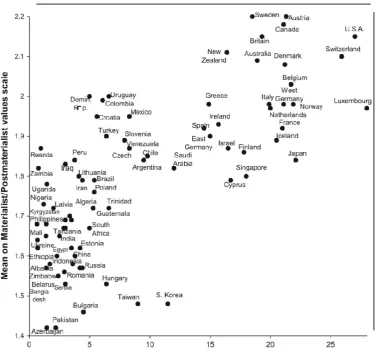
23 Ronald Inglehart is considered one of the driving forces behind the world values survey (WVS). The WVS is a large scale longitudinal research survey into values conducted in roughly 75% of societies around the world (Inglehart, 2000). Results of these surveys show that structural changes into value systems are currently taking place in western industrialized societies. Inglehart labels one of these shifts the movement from materialist’ values (related to ‘the bare necessities of life’) towards postmodern ones (which focus on non-materialistic needs). The WVS shows that values present in members of western societies are being slowly but structurally transformed in the subsequent research waves. As Inglehart explains in his own words:
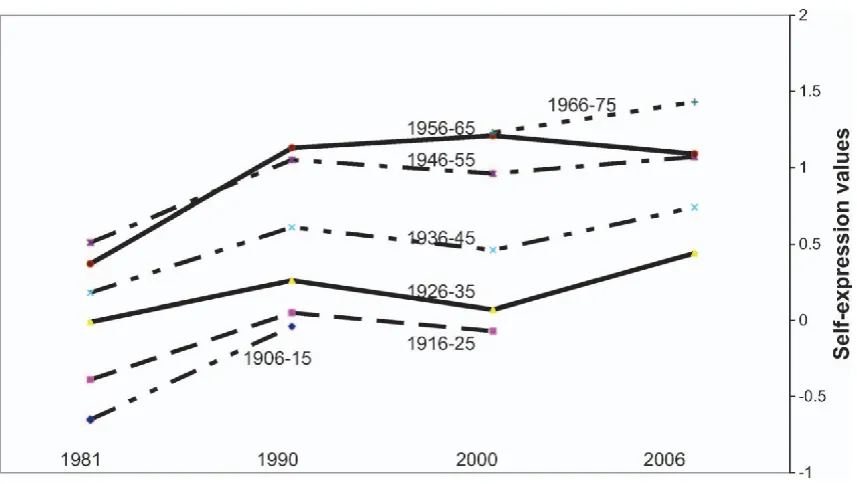
“This societal-level [values] shift is linked with individual-level value changes, from giving top priority to economic and physical security towards giving top priority to self-expression values that emphasize participation, freedom of expression, and quality of life. Under conditions of scarcity, people focus on survival needs, giving top priority to economic and physical security. Economic development increases people’s sense of existential security, leading them to shift their emphasis from survival values toward self-expression values and free choice, which is a more direct way to maximize happiness and life satisfaction. ” (Inglehart et al., 2008, p. 266)
Values associated with materialism are economic and physical security. Examples of post materialist values are autonomy, self-expression and quality of life. The particular place which such values take in a value model is discussed later in section 3.2.1.
Support for the presumed shift from materialist to post-materialist values is found in empirical longitudinal research by questionnaires which show that older generations place more emphasis on materialist values compared to younger generations. Inglehart attributes the particular direction of these changes to the societal conditions which were prevailing during the “formative years” of people belonging to the younger cohorts (Inglehart, 2008, p. 131). Although Inglehart does not seem to specify which ages come to mind when he discusses the notion of formative years, he seems to refer to a specific time period during the youths of such cohorts’ members.
As such a relationship is postulated between the external conditions in which cohorts are being born and spend their formative years, and their prevailing values. Ingleharts’ most simple description of the societal conditions leading to the development of post materialistic values is the idea that existential security is no longer uncertain. This fact ‘frees up’ attention from the materialistic – basic necessities of life – to the post materialistic – values which are considered as important, given that there is sufficient freedom, security, prosperity etc. to be able to be concerned about them.
Inglehart spends considerable attention towards the question of whether such lasting effects of values could be attributed to some other, external, phenomenon and concludes that the societal conditions prevailing during the formative years seems the best explanation.
Before discussing Inglehart’s theories further; several problems arise with such a research method and associated assumptions. Some are classical issues associated with using questionnaires as a research method, and others are related to theoretical assumptions necessary for Inglehart to assume in order to argue for his conclusion. The most pressing issues are discussed below.
24 Firstly, it might be the case that the age difference slowly developing in a cohort is causing shifts in values, not the presumed difference in value systems caused by increasing senses of existential security. Secondly, existential security is a relative concept. It might be that, although concrete factual circumstances are similar, a certain group or country still feels more or less existentially secure. This leads to empirical research challenges because this means that it is difficult to perform research on the relationship between circumstances and felt existential security. Thirdly, it is assumed that most people desire for freedom and autonomy, and it is theorized that conditions in the past prevented people from actually pursuing these desires because bare materialistic needs of life were dominant. This assumption requires some clarification.
AGE AS AN EXTERNAL CAUSE
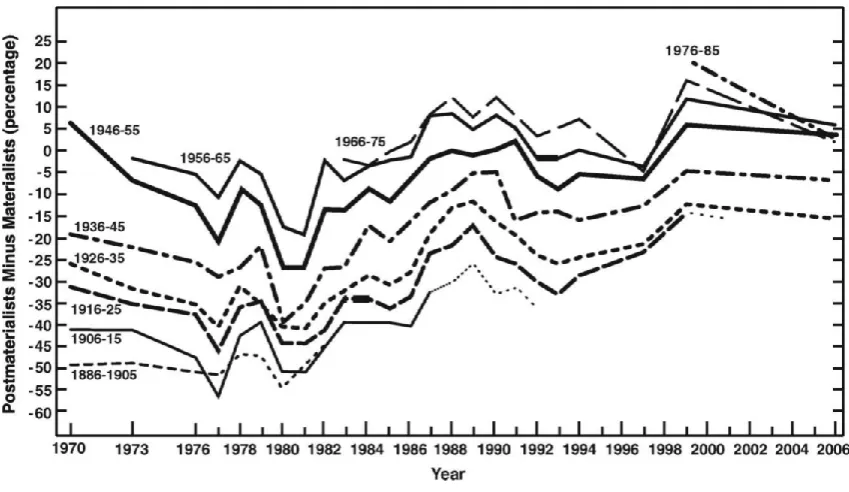
Inglehart recognizes most of these problems and proposes solutions for them. Given that the WVS has been conducted over a large timespan, roughly between 1970 and 2006 for particular countries, it is now possible to test for the causes of shifting values, or at least to exclude age as a possible source. This is because if age would be an independent variable causing shifts in values, early cohorts in the research should be moving towards materialist values due to their increasing age. The VWS shows quite conclusively that this is not the case; exemplified by figure 2.3.1a. If levels of (post) materialism would be changing due to natural ageing of cohorts, then we would see that lines in the figure would slope downwards or even cross each other as the cohorts age. This is not the case, supporting the conclusion that if a certain cohort is found to have a certain level of (post) materialism, they more or less stick to this level. As always in sociological research, (post)
[image:28.595.84.509.464.710.2]materialism levels are not stable over all cohorts all of the time, however a trend is clearly visible and does not support the claim that age explains levels of (post) materialism.