BACHELOR THESIS
THE EU'S COMMITMENTS
TO SUSTAINABLE
DEVELOPMENT:
THE CONTRIBUTION OF
CERTIFICATIONS FOR
COCOA
Carolin Witte
FACULTY OF BEHAVIOURAL, MANAGEMENT AND SOCIAL SCIENCES BACHELOR OF SCIENCE EUROPEAN PUBLIC ADMINISTRATION
EXAMINATION COMMITTEE Dr. M. L. Franco García M. Ramos Mejía, MSc
Table of Contents
ABSTRACT ... II
LIST OF TABLES ... III
LIST OF FIGURES ... III
LIST OF ABBREVIATIONS ... III
1. INTRODUCTION ... 1
1.1 Background ... 1
1.2 The Global Cocoa Market ... 2
1.3 Research Questions ... 5
2. LITERATURE REVIEW ... 6
2.1. Certification Systems for Sustainable Cocoa ... 6
2.1.1. Fairtrade ... 6
2.1.2. UTZ Certified ... 7
2.1.3. Rainforest Alliance ... 8
2.2. The EU’s Goals for Sustainable Development in the Global South ... 9
2.3. Analytical Framework... 12
3. RESEARCH METHODOLOGY ... 13
3.1. Research Design ... 13
3.2. Data Collection ... 15
4. FINDINGS ... 16
4.1. The Effects of Certification Schemes ... 16
4.1.1. Economic Dimension ... 17
4.1.2. Social Dimension ... 19
4.1.3. Environmental Dimension ... 21
4.1.4. Effects of Certification in the Context of the EU’s Goals for Sustainable Development ... 22
4.2. The Current Role of Certification Schemes as Tools for Achieving the EU’s Goals for Sustainable Development in the Global South ... 24
4.3. The Main Barriers for Small Producers of Cocoa for Starting and Continuing with Certification Schemes ... 25
4.4. Strategies to Overcome Barriers ... 26
5. DISCUSSION... 27
6. CONCLUSION AND RECOMMENDATIONS ... 28
REFERENCES ... 30
ANNEX ... 36
Annex A: Tables of FAOSTAT Data ... 36
Abstract
Cocoa is produced in the global south but predominantly consumed in Europe. Developed by non-governmental actors, certification schemes have emerged as measures to combat poverty, preserve biodiversity and improve small producers’ livelihoods in the global south.
In the light of the UN’s new SDGs, the EU is redesigning its approach to sustainable development. This research therefore aims at assessing the role of certifications for cocoa in current EU policies and the future potential for such schemes in policies as tools for sustainable development. This is done by analyzing the effects of certification schemes for cocoa, the conditions for small producers for participating in such a scheme and by identifying possible strategies to overcome potential barriers for participation.
List of Tables
Table 1: Cocoa Bean Production in 2013/2014 in Thousand Tons per Country (Food and Agriculture Organization of the United Nations, 2016) ... 3 Table 2: Trend of Major Global Chocolate Manufacturers’ Commitments to Purchase Sustainably Sourced Cocoa (Fountain & Hütz-Adams, 2015; Mondelez International, 2016; Nestlé, 2014, 2015, 2016) ... 4 Table 3: Research Questions and Methods ... 14 Table 4: Overview of Contribution of Certifications of Cocoa for the EU's Goals for Sustainable Development ... 22
List of Figures
Figure 1: Schematic Analytical Framework ... 13
List of Abbreviations
ACP African, Caribbean and Pacific Group of States
EU European Union
FLO Fairtrade Labelling Organizations International ICCO International Cocoa Organization
MDGs Millennium Development Goals SDGs Sustainable Development Goals TEU Treaty on European Union
1.
Introduction
The three-fold focus of this research project will firstly describe the EU’s goals for sustainable development and the effects of certifications schemes for cocoa, secondly identify the main barriers for small producers of cocoa to start or continue with such a scheme and finally assess how the EU and the small producers themselves can reduce these barriers.
1.1
Background
The cocoa tree, or Theobroma, native to the Amazonian rainforest, is nowadays mainly cultivated in Western African countries such as Ghana and Côte d’Ivoire, but smaller quantities are also produced in Latin America as well as in South East Asia. Small-scale farmers are responsible for 80 to 90% of the world’s cocoa bean production (World Cocoa Foundation, 2014). While there is no official definition of small-scale producers, usually family-run farms with a production area of up to 10 hectares are considered small-scale producers in the case of cocoa (Technical Center for Agricultural and Rural Cooperation, 2014), with the definition depending on the different contextual factors per country or region and the situation relative to other farmers of the same crop (Calcaterra & Aidenvironment, 2013; Dixon, Taniguchi, Wattenbach, & Tanyeri-Arbur, 2004).
Theobroma requires a hot and humid climate as it is found within 20 degrees of latitude north and south
of the equator (World Cocoa Foundation, 2014). Therefore, it is not possible to cultivate cocoa where it is consumed most: in Europe. With EU countries being among the biggest importers of cocoa as well as the biggest exporters of manufactured cocoa products worldwide, the responsibility of the EU for the effects of cocoa consumption cannot be denied.
One tool that has been developed for enhancing sustainability in the cocoa supply chain is product certification. There is a number of certification schemes available, each with different goals and approaches. However, at present, only a fraction of small producers of cocoa is certified, with global market shares of cocoa certified by FLO, UTZ or Rainforest Alliance estimated between 15 and 30% (Fountain & Hütz-Adams, 2015). Not all small producers are able to access these certifications and sell their products under such a scheme. As market demands for cocoa are shifting towards a more sustainable supply chain with certified cocoa, the barriers for small producers to start or continue collaboration with a certification scheme prove to be a challenge. Therefore, the question arises how effective certification schemes can truly be in terms of improving sustainability in the case of cocoa production.
developed a common EU policy on Fair Trade specifically, efforts have been made in order to include Fair Trade in the scope of sustainability policies in the past years (Molle, 2011). This recognition of Fair Trade by the EU proves that the role of sustainable trading practices is growing more important and that certification schemes are considered to be contributing to the promotion of these practices.
There are five to six million cocoa farmers worldwide on mostly small, family-rum farms, as opposed to many other crops which are produced on larger farms (World Cocoa Foundation, 2014). One would think that if those small producers can benefit from the effects of certification schemes, a majority would be engaged in such certifications. However, only a small portion of the world’s cocoa is certified. Some small producers also abandon the certification they already used. This research will therefore investigate which factors hinder the spread of certifications with the aim of assessing the pitfalls of certification schemes and its impact in the light of the EU’s goals for sustainable development.
1.2
The Global Cocoa Market
The total global production of cocoa beans for the year 2013/20141 was 4.450.263 tons (Food and
Agriculture Organization of the United Nations, 2016). When looking at the production of cocoa divided by country, it is easy to see that the produced volume differs vastly among countries. The ten countries which contribute most to the world’s harvest of cocoa beans based on their cocoa bean production in 2013/2014, which is the most recent complete dataset, are summarized in table 1. The difference in volume is significant, with Côte d’Ivoire, Ghana and Indonesia combined supplying about 68% of the world’s cocoa, while the market shares of the remaining seven countries vary between roughly 1% and 6%.
In 2013, imports of EU countries added up to more than 50% of global imports of cocoa beans, with the Netherlands alone contributing for roughly one fifth of global imports (Food and Agriculture Organization of the United Nations, 2016). When looking at imports of cocoa butter and cocoa paste, the same holds true, with slight shifts in the distribution of shares among the EU countries. Considering cocoa powder and cake, the EU accounts for only one third of the world’s imports. Not surprisingly, EU countries’ exports also account for about 50% of the world’s manufactured cocoa products such as chocolate and other foodstuffs containing cocoa, as measured in their value in US Dollars (International Trade Centre, 2017).
The current market share of certified cocoa is still relatively small, although it is increasing, with estimates of cocoa certified by FLO, UTZ or Rainforest Alliance varying between 15 and 30% of the total cocoa production. Due to the fact that some cocoa on the market is not only certified by one, but by two or more certification bodies, only rough estimates about the percentage of certified cocoa sold on the market can be given. Furthermore, not all cocoa produced under the standards of a certification scheme is actually sold as certified cocoa (Fountain & Hütz-Adams, 2015).
The global demand for sustainably sourced cocoa will rise in the coming years due to the increase in the use of sustainably sourced cocoa to which some of the biggest chocolate companies in the world have committed themselves. The five producers Mars, Mondelēz, Nestlé, Ferrero, and Lindt & Sprüngli
belong to the ten main candy manufacturers in the world in terms of net sales volume (Candy Industry, 2016) and can all be found on the European market. The goals for purchasing certified cocoa declared by these global chocolate producers are summarized in table 1:
Table 1: Cocoa Bean Production in 2013/2014 in Thousand Tons per Country (Food and Agriculture Organization of the United Nations, 2016)
Cocoa bean production in 2013/2014 Producing country Volume in thousand tons
% of total world production
Côte d’Ivoire 1434 32.22%
Ghana 859 19.30%
Indonesia 728 16.37%
Nigeria 274 6.15%
Brazil 270 6.06%
Cameroon 248 5.57%
Ecuador 156 3.51%
Peru 82 1.83%
Dominican
Republic 70 1.56%
Colombia 48 1.07%
Rest of the world 282 6,34%
[image:7.595.75.484.125.507.2]Table 2: Trend of Major Global Chocolate Manufacturers’ Commitments to Purchase Sustainably Sourced Cocoa (Fountain & Hütz-Adams, 2015; Mondelez International, 2016; Nestlé, 2014, 2015, 2016)
While Mars and Ferrero commit to purchasing cocoa that is certified by independent third parties, the remaining three manufacturers have developed their own programs or apply a blended approach for improving sustainability along the cocoa supply chain. These programs are aimed at different parts of farmers’ working and living conditions, ranging from capacity building in good agricultural practices, tackling child labor, investments in infrastructure and raw materials to long-term trade relationships. One example is the Farming Program which was developed by Lindt & Sprüngli and will be applied to their entire production of cocoa by 2020, without using any third-party certifications (Lindt & Sprüngli, 2016). Instead, Lindt & Sprüngli has developed four steps to become the preferred buyer for cocoa farmers, and improving the both the quality of cocoa and the quality of life of cocoa farmers at the same time: (1) ensure traceability and farmer organization, (2) provide training and capacity building, (3) support farmer investments and community development and (4) ensure verification and continuous progress. Lindt & Sprüngli also pays a price premium which is reinvested in local projects aimed at improving the farmers’ living and working conditions (Lindt & Sprüngli, n.d.).
Nestlé aims at sourcing 175.000 tons of cocoa through their Nestlé Cocoa Plan by 2018, which roughly equals 44% of Nestlé’s total purchase of cocoa (Nestlé, 2016). A large part, namely 88%, is certified by
2013 2014 2015 2016 goal
2018 goal
2021 goal
Mars 30% 51% 100%
Mondelēz 11% 21% 81%
Nestlé (Cocoa Plan only) 15% 23% 30% 33% 44% Nestlé (UTZ or Fairtrade) 75% 88%
Ferrero 33% 50% 100%
Lindt & Sprüngli 0% 50% 100%
0% 10% 20% 30% 40% 50% 60% 70% 80% 90% 100%
Share of certified or sustainably sourced cocoa of
total cocoa purchases
[image:8.595.72.525.113.458.2]FLO or UTZ already (Nestlé, 2015), but the program does not explicitly commit to 100% independent certification. The plan is based on three pillars, namely capacity building for farmers, improvement of social conditions, and ensuring long-term supply of cocoa. The improvements of social conditions are mainly focused preventing child labor by building schools, gender equality and provision of water and sanitation infrastructure. Nestlé also distributes high-quality cocoa plantlets to farmers free of charge in order to improve the quality and yield.
Mondelēz buys Fairtrade as well as Rainforest Alliance certified cocoa and set up a program called
Cocoa Life with investments aiming to improve the livelihoods of 200,000 cocoa farmers over the course
of 10 years. By the end of 2015, 21% of the company’s cocoa was sustainably sourced according to the program’s requirements (Mondelez International, 2016). Cocoa Life focuses on the benefits of cocoa farming for the entire community,
The global chocolate manufacturers are thus transforming the market by demanding more cocoa certified by external bodies as well as within their own sustainability programs.
1.3
Research Questions
For small cocoa producers in the global south it might be difficult to establish business relationships across continents in order to sell their cocoa to global chocolate manufacturers due to their limited experience, knowledge and networking opportunities. Therefore, it is worth taking a closer look at their possibilities to overcome those obstacles by obtaining fair trade or organic certification, especially within the light of the EU’s interest to foster sustainable development.
More specifically, a closer look should be taken at the different certification systems, their underlying conditions and their feasibility in the context of the small producers.
The aforementioned observations led to the following research question to form the base of this research project:
RQ: To what extent can the EU rely on certifications to make sure its goals for sustainable development are met in the case of small producers of cocoa in the global south?
In order to answer this descriptive research question in a systematic way, four sub-questions that reflect the main components of the general research question were formulated. In this way, a structure for answering the research question is formed. The four sub-questions are:
S2: What is the EU’s policy on sustainable development and in how far do certification schemes already serve as tools to achieve the EU’s goals for sustainable development in the global south?
S3: What are the main barriers for small producers of cocoa for starting and continuing with certification schemes?
S4: What can be done by the EU as well as by the small producers to overcome barriers for starting and continuing with certification schemes?
2.
Literature Review
In this section, the main concepts used in the research as well as the existing body of literature and information derived from official documents will be discussed.
2.1.
Certification Systems for Sustainable Cocoa
A certification is based on a set of standards and rules including monitoring instruments and is recognized by an organization or network (Getz & Shreck, 2006). The certification process leads to the placement of a label on the product, which then communicates the nature of the certification system to the consumer. Another term which is used when referring to certifications is voluntary sustainability standard. This emphasizes the voluntary nature of such a system: it is not mandated by a government or similar institution and participation happens at free will (Komives & Jackson, 2014). There are more than 60 voluntary sustainability standards available which can be awarded to cocoa products (International Trade Centre, 2015). This number includes standards focused on quality or some which focus on a limited number of producing countries and destination markets. The main available certifications for cocoa products related to sustainability which are available worldwide are Fairtrade, UTZ Certified, and Rainforest Alliance, which focus on different aspects of sustainability in cocoa farming. As these types of certifications are the ones most represented on the market, both in terms of geographical availability and of the share of cocoa certified by them, they have also been subject to a number of scientific research projects investigating their effects.
2.1.1.
Fairtrade
producers. It therefore mainly targets small-scale producer organizations (of varying size and with or without hired labor). An important and unique element of the strategy is the payment of a guaranteed minimum price and a premium to the small producers. For cocoa, this currently is 2138€ per metric ton for conventional cocoa beans and 2458€ for organic cocoa beans. The premium in both cases is 214€ per metric ton of cocoa beans (Fairtrade International, 2017). In order to get certified, producer organizations have to undergo an audit procedure which is done independently by FLOCert GmbH. The costs for this procedure depend on the size and type of the organization to be certified and vary between 2004€ and 4095€ for the simplest scenario (FLOCert, 2016). The more complex an organization is, the more expensive the initial audit will be. This initial certification is then followed up by audits, every three to six years which cost between 1199€ and 2839€ per year, again depending on size and type of the organization. The fee will always be paid annually, even if no audit has taken place that year. Regarding traceability, Fairtrade applies the principle of mass balance. This means that certified cocoa can be mixed with non-certified cocoa as long as the corresponding amounts which are traded along the supply chain are always documented and paid accordingly (Basso, Schouten, Renner, & Pfann, 2012). In order to be allowed to put the Fairtrade logo on the product, the manufacturer has to purchase 100% certified cocoa for that product (Fairtrade International, n.d.-a). However, due to the mass balance principle it is possible that the cocoa the manufacturer receives for making the final product is not only certified cocoa, but a mix.
2.1.2.
UTZ Certified
In order to make clear where the product the customer is buying came from, UTZ uses three traceability levels for cocoa: identity preserved, segregation and the aforementioned mass balance (UTZ Certified, 2015a). At the identity preserved level, the origin of the product can be traced back until the producer where it came from. Under segregation, the products of different producers can be mixed, but it remains clear which producers have contributed to the mix. The amount of certified cocoa required in the end product for the label to be awarded to the product is 90% to 100%, depending on the raw product and the traceability level (UTZ Certified, 2015a).
2.1.3.
Rainforest Alliance
Rainforest Alliance (2017) focuses on biodiversity and wants to ensure sustainable livelihoods by the transformation of land-use practices, business practices and consumer behavior. Just as UTZ, Rainforest Alliance also includes larger-scale farms. There is neither a guaranteed minimum price nor a guaranteed premium: prices are entirely set by the market (Rainforest Alliance, 2014). There is no membership fee but a volume-based fee to be paid by the first buyer of 14€ per ton of cocoa beans (Rainforest Alliance, 2012b).
In order to receive and hold the certification, producers as well as traders are audited every year by a number of third-party certification bodies which all set their own prices (Rainforest Alliance, n.d.-a, n.d.-b).
2.2.
The EU’s Goals for Sustainable Development in the Global South
As this research project assesses whether the EU’s objectives for sustainable development are reached by the means of certification of small cocoa producers, a clear definition of these objectives is needed. Since the Treaty of Amsterdam in 1997, sustainable development forms part of the fundamental objectives of the EU, and is required to be integrated into all policies (Baker, 2007).
The first clear and official statement made by the EU concerning the role of the EU in sustainable development was the European Sustainable Development Strategy (EU SDS) of 2001. However, this strategy mainly focused on the internal sustainable development of the EU, and only covered external activities and cooperation on the sidelines. It has been broadened by a renewed version in 2006. In this strategy, the Council of the EU (2006, p. 2) has based its definition of sustainable development on the one developed by the Brundtland Commission, stating that “Sustainable development means that the needs of the present generation should be met without compromising the ability of future generations to meet their own needs”. This general definition is then broadened to include “safeguarding the earth's capacity to support life in all its diversity […] based on the principles of democracy, gender equality, solidarity, the rule of law and respect for fundamental rights, including freedom and equal opportunities for all. It aims at the continuous improvement of the quality of life and well-being on Earth for present and future generations. To that end it promotes a dynamic economy with full employment and a high level of education, health protection, social and territorial cohesion and environmental protection in a peaceful and secure world, respecting cultural diversity.” It can thus be said that the EU’s objectives for sustainable development encompass the economic, social and environmental dimension.
As development cooperation is a shared competence between the EU and its Member States (Art. 4 TFEU, 2016) the 2005 European Consensus on Development
(ECD) marked a milestone in the EU’s commitment to
sustainable development by forming the first common framework for development cooperation for all EU Member States as well as for EU institutions. It set common objectives, values and principles in order to streamline the Member States’ and the EU’s activities, and put the eradication of poverty and the pursuit of the UN’s eight Millennium Development Goals on top of all other objectives of EU development cooperation, next to “the promotion of democracy, good governance and respect for human rights” (Council of the European
Union, European Parliament, & Commission of the European Union, 2006, para. 42). Other important elements of this vision were the increased effectiveness of aid, and policy coherence for development (PCD). This means that the EU commits itself to take into account the development cooperation objectives in those policies that are adopted outside the area of development, but potentially affect developing countries to ensure the achievement of the MDGs.
In the Treaty of Lisbon (2007), which came into effect in 2009, Article 3.5 TEU defines the principles on which the EU’s external relations shall be built. The EU commits itself to “contribute to peace, security, the sustainable development of the Earth, solidarity and mutual respect among peoples, free and fair trade, eradication of poverty and the protection of human rights”. Furthermore, the general provisions for the EU’s external action include the fostering of “the sustainable economic, social and environmental development of developing countries, with the primary aim of eradicating poverty” and helping to “develop international measures to preserve and improve the quality of the environment and the sustainable management of global natural resources, in order to ensure sustainable development” (Art. 21, TEU).
In the light of the replacement of the United Nation’s Millennium Development Goals, the EU has played a major role in the development of the 2030 Agenda for Sustainable Development and its 17 Sustainable Development Goals (SDGs). In 2016, the European Commission published three proposals
related to the EU’s role in the implementation of the SDGs: (1) the Communication Next steps for a
sustainable European future: European action for sustainability (hereinafter Next-Steps-Communication), (2) the Communication Proposal for a new European Consensus on Development: Our World, our Dignity, our Future, (hereinafter New ECD-Proposal), and, along with the High
Representative of the Union for Foreign Affairs and Security Policy, (3) the Joint Communication A The Millennium Development Goals are to:
1. eradicate extreme poverty and
hunger;
2. achieve universal primary
education;
3. promote gender equality and
empower women;
4. reduce the mortality rate of
children;
5. improve maternal health;
6. combat HIV/AIDS, malaria and
other diseases;
7. ensure environmental
sustainability;
8. develop a global partnership for
development
Box 1: The Millennium Development Goals (Council
renewed partnership with the countries of Africa, the Caribbean and the Pacific
(hereinafter New ACP-Proposal).
In its Next-Steps-Communication, the Commission (2016b) identified two steps by which the EU shall respond to the 2030 Agenda: Step one is to embed the SDGs in EU policies and the priorities of the Commission. Step two then aims at the long-term implementation of the SDGs by including them in the vision for after 2020. Other key actions include reporting of the progress, collaboration with external partners and supporting the efforts of developing countries, and the launch of a multi-stakeholder platform with the goal of exchanging best practices in the implementation of the SDGs by the EU, by Member States and across sectors. The New ECD-Proposal aims at updating the former ECD to the new SDGs under the motto “do more, do it better and do it differently” (Commission of the European Union, 2016a). This includes an increased effectiveness and impact of EU development policy by better coordination between the EU and Member States, but also an increased importance of domestic action and each country’s responsibility
for their own sustainable development, assisted by global partners and their Official Development Assistance as well as policy which fosters investment.
The New ACP-Proposal (Commission of the European Union & High Represenative of the Union for Foreign Affairs and Security Policy, 2016) also builds on the SDGs and puts emphasis on tailored partnerships, which means that policy and cooperation should take into account the different situation and challenges in each of the three regions. Therefore, it also aims at a stronger relationship with
Sustainable Development Goals
1. End poverty in all its forms everywhere
2. End hunger, achieve food security and improved
nutrition and promote sustainable agriculture
3. Ensure healthy lives and promote well-being for all
at all ages
4. Ensure inclusive and equitable quality education
and promote lifelong learning opportunities for all
5. Achieve gender equality and empower all women
and girls
6. Ensure availability and sustainable management of
water and sanitation for all
7. Ensure access to affordable, reliable, sustainable
and modern energy for all
8. Promote sustained, inclusive and sustainable
economic growth, full and productive employment and decent work for all
9. Build resilient infrastructure, promote inclusive
and sustainable industrialization and foster innovation
10. Reduce inequality within and among countries
11. Make cities and human settlements inclusive, safe,
resilient and sustainable
12. Ensure sustainable consumption and production
patterns
13. Take urgent action to combat climate change and
its impacts
14. Conserve and sustainably use the oceans, seas and
marine resources for sustainable development
15. Protect, restore and promote sustainable use of
terrestrial ecosystems, sustainably manage forests, combat desertification, and halt and reverse land degradation and halt biodiversity loss
16. Promote peaceful and inclusive societies for
sustainable development, provide access to justice for all and build effective, accountable and inclusive institutions at all levels
17. Strengthen the means of implementation and
revitalize the Global Partnership for Sustainable Development
neighboring regions which are not part of the current ACP, but do influence certain regional challenges. Since several ACP countries are also cocoa producers, this proposal also has the potential to affect the global cocoa market and the conditions for producing cocoa in these countries.
The responsible European institutions and the Member States will discuss these three new proposals in the coming months, and they are therefore not yet legally binding and still subject to change. However, they give an impression of the general direction of the EU’s activities for the next few years. Considering that the EU stuck to the MDGs in the past, it is not likely that the importance of the new SDGs as a baseline will be rejected by any European institution for future policies, especially in the light of current strategies such as the Global Strategy for the Union’s Foreign and Security Policy, which already make reference to the SDGs. It can therefore be concluded that the SDGs serve as a general basis for the EU’s objectives in development-related policy-making.
2.3.
Analytical Framework
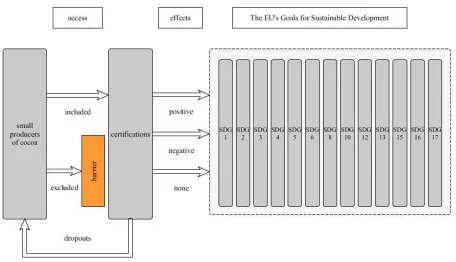
In order to assess in which way certification schemes play a role for the achievement of the EU’s goals for sustainable development, a clear framework is needed. As illustrated in Figure 1, the first step in the analytical process to be looked at is the access to a certification scheme for small producers. There are three types of small producers: (1) those who do gain access, (2) those who gain access but discontinue the certification and (3) those who do not have access to a certification scheme. Only the first two types cross the barrier. The next step in the analysis then is the effects that certification has on the first type of small producers: positive effects, negative effects, and no effect. These effects will be assigned to each of the EU’s goals for sustainable development in order to assess the contribution of certification to them. The goals have been identified before as being equal to the SDGs. In the context of voluntary sustainability standards for cocoa, thirteen goals can be filtered as being the most relevant for this situation as they match the objectives of the three certification schemes in the analysis: SDGs number 1, 2, 3, 4, 5, 6, 8, 10, 12, 13, 15, 16, and 17 (Fairtrade International, 2015; Rainforest Alliance, 2016b; UTZ Certified, 2016c).
Figure 1: Schematic Analytical Framework
3.
Research Methodology
In this section, the main characteristics of the research design, research methods and data collection and the reasons for choosing them are described.
3.1.
Research Design
As described in the introduction section, the main research question driving this research is: To what
extent can the EU rely on certifications to make sure its goals for sustainable development are met in the case of small producers of cocoa in the global south? To the end of answering this question, a
non-experimental design was chosen.
of certification schemes and then compared to the EU’s goals for sustainable development. The qualitative data found in the systematic literature review thus forms the basis for further analysis. The advantages of a non-experimental design and specifically methods such as content analysis and a systematic literature review include the cost and time efficiency and its unobtrusiveness. Another advantage is the flexibility of filtering criteria and codings: When coming across a new insight, it can immediately be included in the analysis, as opposed to for instance survey research (Babbie, 2009; Wolfswinkel et al., 2013). A major disadvantage, on the other hand, is the fact that the aforementioned methods rely on the publication of literature or communication by others: Aspects which have not been analyzed or recorded yet cannot be taken into account.
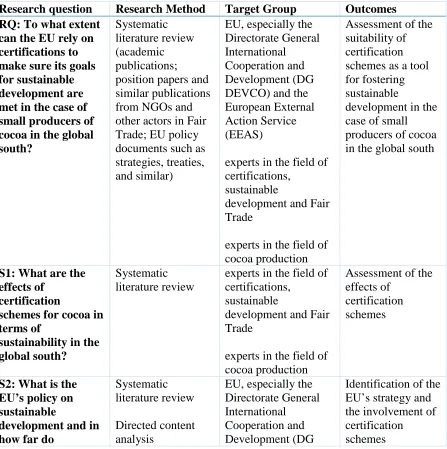
[image:18.595.78.525.320.769.2]In the table below the goals of each subquestion and the means how to answer them are listed:
Table 3: Research Questions and Methods
Research question Research Method Target Group Outcomes
RQ: To what extent can the EU rely on certifications to make sure its goals for sustainable development are met in the case of small producers of cocoa in the global south?
Systematic literature review (academic publications; position papers and similar publications from NGOs and other actors in Fair Trade; EU policy documents such as strategies, treaties, and similar)
EU, especially the Directorate General International
Cooperation and Development (DG DEVCO) and the European External Action Service (EEAS)
experts in the field of certifications,
sustainable
development and Fair Trade
experts in the field of cocoa production
Assessment of the suitability of certification schemes as a tool for fostering sustainable
development in the case of small producers of cocoa in the global south
S1: What are the effects of
certification
schemes for cocoa in terms of
sustainability in the global south?
Systematic literature review
experts in the field of certifications,
sustainable
development and Fair Trade
experts in the field of cocoa production
Assessment of the effects of
certification schemes
S2: What is the EU’s policy on sustainable
development and in how far do
Systematic literature review
Directed content analysis
EU, especially the Directorate General International
Cooperation and Development (DG
certification schemes already serve as tools to achieve the EU’s goals for sustainable development?
DEVCO) and the European External Action Service (EEAS)
S3: What are the main barriers for small producers of cocoa for starting and continuing with certification
schemes?
Systematic literature review
experts in the field of certifications,
sustainable
development and Fair Trade
experts in the field of cocoa production
Identification of barriers to hold certification for small producers
S4: What can be done by the EU as well as by the small producers to
overcome barriers for starting and continuing with certification schemes? Systematic literature review EU
actors in the field of certifications, sustainable
development and Fair Trade (NGOs,
certification bodies, and similar)
small producers of cocoa
Recommendations for future EU policies
Recommendations for small producers
3.2.
Data Collection
As mentioned above, data was collected by applying a systematic literature review. As a source of data, mainly secondary, qualitative data coming from scientific articles as well as policy reports and official documents were used.
As a first step in the systematic literature review, the criteria for the in- or exclusion of a publication were defined. The general scope of the review was set to be certification schemes for cocoa and EU policy. Due to the relation of the research question to EU policies, not only scientific publications were decided to be included, but also policy documents as well as publications made by NGOs. Next, the outlets of the publications were determined to be search engines featuring academic, peer-reviewed journals to ensure methodological quality, such as Web of Science and Google Scholar, as well as the publications channels of the EU such as the Official Journal and the websites of the Commission’s Directorate-General of International Cooperation and Development and the Directorate-General for Trade. Then, the exact search terms were defined. These included cocoa, certification, small producers,
In the second step, the actual search was carried out by using the previously defined criteria.
During the third step, the selection of literature was made by reading titles, abstracts and parts of the literature found, screening for the search terms within their context. Furthermore, citations were screened for additional relevant publications which may not have been found with the search terms yet. After this step, the search was repeated with a focus on coffee for those topics of effects and barriers for which there was no literature found in the context of cocoa, in order to provide a complete picture of (possible) effects and barriers. The final number of publications after this step was 34.
In the Analysis phase, the selected publications were read while making excerpts of their main conclusion and other valuable insights for the scope of the review.
The last step then was the presentation of the results in writing, putting them into the context of the research questions.
4.
Findings
In this chapter, the empirical findings relevant for each subquestion of the research question will be presented to achieve the objectives mentioned in Table 3 in chapter 3.1.
4.1.
The Effects of Certification Schemes
Certification of cocoa has been subject to academic research in the past, but the whole body of available literature remains rather slim nevertheless. In order to study the effects of certifications, it is thus necessary to look at other types of commodities and settings as well. Coffee is a commodity very similar to cocoa in terms of its production and can therefore serve as an addition for gaining insights in the effects of certification of such cash crops.
In the literature, the consequences of different types of certification for producers have been studied for a number of commodities. The positive effects of obtaining certification of small producers have been shown in many cases. However, also negative impacts have been found.
4.1.1.
Economic Dimension
The effects of certifications for cocoa on the economic dimension include the level of income and poverty reduction, market access, productivity and quality, access to credit, and labor and production costs. The effects observed in the literature for each of these aspects will be presented in this section.
4.1.1.1. Level of Income and Poverty Reduction
4.1.1.2. Market Access
The creation of a cooperative and obtaining a certification can significantly change the channels through which small producers sell their commodity. One example are producers of Fair Trade coffee in Costa Rica (Ronchi, 2002b), where the cooperation of a producer organization and FLO led to a significant improvement in market access and information about markets. The contact to potential buyers was built thanks to the Fair Trade certification. This effect has also been observed for cocoa producers in Côte d’Ivoire (Deutsche Gesellschaft für Technische Zusammenarbeit, 2009).
However, Getz & Shreck (2006) also observed negative effects on the market access of non-certified producers in the community. Among Dominican banana farmers, Fairtrade certified farmers were 20% more likely to have access to export markets. Also within the group of certified farmers, there were differences which were caused by the preference given to higher quality bananas. The certified producers able to deliver better quality could sell more of their harvest in the Fairtrade market, and could reinvest their additional earnings to further improve quality. Those producers delivering poorer quality earned less and were therefore not able to improve their quality by the improvement of their techniques.
4.1.1.3. Productivity and Quality
A factor most likely related to the level of income is the productivity of a farm and is therefore worth to be looked at more closely. In Côte d’Ivoire, the newly introduced agricultural practices led to an increase in both the volume of the harvest as the quality of the cocoa harvest after obtaining certification (Krain et al., 2011). Concerning quality, it has been observed that in the case of cotton producers in Mali, Fair Trade certification caused a major improvement in quality which increased the producer’s chances of exporting their products to foreign markets (Balineau, 2013). Moreover, also the quality delivered by non-certified producers rose due to spillover effects. In contrast, Bennett et al. (2013) observed that only certified farmers were better at meeting quality demands set by the market in contrast to non-certified cocoa farmers.
4.1.1.4. Access to Credit
Ronchi (2002a) found that farmers were more aware of the availability of credit after their cooperation had gained Fairtrade certification. Bennett et al. (2013) made the interesting observation that certified farmers requested higher credits than before being certified – but that neither the share of certified farmers requesting credit nor the share of granted credits was higher than among non-certified cocoa farmers.
As Nelson & Galvez (2000) have shown, brazil nut producers in Peru had access to a much less risky and most of all cheaper credit system since they obtained certification. This allowed them to invest more into their activities and to design them in a more efficient way. In Nicaragua, Fair Trade certified coffee producers had better chances of receiving a credit in general compared to non-certified small producers (Christopher M. Bacon, Méndez, Flores Gómez, Stuart, & Díaz Flores, 2008).
4.1.1.5. Labor and Production Costs
Even before adopting a certification scheme, small producers face additional investments for infrastructure and audit costs in order to comply with certifications’ requirements. Kilian, Pratt, Jones, & Villalobos (2004) found that this led to higher production costs in the case of UTZ and Rainforest Alliance certified coffee. Certification also demands for a high-quality administration and management, which is often more complex than the systems small producers and cooperatives used before being certified (Walrecht, Basso, & Hime, 2012). This can increase the costs of production, and even require additional workforce (Valkila, Haaparanta, & Niemi, 2010).
4.1.2.
Social Dimension
In this section, the effects of certifications on the social dimension will be presented. These include farmers’ working conditions, the quality of farmers’ livelihoods, training, and gender quality and women empowerment.
4.1.2.1. Working Conditions
et al., 2011). This entails health and safety at the workplace by protection from harmful substances and access to medical aid, but also an improved job security and housing conditions.
Another factor within this topic is the reduction of child labor (Bennett et al., 2013; Beyer, 2012; Tulane University, 2011). This does not mean that certification has been found to completely eliminate child labor but rather that the different certification schemes have set their requirements in such way that a detection of child labor leads to an exclusion from the certification scheme, encouraging small producers to redesign their workforce.
4.1.2.2. Quality of Farmer Livelihoods
Small producers’ living conditions concerning the value and quality of their homes seem to improve with certification (Krain et al., 2011; Ronchi, 2002b). Also both the quantity as the quality of their nutrition has been found to improve after becoming certified (Committee on Sustainability Assessment, 2013), next to a reported increase in access to clean water (Doherty & Tranchell, 2005).
Another factor is access to education for the small producers’ children. Studies have found mixed results: In several cases of both cocoa and coffee farmers, there was a positive impact on both on the number of certified farmers’ children attending school as on the duration of their education (Arnould, Plastina, & Ball, 2009; Christopher M. Bacon et al., 2008; Ronchi, 2002b), which had for example been achieved by scholarships provided by the cooperations. In contrast, Bennett et al. (2013) found that, despite UTZ certification having reduced child labor, school attendance did not improve, similarly to Méndez et al. (2010) who did not find a significant difference in school attendance between children of certified and non-certified coffee farmers.
Arnould et al. (2009) as well as Ronchi (2002a) furthermore observed a better access to healthcare for certified farmers and their families.
4.1.2.3. Training
to monitor their economic activity (Krain et al., 2011). This enhancement of skills is closely related to the productivity and quality effects of certification.
4.1.2.4. Gender Equality and Women Empowerment
In the case of cocoa producers, no significant impact of certification has been found concerning gender roles (Krain et al., 2011). The position of women, their role within the production process and their control over it remain weak, despite having full voting rights in cooperative councils (Ronchi, 2002b). In the case of coffee producers, however, Bacon et al (2008) claimed that women who were connected to a Fair Trade certified cooperative had better access to and control over financial resources. Moreover, women on Fair Trade certified farms worked more than twice as many days per year than on non-certified farms. At the same time, however, in both non-certified and non-non-certified farms, mostly men were the recipient of the cooperative’s payments, and only half of them shared profits with their wives.
4.1.3.
Environmental Dimension
This section deals with the effects of certification on the environment, including biodiversity, use of natural resources, and use of agrochemicals.
After the adoption of certification, small producers tend to put more effort into implementing measures aimed at the conservation of nature and biodiversity (Committee on Sustainability Assessment, 2013; Krain et al., 2011).
Also the management of natural resources used in cocoa production has been found to improve due to the training received by certification bodies, thereby enhancing the farmers’ knowledge and skills (Krain et al., 2011). When looking at coffee producers, Bacon et al. (2008) found that the number of farmers who implemented measures for the conservation of soil and water was 33% higher amongst certified farmers as opposed to non-certified farmers.
4.1.4.
Effects of Certification in the Context of the EU’s Goals for
Sustainable Development
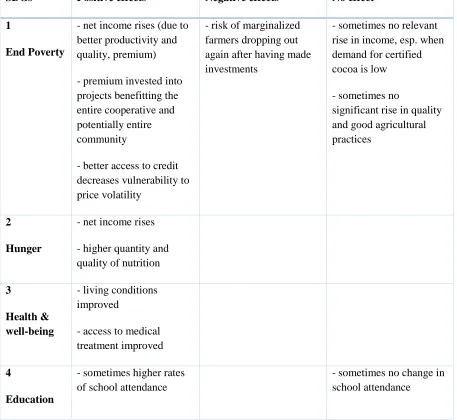
When putting the effects of certifications for cocoa observed in the literature into the context of the EU’s goals for Sustainable Development, as represented by the SDGs, a lot of overlap can be found. However, as table 4 illustrates, the results cover the entire spectrum from positive, negative to no effects. This results in a varying balance for some SDGs so that in many cases it cannot be said whether certifications are a suitable tool for the achievement of that particular SDG or not. This is the case for SDGs 1 (end poverty), 4 (education), 5 (gender equality), and 10 (reduced inequalities). For the remaining SDGs, the observed effects were positive.
Table 4: Overview of Contribution of Certifications of Cocoa for the EU's Goals for Sustainable Development
SDGs Positive effects Negative effects No effect
1
End Poverty
- net income rises (due to better productivity and quality, premium) - premium invested into projects benefitting the entire cooperative and potentially entire community
- better access to credit decreases vulnerability to price volatility
- risk of marginalized farmers dropping out again after having made investments
- sometimes no relevant rise in income, esp. when demand for certified cocoa is low
- sometimes no
significant rise in quality and good agricultural practices
2
Hunger
- net income rises - higher quantity and quality of nutrition
3
Health & well-being
- living conditions improved
- access to medical treatment improved
4
Education
- sometimes higher rates of school attendance
[image:26.595.71.528.329.749.2]- training in good
agricultural practices and administration
5
Gender equality
- premium invested into alternative sources of income for women - sometimes better access to financial resources for women
- sometimes no change in gender roles
- limited participation in decision-making for women
6
Clean water & sanitation
- sometimes improved access to clean water
8
Decent work & economic growth
- improved working conditions (health & safety)
- improved job security & local employment
opportunities
- reduction of child labor
10
Reduced inequalities
- improved access to markets, market information and credit
- decreased market access for non-certified farmers
12
Responsible consumption &
production
- increased awareness of good agricultural practices and environmental issues among producers
13
Climate Action
- better management of natural resources
15
Life on Land
- implementation of biodiversity conservation measures
16
Peace, Justice & Strong Institutions
- increased bargaining power and democratic control
17
Partnership
- long-term trade relationships built
4.2.
The Current Role of Certification Schemes as Tools for Achieving the
EU’s Goals for Sustainable Development in the Global South
Despite the lack of a comprehensive EU policy or regulation on fair trade, the EU has recognized the role of fair trade in sustainable development. The specific reference made to both fair trade and the eradication of poverty made in Art. 3.5 TEU shows the EU’s awareness of the interrelatedness of these two concepts and the responsibility of the EU in this regard. This has been articulated in different legislations, policies and statements made by the EU and its officials.
One example of the integration of fair trade into official EU agreements is the consistent reference to it in new trade agreements with third countries, for instance the agreement with Colombia and Peru (Council of the European Union, 2012).
In 2009, the European Commission suggested that public procurement procedures should include Fair Trade certification as a requirement for purchasing and that there should be investigation into the possibilities to promote Fair Trade using EU budget (Commission of the European Communities, 2009). By 2014, the former suggestion had been incorporated into two new directives on public procurement, allowing public institutions in the EU to make Fair Trade certification a requirement in their tenders (European Parliament & Council of the European Union, 2014a, 2014b). The 2009 communication nevertheless also emphasized that sustainability schemes should remain non-governmental and should not be publicly regulated, leaving innovation and development in this regard to the market.
Promotion of fair trade and other sustainability assurance schemes in free trade agreements, (2) include fair and ethical trade in the next review of the Aid for trade strategy, (3) promotion of fair and ethical trade schemes through EU delegations in third countries, (4) enhanced collection of market data in international bodies, and (5) raising awareness on both the supply and demand side.
Within the Development Cooperation Instrument, the EU has allocated a budget of 1.5 million € for the period between 2014 to 2020 to the support of food security and sustainable agriculture, which explicitly includes fair trade schemes (European Parliament & Council of the European Union, 2014c).
In conclusion, it can be said that the EU seems to be reluctant to adopt extensive policy on fostering sustainability certification but does encourage its voluntary, non-governmental development.
4.3.
The Main Barriers for Small Producers of Cocoa for Starting and
Continuing with Certification Schemes
Small producers located in remote areas might not be easily accessible for a certification scheme for practical reasons, but also the lack of a cooperative in the region where small producers are located is a problem that cannot be overcome by the individual small producers alone (Aidoo & Fromm, 2015; Nelson & Galvez, 2000). Aidoo & Fromm also stated that some small producers might not even be aware of the existence of certifications and the implications of obtaining such. This can be related to the fact whether small producers are members of a cooperative or not: They furthermore found that membership has proven to have a significant positive impact on small producers’ willingness to adopt certification in the case of Ghanaian cocoa farmers. In the case of Nicaraguan coffee producers, however, the establishment of such a cooperative already posed an obstacle (Tellman, Gray, & Bacon, 2011), a phenomenon also observed by Friedmann (2011), in which case it was caused by legal constraints and a lack of knowledge about the way cooperatives work.
because the use of expensive (and thus for this group easily available) inputs such as fertilizers that increase yield is discouraged under certification schemes.
In some countries, the problem of reaching a level of productivity that allows to make exporting cost-efficient hinders small producers from even considering the access to export markets (Tellman et al., 2011).
Another disincentive can be the fact that the land is not owned by the small producers themselves as there is no guarantee for a long-term return of investment for the small producers himself (Waarts, Judge, Brons, & Ruyter de Wildt, 2013). Moreover, Nelson & Galvez (2000) found that farmers were reluctant to invest into their cocoa farming and thereby being forced to upscaling it to their single source of income, instead of using several sources of income to spread the risks.
Particularly looking at those small producers who have already obtained certification but then dropped out of the scheme, several reasons and potential motivations can be found in the literature. Deppeler, Fromm, & Aidoo (2014) found that those cocoa farmers who were not literate struggled to meet the requirements for record keeping. Also the higher labor costs and the requirements to repay credits on time were mentioned as a factor influencing the decision to leave. Interestingly, these problems seemed to affect mostly women. When inquiring the potential reasons for farmers to leave the certification in the future, certifiers not keeping promises concerning premium payments, project implementation and the provision of material were mentioned, next to unfair practices and cheating by the purchaser.
4.4.
Strategies to Overcome Barriers
The barriers for those small producers who do not apply for certification schemes mostly consist of a lack of knowledge about the available schemes in general and their potential benefits (Aidoo & Fromm, 2015). An improved communication strategy to reach local cocoa producers can be a way to diminish this effect as a first step (Friedmann, 2011). A similar approach is already implemented by Rainforest Alliance in the coffee supply chain as they provide information about their certification and organize capacity-building workshops. They also subsidize the costs of certification through a fund fed by revenues and EU subsidies (Consumers International, 2005).
to raise their net income and thereby their capital available for such investments, without the need for access to credit (Friedmann, 2011).
A potential solution for improving market access and quality has been suggested by Tellman et al. (2011): By fostering networking activities between existing cooperatives and mutual learning, these cooperatives gained access to new markets despite not being certified. The financial benefits derived from this new sales channel can then serve to facilitate new investments, such as certification costs as described above.
5.
Discussion
In this thesis, a systematic literature review has been used in order to assess in how far certifications schemes for cocoa are a suitable and reliable tool for fostering sustainable development in the global south within the EU’s policy framework.
The contributions of certifications are in general positive, despite showing mixed results for some SDGs. The most interesting result is that it is not possible to conclusively assess whether certifications contribute to ending poverty in the case of cocoa. A possible reason for this could be the different types of certifications and their goals, which differ in focus. Surprisingly, however, the observations have shown that those schemes whose foremost goal is not poverty alleviation (UTZ and Rainforest Alliance) had a more positive effect of farmers’ income than the scheme that does focus on this topic (Fair Trade). Moreover, the mixed nature of results holds true for a number of other goals, especially gender equality and education. The fact that for most other goals only positive impacts have been found does however not mean that there are no negative impacts or that the benefits outweigh the costs. Instead, many studies have focused on the situation after adoption of certification, without always being able to attribute an observation to the adoption of certification or to clearly determine that an observation represents a change to the pre-certification situation.
The EU’s current policy does not systematically feature certification schemes as a tool for fostering sustainable development except for some minor inclusions into already existing measures. More importantly, the EU has voiced that the development of such certification schemes should remain a non-governmental initiative. Considering the number of certification schemes that are available for products on the European market and the weight EU countries’ imports have on the global cocoa market, this very limited use and support of certifications by the EU is rather unexpected.
potential positive effects of a certification can only be achieved when not only a select group of small producers benefits.
In the existing literature, the possible solutions in order to overcome those barriers have not been dealt with very extensively, but the already existing suggestions and applied strategies point to governmental subsidies, networking between farmers and capacity building activities. It is noteworthy that these solutions thus include both governmental and non-governmental actors.
With the increased recognition of certifications and mainly Fair Trade, the EU has opened the door for a much more strategic and integrated approach to fostering certification schemes and benefitting from their achievements. With the majority of the effects of certification of cocoa being positively related to one or more of the EU’s goals for sustainable development, the EU should take on its responsibility to actively foster the access to those certifications in order to reach the goals the EU has set for itself. By investments into better communication about certification schemes among small producers and providing financial subsidies for certification schemes in order to be able to reduce their initial certification costs for small producers, the EU could potentially significantly lower the barriers and contribute to the achievement of the SDGs. As there are also a number of negative effects and issues which do not seem to be currently resolved by certification, the EU should also have an interest in improving the effectiveness of certification schemes in order to ensure that positive achievements are not cancelled out.
A limitation of this research is the fact that a literature review relies on the existing literature and cannot further explore the reasons behind the observations made by others. A more immersed approach can be especially helpful to find more barriers and potential solutions, in order to deliver more detailed recommendations for future action.
6.
Conclusion and Recommendations
It can be concluded that the effects of certification for small producers are predominantly positive, despite the existence of negative externalities. While the direct effect of a higher sales price or a premium is sometimes negligible due to high costs for compliance with certifications’ requirements, the positive effects for capacity building of the small producers can have a long-term influence on productivity and quality as well as on a community level, even when they decide to abandon the certification. What remains an issue is the accessibility to certifications and the related benefits especially for the poorest and most remote small producers.
Rainforest Alliance in Brazil provides an example of a certification scheme actively working to reach the poorest small producers by reallocating revenue to workshops and subsidies.
With several policies, the EU is already fostering certification schemes directly and indirectly in order to improve sustainability, but has showed very little action regarding the further improvement of the working of such schemes and the reduction of access barriers.
Turning to the extent to which certification schemes contribute to the EU’s goals for sustainable development in the case of small producers of cocoa in the global south, it can be observed in Table 4 that the majority of the effects certifications have can be considered positive while negative implications are seldom. However, certifications do certainly not contribute to all goals in the case of cocoa to the same extent. Therefore, without further action to increase effectiveness, certifications in the context of cocoa can only deliver limited improvements for the EU’s goals for sustainable development.
References
Aidoo, R., & Fromm, I. (2015). Willingness to adopt certifications and sustainable production methods among small-scale cocoa farmers in the Ashanti region of Ghana. Journal of Sustainable
Development, 8(1), 33–43. http://doi.org/10.5539/jsd.v8n1p33
Arnould, E. J., Plastina, A., & Ball, D. (2009). Does Fair Trade deliver on its core value proposition? Effects on income, educational attainment, and health in three countries. Journal of Public Policy
& Marketing, 28(2), 186–201.
Babbie, E. (2009). The Practice of Social Research (12th ed.). Belmont, CA: Wadsworth.
Bacon, C. M. (2005). Confronting the coffee crisis: Can Fair Trade, organic, and specialty coffees reduce small-scale farmer vulnerability in Northern Nicaragua? World Development, 33(3), 497–511. http://doi.org/10.1016/j.worlddev.2004.10.002
Bacon, C. M., Méndez, V. E., Flores Gómez, M. E., Stuart, D., & Díaz Flores, S. R. (2008). Are sustainable coffee certifications enough to secure farmer livelihoods? The Millenium Development Goals and Nicaragua’s Fair Trade cooperatives. Globalizations, 5(2), 259–274. http://doi.org/10.1080/14747730802057688
Baker, S. (2007). Sustainable development as symbolic commitment: Declaratory politics and the seductive appeal of ecological modernisation in the European Union. Environmental Politics,
16(2), 297–317. http://doi.org/10.1080/09644010701211874
Balineau, G. (2013). Disentangling the effects of Fair Trade on the quality of Malian cotton. World
Development, 44, 241–255. http://doi.org/10.1016/j.worlddev.2012.12.005
Basso, K., Schouten, K., Renner, T., & Pfann, M. (2012). Cocoa Certification: Study on the costs,
advantages and disadvantages of cocoa certification. Amstelveen, the Netherlands: KPMG
Advisory N. V. Retrieved from http://www.icco.org/about-us/international-cocoa- agreements/doc_download/302-study-on-the-costs-advantages-and-disadvantages-of-cocoa-certification-october-2012.html
Bennett, M., Giovannucci, D., Rue, C., Ayerakwa, H., & Agyei-Holmes, A. (2013). Cocoa farms in
Ghana: An evaluation of the impact of UTZ certification on the sustainability of smallholders supported by the Solidaridad Cocoa Programme (2010-2012). n.p.: Committee on Sustainability
Assessment (COSA).
Beyer, D. (2012). Child labor in agriculture: Some new developments to an ancient problem. Journal of
Agromedicine, 17(2), 197–207. http://doi.org/10.1080/1059924X.2012.660442
Calcaterra, E., & Aidenvironment. (2013). Defining smallholders: Suggestions for a RSB smallholder
definitions. Lausanne, Switzerland: Ecole Polytechnique Fédérale de Lausanne.
Campfens, B. (2016, September 26). Same UTZ cocoa, different price – why isn’t the cost of sustainability always the same? Your Questions Answered. Retrieved from https://www.utz.org/better-business-hub/sourcing-sustainable-products/utz-cocoa-different-price-isnt-cost-sustainability-always/
Candy Industry. (2016). 2016 Global Top 100 candy companies. Retrieved January 10, 2017, from http://www.candyindustry.com/2016-Global-Top-100-Part-4
Commission of the European Communities. (2009). Communication from the Commission to the Council, the European Parliament and the European Economic and Social Committee: Contributing to sustainable development: The role of fair trade and nongovernmental trade-related sustainability assurance schemes. COM(2009) 215 Final.
Commission of the European Union. (2015). Trade for all: Towards a more responsible trade and
investment policy. Luxembourg, Luxembourg: Publications Office of the European Union.
Retrieved from http://ec.europa.eu/trade/policy/in-focus/new-trade-strategy/%5Cnhttp://trade.ec.europa.eu/doclib/docs/2015/october/tradoc_153846.pdf