Centre for the Study of Globalisation and Regionalisation (CSGR), University of Warwick, Coventry CV4 7AL, United-Kingdom. URL: http://www.csgr.org
Liberalization"
Madanmohan Ghosh and John Whalley
CSGR Working Paper No. 59/00
Madanmohan Ghosh, and John Whalley
University of Western Ontario; Universities of Warwick and Western Ontario.
CSGR Working Paper No. 59/00 October 2000
Abstract:
We explore the implications of trade liberalization in economies with State Owned enterprises (SOEs) and shirking. SOEs are modelled as controlled by the members of the enterprise who determine output and effort levels, while facing output prices and wage rates set by government. Enterprise members must collectively meet a budget constraint that the value of sales equals the enterprise wage bill plus an exogenous enterprise commitment to the state budget. Labour can shirk either through low on the job effort (leisure), or through moonlighting to second jobs in the private sector. Three alternative formulations of equilibria in SOE economies are explored, and in these trade liberalization can produce effects opposite from conventional competitive models. In particular, the output of import competing SOEs increases rather than falls, and negative effects on imports can also occur. These models when calibrated to 1995 data for Vietnam also suggest quantitatively much larger impacts from trade liberalization than is the case for comparable conventional competitive models. This is because departures from Pareto optimality in SOE economies can be large and trade liberalization acts to discipline shirking associated with these inefficiencies. The implication we draw from our analysis is that to evaluate policy initiatives, such as trade liberalization, in developing and transition economies without explicitly recognizing the role that SOE’s can play may be misleading. This is especially the case where SOEs account for a significant fraction of economic activity and shirking is involved.
Keywords: Shirking, State owned enterprises, Trade liberalization.
JEL Classification No. F4, H1, H3, H7.
Address for correspondence:
Professor John Whalley Department of Economics University of Warwick Coventry
CV4 7AL, UK
Email: [email protected]
1
2 These are estimates from the General Statistical Office of Vietnam (1996).
Even though developing and transition economies have undergone extensive policy reform
over the last 10-15 years, a persistent feature of many of these economies is a significance presence
for state-owned enterprises (SOE’s) (see World Bank (1995), p 29). Depending upon the economy
under consideration, these often provide the dominant mode of organization in large scale and heavy
manufacturing (steel, power, cement), as well as in financial and distribution sectors. In 1995 in
Vietnam, for instance, SOEs were estimated to still account for around 30% of non-agricultural
employment, and 43% of non-agricultural value added2.
Despite a large SOE presence in such economies, there has been relatively little analytical
work done on them; including what objective function should be specified for them, what their
optimizing behaviour is; and, more specifically, how they change conventional analyses of policy
reform, such as trade liberalization. Much of the available literature either documents their extent
(Jefferson and Singh (1999) provide a recent discussion of the SOE reform in China, largely
providing data on their performance), empirically evaluates the relative performance of public and
private enterprises (Caves and Christensen (1980), Boardman and Vining (1989), Bennett and
Johnson (1979)), or evaluates the impact of incentive structures on SOE performance (Groves, Hong,
McMillian and Naughton (1994)). Little or none of this literature discusses the impact that SOEs
have on the comparative statics of policy reform within an economy wide analytical framework .
Here we use three related formulations of economies with state owned enterprises to analyze
the implications for trade related policy reform. Our purpose is to show how different the analysis
3 There is wide spread anecdotal evidence to support these characterizations. As the World Bank (1995) publication “Bureaucrats in Business” puts it, “Government employees operate a casino in Ghana, bake cookies in Egypt, assemble watches in India, mine salt in Mexico, make matches in Mali, and bottle cooking oil in Senegal.” (p.1)
qualitatively, more so than to claim we have a universal SOE formulation to be used everywhere,
since SOEs operate in different ways in different economies. In our formulations employees are
assumed to run the enterprise with their collective interest in mind, but to do so within government
set rules. Thus, output prices and wage rates are set by government (a common practice), but
employees determine output levels, effort levels, and can also regulate entry into the enterprise work
force. We thus assume that, given output prices and wage rates, enterprise members jointly meet a
budget constraint which requires that the value of sales cover material costs and state obligations
(including interest), but once they have met this constraint they can shirk. They do this either by
taking part-time jobs outside the enterprise (again common in transition economies), or through
reduced effort3. Shirked labour may either be consumed as leisure, or be deployed (via part-time
jobs) in the private sector. In the open economy case, trade quotas are needed to support a SOE
equilibrium, since the prices set by government will typically depart from world prices.
Our first formulation assumes as a simplification that in all sectors of the economy there are
only SOE enterprises. The membership of all enterprises is fixed, as are wage rates by sector. The
government sets domestic prices for enterprise products and supports these through a series of trade
quotas since the country involved is assumed to be price taker on world markets. Households
(labourers) in each sector have preferences defined over goods and leisure (shirked labour). In
equilibrium, both output levels by enterprise and the degree of shirking in each sector is
4 Although, typically, more general SOE reform precedes other policy reforms, such as in the trade sector. See the discussion of the experience in Vietnam in O’ Connor (1995)
In our second formulation, SOEs and private enterprises coexist in each sector. In contrast
to the first formulation, shirked labour from SOEs can now be used in the private sector which sells
separate and distinctive products and offers part-time jobs. Instead of shirking simply yielding
leisure, shirked labour can now be redeployed in the private sector. Trade liberalization which
disciplines SOEs will thus transfer shirked labour back from the private sector to the SOEs.
Our third formulation, we use a mobility treatment in which SOE membership is no longer
fixed, but endogenously determined to reflect migration decisions based on comparisons of the wage
in the private sector and the combined return from working (including the monetary value of the
marginal utility of shirking) in the SOE sector. In this formulation, equilibrium conditions link wage
rates across the two sectors via the marginal benefit of shirking in the SOE sector.
We model trade liberalization in all three formulations as eliminating trade quotas and
lowering domestic prices of previously protected products4. Given both the fixed membership of
enterprises producing such products and the enterprise budget constraint, this implies that in our first
two formulations, shirking will fall and the output in the import competing sector must increase (not
fall as is conventionally the case when protection is removed). Imports can thus fall rather than rise
under trade liberalization due to increased domestic production of import substituting state enterprise
sector products. Trade liberalization may or may not be welfare improving, depending upon whether
the marginal product of labour in any SOE impacted by the change is higher or lower than the
formulation two). Typically, and as our results show, the quantitative effects on welfare (via changes
in shirking) of trade liberalization in such models will swamp those generated by conventional
competitive models.
We parameterize versions of all these models using data for Vietnam for 1995 and use
counterfactual experiments to analyze the impacts of trade liberalization in the presence of SOEs.
Model results serve to emphasize the themes for the paper set out above; output responses under
liberalization are perverse compared to traditional competitive models; imports can fall;
liberalization can be either welfare worseningor welfare improving; and quantitatively the effects
are typically much larger in models with SOEs than in competitive models. The conclusion we
draw is that when looking at trade and other policy reform in developing and transition economies
in the presence of SOEs, their potential impacts need to be more widely acknowledged and
explicitly incorporated than at present, since the analysis can be quite different from the competitive
1. MODELS OF STATE OWNED ENTERPRISE BEHAVIOUR WITH SHIRKING
A Basic Model
We begin with a simple model of a economy with SOEs, into which we incorporate shirking
behaviour by members of the enterprise. We assume each SOE produces a distinct product, that
labour is the sole variable input for each SOE, and there are decreasing returns to scale (reflecting
the presence of fixed capital). Each enterprise has a fixed work force , but only a portion , , ofL¯i λi
the labour available to it enters production due to shirking.
Shirking arises in the model because each SOE has both a fixed membership and faces a
fixed (government determined) wage which is paid independently of the effort of employees. Once
minimum conditions for each worker’s effort level are met, the remaining effort can be shirked.
Shirking, in practice, will be reflected in limited effort being applied when at work, early departure
from and/or late arrival at work, labour supplied to second jobs, and other such phenomena. For
simplicity, we assume that shirking occurs at a similar level across all members of the enterprise.
This could be because members of the enterprise are able to monitor what all other members do, and
any deviation from common behaviour can be penalized by others in some way (social penalties
(displays of disapproval), for instance). Under this treatment, becomes the variable input inλi
production for the enterprise.
We write each enterprise production function as
(1)
5We can also specify (1) as incorporating a sector specific factorK¯ (capital), and write (1) as i
. In this rewritten form, still remains as the only variable input and decreasing Yi AiK¯(1 αi)
i (λiL¯i)
αi
λi
returns to the variable input still applies, even though the production function might appear to be written as constant returns to scale.
6 There is no rationing on either side of the goods market.
whereYi denotes enterprise output; is a unit term;Ai λi is the fraction of the potential labour input
actually applied to production in the enterprise; andαi<1 since we assume decreasing returns to
scale5.
The budget constraint collectively faced by members of the enterprise is
(2) ¯
PiYiW¯iL¯iS¯i (i1,...N)
We assume that all workers in the enterprise receive a fixed wageW¯i independently of their effort;
the government controls the price of the output of the enterprise at (a common although notP¯i
always uniform practice in developing/transition economies); and is the level of contribution toS¯i
the state budget required from the enterprise, which we take to be exogenous. In this case, simple
substitution of (1) into (2) determines , given and .λi Ai αi
We assume that the government uses a set of binding quotas on net trades, (import and export
quotas, ) to support the government controlled output prices, . These allow domestic prices toNi P¯i
differ from given world prices, Pw6. The removal of these quotas under trade liberalization forces
i
domestic prices to equal world prices.
On the demand side of the economy, a representative household is assumed to reflect the
preferences of workers employed in each enterprise. This representative household maximizes a
utility function
; (j = 1,...N) (3)
Ui(Gi
7 These yield demands for commodities for workers from enterprise j for good i as
, where are share parameters, the cash income
D P I
P P
ij i
j j
i kj k k i j j ( ) ( ) = ∑ − ≠
β
β
σ 1 σ βi σ
j j
j
I
, , and
and the elasticity of substitution in preferences for enterprise j workers respectively. The market demands
D Pi D Pij
j
( )= ∑ ( ).
subject to thebudget constraint
(i = 1,...N) (4)
ˆ
N
j1
¯
PjGjiW¯iL¯i
whereGjiis to the consumption of good j by labour (enterprise) type i, and Ui is the utility of the
representative worker in enterprise i.
We assume, for simplicity, that (3) is additively separable and can be written as
; (j = 1,...N) (5)
Ui(Gi
j)νi((1λi) ¯Li) (i1,...N)
and thus maximizing the subfunction Ui(Gi subject to the budget constraint (4) yields conventional
j)
commodity demand functions for each group of enterprise workers. In the calculations we report
later, we assume that theUi(Gi are CES7
j)
Trade quotas in this formulation are set such that, at the controlled domestic prices , theP¯i
commodity demands Di( ¯P)determined from utility maximizing behaviour (i.e., maximizing (3)
subject to (4), and summing across workers in all enterprises), along with the quotas, clear the
domestic markets, i.e,
(6)
Di( ¯P)NiYi (i1...N)
The Ni also have to satisfy the trade balance condition that at world prices
. (7)
ˆ
N
i1
8 This is in the spirit of satisficing behaviour first described by Simon (1959).
9 Recent papers by Dong and Dow (1993), and Bai and Wong (1998) also discuss shirking and state owned enterprise operations; but do not draw the link to trade liberalization we emphasize here. Also see Mori (1991).
In this formulation, the cash income of workers in the enterprise, W¯iL¯i, is independent of the
amount of shirking. Shirking is limited by the budget constraint of the enterprise, which requires
sufficient labour be deployed to generate sales to cover costs8. Shirking levels will change if the
government changes prices, either directly (with accompanying changes in Ni ) or as an
accompaniment to trade liberalization9.
(1)-(7) thus yields a well defined equilibrium structure in which the level of shirking in each
SOE, , is endogenously determined, while workers are guaranteed jobs in their enterprise at a fixedλi
wage. Product prices are fixed, and enterprises have to satisfy their budget constraint. Trade quotas
which meet a trade balance condition support the equilibrium.
Trade liberalization in this framework involves a change in or removal of the trade quotas
. Under a move to free trade, increase to the point that they are no longer binding, while with
Ni Ni
more heavily protected trade Ni decrease. In the case where the are no longer binding, theNi
government must set prices, , to equal the world prices P¯i Piw. Unrestricted net trades, , are thenTi
endogenously determined such that
(8)
Di(Pw)T iYi
and
. (9)
ˆ
N
i1
PiwTi0
From (1) and (2) a move to free trade will increase λi, reduce shirking, and increase output
10 This is common in Vietnam. The World Bank (1995) also discusses this phenomenon more broadly, indicating its presence in many countries. See also footnote 3.
response for protected industries usually associated with an elimination of protection in the
competitive case. Imports may also fall under trade liberalization due to this production response.
In industries where exports are initially restrained by trade quotas, (P¯i<Piw), a move to free trade
will lower λi (again from (1) and (2)) increase shirking, and reduce output; also a further perverse
supply response relative to that conventional in the literature. Because of these different effects on
shirking and production in export and import industries, and the lack of marginal conditions linking
shirked effort and SOE effort at the margin, the net effect of trade liberalization on welfare is also
unclear; it can either rise or fall.
A Model with a State Owned and Private Sector
In our second model formulation, we consider shirked labour from SOEs being used in part
time private sector (second) jobs instead of going into leisure consumption. We can modify the basic
model set out above by adding a private sector to it, recognizing that, typically, state owned
enterprises coexist with those in the private sector, although the products produced in each may
differ. A common observation is of full time employees of SOEs moonlighting, or taking part time
jobs in the private sector (often in services such as tourism, retailing or business services, and light
manufacturing (clothing, footwear, furniture)). In many transition economies, one often hears of
managers and workers departing from their SOE jobs at some point during the day to work on their
own small business in areas such as these10 .
Under this formulation, the utility function (3) is defined over a vector of SOE products, Gj,
;(j = 1,...N); (k = 1,...K) (10)
Ui(Gi j ,C
i
k) (i1,...N)
where
C
kidenotes consumption of the privately provided good k by household (worker) type i (in thisformulation there are K privately provided goods).
Now shirked labour no longer enters the utility function (3) but the production function for
the state owned enterprise is again given by (1), and the enterprise budget constraint remains as
(2).The household budget constraint for type i workers is instead given by
(11)
ˆ
N
j1
¯
Pj Gji ˆK
k1
Pk Cki W¯i L¯i (1λi) ¯Li Wi
whereWi is the private sector market wage for workers initially employed in state owned enterprise
i; (1-λi) is the portion of labour of type i sold on private sector labour markets; andPk is the price of
the private sector product of type k.
Private sector production of good k is given by the production function
(k = 1,...K) (12)
Ck φk(LkP)αk
where there are again decreasing returns to the variable input LkP. In equilibrium, the total labour
used in all private sector enterprises equals shirked labour supplied by members of all SOEs, i.e.,
(13)
(1 )
1 − 1
∑ = ∑
= =
i N
i i Pk k
K
L L
λ
Since labour in each private sector enterprise is paid its value marginal product, it follows
that
(k = 1,...K) (14)
The return to the implicit fixed factor in each private sector production process reflects the difference
between the value of output at private sector market prices,Pk, and the payment to the variable factor
(shirked labour supplied by SOE members).
In this formulation, private sector goods and labour markets clear in equilibrium, and the λi
are endogenously determined as before. Trade quotas, Ni, are again needed to support prices set by
government for the state owned enterprise sectors. Trade liberalization, represented again by an
elimination of import quotas, will, as before, perversely increase production in protected sectors and
reduce production where export restraints no longer apply. Impacts on imports can again be opposite
to conventional analyses. Whether such a change is welfare worsening or welfare improving are yet
again ambiguous, but now also depend upon the relationship between the value marginal product of
labour in SOEs and the private sector, and the impact on shirking.
Mobility between SOE’s and the Private Sector
We finally consider a further variant on the basic model above where the membership of
SOEs is variable rather than fixed. In this, workers are mobile between SOEs and the private sector
in the event of a shock to the economy, such as trade liberalization. New entry to SOE’s can occur,
and individual members of SOEs can choose to terminate their membership and instead work in
the private sector. Part time jobs in the private sector are excluded under this formulation.
In this case, we again specify a private sector production function of the form
(k= 1,....K) (15)
Ck φk (LkP)αk
whereLkP denotes to the labour employed in the kth private sector. We again assume that private
sector labour is paid its value marginal product, i.e.,
(K=1,...K) (16)
where W is the private sector wage.
Decisions are made by workers as to whether they should move between SOEs and the
private sector by comparing the SOE wage plus the marginal utility of shirking (in money metric
terms) they received by remaining in the SOE sector to the wage they would receive (without
shirking) in the private sector. Thus, in contrast to the basic variant model, an equilibrium condition
prevails across these employment options for workers which implies that
i= (1...,N) (17)
¯
Wi V
l((1λ) i L
s i ) MUIi W
whereVl((1λ is the marginal utility of shirking in the SOE i, and is the marginal utility
i)L s
i ) MUIi
of income of workers of type i. Labour market clearing implies that
(18) ¯
LiˆK
k1
LikP LiS
where Liis the endowment,LikP is the employment in private sector, and L is the employment in
i S
state sector of type i labour.
In this formulation, trade liberalization again lowers shirking in SOEs (raising output as
before), and labour flows into SOEs and out of the private sector. Here, since the marginal utility
from shirking affects the labour market equilibrium condition, liberalization can again be either be
2. EVALUATING THE IMPACTS OF TRADE LIBERALIZATION IN THE PRESENCE OF SOE’S: DATA FOR VIETNAM
We have used the three models set out above to numerically investigate the impacts of trade
liberalization in the presence of SOE’s. We examine the effects of trade liberalization on output,
effort/shirking, welfare and trade. We also compare model predictions in the presence of SOEs to
those from comparably specified conventional competitive models which do not recognize SOEs as
distinct entities. In analyzing trade liberalization in these ways, we follow the procedures widely used
in the general equilibrium modelling literature of calibration of model parameters to a base case data
set, followed by counterfactual equilibrium calculations and comparisons to a base case equilibrium
(Mansur and Whalley (1984)).
We use Vietnamese data for this purpose, both because SOEs remain an extensive part of the
economy in Vietnam and we have data on private and SOE employment in Vietnam for 1995.
Because our focus is partly on quantitative differences in results compared to conventional
competitive models, we keep the analysis simple by examining only 2 groups of enterprises in each
of the models; export oriented and import competing. In our basic model we model two distinct types
of SOEs ; in the other two models we model one SOE (the import competing sector) and one private
sector enterprise, which we assume is also the export sector.
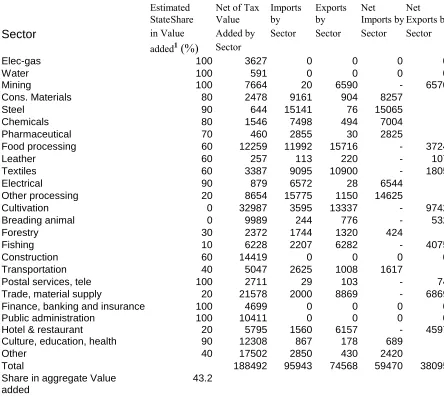
Tables 1 displays the basic data we use to construct model admissible data sets calibrate the
base case model, along with the values for the labour share and elasticity parameters we employ in
calibration. The central components of this data comes from the Vietnamese Input-Output Table for
1995 published in 1996 by the General Statistical Office, Ministry of Finance, Vietnam. In
Table 1
1995 Vietnamese Data Used in Constructing More Aggregated Model Admissible Data Sets For Counterfactual Analysis of the Effects of Trade Liberalization
(Bill. VND at producers prices)
Estimated Net of Tax Imports Exports Net Net
State Share Value by by Imports by Exports by
Sector in Value Added by Sector Sector Sector Sector
added1 (%) Sector
1 Elec-gas 100 3627 0 0 0 0
2 Water 100 591 0 0 0 0
3 Mining 100 7664 20 6590 - 6570
4 Cons. Materials 80 2478 9161 904 8257
-5 Steel 90 644 15141 76 15065
-6 Chemicals 80 1546 7498 494 7004
-7 Pharmaceutical 70 460 2855 30 2825
-8 Food processing 60 12259 11992 15716 - 3724
9 Leather 60 257 113 220 - 107
10 Textiles 60 3387 9095 10900 - 1805
11 Electrical 90 879 6572 28 6544
-12 Other processing 20 8654 15775 1150 14625
-13 Cultivation 0 32987 3595 13337 - 9742
14 Breading animal 0 9989 244 776 - 532
15 Forestry 30 2372 1744 1320 424
-16 Fishing 10 6228 2207 6282 - 4075
17 Construction 60 14419 0 0 0 0
18 Transportation 40 5047 2625 1008 1617
-19 Postal services, tele 100 2711 29 103 - 74
20 Trade, material supply 20 21578 2000 8869 - 6869
21 Finance, banking and insurance 100 4699 0 0 0 0
22 Public administration 100 10411 0 0 0 0
23 Hotel & restaurant 20 5795 1560 6157 - 4597
24 Culture, education, health 90 12308 867 178 689
-25 Other 40 17502 2850 430 2420
-Total 188492 95943 74568 59470 38095
Share in aggregate Value added
43.2
Note: Sectors Aggregated into a single Import competing sector are 1,2,4-7,11-12,15,17,18,21-22,24,25 The remaining are aggregated into a single export oriented sector.
1 These data were obtained from interviews with Vietnamese researchers, in the absence of firm available data. In aggregate these estimates imply an aggregate share of state owned enterprises in value added approximately consistent with data available for the whole economy.
respective SOE and private sectors obtained from interviews with Vietnamese researchers (see
Footnote to Table 1). This information yields a share of the state sector in total value added which
approximately matches the aggregate shares available published data. Employment data both for
state owned enterprises and the private sector are from the Vietnamese Social Affairs Yearbook.
In using these data to produce model admissible data used at a higher level of aggregation
to calibrate our model formulations we make a number adjustments, some of which imply small
modifications to the structure set above. The model admissible data used in this way are set out in
Table 2 for the basic model. We accommodate the trade imbalance in the basic data on Table 1
through an exogenous trade imbalance term in equation (7) which is fixed in real terms. We also
calculate the total value added originating in the state owned enterprise sector, which we then
separate into two parts; one representing an import competing and the other an export sector. Sectors
which are net importers are aggregated as the import competing sector, and those that are net
exporters are aggregated and classified as the export oriented sector. Total SOE employment is
divided in the same way.
We assume a production function coefficient on labour for each state owned enterprise of 0.6.
No estimates for this parameter for Vietnam are available, and we somewhat schematically rely on
estimates by Young (1994) of the labour share parameter for the South Korean manufacturing sector
in the late 1980s of 0.57. Along with the output and employment data we use, this 0.6 value implies
that 33% of labour in the two SOE sectors is shirked in the base case. We subsequently report
Table 2
1995 Model Admissible Base Case Data and Key Parameter Assumptions Used in SOE Trade Liberalization Analyses
Data Used in Calibrating the Basic Model
Key Parameter Assumptions and Calibrated Values
Items Import
Competing Sector
Export Sector
Items Sector 1 Sector 2
Production (Value added, bill VN Dong)
55431 26014 Scale parameter in production (Φ) (set exogenously)
1 1
Labour Value added (bill VN Dong)
39005 12924
No of Workers (thousands)
1880 882 Labour share
parameter (α) (set exogenously)
0.6 0.6
Returns to capital (value added, bill VN Dong)
16426 13090 Work coefficient (λ) (endogenously determined)
0.663 0.466
International price (set exogenously)
0.851 1.0 Consumption share
(β) for household 1 (endogenously determined)
0.876 0.124
Tariff rates (%) 17.5 0.0 Consumption share
(β) for household 2 (endogenously determined)
0.875 0.124
Domestic prices (world prices plus tariffs)
1.0 1.0 Elasticity of subs in consumption, goods (σ) 1.2 (set exogenously)
Exports (bill VN Dong)
- 12726 Leisure sub-utility function elasticity (ρ) 1.5 (set exogenously)
Imports (bill VN Dong)
38920
-Source: Basic data come from Table 1
Our data on 1995 tariff rates for Vietnam imply differences between domestic and world
prices. We assume that the only trade intervention is the tariff (i.e., no quotas or other instruments
are used), while in reality other instruments are employed; which we model as an equivalent quota.
Finally, to complete the model specification we need values for substitution elasticities in
preferences. We use 1.2 as the substitution elasticity between goods in the top level utility function
and 1.5 as the elasticity parameter in the leisure sub function since estimates of elasticities of
substitution in preferences for Vietnam are not available. These may appear on the high side, but
mirror parameter values used in nested CES functions elsewhere whose empirical literature is
unavailable (see the values used by Piggott and Whalley (1996), for instance). We use these values
in the base case and perform sensitivity tests around them.
As is the convention in applied general equilibrium modelling work, we can somewhat
arbitrarily choose units for goods given the value data that we use in calibration. We use units for
goods as that amount which sells for prespecified base period prices (1 million Vietnamese Dong).
Wage rates are then implied by the combination of employment and labour value added data by
sector available to us. We use all the above data and assumed elasticity and other parameter values
to calibrate the model. This yields the values of λi, and βi (consumption shares) reported in Table 2.
The data and assumed parameter values we use in calibrating our second model (with both
SOE and private enterprises) are reported in Table 3. For this model, the data on state owned
enterprises from the first model (value added, employment and use of capital) are aggregated into
a single SOE enterprise. Data from Vietnamese government statistical sources give private sector
Table 3
1995 Model admissible Base Case Data and Key Parameters Used in Trade Liberalization AnalysesUsing an SOE Model with Both Private and State Owned Enterprises
Data for SOE and Private Sectors Key Parameter Values Assigned and Determined Via Calibration
Items SOE
Sector
Private Sector
Items State Private
Production (value added, bill VN Dong)
81445 107047 Scale in production (Φ) (exogenous)
0.923 0.429
No of workersb (thousands)
2762 7720
VA by labour (bill
VN Dong)a 51929 65745 Labour share ((exogenous) α) 0.663 0.614
Fixed capital (value added, bill VN Dong)a
29516 41302 Work coefficient (λ) (endogenous)
0.319 1.0
Assumed
International prices
0.851 1.0 Wage rate
(endogenous)
0.188 0.088
Tariff rates (%) 17.5 0.0 Consumption share
(β) (endogenous)
0.523 0.477
Domestic prices 1.0 1.0 Elasticity of substitution in consumption among goods (σ) 1.2 (exogenous) Exports (bill VN
Dong)c - 8727
Imports (bill VN Dong)c
26191
-Sources: See Table 1
Note; a - Capital income in the basic value added data in the private sector in the IO (1995) table is
reduced by a 40 % factor and this is added to the labour component in the same sector to reflect the undistributed wages of family businesses included in capital income in value added.
b - The no. of workers employed in the private sector is only 6789 (thousands), and shirked labour from SOE is 931 (thousands) in the base case equilibrium.
added by capital as fixed capital required in production. The trade data we use are from the
Vietnamese input-output Table for1995 (see Table 1). A similar unit conventions for prices to earlier
is adopted when calibrating the model, and tariff rates (quotas) imply a similar relationship between
world and domestic prices. The elasticity of substitution in preferences between goods is again
assumed to be 1.2. There is no leisure in preferences in this model variant, and so no sublevel
elasticity parameter. Consumption shares (βi), and shirking coefficients (λi ) are again endogenously
determined through calibration.
The data we use to calibrate the third model (with SOE/private sector mobility) are similar
to above, and are reported in Table 4. We make an adjustment to private sector employment data
in calibrating this model to ensure that the private sector wage exceeds the SOE wage (which it must
if there is any marginal benefit from shirking), since market wage rates for the private sector are
typically underestimated as family workers receive profits. Relative to the second model, the
addition of leisure in the utility function implies the use of a first order condition linking wage
differentials between SOEs and the private sector to the marginal utility of income. In calibrating this
model variant, we use a value for the leisure subutility function elasticity parameter of 1.5, as is in
the basic model. Calibration of this model to the data in Table 4 using with the wage equality
constraint in equation (17) also involves endogenously determining a scale factor ψ in preferences
which satisfies the wage equality condition between the SOE and the private sector.
We have used these three model variants calibrated in the ways we indicate above to analyze
the impacts of trade liberalization in the presence of SOEs; contrasting the three sets of results to
those generated from a comparable conventional competitive trade model with homogeneous
models involve small open economy price taking behaviour, and hence no terms of trade effects are
Table 4
1995 Model Admissible Base Case Data and Key Parameter Values Used in Model Variant with SOE-Private Sector Mobility
Base Case Data for SOE Model Key Parameter values Assigned and Determined Via Calibration
Items State Private Items State Private
Production (value added, bill VN Dong)
81445 107047 Scale in production (Φ) (exogenous)
0.949 0.790
No of workersb (thousands)
2762 2860
Labour share (α) (exogenous)
0.6 0.614
VA by labour (bill VN Dong)a
51929 65745
Fixed capital (value
added, bill VN Dong)a 29516 41302 Work coefficient ((endogenous) λ) 0.633 1
Assumed International prices
0.851 1 Wage rate
(endogenous)
0.188 0.230
Tariff rates 17.5 % 0 Consumption share (β)
(endogenous)
0.523 0.477
Domestic prices 1 1 Elasticity of substitution in consumption of goods utility function (σ) 1.2
Exports (bill VN Dong)c
- 8728 Leisure sub-utility function elasticity parameter (ρ) 1.5
Imports (bill VN
Dong)c 26191 - Scale parameter in sub-utility function (endogenous) ψ=0.29
U L( e)=
ψ
(Le)ρ1
Sources: See Table 1.
Note: a- Capital income in the basic value added data in the private sector in the IO (1995) table is
reduced by a 40 % factor and this is added to the labour component in the same sector to reflect the undistributed wages of family businesses included in capital income in value added.
b - Private sector employment is set so as to yield a wage differential of 20 % between the private and SOE sectors given other elements of the data set.
11 Measured as the Hicksian equivalent variation summed across the two consumer (enterprise) groups.
12 See also Chan, Ghosh and Whalley (1999) for further assessment of the impact of trade liberalization in Vietnam using a competitive model structure.
3. RESULTS FROM MODEL ANALYSES
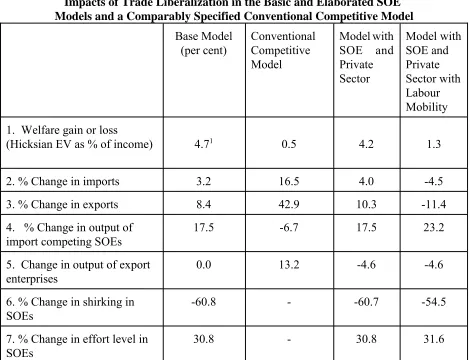
Table 5 reports results of the impact of trade liberalization in Vietnam using 1995 data
generated by the basic version of the SOE model described earlier, and compares these with results
from both the two elaborations also described above, and to those from as a comparably specified
competitive model.
In the basic model there are two SOEs, one involved in import competing and the other in
export production. Table 5 reports results for this model which show an aggregate welfare gain
from a move to free trade, involving the elimination of all trade restrictions, of 4.7% of income11.
This gain stands in contrast to a much smaller gain of 0.5 % from a comparably specified
competitive model12. In these results, the output of the import competing SOE sector from whom
protection is withdrawn increases by 17.5% in contrast to a reduction of 6.7 percent in the
competitive case. Effort increases sharply (shirking falls) by over 30 %. Trade impacts are much
larger in the competitive case compared to the SOE case, with imports rising 16.5% as against 3.2%
in the SOE case and exports rising 42.9 % as against 8.4% in the SOE case. The smaller trade
changes in the SOE case reflect the increase in output of previously protected enterprises, and the
disciplining of shirking under trade liberalization that occurs, as discussed earlier. The asymmetric
percentage trade change for imports and exports reflect the large trade imbalance in the base case
Table 5
Impacts of Trade Liberalization in the Basic and Elaborated SOE Models and a Comparably Specified Conventional Competitive Model
Base Model (per cent)
Conventional Competitive Model
Model with SOE and Private Sector
Model with SOE and Private Sector with Labour Mobility
1. Welfare gain or loss
(Hicksian EV as % of income) 4.71 0.5 4.2 1.3
2. % Change in imports 3.2 16.5 4.0 -4.5
3. % Change in exports 8.4 42.9 10.3 -11.4
4. % Change in output of import competing SOEs
17.5 -6.7 17.5 23.2
5. Change in output of export enterprises
0.0 13.2 -4.6 -4.6
6. % Change in shirking in SOEs
-60.8 - -60.7 -54.5
7. % Change in effort level in SOEs
30.8 - 30.8 31.6
In the other SOE cases, results from the model with an SOE and a private sector (column 3
of Table 5) are broadly similar to those from the basic SOE model (column 1 of Table 5). However,
results from the model where mobility of labour between SOEs and the private sector enters show
more differences. To ensure marginal conditions hold in the labour market in the base case,
calibration involves the selection of a units term for the subutility function for leisure, which
produces a changed marginal valuation of leisure relative to model 1 and different welfare effects
from liberalization. In this case, liberalization generates a larger export response from SOEs to trade
liberalization, but a smaller change in effort. This is due to a reduction in leisure consumption under
liberalization. In this case, and in contrast to model,1 and 3, imports fall rather than rise on
liberalization reflecting the proportionally larger production response from import competing SOEs
that occurs.
The overall picture across all these cases, however, is that trade liberalization in the presence
of SOEs produces results which differ sharply, both qualitatively and quantitatively, from the
competitive case. Output responses from trade protected SOEs are positive rather than negative.
Imports fall as well as rise in some cases. Quantitative impacts suggests much larger welfare impacts
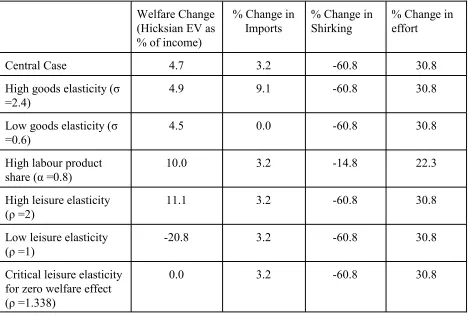
Table 6 reports sensitivity analyses for the results from the basic model reported in Table 4
to values of key parameters used. These showing limited sensitivity to elasticity of substitution (σ)
parameters, while higher values for the labour share parameter (α) yield higher welfare gains from
trade liberalization and lower values small losses.
The most sensitivity in welfare effects occur under changes in the value of the elasticity
parameter in the leisure subutility function in the model. A higher elasticity yields higher welfare
gains, and for a low value these become losses. The latter occurs where the marginal product of
labour forgone in the SOE when labour shirks exceeds the money metric value of the marginal utility
of leisure. In such cases, labour still shirks, since they receive the wage wiindependently of their
effort level, but the level of shirking is lower. We highlight earlier the uncertainty of the sign of the
welfare effects from trade liberalization in the presence of SOEs, and here we can locate critical
regions in the parameter space for which the sign of results change. A critical value of ρ for which
the welfare effect of trade liberalization is zero can be calculated in this model; this is 1.34. A value
of ρ lower than 1.34 yields welfare worsening trade liberalization for this model parameterization.
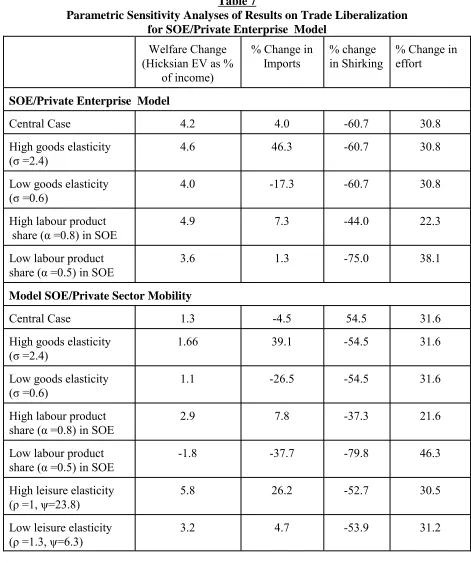
Sensitivity analyses of results for variations on key parameter values for the other two models
are reported in Table 7. We are able to calibrate the model with mobility such that given the elasticity
values in the leisure subutility function, we can choose units terms for this subfunction such that the
wage equality condition (17) holds. If we change the elasticity parameter values in the leisure
subutility function across different model runs, we must also rescale the utility function in this way
so that equation (17) is satisfied in calibration. Limited sensitivity is again found for both models
with regard to the elasticity of substitution in preferences. Welfare effects show more sensitivity to
Table 6
Parametric Sensitivity Analyses of Results on Trade Liberalization for the Basic SOE Model
Welfare Change (Hicksian EV as % of income)
% Change in Imports
% Change in Shirking
% Change in effort
Central Case 4.7 3.2 -60.8 30.8
High goods elasticity (σ =2.4)
4.9 9.1 -60.8 30.8
Low goods elasticity (σ =0.6)
4.5 0.0 -60.8 30.8
High labour product share (α =0.8)
10.0 3.2 -14.8 22.3
High leisure elasticity (ρ =2)
11.1 3.2 -60.8 30.8
Low leisure elasticity (ρ =1)
-20.8 3.2 -60.8 30.8
Critical leisure elasticity for zero welfare effect (ρ =1.338)
Table 7
Parametric Sensitivity Analyses of Results on Trade Liberalization for SOE/Private Enterprise Model
Welfare Change (Hicksian EV as %
of income)
% Change in Imports
% change in Shirking
% Change in effort
SOE/Private Enterprise Model
Central Case 4.2 4.0 -60.7 30.8
High goods elasticity (σ =2.4)
4.6 46.3 -60.7 30.8
Low goods elasticity (σ =0.6)
4.0 -17.3 -60.7 30.8
High labour product share (α =0.8) in SOE
4.9 7.3 -44.0 22.3
Low labour product share (α =0.5) in SOE
3.6 1.3 -75.0 38.1
Model SOE/Private Sector Mobility
Central Case 1.3 -4.5 54.5 31.6
High goods elasticity (σ =2.4)
1.66 39.1 -54.5 31.6
Low goods elasticity (σ =0.6)
1.1 -26.5 -54.5 31.6
High labour product share (α =0.8) in SOE
2.9 7.8 -37.3 21.6
Low labour product share (α =0.5) in SOE
-1.8 -37.7 -79.8 46.3
High leisure elasticity (ρ =1, ψ=23.8)
5.8 26.2 -52.7 30.5
Low leisure elasticity (ρ =1.3, ψ=6.3)
4. CONCLUSION
In this paper we analyse the impacts of trade liberalization in economies with State Owned
Enterprises (SOEs), motivated by both the lack of literature on this topic, and its importance for
work on developing and transition economies. SOEs are modelled as controlled by the members of
the enterprise who set output levels and shirk while facing fixed output prices and wage rates set by
government. Enterprise members must collectively meet the budget constraint that the value of sales
must equal their wage bill plus an exogenous enterprise commitment to the state budget. Once this
constraint is met, labour can shirk either through reduced on the job effort (leisure), or through
moonlighting to second jobs in the private sector.
Three alternative formulations of equilibria in SOE economies are explored, including
numerically using data for Vietnam. In these, trade liberalization can produce effects opposite to
those found in conventional competitive models; such as increasing rather than reducing the output
of the import competing SOEs, and potentially changing the sign of the impacts on trade flows and
welfare, even in the small open economy case. Our results point to sharply larger welfare impacts
from trade liberalization in SOE models than is the case in conventional competitive models,
because the initial departures from Pareto optimality in SOE economies can be large. In such cases
our results suggest that trade liberalization can act to discipline the shirking associated with these
inefficiencies.
The broad implication we draw from our analyses is that to assess policy initiatives, in
developing and transition economies, such as trade liberalization, without explicitly recognizing the
role that SOE’s can play may be misleading. This is especially the case where such enterprises
5. REFERENCES
Bai C. E. and Y. Wang (1998), “Bureacratic Control and the Soft Budget Constraints”, Journal of Comparative Economics, Vol. 26, No. 1, March, pp 41-61.
Bennett, J.T. and M.H. Johnson (1979), “Public versus Private Provision of Collective Goods and Services: Garbage Collection Revisited”, Public Choice, Volume 34, No. 1, pp 55-63.
Boardman A.E. and A.R. Vining (1989), “Ownership and Performance in Competitive Environments: A Comparison of the Performance of Private, Mixed, and State Owned Enterprises”,
Journal of Law and Economics, Vol 32, pp 1-33.
Caves D.W. and L.R. Christensen (1980), “The Relative Efficiency of Public and Private Firms in a Competitive Environment: The Case of Canadian Railroads”, Journal of Political Economy, Vol 88, pp 958-76.
Chan, N., Ghosh, M. and Whalley, J. (1999), “Evaluating Tax Reform in Vietnam Using General Equilibrium”, Research Report # 9906, Department of Economics, University of Western Ontario, Canada.
Dong X.Y. and G.K. Dow (1993), “Does Free Exit Reduce Shirking in Production Teams?”, Journal of Comparative Economics, Vol. 17, No. 2, June, pp 472-84.
General Statistical Office (1996), Statistical Yearbook 1995, 1996, Ministry of Finance, Government of Vietnam.
General Statistical Office (1996), Statistical Yearbook of Labour-Invalids and Social Affairs 1995, Ministry of Finance, Government of Vietnam.
General Statistical Office (1996), Vietnam in Transition to Market-oriented Economy, Ministry of Planning and Investment, Vietnam.
Groves T., Y.M. Hong, J. MacMillan, and B. Naughton (1994), “Autonomy and Incentives in Chinese State Enterprises”, Quarterly Journal of Economics, Vol, 109, No. 1, pp 183-209.
Jefferson, Gary H. and Inderjit Singh (eds, 1999), Enterprise Reform in China: Ownership, Transition, and Performance, World Bank, Research Publications.
Mori P.A. (1991), “The Role of Employers’ Authority when Jobs are Partially Enforceable”,
Economics Letters, Vol. 35, No. 1, pp 89-93.
O’ Conner D. (1996), Labour Market Aspects of State Enterprise Reform in Vietnam, Technical Paper No. 117, OECD, Paris.
Piggott, J. and J. Whalley (1996), “The Tax Unit and Household Production”, Journal of Political Economy, Vol. 104(2), pp 398-418.
Simon H.A. (1959), “Theories of Decision Making in Economics and Behavioural Science”,
American Economic Review, Vol. 49, No. 1, pp 253-283.
World Bank (1995), Bureaucrats in Business, World Bank Policy Research Report, Washington, DC.