NBER WORKING PAPER SERIES
CORPORATE TAX AVOIDANCE AND HIGH POWERED INCENTIVES Mihir A. Desai
Dhammika Dharmapala Working Paper10471
http://www.nber.org/papers/w10471
NATIONAL BUREAU OF ECONOMIC RESEARCH 1050 Massachusetts Avenue
Cambridge, MA 02138 May 2004
We would like to thank Alan Auerbach, Amy Dunbar, Alexander Dyck, Austan Goolsbee, Dirk Jenter, John Phillips, Luigi Zingales and various conference and seminar participants for valuable discussions and comments on an earlier version of this paper. Desai acknowledges the financial support of the Division of Research of Harvard Business School and Dharmapala acknowledges the financial support of the University of Connecticut Research Foundation. Michael Park provided excellent research assistance. The views expressed herein are those of the author(s) and not necessarily those of the National Bureau of Economic Research.
©2004 by Mihir Desai and Dhammika Dharmapala. All rights reserved. Short sections of text, not to exceed two paragraphs, may be quoted without explicit permission provided that full credit, including © notice, is given to the source.
Corporate Tax Avoidance and High Powered Incentives Mihir Desai and Dhammika Dharmapala
NBER Working Paper No. 10471 May 2004
JEL No. G30, H25, H26, J33
ABSTRACT
This paper analyzes the links between corporate tax avoidance, the growth of high-powered incentives for managers, and the structure of corporate governance. We develop and test a simple model that highlights the role of complementarities between tax sheltering and managerial diversion in determining how high-powered incentives influence tax sheltering decisions. The model generates the testable hypothesis that firm governance characteristics determine how incentive compensation changes sheltering decisions. In order to test the model, we construct an empirical measure of corporate tax avoidance - the component of the book-tax gap not attributable to accounting accruals - and investigate the link between this measure of tax avoidance and incentive compensation. We find that, for the full sample of firms, increases in incentive compensation tend to reduce the level of tax sheltering, suggesting a complementary relationship between diversion and sheltering. As predicted by the model, the relationship between incentive compensation and tax sheltering is a function of a firm's corporate governance. Our results may help explain the growing cross-sectional variation among firms in their levels of tax avoidance, the "undersheltering puzzle," and why large book-tax gaps are associated with subsequent negative abnormal returns.
Mihir A. Desai
Graduate School of Business Administration Harvard University Soldiers Field Boston, MA 02163 and NBER [email protected] Dhammika Dharmapala University of Connecticut [email protected]
1. Introduction
As reviewed in Graham (2003), the extensive literature on how taxes influence firm financial decision-making has considered the effect of taxes on financing choices, organizational form and restructuring decisions, payout policy, compensation policy and risk management decisions. In this literature, taxes are viewed as one of many factors that shape these decisions. In contrast, firms also appear to engage in a variety of transactions that, in the words of Michael Graetz, are deals “done by very smart people that, absent tax considerations, would be very stupid.” These activities, broadly labeled corporate tax shelters, are believed to have proliferated so greatly that, according to some observers, they now constitute “the most serious compliance issue threatening the American tax system today.”1
What induces firms and managers to engage in transactions exclusively designed to minimize taxes? Alternatively, given the low perceived probabilities of detection, why don’t all firms engage in these transactions? How are shareholders affected by transactions that are nominally motivated by tax savings? Previous analyses of tax avoidance and evasion have emphasized the behavior of individuals (as in the literature reviewed in Slemrod and Yitzhaki (2002)), rather than corporations. Recently, Slemrod (2004) has stressed the need to consider the differences between individual and corporate tax compliance, arguing that the latter should be analyzed in a principal-agent framework. Our paper develops a simple theoretical framework that embeds the sheltering decision within a managerial agency context, and emphasizes the importance of interactions between rent diversion and tax sheltering. In order to test this model, we construct an empirical measure of corporate tax avoidance – the component of the book-tax gap not attributable to accounting accruals – and investigate its determinants, linking sheltering decisions by US firms to their incentive compensation and corporate governance arrangements.
In order to approximate the conditions facing managers of U.S. firms, our model analyzes the decisions of a manager who chooses levels of income to report to shareholders and to the tax
1 “Tackling The Growth of Corporate Tax Shelters”; Treasury Secretary Lawrence H. Summers, in remarks to the
Federal Bar Association, Washington, DC, February 28, 2000. For a review of typical tax shelter transactions and the policy issues, see U. S. Treasury (1999). One very crude metric of the possible magnitude of such activities is provided by the U.S. General Accounting Office (2004), which documents that (i) from 1996 to 2000,
approximately one-third of large U.S. corporations reported zero tax liability, (ii) that share increased steadily over the period, and (iii) by 2000, 53% of large U.S. corporations reported tax liabilities lower than $100,000. For these purposes, large corporations are those with a minimum of either $250 million in assets or $50 million in gross receipts.
authorities. The manager is also assumed to be able to divert some of the firm’s (potential) earnings in the form of rents. The impact of an increased use of incentive compensation depends on the extent of the “technological complementarities” between diversion and sheltering. The activities are complementary if the costs to the manager of diversion are lower when the level of sheltering is higher and vice versa (for instance, when income that is sheltered from the tax authorities thereby becomes less visible to shareholders, and can be more easily diverted).2 If these complementarities are not too strong, higher-powered incentives will induce the manager to not only reduce her diversion of rents, but also to engage in more tax sheltering activity. In short, greater incentive compensation helps align the incentives of agents and principals and leads managers to be more aggressive about increasing firm value through tax avoidance. On the other hand, if the complementarities are strong, then the manager’s reduced diversion of rents may be accompanied by a reduction in tax sheltering activity.
While the model’s predictions for the effect of higher-powered incentives on tax avoidance are ambiguous, it generates a testable hypothesis about the interaction between higher-powered incentives and governance. Specifically, the impact of higher-powered incentives in leading to greater tax avoidance should be greater in well-governed firms than in firms with weaker governance structures. The intuition is that while increased incentive
compensation will increase sheltering for all firms as managers place more weight on firm value, the offsetting effects of reduced sheltering are a function of the governance of the firm.
Specifically, for a given complementarity between diversion and sheltering, better governed firms will provide less scope for offsetting reductions of sheltering as diversion levels will be lower for such firms. As such, the model is consistent with either a positive or negative
relationship between high-powered incentives and tax avoidance on average, but is unambiguous about the role of the governance environment in mediating those effects.
In our empirical analysis, we estimate the levels of tax sheltering activity for a large sample of corporations, using financial accounting data from the Compustat database. We first generate estimates of the book-tax gap for these firms, following the methodology of Manzon and Plesko (2002). Then, we use data on accruals to isolate the component of the book-tax gap
2 This complementarity between diversion and sheltering is the premise that motivates the analysis of the links
between corporate governance and corporate taxation in Desai, Dyck and Zingales (2003). They discuss a number of examples of this phenomenon in detail.
that is attributable to earnings management activity. The residual book-tax gap is identified as the level of tax sheltering activity for each firm in each year of our sample period. We use a variety of proxies, from the Execucomp database, for the prevalence of incentive compensation at these firms, but our primary measure is the ratio of the Black-Scholes value of stock option grants to total managerial compensation. The quality of corporate governance is measured by the index constructed by Gompers, Ishii and Metrick (2003); this is based on the degree to which managers are entrenched through corporate charter provisions. Clearly, our empirical analysis requires the use of three proxies – for tax sheltering, managerial compensation structure, and governance characteristics – that are inherently imperfect. We have sought, however, to use measures that are widely accepted within each of the relevant literatures.
Merging the data on tax sheltering, managerial compensation, and corporate governance yields a panel of 943 firms over the period 1993-2002. Focusing on within-firm variation, we find that for the full sample of firms, increases in incentive compensation tend to reduce the level of tax sheltering, in a manner that is consistent with complementarity between sheltering and diversion. As predicted by the model, the link between incentive compensation and sheltering is mediated by the corporate governance characteristics of the firm. The observed average
relationship does not hold for the subsample of well-governed firms, as the evidence suggests a minimal (or a weak positive) relationship between incentive compensation and sheltering for these well-governed firms.
Our analysis suggests that the simple intuition that increased alignment of shareholder and manager interests would lead to greater tax sheltering activity is theoretically only a special case, and empirically not operative. While the result that increased alignment between
shareholders and managers leads to reduced sheltering appears counterintuitive initially, the underlying rationale within our model – that sheltering and diversion are complementary – is consistent, as discussed below, with anecdotal evidence about sheltering and diversion. The results in the paper are also consistent with a notable aggregate feature of our tax sheltering measure – the growing cross-sectional variation among firms in their levels of tax avoidance over our sample period.3 It would appear that while the growth of incentive compensation has
3 Cross-sectional variation across firms in their use of tax shelters has been noted in the accounting literature (e.g.
affected virtually all firms, its effects on tax sheltering are different for different firms; this can potentially explain the divergence across firms that we observe.
Our results may also shed some light on what Weisbach (2002) calls the “undersheltering puzzle” - why firms do not use tax shelters more extensively, given the ease and low expected costs of such activities. It may well be the case that shareholders do not want managers to engage in tax sheltering, despite the obvious gains in after-tax firm value, because doing so may also create greater opportunities for managerial diversion of rents. Indeed, the evidence in Lev and Nissim (2002) and Hanlon (2003a) that large book-tax gaps are associated with subsequent negative abnormal returns similarly indicates that tax-motivated activities by firms do not necessarily lead to greater shareholder value.
This paper makes a number of contributions. First, it provides a simple theoretical
framework for understanding the interaction between tax avoidance and corporate governance. It also constructs a quantitative measure of the inherently elusive phenomenon of tax avoidance. Using this measure, it presents empirical results that further our understanding of how incentive compensation affects tax sheltering, and how this relationship is mediated by governance institutions. More generally, we provide new evidence in favor of the emerging paradigm that links taxation and corporate governance as proposed in Desai, Dyck and Zingales (2003), and in particular we find evidence for the existence of complementarities between diversion and sheltering. We also contribute to the large and growing literature on the effects of incentive compensation. Finally, like Crocker and Slemrod (2003), we extend the traditional tax avoidance and evasion literature on individuals to encompass the corporate sector.
The rest of the paper proceeds as follows. Section 2 reviews the related literature on incentive compensation and corporate tax avoidance. Section 3 develops a model that relates incentive compensation to tax avoidance, and provides the motivation for the empirical work that follows. Section 4 describes the data, methodology and empirical framework. Section 5 describes the results and considers alternative interpretations and problems of causality. Section 6
concludes.
2. Related Literature
This paper is related to the very substantial body of research on various aspects of incentive compensation, the literature on firm’s reporting responses to tax incentives and the
emerging analysis of the interactions between taxation and corporate governance. In this section, we briefly review these literatures, emphasizing recent work that is most closely related to our paper.
The growth of stock-based incentive compensation is among the most notable developments in corporate practices in recent years (see Hall and Murphy (2003) for an
overview), and a vast literature has developed on its determinants and effects. As one example of the beneficial effects of incentive compensation, Mehran (1995) finds that firms with a larger fraction of outside directors on the board are more likely to use incentive compensation, and that its use improves firm performance.4 More recently, concerns have arisen about the potentially negative aspects of the use of high-powered incentives, as reviewed in Bebchuk and Fried (2003). For example, Erickson, Hanlon and Maydew (2003) analyze firms that were accused of accounting fraud by the SEC during 1996-2003 and find that incentive compensation
significantly increases the likelihood that a firm is accused of fraud. Our paper extends this literature on how incentive compensation shapes manager and firm behavior, particularly with respect to tax planning. As one example of such an interaction, Gupta and Swenson (2003) find that incentive compensation encourages lobbying by firms for tax benefits.5
The tremendous growth in incentive compensation during the 1990s coincided with an increased disconnect between the profits reported to capital markets and the profits reported to tax authorities. Manzon and Plesko (2002) conclude that the explanatory factors relevant for explaining this gap have not changed over time. In contrast, Desai (2003) argues that the growing divergence between the two during the 1990’s is not attributable to the factors that account for the book-tax gap in the earlier part of this period – the differential treatment of depreciation, foreign source income, and employee option grants in the reporting of book and tax income – and that it cannot be fully explained by increased levels of earning management over this period.6 Lev and Nissim (2002) and Hanlon (2003a) analyze the link between book-tax gaps
4 See Core, Holthausen and Larcker (1999) for an alternative view of the relationship between board structure and
compensation.
5 More generally, Beatty (1995), Core and Guay (2001) and Graham, Lang and Shackelford (2004) all consider how
a firm’s tax characteristics shape incentive compensation plans. This paper turns this question on its head and considers how incentive compensation plans shape a firm’s tax characteristics.
6 For studies on earnings management, see e.g. Healy (1985), Jones (1991) and Dechow, Sloan and Sweeney (1995);
for a recent theoretical perspective, see Goel and Thakor (2003). Other studies on the discrepancies between book and tax reporting include Plesko (2002) and Mills and Newberry (2001).
and future returns in a further effort to understand if these gaps represent earnings manipulation, finding that book-tax gaps predict future negative abnormal returns. Our paper extends this literature by developing a measure of the tax sheltering component of the book-tax gap, and investigating its determinants. Of course, this literature is a subset of the much larger literature on how tax factors interact with reporting decisions.7
Finally, the issue of corporate tax avoidance has previously been linked to the structure of corporate governance. Specifically, Desai, Dyck and Zingales (2003) analyze and test a model of the interaction between tax sheltering activity and the diversion of rents by managers. They argue that strong complementarities between the two activities may exist, so that increased levels of tax enforcement may raise firm value, despite the firm’s increased tax payments, and that a corporate Laffer curve may exist that is a function of the governance environment and levels of insider ownership. Evidence from a recent crackdown in tax enforcement in Russia supports the former prediction and cross-country evidence on the revenue effects of tax rate changes supports the latter prediction. The model presented below demonstrates that this interaction between sheltering and diversion is critical to understanding how the increased use of incentive compensation may be linked to tax sheltering and may be operative in the U.S. setting.8
3. A Simple Model
The effects of high-powered incentives on tax sheltering activity can be analyzed using a simple model of managerial behavior. The aim here is to present a reduced-form specification of the manager’s objective function, and to derive the conditions under which increasing the power of the manager’s incentives will induce the manager to engage in increased or decreased levels of tax sheltering.9 A theoretical literature has recently begun to analyze the nature of the optimal
7 There are two somewhat distinct bodies of work on this issue. The accounting literature (reviewed in Shackelford
and Shevlin (2001) and Maydew (2001)) has emphasized the interaction of tax costs or benefits and other reporting costs or benefits. Separately, a large literature (reviewed in Hines (1999)) exists on how multinationals distort reported profits and investment in response to tax rate differences.
8 There are a variety of ways in which tax policy influences ownership structures and governance outcomes in the
U.S. setting. For example, Morck (2003) investigates the role of the tax treatment of intercorporate dividends in shaping the structure of business groups, and Desai and Gentry (2003) and Maydew, Schipper and Vincent (1999) examine how corporate holdings and divestiture decisions are influenced by tax factors. Aside from cross-holdings, incorporation and reincorporation decisions can also reflect tax considerations, as in Mackie-Mason and Gordon (1997) and Desai and Hines (2002).
9 One of the thorny questions we sidestep in our model is precisely what a tax shelter is. We rely on the intuition
provided by Graetz in the quote at the start of the paper and that is now embodied in the “economic substance” doctrine – specifically, a transaction that has no associated business purpose. In the stark setting of the model, that
incentive contract when managers can engage in tax evasion or avoidance (Crocker and Slemrod, 2003; Chen and Chu, 2003). Our formulation does not address these issues in detail, but is
sufficiently flexible to capture in reduced form any kind of employment contract that may be feasible.
3.1. Assumptions
We assume that a firm generates exogenous earnings of Y > 0, observable only to the manager. The manager chooses a level of income to reveal to shareholders (denoted YS), and a level of income to report to the tax authorities (denoted YT), where YS, YTє [0, Y].10 We restrict attention to the case where YS≥ YT (i.e. where the book-tax gap (YS – YT)) is nonnegative). This constraint simplifies the analysis, but does not fundamentally affect the qualitative response of the manager to changes in the structure of compensation. The manager is assumed to gain utility w(D) from the amount of earnings D = Y – YS diverted (i.e. not reported to shareholders), and consumed by the manager as rents:
A1:w′(D) > 0, w′′(D) < 0 (i.e. w(D) is increasing and concave)
The manager is also assumed to care about firm value as represented by the after-tax cum dividend value of the firm, or (YS – tYT), where t is the corporate tax rate. The manager places a weight θ on firm value; θ captures the extent to which the manager’s outcomes are tied to firm performance (e.g. through incentive compensation).
Engaging in diversion and sheltering activity involves costs for the manager, captured in reduced-form by a loss function L(Y – YS, Y – YT), or equivalently, L(D, Z), where Z = Y – YT is the amount of income sheltered from the tax authorities:
A2:LS(·,·), LT(·,·) < 0 and LSS(·,·), LTT(·,·) > 0 (i.e. L(·,·) is increasing and convex in each
argument)
where LS(·,·) denotes the derivative of L with respect to YS and LT(·,·) denotes the derivative of L
with respect to YT.These costs to the manager may be either ex ante (e.g. the effort and resources
corresponds to underreporting of true profits to tax authorities without any particular emphasis on the means by which this is accomplished. The definition of a shelter is obviously a legal question and our interest lies in understanding managerial motivations for transactions that serve fundamentally to reduce tax liabilities.
10 There are several interesting issues associated with reporting artificial profits to shareholders, i.e. settings where
Ys>Y (as explored in Erickson, Hanlon and Maydew, (2004)) Given that our emphasis is on the interaction of sheltering and diversion, the model follows the convention of the private benefits literature (e.g. Zingales (1995) and Shleifer and Wolfenzon (2002)), where insiders divert income.
expended in diverting and sheltering the firm’s earnings) or ex post (e.g. sanctions imposed upon managers when sheltering or diversion are detected).11
The formulation here allows for interdependencies between the costs of sheltering and the costs of diversion. Desai, Dyck and Zingales (2003) argue that in some circumstances,
technological complementarities between sheltering and diversion may exist. Income that is sheltered from the tax authorities may be less visible to shareholders, and hence more easily diverted. It is also possible that there is a lower probability that diversion will be detected if the income in question has been sheltered. In such cases, LST(·,·) < 0. Alternatively, sheltering and
diversion may be substitutes. For example, the two activities may require distinct forms of effort from managers, or penalties for diversion may be larger when levels of sheltering are large, and vice versa. In such cases, LST(·,·) > 0. We return below to the significance of the assumptions
about the cross-partial LST(·,·).
Assuming an additive form for these various components, the manager’s payoff can be represented as follows:
U = w(Y – YS) + θ(YS – tYT) – L(Y – YS, Y – YT) (1)
The manager’s program can be expressed as: U MaxS T
Y
Y , (2)
i.e. the manager chooses YS and YT to maximize the payoff in Eq. (1), subject to the constraints that YS, YTє [0, Y] and YS≥ YT.
3.2. Results
We begin by deriving how changes in the parameter θ influence the level of diversion and sheltering. The manager’s optimal choices of YS and YT can be characterized using the first order conditions with respect to YS and YT, respectively:
- w´(D*) + LS(D*, Z*) + θ = 0 (3)
- tθ + LT(D*, Z*) = 0 (4)
11 The latter costs may, for example, include civil, criminal and/or reputational sanctions resulting from the detection
of diversion by shareholders and/or regulators. The detection of tax sheltering activity by the tax authorities through audits may also lead to pecuniary sanctions or adverse professional consequences, if the legality of the shelter is successfully challenged by the tax authorities.
where D* and Z* are the equilibrium levels of diversion and sheltering, respectively. Our
primary interest is in the comparative static analysis of small changes in θin the neighborhood of the equilibrium values D* and Z*.12 Differentiating the first order conditions above (Eqs. (3) and (4)) with respect to YS and YT, and expressing this in matrix form leads to:
⎥ ⎦ ⎤ ⎢ ⎣ ⎡ − ⎥ ⎦ ⎤ ⎢ ⎣ ⎡ = ⎥ ⎥ ⎥ ⎥ ⎦ ⎤ ⎢ ⎢ ⎢ ⎢ ⎣ ⎡ ∂ ∂∂ ∂ − t (·,·) -L (·,·) -L (·,·) -L (·,·) w´´(·) - L Y Y TT ST ST SS T S 1 1 θ θ (5)
The second order condition for D* and Z* to maximize the manager’s objective function is satisfied (i.e. the Hessian matrix is negative semidefinite) if:
[LST(D*, Z*)]2 > – [w´´(D*) – LSS(D*, Z*)]LTT(D*, Z*) (6)
Applying Cramer’s Rule,
sign ( θ ∂ ∂YS ) = – sign [– LTT(·,·) – tLST(·,·)] (7) sign ( θ ∂ ∂YT ) = – sign [– t(w´´(D) – LSS(·,·)) + LST(·,·)] (8)
As such, the following condition must apply to ensure that increases in θ to lead to both reduced diversion and increased sheltering:
Condition 1:LST(D*, Z*) > min {– (1/t)LTT(D*, Z*), t(w´´(D*) – LSS(D*, Z*))}
This entails that LST(·,·) is “sufficiently large” in the following sense: either there are no
technological complementarities between sheltering and diversion, or if they exist, they are not too large in magnitude. Note that both expressions on the right-hand side are negative. Thus, any nonnegative LST(·,·) satisfies Condition 1, which requires only that LST(·,·) not be too negative.
The result can be stated as follows:
Proposition 1: If the second-order condition (Eq. (6)) is satisfied and assumptions A1 and A2
and Condition 1 hold, then an infinitesimal increase in θ leads to a decrease in diversion, an increase in sheltering, and an increase in the book-tax divergence (YS – YT):
12 Monotone comparative static results, using lattice-theoretic methods, would apply for all values of θ. However,
such results cannot be obtained here, because USθ = 1 and UTθ = - t have different signs, so that U does not have “increasing differences” in (YS, YT, θ).
i.e. θ ∂ ∂YS > 0, θ ∂ ∂YT < 0, and θ ∂ − ∂(YS YT) > 0
Proof: Follows directly from the assumptions, and Eqs. (7) and (8). As YS increases and YT
decreases, it follows straightforwardly that (YS – YT) must increase.
It is not surprising that the creation of higher-powered incentives leads, through a greater weight on firm value in the manager’s objective function, to a decrease in diversion. This, indeed, is presumably the direct and intended consequence of the use of high-powered
incentives.13 The novel element in our analysis is the inclusion of the possibility of tax sheltering activity by the manager. In such circumstances, an increase in θ will also lead to an increase in the sheltering of income from the tax authorities under these conditions as this provides the manager with an alternative means of increasing after-tax firm value. Consequently, under these conditions, the measurable book-tax divergence (YS – YT) clearly increases in response to an increase in θ.
An important corollary to Proposition 1 is that, when Condition 1 does not hold, it is possible that an increase in θ may lead to a decrease in sheltering:
Proposition 2: Assume that the second-order condition (Eq. (6)) is satisfied, and that
assumptions A1 and A2 hold. Suppose also that t(w´´(D*) – LSS(D*, Z*)) > – (1/t)LTT(D*, Z*),
and that:
LST(D*, Z*) є (– (1/t)LTT(D*, Z*), t(w´´(D*) – LSS(D*, Z*))) (9)
Then an infinitesimal increase in θ leads to decreases in diversion and sheltering (the effect on the book-tax divergence is ambiguous):
i.e. θ ∂ ∂YS > 0 and θ ∂ ∂YT > 0
Proof: Follows directly from the assumptions, and Eqs. (7) and (8).
Technological complementarities between diversion and sheltering will tend to lead to decreases in sheltering when θ rises. Intuitively, when θ rises, the manager’s optimal choice of YS*
increases in response. If the costs of sheltering are higher when the level of diversion is lower,
13 At least, this is true within the standard “optimal contracting” approach to managerial compensation. Alternative
then the manager’s optimal choice of YT* will rise (i.e. the level of sheltering will fall) on account of the increase in YS*. A sufficiently large degree of complementarity can lead to a fall in both diversion and sheltering in response to high-powered incentives.
As this discussion makes clear, our model conceptualizes the conditions under which high-powered incentives can lead to either higher or lower tax sheltering. It does not provide an unambiguous prediction concerning the effects of changes in θon the level of tax sheltering, given the importance of an unobservable technological relationship. However, an unambiguous testable prediction can be derived for the relative effects of changes in θ on tax sheltering that depends on the governance characteristics of firms. We identify stronger governance
characteristics (i.e. a higher initial level of θ) with lower levels of diversion: that is, a manager who places greater weight on firm value will tend to divert less income.
In order to conceptualize the role of the governance of firms, it is useful to consider a polar example. Consider a firm with a governance environment that is sufficiently strong that the manager finds any diversion to be prohibitively costly (so that D = 0). Now suppose that there is an increase in the power of managerial incentives (i.e. a higher θ). The manager will respond by seeking to increase firm value. Given that there is no scope to further reduce D, the manager will engage in a higher level of tax sheltering regardless of the value of LST(·,·). In other
words, sheltering and diversion cannot locally be strong complements around the neighborhood of D = 0, regardless of the global shape of the L(.) function. More formally, we can assume in
such circumstances thatlim ( , ) 0
0 ≥
→ LST D Z
D .
In contrast, consider the same firm (with an identical L(.) function) in a relatively weak governance environment (where D > 0). An increase in θ will induce the manager to increase firm value, and thus have the direct effect of increasing both D and Z. If the L(.) function exhibits complementarities in the relevant range of D, then there will also be an indirect effect on Z: the reduction in diversion will be associated with reduced sheltering. This indirect effect will tend to counteract the direct effect, leading to a smaller net increase (or a larger net decrease) in Z in the weak governance environment, relative to the strong governance environment (where there is no indirect effect to counter the direct effect of an increase in Z).
If we assume that all firms face the same L(.) function (or at least that this function is independent of the firm’s governance characteristics), the argument above implies that the
response of tax sheltering activity by well-governed firms to increases in θ will be greater than the analogous responses of less well-governed firms. Intuitively, while the direct effect of increases in θ is to induce managers to increase Z, the manager of a well-governed firm does not face (at least to the same degree) the counteracting tendency created by the complementarities between D and Z. This logic extends beyond this polar example. Note that, if D is not close to zero even in relatively well-governed firms, than the effect of increases in θ on Z may be negative even for these firms; even so, it can be expected to be less negative than for firms with relatively worse governance characteristics.
As such, the differential response of sheltering to changes in incentive compensation based on the governance of environment provides a testable hypothesis of the relevance of the model:
Hypothesis 1: A small increase in θwill lead to a larger positive (or smaller negative) effect on
Z for well-governed firms, relative to the effect for less well-governed firms.
It is important to stress that we are not claiming that the structure of corporate governance per se will have any particular effect on Z. As noted above, improvements in governance (i.e. lower levels of D) are consistent with either higher or lower levels of Z, depending on the nature of the L(.) function. Rather, our hypothesis is about the mediating effect of governance on how changes in θ influence tax sheltering activity.
4. Data and Methodology
In order to analyze the phenomenon of corporate tax avoidance empirically, and to test the hypothesis we have derived about the effects of the interaction between incentive
compensation and governance on tax sheltering, we integrate several different data sources. We begin by simulating the book-tax gap for a large sample of firms from Standard and Poor’s Compustat database, using a procedure developed by Manzon and Plesko (2002). Then, we construct an empirical measure of tax sheltering activity, by adjusting the book-tax gap for measures of earnings management arising from accrual accounting. Next, we construct measures of managerial incentives, using data from Standard and Poor’s Execucomp database. Then, this data is linked to an index of the quality of corporate governance, developed by Gompers et al. (2003). In this section of the paper, we describe each of these steps in detail, and discuss the data and the empirical specifications.
4.1. Measuring Tax Sheltering
By its very nature, tax sheltering activity is extremely difficult to measure. In order to construct a proxy, we begin with the book-tax gap (YS – YT), operationalized as the difference between the book income reported by a firm to its shareholders and the SEC (using Generally Accepted Accounting Principles (GAAP)), and the tax income reported to the IRS. Because firms’ tax returns are confidential, it must be estimated using simulations based on the available data. A methodology for doing so is developed in Manzon and Plesko (2002). We follow their approach, as described below. We use current Federal tax expense (hereafter, CFTE; Compustat data item #63) to estimate YT. Assuming that each firm faces a tax rate t that is given by the top statutory Federal corporate income tax rate (which was 35% during our sample period), it follows that CFTE = tYT. 14 Thus, the firm’s estimated taxable income Yˆ is simply: T
t CFTE
YˆT = (10)
The (domestic US) taxable income estimated in Eq. (10) can be subtracted from the firm’s (domestic US) financial statement income, to obtain what Manzon and Plesko (2002, p. 192) term the “unadjusted SPREAD”:
Unadjusted SPREAD = YS – Yˆ T (11)
This measure of the book-tax gap can be refined further by adjusting the reported YS to deduct
expenses that are tax-deductible (e.g. state and other income taxes), and to subtract income that is tax-exempt (e.g. equity in income of nonconsolidated subsidiaries). Subtracting these from YS yields an adjusted SPREAD measure. We denote the book-tax gap estimated for firm i in year t as BTi,t (as described below, this is scaled by the lagged value of the firm’s assets when we
construct the tax sheltering measure).
Obviously, estimating taxable income in this manner is fraught with several important measurement problems that are well-known in the literature.15 For our purposes, it is very
14 The account in the text is somewhat simplified, as we adjust for the different tax rates resulting from the
progressivity of the corporate income tax rate structure; the effect of this, however, is very minor for large firms.
15 First, financial income and tax reporting are subject to different rules for determining when related entities can be
consolidated for reporting purposes. Thus, the entity that files a tax return need not correspond to the entity that reports financial income. Second, for firms that have net operating losses (NOLs), the current tax benefit from these NOLs is limited to the tax paid in the previous three years. Thus, if current operating losses exceed these potential
important to stress that the use of nonqualified stock options (NQO’s) by firms does not affect the book-tax gap estimated using this methodology. The accounting treatment of NQO’s entails that the deduction taken by firms for this form of employee compensation reduces tax liability, but does not reduce the reported tax expense (instead, there is an increase in contributed capital). As a result, the approach outlined above will overestimate taxable income for firms that use NQO’s. However, reported financial income is not reduced by the use of NQO’s; thus, our estimate of the book-tax gap is not affected by the use of NQO’s. Consequently, there is no mechanical reason why a firm’s use of incentive compensation in the form of stock options will affect the BTi,t estimated by this methodology (see Manzon and Plesko (2002) for more details).
In our analysis below, we include a measure of the value of stock option grants as an explanatory factor, but this is intended to capture a behavioral, not a mechanical effect.
The book-tax gap BTi,t has grown in recent years beyond the levels that would be
expected purely on the basis of differences in tax and GAAP rules. However, this gap need not represent increasing levels of tax sheltering. Specifically, earnings management – the smoothing of reported income over time in order to reach bonus targets, to avoid reporting losses, and to achieve other aims – might have contributed to the growing gap. Research analyzing earnings management has focused on accruals – adjustments to realized cash flows that are used in calculating the firm’s net income. In order to quantify the degree to which earnings management is responsible for the gap, we adopt the following approach. We use data on accruals to isolate the component of BTi,t that is attributable to earnings management. The remaining, orthogonal
component of BTi,t, which cannot be explained by earnings management, is inferred to be a
measure of tax avoidance activity. In the results that follow, we use total accruals as a proxy for earnings management activity (as in e.g. Healy (1985)), but the results are consistent when “abnormal” (or discretionary) accruals (e.g. Jones, 1991; Dechow, Sloan and Sweeney, 1995) are employed.
In deriving our measure of tax sheltering activity, we first construct a measure of total accruals for each of the firms in our sample for each year over this period, using the approach sketched above. Compustat data is used, with the sample restricted to those firm-years for which
tax benefits, then the above procedure will underestimate current taxable loss. Finally, the estimated book-tax gap may be understated for firms that repatriate foreign-source income when the foreign tax credit limit is not binding. For more discussion of the difficulties of inferring taxable income from financial statements, see Hanlon (2003b).
Execucomp data on managerial compensation is also available (this constrains the time period to 1993-2002). We obtain values of total accruals TAi,t for each firm i in each year t. To account for
the component of the book-tax gap that is attributable to earnings management, we then run the following OLS regression, using firm fixed effects:
BTi,t = β1TAi,t + µi + єi,t (12)
where:
BTi,t: book-tax gap for firm i in year t, scaled by the lagged value of assets
TAi,t: total accruals for firm i in year t, scaled by the lagged value of assets
µi: the average value of the residual for firm i over the sample period 1993-2002
єi,t: the deviation in year t from firm i’s average residual µi
The residual from this regression can be interpreted as a measure of tax sheltering activity. We will denote this measure by TSi,t, where:
TSi,t = µi + єi,t (13)
Essentially, TSi,t is a measure of the component of BTi,t that cannot be explained by variations in
total accruals (and hence by earnings management). We take this residual book-tax gap as a more precise measure of tax sheltering activity.
The approach we have outlined is somewhat analogous to the “Cross-sectional Modified Jones Model” (Jones, 1991) that seeks to isolate the discretionary component of TAi,t. As
accruals perform a valuable function by providing a more informative portrayal of the firm’s economic circumstances than would realized cash flows alone, some component of TAi,t is likely
to be “normal” even in the absence of earnings management. To isolate discretionary accruals, the Jones model estimates the nondiscretionary component of TAi,t as a function of assets,
revenues, and the gross value of plant, property and equipment in the firm’s industry. The residual generated by this estimation (using OLS within each industry) is inferred to be the discretionary component of accruals (i.e. the discretionary accruals measure for firm i in year t is the component of that firm’s total accruals in year t that cannot be explained by these industry-level variables). In a parallel fashion, we estimate the fraction of the book-tax gap that is not associated with normal accruals in order to construct a measure of tax sheltering.
Because it is estimated as a residual, TSi,t is constrained by the regression procedure to
sum to zero over all firms and all years (while єi,t is constrained to sum to zero for firm i over all
years). Thus, neither TSi,t, nor its components µi and єi,t, can be interpreted as the dollar amount
of income sheltered from taxes by firm i in year t. Similarly, it is not possible to aggregate TSi,t
across all firms to obtain a measure of aggregate tax sheltering in the economy in year t. For our purposes, this does not matter. As described below, we use panel data regressions with firm fixed effects, so we only require a measure that proxies adequately for variations in tax sheltering activity within a firm over time. Note also that these fixed effects control for unobserved
heterogeneity across firms, so that, although TSi,t consists of two components, one time-varying
(єi,t) and the other time-invariant (µi), the time-invariant, firm-specific component µi becomes
part of the fixed effect. Thus, when analyzing variation over time within a firm, only the time-varying residual єi,t is used as a measure of tax sheltering.
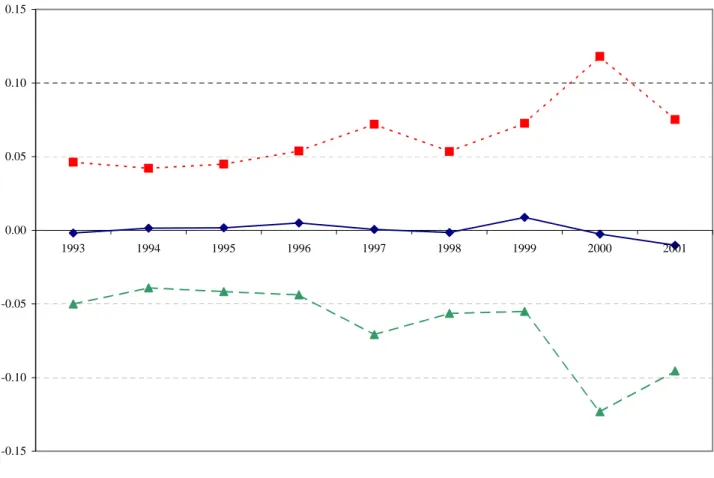
Figure 1 plots TSi,t, averaged across all firms in the sample for each year from 1993-2002
(summary statistics for the tax sheltering measure are provided in Table 1). Because TSi,t is
derived as a residual, Figure 1 cannot be used to address questions about whether the aggregate amount of tax sheltering has grown over this period. The variability of TSi,t across firms in each
of these years is also represented, using measures of TSi,t for firms one standard deviation from
the mean in each of these years. The most notable feature is the substantial increase in the variation of this measure across firms since the mid-1990’s. One of the aims of our analysis is to provide an explanation for this increase in variation across firms. Although our analysis relies only on within-firm variation, the explanatory factors for tax sheltering that we identify within firms over time can also shed light on the determinants of cross-sectional variation across firms.
4.2. Measures of Managerial Incentives
Our analysis requires some empirical proxy for the parameter θ (the degree to which managerial incentives are aligned with shareholder interests). Data on the structure of executive compensation is available for a large sample of firms from Standard and Poor’s Execucomp database for the period 1993-2002.16 Execucomp data is provided at the manager-year level – i.e. the unit of observation is an individual manager in a particular year. Typically, the data
16 The Execucomp data begins in 1992, but we choose 1993 as our starting point to ensure more complete coverage
includes observations on 5 top managers for each firm in the sample, although the precise
number differs across firms. As our focus is on the tax sheltering activity of firms, rather than the behavior of individual managers, we aggregate the managerial compensation measures across all managers in a given firm in a given year, to obtain a measure of the structure of managerial compensation at that firm.
The literature on incentive compensation has used a variety of measures of managerial incentives. For example, Mehran (1995) measures the prevalence of incentive compensation by the fraction of the firm owned by managers, and by the fraction of equity-based compensation in managers’ total compensation. We essentially follow the latter approach here; there is relatively little time-series variation in the overall level of managerial stock ownership, and so it appears inappropriate for our longitudinal analysis. Moreover, it has also been argued (Morck, Shleifer and Vishny, 1988) that high levels of managerial share ownership may lead to “entrenchment” – i.e. managers in firms with high levels of insider ownership may have greater freedom to divert rents. If so, then higher levels of managerial share ownership may be associated with lower, rather than higher, values of θ.
Instead, we use a measure of stock-based compensation similar to that of Erickson, Hanlon and Maydew (2003). We emphasize the value of stock option grants to executives, as a fraction of total compensation. This variable, which we denote by STKMIXGRANTi,t, is
calculated as follows: for firm i in year t, we take the Black-Scholes value of stock options granted that year to executive j (Execucomp variable Blk_value, which we denote by
BLKVALj,i,t), and sum this across all the firm’s managers. We do the same for the salary and
bonus for that firm’s executives in that year (Execucomp variables Salary and Bonus, which we denote SALARYj,i,t and BONUSj,i,t, respectively). Our measure is the ratio of the sum of the values
of stock options to total compensation (defined as the sum of the value of stock options, salary and bonus). Thus,
∑
∑
∑
∑
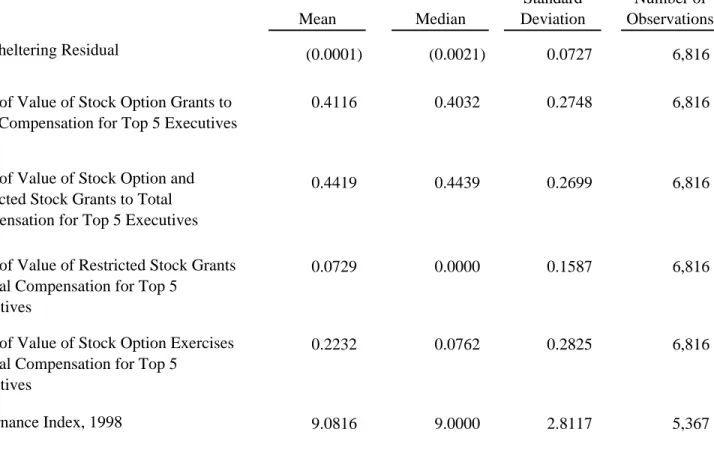
+ + = j jit j jit j jit j t i j t i BONUS SALARY BLKVAL BLKVAL NT STKMIXFGRA , , , , , , , , , (14)where j indexes executives, i indexes firms, and t indexes years.Summary statistics for this and all the other compensation variables are shown in Table 1.
A broader measure of equity-based compensation includes restricted stock grants (Execucomp variable Rstkgrnt, which we denote by RSTKGRNTj,i,t) as well as options. We
calculate a measure of restricted stock grants as a fraction of total compensation in a manner analogous to Eq. (14), and denote this by STKMIXRESTi,t. We also sum option grants and
restricted stock grants in order to construct an overall measure of stock-based compensation as a fraction of total compensation, denoted by STKMIXi,t (again, as in Eq. (14)).
We also construct a measure of the value of stock option exercises by executives as a ratio of total compensation, denoted STKMIXEXERi,t, in a manner analogous to Eq. (14).
However, there are serious problems of interpretation associated with this variable. In particular, an executive who exercises her stock options achieves greater diversification and thereby reduces the degree to which she internalizes shareholder interests. Thus, exercises may be associated with lower, rather than higher, values of θ. In addition, there is a potentially serious endogeneity problem with STKMIXEXERi,t: when the tax sheltering residual TSi,t is exogenously large, this
will raise the firm’s market value, and induce executives to exercise their options. Because of these issues, we focus primarily on other measures of incentive compensation, most notably on
STKMIXGRANTi,t.
Clearly, none of these measures (including STKMIXGRANTi,t, on which we focus)
precisely captures the theoretical parameter of interest (θ). Ideally, we would require a measure of the extent to which firm value is internalized in the objective function of managers. However, as noted earlier, managerial ownership appears inappropriate for a panel study, and, moreover, is subject to difficulties of interpretation. What our measures (in particular, STKMIXGRANTi,t) seek
to do is to proxy for the prevalence of incentive compensation at a particular firm at a given time. While the incentive measures discussed above capture the benefits to managers of
engaging in tax sheltering activity, a complete analysis would also take the costs into account. Drawing on standard economic models of enforcement, it may be expected that changes in the probability of audit, in the probability that tax shelters are found to be illegal, or in the associated sanctions, would affect the level of tax sheltering. While it is difficult to find precise data on these factors, we include firm fixed effects that can capture firm or industry level variations in these factors. In addition, we include year dummies that can (among other things) capture the effects of variations over time in enforcement variables.
4.3. The Governance Index
Given that Hypothesis 1 relates not to the effect of θ on tax sheltering per se but rather to the effects of the interaction between θ and a firm’s governance characteristics, we employ the governance index developed by Gompers et al. (2003), denoted by G, to test this hypothesis. This index is based on listings produced by the Investor Responsibility Research Center (IRRC) of the takeover defenses adopted by a large sample of major corporations. The IRRC tracks 22 antitakeover provisions; Gompers et al. (2003) combine this data with the coverage of these corporations under state antitakeover statutes to produce an index that summarizes the extent to which each firm in the sample is protected by 24 distinct corporate or state antitakeover
provisions. The index is simply the number of these provisions that apply to a given firm. Thus, for each firm, G can take on integer values from 0 to 24. Lower values of G are associated with a better quality of corporate governance - in particular, with a lower degree of insulation of
incumbent managers from hostile takeovers (for more details regarding these provisions, see Gompers et al. (2003, Appendix 1)).
Gompers et al. (2003) construct values of G for a large sample of firms for various years beginning in 1990.17 Governance characteristics, as measured by G, have been relatively stable for most firms over this period, providing little time-series variation in G for the typical firm. Moreover, it is difficult to interpret what variation exists because the cardinal properties of G are unclear: it simply represents a count of the number of antitakeover provisions that apply to a given firm, and some of these provisions may be more important than others. Accordingly, we simply use the values of G for 1998 (which provides the widest coverage of firms, because the IRRC significantly expanded its coverage in that year) as our measure of governance. In our analysis, G is thus firm-specific and time-invariant (i.e. Gi,t = Gi); because Gi is interacted with
time-varying variables, it is not absorbed by the firm fixed effects. In addition, we use G simply to divide the sample into relatively well-governed firms and less well-governed firms. Thus, the cardinality issue is less relevant for our analysis.
Another potential concern is the relationship between this index and various other
characteristics of firms. Gompers et al. (2003, Table V) show that G is positively correlated with inclusion in the Standard and Poor’s (S&P) 500, size, share price, trading volume, and
institutional ownership (that is, higher values of these characteristics are associated with
relatively weak governance, as measured by G). In contrast, G is negatively correlated with past sales growth. Thus, the well-governed and less well-governed subsamples differ in a variety of ways. It is possible that the distinctive effects for well-governed and poorly-governed firms that we find may be due, not to their governance characteristics per se, but rather to these associated characteristics such as firm size. To the extent that these factors are constant over time, they will be absorbed by the firm fixed effects. In addition, we include controls for factors related to firm size – assets, market value, and sales - in order to capture the potential effects of changes in these characteristics over time. In the reported results below, these controls are in logs. However, as explained in Section 5.3 below, the basic results are unchanged when the controls are included in linear form, or excluded altogether.
5. Results
In order to examine the empirical relevance of our model, we first consider the links between incentive compensation and tax sheltering, and then refine the analysis by examining the role of governance. Then, we carry out some checks of the robustness of the results. Finally, we address concerns about endogeneity.
5.1. Tax Sheltering and Incentive Compensation
Our basic empirical specification seeks to estimate the marginal effect of changes in θ on tax sheltering. As discussed above, our model does not have an unambiguous prediction on this coefficient. The model, however, does provide a framework in which the results can be
interpreted. As proxies for θ, we use (in separate regressions) each of the four measures of incentive compensation defined above. We also include firm fixed effects to capture unobserved heterogeneity across firms, and include year dummies. In some cases, we also include a vector of control variables (assets, market value, and sales, all in logs) that capture changes in the scale or size of the firm (and also proxy for the benefits of sheltering). The basic specification is the following:
where ICi,tis a measure of incentive compensation (STKMIXGRANTi,t, STKMIXi,t,
STKMIXRESTi,t, or STKMIXEXERi,t), and νi,t is the error term. The firm-year size controls are
LOGASSETSi,t, LOGMKTVALi,tand LOGSALESi,t, as discussed earlier.
The results using this specification – for all firms for which we have Execucomp data on ICi,t, a total of 6,816 observations on 1,381 firms (or 6,743 observations on 1,374 firms when all
controls are included) – are presented in Table 2. A clear pattern emerges from these results – option grants and the overall stock-based compensation measure have negative and significant effects on tax sheltering (Columns (1) and (2)). Restricted stock grants are insignificant, though also negative (Column (3)), suggesting that the effect of stock-based compensation is mostly driven by option grants. Option exercises, on the other hand, have a positive and significant effect on tax sheltering (Column (4)). We do not interpret this as contradicting the other findings, however; as discussed above, exercises are best understood as reductions in θ. Thus, the positive effect of exercises reinforces the general impression that increases in θ tend to reduce the level of tax sheltering activity. However, because of the difficulties of interpretation noted earlier, we do not stress the results using option exercises in the subsequent analysis. The significance of option grants and options exercises is unaffected by the inclusion of firm-year size controls (Columns (5) and (6)). Note that these and all subsequent results use robust standard errors that are clustered at the firm level.
Tax avoidance activity by corporations is generally viewed as benefiting shareholders. Thus, the negative and significant effect of incentive compensation on tax sheltering that we find would appear to be counterintuitive. However, our model provides a framework in which we can make sense of these results. A negative effect is consistent with a situation in which
technological complementarities between sheltering and diversion are relatively strong. That is, the underlying quality of corporate governance is sufficiently low that any increases in the alignment of shareholder and manager interests will have the primary effect of inducing the manager to reduce the level of diversion. Because of the complementarities, this in turn induces the manager to shelter less income. To the extent that our general framework is accepted, this appears to be the case here, and is consistent with the emphasis on the complementarity of diversion and sheltering in Desai, Dyck and Zingales (2003).
Given that the evidence points toward complementarities between diversion and sheltering, it is important to consider the degree to which either strong complementarities or substitutability between diversion and sheltering reflect common intuition. The intuition underlying complementarities is fairly straightforward. To the degree that a dollar of sheltered income is more easily diverted than a non-sheltered dollar, the activities are complementary. If any obfuscatory actions are taken to shelter income from tax authorities (e.g. the use of offshore tax havens or the creation of complex structures involving tax-indifferent parties), then it is easy to see how such sheltered income could be more easily diverted. Indeed, recent reports of corporate malfeasance at Tyco and Enron both suggest that complex tax avoidance activities generated sufficient obscurity to allow for managerial self-dealing. In contrast, substitutability (which is required for increased high-powered incentives to lead to greater sheltering) would require that effort associated with sheltering would detract from efforts toward diversion. While we believe that either possibility is admissible, complementarity between diversion and
sheltering would certainly seem to be reasonable.
5.2. The Role of Corporate Governance
In order to test Hypothesis 1, we require some means of distinguishing well-governed firms from other firms, and estimating the effect of incentive compensation separately for each group of firms. One approach to doing this is to interact Gi with our incentive compensation
measures ICi,t. For example, this specification for STKMIXGRANTi,t is:
TSi,t = β0 + β1STKMIXGRANTi,t + β2(Gi*STKMIXGRANTi,t) + Firm Fixed Effects
+ Year Dummies (+ Controls)+ νi,t (16)
Hypothesis 1 implies that β2 < 0 (recalling that lower values of Gi indicate better governance).
Because of concerns about the cardinal properties of Gi, however, we primarily adopt a slightly
different approach, defining a dummy variable WELLGOVi, which takes on the value 1 for
well-governed firms and 0 for less well-well-governed firms. In the reported results, we use Gi≤ 7 as our
definition of a “well-governed” firm. As discussed below, however, the main results are robust to the use of alternative definitions with different values of Gi. We interact WELLGOVi with
STKMIXGRANTi,t and STKMIXEXERi,t, using the following specifications:
TSi,t = β0 + β1STKMIXGRANTi,t + β2(WELLGOVi*STKMIXGRANTi,t) + Firm Fixed
TSi,t = β0 + β1STKMIXEXERi,t + β2(WELLGOVi*STKMIXEXERi,t) + Firm Fixed
Effects + Year Dummies (+ Controls)+ νi,t (18)
The results from this analysis are presented in Table 3 (this sample only includes those firms for which Execucomp data on incentive compensation and the governance data both exist; this gives us 5,367 observations on 943 firms). Panel A shows the results using
STKMIXGRANTi,t, and Panel B those using STKMIXEXERi,t. The first column of each panel
simply uses the basic specification (Eq. (15)) on the restricted sample of 943 firms that we obtain when we merge the data used earlier with the governance index Gi; the results are essentially the
same for this sample as those reported in Table 2.
Column (2) of Table 3 reports the results using the interaction term (Eq. (17)). Note firstly that this confirms the negative and significant effect of option grants on tax sheltering for the typical firm. The interaction effect also enables us to test Hypothesis 1 directly. Our
hypothesis is that the effect of option grants on tax sheltering for well-governed firms differs from (and is more positive or less negative than) that for less well-governed firms. In terms of Eq. (17), this entails that β2 > 0. The results in Column (2) of Panel A reveal that this is indeed
the case – the coefficient on the interaction term is positive, and significant at the 10% level. Column (6) of Table 3 reports the corresponding results for Eq. (18). Once again, the positive and significant effect of STKMIXEXERi,t is confirmed for the typical firm (recall that
this corresponds to a negative and significant effect of θ). The direct test of Hypothesis 1 using the interaction term leads to the same conclusion as when the option grants measure is used. Note that, because increases in STKMIXEXERi,t are associated with decreases in θ, Hypothesis 1
implies that β2 < 0 in Eq. (18). The coefficient on the interaction term in Column (6) is indeed
negative, and is significant at the 5% level. This implies that the effect of θ on tax sheltering for well-governed firms differs from (and in particular is less negative than) the corresponding effect for less well-governed firms. Thus the pattern of results in Table 3 is consistent with Hypothesis 1, even though some of these results may be of borderline significance.
We also test Hypothesis 1 using separate regressions for governed and less well-governed firms. These specifications involve running Eq. (15) on the appropriate subsample of firms. Note that this is not identical to the procedure in Eq.’s (17) and (18), because the latter constrain the year dummies to have the same effects for both categories of firms. The results
using stock option grants are presented in Column (3) (for the well-governed subsample of 317 firms, with a total of 1665 observations) and Column (4) (for the poorly-governed subsample of 626 firms, with a total of 3702 observations). Clearly, the effect of STKMIXGRANTi,t on tax
sheltering is negative and very significant for poorly-governed firms. In contrast, the coefficient
on STKMIXGRANTi,t is positive for well-governed firms (indicating that increases in θ increase
tax sheltering), but is very insignificant. Similar results are obtained in Columns (7) and (8), using stock option exercises. The effect of STKMIXEXERi,t on tax sheltering is positive and very
significant for poorly-governed firms. In contrast, the coefficient on STKMIXEXERi,t is negative
for well-governed firms (indicating that increases in θ increase tax sheltering), but, as in Panel A, is very insignificant.
Our result that the generally negative effect of incentive compensation on tax sheltering does not apply to well-governed firms is consistent with our main testable hypothesis. Increases in incentive compensation do not affect tax sheltering for well-governed firms; if anything, there may be a weak positive relationship. The divergent impact of incentive compensation on tax sheltering for different types of firms may help to explain the phenomenon that we highlighted in our discussion of Figure 1. The most notable feature of our measure of tax avoidance activity is the growing divergence across firms. This has occurred despite the fact that the growth of incentive compensation has been a widespread phenomenon, affecting most major firms. The solution suggested by our results is that the growth in incentive compensation has had different effects on different firms. For relatively well-governed firms, it has either increased tax
sheltering or had no impact. For less well-governed firms, it has reduced tax sheltering activity. This would account for the pattern of growing divergence shown in Figure 1.18
5.3. Some Checks for Robustness
The basic results reported in Tables 3 and 4 may be compromised by imprecise
measurement of governance, changing incentives for tax avoidance over the period, the fact that governance measures may reflect unobserved heterogeneity, and the possibility that option activity and tax planning are jointly determined. We address these concerns in turn.
18 Of course, there are alternative explanations as well. For example, a growth in foreign income among a subset of
firms over this period may be attributed to tax sheltering activity by our methodology for calculating TSi,t. However, to the extent that our proxy captures tax sheltering, our results are at least consistent with the pattern shown in Figure 1.
The results reported in Table 3 rely on a definition of a well-governed firm as one for which Gi≤ 7. These basic results are robust to varying this definition (by, for instance,
categorizing firms for which Gi≤ 5, Gi≤ 6, or Gi≤ 8 as well-governed). Most importantly, in no
instance is the effect of θ on tax sheltering for well-governed firms negative and significant. For the less well-governed subsample of firms, however, the effect of θ on tax sheltering is negative and significant in all these variations. The “less well-governed” category in Table 3 includes 626 firms, with presumably widely varying governance institutions. Thus, we also divided this
subsample further (into “moderately well-governed” firms, for which Giє {8, 9, 10}, and the
most poorly-governed firms, for which Gi≥ 11). No major differences between these two
subsamples were found (with the effect of θ on tax sheltering being negative and generally significant for both), suggesting that the most important distinction is between well-governed firms and the rest of the sample. Using the variation in G to any greater extent leads to samples that are too small to produce significant results.19
Our sample period (1993-2002) covers both the boom of the 1990’s, and the subsequent years, when many firms experienced reduced profits or losses. It is possible that the incentives for tax sheltering that existed when firms were profitable became attenuated or were reversed during the latter part of our sample period (notwithstanding NOL carryforwards, which can make tax savings potentially valuable even for loss-making firms). To address this concern, we
estimated our regression models using only data for the period 1993-99. The results (not shown) are basically consistent with those in Tables 2 and 3. The effect of stock option grants on tax sheltering is negative and significant for the typical firm. The coefficient on the interaction term in Eq. (17) is clearly positive (although its significance becomes borderline), and the separate regression for well-governed firms reveals an insignificant effect.20
Some of the results in Table 2, and all those in Table 3, are obtained using controls for firm size and related characteristics. Specifically, we include LOGASSETSi,t, LOGMKTVALi,tand
LOGSALESi,t, which are the log values of firm i’sassets, market value, and sales in year t. As
noted in Section 4.3, there is a potential concern that our results may be affected by systematic
19 This applies a fortiori when we attempt to use all the information represented in G by including an interaction
term Gi*STKMIXGRANTi,t (as in Eq. (16)). This leads to negative coefficients on both STKMIXGRANTi,t and the interaction term, but neither is significant. However, the negative coefficient on the interaction term
Gi*STKMIXGRANTi,t is at least consistent with Hypothesis 1, and with the results obtained in Table 3.
20 It is difficult to find significant results for the 2000-02 period, where (bearing in mind the firm fixed effects) the