Mutual Disambiguation for Entity Linking
Eric Charton
Polytechnique Montr´eal Montr´eal, QC, Canada
Marie-Jean Meurs
Concordia University Montr´eal, QC, Canada
Ludovic Jean-Louis
Polytechnique Montr´eal
Michel Gagnon
Polytechnique Montr´eal
Abstract
The disambiguation algorithm presented in this paper is implemented in SemLinker, an entity linking system. First, named entities are linked to candidate Wikipedia pages by a generic annotation engine. Then, the al-gorithm re-ranks candidate links according to mutual relations between all the named enti-ties found in the document. The evaluation is based on experiments conducted on the test corpus of the TAC-KBP 2012 entity linking task.
1 Introduction
The Entity Linking (EL) task consists in linking namementionsof named entities (NEs) found in a document to their corresponding entities in a ref-erence Knowledge Base (KB). These NEs can be of type person (PER), organization (ORG), etc., and they are usually represented in the KB by a Uniform Resource Identifier (URI). Dealing with ambiguity is one of the key difficulties in this task, since mentions are often highly polysemous, and potentially related to many different KB entries. Various approaches have been proposed to solve the named entity disambiguation (NED) problem. Most of them involve the use of surface forms ex-tracted from Wikipedia. Surface forms consist of a word or a group of words that match lexical units like Paris or New York City. They are used as matching sequences to locate corresponding can-didate entries in the KB, and then to disambiguate those candidates using similarity measures.
The NED problem is related to theWord Sense Disambiguation (WSD) problem (Navigli, 2009), and is often more challenging since mentions of NEs can be highly ambiguous. For instance, names of places can be very common as is Paris, which refers to 26 different places in Wikipedia. Hence, systems that attempt to address the NED
problem must include disambiguation resources. In the context of the Named Entity Recognition (NER) task, such resources can be generic and generative. This generative approach does not ap-ply to the EL task where each entity to be linked to a semantic description has a specific word context, marker of its exact identity.
One of the classical approach to conduct the disambiguation process in NED applications is to consider the context of the mention to be mapped, and compare this context with contextual informa-tion about the potential target entities (see for in-stance the KIM system (Popov et al., 2003)). This is usually done using similarity measures (such as cosine similarity, weighted Jaccard distance, KL divergence...) that evaluate the distance between a bag of words related to a candidate annotation, and the words surrounding the entity to annotate in the text.
In more recent approaches, it is suggested that annotation processes based on similarity distance measures can be improved by making use of other annotations present in the same document. Such techniques are referred to as semantic related-ness (Strube and Ponzetto, 2006), collective dis-ambiguation(Hoffart et al., 2011b), or joint dis-ambiguation(Fahrni et al., 2012). The idea is to evaluate in a set of candidate links which one is the most likely to be correct by taking the other links contained in the document into account. For example, if a NE describes a city name likeParis, it is more probable that the correct link for this city name designates Paris (France) rather than
Paris (Texas)if a neighbor entity offers candidate links semantically related to Paris (France) like theSeine riveror theChamps-Elys´ees. Such tech-niques mostly involve exploration of graphs result-ing of all the candidate annotations proposed for a given document, and try to rank the best candi-dates for each annotation using an ontology. The ontology (like YAGO or DBPedia) provides a
existing set of potential relations between the enti-ties to link (like for instance, in our previous exam-ple, Paris (France) has river Seine) that will be used to rank the best candidates according to their mutual presence in the document.
In this paper we explore the capabilities of a dis-ambiguation algorithm using all the available an-notation layers of NEs to improve their links. The paper makes the following novel propositions: 1) the ontology used to evaluate the relatedness of candidates is replaced by internal links and cate-gories from the Wikipedia corpus; 2) the coher-ence of entities is improved prior to the calcula-tion of semantic relatedness using a co-reference resolution algorithm, and a NE label correction method; 3) the proposed method is robust enough to improve the performance of existing entity link-ing annotation engines, which are capable of pro-viding a set of ranked candidates for each annota-tion in a document.
This paper is organized as follows. Section 2 describes related works. The proposed method is presented in Section 3 where we explain how our SemLinker system prepares documents that con-tain mentions to disambiguate, then we detail the disambiguation algorithm. The evaluation of the complete system is provided in Section 4. Finally, we discuss the obtained results, and conclude.
2 Related Work
Entity annotation and linking in natural language text has been extensively studied in NLP research. A strong effort has been conducted recently by the TAC-KBP evaluation task (Ji et al., 2010) to cre-ate standardized corpus, and annotation standards based on Wikipedia for evaluation and comparison of EL systems. In this paper, we consider the TAC-KBP framework. We describe below some recent approaches proposed for solving the EL task.
2.1 Wikipedia-based Disambiguation Methods The use of Wikipedia for explicit disambiguation dates back to (Bunescu and Pasca, 2006) who built a system that compared the context of a mention to the Wikipedia categories of an entity candidate. Lately, (Cucerzan, 2007; Milne and Witten, 2008; Nguyen and Cao, 2008) extended this framework by using richer features for similarity comparison. Some authors like Milne and Witten (2008) uti-lized machine learning methods rather than a sim-ilarity function to map mentions to entities. They
also introduced the notion of semantic relatedness. Alternative propositions were suggested in other works like (Han and Zhao, 2009) that considered the relatedness of common noun phrases in a men-tion context with Wikipedia article names. While all these approaches focus on semantic relation be-tween entities, their potential is limited by the sep-arate mapping of candidate links for each mention.
2.2 Semantic Web Compliant Methods More recently, several systems have been launched as web services dedicated to EL tasks. Most of them are compliant with new emergent semantic web standards like LinkedData network. DBPedia Spotlight (Mendes et al., 2011) is a system that finds mentions of DBpedia (Auer et al., 2007) resources in a textual document. Wikimeta (Charton and Gagnon, 2012) is another system relying on DBpedia. It uses bags of words to disambiguate semantic entities according to a cosine similarity algorithm. Those systems have been compared with commercial ones like AlchemyAPI, Zemanta, or Open Calais in (Gangemi, 2013). The study showed that they perform differently on various essential aspects of EL tasks (mention detection, linking, disambiguation). This suggests a wide range of potential improvements on many aspects of the EL task. Only some of these systems introduce the semantic relatedness in their methods like the AIDA (Hoffart et al., 2011b) system. It proposes a disambiguation method that combines popularity-based priors, similarity measures, and coherence. It relies on the Wikipedia-derived YAGO2 (Hoffart et al., 2011a) knowledge base.
3 Proposed Algorithm
We propose a mutual disambiguation algorithm that improves the accuracy of entity links in a doc-ument by using successive corrections applied to an annotation object representing this document. The annotation object is composed of information extracted from the document along with linguistic and semantic annotations as described hereafter.
3.1 Annotation Object
in an array calledannotation object, which has ini-tially one row per document lexical unit. Since the system focuses on NEs, rows with lexical units that do not belong to a NE SF are dropped from the annotation object, and NE SF are refined as de-scribed in (Charton et al., 2014). When NE SF are spanned over several rows, these rows are merged into a single one. Thus, we consider an annotation objectAD, which is an array with a row for each NE, and columns storing related knowledge.
If nNEs were annotated inD, thenAD has n
rows. If l candidate URIs are provided for each NE, then AD has (l + 4) columns cu,u∈{1,l+4}.
Columnsc1toclstore Wikipedia URIs associated
with NEs, ordered by decreasing values of likeli-hood. Column cl+1 stores the offset of the NEs,
cl+2stores their surface forms,cl+3stores the NE
labels (PER, ORG, ...), and cl+4 stores the
(vec-tors of) POS tags associated with the NE surface forms. AD contains all the available knowledge
about the NEs found inD. Before being processed by the disambiguation module,ADis dynamically
updated by correction processes. 3.2 Named Entity Label Correction
To support the correction process based on co-reference chains, the system tries to correct NE labels for all the NEs listed in theannotation ob-ject. The NE label correction process assigns the same NE label to all the NEs associated with the same first rank URI. For all the rows inAD, sets of
rows with identical first rank URIs are considered. Then, for each set, NE labels are counted per type, and all the rows in a same set are updated with the most frequent NE label found in the set, i.e. all the NEs in this set are tagged with this label.
3.3 Correction Based on Co-reference Chains First rank candidate URIs are corrected by a pro-cess that relies on co-reference chains found in the document. The co-reference detection is con-ducted using the information recorded in the anno-tation object. Among the NEs present in the docu-ment, the ones that co-refer are identified and clus-tered by logical rules applied to the content of the annotation object. When a co-reference chain of NEs is detected, the system assigns the same URI to all the members of the chain. This URI is se-lected through a decision process that gives more weight to longer surface forms and frequent URIs. The following example illustrates an application of this correction process:
Three sentences are extracted from a document about Paris, the French capital. NEs are indicated in brackets, first rank URIs and surface forms are added below the content of each sentence.
- [Paris] is famous around the world.
URI1:http://en.wikipedia.org/wiki/Paris Hilton NE surface form:Paris
- The [city of Paris] attracts millions of tourists. URI1:http://en.wikipedia.org/wiki/Paris
NE surface form:city of Paris
- The [capital of France] is easy to reach by train. URI1:http://en.wikipedia.org/wiki/Paris
NE surface form:capital of France
The three NEs found in these sentences com-pose a co-reference chain. The second NE has a longer surface form than the first one, and its associated first rank URI is the most fre-quent. Hence, the co-reference correction pro-cess will assign the right URI to the first NE (URI1: http://en.wikipedia.org/wiki/Paris), which was wrongly linked to the actress Paris Hilton.
3.4 Mutual Disambiguation Process
The extraction of an accurate link is a process oc-curring after the URI annotation of NEs in the whole document. The system makes use of all the semantic content stored in AD to locally im-prove the precision of each URI annotation in the document. The Mutual Disambiguation Process (MDP) relies on the graph of all the relations (in-ternal links, categories) between Wikipedia con-tent related to the document annotations.
A basic example of semantic relatedness that should be captured is explained hereafter. Let us consider the mention IBM in a given document. Candidate NE annotations for this mention can be
International Business Machine or International Brotherhood of Magicians. But if the IBM men-tion co-occurs with aThomas Watson, Jrmention in the document, there will probably be more links between the International Business Machine and
Thomas Watson, Jr related Wikipedia pages than between the International Brotherhood of Magi-cians and Thomas Watson, Jr related Wikipedia pages. The purpose of the MDP is to capture this semantic relatedness information contained in the graph of links extracted from Wikipedia pages re-lated to each candidate annotation.
to this URI are collected. This information will be used to calculate a weight for each of the l can-didate URI annotations of each mention. For a given NE, this weight is expected to measure the mutual relations of a candidate annotation with all the other candidate annotations of NEs in the doc-ument. The input of the MDP is an annotation objectAD withnrows, obtained as explained in
Section 3.1. For alli∈[[1, n]],k∈[[1, l]], we build the setSk
i, composed of the Wikipedia URIs and
categories contained in the source Wikipedia doc-ument related to the URI stored in AD[i][k] that we will refer to as URIk
i to ease the reading.
Scoring:
For alli, j ∈ [[1, n]],k ∈ [[1, l]], we want to cal-culate the weight of mutual relations between the candidate URIk
i and all the first rank candidates
URI1
j for j 6= i. The calculation combines two
scores that we calleddirect semantic relationscore (dsr score) and common semantic relation score (csr score):
- the dsr score for URIk
i sums up the number of
occurrences of URIk
i inSj1for allj∈[[1, n]]−{i}.
- the csr score for URIk
i sums up the number of
common URIs and categories betweenSk i andSj1
for allj∈[[1, n]]− {i}.
We assumed the dsr score was much more semantically significant than the csr score, and translated this assumption in the weight calcula-tion by introducing two correccalcula-tion parameters α andβused in the final scoring calculation. Re-ranking:
For alli∈[[1, n]], for each set of URIs{URIk i, k∈
[[1, l]]}, the re-ranking process is conducted ac-cording to the following steps:
For alli∈I,
1. ∀k∈[[1, l]], calculate dsr score(URIk i)
2. ∀k∈[[1, l]], calculate csr score(URIk i)
3. ∀k∈[[1, l]], calculate mutual relation score(URIk
i) =
α.dsr score(URIk
i)+β.csr score(URIki)
4. re-order{URIk
i, k∈[[1, l]]}, by
decreasing order of mutual relation score.
In the following, we detail the MDP in the con-text of a toy example to illustrate how it works. The document contains two sentences, NE men-tions are in bold:
IBM has 12 research laboratories worldwide. Thomas J. Watson, Jr. became president of the company.
For the first NE mention [IBM], AD contains
two candidate URIs identifying two different re-sources:
[IBM] URI1
1≡International Brotherhood of Magicians URI2
1≡International Business Machines Corporation
For the second NE mention [Thomas J. Watson, Jr.],ADcontains the following can-didate URI, which is ranked first:
[Thomas J. Watson, Jr.] URI1
2≡Thomas Watson, Jr.
S1
1 gathers URIs and categories contained in the
International Brotherhood of Magicians Wikipedia
page.S2
1 is associated to theInternational Business
Machines Corporation, and S21 to the Thomas Watson, Jr. page. dsr score(URI11) sums up the number of
occurrences of URI1
1inSj1for allj∈[[1, n]]−{1}.
Hence, in the current example, dsr score(URI1 1) is
the number of occurrences of URI1
1inS21, namely
the number of times the International Brotherhood of Magicians are cited in the Thomas Watson, Jr.
page. Similarly, dsr score(URI2
1) is equal to the
number of times theInternational Business Machines Corporationis cited in theThomas Watson, Jr.page.
csr score(URI1
1) sums up the number of common
URIs and categories betweenS1
1 andS21, i.e. the
number of URIs and categories appearing in both
International Brotherhood of Magicians and Thomas Watson, Jr. pages. csr score(URI21) counts the
number of URIs and categories appearing in both
International Business Machines Corporation and Thomas Watson, Jr.pages.
After calculation, we have: mutual relation score(URI1
1)<mutual relation score(URI21) The candidate URIs for [IBM] are re-ranked accordingly, and International Business Machines Corporationbecomes its first rank candidate.
4 Experiments and Results
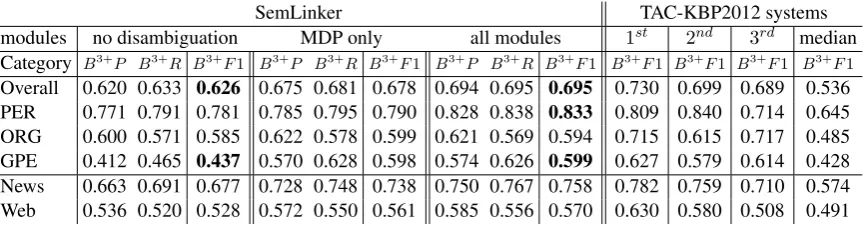
SemLinker TAC-KBP2012 systems modules no disambiguation MDP only all modules 1st 2nd 3rd median
Category B3+P B3+R B3+F1 B3+P B3+R B3+F1 B3+P B3+R B3+F1 B3+F1 B3+F1 B3+F1 B3+F1
[image:5.595.77.511.62.175.2]Overall 0.620 0.633 0.626 0.675 0.681 0.678 0.694 0.695 0.695 0.730 0.699 0.689 0.536 PER 0.771 0.791 0.781 0.785 0.795 0.790 0.828 0.838 0.833 0.809 0.840 0.714 0.645 ORG 0.600 0.571 0.585 0.622 0.578 0.599 0.621 0.569 0.594 0.715 0.615 0.717 0.485 GPE 0.412 0.465 0.437 0.570 0.628 0.598 0.574 0.626 0.599 0.627 0.579 0.614 0.428 News 0.663 0.691 0.677 0.728 0.748 0.738 0.750 0.767 0.758 0.782 0.759 0.710 0.574 Web 0.536 0.520 0.528 0.572 0.550 0.561 0.585 0.556 0.570 0.630 0.580 0.508 0.491
Table 1: SemLinker results on the TAC-KBP 2012 test corpus with/out disambiguation modules, and three best results and median from TAC-KBP 2012 systems.
posts to blogs and newsgroups (Web). Given a query that consists of a document with a specified name mention of an entity, the task is to determine the correct node in the reference KB for the entity, adding a new node for the entity if it is not already in the reference KB. Entities can be of type person (PER), organization (ORG), or geopolitical entity (GPE). The reference knowledge base is derived from an October 2008 dump of English Wikipedia, which includes 818,741 nodes. Table 2 provides a breakdown of the queries per categories of entities, and per type of documents.
Category All PER ORG GPE News Web # queries 2226 918 706 602 1471 755
Table 2: Breakdown of the TAC-KBP 2012 test corpus queries according to entity types, and doc-ument categories.
A complete description of these linguistic re-sources can be found in (Ellis et al., 2011). For the sake of reproducibility, we applied the KBP scoring metric (B3+F) described in (TAC-KBP,
2012), and we used the KBP scorer1.
The evaluated system makes use of the Wikimeta annotation engine. The maximum num-ber of candidate URIs isl= 15. The MDP correc-tion parametersα andβ described in Section 3.4 have been experimentally set toα = 10, β = 2. Table 1 presents the results obtained by the sys-tem in three configurations. In the first column, the system is evaluated without the disambigua-tion module. In the second column, we applied the MDP without correction processes. The sys-tem with the complete disambiguation module ob-tained the results provided in the third column. The three best results and the median from TAC-KBP 2012 systems are shown in the remaining columns for the sake of comparison.
1http://www.nist.gov/tac/2013/KBP/
EntityLinking/tools.html
We observe that the complete algorithm (co-references, named entity labels and MDP) pro-vides the best results on PER NE links. On GPE and ORG entities, the simple application of MDP without prior corrections obtains the best results. A slight loss of accuracy is observed on ORG NEs when the MDP is applied with corrections. For those three categories of entities, we show that the complete system improves the performance of a simple algorithm using distance measures. Results on categories News and Web show that the best performance on the whole KBP corpus (without distinction of NE categories) is obtained with the complete algorithm.
5 Conclusion
The presented system provides a robust seman-tic disambiguation method, based on mutual re-lation of entities inside a document, using a stan-dard annotation engine. It uses co-reference, NE normalization methods, and Wikipedia internal links as mutual disambiguation resource to im-prove the annotations. We show that our propo-sition improves the performance of a standard an-notation engine applied to the TAC-KBP evalua-tion framework. SemLinker is fully implemented, and publicly released as an open source toolkit (http://code.google.com/p/semlinker). It
has been deployed in the TAC-KBP 2013 evalu-ation campaign. Our future work will integrate other annotation engines in the system architecture in a collaborative approach.
Acknowledgments
References
S¨oren Auer, Christian Bizer, Georgi Kobilarov, Jens Lehmann, Richard Cyganiak, and Zachary Ives. 2007. Dbpedia: A nucleus for a web of open data. InThe semantic web, pages 722–735. Springer. Razvan C. Bunescu and Marius Pasca. 2006.
Us-ing encyclopedic knowledge for named entity dis-ambiguation. In Proceedings of the Conference of the European Chapter of the Association for Com-putational Linguistics (EACL). ACL.
Eric Charton and Michel Gagnon. 2012. A disam-biguation resource extracted from Wikipedia for se-mantic annotation. InProceedings of LREC 2012. Eric Charton, Marie-Jean Meurs, Ludovic Jean-Louis,
and Michel Gagnon. 2013. SemLinker system for KBP2013: A disambiguation algorithm based on mutual relations of semantic annotations inside a document. In Text Analysis Conference KBP. U.S. National Institute of Standards and Technology (NIST).
Eric Charton, Marie-Jean Meurs, Ludovic Jean-Louis, and Michel Gagnon. 2014. Improving Entity Link-ing usLink-ing Surface Form Refinement. InProceedings of LREC 2014.
Silviu Cucerzan. 2007. Large-scale named entity dis-ambiguation based on wikipedia data. In Proceed-ings of the Conference on Empirical Methods in Nat-ural Language Processing EMNLP-CoNLL. ACL. Joe Ellis, Xuansong Li, Kira Griffitt, Stephanie M
Strassel, and Jonathan Wright. 2011. Linguistic re-sources for 2012 knowledge base population evalu-ations. InProceedings of TAC-KBP 2012.
Angela Fahrni, Thierry G¨ockel, and Michael Strube. 2012. Hitsmonolingual and cross-lingual entity linking system at tac 2012: A joint approach. In
TAC (Text Analysis Conference) 2012 Workshop. Aldo Gangemi. 2013. A Comparison of Knowledge
Extraction Tools for the Semantic Web. InThe 10th Extended Semantic Web Conference (ESWC) 2013. Xianpei Han and Jun Zhao. 2009. Named entity
disambiguation by leveraging wikipedia semantic knowledge. In Proceedings of the Conference on Information and Knowledge Management (CIKM). ACM.
Johannes Hoffart, Fabian M Suchanek, Klaus Berberich, Edwin Lewis-Kelham, Gerard De Melo, and Gerhard Weikum. 2011a. Yago2: exploring and querying world knowledge in time, space, context, and many languages. In Proceedings of the 20th international conference companion on World wide web, pages 229–232. ACM.
Johannes Hoffart, Mohamed Amir Yosef, Ilaria Bor-dino, Hagen F¨urstenau, Manfred Pinkal, Marc Span-iol, Bilyana Taneva, Stefan Thater, and Gerhard
Weikum. 2011b. Robust disambiguation of named entities in text. InProceedings of the Conference on Empirical Methods in Natural Language Process-ing, pages 782–792. Association for Computational Linguistics.
Heng Ji, Ralph Grishman, HT Dang, and K Griffitt. 2010. Overview of the TAC 2010 knowledge base population track. Proceedings of TAC 2010. Pablo N Mendes, Max Jakob, Andr´es Garc´ıa-Silva, and
Christian Bizer. 2011. DBpedia Spotlight: Shed-ding Light on the Web of Documents. InThe 7th International Conference on Semantic Systems (I-Semantics) 2011, pages 1–8.
David N. Milne and Ian H. Witten. 2008. Named en-tity disambiguation by leveraging wikipedia seman-tic knowledge. InProceedings of the Conference on Information and Knowledge Management (CIKM). ACM.
Roberto Navigli. 2009. Word sense disambiguation: A survey. ACM Computing Surveys (CSUR), 41(2):10. Hien T. Nguyen and Tru H. Cao. 2008. Named entity disambiguation on an ontology enriched by wikipedia. InResearch, Innovation and Vision for the Future, 2008. RIVF 2008. IEEE International Conference on, pages 247–254. IEEE.
Borislav Popov, Atanas Kiryakov, Angel Kirilov, Dimi-tar Manov, Damyan Ognyanoff, and Miroslav Gora-nov. 2003. KIM – Semantic annotation platform.
Lecture Notes in Computer Science, pages 834–849. Michael Strube and Simone Paolo Ponzetto. 2006. WikiRelate! Computing Semantic Relatedness Us-ing Wikipedia. In AAAI, volume 6, pages 1419– 1424.