Proceedings of the 45th Annual Meeting of the Association of Computational Linguistics, pages 336–343,
Sentence generation as a planning problem
Alexander Koller
Center for Computational Learning Systems Columbia University
Matthew Stone
Computer Science Rutgers University
Abstract
We translate sentence generation from TAG grammars with semantic and pragmatic in-formation into a planning problem by encod-ing the contribution of each word declara-tively and explicitly. This allows us to ex-ploit the performance of off-the-shelf plan-ners. It also opens up new perspectives on referring expression generation and the rela-tionship between language and action.
1 Introduction
Systems that produce natural language must synthe-size the primitives of linguistic structure into well-formed utterances that make desired contributions to discourse. This is fundamentally a planning prob-lem: Each linguistic primitive makes certain con-tributions while potentially introducing new goals. In this paper, we make this perspective explicit by translating the sentence generation problem of TAG grammars with semantic and pragmatic information into a planning problem stated in the widely used Planning Domain Definition Language (PDDL, Mc-Dermott (2000)). The encoding provides a clean separation between computation and linguistic mod-elling and is open to future extensions. It also allows us to benefit from the past and ongoing advances in the performance of off-the-shelf planners (Blum and Furst, 1997; Kautz and Selman, 1998; Hoffmann and Nebel, 2001).
While there have been previous systems that en-code generation as planning (Cohen and Perrault, 1979; Appelt, 1985; Heeman and Hirst, 1995), our approach is distinguished from these systems by its focus on the grammatically specified contributions
of each individual word (and the TAG tree it an-chors) to syntax, semantics, and local pragmatics (Hobbs et al., 1993). For example, words directly achieve content goals by adding a corresponding se-mantic primitive to the conversational record. We deliberately avoid reasoning about utterances as co-ordinated rational behavior, as earlier systems did; this allows us to get by with a much simpler logic.
The problem we solve encompasses the genera-tion of referring expressions (REs) as a special case. Unlike some approaches (Dale and Reiter, 1995; Heeman and Hirst, 1995), we do not have to dis-tinguish between generating NPs and expressions of other syntactic categories. We develop a new per-spective on the lifecycle of a distractor, which allows us to generate more succinct REs by taking the rest of the utterance into account. More generally, we do not split the process of sentence generation into two separate steps of sentence planning and realization, as most other systems do, but solve the joint prob-lem in a single integrated step. This can potentially allow us to generate higher-quality sentences. We share these advantages with systems such as SPUD (Stone et al., 2003).
Crucially, however, our approach describes the dynamics of interpretation explicitly and declara-tively. We do not need to assume extra machin-ery beyond the encoding of words as PDDL plan-ning operators; for example, our planplan-ning opera-tors give a self-contained description of how each individual word contributes to resolving references. This makes our encoding more direct and transpar-ent than those in work like Thomason and Hobbs (1997) and Stone et al. (2003).
the planning operators. After a brief review of LTAG and PDDL, we first focus on syntax alone and show how to cast the problem of generating grammatically well-formed LTAG trees as a planning problem in Section 2. In Section 3, we add semantics to the ele-mentary trees and add goals to communicate specific content (this corresponds to surface realization). We complete the account by modeling referring expres-sions and go through an example. Finally, we assess the practical efficiency of our approach and discuss future work in Section 4.
2 Grammaticality as planning
We start by reviewing the LTAG grammar formal-ism and giving an intuition of how LTAG gen-eration is planning. We then add semantic roles to the LTAG elementary trees in order to distin-guish different substitution nodes. Finally, we re-view the PDDL planning specification language and show how LTAG grammaticality can be encoded as a PDDL problem and how we can reconstruct an LTAG derivation from the plan.
2.1 Tree-adjoining grammars
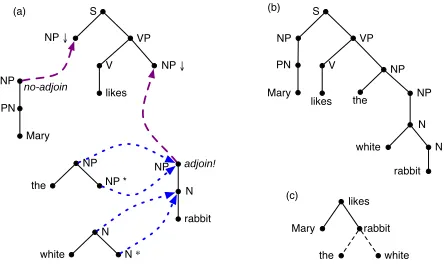
The grammar formalism we use here is that of lex-icalized tree-adjoining grammars(LTAG; Joshi and Schabes (1997)). An LTAG grammar consists of a finite set of lexicalizedelementary treesas shown in Fig. 1a. Each elementary tree contains exactly one anchornode, which is labelled by a word. Elemen-tary trees can containsubstitution nodes, which are marked by down arrows (↓). Those elementary trees that areauxiliary treesalso contain exactly onefoot node, which is marked with an asterisk (∗). Trees that are not auxiliary trees are calledinitial trees.
Elementary trees can be combined bysubstitution and adjunction to form larger trees. Substitution is the operation of replacing a substitution node of some tree by another initial tree with the same root label. Adjunction is the operation of splicing an aux-iliary tree into some nodevof a tree, in such a way that the root of the auxiliary tree becomes the child ofv’s parent, and the foot node becomes the parent ofv’s children. If a node carries a null adjunction constraint(indicated byno-adjoin), no adjunction is allowed at this node; if it carries an obligatory ad-junction constraint (indicated byadjoin!), an
auxil-S
NP ↓ VP
V
likes
NP
the NP *
PN Mary
N
white N *
Mary likes
rabbit white
(a) (b)
(c) NP ↓
N rabbit NP adjoin!
NP
S
NP VP
V
likes NP
PN
Mary
NP
the N
white N
rabbit
the
[image:2.612.316.538.72.206.2]no-adjoin
Figure 1: Building a derived (b) and a derivation tree (c) by combining elementary trees (a).
iary treemustbe adjoined there.
In Fig. 1a, we have combined some
ele-mentary trees by substitution (indicated by the dashed/magenta arrows) and adjunction (dotted/blue arrows). The result of these operations is thederived treein Fig. 1b. The derivation treein Fig. 1c rep-resents the tree combination operations we used by having one node per elementary tree and drawing a solid edge if we combined the two trees by substitu-tion, and a dashed edge for adjunctions.
2.2 The basic idea
Consider the process of constructing a derivation tree top-down. To build the tree in Fig. 1c, say, we start with the empty derivation tree and an obligation to generate an expression of category S. We satisfy this obligation by adding the tree for “likes” as the root of the derivation; but in doing so, we have in-troduced new unfilled substitution nodes of category NP, i.e. the derivation tree is not complete. We use the NP tree for “Mary” to fill one substitution node and the NP tree for “rabbit” to fill the other. This fills both substitution nodes, but the “rabbit” tree in-troduces an obligatory adjunction constraint, which we must satisfy by adjoining the auxiliary tree for “the”. We now have a grammatical derivation tree, but we are free to continue by adding more auxiliary trees, such as the one for “white”.
initial stateto a state that satisfies all the goals. In our case, the states are defined by the unfilled sub-stitution nodes, the unsatisfied obligatory adjunction constraints, and the nodes that are available for ad-junction in some (possibly incomplete) derivation tree. Each action adds a single elementary tree to the derivation, removing some of these “open nodes” while introducing new ones. The initial state is asso-ciated with the empty derivation tree and a require-ment to generate an expression for the given root cat-egory. The goal is for the current derivation tree to be grammatically complete.
2.3 Semantic roles
Formalizing this intuition requires unique names for each node in the derived tree. Such names are nec-essary to distinguish the different open substitution nodes that still need to be filled, or the different available adjunction sites; in the example, the plan-ner needed to be aware that “likes” introduces two separate NP substitution nodes to fill.
There are many ways to assign these names. One that works particularly well in the context of PDDL (as we will see below) is to assume that each node in an elementary tree, except for ones with null ad-junction constraints, is marked with asemantic role, and that all substitution nodes are marked with dif-ferent roles. Nothing hinges on the particular role in-ventory; here we assume an inventory including the rolesagfor “agent” andpat for “patient”. We also assume one special roleself, which must be used for the root of each elementary tree and must never be used for substitution nodes.
We can now assign a unique name to every sub-stitution node in a derived tree by assigning arbitrary but distinctindicesto each use of an elementary tree, and giving the substitution node with rolerin the el-ementary tree with indexitheidentity i.r. In the ex-ample, let’s say the “likes” tree has index 1 and the semantic roles for the substitution nodes wereagand
pat, respectively. The planner action that adds this tree would then require substitution of one NP with identity 1.agand another NP with identity 1.pat; the “Mary” tree would satisfy the first requirement and the “rabbit” tree the second. If we assume that no elementary tree contains two internal nodes with the same category and role, we can refer to adjunction opportunities in a similar way.
ActionS-likes-1(u).Precond: subst(S,u),step(1) Effect:¬subst(S,u),subst(NP,1.ag),
subst(NP,1.pat),¬step(1),step(2)
ActionNP-Mary-2(u).Precond: subst(NP,u),step(2) Effect:¬subst(NP,u),¬step(2),step(3)
ActionNP-rabbit-3(u).Precond: subst(NP,u),step(3) Effect:¬subst(NP,u),canadjoin(NP,u),
mustadjoin(NP,u),¬step(3),step(4)
ActionNP-the-4(u).Precond: canadjoin(NP,u),step(4) Effect:¬mustadjoin(NP,u),¬step(4),step(5)
Figure 2: Some actions for the grammar in Fig. 1.
2.4 Encoding in PDDL
Now we are ready to encode the problem of generat-ing grammatical LTAG derivation trees into PDDL. PDDL (McDermott, 2000) is the standard input lan-guage for modern planning systems. It is based on the well-known STRIPS language (Fikes and Nils-son, 1971). In this paradigm, a planning state is defined as a finite set of ground atoms of predicate logic that are true in this state; all other atoms are as-sumed to be false. Actions have a number of param-eters, as well as a precondition andeffect, both of which are logical formulas. When a planner tries to apply an action, it will first create an actioninstance by binding all parameters to constants from the do-main. It must then verify that the precondition of the action instance is satisfied in the current state. If so, the action can be applied, in which case the effect is processed in order to change the state. In STRIPS, the precondition and effect both had to be conjunc-tions of atoms or negated atoms; positive effects are interpreted as making the atom true in the new state, and negative ones as making it false. PDDL per-mits numerous extensions to the formulas that can be used as preconditions and effects.
substitu-S-likes-1 (1.self)
subst(S,1.self)
subst(NP,1.ag)
NP-Mary-2 (1.ag)
subst(NP,1.pat)
NP-rabbit-3 (1.pat)
mustadjoin(NP,1.pat)
NP-the-4 (1.pat)
canadjoin(NP,1.pat)
subst(NP,1.pat)
canadjoin(NP,1.pat)
step(1)
step(2)
step(3)
step(4)
[image:4.612.70.544.69.121.2]step(5)
Figure 3: A plan for the actions in Fig. 2.
tion node uis now filled); an auxiliary tree has an effect¬mustadjoin(A,u)to indicate that any oblig-atory adjunction constraint is satisfied but leaves the
canadjoin condition in place to allow multiple ad-junctions into the same node. In both cases, effects addsubst, canadjoin andmustadjoin atoms repre-senting the substitution nodes and adjunction sites that are introduced by the new elementary tree.
One remaining complication is that an action must assign new identities to the nodes it introduces; thus it must have access to a tree index that was not used in the derivation tree so far. We use the number of the current plan step as the index. We add an atom
step(1) to the initial state of the planning problem, and we introducekdifferent copies of the actions for each elementary tree, where k is some upper limit on the plan size. These actions are identical, except that thei-th copy has an extra preconditionstep(i)
and effects¬step(i)andstep(i+1). It is no restric-tion to assume an upper limit on the plan size, as most modern planners search for plans smaller than a given maximum length anyway.
Fig. 2 shows some of the actions into which the grammar in Fig. 1 translates. We display only one copy of each action and have left out most of the
canadjoineffects. In addition, we use an initial state containing the atoms subst(S,1.self) and step(1)
and a final state consisting of the following goal:
∀A,u.¬subst(A,u)∧ ∀A,u.¬mustadjoin(A,u).
We can then send the actions and the initial state and goal specifications to any off-the-shelf planner and obtain the plan in Fig. 3. The straight arrows in the picture link the actions to their preconditions and (positive) effects; the curved arrows indicate atoms that carry over from one state to the next without being changed by the action. Atoms are printed in boldface iff they contradict the goal.
This plan can be read as a derivation tree that has one node for each action instance in the plan, and an edge from nodeuto node vifuestablishes asubst
orcanadjoinfact that is a precondition of v. These causal links are drawn as bold edges in Fig. 3. The mapping is unique for substitution edges because
subst atoms are removed by every action that has them as their precondition. There may be multiple action instances in the plan that introduce the same atom canadjoin(A,u). In this case, we can freely choose one of these instances as the parent.
3 Sentence generation as planning
Now we extend this encoding to deal with semantics and referring expressions.
3.1 Communicative goals
In order to use the planner as a surface realiza-tion algorithm for TAG along the lines of Koller and Striegnitz (2002), we attachsemantic contentto each elementary tree and require that the sentence achieves a certaincommunicative goal. We also use aknowledge basethat specifies the speaker’s knowl-edge, and require that we can only use trees that ex-press information in this knowledge base.
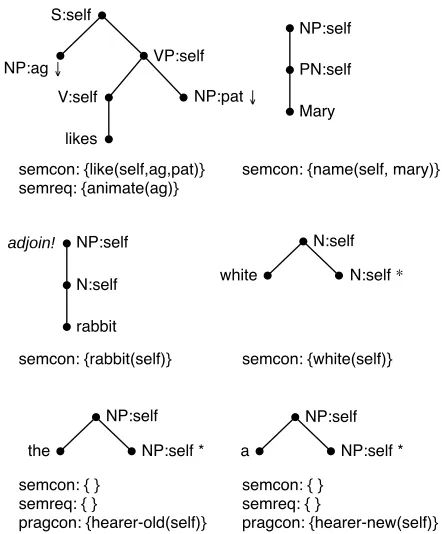
We follow Stone et al. (2003) in formalizing the semantic content of a lexicalized elementary treetas a finite set of atoms; but unlike in earlier approaches, we use the semantic roles int as the arguments of these atoms. For instance, the semantic content of the “likes” tree in Fig. 1 is{like(self,ag,pat)} (see also thesemcon entries in Fig. 4). The knowledge base is some finite set of ground atoms; in the exam-ple, it could contain such entries aslike(e,m,r)and
We then add parametersx1, . . . ,xn to each action with n semantic roles (including self). These new parameters are intended to be bound to individual constants in the knowledge base by the planner. For each elementary treetand possible step indexi, we establish the relationship between these parameters and the roles in two steps. First we fix a functionid
that maps the semantic roles oft to node identities. It mapsself touand each other rolertoi.r. Second, we fix a functionref that maps the outputs ofid bi-jectively to the parametersx1, . . . ,xn, in such a way thatref(u) =x1.
We can then capture the contribution of the i-th action fort to the communicative goal by giving it an effect¬cg(P,ref(id(r1)), . . . ,ref(id(rn)))for each elementP(r1, . . . ,rn)of the elementary tree’s seman-tic content. We restrict ourselves to only expressing true statements by giving the action a precondition
skb(P,ref(id(r1)), . . . ,ref(id(rn))) for each element of the semantic content.
In order to keep track of the connection between node identities and individuals for future reference, each action gets an effectreferent(id(r),ref(id(r)))
for each semantic rolerexceptself. We enforce the connection betweenuandx1by adding a
precondi-tionreferent(u,x1).
In the example, the most interesting action in this respect is the one for the elementary tree for “likes”. This action looks as follows:
ActionS-likes-1(u,x1,x2,x3).
Precond:subst(S,u),step(1),referent(u,x1), skb(like,x1,x2,x3)
Effect: ¬subst(S,u),subst(NP,1.ag),subst(NP,1.pat),
¬step(1),step(2),
referent(1.ag,x2),referent(1.pat,x3),
¬cg(like,x1,x2,x3)
We can run a planner and interpret the plan as above; the main difference is that complete plans not only correspond to grammatical derivation trees, but also express all communicative goals. Notice that this encoding models some aspects of lexical choice: The semantic content sets of the elementary trees need not be singletons, and so there may be multiple ways of partitioning the communicative goal into the content sets of various elementary trees.
3.2 Referring expressions
Finally, we extend the system to deal with the gen-eration of referring expressions. While this
prob-lem is typically taken to require the generation of a noun phrase that refers uniquely to some individual, we don’t need to make any assumptions about the syntactic category here. Moreover, we consider the problem in the wider context of generating referring expressions within a sentence, which can allow us to generate more succinct expressions.
Because a referring expression must allow the hearer to identify the intended referent uniquely, we keep track of the hearer’s knowledge base sep-arately. We use atoms hkb(P,a1, . . . ,an), as with
skb above. In addition, we assume pragmatic information of the form pkb(P,a1, . . . ,an). The three pragmatic predicates that we will use here are
hearer-new, indicating that the hearer does not know about the existence of an individual and can’t infer it (Stone et al., 2003),hearer-oldfor the opposite, and
contextset. Thecontext setof an intended referent is the set of all individuals that the hearer might possi-bly confuse it with (DeVault et al., 2004). It is empty for hearer-new individuals. To say thatb is in a’s context set, we put the atom pkb(contextset,a,b)
into the initial state.
In addition to the semantic content, we equip ev-ery elementary tree in the grammar with a seman-tic requirement and a pragmatic condition (Stone et al., 2003). The semantic requirement is a set of atoms spelling out presuppositions of an elementary tree that can help the hearer identify what its argu-ments refer to. For instance, “likes” has the selec-tional restriction that its agent must be animate; thus the hearer will not consider inanimate individuals as distractors for the referring expression in agent posi-tion. The pragmatic condition is a set of atoms over the predicates in the pragmatic knowledge base.
but consistent with the partial referring expression we have constructed so far. We enforce uniqueness of all referring expressions by adding the conjunct ∀u,x¬distractor(u,x)to the planning goal.
Now whenever an action introduces a new substi-tution nodeu, it will also introduce somedistractor
atoms to record the initial distractors for the refer-ring expression atu. An individualais in the initial distractor set for the substitution node with role r if (a) it is not the intended referent, (b) it is in the context set of the intended referent, and (c) there is a choice of individuals for the other parameters of the action that satisfies the semantic requirement together with a. This is expressed by adding the following effect for each substitution node; the con-junction is over the elementsP(r1, . . . ,rn)of the se-mantic requirement, and there is one universal quan-tifier for y and for each parameter xj of the action except forref(id(r)).
∀y,x1, . . . ,xn
(y6=ref(id(r))∧pkb(contextset,ref(id(r)),y)∧ V
hkb(P,ref(id(r1)), . . . ,ref(id(rn)))[y/ref(id(r))]) →distractor(id(r),y)
On the other hand, a distractorafor a referring ex-pression introduced atuis removed when we substi-tute or adjoin an elementary tree intouwhich rules aout. For instance, the elementary tree for “rabbit” will remove all non-rabbits from the distractor set of the substitution node into which it is substituted. We achieve this by adding the following effect to each action; here the conjunction is over all elements of the semantic content.
∀y.(¬V
hkb(P,ref(id(r1)), . . . ,ref(id(rn))))[y/x1]
→ ¬distractor(u,y),
Finally, each action gets its pragmatic condition as a precondition.
3.3 The example
By way of example, Fig. 5 shows the full versions of the actions from Fig. 2, for the extended gram-mar in Fig. 4. Let’s say that the hearer knows about two rabbits r (which is white) andr0 (which is not), about a personmwith the name Mary, and about an event e, and that the context set of r is {r,r0,m,e}. Let’s also say that our communicative goal is {like(e,m,r)}. In this case, the first action instance in Fig. 3, S-likes-1(1.self,e,m,r), intro-duces a substitution node with identity 1.pat. The
S:self
NP:ag ↓ VP:self
V:self
likes
NP:self
the NP:self *
NP:self
a NP:self * NP:self
PN:self
Mary
N:self
rabbit
N:self
white N:self * semcon: {like(self,ag,pat)}
semreq: {animate(ag)}
semcon: { } semreq: { }
pragcon: {hearer-old(self)}
semcon: { } semreq: { }
pragcon: {hearer-new(self)} semcon: {white(self)} semcon: {name(self, mary)}
semcon: {rabbit(self)}
NP:pat ↓
[image:6.612.316.537.70.337.2]adjoin! NP:self
Figure 4: The extended example grammar.
initial distractor set of this node is{r0,m} – the set of all individuals inr’s context set except for inan-imate objects (which violate the semantic require-ment) andritself. TheNP-rabbit-3action removes mfrom the distractor set, but at the end of the plan in Fig. 3,r0is still a distractor, i.e. we have not reached a goal state. We can complete the plan by perform-ing a final actionNP-white-5(1.pat,r), which will remove this distractor and achieve the planning goal. We can still reconstruct a derivation tree from the complete plan literally as described in Section 2.
Now let’s say that the hearer did not know about the existence of the individualrbefore the utterance we are generating. We model this by markingr as
hearer-newin the pragmatic knowledge base and as-signing it an empty context set. In this case, the re-ferring expression 1.patwould be initialized with an empty distractor set. This entitles us to use the action NP-a-4and generate the four-step plan correspond-ing to the sentence “Mary likes a rabbit.”
4 Discussion and future work
ActionS-likes-1(u,x1,x2,x3).
Precond: referent(u,x1),skb(like,x1,x2,x3),subst(S,u),step(1)
Effect: ¬cg(like,x1,x2,x3),¬subst(S,u),¬step(1),step(2),subst(NP,1.ag),subst(NP,1.pat),
∀y.¬hkb(like,y,x2,x3)→ ¬distractor(u,y),
∀y,x1,x3.x26=y∧pkb(contextset,x2,y)∧animate(y)→distractor(1.ag,y),
∀y,x1,x2.x36=y∧pkb(contextset,x3,y)→distractor(1.pat,y)
ActionNP-Mary-2(u,x1).
Precond:referent(u,x1),skb(name,x1,mary), subst(NP,u),step(2)
Effect: ¬cg(name,x1,mary),¬subst(NP,u),
¬step(2),step(3),
∀y.¬hkb(name,y,mary)→ ¬distractor(u,y)
ActionNP-rabbit-3(u,x1).
Precond:referent(u,x1),skb(rabbit,x1), subst(N,u),step(3)
Effect:¬cg(rabbit,x1),¬subst(N,u),¬step(3),step(4), canadjoin(NP,u),mustadjoin(NP,u),
∀y.¬hkb(rabbit,y)→ ¬distractor(u,y)
ActionNP-the-4(u,x1).
Precond:referent(u,x1),canadjoin(NP,u),step(4), pkb(hearer-old,x1)
Effect: ¬mustadjoin(NP,u),¬step(4),step(5)
ActionNP-a-4(u,x1).
Precond:referent(u,x1),canadjoin(NP,u),step(4), pkb(hearer-new,x1)
Effect:¬mustadjoin(NP,u),¬step(4),step(5)
ActionNP-white-5(u,x1).
Precond: referent(u,x1),skb(white,x1),canadjoin(NP,u),step(5)
Effect: ¬cg(white,x1),¬mustadjoin(NP,u),¬step(5),step(6),
∀y.¬hkb(white,y)→ ¬distractor(u,y)
Figure 5: Some of the actions corresponding to the grammar in Fig. 4.
4.1 Computational issues
We lack the space to present the formal definition of the sentence generation problem we encode into PDDL. However, this problem is NP-complete, by reduction of Hamiltonian Cycle – unsurprisingly, given that it encompasses realization, and the very similar realization problem in Koller and Striegnitz (2002) is NP-hard. So any algorithm for our prob-lem must be prepared for exponential runtimes.
We have implemented the translation described in this paper and experimented with a number of differ-ent grammars, knowledge bases, and planners. The FF planner (Hoffmann and Nebel, 2001) can com-pute the plans in Section 3.3 in under 100 ms us-ing the grammar in Fig. 4. If we add 10 more lex-icon entries to the grammar, the runtime grows to 190 ms; and for 20 more entries, to 360 ms. The runtime also grows with the plan length: It takes 410 ms to generate a sentence “Mary likes the Adj . . . Adj rabbit” with four adjectives and 890 ms for six adjectives, corresponding to a plan length of 10. We compared these results against a planning-based reimplementation of SPUD’s greedy search heuris-tic (Stone et al., 2003). This system is faster than FF for small inputs (360 ms for four adjectives), but be-comes slower as inputs grow larger (1000 ms for six adjectives); but notice that while FF is also a heuris-tic planner, it is guaranteed to find a solution if one
exists, unlike SPUD.
Planners have made tremendous progress in effi-ciency in the past decade, and by encoding sentence generation as a planning problem, we are set to profit from any future improvements; it is an advantage of the planning approach that we can compare very different search strategies like FF’s and SPUD’s in the same framework. However, our PDDL problems are challenging for modern planners because most planners start by computing all instances of atoms and actions. In our experiments, FF generally spent only about 10% of the runtime on search and the rest on computing the instances; that is, there is a lot of room for optimization. For larger grammars and knowledge bases, the number of instances can easily grow into the billions. In future work, we will there-fore collaborate with experts on planning systems to compute action instances only by need.
4.2 Referring expressions
However, an important detail in the encoding of referring expressions above is that an individual a counts as a distractor for the role r if there is any tuple of values that satisfies the semantic require-ment and hasain ther-component. This is correct, but can sometimes lead to overly complicated refer-ring expressions. An example is the construction “X takesY fromZ”, which presupposes thatY is inZ. In a scenario that involves multiple rabbits, multiple hats, and multiple individuals that are inside other individuals, but only one pair of a rabbit r inside a hat h, the expression “X takes the rabbit from the hat” is sufficient to refer uniquely torandh(Stone and Webber, 1998). Our system would try to gen-erate an expression for Y that suffices by itself to distinguish r from all distractors, and similarly for Z. We will explore this issue further in future work.
5 Conclusion
In this paper, we have shown how sentence gener-ation with TAG grammars and semantic and prag-matic information can be encoded into PDDL. Our encoding is declarative in that it can be used with any correct planning algorithm, and explicit in that the actions capture the complete effect of a word on the syntactic, semantic, and local pragmatic goals. In terms of expressive power, it captures the core of SPUD, except for its inference capabilities.
This work is practically relevant because it opens up the possibility of using efficient planners to make generators faster and more flexible. Conversely, our PDDL problems are a challenge for current plan-ners and open up NLG as an application domain that planning research itself can target.
Theoretically, our encoding provides a new framework for understanding and exploring the gen-eral relationships between language and action. It suggests new ways of going beyondSPUD’s expres-sive power, to formulate utterances that describe and disambiguate concurrent real-world actions or ex-ploit the dynamics of linguistic context within and across sentences.
Acknowledgments. This work was funded by a DFG re-search fellowship and the NSF grants HLC 0308121, IGERT 0549115, and HSD 0624191. We are indebted to Henry Kautz for his advice on planning systems, and to Owen Rambow, Bon-nie Webber, and the anonymous reviewers for feedback.
References
D. Appelt. 1985. Planning English Sentences. Cam-bridge University Press, CamCam-bridge England.
A. Blum and M. Furst. 1997. Fast planning through graph analysis.Artificial Intelligence, 90:281–300.
P. R. Cohen and C. R. Perrault. 1979. Elements of a plan-based theory of speech acts. Cognitive Science, 3(3):177–212.
R. Dale and E. Reiter. 1995. Computational interpreta-tions of the Gricean maxims in the generation of refer-ring expressions. Cognitive Science, 19.
D. DeVault, C. Rich, and C. Sidner. 2004. Natural lan-guage generation and discourse context: Computing distractor sets from the focus stack. InProc. FLAIRS.
R. Fikes and N. Nilsson. 1971. STRIPS: A new approach in the application of theorem proving to problem solv-ing.Artificial Intelligence, 2:189–208.
P. Heeman and G. Hirst. 1995. Collaborating on referring expressions. Computational Linguistics, 21(3):351–382.
J. Hobbs, M. Stickel, D. Appelt, and P. Martin. 1993. Interpretation as abduction. Artificial Intelligence, 63:69–142.
J. Hoffmann and B. Nebel. 2001. The FF planning system: Fast plan generation through heuristic search. Journal of Artificial Intelligence Research, 14.
A. Joshi and Y. Schabes. 1997. Tree-Adjoining Gram-mars. In G. Rozenberg and A. Salomaa, editors, Handbook of Formal Languages, chapter 2, pages 69– 123. Springer-Verlag, Berlin.
H. Kautz and B. Selman. 1998. Blackbox: A new ap-proach to the application of theorem proving to prob-lem solving. InWorkshop Planning as Combinatorial Search, AIPS-98.
A. Koller and K. Striegnitz. 2002. Generation as depen-dency parsing. InProc. 40th ACL, Philadelphia.
D. V. McDermott. 2000. The 1998 AI Planning Systems Competition. AI Magazine, 21(2):35–55.
M. Stone and B. Webber. 1998. Textual economy through close coupling of syntax and semantics. In Proc. INLG.
M. Stone, C. Doran, B. Webber, T. Bleam, and M. Palmer. 2003. Microplanning with communicative inten-tions: The SPUD system. Computational Intelligence, 19(4):311–381.