A Monthly Double-Blind Peer Reviewed Refereed Open Access International e-Journal - Included in the International Serial Directories
International Research Journal of Natural and Applied Sciences (IRJNAS)
Website: www.aarf.asia. Email: [email protected] , [email protected] Page 125
ASSESSING THE EFFECTIVENESS OF E – LEARNING EDUCATION
MATERIAL ON NUTRITION AND HEALTH KNOWLEDGE OF RURAL
WOMEN : A QUASI EXPERIMENTAL STUDY.
Nida Fatima Hazari (Msc) Department of Foods& Nutrition College of Home Science, PJTSAU,
Hyderabad, India.
Dr. V. Vijaya Lakshmi Professor & Head,
Department of Foods& Nutrition College of Home Science, PJTSAU,
Hyderabad, India.
ABSTRACT
This study was conducted to assess the effectiveness of education through the e – learning education material developed on changes in knowledge in nutrition and health among of rural women. It was a quasi experimental pre test – post test research design . A total sample of 130 rural women belonging to the reproductive age group (15 – 49) years were selected from three villages, one of which served as an experimental group (n=100) and the other acted as the control group(n=30). The tool consisted of an interview schedule covering various aspects of socio – economic and demographic characteristics of the respondents. A standardized questionnaire was used to assess knowledge at pre- and post-intervention. The intervention group received nutrition education through e – learning education material intervention while the control group did not receive any such type of intervention. There were significant increments in the post intervention mean scores of knowledge in both the groups (17.70 vs 11.20).The findings also revealed that age was negatively but significantly correlated with knowledge.
Introduction
A Monthly Double-Blind Peer Reviewed Refereed Open Access International e-Journal - Included in the International Serial Directories
International Research Journal of Natural and Applied Sciences (IRJNAS)
Website: www.aarf.asia. Email: [email protected] , [email protected] Page 126
these gaps in knowledge. With this objective in mind the study aimed at providing e – learning education intervention on nutrition and health knowledge for a period of six months in the form of a 2D animated film and assess its effectiveness on their knowledge levels after intervention.The effect of the independent variables on the knowledge scores was assessed.
Materials and methods
The study adopted a quasi experimental pre-test post test research design with a specific period of six months of intervention. A total sample of 130 rural women belonging to the reproductive age group of (15-49)years were selected from three villages namely Pudur,Gangupaly and Mirzapur.of Pudur mandal,Rangareddy district,Telangana. The control group constituted of 30 women ,10 from each village and the rest of 100 rural women were divided among the three villages which comprised the experimental group.
Data was collected from both the groups through an interview schedule.Relevant information on the socio-economic and demographic variables was collected.A standardized knowledge questionnaire on aspects of nutrition, health and hygiene (diet during pregnancy and lactation, breastfeeding, infant and young child feeding, nutritional deficiency diseases and health and hygiene) was developed for the present research.
After the collection of the relevant data, the educational intervention using the e – learning education material in the form of 2 d animated film was shown to the experimental group only. The intervention was once a week for a period of six months, whereas the control group was devoid of any such kind of experience. Rural women in both groups were then post tested with the same knowledge questionnaire to see the effect of intervention on their knowledge. For evaluating the questionnaire, score of 1 was awarded for correct answer and 0 for the wrong.
Appropriate statistical tools such as means and percentages were used to analyse the data. To test the significance t-test was applied and correlation was done.
Results and Discussion
The present study showed that the e – learning education intervention conducted over a period of 6 months had a positive impact on knowledge on nutrition and health among of rural women.
A Monthly Double-Blind Peer Reviewed Refereed Open Access International e-Journal - Included in the International Serial Directories
International Research Journal of Natural and Applied Sciences (IRJNAS)
Website: www.aarf.asia. Email: [email protected] , [email protected] Page 127
Socio economic and Demographic information of the subjects
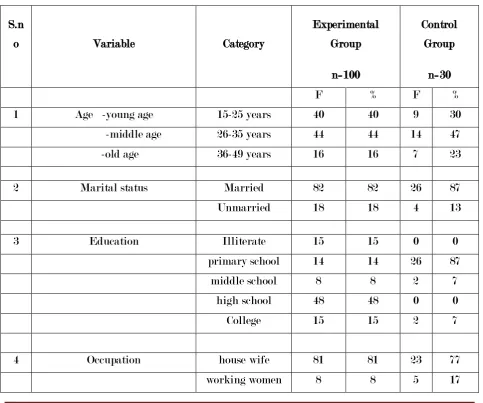
In the present study, majority of the rural women (44 percent) belonged to the middle age group (26-35 years) and 40 percent of them belonged to the younger age group (15-25 years) and 16 percent of the respondents belonged to the older age group (36-49 years) in the experimental group.With regard to the control group, majority 47 percent of the respondents belonged to the middle age group (26-35 years )followed by younger age group (30 percent) and old age group (23 percent). This distribution indicated that majority of the rural women in experimental group and control group fell under middle age group category.
In the present study 82percent of the women were married in the experimental group and 18% were unmarried where as in the control group 87 percent of the women were married and 13percent were unmarried.
With regard to the education level, 15 percent of the respondents in the experimental group completed college education, 48 percent of the respondents completed high school and 8 percent of the respondents completed middle school followed by 14 percent primary school education and however those who could not attend school were 15 percent . In the control group 7 percent of the respondents completed college education, 7percent of the respondents completed middle school and 87 percent of the respondents completed their primary school education. None of them were illiterates in the control group. It was quite evident that most of the respondents had atleast primary level of education.About 55 percent of the respondents in the experimental group belonged to nuclear family followed by 45 percent in joint family.About 60 percent of the respondents belonged to nuclear family followed by (40 percent) joint family in control group.
A Monthly Double-Blind Peer Reviewed Refereed Open Access International e-Journal - Included in the International Serial Directories
International Research Journal of Natural and Applied Sciences (IRJNAS)
Website: www.aarf.asia. Email: [email protected] , [email protected] Page 128
It could be observed that in experimental group nearly 96 percent of the respondents had been exposed to media type i.e. television, followed by educational films( 2 percent) and newspapers/periodicals (2 percent) where as in the control group, 93 percent of the respondents had exposure to information service i.e. educational films followed newspapers/ periodicals (7 percent)
Considerable number of respondents in experimental group (77 percent) had moderate contact with urban area mainly the visits to a nearby health care centre followed by 23 percent of high urban contact. Whereas in control group all the respondents (100 percent)had medium contacts in urban setup.
Table I.Distribution of respondents according to their profile characteristics in experimental group and control group.
S.n
o Variable Category
Experimental Group
n=100
Control Group
n=30
F % F %
1 Age -young age 15-25 years 40 40 9 30
-middle age 26-35 years 44 44 14 47
-old age 36-49 years 16 16 7 23
2 Marital status Married 82 82 26 87
Unmarried 18 18 4 13
3 Education Illiterate 15 15 0 0
primary school 14 14 26 87
middle school 8 8 2 7
high school 48 48 0 0
College 15 15 2 7
4 Occupation house wife 81 81 23 77
[image:4.595.66.550.353.756.2]A Monthly Double-Blind Peer Reviewed Refereed Open Access International e-Journal - Included in the International Serial Directories
International Research Journal of Natural and Applied Sciences (IRJNAS)
Website: www.aarf.asia. Email: [email protected] , [email protected] Page 129
agriculture labor 0 0 0 0
Student 11 11 2 7
5 Family Nuclear 55 55 18 60
Joint 45 45 12 40
6 Income -poor upto 2000 2 2 2 7
-low 2000-5000 39 39 5 17
-medium 5000-10000 40 40 23 77
-high > 10000 19 19 0 0
7
Audio-visual material
possession Television 51 51 18 60
Mobile 36 36 12 40
CD
Player/Laptop 13 13 0 0
8 Mass media exposure Never 2 2 2 7
occasional 2 2 28 93
daily 96 96 0 0
9 Urban contact low 0 0 0 0
Medium 77 77 30 100
A Monthly Double-Blind Peer Reviewed Refereed Open Access International e-Journal - Included in the International Serial Directories
International Research Journal of Natural and Applied Sciences (IRJNAS)
Website: www.aarf.asia. Email: [email protected] , [email protected] Page 130
Table II. Distribution of knowledge scores in experimental and control group.
Experimental group (n=100)
Control group (n=30) scores Pre- test
n %
Post- test n %
Pre-test n %
Post-test n % knowledge
5-9 14 14 0 0.00 7 23.33 3 10.00
9-13 73 73 0 0.00 19 63.33 19 63.33
13-17 9 9 16 16 4 13.33 8 26.67
17-21 4 4 84 84 0 0.00 0 0.00
The distribution of KAP scores of the subjects is presented in Table II. It is seen in the experimental group that majority of the subjects (73% )obtained knowledge scores between 9-13, followed by 14% of the subjects who obtained scores between 5-9, 9% per cent obtained between 13-17 and only 4% obtained scores between 13-17-21 before intervention.
The corresponding figures in case of control group were 63.33% subjects obtained scores between 9 - 13, followed by 23.33% subjects who scored between 5 – 9 and 13.33% subjects scored between 13 – 17 scores before intervention.
It was seen that after intervention majority of the subjects in the experimental group had moved to the upper category of scores i.e. low scores moved towards higher scores.About 84% of the subjects scored between 17 – 21 scores,16% scored between 13 – 17 scores where as in the control group there was no education intervention and thus the subjects did not show any significant improvement but still post intervention the number of subjects who scored between 13 – 17 scores increased to 26.67% from 13.33%. The probable reason might be the discussions and talk with the other women folk who received intervention.
A Monthly Double-Blind Peer Reviewed Refereed Open Access International e-Journal - Included in the International Serial Directories
International Research Journal of Natural and Applied Sciences (IRJNAS)
Website: www.aarf.asia. Email: [email protected] , [email protected] Page 131
S.no Category Mean knowledge score ‘t’ value Gain in knowledge
Quantum of improvement Before
exposure
After exposure
1 Experimental group
10.58±0.24 17.70±0.13 25.03** 6.85 1.63
2 Control group 10.13±0.34 11.20±0.39 2.06** 1.07 1.11
** - Significant at 1%
Results presented in table III indicate that before exposure to the animated film,mean knowledge scores of the experimental group was 10.58 and for the control group 10.13. The mean knowledge scores after exposure was 17.70 in experimental group and for the control group it was 11.20. The main gain in knowledge score was 6.85 for the experimental group and 1.07 for the control group showing that the change in their knowledge scores was 5.78 i.e.(6.87 – 1.09) taking the gain in knowledge of control group as base score.
Further, it was reported that quantum of improvement (post scores/pre scores) on Knowledge in the experimental group and control were 1.63 and 1.11 times respectively.
MEAN KNOWLEDGE SCORE:
As seen from the Table III the computed ‘t’ value was found to be positive and significant at 1% for 2D animated film in respect of difference in knowledge in the experimental group. So it could
0 2 4 6 8 10 12 14 16 18 20
experimental group
control group
before exposure
A Monthly Double-Blind Peer Reviewed Refereed Open Access International e-Journal - Included in the International Serial Directories
International Research Journal of Natural and Applied Sciences (IRJNAS)
Website: www.aarf.asia. Email: [email protected] , [email protected] Page 132
be concluded that there was a highly significant positive difference in knowledge levels before and after exposure to the educational intervention programme in the experimental group, where as in control group it was found to be very less significant at 1%.
From the findings of the Table III it could be inferred that there was a significant difference in the scores obtained for knowledge before and after intervention.The probable reason could be that the experimental group was exposed to the 2D animated film which resulted in increase in knowledge where as the control group was not exposed.Thus the gain in knowledge was not significant.
Similar result was obtained by Gupta and Kochar (2009) who reported that the mean scores of knowledge increased from 12.5 to 19.2 after nutrition education among adolescent girls of Kurukshetra.It was also observed that the gain in knowledge was 7.51 and quantum of improvement was 1.61 times after nutrition counseling which was higher as compared to the present study.
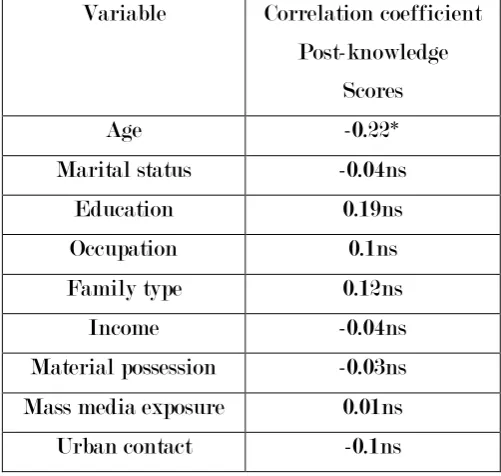
[image:8.595.98.349.463.701.2]Correlation coefficient of nutrition and health knowledge with selected socio – economic and demographic variables were computed.
Table IV .Correlation coefficient between socio – economic and demographic variables and nutrition and health knowledge.
Variable Correlation coefficient Post-knowledge
Scores
Age -0.22*
Marital status -0.04ns
Education 0.19ns
Occupation 0.1ns
Family type 0.12ns
Income -0.04ns
Material possession -0.03ns Mass media exposure 0.01ns
A Monthly Double-Blind Peer Reviewed Refereed Open Access International e-Journal - Included in the International Serial Directories
International Research Journal of Natural and Applied Sciences (IRJNAS)
Website: www.aarf.asia. Email: [email protected] , [email protected] Page 133
Generally there exists a close association between socio – economic and demographic parameters of the status of the women and the present data revealed that only the age of the respondent was significantly but negatively correlated with the nutrition and health knowledge levels of the respondent.No significant changes were observed with the other socio – economic and demographic variables in relation with nutrition and health knowledge levels of the respondents.
Fakhri et al. (2011) also assessed the awareness, knowledge , attitude and practice of hypertensive patients and its relation to the demographic data and concluded that there was a significant relationship between knowledge score and age of the respondents.Variables impacting significantly on the knowledge score were english as a first language , age (negative correlation , p<0.001) and the receipt of information relating to cardiac health (Hui,2006)
Conclusion