PCFGs with Syntactic and Prosodic Indicators of Speech Repairs
John HaleaIzhak Shafranb Lisa Yungc
Bonnie DorrdMary HarperdeAnna Krasnyanskayaf Matthew Leaseg Yang LiuhBrian RoarkiMatthew SnoverdRobin Stewartj
a
Michigan State University;b,cJohns Hopkins University;dUniversity of Maryland, College Park;ePurdue University
f
UCLA;gBrown University;hUniversity of Texas at Dallas;iOregon Health & Sciences University;jWilliams College
Abstract
A grammatical method of combining two kinds of speech repair cues is presented. One cue, prosodic disjuncture, is detected by a decision tree-based ensemble clas-sifier that uses acoustic cues to identify where normal prosody seems to be inter-rupted (Lickley, 1996). The other cue, syntactic parallelism, codifies the expec-tation that repairs continue a syntactic category that was left unfinished in the reparandum (Levelt, 1983). The two cues are combined in a Treebank PCFG whose states are split using a few simple tree transformations. Parsing performance on the Switchboard and Fisher corpora sug-gests that these two cues help to locate speech repairs in a synergistic way.
1 Introduction
Speech repairs, as in example (1), are one kind of disfluent element that complicates any sort of syntax-sensitive processing of conversational speech.
(1) and[the first kind of invasion of]the first type of privacy seemed invaded to me
The problem is that the bracketed
reparan-dum region (following the terminology of Shriberg
(1994)) is approximately repeated as the speaker
The authors are very grateful for Eugene Charniak’s help adapting his parser. We also thank the Center for Language and Speech processing at Johns Hopkins for hosting the sum-mer workshop where much of this work was done. This material is based upon work supported by the National Sci-ence Foundation (NSF) under Grant No. 0121285. Any opin-ions, findings and conclusions or recommendations expressed in this material are those of the authors and do not necessarily reflect the views of the NSF.
“repairs” what he or she has already uttered. This extra material renders the entire utterance ungrammatical—the string would not be gener-ated by a correct grammar of fluent English. In particular, attractive tools for natural language understanding systems, such as Treebank gram-mars for written corpora, naturally lack appropri-ate rules for analyzing these constructions.
One possible response to this mismatch be-tween grammatical resources and the brute facts of disfluent speech is to make one look more like the other, for the purpose of parsing. In this separate-processing approach, reparanda are located through a variety of acoustic, lexical or string-based techniques, then excised before sub-mission to a parser (Stolcke and Shriberg, 1996; Heeman and Allen, 1999; Spilker et al., 2000; Johnson and Charniak, 2004). The resulting parse tree then has the reparandum re-attached in a standardized way (Charniak and Johnson, 2001). An alternative strategy, adopted in this paper, is to use the same grammar to model fluent speech, disfluent speech, and their interleaving.
Such an integrated approach can use syntac-tic properties of the reparandum itself. For in-stance, in example (1) the reparandum is an
unfinished noun phrase, the repair a finished
noun phrase. This sort of phrasal correspon-dence, while not absolute, is strong in conver-sational speech, and cannot be exploited on the separate-processing approach. Section 3 applies metarules (Weischedel and Sondheimer, 1983; McKelvie, 1998a; Core and Schubert, 1999) in recognizing these correspondences using standard context-free grammars.
At the same time as it defies parsing, con-versational speech offers the possibility of lever-aging prosodic cues to speech repairs.
Figure 1: The pause between two or s and the glottalization at the end of the first makes it easy for a listener to identify the repair.
tion 2 describes a classifier that learns to label prosodic breaks suggesting upcoming disfluency. These marks can be propagated up into parse trees and used in a probabilistic context-free gram-mar (PCFG) whose states are systematically split to encode the additional information.
Section 4 reports results on Switchboard (God-frey et al., 1992) and Fisher EARS RT04F data, suggesting these two features can bring about in-dependent improvements in speech repair detec-tion. Section 5 suggests underlying linguistic and statistical reasons for these improvements. Sec-tion 6 compares the proposed grammatical method to other related work, including state of the art separate-processing approaches. Section 7 con-cludes by indicating a way that string- and tree-based approaches to reparandum identification could be combined.
2 Prosodic disjuncture
Everyday experience as well as acoustic anal-ysis suggests that the syntactic interruption in speech repairs is typically accompanied by a change in prosody (Nakatani and Hirschberg, 1994; Shriberg, 1994). For instance, the spectro-gram corresponding to example (2), shown in Fig-ure 1,
(2) the jehovah’s witness or [ or ] mormons or someone
reveals a noticeable pause between the occurrence of the two ors, and an unexpected glottalization at the end of the first one. Both kinds of cues have been advanced as explanations for human listen-ers’ ability to identify the reparandum even before the repair occurs.
Retaining only the second explanation, Lickley (1996) proposes that there is no “edit signal” per se but that repair is cued by the absence of smooth
formant transitions and lack of normal juncture phenomena.
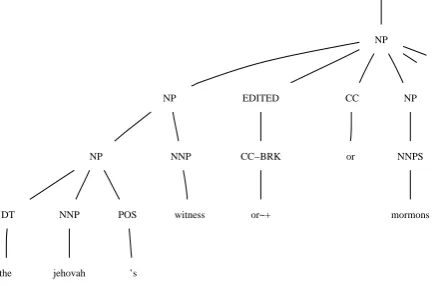
One way to capture this notion in the syntax is to enhance the input with a special disjunc-ture symbol. This symbol can then be propa-gated in the grammar, as illustrated in Figure 2. This work uses a suffix ˜+to encode the percep-tion of abnormal prosody after a word, along with phrasal-BRKtags to decorate the path upwards to reparandum constituents labeled EDITED. Such
NP
NP EDITED CC NP
NP NNP CC−BRK or NNPS
DT NNP POS witness
the jehovah ’s
or~+ mormons
Figure 2: Propagating BRK, the evidence of dis-fluent juncture, from acoustics to syntax.
disjuncture symbols are identified in the ToBI la-beling scheme as break indices (Price et al., 1991; Silverman et al., 1992).
[image:2.595.309.526.378.521.2]hesitation or planning. In conversational speech the intermediate levels occur infrequently and the break indices can be broadly categorized into three groups, namely, 1, 4 and p as in Wong et al. (2005).
A classifier was developed to predict three break indices at each word boundary based on variations in pitch, duration and energy asso-ciated with word, syllable or sub-syllabic con-stituents (Shriberg et al., 2005; Sonmez et al., 1998). To compute these features, phone-level time-alignments were obtained from an automatic speech recognition system. The duration of these phonological constituents were derived from the ASR alignment, while energy and pitch were com-puted every 10ms with snack, a public-domain sound toolkit (Sjlander, 2001). The duration, en-ergy, and pitch were post-processed according to stylization procedures outlined in Sonmez et al. (1998) and normalized to account for variability across speakers.
Since the input vector can have missing val-ues such as the absence of pitch during unvoiced sound, only decision tree based classifiers were investigated. Decision trees can handle missing features gracefully. By choosing different com-binations of splitting and stopping criteria, an ensemble of decision trees was built using the publicly-available IND package (Buntine, 1992). These individual classifiers were then combined into ensemble-based classifiers.
Several classifiers were investigated for detect-ing break indices. On ten-fold cross-validation, a bagging-based classifier (Breiman, 1996) pre-dicted prosodic breaks with an accuracy of 83.12% while chance was 67.66%. This compares favor-ably with the performance of the supervised classi-fiers on a similar task in Wong et al. (2005). Ran-dom forests and hidden Markov models provide marginal improvements at considerable computa-tional cost (Harper et al., 2005).
For speech repair, the focus is on detecting dis-fluent breaks. The precision and recall trade-off on its detection can be adjusted using a thresh-old on the posterior probability of predicting “p”, as shown in Figure 3.
In essence, the large number of acoustic and prosodic features related to disfluency are encoded via the ToBI label ‘p’, and provided as additional observations to the PCFG. This is unlike previous work on incorporating prosodic information
(Gre-0 0.1 0.2 0.3 0.4 0.5 0.6
0 0.1 0.2 0.3 0.4 0.5 0.6
Probability of Miss
[image:3.595.322.515.75.215.2]Probability of False Alarm
Figure 3: DET curve for detecting disfluent breaks from acoustics.
gory et al., 2004; Lease et al., 2005; Kahn et al., 2005) as described further in Section 6.
3 Syntactic parallelism
The other striking property of speech repairs is their parallel character: subsequent repair regions ‘line up’ with preceding reparandum regions. This property can be harnessed to better estimate the length of the reparandum by considering paral-lelism from the perspective of syntax. For in-stance, in Figure 4(a) the unfinished reparandum noun phrase is repaired by another noun phrase – the syntactic categories are parallel.
3.1 Levelt’s WFR and Conjunction
The idea that the reparandum is syntactically par-allel to the repair can be traced back to Levelt (1983). Examining a corpus of Dutch picture de-scriptions, Levelt proposes a bi-conditional well-formedness rule for repairs (WFR) that relates the structure of repairs to the structure of conjunc-tions. The WFR conceptualizes repairs as the con-junction of an unfinished reparandum string (α) with a properly finished repair (γ). Its original formulation, repeated here, ignores optional inter-regna like “er” or “I mean.”
Well-formedness rule for repairs (WFR) A
re-pairhα γiis well-formed if and only if there is a stringβsuch that the stringhαβand∗ γi
is well-formed, whereβ is a completion of the constituent directly dominating the last element of α. (and is to be deleted if that last element is itself a sentence connective)
render the whole phrase αβ grammatically con-joinable with the repairγ. In example (1)αis the string ‘the first kind of invasion of’,γ is ‘the first type of privacy’ andβis probably the single word ‘privacy.’
This kind of conjoinability typically requires the syntactic categories of the conjuncts to be the same (Chomsky, 1957, 36). That is, a rule schema such as (2) where X is a syntactic category, is pre-ferred over one where X is not constrained to be the same on either side of the conjunction.
X → X Conj X (2)
If, as schema (2) suggests, conjunction does fa-vor like-categories, and, as Levelt suggests, well-formed repairs are conjoinable with finished ver-sions of their reparanda, then the syntactic cate-gories of repairs ought to match the syntactic cat-egories of (finished versions of) reparanda.
3.2 A WFR for grammars
Levelt’s WFR imposes two requirements on a grammar
• distinguishing a separate category of ‘unfin-ished’ phrases
• identifying a syntactic category for reparanda
Both requirements can be met by adapting Tree-bank grammars to mirror the analysis of McK-elvie1 (1998a; 1998b). McKelvie derives phrase structure rules for speech repairs from fluent rules by adding a new feature called abort that can take values true and false. For a given gram-mar rule of the form
A→B C
a metarule creates other rules of the form
A[abort=Q]→
B[abort=false]C[abort=Q]
where Qis a propositional variable. These rules say, in effect, that the constituent A is aborted just in case the last daughter C is aborted. Rules that don’t involve a constant value forQensure that the same value appears on parents and children. The
1McKelvie’s metarule approach declaratively expresses
Hindle’s (1983) Stack Editor and Category Copy Editor rules. This classic work effectively states the WFR as a program for the Fidditch deterministic parser.
WFR is then implemented by rule schemas such as (3)
X→X[abort=true] (AFF)X (3)
that permit the optional interregnum AFF to con-join an unfinished X-phrase (the reparandum) with a finished X-phrase (the repair) that comes after it.
3.3 A WFR for Treebanks
McKelvie’s formulation of Levelt’s WFR can be applied to Treebanks by systematically recoding the annotations to indicate which phrases are un-finished and to distinguish matching from non-matching repairs.
3.3.1 Unfinished phrases
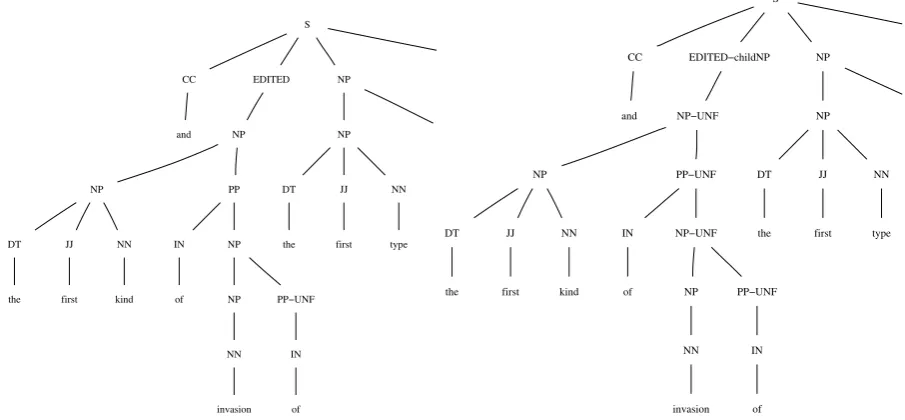
Some Treebanks already mark unfinished phrases. For instance, the Penn Treebank pol-icy (Marcus et al., 1993; Marcus et al., 1994) is to annotate the lowest node that is unfinished with an-UNFtag as in Figure 4(a).
It is straightforward to propagate this mark up-wards in the tree from wherever it is annotated to the nearest enclosing EDITED node, just as-BRK is propagated upwards from disjuncture marks on individual words. This percolation simulates the action of McKelvie’s [abort = true]. The re-sulting PCFG is one in which distributions on phrase structure rules with ‘missing’ daughters are segregated from distributions on ‘complete’ rules.
3.4 Reparanda categories
The other key element of Levelt’s WFR is the idea of conjunction of elements that are in some sense the same. In the Penn Treebank annota-tion scheme, reparanda always receive the label EDITED. This means that the syntactic category of the reparandum is hidden from any rule which could favor matching it with that of the repair. Adding an additional mark on this EDITED node (a kind of daughter annotation) rectifies the situ-ation, as depicted in Figure 4(b), which adds the notation-childNPto a tree in which the unfin-ished tags have been propagated upwards. This allows a Treebank PCFG to represent the general-ization that speech repairs tend to respect syntactic category.
4 Results
S
CC EDITED NP
and NP NP
NP PP
DT JJ NN IN NP
the first kind of NP PP−UNF
NN IN
invasion of
DT JJ NN
the first type
(a) The lowest unfinished node is given.
S
CC EDITED−childNP NP
and NP−UNF NP
NP PP−UNF
DT JJ NN IN NP−UNF
the first kind of NP PP−UNF
NN IN
invasion of
DT JJ NN
the first type
[image:5.595.69.522.76.286.2](b) -UNF propagated, daughter-annotated Switchboard tree
Figure 4: Input (a) and output (b) of tree transformations.
speech repairs. The first two use the CYK algo-rithm to find the most likely parse tree on a gram-mar read-off from example trees annotated as in Figures 2 and 4. The third experiment measures the benefit from syntactic indicators alone in Char-niak’s lexicalized parser (Charniak, 2000). The ta-bles in subsections 4.1, 4.2, and 4.3 summarize the accuracy of output parse trees on two mea-sures. One is the standard Parseval F-measure, which tracks the precision and recall for all labeled constituents as compared to a gold-standard parse. The other measure, EDIT-finding F, restricts con-sideration to just constituents that are reparanda. It measures the per-word performance identifying a word as dominated by EDITED or not. As in pre-vious studies, reference transcripts were used in all cases. A check(√)indicates an experiment where prosodic breaks where automatically inferred by the classifier described in section 2, whereas in the
(×)rows no prosodic information was used.
4.1 CYK on Fisher
Table 1 summarizes the accuracy of a stan-dard CYK parser on the newly-treebanked Fisher corpus (LDC2005E15) of phone conver-sations, collected as part of the DARPA EARS program. The parser was trained on the entire Switchboard corpus (ca. 107K utterances) then tested on the 5368-utterance ‘dev2’ subset of the Fisher data. This test set was tagged using MX
-POST(Ratnaparkhi, 1996) which was itself trained on Switchboard. Finally, as described in section 2 these tags were augmented with a special prosodic break symbol if the decision tree rated the proba-bility a ToBI ‘p’ symbol higher than the threshold value of 0.75.
Annotation Br
eak
index
P
arse
v
al
F
EDIT
F
none √× 66.54 22.9
66.08 26.1
daughter annotation √× 66.41 29.4 65.81 31.6
-UNF propagation √× 67.06 31.5
66.45 34.8
both √× 69.21 40.2
67.02 40.6
Table 1: Improvement on Fisher,MXPOSTed tags. The Fisher results in Table 1 show that syntac-tic and prosodic indicators provide different kinds of benefits that combine in an additive way. Pre-sumably because of state-splitting, improvement in EDIT-finding comes at the cost of a small decre-ment in overall parsing performance.
4.2 CYK on Switchboard
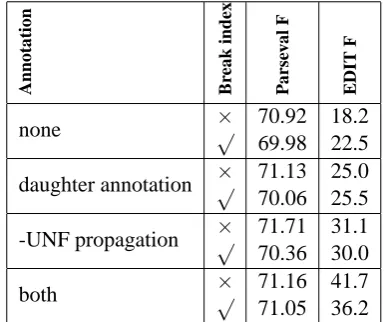
train/dev/test partition of Charniak and Johnson (2001). In these experiments, the parser was given correct part-of-speech tags as input.
Annotation Br
eak
index
P
arse
v
al
F
EDIT
F
none √× 70.92 18.2
69.98 22.5
daughter annotation √× 71.13 25.0 70.06 25.5
-UNF propagation √× 71.71 31.1
70.36 30.0
both √× 71.16 41.7
[image:6.595.84.279.113.274.2]71.05 36.2
Table 2: Improvement on Switchboard, gold tags.
The Switchboard results demonstrate independent improvement from the syntactic annotations. The prosodic annotation helps on its own and in com-bination with the daughter annotation that imple-ments Levelt’s WFR.
4.3 Lexicalized parser
Finally, Table 3 reports the performance of Char-niak’s non-reranking, lexicalized parser on the Switchboard corpus, using the same test/dev/train partition.
Annotation Parseval F EDIT F
baseline 83.86 57.6
daughter annotation 80.85 67.2
-UNF propagation 81.68 64.7
both 80.16 70.0
flattened EDITED 82.13 64.4
Table 3: Charniak as an improved EDIT-finder.
Since Charniak’s parser does its own tagging, this experiment did not examine the utility of prosodic disjuncture marks. However, the com-bination of daughter annotation and -UNF prop-agation does lead to a better grammar-based reparandum-finder than parsers trained on flat-tened EDITED regions. More broadly, the re-sults suggest that Levelt’s WFR is synergistic with the kind of head-to-head lexical dependencies that Charniak’s parser uses.
5 Discussion
The pattern of improvement in tables 1, 2, and 3 from none or baseline rows where no
syntac-tic parallelism or break index information is used, to subsequent rows where it is used, suggest why these techniques work. Unfinished-category an-notation improves performance by preventing the grammar of unfinished constituents from being polluted by the grammar of finished constituents. Such purification is independent of the fact that rules with daughters labeledEDITED-childXP tend to also mention categories labeled XP fur-ther to the right (or NP and VP, when XP starts with S). This preference for syntactic parallelism can be triggered either by externally-suggested ToBI break indices or grammar rules annotated
with -UNF. The prediction of a disfluent break
could be further improved by POS features and N-gram language model scores (Spilker et al., 2001; Liu, 2004).
6 Related Work
There have been relatively few attempts to harness prosodic cues in parsing. In a spoken language system for VERBMOBIL task, Batliner and col-leagues (2001) utilize prosodic cues to dramati-cally reduce lexical analyses of disfluencies in a end-to-end real-time system. They tackle speech repair by a cascade of two stages – identification of potential interruption points using prosodic cues with 90% recall and many false alarms, and the lexical analyses of their neighborhood. Their ap-proach, however, does not exploit the synergy be-tween prosodic and syntactic features in speech re-pair. In Gregory et al. (2004), over 100 real-valued acoustic and prosodic features were quantized into a heuristically selected set of discrete symbols, which were then treated as pseudo-punctuation in a PCFG, assuming that prosodic cues function like punctuation. The resulting grammar suffered from data sparsity and failed to provide any benefits. Maximum entropy based models have been more successful in utilizing prosodic cues. For instance, in Lease et al. (2005), interruption point probabil-ities, predicted by prosodic classifiers, were quan-tized and introduced as features into a speech re-pair model along with a variety of TAG and PCFG features. Towards a clearer picture of the inter-action with syntax and prosody, this work uses ToBI to capture prosodic cues. Such a method is analogous to Kahn et al. (2005) but in a genera-tive framework.
[image:6.595.81.280.457.544.2]rep-resents the state of the art in reparandum-finding. Johnson and Charniak explicitly model the crossed dependencies between individual words in the reparandum and repair regions, intersect-ing this sequence model with a parser-derived lan-guage model for fluent speech. This second step improves on Stolcke and Shriberg (1996) and Hee-man and Allen (1999) and outperforms the specific grammar-based reparandum-finders tested in sec-tion 4. However, because of separate-processing the TAG channel model’s analyses do not reflect the syntactic structure of the sentence being ana-lyzed, and thus that particular TAG-based model cannot make use of properties that depend on the phrase structure of the reparandum region. This includes the syntactic category parallelism dis-cussed in section 3 but also predicate-argument structure. If edit hypotheses were augmented to mention particular tree nodes where the reparan-dum should be attached, such syntactic paral-lelism constraints could be exploited in the rerank-ing framework of Johnson et al. (2004).
The approach in section 3 is more closely re-lated to that of Core and Schubert (1999) who also use metarules to allow a parser to switch from speaker to speaker as users interrupt one another. They describe their metarule facility as a modi-fication of chart parsing that involves copying of specific arcs just in case specific conditions arise. That approach uses a combination of longest-first heuristics and thresholds rather than a complete probabilistic model such as a PCFG.
Section 3’s PCFG approach can also be viewed as a declarative generalization of Roark’s (2004) EDIT-CHILD function. This function helps an incremental parser decide upon particular tree-drawing actions in syntactically-parallel contexts like speech repairs. Whereas Roark conditions the expansion of the first constituent of the repair upon the corresponding first constituent of the reparan-dum, in the PCFG approach there exists a separate rule (and thus a separate probability) for each al-ternative sequence of reparandum constituents.
7 Conclusion
Conventional PCFGs can improve their detection of speech repairs by incorporating Lickley’s hy-pothesis about interrupted prosody and by im-plementing Levelt’s well-formedness rule. These benefits are additive.
The strengths of these simple tree-based
tech-niques should be combinable with sophisticated string-based (Johnson and Charniak, 2004; Liu, 2004; Zhang and Weng, 2005) approaches by applying the methods of Wieling et al. (2005) for constraining parses by externally-suggested brackets.
References
L. Breiman. 1996. Bagging predictors. Machine Learning, 24(2):123–140.
W. Buntine. 1992. Tree classication software. In Tech-nology 2002: The Third National TechTech-nology Trans-fer ConTrans-ference and Exposition, Baltimore.
E. Charniak and M. Johnson. 2001. Edit detection and parsing for transcribed speech. In Proceedings of the 2nd Meeting of the North American Chap-ter of the Association for Computational Linguistics, pages 118–126.
E. Charniak. 2000. A maximum-entropy-inspired parser. In Proceedings of NAACL-00, pages 132– 139.
N. Chomsky. 1957. Syntactic Structures. Anua Lin-guarum Series Minor 4, Series Volume 4. Mouton de Gruyter, The Hague.
M. G. Core and L. K. Schubert. 1999. A syntactic framework for speech repairs and other disruptions. In Proceedings of the 37thAnnual Meeting of the As-sociation for Computational Linguistics, pages 413– 420.
J. J. Godfrey, E. C. Holliman, and J. McDaniel. 1992. SWITCHBOARD: Telephone speech corpus for re-search and development. In Proceedings of ICASSP, volume I, pages 517–520, San Francisco.
M. Gregory, M. Johnson, and E. Charniak. 2004. Sentence-internal prosody does not help parsing the way punctuation does. In Proceedings of North American Association for Computational Linguis-tics.
M. Harper, B. Dorr, J. Hale, B. Roark, I. Shafran, M. Lease, Y. Liu, M. Snover, and L. Yung. 2005. Parsing and spoken structural event detection. In 2005 Johns Hopkins Summer Workshop Final Re-port.
P. A. Heeman and J. F. Allen. 1999. Speech repairs, intonational phrases and discourse markers: model-ing speakers’ utterances in spoken dialog. Compu-tational Linguistics, 25(4):527–571.
D. Hindle. 1983. Deterministic parsing of syntactic non-fluencies. In Proceedings of the ACL.
M. Johnson, E. Charniak, and M. Lease. 2004. An im-proved model for recognizing disfluencies in conver-sational speech. In Proceedings of Rich Transcrip-tion Workshop.
J. G. Kahn, M. Lease, E. Charniak, M. Johnson, and M. Ostendorf. 2005. Effective use of prosody in parsing conversational speech. In Proceedings of Human Language Technology Conference and Con-ference on Empirical Methods in Natural Language Processing, pages 233–240.
M. Lease, E. Charniak, and M. Johnson. 2005. Pars-ing and its applications for conversational speech. In Proceedings of ICASSP.
W. J. M. Levelt. 1983. Monitoring and self-repair in speech. Cognitive Science, 14:41–104.
R. J. Lickley. 1996. Juncture cues to disfluency. In Proceedings the International Conference on Speech and Language Processing.
Y. Liu. 2004. Structural Event Detection for Rich Transcription of Speech. Ph.D. thesis, Purdue Uni-versity.
M. Marcus, B. Santorini, and M. A. Marcinkiewicz. 1993. Building a large annotated corpus of En-glish: The Penn Treebank. Computational Linguis-tics, 19(2):313–330.
M. Marcus, G. Kim, M. A. Marcinkiewicz, R. MacIn-tyre, A. Bies, M. Ferguson, K. Katz, and B. Schas-berger. 1994. The Penn Treebank: Annotating Predicate Argument Structure. In Proceedings of the 1994 ARPA Human Language Technology Work-shop.
D. McKelvie. 1998a. SDP – Spoken Dialog Parser. ESRC project on Robust Parsing and Part-of-speech Tagging of Transcribed Speech Corpora, May.
D. McKelvie. 1998b. The syntax of disfluency in spon-taneous spoken language. ESRC project on Robust Parsing and Part-of-speech Tagging of Transcribed Speech Corpora, May.
C. Nakatani and J. Hirschberg. 1994. A corpus-based study of repair cues in spontaneous speech. Journal of the Acoustical Society of America, 95(3):1603– 1616, March.
M. Ostendorf, I. Shafran, S. Shattuck-Hufnagel, L. Carmichael, and W. Byrne. 2001. A prosodically labelled database of spontaneous speech. In Proc. ISCA Tutorial and Research Workshop on Prosody in Speech Recognition and Understanding, pages 119–121.
P. Price, M. Ostendorf, S. Shattuck-Hufnagel, and C. Fong. 1991. The use of prosody in syntactic disambiguation. Journal of the Acoustic Society of America, 90:2956–2970.
A. Ratnaparkhi. 1996. A maximum entropy part-of-speech tagger. In Proceedings of Empirical Methods in Natural Language Processing Conference, pages 133–141.
B. Roark. 2004. Robust garden path parsing. Natural Language Engineering, 10(1):1–24.
E. Shriberg, L. Ferrer, S. Kajarekar, A. Venkataraman, and A. Stolcke. 2005. Modeling prosodic feature sequences for speaker recognition. Speech Commu-nication, 46(3-4):455–472.
E. Shriberg. 1994. Preliminaries to a Theory of Speech Disfluencies. Ph.D. thesis, UC Berkeley.
H. F. Silverman, M. Beckman, J. Pitrelli, M. Ostendorf, C. Wightman, P. Price, J. Pierrehumbert, and J. Hir-shberg. 1992. ToBI: A standard for labeling English prosody. In Proceedings of ICSLP, volume 2, pages 867–870.
K. Sjlander, 2001. The Snack sound visualization mod-ule. Royal Institute of Technology in Stockholm. http://www.speech.kth.se/SNACK.
K. Sonmez, E. Shriberg, L. Heck, and M. Weintraub. 1998. Modeling dynamic prosodic variation for speaker verification. In Proceedings of ICSLP, vol-ume 7, pages 3189–3192.
J¨org Spilker, Martin Klarner, and G¨unther G¨orz. 2000. Processing self-corrections in a speech-to-speech system. In Wolfgang Wahlster, editor, Verbmobil: Foundations of speech-to-speech translation, pages 131–140. Springer-Verlag, Berlin.
J. Spilker, A. Batliner, and E. N¨oth. 2001. How to repair speech repairs in an end-to-end system. In R. Lickley and L. Shriberg, editors, Proc. of ISCA Workshop on Disfluency in Spontaneous Speech, pages 73–76.
A. Stolcke and E. Shriberg. 1996. Statistical language modeling for speech disfluencies. In Proceedings of the IEEE International Conference on Acoustics, Speech and Signal Processing, pages 405–408, At-lanta, GA.
R. M. Weischedel and N. K. Sondheimer. 1983. Meta-rules as a basis for processing ill-formed in-put. American Journal of Computational Linguis-tics, 9(3-4):161–177.
M. Wieling, M-J. Nederhof, and G. van Noord. 2005. Parsing partially bracketed input. Talk presented at Computational Linguistics in the Netherlands.
D. Wong, M. Ostendorf, and J. G. Kahn. 2005. Us-ing weakly supervised learnUs-ing to improve prosody labeling. Technical Report UWEETR-2005-0003, University of Washington Electrical Engineering Dept.