1Department of Materials Science and Engineering, Tokyo Institute of Technology, Yokohama 226–8502, Japan
2Department of Materials and Synchrotron Radiation Engineering, Graduate School of Engineering, University of Hyogo, Himeji 671–2280, Japan
3Department of Metallurgy and Ceramics Science, Tokyo Institute of Technology, Tokyo 152–8552, Japan
The microstructure and texture evolution of an accumulative roll bonding (ARB) processed 4N-Cu with and without lubrication were compared in addition to the mechanical properties, in order to understand the effect of additional shear strain caused by the friction between the rolls and a sheet. Furthermore, subsequent annealing at 423 K, 448 K and 473 K was applied for 4N-Cu ARB processed with and without lubri-cation, and, softening was observed for all temperatures. The texture change due to the ARB process and subsequent annealing were discussed using {111} pole figures and ODF maps. As a result, a 45 rotated Cube texture around ND was formed by additional shear strain, whereas the typical fcc rolling texture was formed by ARB with lubrication. At higher ARB cycles of 4N-Cu, discontinuous recrystallization occurs due to its medium stacking fault energy. Cube orientation appeared in annealed-ARB processed 4N-Cu with lubrication, whereas no specific texture appeared in annealed-ARB processed 4N-Cu without lubrication [doi:10.2320/matertrans.MH201506]
(Received February 29, 2016; Accepted May 13, 2016; Published June 24, 2016)
Keywords: severe plastic deformation (SPD), accumulative roll bonding (ARB), texture, copper, electron back scattering diffraction (EBSD)
1. Introduction
An accumulative roll bonding (ARB) process is known as one of the severe plastic deformation (SPD) processes which can give much larger equivalent strain than that of normal plastic deformation, and generally, the equivalent strain be-comes larger than four in the SPD processes1). The ARB
pro-cess contains a roll bonding with the rolling reduction of 50%, and therefore, the microstructure evolution of the ARB processed metals is expected to be similar with that of rolled metals.
There are essentially two types of surface condition of rolls for the ARB process, i.e. with and without lubrication. The difference between with and without lubrication is the pres-ence of machine oil on the surface of the rolls, which gives different friction between the surfaces of the rolls and metal plates. If the surface friction is lowered by the machine oil, the deformation of the one cycle of the ARB process can be treated as plane strain compression, of which equivalent strain is about 0.82). On the other hand, the larger friction
gives larger strain adjacent to the surface, and therefore en-hances the microstructural evolution close to the surface, which is described as the additional shear strain3–5).
Further-more, the additional shear strain was reproduced in finite ele-ment method (FEM)6).
It is also well known that the application of a same mode of deformation on polycrystalline metals results in creating a
strong deformation texture. For instance, rolling deformation on face centred cubic (FCC) metals produces strong rolling texture which consists of some components; Brass {110}<112>, S {123}<634>, and Copper {110}<112> orien-tations7,8). Since it is essentially impossible to apply the
in-situ microstructural observations/measurements during SPD processes, the texture analysis becomes a strong tool in order to understand the microstructural evolution during the SPD process. Although there are texture analysis on the ARB processed metals3–5,9–15), especially, there are not many
re-ports on Cu16). Thus, we studied the texture evolution of pure
Cu during ARB process with and without lubrication.
2. Experimental
The starting materials for the ARB process were fully re-crystallized 99.99% purity Cu sheets having the mean grain size of 32 μm as a result of the annealing at 873 K for 7.2 ks. The thickness, width and length of the sheets were 1 mm, 90 mm and 250 mm, respectively. The ARB process was per-formed up to eight cycles with and without lubrication at room temperature. Hereafter, the N th ARB processed Cu sheet is denoted as ARB Nc, and here, N is the ARB cycle number. It should be noted that annealed 4N-Cu used as the starting material is treated as ARB 0c.
The microstructure of the ARB processed Cu was investi-gated by EBSD analysis in a field emission type scanning electron microscope (FE-SEM), JEOL JSM-6500FK, operat-ed at 15 kV. The EBSD analysis was carrioperat-ed out using a pro-gram, TSL OIM data collection 4.6. The specimens for the EBSD observation were cut using an arc discharge wire cut-ting machine, and then, the damaged surface layer was re-moved by mechanical polishing with SiC papers. Finally, electrolytic polishing was performed in a solution of phos-phoric acid, ethanol and water of 1:1:2 ratio in volume. The sample coordinates are defined by rolling direction (RD), *1
Corresponding author, E-mail: [email protected]
*2
Present address: School of Materials and Chemical Technology, Tokyo Institute of Technology, Yokohama 226–8502, Japan
*3
Graduate Student, Tokyo Institute of Technology. Present address: IHI Corporation, Yokohama 235–8501, Japan
*4
Present address: School of Materials and Chemical Technology, Tokyo Institute of Technology, Tokyo 152–8552, Japan
*5
transverse direction (TD) and normal direction (ND). The mi-crostructure observations were performed from TD. As shown in Fig. 1, the observation areas were three along ND; close to the surface (surface), a quarter thickness distance from the surface (quarter) and close to the centre (centre), in the case of the ARB without lubrication. Whereas, the observation area is only quarter for the ARB with lubrication, since it was reported that the ARB with lubrication produces almost ho-mogeneous structure along ND in the case of Al13).
From EBSD data, two types of grain boundary (GB) were defined; one is low angle grain boundary (LAGB) and the other is high angle grain boundary (HAGB). Due to the lim-itation of the measurement, GB having misorientation angle θ less than 2 was ignored. Thus, LAGB and HAGB were 2◦ ≤ θ < 15◦ and 15◦ ≤ θ, respectively. It should be noted that the {111} pole figures and orientation distribution function (ODF) maps were constructed from EBSD data.
As the mechanical test, the uniaxial tensile tests with the gage length of 10 mm, thickness of 1 mm and width of 3 mm, and, the Vickers hardness tests on the plane normal to TD (TD plane) were performed. The Vickers hardness tests were car-ried out on three areas the same as EBSD measurements; sur-face, quarter and centre for without lubrication, and, only quarter for with lubrication.
Furthermore, ARB 6c with and without lubrication were subjected to annealing inside an oil bath with the tempera-tures of 423 K, 448 K and 473 K. The change in Vickers hardness depending on annealing time was measured, and, EBSD measurements were performed for the texture analysis after the softening due to annealing stopped.
3. Results and Discussion
3.1 Effect of roll-bonding condition on ARB processed 4N-Cu
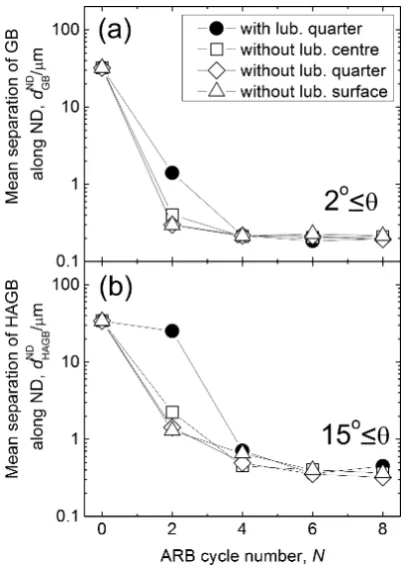
From EBSD data, GB and HAGB maps were constructed. The former displays both LAGB and HAGB, whereas, the latter displays only HAGB. From these maps, mean separa-tion of GB and HAGB along ND (dND
GB and dHAGBND ) were
eval-uated using interception method as shown in Fig. 2. The ini-tial grain size is about 32 μm both for dND
GB and dNDHAGB. Both
ARB with and without lubrication reduces dND
GB and dHAGBND
with increasing N, and, dND
GB is always smaller than dNDHAGB.
However, the decrease in dND
GB and dNDHAGB of the ARB with
lu-brication is smaller than these of the ARB without lubrica-tion, which is associated with the grain refinement due to the
additional shear strain caused by the friction between the sur-faces of the sheets and roll3–5). The inhomogeneity along ND
due to the ARB without lubrication can be strongly seen only at-2c for both dND
GB and dNDHAGB in Fig. 2. For instance, dGBND of
ARB 2c at centre, quarter and surface are about 0.40 μm, 0.30 μm and 0.30 μm, respectively. Whereas, dND
HAGB of ARB
2c at centre, quarter and surface are about 2.3 μm, 1.4 μm and 1.3 μm, respectively. Obviously, the grain refinements of the area at centre is delayed compared with the areas at quarter and surface, and the inhomogeneity along ND can be seen. After 2c, the more grain refined surface region is folded into the centre of the sheet due to the stacking/roll bonding during the ARB process, and, the grain size inhomogeneity along ND is reduced. Both dND
GB and dHAGBND become almost constant
after 4c and 6c, respectively. It is known as the saturation of grain refinement when the SPD processes are used.
In the case of dND
GB of ARB 8c without lubrication at centre,
quarter and surface are almost 0.21 μm, 0.19 μm and 0.22 μm, respectively. Whereas, dND
HAGB of ARB 8c without lubrication
at centre, quarter and surface are about 0.37 μm, 0.32 μm and 0.37 μm, respectively. On the other hand, dND
GB and dNDHAGB of
ARB 8c with lubrication are 0.20 μm and 0.45 μm, respec-tively. In the case of dND
HAGB of ARB 8c, the difference between
with and without lubrication is relatively larger than the case of dND
GB
Figure 3 shows the Vickers hardness h of ARB processed 4N-Cu with and without lubrication on the TD plane, and, the error bars show the standard deviation. Nevertheless, the siz-es of the error bars are similar size of symbols in Fig. 3. Ini-tially, h is about 50 Hv for ARB 0c. Then, h drastically in-creases to about 140 Hv at surface of the ARB 1c without lu-Fig. 2 Mean separation of (a) GB (2◦ ≤ θ) and (b) HAGB (15◦ ≤ θ) along
[image:2.595.325.528.68.354.2] [image:2.595.81.256.69.181.2]brication and the hardness of the other samples after 1c reach-es to about 120 Hv. The hardnreach-ess at the surface of ARB sam-ple without lubrication seems to be constant after 1c, whereas the other increases gradually with increasing N up to 4, and then, saturate. The reason why the hardness at surface is al-ways higher than those of the others is again associated with the additional grain refinement caused by the friction between the surfaces of sheet and rolls.
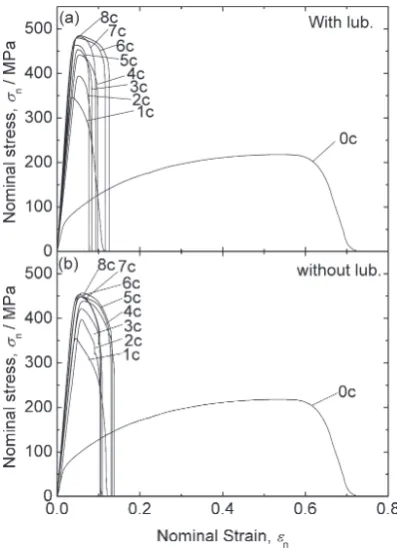
Figure 4 shows the nominal stress versus nominal strain curves of ARB processed 4N-Cu (a) with and (b) without lu-brication. As can be seen, strength seems to increase with in-creasing N, but, it saturates after 6c and 5c for with and with-out lubrication, respectively. The ductility of ARB processed 4N-Cu-sheets is much less than that for annealed 4N-Cu.
From the s-s curves, 0.2% proof stress σ0.2 and ultimate
[image:3.595.68.274.69.214.2]tensile stress (UTS) σUTS were evaluated and displayed in
Fig. 5. The initial values of σ0.2 and σUTS are about 60 MPa
and 210 MPa at 0c, respectively. These values for both ARB with and without lubrication drastically increased to about 350 MPa at 1c. Then, those values become about 400 MPa at 2c. Although σ0.2 of the sample processed without lubrication
seems to be independent of N, that of the sample processed with lubrication increases to about 450 MPa at 3c and then saturate after 4c. Up to 6c, σUTS of the ARB with and without
lubrication still gradually increases to 480 MPa and 450 MPa, respectively, and then, saturate. The trend of σ0.2 and σUTS is
opposite compared with that of Vickers hardness, which will be discussed later.
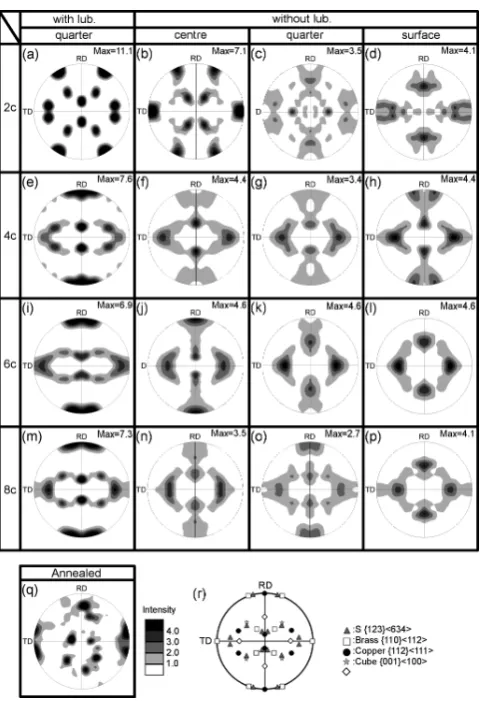
The {111} pole figures of ARB processed 4N-Cu with and without lubrication are shown in Fig. 6. As can be seen in Fig. 6(q), ARB 0c has Cube {001}<100> texture which is known as rolling and recrystallization texture for fcc metals. There is no specific poles related to the typical fcc rolling texture at 2c since they are still transition state for both ARB with and without lubrication. In the case of the ARB 2c with lubrication, the poles move to the typical rolling texture such as Copper {112}<111>, Brass {110}<112> and S {123}<634> with increasing N. Whereas the ARB 2c without lubrication shows different texture at centre, quarter and surface. The tex-ture of the ARB without lubrication at all locations are rela-tively similar up to 4c. Then, that at centre and quarter still show relatively similar texture compared with the ARB with lubrication, but, that at surface shows different from the typi-cal rolling texture which seems rather 45 rotated Cube {001}<110> texture around ND. It should be noted that this rotated Cube texture is also found in ARB processed com-mercial purity Al and Ni without lubrication3–5,9,14). The
dif-ference is also associated with the additional shear strain caused by the surface friction due to the surfaces between the sheet and the rolls. The effect of additional shear strain is more prominent at surface region than that inside the sheets. The effect of additional shear strain still seems to exist close to the centre since the centre was the surfaces of the sheet before the last roll bonding. However, the texture at centre seems to be not exactly the same as that at surface.
Since pole figure is the stereographic projection of orienta-tion on plane, sometimes it is difficult to distinguish some orientations. Thus, ODF maps are useful since they are sec-tions in Euler angle space. In this study, Bunge s notation is used to represent Euler angle (ϕ1, Φ, ϕ2), such as, Copper Fig. 3 Vickers hardness of ARB processed 4N-Cu with and without
lubri-cation. In the case of the ARB without lubrication, three areas displayed in Fig. 1 were measured.
Fig. 4 Nominal stress versus nominal strain curves of ARB processed 4N-Cu (a) with and (b) without lubrication.
[image:3.595.324.529.69.212.2] [image:3.595.68.267.271.547.2](90◦ , 35◦ , 45◦ ), Brass (35◦ , 45◦ , 0◦ ), S (59◦ , 37◦ , 63◦ ), Cube (0◦ , 0◦ , 0◦ ) and rotated cube (45◦ , 0◦ , 0◦ ).
Figures 7 and 8 show the ODF maps of ARB processed 4N-Cu with and without lubrication on ϕ1 = 0 and ϕ2 = 45
sections, respectively. From the most left column shows the ODF maps of the ARB with lubrication, and, from the second most left column to the most right column show those of the ARB without lubrication at centre, quarter and surface, re-spectively. From the top to the bottom rows, ARB 2c, ARB 4c, ARB 6c and ARB 8c are shown.
From Fig. 7 (d), (h), (l) and (p), it is confirmed that the surface of the ARB processed 4N-Cu without lubrication has strong texture consisting of 45 rotated Cube around ND (45◦ , 0◦ , 0◦ ). The intensity of the rotated Cube at surface of ARB without lubrication increases with increasing N up to 6, and then, slightly decreases after 8c. Furthermore, rotated Cube can be found all the regions when N = 4, 6 and 8. The strength of poles is listed from the stronger, surface, quarter and cen-tre.
From Fig. 8 (e), (i) and (m), it is also confirmed that the typical rolling texture, such as Copper and Brass, exists after 4c with lubrication. Strictly speaking, Brass seems to appear only at 6c, and, Copper seems to be the main component but
the intensity is the highest at 4c. After 4c, intensity of Copper seems to decreases with increasing N. Weak poles of rolling texture components, such as Brass at 2c and Copper at 4c, 6c and 8c, are also observed at the centre of ARB without lubri-cation.
Heason and Prangnell showed the texture evolution of A1100 aluminium alloy processed by ARB without lubrica-tion, and, found out similar texture evolution compared with this study9). They also qualitatively explained by using
simu-lation that rotated Cube shift toward Copper orientation due to pure plane strain compression, whereas, Copper, Brass and S orientations shift toward rotated Cube due to the additional shear strain. The simulation results agree with the texture evolution observed in this study, if we consider that the ARB with lubrication and the centre region in the ARB without lubrication deform in plane strain compression, while an ad-ditional shear strain is applied to the surface and quarter re-gions in the ARB without lubrication. Therefore, the texture appeared in ARB processed Cu with and without lubrication can be understood qualitatively, apart from at ARB 8c, the strength of texture decreases compared with ARB 6c. If the same deformation is continuously applied, the texture evolu-Fig. 6 {111} pole figures of ARB processed 4N-Cu: (a)–(d) are ARB 2c,
(e)–(h) are ARB 4c, (i)–(l) are ARB 6c, and (m)–(p) are ARB 8c, respec-tively. The first column from the left is the results at quarter of ARB with lubrication. The second, third, and the fourth columns from the left are at centre, quarter, and surface of ARB without lubrication, respectively. (q)
{111} pole figure of annealed (ARB 0c) 4N-Cu, and (r) ideal orientations of the rolling texture along β fibre, Cube and rotated Cube orientations.
Fig. 7 ODF map on ϕ2 = 0 section of ARB processed 4N-Cu: (a)–(d) are
ARB 2c, (e)–(h) are ARB 4c, (i)–(l) are ARB 6c, and (m)–(p) are ARB 8c, respectively. The first column from the left is the results at quarter of ARB with lubrication. The second, third, and the fourth columns from the left are at centre, quarter, and surface of ARB without lubrication, respective-ly. (q) annealed (ARB 0c) 4N-Cu, and (r) ideal orientations on ϕ2 = 0
[image:4.595.49.293.66.417.2] [image:4.595.305.549.66.425.2]tion should continue and intensity of poles is expected to be stronger.
The reason why rolling texture component in ARB with lubrication becomes weaker after 6c is associated with the grain growth during ARB process. From Fig. 2(b), dND
HAGB of
the ARB 8c with lubrication is slightly higher than that of the ARB 6c. This implies that grain growth may occur in ARB with lubrication at relatively higher cycles. In such case, if the new grains with different orientations from Copper texture appear, the decrease of the intensity can be understood. Al-though no significant increase of the grain size can be seen in Fig. 2 in the case of ARB without lubrication, new grains hav-ing different orientations may still appear. If so, the decrease of the intensity of rotated Cube can also be understood. The grain growth during ARB process has also been observed in 4N-Al case, though the decrease of intensity for the rolling texture components was not observed15). In the Al case, the
intensity of rolling texture component rather increased with increasing N.
The different texture evolution between Cu and Al is at-tributed to the difference in stacking fault energy (SFE). It is known that UFG metals having high SFE shows continuous
recrystallization (recovery type), whereas, those having mid-ium-low SFE shows discontinuous recrystallization (recrys-tallization type)17). When the continuous recrystallization
occurs, strong change in texture is not observed since some pre-existing grains increase their size. On the other hand, when the discontinuous recrystallization occurs, new grains with different orientations from pre-existing grains appear. It is noted that Cu and Ni are classified to be medium SFE fcc metals, whereas, Al is classified to be high SFE fcc metal.
Thus, the intensity of fcc rolling texture components in ARB processed 4N-Cu with lubrication and rotated Cube in ARB processed 4N-Cu without lubrication decrease at rela-tively high N, since dynamic discontinuous recrystallization occurs due to the medium SFE. On the other hand, 4N-Al ARB processed with lubrication is thought to show dynamic continuous recrystallization, and therefore, the intensity for the rolling texture components increases with increasing N.
The effect of the different texture evolution between 4N-Cu ARB processed with and without lubrication affects the mechanical properties, such as the saturation value of σ0.2
and σUTS. Because, the difference of the values of σ0.2 and σUTS cannot be simply associated with the difference of the
grain size, such as dND
GB and dHAGBND . For instance, dNDGB of ARB
8c with and without lubrication are almost constant values, Fig. 8 ODF map on ϕ2 = 45 section of ARB processed 4N-Cu: (a)–(d) are
ARB 2c, (e)–(h) are ARB 4c, (i)–(l) are ARB 6c, and (m)–(p) are ARB 8c, respectively. The first column from the left is the results at quarter of ARB with lubrication. The second, third, and the fourth columns from the left are at centre, quarter, and surface of ARB without lubrication, respective-ly. (q) annealed (ARB 0c) 4N-Cu, and (r) ideal orientations on ϕ2 = 45
section.
[image:5.595.49.290.66.431.2] [image:5.595.323.523.71.438.2]and dND
HAGB of ARB with lubrication is slightly smaller than
that of without lubrication. This is again the opposite trend if only grain refinement strengthening is considered. However, it is known that the mechanical properties of material having strong texture can be isotropic since some mechanical proper-ties can be anisotropic such as yield stress. Thus, the ARB processed 4N-Cu with and without lubrication may show the difference in yield stress due to their strong and different tex-ture.
3.2 Effect of annealing on ARB processed 4N-Cu Figure 9 shows the changes in Vickers hardness of ARB 6c with and without lubrication due to annealing at 423 K, 448 K and 473 K. The maximum and the minimum error bars ex-press the standard deviation. In the case of the annealing tem-perature Ta at 423 K, h decreases from about 140 Hv for the
initial value of the ARB 6c down to 130 Hv for annealing time ta at about 300 s. Then, h rapidly decreases down to
about 70 Hv for ta at about 14 ks and saturate after about
14 ks. In the case of Ta = 448 K, h decreases down to about
130 Hv when ta ≈ 60 s, and, rapidly decreases down to about
70 Hv when ta ≈ 7.2 ks. In the case of Ta = 473 K, h decreases
immediately from about 140 Hv down to about 70 Hv when ta ≈ 500 s, and then, saturates. When lining up in order of
decreasing h at the saturation region: ARB without tion at centre, that at quarter, that at surface and with lubrica-tion.
EBSD measurements were performed with samples of which h reaches the saturation region, and, {111} pole figures and ODF maps on ϕ2 = 0 section of annealed ARB 6c are
displayed in Figs. 10 and 11, respectively. Top, medium and
bottom rows are the result of annealing temperature at 423 K, 448 K and 473 K, respectively. The first column from the left is the results of ARB with lubrication. The second, third, and the fourth columns from the left are at centre, quarter, and surface of ARB without lubrication. From those figures, Cube orientation can be seen only for annealed ARB 6c with lubri-cation. In contrast, ARB 6c without lubrication at all the re-gions show no Cube orientation for all annealing tempera-tures and rather random texture.
Cube orientation is known as typical rolling-recrystalliza-tion of fcc metals having relatively high SFE, and therefore, the present results about annealed ARB with and without lu-brication are reasonable. Thus, ARB with lulu-brication is re-garded to be equivalent to the conventional rolling from roll-ing texture evolution and annealed texture point of views. It should be also pointed out that annealed 4N-Cu ARB pro-cessed without lubrication gives random texture. In other words, additional shear strain is useful from the industrial point of view, if strong Cube orientation wanted to be avoided as a result of annealing of fcc metals having relatively high SFE. Because additional shear strain reduces the strength of typical fcc rolling texture, but, the mechanism why the ran-dom texture appeared after the annealing of Cu ARB pro-cessed without lubrication is unknown. Thus, the further in-vestigation is requested for revealing the mechanism to ap-pear the random texture.
4. Conclusions
The microstructure and texture evolution of ARB pro-Fig. 10 {111} pole figures of ARB processed 4N-Cu: (a)–(d) are ARB 6c
annealed at 423 K, (e)–(h) are ARB 6c annealed at 448 K and (i)–(l) are ARB 6c annealed at 473 K. The first column from the left is the results at quarter of ARB with lubrication. The second, third, and the fourth col-umns from the left are at centre, quarter, and surface of ARB without lu-brication, respectively. (m) ideal orientations of the rolling texture along β
fibre, Cube and rotated Cube orientations.
Fig. 11 ODF map on ϕ2 = 0 section of ARB processed 4N-Cu: (a)–(d) are
[image:6.595.48.299.65.321.2] [image:6.595.305.549.68.339.2]with the friction between the surfaces of rolls and sheets. The grain-subdivision is accelerated in the ARB process without lubrication due to the additional shear strain during rolling.
(2) Since the additional shear strain strongly affects adjacent to the surface, the effect of additional shear strain is more prominent at surface region than that in the inside of the sheets. However, the effect of additional shear strain still exists close to the centre since the centre was the surfaces of the sheet before the last roll bonding.
(3) 45 rotated Cube around ND was the main component of the texture in 4N-Cu processed by ARB without lubrica-tion, whereas, that produced by ARB with lubrication was Copper orientation. From texture point of view, ARB with lubrication is equivalent to the conventional cold rolling with lubrication.
(4) When annealing was applied for 4N-Cu ARB processed with and without lubrication, Vickers hardness decreases from about 140 Hv down to about 70 Hv, and then, satu-rates. At the saturation region, Cube orientation appeared as the main component in 4N-Cu ARB processed with lubrication, whereas, no specific texture appears in 4N-Cu ARB processed without lubrication. From application point of view, 45 rotated Cube around ND formed by additional shear strain can be used for the texture control of sheets when annealing is applied.
REFERENCES
1) A. Azushima, R. Kopp, A. Korhonen, D.Y. Yang, F. Micari, G.D. Laho-ti, P. Groche, J. Yanagimoto, N. Tsuji, A. Rosochowski and A. Yanagi-da: CIRP Annu.-Manuf. Technol. 57 (2008) 716–735.
2) S. Onaka: J. Japan Inst. Metals 74 (2010) 165–170.
3) N. Kamikawa, N. Tsuji and Y. Minamino: Sci. Technol. Adv. Mater. 5 (2004) 163–172.
4) N. Kamikawa, N. Tsuji, X.X. Huang and N. Hansen: Mater. Trans. 48 (2007) 1978–1985.
5) N. Kamikawa, T. Sakai and N. Tsuji: Acta Mater. 55 (2007) 5873–5888.
6) T. Inoue and N. Tsuji: Comput. Mater. Sci. 46 (2009) 261–266.
7) J. Hirsch and K. Lucke: Acta Metall. Mater. 36 (1988) 2863–2882.
8) J. Hirsch and K. Lucke: Acta Metall. Mater. 36 (1988) 2883–2904.
9) C.P. Heason and P.B. Prangnell: Mater Sci Forum. 408-4 (2002) 733– 738.
10) S.Y. Li, F.W. Sun and H. Li: Acta Mater. 58 (2010) 1317–1331.
11) K. Kashihara, W. Ikushima, Y. Miyajima, D. Terada and N. Tsuji: Ma-ter. Trans. 52 (2011) 825–829.
12) P.P. Bhattacharjee, Y. Takatsuji, Y. Miyajima, D. Terada and N. Tsuji:
Metall. Mater. Trans., A Phys. Metall. Mater. Sci. 43A (2012) 2442– 2452.
13) Y. Miyajima, D. Kashioka and N. Tsuji: Mater. Sci. Forum 702–703 (2012) 173–176.
14) Y.B. Zhang, O.V. Mishin and A. Godfrey: J. Mater. Sci. 49 (2014) 287– 293.
15) P.L. Sun, W.J. Li and W.C. Hsu: J. Mater. Sci. 51 (2016) 3607–3618.
16) N. Takata, K. Yamada, K. Ikeda, F. Yoshida, H. Nakashima and N. Tsu-ji: Mater. Trans. 48 (2007) 2043–2048.