Deciphering Foreign Language
Sujith Ravi and Kevin Knight University of Southern California
Information Sciences Institute Marina del Rey, California 90292
{sravi,knight}@isi.edu
Abstract
In this work, we tackle the task of ma-chine translation (MT) without parallel train-ing data. We frame the MT problem as a de-cipherment task, treating the foreign text as a cipher for English and present novel meth-ods for training translation models from non-parallel text.
1 Introduction
Bilingual corpora are a staple of statistical machine translation (SMT) research. From these corpora, we estimate translation model parameters: word-to-word translation tables, fertilities, distortion pa-rameters, phrase tables, syntactic transformations, etc. Starting with the classic IBM work (Brown et al., 1993), training has been viewed as a maximiza-tion problem involving hidden word alignments (a) that are assumed to underlie observed sentence pairs (e, f):
arg max θ
Y
e,f
Pθ(f|e) (1)
= arg max θ
Y
e,f
X
a
Pθ(f, a|e) (2)
Brown et al. (1993) give various formulas that boil
Pθ(f, a|e)down to the specific parameters to be es-timated.
Of course, for many language pairs and domains, parallel data is not available. In this paper, we address the problem of learning a full transla-tion model from non-parallel data, and we use the
learned model to translate new foreign strings. As successful work develops along this line, we expect more domains and language pairs to be conquered by SMT.
How can we learn a translation model from non-parallel data? Intuitively, we try to construct trans-lation model tables which, when applied to ob-served foreign text, consistently yield sensible En-glish. This is essentially the same approach taken by cryptanalysts and epigraphers when they deal with source texts.
In our case, we observe a large number of foreign stringsf, and we apply maximum likelihood train-ing:
arg max θ
Y
f
Pθ(f) (3)
Following Weaver (1955), we imagine that this cor-pus of foreign strings “is really written in English, but has been coded in some strange symbols,” thus:
arg max θ
Y
f
X
e
P(e)·Pθ(f|e) (4)
The variable e ranges over all possible English strings, and P(e) is a language model built from large amounts of English text that is unrelated to the foreign strings. Re-writing for hidden alignments, we get:
arg max θ
Y
f
X
e
P(e)·X
a
Pθ(f, a|e) (5)
Note that this formula has the same free
Pθ(f, a|e) parameters as expression (2). We seek to manipulate these parameters in order to learn the
same full translation model. We note that for each
f, not only is the alignmentastill hidden, but now the English translationeis hidden as well.
A language modelP(e)is typically used in SMT decoding (Koehn, 2009), but here P(e) actually plays a central role in training translation model pa-rameters. To distinguish the two, we refer to (5) as
decipherment, rather than decoding.
We can now draw on previous decipherment work for solving simpler substitution/transposition ciphers (Bauer, 2006; Knight et al., 2006). We must keep in mind, however, that foreign language is a much more demanding code, involving highly non-deterministic mappings and very large substitution tables.
The contributions of this paper are therefore:
• We give first results for training a full transla-tion model from non-parallel text, and we apply the model to translate previously-unseen text. This work is thus distinguished from prior work on extracting or augmenting partial lexicons using non-parallel corpora (Rapp, 1995; Fung and McKeown, 1997; Koehn and Knight, 2000; Haghighi et al., 2008). It also contrasts with self-training (McClosky et al., 2006), which re-quires a parallel seed and often does not engage in iterative maximization.
• We develop novel methods to deal with large-scale vocabularies inherent in MT problems.
2 Word Substitution Decipherment
Before we tackle machine translation without par-allel data, we first solve a simpler problem—word substitution decipherment. Here, we do not have to worry about hidden alignments since there is only one alignment. In a word substitution cipher, every word in the natural language (plaintext) sequence is substituted by a cipher token, according to a substi-tution key. The key is deterministic—there exists a 1-to-1 mapping between cipher units and the plain-text words they encode.
For example, the following English plaintext se-quences:
I SAW THE BOY . THE BOY RAN .
may be enciphered as:
xyzz fxyy crqq tmnz lxwz crqq tmnz gdxx lxwz
according to the key:
THE → crqq, SAW → fxyy, RAN → gdxx, . → lxwz, BOY → tmnz, I → xyzz
The goal of word substitution decipherment is to guess the original plaintext from given cipher data without any knowledge of the substitution key.
Word substitution decipherment is a good test-bed for unsupervised statistical NLP techniques for two reasons—(1) we face large vocabularies and corpora sizes typically seen in large-scale MT problems, so our methods need to scale well, (2) similar deci-pherment techniques can be applied for solving NLP problems such as unsupervised part-of-speech tag-ging.
Probabilistic decipherment: Our decipherment method follows a noisy-channel approach. We first model the process by which the ciphertext sequence
c = c1...cn is generated. The generative story for decipherment is described here:
1. Generate an English plaintext sequence e =
e1...en, with probabilityP(e).
2. Substitute each plaintext wordeiwith a cipher-text tokenci, with probabilityPθ(ci|ei)in order to generate the ciphertext sequencec=c1...cn.
We model P(e) using a statistical word n-gram English language model (LM). During decipher-ment, our goal is to estimate the channel model pa-rametersθ. Re-writing Equations 3 and 4 for word substitution decipherment, we get:
arg max θ
Y
c
Pθ(c) (6)
= arg max θ
Y
c
X
e
P(e)·
n
Y
i=1
Pθ(ci|ei) (7)
We propose novel methods that can deal with these challenges effectively and solve word substi-tution ciphers:
1. EM solution:We would like to use the Expecta-tion MaximizaExpecta-tion (EM) algorithm (Dempster et al., 1977) to estimateθfrom Equation 7, but EM training is not feasible in our case. First, EM cannot scale to such large vocabulary sizes (running the forward-backward algorithm for each iteration requiresO(V2)time). Secondly, we need to instantiate the entire channel and re-sulting derivation lattice before we can run EM, and this is too big to be stored in memory. So, we introduce a new training method (Iterative EM) that fixes these problems.
2. Bayesian decipherment: We also propose a novel decipherment approach using Bayesian inference. Typically, Bayesian inference is very slow when applied to such large-scale prob-lems. Our method overcomes these challenges and does fast, efficient inference using (a) a novel strategy for selecting sampling choices, and (b) a parallelized sampling scheme.
In the next two sections, we describe these meth-ods in detail.
2.1 Iterative EM
We devise a method which overcomes memory and running time efficiency issues faced by EM. Instead of instantiating the entire channel model (with all its parameters), we iteratively train the model in small steps. The training procedure is described here:
1. Identify the topKfrequent word types in both the plaintext and ciphertext data. Replace all other word tokens withUnknown. Now, instan-tiate a small channel with just (K + 1)2 pa-rameters and use the EM algorithm to train this model to maximize likelihood of cipher data.
2. Extend the plaintext and ciphertext vocabular-ies from the previous step by adding the next
K most frequent word types (so the new vo-cabulary size becomes 2K + 1). Regenerate the plaintext and ciphertext data.
3. Instantiate a new(2K+ 1)×(2K+ 1)channel model. From the previous EM-trained channel, identify all thee → cmappings that were as-signed a probabilityP(c|e) >0.5. Fix these mappings in the new channel, i.e. setP(c|e)= 1.0. From the new channel, eliminate all other parameterse → cj associated with the plain-text word typee(wherecj 6=c). This yields a much smaller channel with size<(2K + 1)2. Retrain the new channel using EM algorithm.
4. Goto Step 2 and repeat the procedure, extend-ing the channel size iteratively in each stage.
Finally, we decode the given ciphertextcby using the Viterbi algorithm to choose the plaintext decod-ingethat maximizesP(e)·Pθtrained(c|e)
3,
stretch-ing the channel probabilities (Knight et al., 2006).
2.2 Bayesian Decipherment
Bayesian inference methods have become popular in natural language processing (Goldwater and Grif-fiths, 2007; Finkel et al., 2005; Blunsom et al., 2009; Chiang et al., 2010; Snyder et al., 2010). These methods are attractive for their ability to manage un-certainty about model parameters and allow one to incorporate prior knowledge during inference.
Here, we propose a novel decipherment approach using Bayesian learning. Our method holds sev-eral other advantages over the EM approach—(1) inference using smart sampling strategies permits efficient training, allowing us to scale to large data/vocabulary sizes, (2) incremental scoring of derivations during sampling allows efficient infer-ence even when we use higher-order n-gram LMs, (3) there are no memory bottlenecks since the full channel model and derivation lattice are never in-stantiated during training, and (4) prior specification allows us to learnskeweddistributions that are useful here—word substitution ciphers exhibit 1-to-1 cor-respondence between plaintext and cipher types.
channel.1 We perform inference using point-wise Gibbs sampling (Geman and Geman, 1984). We de-fine a sampling operator that samples plaintext word choices for every cipher token, one at a time. Using the exchangeability property, we efficiently score the probability of each derivation in an incremental fashion. In addition, we make further improvements to the sampling procedure which makes it faster.
Smart sample-choice selection: In the original sampling step, for each cipher token we have to sam-ple from a list of all possible plaintext choices (10k-1M English words). There are 100k cipher tokens in our data which means we have to perform∼109 sampling operations to make one entire pass through the data. We have to then repeat this process for 2000 iterations. Instead, we now reduce our choices in each sampling step.
Say that our current plaintext hypothesis contains English words X, Y and Z at positionsi−1,iand
i+1respectively. In order to sample at positioni, we choose the topKEnglish wordsY ranked byP(X Y Z), which can be computed offline from a statistical word bigram LM. If this probability is 0 (i.e., X and Z never co-occurred), we randomly pick K words from the plaintext vocabulary. We set K = 100 in our experiments. This significantly reduces the sam-pling possibilities (10k-1M reduces to 100) at each step and allows us to scale to large plaintext vocab-ulary sizes without enumerating all possible choices at every cipher position.2
Parallelized Gibbs sampling: Secondly, we paral-lelize our sampling step using a Map-Reduce frame-work. In the past, others have proposed parallelized sampling schemes for topic modeling applications (Newman et al., 2009). In our method, we split the entire corpus into separate chunks and we run the sampling procedure on each chunk in parallel. At
1For word substitution decipherment, we want to keep the
language model probabilities fixed during training, and hence we set the prior on that model to be high (α= 104). We use a sparse Dirichlet prior for the channel (β = 0.01). We use the output from Iterative EM decoding (using 101 x 101 channel) as initial sample and run the sampler for 2000 iterations. Dur-ing samplDur-ing, we use a linear annealDur-ing schedule decreasDur-ing the temperature from1→0.08.
2Since we now sample from an approximate distribution, we
have to correct this with the Metropolis-Hastings algorithm. But in practice we observe that samples from our proposal distribu-tion are accepted with probability>0.99, so we skip this step.
the end of each sampling iteration, we combine the samples corresponding to each chunk and collect the counts of all events—this forms our cache for the next sampling iteration. In practice, we observe that the parallelized sampling run converges quickly and runs much faster than the conventional point-wise sampling—for example, 3.1 hours (using 10 nodes) versus 11 hours for one of the word substitution ex-periments. We also notice a higher speedup when scaling to larger vocabularies.3
Decoding the ciphertext: After the sampling run has finished, we choose the final sample and ex-tract a trained version of the channel modelPθ(c|e) from this sample following the technique of Chi-ang et al. (2010). We then use the Viterbi algo-rithm to choose the English plaintext e that maxi-mizesP(e)·Pθtrained(c|e)
3.
2.3 Experiments and Results
Data:For the word substitution experiments, we use two corpora:
• Temporal expression corpus containing short English temporal expressions such as “THE
NEXT MONTH”, “THE LAST THREE
YEARS”, etc. The cipher data contains 5000 expressions (9619 tokens, 153 word types). We also have access to a separate English corpus (which is not parallel to the ciphertext) containing 125k temporal expressions (242k word tokens, 201 word types) for LM training.
• Transtac corpus containing full English tences. The data consists of 10k cipher sen-tences (102k tokens, 3397 word types); and a plaintext corpus of 402k English sentences (2.7M word tokens, 25761 word types) for LM training. We use all the cipher data for deci-pherment training but evaluate on the first 1000 cipher sentences.
The cipher data was originally generated from En-glish text by substituting each EnEn-glish word with a unique cipher word. We use the plaintext corpus to
3
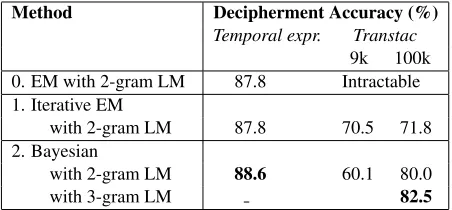
Method Decipherment Accuracy (%)
Temporal expr. Transtac 9k 100k 0. EM with 2-gram LM 87.8 Intractable 1. Iterative EM
with 2-gram LM 87.8 70.5 71.8 2. Bayesian
with 2-gram LM 88.6 60.1 80.0
[image:5.612.320.536.55.214.2]with 3-gram LM 82.5
Figure 1: Comparison of word substitution decipherment results using (1) Iterative EM, and (2) Bayesian method. For the Transtac corpus, decipherment performance is also shown for different training data sizes (9k versus 100k cipher tokens).
build an English word n-gram LM, which is used in the decipherment process.
Evaluation:We compute the accuracy of a particu-lar decipherment as the percentage of cipher tokens that were correctly deciphered from the whole cor-pus. We run the two methods (Iterative EM4 and Bayesian) and then compare them in terms of word substitution decipherment accuracies.
Results: Figure 1 compares the word substitution results from Iterative EM and Bayesian decipher-ment. Both methods achieve high accuracies, de-coding 70-90% of the two word substitution ciphers. Overall, Bayesian decipherment (with sparse priors) performs better than Iterative EM and achieves the best results on this task. We also observe that both methods benefit from better LMs and more (cipher) training data. Figure 2 shows sample outputs from Bayesian decipherment.
3 Machine Translation as a Decipherment Task
We now turn to the problem of MT without par-allel data. From a decipherment perspective, ma-chine translation is a much more complex task than word substitution decipherment and poses several technical challenges: (1) scalability due to large corpora sizes and huge translation tables, (2) non-determinism in translation mappings (a word can have multiple translations), (3) re-ordering of words
4For Iterative EM, we start with a channel of size 101x101
(K=100) and in every pass we iteratively increase the vocabu-lary sizes by 50, repeating the training procedure until the chan-nel size becomes 351x351.
C: 3894 9411 4357 8446 5433
O: a diploma that’s good . D: afencethat’s good . C: 8593 7932 3627 9166 3671
O: three families living here ? D: threebrothersliving here ?
C: 6283 8827 7592 6959 5120 6137 9723 3671
O: okay and what did they tell you ? D: okay and what did they tell you ?
C: 9723 3601 5834 5838 3805 4887 7961 9723 3174 4518 9067 4488 9551 7538 7239 9166 3671
O: you mean if we come to see you in the afternoon after five you’ll be here ?
D: imean if we come to see you in the afternoon afterthirty
you’ll be here ? ...
Figure 2: Comparison of the original (O) English plain-text with output from Bayesian word substitution deci-pherment (D) for a few samples cipher (C) sentences from theTranstaccorpus.
or phrases, (4) a single word can translate into a phrase, and (5) insertion/deletion of words.
Problem Formulation: We formulate the MT de-cipherment problem as—given a foreign textf(i.e., foreign word sequencesf1...fm) and a monolingual English corpus, our goal is to decipher the foreign text and produce an English translation.
Probabilistic decipherment:Unlike parallel train-ing, here we have to estimate the translation model
Pθ(f|e) parameters using only monolingual data. During decipherment training, our objective is to es-timate the model parametersθin order to maximize the probability of the foreign corpusf. From Equa-tion 4 we have:
arg max θ
Y
f
X
e
P(e)·Pθ(f|e)
For P(e), we use a word n-gram LM trained on monolingual English data. We then estimate param-eters of the translation modelPθ(f|e) during train-ing. Next, we present two novel decipherment ap-proaches for MT training without parallel data.
1. EM Decipherment: We propose a new transla-tion model for MT decipherment which can be efficiently trained using the EM algorithm.
[image:5.612.74.300.57.162.2]memory issues and we use sampling to perform efficient inference during training.
3.1 EM Decipherment
For the translation model Pθ(f|e), we would like to use a well-known statistical model such as IBM Model 3 and subsequently train it using the EM algorithm. But without parallel training data, EM training for IBM Model 3 becomes intractable due to (1) scalability and efficiency issues because of large-sized fertility and distortion parameter tables, and (2) the resulting derivation lattices become too big to be stored in memory.
Instead, we propose a simpler generative story for MT without parallel data. Our model accounts for (word) substitutions, insertions, deletions and local re-ordering during the translation process but does not incorporate fertilities or global re-ordering. We describe the generative process here:
1. Generate an English string e = e1...el, with probabilityP(e).
2. Insert a NULL word at any position in the En-glish string, with uniform probability.
3. For each English word token ei (including NULLs), choose a foreign word translationfi, with probability Pθ(fi|ei). The foreign word may be NULL.
4. Swap any pair of adjacent foreign words
fi−1, fi, with probability Pθ(swap). We set this value to 0.1.
5. Output the foreign stringf =f1...fm, skipping over NULLs.
We use the EM algorithm to estimate all the pa-rameters θ in order to maximize likelihood of the foreign corpus. Finally, we use the Viterbi algo-rithm to decode the foreign sentence f and pro-duce an English translationethat maximizesP(e)· Pθtrained(f|e).
Linguistic knowledge for decipherment: To help limit translation model size and deal with data spar-sity problem, we use prior linguistic knowledge. We use identity mappings for numeric values (for ex-ample, “8” maps to “8”), and we split nouns into
morpheme units prior to decipherment training (for example, “YEARS”→“YEAR” “+S”).
Whole-segment Language Models: When using word n-gram models of English for decipherment, we find that some of the foreign sentences are decoded into sequences (such as “THANK YOU TALKING ABOUT ?”) that are not good English. This stems from the fact that n-gram LMs have no global information about what constitutes a valid English segment. To learn this information auto-matically, we build aP(e) model that only recog-nizes English whole-segments (entire sentences or expressions) observed in the monolingual training data. We then use this model (in place of word n-gram LMs) for decipherment training and decoding.
3.2 Bayesian Method
Brown et al. (1993) provide an efficient algorithm for training IBM Model 3 translation model when parallel sentence pairs are available. But we wish to perform IBM Model 3 training under non-parallel conditions, which is intractable using EM training. Instead, we take a Bayesian approach.
Following Equation 5, we represent the transla-tion model as Pθ(f, a|e) in terms of hidden align-mentsa. Recall the generative story for IBM Model 3 translation which has the following formula:
Pθ(f, a|e) = l
Y
i=0
tθ(faj|ei)·
l
Y
i=1
nθ(φi|ei)
·
m
Y
aj6=0,j=1
dθ(aj|i, l, m)· l
Y
i=0
φi!
· 1 φ0!·
m−φ0
φ0
·pφ0
1θ ·p
m−2φ0
0θ (8)
The alignmentais represented as a vector;aj =i implies that the foreign wordfj is produced by the English wordeiduring translation.
Bayesian Formulation: Our goal is to learn the probability tablest (translation parameters) n (fer-tility parameters), d (distortion parameters), and p
Chinese Restaurant Process (CRP) formulation. For example, to model the translation probabilities, we use the formula:
tθ(fj|ei) =
α·P0(fj|ei) +Chistory(ei, fj)
α+Chistory(ei)
(9)
where,P0 represents the base distribution (which is set to uniform) andChistoryrepresents the count of events occurring in the history (cache). Similarly, we use CRP formulations for the other probabilities (n, dandp). We use sparse Dirichlet priors for all these models (i.e., low values forα) and plug these probabilities into Equation 8 to getPθ(f, a|e).
Sampling IBM Model 3: We use point-wise Gibbs sampling to estimate the IBM Model 3 parameters. The sampler is seeded with an initial English sample translation and a corresponding alignment for every foreign sentence. We define several sampling oper-ators, which are applied in sequence one after the other to generate English samples for the entire for-eign corpus. Some of the sampling operators are de-scribed below:
• TranslateWord(j): Sample a new English word translation for foreign wordfj, from all possi-bilities (including NULL).
• SwapSegment(i1, i2): Swap the alignment links for English wordsei1 andei2.
• JoinWords(i1, i2): Eliminate the English word
ei1 and transfer its links to the wordei2.
During sampling, we apply each of these opera-tors to generate a new derivatione, afor the foreign text f and compute its score as P(e)·Pθ(f, a|e). These small-change operators are similar to the heuristic techniques used for greedy decoding by German et al. (2001). But unlike the greedy method, which can easily get stuck, our Bayesian approach guarantees that once the sampler converges we will be sampling from the trueposteriordistribution.
As with Bayesian decipherment for word sub-stitution, we compute the probability of each new derivation incrementally, which makes sampling ef-ficient. We also apply blocked sampling on top of point-wise sampling—we treat all occurrences of a particular foreign sentence as a single block and sample a single derivation for the entire block.
We also parallelize the sampling procedure (as de-scribed in Section 2.2).5
Choosing the best translation:Once the sampling run finishes, we select the final sample and extract the corresponding English translations for every for-eign sentence. This yields the final decipherment output.
3.3 MT Experiments and Results
Data: We work with the Spanish/English language pair and use the following corpora in our MT exper-iments:
• Time corpus: We mined English newswire text on the Web and collected 295k tempo-ral expressions such as “LAST YEAR”, “THE FOURTH QUARTER”, “IN JAN 1968”, etc. We first process the data and normalize num-bers and names of months/weekdays—for ex-ample, “1968” is replaced with “NNNN”, “JANUARY” with “[MONTH]”, and so on. We then translate the English temporal phrases into Spanish using an automatic translation soft-ware (Google Translate) followed by manual annotation to correct mistakes made by the software. We create the following splits out of the resulting parallel corpus:
TRAIN(English): 195k temporal expressions (7588 unique), 382k word tokens, 163 types.
TEST (Spanish): 100k temporal expressions (2343 unique), 204k word tokens, 269 types.
• OPUS movie subtitle corpus: This is a large open source collection of parallel corpora avail-able for multiple language pairs (Tiedemann, 2009). We downloaded the parallel Span-ish/English subtitle corpus which consists of aligned Spanish/English sentences from a col-lection of movie subtitles. For our MT ex-periments, we select only Spanish/English sen-tences with frequency>10 and create the fol-lowing train/test splits:
5For Bayesian MT decipherment, we set a high prior value
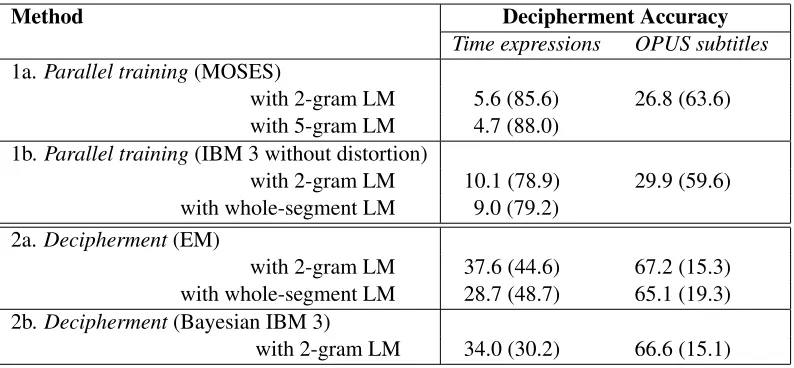
Method Decipherment Accuracy
Time expressions OPUS subtitles
1a.Parallel training(MOSES)
with 2-gram LM 5.6 (85.6) 26.8 (63.6)
with 5-gram LM 4.7 (88.0)
1b.Parallel training(IBM 3 without distortion)
with 2-gram LM 10.1 (78.9) 29.9 (59.6)
with whole-segment LM 9.0 (79.2)
2a.Decipherment(EM)
with 2-gram LM 37.6 (44.6) 67.2 (15.3)
with whole-segment LM 28.7 (48.7) 65.1 (19.3)
2b.Decipherment(Bayesian IBM 3)
[image:8.612.110.507.56.240.2]with 2-gram LM 34.0 (30.2) 66.6 (15.1)
Figure 3: Comparison of Spanish/English MT performance on theTimeandOPUStest corpora achieved by various MT systems trained under (1)parallel—(a) MOSES, (b) IBM 3 without distortion, and (2)deciphermentsettings— (a) EM, (b) Bayesian. The scores reported here are normalized edit distance values with BLEU scores shown in parentheses.
TRAIN (English): 19770 sentences (1128 unique), 62k word tokens, 411 word types.
TEST (Spanish): 13181 sentences (1127 unique), 39k word tokens, 562 word types.
Both Spanish/English sides ofTRAINare used for parallel MT training, whereas decipherment uses only monolingual English data for training LMs.
MT Systems: We build and compare different MT systems under two training scenarios:
1. Parallel trainingusing: (a)MOSES, a phrase translation system (Koehn et al., 2007) widely used in MT literature, and (b) a simpler version ofIBM Model 3 (without distortion param-eters)which can be trained tractably using the strategy of Knight and Al-Onaizan (1998).
2. Decipherment without parallel data using: (a) EM method (from Section 3.1), and (b) Bayesian method(from Section 3.2).
Evaluation: All the MT systems are run on the Spanish test data and the quality of the result-ing English translations are evaluated usresult-ing two different measures—(1) Normalized edit distance score (Navarro, 2001),6 and (2) BLEU (Papineni et
6When computing edit distance, we account for
substitu-tions, insersubstitu-tions, deletions as well as local-swap edit operations required to convert a given English string into the (gold) refer-ence translation.
al., 2002), a standard MT evaluation measure.
Results: Figure 3 compares the results of vari-ous MT systems (using parallel versus decipherment training) on the two test corpora in terms of edit dis-tance scores (a lower score indicates closer match to the gold translation). The figure also shows the cor-responding BLEU scores in parentheses for compar-ison (higher scores indicate better MT output).
We observe that even without parallel training data, our decipherment strategies achieve MT accu-racies comparable to parallel-trained systems. On the Time corpus, the best decipherment (Method 2a in the figure) achieves an edit distance score of 28.7 (versus 4.7 for MOSES). Better LMs yield bet-ter MT results for both parallel and decipherment training—for example, using a segment-based En-glish LM instead of a 2-gram LM yields a 24% re-duction in edit distance and a 9% improvement in BLEU score for EM decipherment.
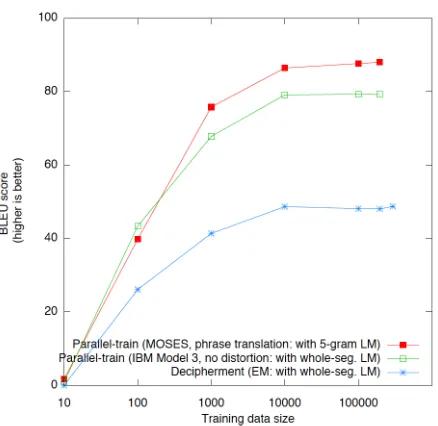
train-Figure 4: Comparison oftraining data sizeversusMT ac-curacyin terms of BLEU score under different training conditions: (1)Parallel training—(a) MOSES, (b) IBM Model 3 without distortion, and (2)Decipherment with-out parallel data using EM method (from Section 3.1).
ing instances for this domain.
It is interesting to quantify the value of parallel versus non-parallel data for any given MT task. In other words, “how much non-parallel data is worth how much parallel data in order to achieve the same MT accuracy?” Figure 4 provides a reasonable an-swer to this question for the Spanish/English MT task described here. We see that deciphering with 10k monolingual Spanish sentences yields the same performance as training with around 200-500 paral-lel English/Spanish sentence pairs. This is the first attempt at such a quantitative comparison for MT and our results are encouraging. We envision that further developments in unsupervised methods will help reduce this gap further.
4 Conclusion
Our work is the first attempt at doing MT with-out parallel data. We discussed several novel deci-pherment approaches for achieving this goal. Along the way, we developed efficient training methods that can deal with large-scale vocabularies and data sizes. For future work, it will be interesting to see if we can exploit both parallel and non-parallel data to improve on both.
Acknowledgments
This material is based in part upon work supported by the National Science Foundation (NSF) under Grant No. IIS-0904684 and the Defense Advanced Research Projects Agency (DARPA) through the Department of Interior/National Business Center un-der Contract No. NBCHD040058. Any opinion, findings and conclusions or recommendations ex-pressed in this material are those of the author(s) and do not necessarily reflect the views of the Defense Advanced Research Projects Agency (DARPA), or the Department of the Interior/National Business Center.
References
Friedrich L. Bauer. 2006. Decrypted Secrets: Methods and Maxims of Cryptology. Springer-Verlag.
Phil Blunsom, Trevor Cohn, Chris Dyer, and Miles Os-borne. 2009. A Gibbs sampler for phrasal syn-chronous grammar induction. In Proceedings of the Joint Conference of the 47th Annual Meeting of the ACL and the 4th International Joint Conference on Natural Language Processing of the Asian Federa-tion of Natural Language Processing (ACL-IJCNLP), pages 782–790.
Peter Brown, Vincent Della Pietra, Stephen Della Pietra, and Robert Mercer. 1993. The mathematics of statis-tical machine translation: Parameter estimation. Com-putational linguistics, 19(2):263–311.
David Chiang, Jonathan Graehl, Kevin Knight, Adam Pauls, and Sujith Ravi. 2010. Bayesian inference for finite-state transducers. InProceedings of the Confer-ence of the North American Chapter of the Associa-tion for ComputaAssocia-tional Linguistics - Human Language Technologies (NAACL/HLT), pages 447–455.
Arthur P. Dempster, Nan M. Laird, and Donald B. Ru-bin. 1977. Maximum likelihood from incomplete data via the EM algorithm. Journal of the Royal Statistical Society, Series B, 39(1):1–38.
Jenny Finkel, Trond Grenager, and Christopher Manning. 2005. Incorporating non-local information into infor-mation extraction systems by Gibbs sampling. In Pro-ceedings of the 43rd Annual Meeting of the Associa-tion for ComputaAssocia-tional Linguistics (ACL), pages 363– 370.
Pascal Fung and Kathleen McKeown. 1997. Finding ter-minology translations from non-parallel corpora. In
[image:9.612.76.295.54.267.2]Stuart Geman and Donald Geman. 1984. Stochastic re-laxation, Gibbs distributions and the Bayesian restora-tion of images. IEEE Transactions on Pattern Analysis and Machine Intelligence, 6(6):721–741.
Ulrich Germann, Michael Jahr, Kevin Knight, Daniel Marcu, and Kenji Yamada. 2001. Fast decoding and optimal decoding for machine translation. In Proceed-ings of the 39th Annual Meeting on Association for Computational Linguistics, pages 228–235.
Sharon Goldwater and Thomas Griffiths. 2007. A fully Bayesian approach to unsupervised part-of-speech tag-ging. InProceedings of the 45th Annual Meeting of the Association of Computational Linguistics, pages 744– 751.
Aria Haghighi, Percy Liang, Taylor Berg-Kirkpatrick, and Dan Klein. 2008. Learning bilingual lexi-cons from monolingual corpora. In Proceedings of the Annual Meeting of the Association for Compu-tational Linguistics - Human Language Technologies (ACL/HLT), pages 771–779.
Kevin Knight and Yaser Al-Onaizan. 1998. Transla-tion with finite-state devices. In David Farwell, Laurie Gerber, and Eduard Hovy, editors, Machine Transla-tion and the InformaTransla-tion Soup, volume 1529 ofLecture Notes in Computer Science, pages 421–437. Springer Berlin / Heidelberg.
Kevin Knight, Anish Nair, Nishit Rathod, and Kenji Ya-mada. 2006. Unsupervised analysis for decipherment problems. InProceedings of the Joint Conference of the International Committee on Computational guistics and the Association for Computational Lin-guistics, pages 499–506.
Philipp Koehn and Kevin Knight. 2000. Estimating word translation probabilities from unrelated monolingual corpora using the EM algorithm. In Proceedings of the Seventeenth National Conference on Artificial In-telligence and Twelfth Conference on Innovative Ap-plications of Artificial Intelligence, pages 711–715. Philipp Koehn, Hieu Hoang, Alexandra Birch, Chris
Callison-Burch, Marcello Federico, Nicola Bertoldi, Brooke Cowan, Wade Shen, Christine Moran, Richard Zens, Chris Dyer, Ondˇrej Bojar, Alexandra Con-stantin, and Evan Herbst. 2007. Moses: open source toolkit for statistical machine translation. In Proceed-ings of the 45th Annual Meeting of the ACL on Inter-active Poster and Demonstration Sessions.
Philip Koehn. 2009. Statistical Machine Translation. Cambridge University Press.
David McClosky, Eugene Charniak, and Mark Johnson. 2006. Effective self-training for parsing. In Proceed-ings of the main conference on Human Language Tech-nology Conference of the North American Chapter of the Association of Computational Linguistics, pages 152–159.
Gonzalo Navarro. 2001. A guided tour to approximate string matching. ACM Computing Surveys, 33:31–88, March.
David Newman, Arthur Asuncion, Padhraic Smyth, and Max Welling. 2009. Distributed algorithms for topic models. Journal of Machine Learning Research, 10:1801–1828.
Kishore Papineni, Salim Roukos, Todd Ward, and Wei-Jing Zhu. 2002. Bleu: a method for automatic eval-uation of machine translation. InProceedings of the 40th Annual Meeting on Association for Computa-tional Linguistics, pages 311–318.
Reinhard Rapp. 1995. Identifying word translations in non-parallel texts. InProceedings of the Conference of the Association for Computational Linguistics, pages 320–322.
Benjamin Snyder, Regina Barzilay, and Kevin Knight. 2010. A statistical model for lost language decipher-ment. InProceedings of the 48th Annual Meeting of the Association for Computational Linguistics, pages 1048–1057.
J¨org Tiedemann. 2009. News from OPUS - A collec-tion of multilingual parallel corpora with tools and in-terfaces. In N. Nicolov, K. Bontcheva, G. Angelova, and R. Mitkov, editors, Recent Advances in Natural Language Processing, volume V, pages 237–248. John Benjamins, Amsterdam/Philadelphia.