Reviving the Globalization and Poverty Debate: Effects of
Real and Financial Integration on the Developing World
Ashish Bharadwaj
International Max Planck Research School for Competition and Innovation,
Munich Centre for Innovation and Entrepreneurship Research, Marstallplatz 1, 80539 Munich, Germany *Corresponding Author: [email protected]
Copyright © 2014 Horizon Research Publishing All rights reserved.
Abstract Around the turn of this century there were
concerns about the possible adverse effects of globalization which led to a polarized debate on the plight of the world’s poorest. This paper attempts to answer the question of whether or not the billions of people who still live on less than $1 a day are sharing in the benefits of greater integration among economies. The first part of the paper summarizes the channels and transmission mechanisms, such as greater openness to trade and foreign investment, through which the process of globalization could affect poverty in the developing world. Using a panel data of 35 developing countries from 1990 to 2004 an empirical examination is carried out of the impact of real and financial integration on the head count ratio and poverty gap. Results suggest that, on an aggregate level, capital flows via FDI have had an adverse effect and real trade-induced income growth had a favorable effect on the incidence of poverty. On the other hand, a policy of excessive openness to external trade without complementary support mechanisms was found to be negatively related to the depth of poverty in developing countries.Keywords
Globalization, GDP growth, International trade, FDI, PovertyJEL Classification: F14, F60, I32
1. Introduction
Global circulation of goods, services and capital, along with exchange of information, ideas and people can safely be referred to as ‘Globalization’. It has become an increasingly visible force in recent decades that has shaped nearly the entire second half of the 20th century. Although there are many factors that have spurred, and in turn have been reinforced by, globalization, two have played a particularly important role in contributing to its accelerating pace in the 1980s and 1990s (World Bank, 2000). The first is technical progress especially in information technology, international
communication and global transportation. Not only goods but also services and knowledge can flow much more easily because of innovations such as the Internet. The second major development is the shift in policy orientation as governments everywhere have reduced barriers that had curbed the development of domestic markets and their links to the international economy.
Openness to international trade accelerates development (Dollar& Kraay, 2004). This is one of the most widely held beliefs in the economics profession, one of the few things on which Nobel prize winners of the both the left and the right agree. Trade promotes growth through a number of channels such as technology transfers, scale economies, and comparative advantage (Yanikkaya, 2003). As is common in most contentious public debates, different people mean different things by globalization. Some interpret it to mean the global reach of new technology and capital movements, some refer to outsourcing by domestic companies in rich countries, others protest against the tentacles of corporate capitalism or the US (economic, military, or cultural) hegemony.
In this age of globalization tremendous advances have been made by large segments of the world population. Yet, there is a fear that globalization is exacerbating inequality, and perhaps even worsening the lot of the poor by eroding their incomes, increasing their vulnerability, and adding to their disempowerment. This fear may not be universal, but it does play a role in the public perception that cannot be ignored. More than 1 billion people live in extreme poverty, which is defined by the World Bank as subsisting on less than 1 dollar a day1. In 2001, half of the developing world lived on less than 2 dollars a day. Yet poverty rates are much lower today than twenty years ago. In the last two decades, the percentage of the developing world living in extreme poverty has been cut in half (Harrison, 2006). While poverty rates were falling, developing countries became increasingly integrated into the world trading system. Poor countries have slashed protective tariffs and increased their participation in world trade. Against this backdrop, this study presents
1Poverty estimates taken from the World Bank’s PovcalNet tool, available at http://iresearch.worldbank.org/PovcalNet/jsp?index.jsp
empirical evidence on the impact of globalization on poverty of 35 low and middle-low income countries of the world for the years 1990, 1993, 1996, 1999, 2002 and 2004.
In this paper, I shall limit myself to interpreting globalization simply as openness to foreign trade and capital flows such as Foreign Direct Investment (FDI). I shall ignore here the important issues arising from the devastation caused to fragile economies by billions of dollars of volatile short-term capital stampeding around the globe in herd-like movements, or the substantial poverty-reducing potential of international (unskilled) labor flows from poor to rich countries (even if allowed in temporary and regulated doses). By poverty, I shall refer to absolute poverty in low-income countries. A large part of the discussion around globalization is around its effect on relative inequality, which will largely be skipped in this paper.
This paper is organized as follows. Chapter 2 provides a literature review on the inter linkages between poverty and globalization. Chapter 3 then identifies linkages between globalization and poverty. Chapter 4 discusses the ways through which globalization might hurt the poor. This review is by no means exhaustive; my objective here is mainly to show that although there are very good analytical arguments to suggest that globalization may benefit the poor (as discussed earlier), there are equally plausible ones that support the view that trade or financial integration may have an adverse effect on poverty. Determining whether globalization is (on net) ‘‘good’’ or ‘‘bad’’ for the poor is – as is often the case in economics – an empirical issue, not a matter of faith (Agénor, 2004). This is by no means a claim to novelty but rather a reminder of a point that has often been ‘‘lost’’ by partisan views on both sides of the debate. Chapter 5 introduces the Model, data used and the methodology of the empirical exercise carried out. This chapter discusses the basic specification of the regression model (including the choice of control variables) and explains the two dimensions through which globalization is measured. By necessity, my operational definition of ‘‘globalization’’ is narrower than what the concept usually involves (as defined earlier); I focus on measures of trade and financial openness (which indirectly account for technology transfers), but I do not capture the potentially important effects of labor and information flows. Chapter 6 provides an interpretation of the results and the conclusion.
2. Literature Review
Critical importance of trade policy in economic growth cannot be denied and it has been at the centre stage of all debates in the development literature since mid 1950s. Whereas the prevailing wisdom in the 1950s and 1960s favoured import substitution, that in the 1970s and 1980s favoured export promotion/outward orientation. Krueger (1997) chartered out the evolution of thinking on trade orientation and growth emphasizing the evidence of a positive correlation between growth of exports and the
growth of GDP, countries with a more open trade orientation appearing to grow faster through time. Edwards (1998) has argued that the positive association between trade openness and growth is robust to the measure of openness used, though Rodriquez and Rodrik (1999) challenge this conclusion, arguing that although there is little systematic evidence linking inward oriented trade policies and growth, the evidence linking outward orientation and growth overstates the relationship between the two.
Globalization, as Bardhan (2006) argues, can cause many hardships for the poor in less developed countries, but it also opens up opportunities which some countries utilize and others do not, largely depending on their domestic political and economic institutions and policies, and the net outcome is often quite complex and almost always context dependent, belying the glib pronouncements for or against globalization made in the opposing camps. A study by Deaton (2002) revealed that though the fraction of humanity in poverty is falling, absolute numbers in poverty have shown limited change.
Empirical support for the view that trade openness promotes economic growth can be found in (amongst others) Dollar (1992), Sachs and Warner (1995) and Harrison (1996). In a meta-study of all the cross-country growth regressions with an average of seven regressors (chosen from 67 candidates drawn from the literature on cross-country growth regressions) Sala-I-Martin, Doppelhofer and Miller (2004) report that trade volume is a significant in two-thirds of the regressions, though is not amongst their subset of 18 robust predictors of economic growth.
There have been attempts to positively relate trade liberalization with economic growth, and relate growth with poverty reduction on the basis of cross-country regressions. The former relation has been found controversial, while the latter is sturdier (Bardhan, 2006). Average estimated value of the elasticity of this effect—taken to be 2 in an estimate reported in the World Development Report 2001, that is, a 1% increase in real per capita income has been associated with a reduction in the headcount incidence of poverty by 2%. Pro-globalizers point to the large decline in poverty in China, India, and Indonesia (countries long characterized by massive rural poverty) in the recent decades of international economic integration. Chen and Ravallion (2004) have estimated that during 1981–2001, the percentage of rural people living below an international poverty line of $1.08 per day (at 1993 purchasing power parity) declined from about 79% to about 27% in China, from about 63% to about 42% in India, and 55% to 11% in Indonesia.
reform may be largely responsible for poverty reduction in China is suggested by the fact that the substantial part of the decline in poverty in the last two decades already occurred by mid-1980s, before the big strides in foreign trade or investment. Similarly, rural poverty reduction in India may be attributable to the spread of Green Revolution in agriculture, large anti-poverty programs or social movements in India, and not the trade liberalization of the 1990s. In Indonesia sensible macroeconomic policies, an active rice price stabilization policy, massive investment in rural infrastructure, and the Green Revolution played a substantial role in the large reduction of rural poverty during 1981–2001.
Those who are more dubious of global processes point out that in the same decades, poverty has remained stubbornly high in sub- Saharan Africa; as Chen and Ravallion (2004) have estimated, during 1981–2001 the percentage of people living below the poverty line of $1.08 per day (at 1993 purchasing power parity) increased in sub-Saharan Africa from about 42% to about 46%. But this may have little to do with globalization, and more to do with unstable or failed political regimes, wars, and civil conflicts which afflicted several countries in Africa; if anything, such instability only reduced their extent of globalization, as it scared off many foreign investors and traders.
Agénor (2004) used a ‘‘globalization index’’ based on principal components analysis and tested for both linear and nonlinear effects. Results of his study suggest the existence of an inverted U-shape relationship between globalization and poverty. At low levels, globalization appears to hurt the poor; but beyond a certain threshold, it seems to reduce poverty – possibly because it brings with it renewed impetus for reform. Bhagwati & Srinivasan in their work in 2002 argue that the theoretical and empirical analysis of the impact of freer trade on poverty in the rich and in the poor countries is not symmetric. Trade policy reforms typically result in some households winning and some households losing. Given the diversity of households in an actual economy, even the most attractive reforms will typically result in some households losing, at least in the short run. Harrison et al. (1999) argued that one approach is just to accept these losses if they are ‘‘acceptable’’ as the price of achieving some greater good. Another approach is to argue against any reform that hurts even one household, especially if that household is poor.
Even though the theoretical growth studies provided no conclusive evidence about the direction of growth effects of trade barriers, especially for developing countries, a great majority of the empirical studies concluded that there exists a significant and negative relationship between trade restrictions and growth. Whereas, results by Yanikkaya (2003) are much closer to the predictions of theoretical studies and evidently contradict the findings of earlier empirical studies. The results cast substantial doubts on the conventional view that suggests a robust and negative relationship between trade barriers and growth. The cross-section results of Mbabazi et al. (2001) suggest that
there is weak evidence that openness is associated with higher growth. Regarding poverty, the only consistent patterns are that higher levels of human capital are associated with lower levels of poverty, while poverty is higher in sub-Saharan Africa. There is no evidence that growth and trade liberalization affect poverty, although countries that have sustained an open trade regime appear to have lower levels of poverty. Ravallion (2001) views the issue through two empirical lenses. The macro lens uses cross-country comparisons and aggregate time series data; the micro lens uses household-level data combined with structural modelling of the impacts of specific trade reforms. Both the macro and micro approaches cast doubt on some widely heard generalizations from both sides of the globalization debate. The results point to the importance of combining trade reforms with well-designed social protection policies.
3. Understanding Globalization-Poverty
Linkages
3.1. Facets of Globalization
In terms of international trade, there has been a growing divergence over the last three decades in shares of trade, between those countries actively participating in the global economy and those that do not. For many of the poorest, Least Developed Countries (LDCs) the problem is not that they are being impoverished by globalization, but that they are in danger of being largely excluded from it. A study by World Bank (2000) reports that the minuscule 0.4 percent share of these countries in world trade in 1997 was down by half from 1980. Similarly, although financial flows to developing countries have also grown dramatically, they remain concentrated. Fifteen emerging market countries, mainly in East Asia, Latin America and Europe, accounted for 83 percent of all net long-term private capital flows to developing countries in 1997. Sub-Saharan Africa as a whole received only 2 percent of the total (World Bank, 2000).
World Bank carried out a simulation exercise intended to determine the benefits resulting from a Doha Round that eliminated import duties, export subsidies, and subsidies to domestic production, following a timetable to be completed by the year 2015 (World Bank, 2001a). According to the estimates, the potential global gains from such an agreement would amount to more than US$ 800 billion a year, of which over two-third would be associated with agricultural liberalization; these gains would benefit both the developing and the industrialized countries, with the latter receiving approximately 40% of the gains.
higher incidence of poverty. Export growth is associated with the opposite: falling informal sector employment, rising minimum wage compliance, and falling poverty. Goldberg and Pavcnik (2004b) present evidence suggesting that workers cannot easily relocate away from contracting towards expanding sectors in the context of trade reforms, contradicting the assumption of perfect labor mobility in the HO framework.
3.2. Poverty Trends
It is important to distinguish between the incidence of poverty as a percentage of a total population and the absolute number of the poor. World Bank (2000) states that the share of the population in poverty has declined for developing countries as a whole (from 28.3% in 1987 to 24% in 1998 based on $1/day and from 61% in 1987 to 56% in 1998 based on $2/day) and in all developing regions except Sub-Saharan Africa and Eastern Europe and Central Asia. Declines have been pronounced and sustained over a longer time period for the most populous developing countries. For example, the incidence of poverty in India measured by the official poverty line fell from 57% in 1973 to around 35% in 1998, whereas the incidence of poverty fell from 60% to 20% between 1985 and 1998 for Indonesia. Standards of living have also improved. Infant mortality rates globally have been cut in half during 1970-1997, from 107 to 56 per thousand; and life expectancy has risen from 55 years to 67 years. However, in spite of this broad based progress, more than 40 developing countries with 400 million people have had negative or close to zero per capita income growth over the past thirty years. And the absolute number of poor has continued to increase in all regions except East Asia and the Middle East. Overall, despite impressive growth performance in many large developing countries, absolute poverty worldwide is still increasing.
Poverty trends between 1990 and 2001 vary according to the definition of poverty applied. If the poor are considered to be those living on less than one dollar a day —that is to say, those in a situation of extreme poverty— then during that period there was a significant reduction in the number of poor: from 1,219 million to 1,101 million. On the other hand, if the poor are considered to be those living on less than two dollars a day, then the number increased from 2,689 million to 2,733 million over that period (World Bank, 2004a). Even more important is the fact that under both these definitions of poverty the regional dispersion is rather significant. The only region in which poverty went down was Asia; in the other regions the number of poor increased. Thus, under the definition based on an income of less than one dollar a day, the number of poor in Asia went down from 934 to 712 million between 1990 and 2001, whereas in Africa it rose from 233 to 321 million over the same period, and in Latin America it went up, albeit only slightly, from 49 to 50 million.
3.3. Economic Growth and Poverty
Globalization has played an important catalytic role in reducing poverty in developing countries through its impact on growth. More open economies, and those who have been more successful in accelerating their pace of integration, have recorded the best growth performance, whereas developing countries with inward oriented policies have suffered from poor growth rates. Frankel and Romer (1999) have estimated that an increase in the ratio of trade to GDP by one percent raises the level of income by one-half to two percent. By stimulating higher growth, integration can have a strong positive impact on poverty reduction. There is now robust cross-country empirical evidence that growth is on average associated one-for-one with higher incomes of the poor. There are, however, significant variations in this relation between countries. In the aggregate, no more than 50% of the variation in the poverty measure is explained by differences in growth. Another way to state this is to say that poverty is affected by many factors other than growth.
There is widespread acceptance that in the long run open economies fare better in aggregate than do closed ones, and that relatively open policies contribute to long-run development (Winters, 2000). Many commentators fear, however, that in the shorter run trade liberalisation puts great stress on certain actors in the economy and that even in the longer run successful open regimes may leave some behind in poverty. Others additionally argue that being open – rather than just the process of opening up – exposes an economy to shocks that generate uncertainty, cause it to operate with higher levels of poverty than would a less open economy and undermine policy measures designed to alleviate poverty and redistribute income.
The Stolper-Samuelson (SS) Theorem, that an increase in the price of the labour intensive good raises real labour incomes and reduces real returns to capital, is a hugely powerful result of direct and immediate relevance to the link between international trade and poverty. Like all theory, however, it is built on restrictive assumptions, and once these are violated its power and definitiveness are eroded. This erosion does not mean that the Theorem has nothing to say – indeed, it is still a vital part of economists’ tool-kits – but it does mean that it needs to be supplemented with further, usually case-specific, analysis to draw concrete conclusions. Broadly speaking, if the prices of unskilled-labour-intensive goods increase we would expect unskilled wages to increase. As these industries expand to meet increases in demand they absorb factors from other sectors. By definition, an unskilled- labour intensive sector requires more unskilled labour per unit of other factors than do other sectors and so this shift in the balance of production increases the net demand for unskilled labour and reduces it for other factors. If poor households depend largely on unskilled wage earners, poverty will be alleviated by the resulting wage increase. However, head-count indices will vary only if the wage increase moves families from one side of the boundary to the other (Winters, 2000).
wages in general. However, within those countries it is not clear that the least-skilled workers, and thus the most likely to be poor, are the most intensively used factor in the production of tradable goods. To quote Winters (2000), the wages of workers with completed primary education may increase with trade liberalisation, those of illiterate workers may be left behind or even fall.
3.4. Globalization and Vulnerability
While trade integration does not appear to increase vulnerability, and foreign direct investment flows have been remarkably stable, integration with financial markets can increase the propensity to develop crises. The increased susceptibility to and costs of crises are due to inadequacies in the domestic policy and institutional framework and larger and more volatile private capital flows. Although the increased prevalence of financial crises has not raised GDP volatility (with the exception of East Asia), it can have a large detrimental impact on the poor both through output declines and the socialization of large resolution costs (World Bank, 2000). Beyond these aggregate effects, globalization can increase insecurity of particular groups, especially workers, in a more footloose and fast changing world. There are concerns, although with no systematic evidence, about greater instability in earnings and duration of employment, reflected in the antipathy towards globalization amongst labor unions in both developed and developing countries. The heightened sense of insecurity also reflects the sheer speed of change and the pressure to acquire new skills which is associated with the global spread of technical change.
The poor in countries with an abundance of unskilled labor do not always gain from trade reform (Harrison, 2006). Many economists have used the Heckscher-Ohlin (HO) framework in international trade to argue that trade liberalization should raise the incomes of the unskilled in labor-abundant countries. Most researchers who use this framework to argue that globalization is good for the world’s poor make a number of heroic assumptions. These assumptions—such as the necessity that all countries produce all goods are often challenged. In addition, the country studies show that labor is not nearly as mobile as the HO trade model assumes; for comparative advantage to increase the incomes of the unskilled, they need to be able to move out of contracting sectors and into expanding ones. Another reason why the poor may not gain from trade reforms is that developing countries have historically protected sectors that use unskilled labor, such as textiles and apparel. This pattern of protection, while at odds with simple interpretations of HO models, makes sense if standard assumptions (such as factor price equalization) are relaxed. Trade reforms may result in less protection for unskilled workers, who are most likely to be poor. Finally, penetrating global markets even in sectors that traditionally use unskilled labor requires more skills than the poor in developing countries typically possess.
The poor are more likely to share in the gains from globalization when there are complementary policies in place (Harrison, 2006). The studies on India and Colombia suggest that globalization is more likely to benefit the poor if trade reforms are implemented in conjunction with reducing impediments to labor mobility. In Zambia, poor farmers are only expected to benefit from greater access to export markets if they also have access to credit, technical know-how, and other complementary inputs. The studies also point to the importance of social safety nets. In Ethiopia, if food aid had not been well targeted, globalization would have had little impact on the poor.
There are, undoubtedly, significant potential benefits to globalization. Openness to foreign direct investment, for instance, can contribute to growth by stimulating domestic capital formation and improving efficiency and productivity, as a result of greater access to new technologies. At the same time, openness to capital flows may also increase opportunities for portfolio risk diversification and consumption smoothing through borrowing and lending; and producers who are able to diversify risks on world capital markets may invest in riskier (and higher-yield) projects, thereby raising the country’s rate of economic growth (Obstfeld, 1994). Increased access to the domestic financial system by foreign banks may raise the efficiency of the intermediation process between savers and borrowers, thereby lowering markup rates in banking, as well as the cost of investment, and again raising growth rates (Baldwin and Forslid, 2000). And to the extent that financial openness helps to mitigate asymmetric information problems and to reduce the fixed costs associated with small-scale lending, it can improve the opportunities for the poor to access the formal financial system.
Similarly, openness to trade may generate significant gains, both static and dynamic (Agénor, 2004). Static economic gains, as emphasized by conventional trade theory, refer to the fact that under greater openness to trade, productive resources tend to be reallocated toward activities where they are used with comparatively greater efficiency and away from less efficient activities (such as import-substitution industries or rent-seeking activities). In addition, the literature on endogenous growth has emphasized the existence of various mechanisms through which trade openness may generate dynamic gains and thereby affect the economy’s rate of growth in the long run. In particular, it has been argued that trade openness may facilitate the acquisition of new inputs, less expensive or higher-quality intermediate goods, and improved technologies, which enhance the overall productivity of the economy. Romer (1994), for instance, has argued that in an economy subject to trade restrictions, only a narrow range of specialized intermediate goods or capital goods can be profitably produced and therefore the full range of technological possibilities, which rely on a potentially broader range of inputs, cannot be exploited effectively.
economic and social costs. Openness to global capital markets has brought greater volatility in domestic financial markets, particularly in countries whose financial systems were weak to begin with and economic policies lacked credibility. Large reversals in short-term capital flows (often induced by contagion effects or abrupt changes in market sentiment on world capital markets) have led to severe financial crises and sharp increases in unemployment and poverty, which have in some cases persisted beyond the short term (Agénor, 2004). Similarly, trade liberalization has led in some countries to reduced demand for unskilled labor and lower real wages in the short run; combined with a low degree of inter-sectoral labor mobility, job losses and income declines have often translated into higher poverty rates.
4. How Globalization May Hurt the Poor
It is actually not very difficult to think of a number of channels through which the process of globalization may hurt the poor. Even some of the most ardent ‘‘pro-globalization’’ advocates would admit that, for instance, trade reform in developing countries may lead in the short run to higher unemployment and greater poverty. This could be as a result of pervasive labor market distortions – such as a low degree of wage flexibility and imperfect labor mobility across sectors (Agénor, 2004). In this section I want to emphasize, without trying to be exhaustive, the possibility that globalization may affect poverty adversely in the long run as well. I first describe some possible channels through which trade liberalization may increase poverty, and then proceed to do the same for financial integration.4.1. The Protectionist Fortress
With regard to import duties or customs tariffs, the industrialized countries have built a real protectionist fortress, levying taxes more heavily on the goods produced by the poor countries (agricultural products and textiles), as well as imposing numerous non-tariff barriers (quotas, import licences, anti-dumping duties and technical requirements) that in many cases are more burdensome than the tariffs themselves. In the case of tariffs, for example, the average customs tariff on agricultural imports applied by the European Union is 20%, and 9% in the case of the United States (Guadagni and Kaufmann, 2004). In the case of textiles and clothing, the average tariff in the United States is 8.9%, while in the European Union it is 7.9% (Oxfam International, 2002). These figures contrast starkly with the average tariff of only 1% applied on imports by these countries reciprocally (The Economist, 2003). The International Food Policy Research Institute (IFPRI) recently estimated the effects of that protectionist fortress on the exports of the poor countries. According to those estimates, the developing countries lose around US$ 40 billion per year due to the lower exports as a result of the agricultural protectionism of the industrialized countries.
[image:6.595.313.553.191.265.2]This means that, if those protectionist barriers did not exist, the agricultural exports of the developing countries would be three times higher. The largest share of this loss corresponds to Latin America, which currently exports some US$ 32 billion dollars to the industrialized countries but could export more than US$ 46 billion. In other words, the annual loss to the region is over US$14 billion (IFPRI, 2003).
Table 1. Latin America and the industrialized countries: Disparity between average tariffs (Levels of protection faced by exporters in each region)
Exporting Region Importing Region
Latin America Industrialized countries
Agricultural goods
Latin America - 20.4%
Non Agricultural goods
Industrialized countries 8.5% -
Source: World Bank (2003)
Table 1 shows the disparity between average tariffs depicting the levels of protection faced by exporters in Latin America versus the group of industrialized countries. It shows that he exports by the poor developing countries —in this particular case, Latin America— to the industrialized countries face higher tariffs than those imposed by the developing countries on their imports from the industrialized nations2. The tariffs levied by the United States on imports from the developing countries can be as much as 20 times higher than those applied on imports from other rich developed countries. Last year, the average United States tariff on imports from Bangladesh was 14%, a total of US$ 301 million, although that country supplied only 0.1% of total United States imports. This amount was only slightly less than the total duties paid on imports from France, which were subject to a tariff of only 1% and represented 2.4% of total United States imports (Oxfam International, 2003). The tariffs of the European Union severely discriminate against the developing countries. Its duties on imports from India were almost four times higher than those on imports from the United States (Guadagni and Kaufmann, 2004).
Table 2. Tariffs applied by the industrialized countries: The developing countries are condemned to export goods without value added
Exports Tariff applied by: European (in percentages)
Union United States Japan Coffee As raw material processed 12.1 7.3 10.0 0.1 18.8 6.0 Cocoa As raw material processed 30.6 0.0 15.5 0.0 22.0 0.0 Sugar As raw material processed 18.9 36.4 17.7 2.0 25.0 a Fruit As raw material processed 22.5 9.2 10.7 4.6 16.7 8.7 Source: World Bank (2003)
One of the features of the tariff structure of the industrialized countries is that it strongly discourages production with higher value added, as seen in Table 2 above.
2 See Table A.2 in the appendix.
This situation, which prevails in the European Union, the United States and Japan, also exists in the other industrialized countries. Canada’s tariffs on processed food products, for example, are 12 times higher than those applied to products in the primary stage of processing. The European Union’s tariff is less than 4% on imports of yarn, but 14% on clothing. The United States and the European Union apply zero tariffs on imports of cocoa beans, but up to 30.6% on processed products such as cocoa paste and chocolate. As a result, the developing countries produce over 90% of all cocoa beans but less than 5% of world chocolate production (Guadagni and Kaufmann, 2004).
While freer trade, or openness in trade, is now widely regarded as economically benign, in the sense that it increases the size of the pie, the recent anti-globalization critics have suggested that it is socially malign on several dimensions, among them the question of poverty being the most important one. Their contention is that trade accentuates not ameliorates, deepens not diminishes, poverty in both the rich and the poor countries (Bhagwati and Srinivasan, 2002).
4.2. Trade Openness
Although there are some good arguments suggesting that trade liberalization may improve resource allocation in the short term or raise growth rates permanently (and thus be beneficial to the poor), there are a number of other arguments suggesting the opposite3. Opening a country’s markets to foreign firms, for instance, tends to reduce the market power of domestic firms and increase competitive pressures on them, eventually forcing (some of) them out of business (Agénor, 2004). In the longer run, the country may well become more efficient in using its productive resources, thereby enjoying higher growth rates and lower poverty. But in the short term, the inability to compete, and the presence of labor market rigidities (segmentation due to minimum wage legislation or wage-setting behavior by firms or trade unions, as well as imperfect mobility across sectors), may hamper the reallocation of all categories of labor from the non-tradable sector to the tradable sector that a reduction in tariffs normally entails (Agénor and Aizenman, 1996). As a result, both unemployment and poverty may increase and persist over time.
Exports of many developing countries continue to consist of raw materials (including energy and agricultural products) and relatively low-technology manufactured goods (such as textiles). Even though openness to trade (and capital flows) may help these countries to assimilate technologies and production techniques over time (thereby enabling them to shift eventually toward the production of goods and services that are characterized by dynamic gains) there may again be a ‘‘transition period’’ during which globalization may have an adverse effect on growth and poverty. Indeed, opening an economy to trade may discourage domestic research and
3 See Winters (2002) for a detailed discussion of the linkages between trade policies and poverty
development activities, for instance by inducing the poorer countries to allocate too much of their limited supply of skilled labor to the production of manufactured goods. In such conditions, restrictions on trade may accelerate growth.
Trade integration can also affect the poor beyond and above its impact through higher growth, but these effects are not clear cut. In general, for the poorest countries, opening up trade will expand the production of goods intensive in the use of low-skilled labor, but the demand for the least-skilled labor may not be boosted by trade and may be adversely affected by technological change spread by globalization. For middle-income countries, the impact on the poor is likely to be even less clear cut based on the prevalence of the poor in previously sheltered sectors relative to potentially expanding sectors, and the competition coming from large low-income countries. There is evidence, however, from a large developing country sample of medium-to-long term growth episodes that, on average, in economies/periods of fast trade integration, income growth of the poor has kept pace with mean income growth (World Bank, 2001b). By contrast, in economies/periods of slow or declining outward orientation, on average the poor have tended to fall behind.
4.3. Skill Bias
Trade liberalization may also lead to higher poverty by reducing the demand for unskilled labor (not only in import-substitution industries but also in other sectors as well) and a worsening of wage income distribution. In a number of countries in Latin America and Asia, openness to trade during the 1980s and 1990s has coincided with an increase in the demand of, and the return to, skilled labor relative to unskilled labor, and a worsening of wage inequality (Robbins, 1996 and Harrison & Hanson, 1999).
A possible explanation of this phenomenon is that trade liberalization has been associated with the introduction of higher-level technology, the use of which requires skilled labor. The reason is that the cost of (imported) capital depends not only on the relative price of capital goods but also on tariffs that are incurred in purchasing a unit of capital goods abroad. To the extent that a fall in tariffs translates into a fall in the cost of capital, a high degree of complementarity between skilled labor and capital, and a high degree of substitutability between unskilled labor and capital, would indeed entail an increase in the demand for skilled workers – thereby leading to a widening of the wage gap between skilled and unskilled labor4.
The reduction in the demand for unskilled labor may translate into higher unemployment for that category of labor and increased poverty. Moreover, in the presence of imperfect credit markets (and following the logic of Galor and Zeira (1993)), the worsening of income distribution may hamper the ability of unskilled workers to pledge collateral and borrow to finance the acquisition of skills, thereby
4 For instance, Beyer et al. (1999) found that trade openness, as measured by the volume of trade over GDP, widened the wage gap between skilled and unskilled labour in Chile.
making an escape from the poverty trap more difficult. There is strong empirical evidence suggesting that, indeed, human capital accumulation in developing countries is subject to this type of credit market imperfections.
The link between trade openness and the accumulation of human capital is important to understand the long-run effects of globalization on poverty. Do open trade regimes lead to high investment in human capital in developing countries? Some theoretical models actually predict that free trade may lead to a decrease in the accumulation of human capital in countries that are initially skills-scarce. Findlay and Kierzkowski (1983), for instance, using a model in which capital markets are perfect, showed that the accumulation of human capital (and thus the supply of skilled labor) in countries that are initially skills-scarce falls when the rewards to education are reduced by the availability of cheaper, skills-intensive import goods.
If human capital formation has spillover effects on growth (as in endogenous growth models of the Lucas-Romer variety), trade liberalization may thus lead to higher poverty rates. By contrast, Cartiglia (1997) showed that trade may actually reduce initial differences in supplies of human capital. A key element of his analysis is the assumption that credit constraints (as mentioned earlier) limit the ability of unskilled workers to finance the education needed to become skilled. In such conditions, capital market imperfections affect the pattern of comparative advantage and the impact of trade liberalization.
4.4. Financial Integration
Although international financial market integration may bring significant benefits in the long term, it is now well recognized that a high degree of financial openness may entail significant short-term costs as well. The magnitude of the capital inflows recorded by some developing countries in recent years and the abrupt reversals that such flows have displayed at times have been associated with deep financial instability, economic crises and sharp increases in poverty rates – particularly in countries with imprudent sovereign debt management, improperly sequenced capital account liberalization, and poorly regulated domestic financial systems. The recent crisis in East Asia is a case in point5.
A key problem associated with financial openness, as Agénor (2004) points out, is that access to world capital markets tends to be asymmetric. Many developing countries (including some of the richer ones) are able to borrow on world capital markets only in “good” times, whereas in “bad” times they tend to face credit constraints. Access is thus pro-cyclical. Clearly, in such conditions, one of the alleged benefits of accessing world capital markets (the ability to borrow to smooth consumption in the face of temporary adverse shocks), is nothing but a fiction (Agénor, 2003). Pro-cyclicality may, in fact, have a perverse effect and increase macroeconomic instability (Dadush et al., 2000).
5 See Horton and Mazumdar (2001) and Fallon and Lucas (2002) for more details on this.
This can be understood in the following manner. Favorable shocks may attract large capital inflows and encourage consumption and spending at levels that are unsustainable in the longer term, forcing countries to over-adjust to adverse shocks as a result of abrupt capital reversals. The impact on poverty may thus be magnified.
In recent years, financial globalization in many transition and developing economies has taken the form of greater penetration of the domestic financial system by foreign banks. Agénor (2003) explains this lucidly: “Unlike trade liberalization, which has often resulted from unilateral decisions by governments to lower tariffs, this form of financial integration has often been less a matter of choice than a decision imposed by the country’s situation – in several cases, the need to recapitalize domestic banks in the aftermath of a banking crisis”. Although there are potentially large benefits associated with greater foreign penetration (such as enhanced quality of financial services, better techniques for credit analysis, and reduced risks of domestic financial instability), which may translate into higher growth rates and lower poverty, there are potentially adverse effects as well.
Another channel through which financial openness may have an adverse effect on the poor (at least in the short run) is the credit market. As argued by Agénor and Aizenman (1998, 1999),6 the increased exposure to volatile shocks that is associated with financial openness may translate into higher domestic interest rates (because of the increased risk of default), lower domestic output, and thus possibly higher poverty rates. The key reason is that increased volatility (of world interest rates, in particular) raises expected intermediation costs and lead domestic financial institutions (whose ability to enforce loan contracts is limited) to either increase domestic interest rates or to ration credit to maintain expected profits. Of course, what this argument implies is not that financial openness per se is undesirable, but rather that financial integration should be accompanied by adequate reforms of the domestic financial system to minimize the adverse effects of volatility on output, employment, and poverty.
In addition to level effects associated with greater exposure to volatility, financial openness may also have adverse effects on growth and, through that channel, on poverty. If financial openness is accompanied by capital flight, the lower rate of accumulation of domestic capital that may result could be associated with a persistent, adverse effect on growth in the presence of increasing returns driven by externalities in knowledge and capital formation (Song, 1993).
Another significant result of Harrison (2006) is that financial crises turn out to be very costly to the poor. Poverty rates in Indonesia increased by at least 50 percent after the currency crisis in 1997. Cross-country evidence also suggests that financial globalization leads to higher
6 In a framework that emphasizes the links between capital flows, the financial system, and the supply side of the economy, and monitoring costs, as in the costly state verification approach pioneered by Townsend (1979).
consumption and output volatility in low income countries. One implication is that low income countries are more likely to benefit from financial integration if they also create reliable institutions and pursue macroeconomic stabilization policies (including the use of flexible exchange rate regimes). Unrestricted foreign capital flows are generally associated with high poverty rates among less developed countries.
4.5. “Market Seeking” FDI
A major challenge of foreign direct investment (FDI) for an emerging economy is the retention of some of the profits earned by the investing firm. If none of the benefits of FDI is reinvested in the local economy, then the investment is not worthwhile for the emerging economy. FDI may also slowdown growth and lower the real income of the country, if the FDI worsens the terms of trade of the country.
Kumar (2002) argues that the quality of FDI can be determined by how much the foreign affiliates have linkages with the economy. How much a country would benefit from FDI depends on the quality and quantity of FDI and the domestic economic environment, e.g., whether and how the benefits are distributed among the people. The study also throws light on the determinants of quality of FDI and the possible adverse effects of it. The former are summarized as:
1. The extent of localization of affiliates’ output: how much linkage foreign affiliates have with the local economy;
2. Its contribution to the development of modern industries: foreign affiliates entering into relatively technology-intensive industries, which are new to the host country, bring more benefits;
3. Its extent of export-orientation: FDI in export-oriented units can have substantial balance of payments benefits and positive external effects; or
4. Research and development (R&D) activity of affiliates: such activities have substantial positive externalities. While the adverse effects of FDI are summarized as: 1. Negative impact on balance of payments (increases balance of payments deficit), if it increases imports of raw materials and inputs and remittances of royalties and dividends;
2. Leads to inaccurate transfer pricing, if the products, which are imported by foreign affiliates from parent companies, are overvalued and the exports to the parent company are undervalued. This may also lead to balance of payments deficit;
3. May reduce domestic investment or replace domestic monopolies by foreign companies. This leads to unemployment; and
4. May transfer outdated or environmentally harmful technologies.
5. Data and Methodology
5.1. Sources of Data, Variables and Methodology
To assess the relationship between globalization and poverty I use a panel regression framework, for 35 developing countries for which I was able to collect sufficient data. The dependent variables used are Headcount ratio (HC) and Poverty Gap (PG), both based on $1.08 a day international poverty lines used by the World Bank. The poverty headcount ratio is the proportion of the national population whose incomes are below the official threshold set by the national government ($1.08 a day in this case)7. While the HCR is widely used, it does not capture the extent to which different households fall short of the poverty line, and is highly sensitive to the number of poor households near the poverty line. Thus, I also analyze the poverty gap index, defined as the normalized aggregate shortfall of poor people’s income from the poverty line8.
In addition to measures of trade and financial integration, I include two sets of control variables: macroeconomic variables and structural indicators. The set of explanatory variables used in the regressions are given below to estimate the following equation:
𝐻𝐻𝐻𝐻𝐻𝐻𝐻𝐻𝐻𝐻𝐻𝐻𝐻𝐻𝐻𝐻𝐻𝐻 𝑅𝑅𝐻𝐻𝐻𝐻𝑅𝑅𝐻𝐻 = 𝜑𝜑(𝐼𝐼𝐼𝐼𝐼𝐼𝐼𝐼, 𝐼𝐼𝐼𝐼𝐿𝐿𝐿𝐿, 𝐺𝐺𝐺𝐺𝐺𝐺, 𝐿𝐿𝑇𝑇𝐿𝐿, 𝑇𝑇𝐺𝐺𝑂𝑂𝐼𝐼, 𝐼𝐼𝐺𝐺𝐼𝐼)
Where,
INFL is the inflation rate in terms of consumer prices; LITY is the total gross enrollment rate (secondary) for both males and females which aims to capture the level of education of the labor force;
GDP is the annual growth rate of GDP per capita, measured at PPP exchange rates, which can be viewed as either a proxy for the rate of return on physical investment, or as a measure of cyclical movements in output;
TOT is the annual percentage change in the terms of trade.
5.2. Choice of Variables
Inflation (which is a tax on non-indexed assets, such as currency holdings) lowers the overall purchasing power of households and tends to raise poverty. A higher literacy rate, or an increase in rate of growth of per capita GDP, is expected to be negatively correlated with the poverty rate. An improvement in the terms of trade tends to reduce poverty if it is brought about by an increase in the price of exports of agricultural commodities (thereby benefiting small farmers in rural areas) or if it results from a reduction in the price of imported consumption goods (benefiting therefore households in urban areas). In addition, a fall in the
7 Global Data Monitoring Information System, World Bank Website 8 Both the headcount ratio and the poverty gap are members of the Foster-Greer-Thorbecke class of poverty measures, defined as
0
( )
z z y
P f y dy
z
α
α −
=
∫
where z is the poverty line and incomes aredistributed according to the density function f(y). The headcount ratio is
calculated by setting α to be 0 and the poverty gap by setting α = 1. An illustration of the difference between the two measures is provided in the Appendix (Table A.3)
foreign-currency value of import prices may also have a positive supply-side effect (because it lowers the cost of imported inputs) and may raise output, employment, and real wages, thereby reducing further the poverty rate.
To measure globalization, even narrowly defined (as is the case in this study) to focus on trade and financial integration, is an arduous task. In particular, it is difficult to find an adequate measure of trade openness, which ideally should measure how open markets are to foreign competition. Since sufficient data on tariffs, non-tariff barriers, and effective rates of protection as proxies for openness was not available, I use share of total trade in GDP (that is, total value of imports and exports as a percentage of GDP) as a measure of globalization, denoted OPEN9.
The most common approach to examining the impact of financial openness in cross-country studies is to build an index of capital account restrictions on the basis of the qualitative information reported in the IMF’s Annual Report on Exchange Arrangements and Restrictions. The trouble with this approach is that it provides no clue regarding the intensity of capital restrictions – or, what amounts to the same thing, the effective degree of capital account liberalization (Agénor, 2004). Here, I chose a different route and opted for an ‘‘effective’’ measure of financial globalization, the ratio of foreign direct investment flows (FDI) to GDP, as for instance in Bosworth and Collins (2000), denoted FDI. Put differently, the assumption is that more longer-term capital flows as share of output is a signal of greater international financial integration.
It is important to acknowledge at the outset that the above measures of globalization are problematic, because they capture only indirectly the process of trade and financial openness. There are also many factors influencing capital flows, and the ratio of FDI to GDP may not be an accurate proxy for financial openness. Nevertheless, these indicators
9 In preliminary regressions, I also tried to use average tariff rate (that is, total tariff revenue divided by the value of imports) as a measure of globalization but due to unavailability of data on tariff revenues they were dropped from the final regression. A problem with this variable is that it does not capture NTB’s-information on which is hard to collect.
seem to be a reasonable choice given the alternatives. Thus, if trade openness lowers poverty, openness should have a negative coefficient in the estimated regressions, whereas if financial integration reduces poverty, the FDI-to-GDP ratio should have a negative coefficient.
In addition to the problem of finding adequate indicators of trade and financial openness, there is a major data constraint relative to poverty rates and some of the other control variables defined earlier. I first started by compiling all the data available on Headcount ratio in developing countries contained in the World Bank’s PovcalNet Database, which only covers 7 periods- 1990, 1993, 1996, 1999, 2002 and 2004. A sample of 60 countries was taken on the basis of income10and a total number of observations equal to 420. However, due to the lack of available data on lots of countries and on FDI flows, the maximum number of countries that can be used drops to 35. Data on rest of the variables is taken from World Bank’s World Development Indicators (WDI) Online Database.
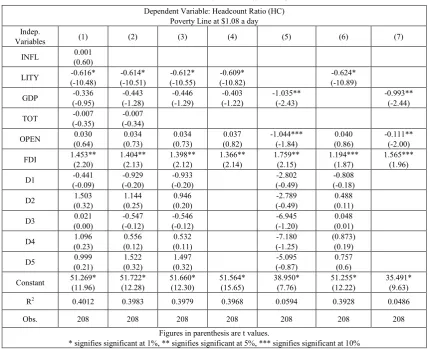
The preliminary pooled OLS regression results, though not quite relevant, give a brief idea about the expected signs of the variables. These are elaborated in Table A.2 in the appendix. Per capita GDP growth and literacy have a negative sign in all pooled regressions and are significant. Terms of trade and inflation come out to be insignificant. To check for changes in Headcount ratios overtime, time dummies were introduced. Although insignificant, all time dummies show a negative sign depicting the decline in poverty from 1990 to 2004. Finally, the FDI-to-GDP ratio does appear to have a significant (adverse) effect on the behavior of poverty across countries however trade openness is significant and favourable for poverty. Thus, financial integration appears to increase poverty – perhaps through some of the various channels identified earlier but trade openness per se does not exacerbate poverty.
10 38 low income countries and 22 low middle income countries according to World Bank classification.
http://lnweb18.worldbank.org/ESSD/envext.nsf/PrintFriendly/C4ADB8BB 4FC850CE85256D21006E7810?Opendocument
Details provided in the appendix
5.3. Results
Table 3. Globalization and Poverty- Panel Regression Results Dependent Variable: Headcount Ratio (HC)
Poverty Line at $1.08 a day Independent
Variables (1) FE RE (2) FGLS (3) FGLS (4)
(5) (6) (7) OLS or Prais Winsten models with panel corrected
SE Prob.>F
Wooldridge
Test na na na na 0.0
$ 0.0$ 0.0$
INFL -0.0005 (-0.65) -0.0006 (-0.81) 0.001 (0.61) (0.64) 0.001
LITY -0.159** (-2.18) -0.273* (-4.17) (-10.98) -0.612* (-16.36) -0.612* (-17.85) -0.609*
GDP -0.0305 (-0.20) (-0.38) -0.060 -0.313 (-0.95) -0.9932* (-2.46) (-1.53) -0.313 -0.403*** (-1.64) -0.99** (-2.06) TOT 0.0003 (0.41) 0.0004 (0.49) -0.0006 (-0.31) 0.0006 (-0.29)
OPEN (-1.79) -0.089 (-1.07) -0.050 0.0316 (0.69) -0.1113** (-2.02) (0.86) 0.031 (1.09) 0.037 -0.111* (-3.31) FDI (-1.32) -0.444 (-0.93) -0.315 1.447** (2.30) 1.565** (1.98) 1.447* (2.61) 1.366* (2.68) 1.565** (2.41) Constant 42.643* (12.74) (10.22) 44.928 51.537* (15.81) 35.491* (9.73) 51.537* (27.67) 51.564* (29.85) (19.98) 35.49* WithinR2
Btw R2 0.1013 0.2341 0.0926 0.3574
Overall R2 0.2073 0.3174 0.4004 0.3968 0.0486
Hausman Test, p=0.1311
Since value>0.05=> RE Log likelihood=-896.8
Log
likelihood=
-949 Number of
Obs. 207 207 207 207 207 207 207
Figures in parenthesis are t values.
* signifies significant at 1%, ** signifies significant at 5%, *** signifies significant at 10%
Note: INFL is the annual change in the consumer price index. LITY is the total gross enrollment rate (secondary) for both males and females as a share of total population. GDP is the annual growth rate of GDP per capita (PPP constant 2000 international $). TOT is the percentage change in the terms of trade. FDI is the total value of foreign direct investment as a share of GDP. OPEN is the total value of trade (exports and imports) as a share of GDP. D1 is the year dummy for 1993, D2 for 1996, D3 for 1999, D4 for 2002 and D5 for 2004.
$Method of estimation: Panel corrected SE with panel specific AR (1) disturbances as H0: No AR (1) is rejected
6. Discussion
6.1. Interpretation of Results
Using random effects, after conducting the Hausman test, results show that LITY is negatively (the only significant variable) related with HC. Higher the proportion of literate population more the chances of those who are poor of getting out of the poverty trap. Feasible GLS results show the same result. In this regression, FDI is seen to be harmful to poverty for the reasons mentioned above. Since LITY is explaining a lot of variations in HC, dropping it in (4) we see that GDP is, as expected, negatively associated with HC. Also, coefficient of OPEN has a negative sign. Finally, in (5), (6) and (7), using Prais-Winsten method we see negative relation of HC with LITY and GDP while FDI has a positive sign. The final regression (7) confirms the findings that per capita GDP growth and openness are beneficial for the poor and higher FDI flows accentuate poverty.
effect of the trade openness. In those areas, the changes in the income distribution seem to have taken place in the high end, as some workers tapped into the benefits of liberalization, thereby increasing inequality.
There may be polarization of the income distribution and inequality in the gains that different groups receive due to globalization and there may be losses experienced by subgroups of the poor even when aggregate poverty has declined. Thus, using poverty gap (PG) as a measure of poverty, the results in the second set of regressions suggest that though LITY and GDP are negatively related with poverty, coefficients of both FDI and OPEN have a positive sign. All these explanatory variables are significant using Prais-Winsten methods with panel corrected standard errors. One can see that LITY and GDP have a negative sign and OPEN has a positive sign throughout. Coefficient of FDI in all but one regression has an expected positive coefficient.
Table 4. Globalization and Poverty- Panel Regression Results Dependent Variable: Poverty Gap (PG)
Poverty Line at $1.08 a day Independent
Variables (1) FE RE (2) FGLS (3) FGLS (4)
(5) (6) (7) OLS or Prais Winsten models with panel corrected
SE Prob.>F
Wooldridge
Test na na na na 0.0
$ 0.0$ 0.0$
INFL -0.0001 (-0.37) -0.0002 (-0.53) 0.0004 (0.50) 0.0004 (0.71) 0.0004 (0.70)
LITY -0.0448 (-1.28) -0.093* (-2.90) -0.278* (-9.16) -0.276* (-9.14) (-12.52) -0.278* (-13.31) -0.277* -0.276* (14.31) GDP -0.0246 (-0.33) -0.0413 (-0.54) -0.311*** (-1.73) -0.355** (-2.0) -0.311** (-2.40) -0.315** (-2.32) -0.355** (-2.41) TOT 0.0003 (-090) 0.00003 (-0.94) 0.00004 (-0.44) 0.00004 (-0.34)
OPEN -0.0146 (-0.61) 0.0017 (0.08) 0.041*** (1.65) 0.044*** (1.78) 0.041*** (1.67) 0.0413*** (1.67) 0.443*** (1.91) FDI -0.1134 (-0.70) -0.0561 (-0.34) 1.003* (2.93) 0.962* (2.81) 1.003* (2.82) 0.999* (2.94) 0.962* (3.01) Constant 14.220* (8.88) 15.237* (6.69) (10.87) 19.3* (16.14) 19.3* (16.97) 19.2* WithinR2
Btw R2
0.0332 0.1789
0.0279 0.2975
Overall R2 0.1509 0.2596 0.3309 0.3303 0.3289
Hausman Test, p=0.0450 Since value<0.05=> FE
Number of
Obs. 207 207 207 207 207 207 207
Figures in parenthesis are t values.
* signifies significant at 1%, ** signifies significant at 5%, *** signifies significant at 10%
Note: INFL is the annual change in the consumer price index. LITY is the total gross enrollment rate (secondary) for both males and females as a share of total population. GDP is the annual growth rate of GDP per capita (PPP constant 2000 international $). TOT is the percentage change in the terms of trade. FDI is the total value of foreign direct investment as a share of GDP. OPEN is the total value of trade (exports and imports) as a share of GDP.
$Method of estimation: Panel corrected SE with panel specific AR (1) disturbances as H
0: No AR (1) is rejected
6.2. Conclusion
Globalization or the integration of economies and societies through trade, investment, finance, information and labor flows is, in the view of many, an inescapable feature of the world today. On the one hand, there is a considerable body of opinion arguing that globalization has led to substantial economic progress among rich and poor countries alike and, indeed, may be the principal mechanism for the international convergence of living standards. On the other, many point to the challenges that it poses for many countries as well as for the most vulnerable socio-economic groups within countries. The purpose of this paper has been to examine the extent to which globalization affects the poor. Chapter 3 presented various arguments that may explain how trade and financial integration may hurt the poor. The main point that emerged is that it is usually difficult to draw clear-cut theoretical conclusions regarding the effect of globalization on poverty as a result of conflicting effects, both in the short and the long run.
poor wage earners in exporting sectors or in sectors with incoming foreign investment gained from trade and investment reforms; conversely, poverty rates increased in previously protected sectors which were exposed to import competition. Within the same country or even the same region, a trade reform may lead to income losses for rural agricultural producers and income gains for rural or urban consumers of those same goods. Openness to trade has long been seen as an important element of good economic policy, and trade liberalisation as a necessary step for achieving it. Continuing extreme poverty, on the other hand, is perhaps the biggest blemish on the contemporary global economic canvas. Trade liberalisation is generally an ally in the fight against poverty: it tends to increase mean incomes, providing more resources with which to tackle poverty, and, while it will generally affect income distribution, it does not do so in a systematically adverse way. However, most trade reforms will hurt someone, and that some reforms may increase overall poverty even while they boost incomes in total.
There are attributes of poverty that are important to consider in relation to the effects of trade reforms. First, the poor lack physical, financial, or human capital and are therefore much more vulnerable to economic fluctuations or sudden changes in economic environment that might come from trade reform. For instance, a farmer might respond to the effects of a change in relative prices by diversifying from the cultivation of traditional to non-traditional products, but this will typically involve an investment of resources to acquire new seeds, new tools and new cultivation methods. A lack of physical, financial, or human capital will make this switch much more difficult. Second, there is evidence of continuous rotation of households into and out of poverty. To the extent that trade policy affects the determinants of these movements, it will have an effect on the number of poor.
More importantly, severe shocks can turn transitory poverty into a permanent phenomenon. Even a transitory loss of income can cause the poor to lose opportunities to acquire human capital through education, health care, and nutrition and thus affect their ability to get out of poverty in the future. Third, the poor may not be tightly linked to the formal economy and generally subsist in the urban informal sector or in rural subsistence agriculture. Thus, trade policy reform that seeks to be sensitive to its effect on the poor will not be able to ignore these sectors.
One has to acknowledge that poverty is fundamentally a relative measure which would probably gain an entirely different meaning as the world economy becomes more integrated. For example, if global growth continues at a rapid pace during the next century, it is possible that emerging market economies, including China and India, could attain income levels exceeding those of Americans today by the end of the century. This implies that Malthusian notions of poverty are likely to become a distant memory in most parts of the world as global income inexorably expands over the next century, and issues of inequality, rather than subsistence, will increasingly take center stage in the poverty debate.
Appendix
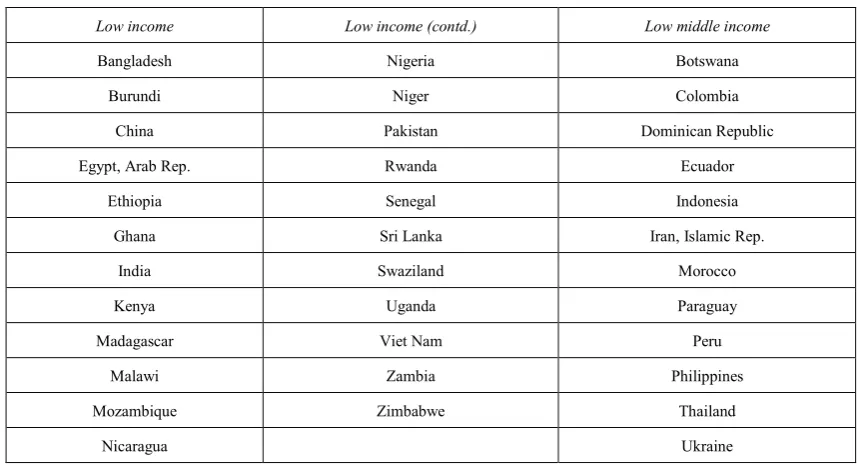
Table A.1. List of countries in the study
Low income Low income (contd.) Low middle income
Bangladesh Nigeria Botswana
Burundi Niger Colombia
China Pakistan Dominican Republic Egypt, Arab Rep. Rwanda Ecuador
Ethiopia Senegal Indonesia
Ghana Sri Lanka Iran, Islamic Rep.
India Swaziland Morocco
Kenya Uganda Paraguay
Madagascar Viet Nam Peru
Malawi Zambia Philippines
Mozambique Zimbabwe Thailand
Nicaragua Ukraine
Source: World Bank Website
[image:13.595.89.518.470.705.2]Table A.2. Trends in average tariff rates for selected developing countries
Country Average (1986-90) Average (1991-95) Average (1996-02)
Bangladesh 93 63 26
Burundi 37 7
Chine 39 40 14
Colombia 29 14 12
Egypt 40 33 30
Ghana 19 17 16
India 94 54 40
Indonesia 26 20 7
Kenya 40 30 20
Malawi 18 20 16
Morocco 23 24 34
Nigeria 32 33 25
Pakistan 67 57 24
Peru 41 17 14
Philippines 28 23 8
Sri Lanka 28 24 16
Thailand 40 32 17
Source: World Bank data; IMF data in Berg and Krueger (2003)
Table A.3. Poverty Groups by Socioeconomic Groups (Madagascar, 1994)
Socioeconomic group Headcount Rank Poverty Gap Rank
Small farmers 81.6 (1) 41.0 (1)
Large farmers 77.0 (2) 34.6 (2)
Unskilled workers 62.7 (3) 25.5 (4) Herders/fishermen 61.4 (4) 27.9 (3) Source: World Bank (1996b, p. 21)
[image:14.595.88.522.432.523.2]