Coupling Label Propagation and Constraints for Temporal Fact Extraction
Yafang Wang, Maximilian Dylla, Marc Spaniol and Gerhard Weikum Max Planck Institute for Informatics, Saarbr¨ucken, Germany
{ywang|mdylla|mspaniol|weikum}@mpi-inf.mpg.de
Abstract
The Web and digitized text sources contain a wealth of information about named entities such as politicians, actors, companies, or cul-tural landmarks. Extracting this information has enabled the automated construction of large knowledge bases, containing hundred millions of binary relationships or attribute values about these named entities. However, in reality most knowledge is transient, i.e. changes over time, requiring a temporal dimension in fact extrac-tion. In this paper we develop a methodology that combines label propagation with constraint reasoning for temporal fact extraction. Label propagation aggressively gathers fact candi-dates, and an Integer Linear Program is used to clean out false hypotheses that violate tem-poral constraints. Our method is able to im-prove on recall while keeping up with preci-sion, which we demonstrate by experiments with biography-style Wikipedia pages and a large corpus of news articles.
1 Introduction
In recent years, automated fact extraction from Web contents has seen significant progress with the emer-gence of freely available knowledge bases, such as DBpedia (Auer et al., 2007), YAGO (Suchanek et al., 2007), TextRunner (Etzioni et al., 2008), or ReadTheWeb (Carlson et al., 2010a). These knowl-edge bases are constantly growing and contain cur-rently (by example of DBpedia) several million enti-ties and half a billion facts about them. This wealth of data allows to satisfy the information needs of advanced Internet users by raising queries from key-words to entities. This enables queries like “Who is married to Prince Charles?” or “Who are the team-mates of Lionel Messi at FC Barcelona?”.
However, factual knowledge is highly ephemeral: Royals get married and divorced, politicians hold positions only for a limited time and soccer players transfer from one club to another. Consequently, knowledge bases should be able to support more sophisticatedtemporal queries atentity-level, such as “Who have been the spouses of Prince Charles before 2000?” or “Who are the teammates of Lionel Messi at FC Barcelona in the season 2011/2012?”. In order to achieve this goal, the next big step is to
distilltemporal knowledgefrom the Web.
Extracting temporal facts is a complex and time-consuming endeavor. There are “conservative” strate-gies that aim at high precision, but they tend to suffer from low recall. On the contrary, there are “aggres-sive” approaches that target at high recall, but fre-quently suffer from low precision. To this end, we introduce a method that allows us to gain maximum benefit from both “worlds” by “aggressively” gath-ering fact candidates and subsequently “cleaning-up” the incorrect ones. The salient properties of our ap-proach and the novel contributions of this paper are the following:
• A temporal fact extraction strategy that is able to efficiently gather thousands of fact candidates based on a handful of seed facts.
• An ILP solver incorporating constraints on tem-poral relations among events (e.g., marriage of a person must be non-overlapping in time).
• Experiments on real world news and Wikipedia
articles showing that we gain recall while keep-ing up with precision.
2 Related Work
Recently, there have been several approaches that aim at the extraction of temporal facts for the auto-mated construction of large knowledge bases, but
time-aware fact extraction is still in its infancy. An approach toward fact extraction based on coupled semi-supervised learning for information extraction (IE) is NELL (Carlson et al., 2010b). However, it does neither incorporate constraints nor temporal-ity. TIE (Ling and Weld, 2010) binds time-points of events described in sentences, but does not dis-ambiguate entities or combine observations to facts. A pattern-based approach for temporal fact extrac-tion is PRAVDA (Wang et al., 2011), which utilizes label propagation as a semi-supervised learning strat-egy, but does not incorporate constraints. Similarly, TOB is an approach of extracting temporal business-related facts from free text, which requires deep pars-ing and does not apply constraints as well (Zhang et al., 2008). In contrast, CoTS (Talukdar et al., 2012) introduces a constraint-based approach of coupled semi-supervised learning for IE, however not focus-ing on the extraction part. Buildfocus-ing on TimeML (Pustejovsky et al., 2003) several works (Verhagen et al., 2005; Mani et al., 2006; Chambers and Jurafsky, 2008; Verhagen et al., 2009; Yoshikawa et al., 2009) identify temporal relationships in free text, but don’t focus on fact extraction.
3 Framework
Facts and Observations.We aim to extract factual knowledge transient over time from free text. More
specifically, we assume time T = [0, Tmax] to
be a finite sequence of time-points with yearly
granularity. Furthermore, a fact consists of a
relation with two typed arguments and a time-interval defining its validity. For instance, we write
worksForClub(Beckham,RMadrid)@[2003,2008)
to express that Beckham played for Real Madrid from 2003 to 2007. Since sentences containing a fact and its full time-interval are sparse, we consider three kinds of textual observations for each relation,
namelybegin, during, and end. “Beckham signed
for Real Madrid from Manchester United in 2003.”
includes both thebeginobservation of Beckham
be-ing with Real Madrid as well as theendobservation
of working for Manchester. Apositive seed factis a valid fact of a relation, while anegative seed factis incorrect (e.g., for relationworksForClub, apositive seed fact is worksForClub(Beckham,RMadrid),
while worksForClub(Beckham,BMunich) is a
negative seed fact).
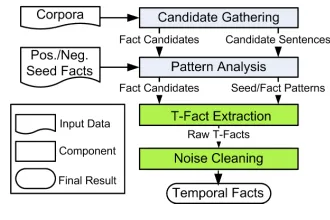
Framework.As depicted in Figure 1, our framework is composed of four stages, where the first collects candidate sentences, the second mines patterns from the candidates sentences, the third extracts temporal facts from the sentences utilizing the patterns and the last removes noisy facts by enforcing constraints.
[image:2.612.338.503.206.316.2]Preprocessing. We retrieve all sentences from the corpus comprising at least two entities and a temporal expression, where we use YAGO for entity recogni-tion and disambiguarecogni-tion (cf. (Hoffart et al., 2011)).
Figure 1: System Overview
Pattern Analysis.Apatternis a n-gram based fea-ture vector. It is generated by replacing entities by their types, keeping only stemmed nouns, verbs converted to present tense and the last preposition. For example, considering “Beckham signed for Real Madrid from Manchester United in 2003.” the
cor-responding pattern for theendoccurrence is “sign
for CLUB from”. We quantify thestrengthof each
pattern by investigating how frequent the pattern oc-curs with seed facts of a particular relation and how infrequent it appears with negative seed facts.
Fact Candidate Gathering. Entity pairs that co-occur with patterns whose strength is above a mini-mum threshold become fact candidates and are fed into the next stage of label propagation.
4 T-Fact Extraction
Building on (Wang et al., 2011) we utilize Label Propagation (Talukdar and Crammer, 2009) to deter-mine the relation and observation type expressed by each pattern.
Graph.We create a graphG= (VF∪V˙ P,E)having
one vertexv∈ VF for each fact candidate observed
in the text and one vertexv ∈ VP for each pattern.
Edges betweenVF andVPare introduced whenever a
amongVP nodes have weights derived from the n-gram overlap of the patterns.
Labels.Moreover, we use one label for each observa-tion type (begin,during, andend) of each relation and a dummy label representing the unknown relation.
Objective Function. Let Y ∈ R|V|×|+ Labels|
de-note the graph’s initial label assignment, andYb ∈
R|V|×|+ Labels| stand for the estimated labels of all
ver-tices,Slencode the seed’s weights on its diagonal, andR∗lcontain zeroes except for the dummy label’s column. Then, the objective function is:
L(Yb) = X
`
"
(Y∗`−Yb∗`)TS`(Y∗`−Yb∗`)
+µ1YbT∗`LYb∗`+µ2kYb∗`−R∗`k2
#
(1)
Here, the first term(Y∗` −Yb∗`)TS`(Y∗` −Yb∗`) ensures that the estimated labels approximate the initial labels. The labeling of neighboring vertices is smoothed byµ1Yb∗T`LYb∗`, whereLrefers to the Laplacian matrix. The last term is a L2 regularizer.
5 Cleaning of Fact Candidates
To prune noisy t-facts, we compute a consistent sub-set of t-facts with respect to temporal constraints (e.g. joining a sports club takes place before leaving a sports club) by an Integer Linear Program (ILP).
Variables. We introduce a variablexr ∈ {0,1}for
each t-fact candidater∈ R, where1means the
can-didate is valid. Two variablesxf,b, xf,e ∈[0, Tmax]
denote begin (b) and end (e) of time-interval of a fact
f ∈ F. Note, that many t-fact candidates refer to the
same factf, since they share their entity pairs.
Objective Function.The objective function intends to maximize the number of valid raw t-facts, where wris a weight obtained from the previous stage:
maxX
r∈R wr·xr
Intra-Fact Constraints. xf,b and xf,e encode a proper time-interval by adding the constraint:
∀f ∈ F xf,b< xf,e
Considering only a single relation, we assume the setsRb,Rd, andReto comprise its t-fact candidates with respect to thebegin,during, andend observa-tions. Then, we introduce the constraints
∀l∈ {b, e}, r∈ Rl tl·xr ≤xf,l (2)
∀l∈ {b, e}, r∈ Rl xf,l≤tl·xr+ (1−xr)Tmax(3)
∀r∈ Rd xf,b≤tb·xr+ (1−xr)Tmax(4)
∀r∈ Rd te·xr ≤xf,e (5)
wheref has the same entity pair asrandtb,teare
begin and end ofr’s time-interval. Wheneverxris
set to1for begin orend t-fact candidates, Eq. (2) and Eq. (3) set the value ofxf,borxf,etotb orte,
respectively. For eachduringt-fact candidate with
xr = 1, Eq. (4) and Eq. (5) enforcexf,b ≤ tb and
te≤xf,e.
Inter-Fact Constraints.Since we can refer to a fact
f’s time interval byxf,bandxf,eand the connectives
of Boolean Logic can be encoded in ILPs (Karp, 1972), we can use all temporal constraints expressible
by Allen’s Interval Algebra (Allen, 1983) to specify inter-fact constraints. For example, we leverage this by prohibiting marriages of a single person from overlapping in time.
Previous Work. In comparison to (Talukdar et al., 2012), our ILP encoding is time-scale invariant. That
is, for the same data, if the granularity of T is
changed from months to seconds, for example, the size of the ILP is not affected. Furthermore, because we allow all relations of Allen’s Interval Algebra, we support a richer class of temporal constraints.
6 Experiments
Corpus. Experiments are conducted in the soccer
and the celebrity domain by considering the
works-ForClubandisMarriedTorelation, respectively. For each person in the “FIFA 100 list” and “Forbes 100 list” we retrieve their Wikipedia article. In addition, we obtained about 80,000 documents for the soccer domain and 370,000 documents for the celebrity do-main from BBC, The Telegraph, Times Online and
ESPN by querying Google’s News Archive Search1
in the time window from 1990-2011. All hyperpa-rameters are tuned on a separate data-set.
Seeds.For each relation we manually select the 10 positive and negative fact candidates with highest occurrence frequencies in the corpus as seeds.
Evaluation.We evaluateprecisionby randomly sam-pling 50 (isMarriedTo) and 100 (worksForClub) facts for each observation type and manually evaluating them against the text documents. All experimental data is available for download from our website2.
6.1 Pipeline vs. Joint Model
Setting. In this experiment we compare the perfor-mance of the pipeline being stages 3 and 4 in Figure
1news.google.com/archivesearch 2
1 and a joint model in form of an ILP solving the t-fact extraction and noise cleaning at the same time. Hence, the joint model resembles (Roth and Yih, 2004) extended by Section 5’s temporal constraints.
Relation
Observation Label Propagation ILP for T-Fact Extraction
Precision # Obs. Precision # Obs.
w
orksF
orClub
begin 80% 2537 81% 2426
W
ithout
Noise
Cleaning
during 78% 2826 86% 1153
end 65% 440 50% 550
isMarriedT
o begin 52% 195 28% 232
during 76% 92 6% 466
end 62% 50 2% 551
w
orksF
orClub
begin 85% 2469 87% 2076
W
ith
Noise
Cleaning
during 85% 2761 79% 1434
end 74% 403 72% 275
isMarriedT
o begin 64% 177 74% 67
during 79% 89 88% 61
[image:4.612.80.291.123.348.2]end 70% 47 71% 28
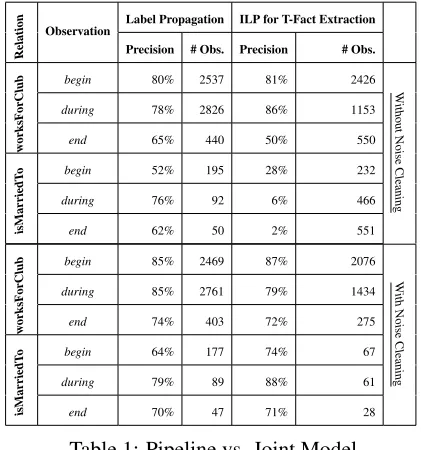
Table 1: Pipeline vs. Joint Model
Results. Table 1 shows the results on the pipeline model (lower-left), joint model (lower-right), label-propagation w/o noise cleaning (upper-left), and ILP for t-fact extraction w/o noise cleaning (upper-right).
Analysis. Regarding the upper part of Table 1 the
pattern-based extraction works very well for
works-ForClub, however it fails onisMarriedTo. The reason
is, that the types ofworksForClub distinguish the
patterns well from other relations. In contrast, isMar-riedTo’s patterns interfere with other person-person relations making constraints a decisive asset. When comparing the joint model and the pipeline model, the former sacrifices recall in order to keep up with the latter’s precision level. That is because the joint model’s ILP decides with binary variables on which patterns to accept. In contrast, label propagation ad-dresses the inherent uncertainty by providing label assignments with confidence numbers.
6.2 Increasing Recall
Setting.In a second experiment, we move the t-fact extraction stage away from high precision towards higher recall, where the successive noise cleaning stage attempts to restore the precision level.
Results. The columns of Table 2 show results for different values ofµ1 of Eq. (1). From left to right,
we usedµ1 = e−1,0.6,0.8for worksForCluband
µ1 =e−2, e−1,0.6forisMarriedTo. The table’s
up-per part reports on the output of stage 3, whereas the lower part covers the facts returned by noise cleaning.
Analysis. For the conservative setting label propa-gation produces high precision facts with only few inconsistencies, so the noise cleaning stage has no effect, i.e. no pruning takes place. This is the set-ting usual pattern-based approaches without cleaning stage are working in. In contrast, for the standard set-ting (coinciding with Table 1’s left column) stage 3 yields less precision, but higher recall. Since there are more inconsistencies in this setup, the noise cleaning stage accomplishes precision gains compensating for the losses in the previous stage. In the relaxed setting precision drops too low, so the noise cleaning stage is unable to figure out the truly correct facts. In general, the effects onworksForClubare weaker, since in this relation the constraints are less influential.
Conservative Standard Relaxed
Prec. # Obs. Prec. # Obs. Prec. # Obs.
w
orksF
orClub
begin 83% 2443 80% 2537 80% 2608
W
ithout
Noise
Cleaning
during 81% 2523 78% 2826 76% 2928
end 77% 377 65% 440 62% 501
isMarriedT
o begin 72% 112 52% 195 44% 269
during 90% 63 76% 92 52% 187
end 67% 37 62% 50 36% 116
w
orksF
orClub
begin 83% 2389 85% 2469 84% 2536
W
ith
Noise
Cleaning
during 88% 2474 85% 2761 75% 2861
end 79% 349 72% 403 70% 463
isMarriedT
o begin 72% 111 64% 177 46% 239
during 90% 62 79% 89 54% 177
[image:4.612.319.529.319.561.2]end 69% 36 68% 47 38% 110
Table 2: Increasing Recall.
7 Conclusion
Acknowledgements
This work is supported by the7thFramework IST
programme of the European Union through the fo-cused research project (STREP) on Longitudinal An-alytics of Web Archive data (LAWA) under contract no. 258105.
References
James F. Allen. 1983. Maintaining knowledge about
temporal intervals. Commun. ACM, 26(11):832–843,
November.
S¨oren Auer, Christian Bizer, Georgi Kobilarov, Jens Lehmann, and Zachary Ives. 2007. Dbpedia: A nu-cleus for a web of open data. InIn 6th Intl Semantic Web Conference, Busan, Korea, pages 11–15. Springer. Andrew Carlson, Justin Betteridge, Bryan Kisiel, Burr Settles, Estevam R. Hruschka Jr., and Tom M. Mitchell. 2010a. Toward an architecture for never-ending lan-guage learning. InAAAI, pages 1306–1313.
Andrew Carlson, Justin Betteridge, Richard C. Wang, Es-tevam R. Hruschka Jr., and Tom M. Mitchell. 2010b. Coupled semi-supervised learning for information ex-traction. InProceedings of the Third ACM Interna-tional Conference on Web Search and Data Mining (WSDM 2010).
Nathanael Chambers and Daniel Jurafsky. 2008. Jointly combining implicit constraints improves temporal or-dering. InEMNLP, pages 698–706.
Oren Etzioni, Michele Banko, Stephen Soderland, and Daniel S. Weld. 2008. Open information extraction
from the web.Commun. ACM, 51(12):68–74,
Decem-ber.
Johannes Hoffart, Mohamed Amir Yosef, Ilaria Bordino, Hagen F¨urstenau, Manfred Pinkal, Marc Spaniol, Ste-fan Thater, and Gerhard Weikum. 2011. Robust disam-biguation of named entities in text. InProc. of EMNLP 2011: Conference on Empirical Methods in Natural Language Processing, Edinburgh, Scotland, UK, July 2731, pages 782–792.
Richard M. Karp. 1972. Reducibility among
combinato-rial problems. InComplexity of Computer
Computa-tions, pages 85–103.
Xiao Ling and Daniel S. Weld. 2010. Temporal infor-mation extraction. InProceedings of the AAAI 2010 Conference, pages 1385 – 1390, Atlanta, Georgia, USA, July 11-15. Association for the Advancement of Artifi-cial Intelligence.
Inderjeet Mani, Marc Verhagen, Ben Wellner, Chong Min Lee, and James Pustejovsky. 2006. Machine learning of temporal relations. InIn ACL-06, pages 17–18. James Pustejovsky, Jos´e M. Casta˜no, Robert Ingria, Roser
Sauri, Robert J. Gaizauskas, Andrea Setzer, Graham
Katz, and Dragomir R. Radev. 2003. TimeML: Robust specification of event and temporal expressions in text. InNew Directions in Question Answering, pages 28– 34.
Dan Roth and Wen-Tau Yih, 2004.A Linear Programming Formulation for Global Inference in Natural Language Tasks, pages 1–8.
Fabian M. Suchanek, Gjergji Kasneci, and Gerhard Weikum. 2007. Yago: a core of semantic knowledge. InWWW ’07: Proceedings of the 16th International Conference on World Wide Web, pages 697–706, New York, NY, USA. ACM.
Partha Pratim Talukdar and Koby Crammer. 2009. New regularized algorithms for transductive learning. In
Proceedings of the European Conference on Machine Learning and Knowledge Discovery in Databases: Part II, ECML PKDD ’09, pages 442–457, Berlin, Heidel-berg. Springer-Verlag.
Partha Pratim Talukdar, Derry Wijaya, and Tom Mitchell. 2012. Coupled temporal scoping of relational facts. InProceedings of the Fifth ACM International Confer-ence on Web Search and Data Mining (WSDM), Seattle, Washington, USA, February. Association for Comput-ing Machinery.
Marc Verhagen, Inderjeet Mani, Roser Sauri, Robert Knip-pen, Seok Bae Jang, Jessica Littman, Anna Rumshisky, John Phillips, and James Pustejovsky. 2005.
Automat-ing temporal annotation with TARSQI. InACL ’05:
Proceedings of the ACL 2005 on Interactive poster and demonstration sessions, pages 81–84, Morristown, NJ, USA. Association for Computational Linguistics. Marc Verhagen, Robert Gaizauskas, Frank Schilder, Mark
Hepple, Jessica Moszkowicz, and James Pustejovsky. 2009. The tempeval challenge: identifying temporal relations in text.Language Resources and Evaluation, 43:161–179.
Yafang Wang, Bin Yang, Lizhen Qu, Marc Spaniol, and Gerhard Weikum. 2011. Harvesting facts from textual web sources by constrained label propagation. In Pro-ceedings of the 20th ACM international conference on Information and knowledge management, CIKM ’11, pages 837–846, New York, NY, USA. ACM.
Katsumasa Yoshikawa, Sebastian Riedel, Masayuki Asa-hara, and Yuji Matsumoto. 2009. Jointly identifying temporal relations with markov logic. InProceedings of the Joint Conference of the 47th Annual Meeting of the ACL and the 4th International Joint Conference on Natural Language Processing of the AFNLP: Volume 1 - Volume 1, ACL ’09, pages 405–413, Stroudsburg, PA,
USA. Association for Computational Linguistics. Qi Zhang, Fabian Suchanek, and Gerhard Weikum. 2008.