Proceedings of the 49th Annual Meeting of the Association for Computational Linguistics:shortpapers, pages 726–731,
Entity Set Expansion using Topic information
Kugatsu Sadamitsu, Kuniko Saito, Kenji Imamura and Genichiro Kikui∗ NTT Cyber Space Laboratories, NTT Corporation
1-1 Hikarinooka, Yokosuka-shi, Kanagawa, 239-0847, Japan
{sadamitsu.kugatsu, saito.kuniko, imamura.kenji}@lab.ntt.co.jp [email protected]
Abstract
This paper proposes three modules based on latent topics of documents for alleviating “se-mantic drift” in bootstrapping entity set ex-pansion. These new modules are added to a discriminative bootstrapping algorithm to re-alize topic feature generation, negative exam-ple selection and entity candidate pruning. In this study, we model latent topics with LDA (Latent Dirichlet Allocation) in an unsuper-vised way. Experiments show that the accu-racy of the extracted entities is improved by 6.7 to 28.2% depending on the domain.
1 Introduction
The task of this paper is entity set expansion in which the lexicons are expanded from just a few seed entities (Pantel et al., 2009). For example, the user inputs a few words “Apple”, “Google” and “IBM” , and the system outputs “Microsoft”, “Face-book” and “Intel”.
Many set expansion algorithms are based on boot-strapping algorithms, which iteratively acquire new entities. These algorithms suffer from the general problem of “semantic drift”. Semantic drift moves the extraction criteria away from the initial criteria demanded by the user and so reduces the accuracy of extraction. Pantel and Pennacchiotti (2006) pro-posed Espresso, a relation extraction method based on the co-training bootstrapping algorithm with en-tities and attributes. Espresso alleviates semantic-drift by a sophisticated scoring system based on
∗Presently with Okayama Prefectural University
pointwise mutual information (PMI). Thelen and Riloff (2002), Ghahramani and Heller (2005) and Sarmento et al. (2007) also proposed original score functions with the goal of reducing semantic-drift.
Our purpose is also to reduce semantic drift. For achieving this goal, we use a discriminative method instead of a scoring function and incorporate topic information into it. Topic information means the genre of each document as estimated by statisti-cal topic models. In this paper, we effectively uti-lize topic information in three modules: the first generates the features of the discriminative mod-els; the second selects negative examples; the third prunes incorrect examples from candidate examples for new entities. Our experiments show that the pro-posal improves the accuracy of the extracted entities. The remainder of this paper is organized as fol-lows. In Section 2, we illustrate discriminative boot-strapping algorithms and describe their problems. Our proposal is described in Section 3 and experi-mental results are shown in Section 4. Related works are described in Section 5. Finally, Section 6 pro-vides our conclusion and describes future works.
2 Problems of the previous Discriminative Bootstrapping method
multiple features are used to support the evidence. However, three problems exist in their methods. First, they use only local context features. The dis-criminative approach is useful for using arbitrary features, however, they did not identify which fea-ture or feafea-tures are effective for the methods. Al-though the context features and attributes partly re-duce entity word sense ambiguity, some ambiguous entities remain. For example, consider the domain
broadcast program (PRG) and assume that PRG’s attribute isadvertisement. A false example is shown here: “Android ’sadvertisement employs Japanese popular actors. The attractive smartphone begins to target new users who are ordinary people.” The en-tityAndroid belongs to the cell-phonedomain, not PRG, but appears with positive attributes or contexts because many cell-phonesare introduced in adver-tisements as same as broadcast program. By us-ing topic, i.e. the genre of the document, we can distinguish “Android” from PRG and remove such false examples even if the false entity appeared with positive context strings or attributes. Second, they did not solve the problem of negative example se-lection. Because negative examples are necessary for discriminative training, they used all remaining examples, other than positive examples, as negative examples. Although this is the simplest technique, it is impossible to use all of the examples provided by a large-scale corpus for discriminative training. Third, their methods discriminate all candidates for new entities. This principle increases the risk of gen-erating many false-positive examples and is ineffi-cient. We solve these three problems by using topic information.
3 Set expansion using Topic information
3.1 Basic bootstrapping methods
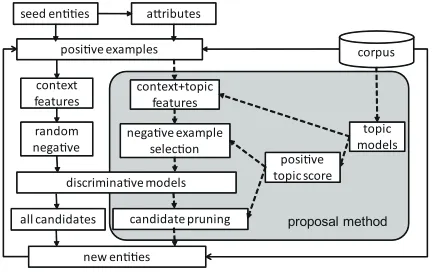
In this section, we describe the basic method adopted from Bellare (Bellare et al., 2006). Our system’s configuration diagram is shown in Figure 1. In Figure 1, arrows with solid lines indicate the basic process described in this section. The other parts are described in the following sections. After
Ns positive seed entities are manually given, every
noun co-occurring with the seed entities is ranked by PMI scores and then selected manually as Na
positive attributes. Ns and Na are predefined
ba-Figure 1: The structure of our system.
sic adjustment numbers. The entity-attribute pairs are obtained by taking the cross product of seed en-tity lists and attribute lists. The pairs are used as queries for retrieving the positive documents, which include positive pairs. The document set De,a
in-cluding same entity-attribute pair{e, a}is regarded as one exampleEe,ato alleviate over-fitting for
con-text features. These are called positive examples in Figure 1. Once positive examples are constructed, discriminative models can be trained by randomly selecting negative examples.
Candidate entities are restricted to only the Named Entities that lie in the close proximity to the positive attributes. These candidates of documents, including Named Entity and positive attribute pairs, are regarded as one example the same as the train-ing data. The discriminative models are used to cal-culate the discriminative positive score, s(e, a), of each candidate pair,{e, a}. Our system extractsNn
types of new entities with high scores at each iter-ation as defined by the summiter-ation ofs(e, a) of all positive attributes (AP);
∑
a∈APs(e, a). Note that
we do not iteratively extract new attributes because our purpose is entity set expansion.
3.2 Topic features and Topic models
[image:2.612.319.535.71.207.2]between documents and words through hidden top-ics. The topic models can calculate the posterior probability p(z|d) of topic z in document d. For example, the topic models give high probability to topic z =”cell-phone” in the above example sen-tences 1. This posterior probability is useful as a global feature for discrimination. The topic feature valueφt(z, e, a)is calculated as follows.
φt(z, e, a) =
∑
d∈De,ap(z|d) ∑
z0
∑
d∈De,ap(z
0|d).
In this paper, we use Latent Dirichlet Allocation (LDA) as the topic models (Blei et al., 2003). LDA represents the latent topics of the documents and the co-occurrence between each topic.
In Figure 1, shaded part and the arrows with bro-ken lines indicate our proposed method with its use of topic information including the following sec-tions.
3.3 Negative example selection
If we choose negative examples randomly, such ex-amples are harmful for discrimination because some examples include the same contexts or topics as the positive examples. By contrast, negative examples belonging to broad genres are needed to alleviate se-mantic drift. We use topic information to efficiently select such negative examples.
In our method, the negative examples are cho-sen far from the positive examples according to the measure of topic similarity. For calculating topic similarity, we use a ranking score called “positive topic score”,P T(z), defined as follows,P T(z) =
∑
d∈DPp(z|d), whereDP indicates the set of
pos-itive documents andp(z|d) is topic posterior prob-ability for a given positive document. The bottom 50% of the topics sorted in decreasing order of pos-itive topic score are used as the negative topics. Our system picks up as many negative documents as there are positive documents with each selected negative topic being equally represented.
3.4 Candidate Pruning
Previous works discriminate all candidates for ex-tracting new entities. Our basic system can constrain
1zis a random variable whose sample space is represented as a discrete variable, not explicit words.
the candidate set by positive attributes, however, this is not enough as described in Section 2. Our candi-date pruning module, described below, uses the mea-sure of topic similarity to remove obviously incor-rect documents.
This pruning module is similar to negative exam-ple selection described in the previous section. The positive topic score,P T, is used as a candidate con-straint. Taking all positive examples, we select the positive topics,P Z, which including all topicsz sat-isfying the condition P T(z) > th. At least one topic with the largest score is chosen as a positive topic whenP T(z) ≤ thabout all topics. After se-lecting this positive topic, the documents including entity candidates are removed if the posterior prob-ability satisfyp(z|d) ≤ th for all topics z. In this paper, we set the threshold toth = 0.2. This con-straint means that the topic of the document matches that of the positive entities and can be regarded as a hard constraint for topic features.
4 Experiments
4.1 Experimental Settings
We use 30M Japanese blog articles crawled in May 2008. The documents were tokenized by JTAG (Fuchi and Takagi, 1998), chunked, and labeled with IREX 8 Named Entity types by CRFs using Mini-mum Classification Error rate (Suzuki et al., 2006), and transformed into features. The context features were defined using the template “(head)entity(mid.)
attribute (tail)”. The words included in each part were used as surface, part-of-speech and Named En-tity label features added position information. Max-imum word number of each part was set at 2 words. The features have to appear in both the positive and negative training data at least 5 times.
In the experiments, we used three domains, car (“CAR”), broadcast program (“PRG”) and sports or-ganization (“SPT”). The adjustment numbers for ba-sic settings areNs = 10, Na = 10, Nn = 100.
CAR PRG SPT
1. Baseline 0.249 0.717 0.781
2. Topic features + 1. 0.483 0.727 0.844
3. Negative selection + 2. 0.509 0.762 0.846 4. Candidate pruning + 3. 0.531 0.824 0.848
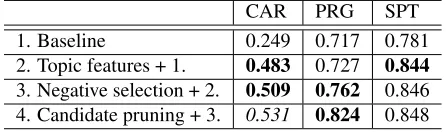
Table 1: The experimental results for the three domains. Bold font indicates that the difference between accuracy of the methods in the row and the previous row is signifi-cant (P <0.05by binomial test) and italic font indicates (P <0.1).
14 days of blog articles. In the Markov-chain Monte Carlo (MCMC) method, sampling was iterated 200 times for training with a burn-in taking 50 iterations. These parameters were selected based on the results of a preliminary experiment.
Four experimental settings were examined. First is Baseline; it is described in Section 3.1. Second is the first method with the addition of topic features. Third is the second method with the addition of a negative example selection module. Fourth is the third method with the addition of a candidate prun-ing module (equals the entire shaded part in Fig-ure 1). Each extracted entity is labeled with cor-rectorincorrect by two evaluators based on the re-sults of a commercial search engine. Theκscore for agreement between evaluators was 0.895. Because the third evaluator checked the two evaluations and confirmed that the examples which were judged as correct by either one of the evaluators were correct, those examples were counted as correct.
[image:4.612.74.297.72.138.2]4.2 Experimental Results
Table 1 shows the accuracy and significance for each domain. Using topic features significantly improves accuracy in the CAR and SPT domains. The nega-tive example selection module improves accuracy in the CAR and PRG domains. This means the method could reduce the risk of selecting false-negative ex-amples. Also, the candidate pruning method is ef-fective for the CAR and PRG domains. The CAR domain has lower accuracy than the others. This is because similar entities such as motorcycles are extracted; they have not only the same context but also the same topic as the CAR domain. In the SPT domain, the method with topic features offer signif-icant improvements in accuracy and no further
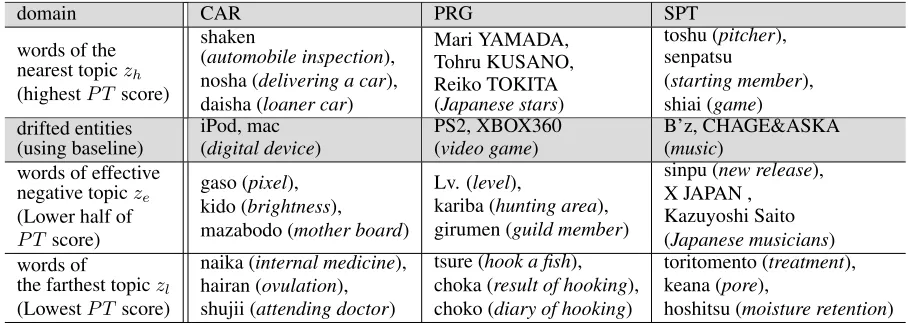
im-provement was achieved by the other two modules. To confirm whether our modules work properly, we show some characteristic words belonging to each topic that is similar and not similar to target do-main in Table 2. Table 2 shows characteristic words for one positive topiczh and two negative topicszl
andze, defined as follow.
• zh(the second row) is the topic that maximizes
P T(z), which is used as a positive topic.
• zl (the fourth row) is the topic that minimizes
P T(z), which is used as a negative topic.
• ze(the fifth row) is a topic that, we consider,
ef-fectively eliminates “drifted entities” extracted by the baseline method. ze is eventually
in-cluded in the lower half of topic list sorted by
P T(z).
For a given topic,z, we chose topmost three words in terms of topic-word score. The topic-word score of a word,v, is defined asp(v|z)/p(v), wherep(v) is the unigram probability ofv, which was estimated by maximum likelihood estimation. For utilizing candidate pruning, near topics includingzhmust be
similar to the domain. By contrast, for utilizing neg-ative example selection, the lower half of topics,zl,
ze and other negative topics, must be far from the
domain. Our system succeeded in achieving this. As shown in “CAR” in Table 2, the nearest topic includes “shaken” (automobile inspection) and the farthest topic includes “naika” (internal medicine) which satisfies our expectation. Furthermore, the ef-fective negative topic is similar to the topic of drifted entity sets (digital device). This indicates that our method successfully eliminated drifted entities. We can confirm that the other domains trend in the same direction as “CAR” domain.
5 Related Works
domain CAR PRG SPT
words of the nearest topiczh (highestP T score)
shaken
(automobile inspection), nosha (delivering a car), daisha (loaner car)
Mari YAMADA, Tohru KUSANO, Reiko TOKITA (Japanese stars)
toshu (pitcher), senpatsu
(starting member), shiai (game) drifted entities
(using baseline)
iPod, mac (digital device)
PS2, XBOX360 (video game)
B’z, CHAGE&ASKA (music)
words of effective negative topicze (Lower half of P T score)
gaso (pixel), kido (brightness),
mazabodo (mother board)
Lv. (level),
kariba (hunting area), girumen (guild member)
sinpu (new release), X JAPAN ,
Kazuyoshi Saito (Japanese musicians) words of
the farthest topiczl (LowestP T score)
naika (internal medicine), hairan (ovulation), shujii (attending doctor)
tsure (hook a fish), choka (result of hooking), choko (diary of hooking)
toritomento (treatment), keana (pore),
[image:5.612.77.531.71.233.2]hoshitsu (moisture retention)
Table 2: The characteristic words belonging to three topics,zh, zlandze.zhis the nearest topic andzlis the farthest topic for positive entity-attribute seed pairs.zeis an effective negative topic for eliminating “drifted entities” extracted by the baseline system.
are clustering methods based on probabilistic mea-sures. By contrast, Pas¸ca and Durme (2008) pro-posed clustering methods that are effective in terms of extraction, even though their clustering target is only the surrounding context. Ritter and Etzioni (2010) proposed a generative approach to use ex-tended LDA to model selectional preferences. Al-though their approach is similar to ours, our ap-proach is discriminative and so can treat arbitrary features; it is applicable to bootstrapping methods.
The accurate selection of negative examples is a major problem for positive and unlabeled learning methods or general bootstrapping methods and some previous works have attempted to reach a solution (Liu et al., 2002; Li et al., 2010). However, their methods are hard to apply to the Bootstrapping al-gorithms because the positive seed set is too small to accurately select negative examples. Our method uses topic information to efficiently solve both the problem of extracting global information and the problem of selecting negative examples.
6 Conclusion
We proposed an approach to set expansion that uses topic information in three modules and showed that it can improve expansion accuracy. The remaining problem is that the grain size of topic models is not always the same as the target domain. To resolve this problem, we will incorporate the active learning or the distributional approaches. Also, comparisons with the previous works are remaining work. From
another perspective, we are considering the use of graph-based approaches (Komachi et al., 2008) in-corporated with the topic information using PHITS (Cohn and Chang, 2000), to further enhance entity extraction accuracy.
References
Kedar Bellare, Partha P. Talukdar, Giridhar Kumaran, Fernando Pereira, Mark Liberman, Andrew McCal-lum, and Mark Dredze. 2006. Lightly-supervised at-tribute extraction. InProceedings of the Advances in Neural Information Processing Systems Workshop on Machine Learning for Web Search.
David M. Blei, Andrew Y. Ng, and Michael I. Jordan. 2003. Latent dirichlet allocation. The Journal of Ma-chine Learning Research, 3:993–1022.
David Cohn and Huau Chang. 2000. Learning to prob-abilistically identify authoritative documents. In Pro-ceedings of the 17th International Conference on Ma-chine Learning, pages 167–174.
Takeshi Fuchi and Shinichiro Takagi. 1998. Japanese Morphological Analyzer using Word Co-occurrence-JTAG. In Proceedings of the 36th Annual Meeting of the Association for Computational Linguistics and 17th International Conference on Computational Lin-guistics, pages 409–413.
Zoubin Ghahramani and Katherine A. Heller. 2005. Bayesian sets. InProceedings of the Advances in Neu-ral Information Processing Systems.
Mamoru Komachi, Taku Kudo, Masashi Shimbo, and Yuji Matsumoto. 2008. Graph-based analysis of se-mantic drift in Espresso-like bootstrapping algorithms. In Proceedings of the 2008 Conference on Empiri-cal Methods in Natural Language Processing, pages 1011–1020.
Xiao-Li Li, Bing Liu, and See-Kiong Ng. 2010. Neg-ative Training Data can be Harmful to Text Classi-fication. In Proceedings of the 2010 Conference on Empirical Methods in Natural Language Processing, pages 218–228.
Bing Liu, Wee S. Lee, Philip S. Yu, and Xiaoli Li. 2002. Partially supervised classification of text documents. In Proceedings of the 19th International Conference on Machine Learning, pages 387–394.
Zhiyuan Liu, Yuzhou Zhang, Edward Y. Chang, and Maosong Sun. 2011. PLDA+: Parallel latent dirich-let allocation with data placement and pipeline pro-cessing. ACM Transactions on Intelligent Systems and Technology, special issue on Large Scale Machine
Learning. Software available at http://code.
google.com/p/plda.
Mike Mintz, Steven Bills, Rion Snow, and Dan Jurafsky. 2009. Distant supervision for relation extraction with-out labeled data. InProceedings of the Joint Confer-ence of the 47th Annual Meeting of the ACL and the 4th International Joint Conference on Natural Language Processing of the AFNLP, pages 1003–1011.
Marius Pas¸ca and Benjamin Van Durme. 2008. Weakly-supervised acquisition of open-domain classes and class attributes from web documents and query logs. InProceedings of the 46th Annual Meeting of the As-sociation for Computational Linguistics, pages 19–27. Patrick Pantel and Marco Pennacchiotti. 2006. Espresso: Leveraging generic patterns for automatically harvest-ing semantic relations. InProceedings of the 21st In-ternational Conference on Computational Linguistics and the 44th annual meeting of the Association for Computational Linguistics, pages 113–120.
Patrick Pantel, Eric Crestan, Arkady Borkovsky, Ana-Maria Popescu, and Vishnu Vyas. 2009. Web-scale distributional similarity and entity set expansion. In
Proceedings of the 2009 Conference on Empirical Methods in Natural Language Processing, pages 938– 947.
Alan Ritter and Oren Etzioni. 2010. A Latent Dirich-let Allocation method for Selectional Preferences. In
Proceedings of the 48th ACL Conference, pages 424– 434.
Luis Sarmento, Valentin Jijkuon, Maarten de Rijke, and Eugenio Oliveira. 2007. More like these: grow-ing entity classes from seeds. In Proceedings of the 16th ACM Conference on Information and Knowledge Management, pages 959–962.
Jun Suzuki, Erik McDermott, and Hideki Isozaki. 2006. Training Conditional Random Fields with Multivari-ate Evaluation Measures. InProceedings of the 21st COLING and 44th ACL Conference, pages 217–224. Michael Thelen and Ellen Riloff. 2002. A