Speech-driven Access to the Deep Web on Mobile Devices
Taniya Mishra and Srinivas Bangalore AT&T Labs - Research
180 Park Avenue Florham Park, NJ 07932 USA.
{taniya,srini}@research.att.com.
Abstract
The Deep Web is the collection of infor-mation repositories that are not indexed by search engines. These repositories are typically accessible through web forms and contain dynamically changing infor-mation. In this paper, we present a sys-tem that allows users to access such rich repositories of information on mobile de-vices using spoken language.
1 Introduction
The World Wide Web (WWW) is the largest repository of information known to mankind. It is generally agreed that the WWW continues to significantly enrich and transform our lives in un-precedent ways. Be that as it may, the WWW that we encounter is limited by the information that is accessible through search engines. Search en-gines, however, do not index a large portion of
WWW that is variously termed as theDeep Web,
Hidden Web, orInvisible Web.
Deep Web is the information that is in propri-etory databases. Information in such databases is usually more structured and changes at higher fre-quency than textual web pages. It is conjectured that the Deep Web is 500 times the size of the surface web. Search engines are unable to index this information and hence, unable to retrieve it for the user who may be searching for such infor-mation. So, the only way for users to access this information is to find the appropriate web-form, fill in the necessary search parameters, and use it to query the database that contains the information that is being searched for. Examples of such web forms include, movie, train and bus times, and air-line/hotel/restaurant reservations.
Contemporaneously, the devices to access infor-mation have moved out of the office and home en-vironment into the open world. The ubiquity of mobile devices has made information access an any time, any place activity. However,
informa-tion access using text input on mobile devices is te-dious and unnatural because of the limited screen space and the small (or soft) keyboards. In
addi-tion, by themobilenature of these devices, users
often like to use them in hands-busy environments, ruling out the possibility of typing text. Filling web-forms using the small screens and tiny key-boards of mobile devices is neither easy nor quick.
In this paper, we present a system, Qme!,
de-signed towards providing a spoken language
inter-face to the Deep Web. In its current form,Qme!
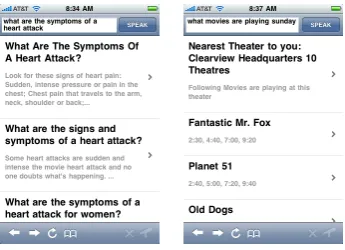
provides a unifed interface onn iPhone (shown in Figure 1) that can be used by users to search for
[image:1.595.332.505.528.653.2]staticanddynamicquestions.Staticquestions are questions whose answers to these questions re-main the same irrespective of when and where the questions are asked. Examples of such questions are What is the speed of light?, When is George Washington’s birthday?. For staticquestions, the system retrieves the answers from an archive of human generated answers to questions. This en-sures higher accuracy for the answers retrieved (if found in the archive) and also allows us to retrieve related questions on the user’s topic of interest.
Figure 1: Retrieval results for static and dynamic
questions usingQme!
Dynamic questions are questions whose an-swers depend on when and where they are asked.
Examples of such questions areWhat is the stock
price of General Motors?,Who won the game last night?,What is playing at the theaters near me?.
The answers to dynamic questions are often part of the Deep Web. Our system retrieves the answers to such dynamic questions by parsing the questions to retrieve pertinent search keywords, which are in turn used to query information databases accessi-ble over the Internet using web forms. However, the internal distinction between dynamic and static questions, and the subsequent differential treat-ment within the system is seamless to the user. The user simply uses a single unified interface to ask a
question and receive a collection of answers that
potentially address her question directly.
The layout of the paper is as follows. In
Sec-tion 2, we present the system architecture. In
Section 3, we present bootstrap techniques to dis-tinguish dynamic questions from static questions, and evaluate the efficacy of these techniques on a test corpus. In Section 4, we show how our system retrieves answers to dynamic questions. In Sec-tion 5, we show how our system retrieves answers to static questions. We conclude in Section 6.
2 Speech-driven Question Answer System
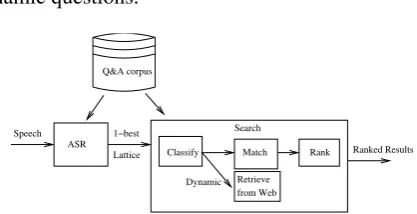
[image:2.595.311.520.72.179.2]Speech-driven access to information has been a popular application deployed by many compa-nies on a variety of information resources (Mi-crosoft, 2009; Google, 2009; YellowPages, 2009; vlingo.com, 2009). In this prototype demonstra-tion, we describe a speech-driven question-answer application. The system architecture is shown in Figure 2.
The user of this application provides a spoken language query to a mobile device intending to find an answer to the question. The speech recog-nition module of the system recognizes the spo-ken query. The result from the speech recognizer can be either a single-best string or a weighted word lattice.1This textual output of recognition is then used to classify the user query either as a dy-namic query or a static query. If the user query is static, the result of the speech recognizer is used to search a large corpus of question-answer pairs to retrieve the relevant answers. The retrieved results
are ranked usingtf.idf based metric discussed in
Section 5. If the user query is dynamic, the an-swers are retrieved by querying a web form from
the appropriate web site (e.g www.fandango.com
for movie information). In Figure 1, we illustrate
the answers that Qme!returns for static and
dy-1
For this paper, the ASR used to recognize these utter-ances incorporates an acoustic model adapted to speech col-lected from mobile devices and a four-gram language model that is built from the corpus of questions.
namic questions.
Lattice 1−best Q&A corpus
ASR Speech
Dynamic Classify
from Web Retrieve
Rank Search
Ranked Results Match
Figure 2: The architecture of the speech-driven question-answering system
2.1 Demonstration
In the demonstration, we plan to show the users static and dynamic query handling on an iPhone using spoken language queries. Users can use the iphone and speak their queries using an interface
provided byQme!. A Wi-Fi access spot will make
this demonstation more compelling.
3 Dynamic and Static Questions
As mentioned in the introduction, dynamic ques-tions require accessing the hidden web through a web form with the appropriate parameters. An-swers to dynamic questions cannot be preindexed as can be done for static questions. They depend on the time and geographical location of the ques-tion. In dynamic questions, there may be no ex-plicit reference to time, unlike the questions in the TERQAS corpus (Radev and Sundheim., 2002) which explicitly refer to the temporal properties of the entities being questioned or the relative or-dering of past and future events.
The time-dependency of a dynamic question lies in the temporal nature of its answer. For
exam-ple, consider the question,What is the address of
the theater White Christmas is playing at in New York?. White Christmas is a seasonal play that plays in New York every year for a few weeks in December and January, but not necessarily at the same theater every year. So, depending when this question is asked, the answer will be differ-ent. If the question is asked in the summer, the answer will be “This play is not currently playing anywhere in NYC.” If the question is asked dur-ing December, 2009, the answer might be different than the answer given in December 2010, because the theater at which White Christmas is playing differs from 2009 to 2010.
iden-tification using a tagger culminated in the devel-opment of TimeML (Pustejovsky et al., 2001), a markup language for annotating temporal ex-pressions and events in text. Other examples in-clude, QA-by-Dossier with Constraints (Prager et al., 2004), a method of improving QA accuracy by asking auxiliary questions related to the original question in order to temporally verify and restrict the original answer. (Moldovan et al., 2005) detect and represent temporally related events in natural language using logical form representation. (Sa-quete et al., 2009) use the temporal relations in a question to decompose it into simpler questions, the answers of which are recomposed to produce the answers to the original question.
3.1 Question Classification: Dynamic and Static Questions
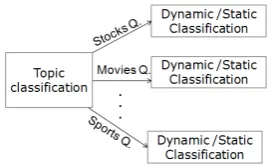
We automatically classify questions as dynamic and static questions. The answers to static ques-tions can be retrieved from the QA archive. To an-swer dynamic questions, we query the database(s) associated with the topic of the question through web forms on the Internet. We first use a topic classifier to detect the topic of a question followed by a dynamic/static classifier trained on questions related to a topic, as shown in Figure 3. For the
question what movies are playing around me?,
we detect it is a movie related dynamic ques-tion and query a movie informaques-tion web site (e.g. www.fandango.com) to retrieve the results based on the user’s GPS information.
Dynamic questions often contain temporal
in-dexicals, i.e., expressions of the formtoday, now,
this week, two summers ago, currently, recently, etc. Our initial approach was to use such signal words and phrases to automatically identify dy-namic questions. The chosen signals were based on annotations in TimeML. We also included spa-tial indexicals, such ashereand other clauses that were observed to be contained in dynamic ques-tions such ascost of, andhow much isin the list of signal phrases. These signals words and phrases were encoded into a regular-expression-based rec-ognizer.
This regular-expression based recognizer iden-tified 3.5% of our dataset – which consisted of several million questions – as dynamic. The type
of questions identified were What is playing in
the movie theaters tonight?, What is tomorrow’s weather forecast for LA?, Where can I go to get Thai food near here?However, random samplings of the same dataset, annotated by four independent human labelers, indicated that on average 13.5%
of the dataset is considered dynamic. This shows that the temporal and spatial indexicals encoded as a regular-expression based recognizer is unable to identify a large percentage of the dynamic ques-tions.
This approach leaves out dynamic questions that do not contain temporal or spatial indexicals.
For example,What is playing at AMC Loew’s?, or
What is the score of the Chargers and Dolphines game?. For such examples, considering the tense of the verb in question may help. The last two ex-amples are both in the present continuous tense. But verb tense does not help for a question such asWho got voted off Survivor?. This question is certainly dynamic. The information that is most likely being sought by this question is what is the name of the person who got voted off the TV show
Survivormost recently, and not what is the name
of the person (or persons) who have gotten voted off the Survivor at some point in the past.
Knowing the broad topic (such as movies, cur-rent affairs, and music) of the question may be very useful. It is likely that there may be many dynamic questions about movies, sports, and fi-nance, while history and geography may have few or none. This idea is bolstered by the following analysis. The questions in our dataset are anno-tated with a broad topic tag. Binning the 3.5% of our dataset identified as dynamic questions by their broad topic produced a long-tailed distribu-tion. Of the 104 broad topics, the top-5 topics
con-tained over 50%of the dynamic questions. These
top five topics were sports, TV and radio, events, movies, and finance.
[image:3.595.347.485.625.708.2]Considering the issues laid out in the previ-ous section, our classification approach is to chain two machine-learning-based classifiers: a topic classifier chained to a dynamic/static classifier, as shown in Figure 3. In this architecture, we build one topic classifier, but several dynamic/static classifiers, each trained on data pertaining to one broad topic.
Figure 3: Chaining two classifiers
classifier, since our entire dataset is annotated by human experts with topic labels. In contrast, to train a dynamic/static classifier, we experimented with the following three different techniques.
Baseline: We treat questions as dynamic if they contain temporal indexicals, e.g. today,now,this week,two summers ago,currently,recently, which were based on the TimeML corpus. We also
in-cluded spatial indexicals such ashere, and other
substrings such as cost of and how much is. A
question is considered static if it does not contain any such words/phrases.
Self-training with bagging: The general self-training with bagging algorithm (Banko and Brill, 2001). The benefit of self-training is that we can build a better classifier than that built from the small seed corpus by simply adding in the large unlabeled corpus without requiring hand-labeling.
Active-learning: This is another popular method for training classifiers when not much annotated data is available. The key idea in active learning is to annotate only those instances of the dataset that are most difficult for the classifier to learn to classify. It is expected that training classifiers us-ing this method shows better performance than if samples were chosen randomly for the same hu-man annotation effort.
We used the maximum entropy classifier in LLAMA (Haffner, 2006) for all of the above clas-sification tasks. We have chosen the active learn-ing classifier due to its superior performance and
integrated it into the Qme! system. We
pro-vide further details about the learning methods in (Mishra and Bangalore, 2010).
3.2 Experiments and Results
3.2.1 Topic Classification
The topic classifier was trained using a training set consisting of over one million questions down-loaded from the web which were manually labeled by human experts as part of answering the ques-tions. The test set consisted of 15,000 randomly selected questions. Word trigrams of the question are used as features for a MaxEnt classifier which outputs a score distribution on all of the 104 pos-sible topic labels. The error rate results for models selecting the top topic and the top two topics ac-cording to the score distribution are shown in Ta-ble 1. As can be seen these error rates are far lower than the baseline model of selecting the most fre-quent topic.
[image:4.595.357.475.61.104.2]Model Error Rate Baseline 98.79% Top topic 23.9% Top-two topics 12.23%
Table 1: Results of topic classification
3.2.2 Dynamic/static Classification
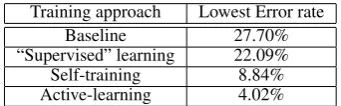
As mentioned before, we experimented with three different approaches to bootstrapping a
dy-namic/static question classifier. We evaluated
these methods on a 250 question test set drawn
from the broad topic of Movies. The error rates
are summarized in Table 2. We provide further de-tails of this experiment in (Mishra and Bangalore, 2010).
Training approach Lowest Error rate
Baseline 27.70%
“Supervised” learning 22.09% Self-training 8.84% Active-learning 4.02%
Table 2: Best Results of dynamic/static classifica-tion
4 Retrieving answers to dynamic questions
Following the classification step outlined in Sec-tion 3.1, we know whether a user query is static or dynamic, and the broad category of the question. If the question is dynamic, then our system per-forms a vertical search based on the broad topic of the question. In our system, so far, we have in-corporated vertical searches on three broad topics: Movies, Mass Transit, and Yellow Pages.
For each broad topic, we have identified a few trusted content aggregator websites. For example, for dynamic questions related to Movies-related
dynamic user queries, www.fandango.com is
a trusted content aggregator website. Other such trusted content aggregator websites have been identified for Mass Transit related and for Yellow-pages related dynamic user queries. We have also identified the web-forms that can be used to search these aggregator sites and the search parameters that these web-forms need for searching. So, given a user query, whose broad category has been deter-mined and which has been classified as a dynamic query by the system, the next step is to parse the query to obtain pertinent search parameters.
[image:4.595.331.502.274.327.2]of the user query. From the search parameters, a search query to the associated web-form is issued to search the related aggregator site. For
exam-ple, for a movie-related query, What time is
Twi-light playing in Madison, New Jersey?, the per-tinent search parameters that are parsed out are
movie-name: Twilight, city: Madison, andstate: New Jersey, which are used to build a search string that Fandango’s web-form can use to search the Fandango site. For a yellow-pages type of query,
Where is the Saigon Kitchen in Austin, Texas?, the pertinent search parameters that are parsed out are
business-name: Saigon Kitchen,city: Austin, and
state: Texas, which are used to construct a search string to search the Yellowpages website. These are just two examples of the kinds of dynamic user queries that we encounter. Within each broad cat-egory, there is a wide variety of the sub-types of user queries, and for each sub-type, we have to parse out different search parameters and use dif-ferent web-forms. Details of this extraction are presented in (Feng and Bangalore, 2009).
It is quite likely that many of the dynamic queries may not have all the pertinent search pa-rameters explicitly outlined. For example, a mass
transit query may be When is the next train to
Princeton?. The bare minimum search parameters
needed to answer this query are a from-location,
and ato-location. However, the from-locationis
not explicitly present in this query. In this case, thefrom-locationis inferred using the GPS sensor present on the iPhone (on which our system is built to run). Depending on the web-form that we are querying, it is possible that we may be able to sim-ply use the latitude-longitude obtained from the
GPS sensor as the value for thefrom-location
pa-rameter. At other times, we may have to perform an intermediate latitude-longitude to city/state (or zip-code) conversion in order to obtain the appro-priate search parameter value.
Other examples of dynamic queries in which search parameters are not explicit in the query, and hence, have to be deduced by the system, include
queries such asWhere is XMen playing?andHow
long is Ace Hardware open?. In each of these examples, the user has not specified a location. Based on our understanding of natural language, in such a scenario, our system is built to assume that the user wants to find a movie theatre (or, is referring to a hardware store)nearwhere he is cur-rently located. So, the system obtains the user’s location from the GPS sensor and uses it to search for a theatre (or locate the hardware store) within a five-mile radius of her location.
In the last few paragraphs, we have discussed how we search for answers to dynamic user queries from the hidden web by using web-forms. However, the search results returned by these web-forms usually cannot be displayed as is in our
Qme!interface. The reason is that the results are
often HTML pages that are designed to be dis-played on a desktop or a laptop screen, not a small mobile phone screen. Displaying the results as they are returned from search would make read-ability difficult. So, we parse the HTML-encoded result pages to get just the answers to the user
query and reformat it, to fit the Qme! interface,
which is designed to be easily readable on the iPhone (as seen in Figure 1).2
5 Retrieving answers to static questions
Answers to static user queries – questions whose answers do not change over time – are retrieved in a different way than answers to dynamic ques-tions. A description of how our system retrieves the answers to static questions is presented in this section.
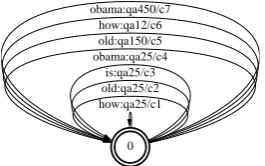
0 how:qa25/c1
old:qa25/c2 is:qa25/c3 obama:qa25/c4
old:qa150/c5 how:qa12/c6 obama:qa450/c7
[image:5.595.351.484.374.457.2]is:qa1450/c8
Figure 4: An example of an FST representing the search index.
5.1 Representing Search Index as an FST
To obtain results for static user queries, we have implemented our own search engine using finite-state transducers (FST), in contrast to using Lucene (Hatcher and Gospodnetic., 2004) as it is a more efficient representation of the search index that allows us to consider word lattices output by ASR as input queries.
The FST search index is built as follows. We index each question-answer (QA) pair from our repository ((qi, ai),qai for short) using the words (wqi) in questionqi. This index is represented as a weighted finite-state transducer (SearchFST) as shown in Figure 4. Here a wordwqi(e.gold) is the input symbol for a set of arcs whose output
sym-bol is the index of the QA pairs whereoldappears
2
in the question. The weight of the arcc(wqi,qi)is one of the similarity based weights discussed in Section 4.1. As can be seen from Figure 4, the wordshow,old,isandobamacontribute a score to
the question-answer pairqa25; while other pairs,
qa150, qa12, qa450 are scored by only one of these words.
5.2 Search Process using FSTs
A user’s speech query, after speech recogni-tion, is represented as a finite state automaton
(FSA, either 1-best or WCN), QueryFSA. The
QueryFSA is then transformed into another FSA (NgramFSA) that represents the set of n-grams
of the QueryFSA. In contrast to most text search
engines, where stop words are removed from the query, we weight the query terms with theiridf
val-ues which results in a weighted NgramFSA. The
NgramFSA is composed with the SearchFSTand we obtain all the arcs(wq, qawq, c(wq,qawq))where
wq is a query term,qawq is a QA index with the
query term and, c(wq,qa
wq) is the weight associ-ated with that pair. Using this information, we
aggregate the weight for a QA pair (qaq) across
all query words and rank the retrieved QAs in the descending order of this aggregated weight. We
select the top N QA pairs from this ranked list.
The query composition, QA weight aggregation
and selection of top N QA pairs are computed
with finite-state transducer operations as shown
in Equations 1 and 23. An evaluation of this
search methodology on word lattices is presented in (Mishra and Bangalore, 2010).
D=π2(N gramF SA◦SearchF ST) (1)
T opN =f smbestpath(f smdeterminize(D), N)
(2)
6 Summary
In this demonstration paper, we have presented
Qme!, a speech-driven question answering system
for use on mobile devices. The novelty of this sys-tem is that it provides users with a single unified interface for searching both the visible and the hid-den web using the most natural input modality for use on mobile phones – spoken language.
7 Acknowledgments
We would like to thank Junlan Feng, Michael Johnston and Mazin Gilbert for the help we re-ceived in putting this system together. We would
3
We have dropped the need to convert the weights into the realsemiring for aggregation, to simplify the discussion.
also like to thank ChaCha for providing us the data included in this system.
References
M. Banko and E. Brill. 2001. Scaling to very very large corpora for natural language disambiguation. InProceedings of the 39th annual meeting of the as-sociation for computational linguistics: ACL 2001, pages 26–33.
J. Feng and S. Bangalore. 2009. Effects of word con-fusion networks on voice search. InProceedings of EACL-2009, Athens, Greece.
Google, 2009.http://www.google.com/mobile.
P. Haffner. 2006. Scaling large margin classifiers for spoken language understanding. Speech Communi-cation, 48(iv):239–261.
E. Hatcher and O. Gospodnetic. 2004. Lucene in Ac-tion (In AcAc-tion series). Manning Publications Co., Greenwich, CT, USA.
Microsoft, 2009.http://www.live.com.
T. Mishra and S. Bangalore. 2010. Qme!: A speech-based question-answering system on mobile de-vices. InProceedings of NAACL-HLT.
D. Moldovan, C. Clark, and S. Harabagiu. 2005. Tem-poral context representation and reasoning. In Pro-ceedings of the 19th International Joint Conference on Artificial Intelligence, pages 1009–1104.
J. Prager, J. Chu-Carroll, and K. Czuba. 2004. Ques-tion answering using constraint satisfacQues-tion: Qa-by-dossier-with-contraints. InProceedings of the 42nd annual meeting of the association for computational linguistics: ACL 2004, pages 574–581.
J. Pustejovsky, R. Ingria, R. Saur´ı, J. Casta no, J. Littman, and R. Gaizauskas., 2001. The language of time: A reader, chapter The specification languae – TimeML. Oxford University Press.
D. Radev and B. Sundheim. 2002. Using timeml in question answering. Technical report, Brandies Uni-versity.
E. Saquete, J. L. Vicedo, P. Mart´ınez-Barco, R. Mu noz, and H. Llorens. 2009. Enhancing qa systems with complex temporal question processing capabilities.
Journal of Artificial Intelligence Research, 35:775– 811.
vlingo.com, 2009.
http://www.vlingomobile.com/downloads.html.