Yufang Hou
IBM Research Ireland [email protected]Katja Markert
Heidelberg UniversityDepartment of Computational Linguistics
Michael Strube
∗Heidelberg Institute for Theoretical Studies
In contrast to identity anaphors, which indicate coreference between a noun phrase and its antecedent, bridging anaphors link to their antecedent(s) via lexico-semantic, frame, or en-cyclopedic relations. Bridging resolution involves recognizing bridging anaphors and finding links to antecedents. In contrast to most prior work, we tackle both problems. Our work also follows a more wide-ranging definition of bridging than most previous work and does not impose any restrictions on the type of bridging anaphora or relations between anaphor and antecedent.
We create a corpus (ISNotes) annotated for information status (IS), bridging being one of the IS subcategories. The annotations reach high reliability for all categories and marginal reliability for the bridging subcategory. We use a two-stage statistical global inference method for bridging resolution. Given all mentions in a document, the first stage,bridging anaphora recognition, recognizes bridging anaphors as a subtask of learning fine-grained IS. We use a cascading collective classification method where (i) collective classification allows us to inves-tigate relations among several mentions and autocorrelation among IS classes and (ii) cascaded classification allows us to tackle class imbalance, important for minority classes such as bridging. We show that our method outperforms current methods both for IS recognition overall as well as for bridging, specifically. The second stage,bridging antecedent selection, finds the antecedents for all predicted bridging anaphors. We investigate the phenomenon of semantically or syntactically related bridging anaphors that share the same antecedent, a phenomenon we call sibling anaphors. We show that taking sibling anaphors into account in a joint inference
Submission received: 15 January 2017; revised version received: 16 January 2018; accepted for publication: 1 March 2018.
model improves antecedent selection performance. In addition, we develop semantic and salience features for antecedent selection and suggest a novel method to build the candidate antecedent list for an anaphor, using the discourse scope of the anaphor. Our model outperforms previous work significantly.
1. Introduction
An anaphor is an expression whose interpretation depends upon a previous expres-sion in the discourse (the antecedent). Figure 1 shows an excerpt of a news arti-cle with three anaphoric references: “its” is a pronominal anaphor referring back to the antecedent “The business,” which itself refers back to “The Bakersfield Super-market.” Both of these two anaphors refer to the same entity as their antecedents. Differently, the bridging anaphor “friends” does not refer to the same entity as its antecedent “its owner.” The phenomena illustrated in (1) and (2) have attracted a lot of interest under the heading of coreference resolution(Hobbs 1978; Hirschman and Chinchor 1997; Soon, Ng, and Lim 2001; Lee et al. 2013, 2017, inter alia). This article, however, focuses on the phenomenon illustrated in (3), known as bridging
(Clark 1975) or associative anaphora (Hawkins 1978). Bridging anaphors are ana-phoric noun phrases that are not coreferent but instead linked via associative relations to the antecedent.
Bridging resolution has to recognize bridging anaphors and find links to their antecedents. In Example (1), the bridging anaphors The windows, The carpets and
walls can be felicitously used thanks to their part-of relation to their antecedent the Polish center.1
(1) If Mr. McDonough’s plans get executed, as much as possible of the Polish centerwill be made from aluminum, steel and glass recycled from Warsaw’s abundant rubble. [2 sent.] The windows will open. The carpets won’t be glued down andwallswill be coated with non-toxic finishes.
Bridging plays an important role in establishing entity coherence in a text. Barzilay and Lapata (2008) model local coherence with the entity grid based on coreference only. However, Example (1) does not exhibit any coreferential entity coherence, and therefore entity coherence can only be established when bridging is resolved. Further-more, text understanding applications such as textual entailment (Mirkin, Dagan, and Pad ´o 2010), context question answering (Voorhees 2001), and opinion mining (Kobayashi, Inui, and Matsumoto 2007) have been shown to benefit from bridging resolution.
The main contributions presented in this article lie in the following aspects:
1. We present an English corpus (ISNotes) annotated for a wide range of information status (IS) categories as well as full anaphoric information for three anaphora types (coreference, bridging, and comparative; Section 3). Importantly, we impose no syntactic or relational restrictions on
bridging—that is, bridging anaphora are not limited to definite noun phrases as in most previous work; antecedents can be noun phrases, verb
Figure 1
Coreference anaphora and bridging anaphora.
phrases, or even clauses; and bridging relations are not restricted to meronymy. We show that bridging anaphora are very diverse. The overall annotation scheme is highly reliable, with the bridging category being annotated marginally reliably.2The corpus is available as an OntoNotes annotation layer viahttp://www.h-its.org/en/research/nlp/ isnotes-corpus/.
2. We modelbridging anaphora recognitionas a subtask of learning fine-grained information status (Section 4). We integrate discourse structure, lexico-semantic, and genericity detection features into a
cascading collective classification algorithm. Collective classification investigates relational autocorrelation among several IS classes whereas cascading classification addresses the multi-class imbalance problem, in particular the relative rarity of bridging compared to many other IS classes. Our model combines these two advantages by using binary classifiers for minority categories and a collective classifier for all categories. We beat current models both for overall IS classification accuracy as well as for bridging anaphora recognition on ISNotes.
3. We explore a joint inference framework forbridging antecedent selection
(Section 5). This model expresses an interesting topological property of bridging not used before—namely, that semantically or syntactically related anaphors are likely to share the same antecedent (such asThe windowsandwallsin Example (1)). In addition, we develop semantic, syntactic, and salience features based on linguistic insights and present a novel method for constructing candidate antecedent lists, according to the anaphor’sdiscourse scope. Our model significantly outperforms prior work.
4. Finally, we evaluatebridging resolutionas a pipeline consisting of bridging recognition and antecedent selection (Section 6). This is the first full bridging resolution system that attempts the unrestricted
phenomenon in a real setting.
All our experiments are performed on ISNotes and therefore all our claims hold only for the news genre. Although we believe the benefit of joint optimization to hold across other genres, several of our features are optimized for that particular corpus
and therefore our figures indicate the best possible performance of our approach. The adaptation to other corpora will likely need additional fine-tuning.3
Connection to previous conference publications.This article synthesizes Markert, Hou, and Strube (2012) and Hou et al. (2013a, 2013b). It provides more technical details, error analyses, and also includes the following new aspects. For the corpus, we now include a detailed analysis of our bridging cases (Section 3.3). In bridging recognition, we now use Markov Logic Networks instead of iterative collective classification to unify the approaches to the two tasks.4With regard to antecedent selection, we introduce several new features as well as the notion of using the discourse scope of an anaphor to adjust the set of potential antecedents it can refer back to (Section 5.3). We also now consider different evaluation paradigms dependent on whether one has access to full coreference information prior to bridging antecedent selection (mention-entity model) or not (mention model), whereas before we only considered the mention-entity model (Section 5.4.4). Finally, we include a pipeline of the two models for bridging recognition and antecedent selection to evaluate performance of the full task (Section 6).5
2. Related Work
We first review theoretical studies related to bridging (Section 2.1) before discussing corpus studies in Section 2.2. Section 2.3 reviews automatic algorithms for bridging resolution and Section 2.4 discusses bridging and implicit semantic role labeling.
2.1 Bridging: Theoretical Studies
Theoretical studies on bridging include linguistic (Hawkins 1978; Prince 1981, 1992), psycholinguistic (Clark 1975; Clark and Haviland 1977; Garrod and Sanford 1982), pragmatic and cognitive (Erk ¨u and Gundel 1987; Gundel, Hedberg, and Zacharski 2000; Matsui 2000; Schwarz 2000), as well as formal accounts (Hobbs et al. 1993; Bos, Buitelaar, and Mineur 1995; Asher and Lascarides 1998; L ¨obner 1998; Cimiano 2006; Irmer 2009).
Our concept of bridging is closest to the notions of associative anaphora in Hawkins (1978) and (noncontained) inferrables in Prince (1981): noun phrases (NPs) that are not coreferent to a previous mention but the referent of which is identifiable via a lexico-semantic, frame, or encyclopedic relation to a previous mention, with this relation not being syntactically expressed.
Relation types used are very diverse and antecedents can be noun phrases, verb phrases, or even whole sentences (Clark 1975; Asher and Lascarides 1998, inter alia). Several studies, such as Hawkins (1978) and L ¨obner (1998), limit bridging to definite NPs; we, however, believe that there is no clear difference in information status between
the windows, on the one hand, andwalls, on the other hand, in Example (1).6
3 Unfortunately, as we explain in Section 2.2, no other English corpus that is immediately usable for the full problem of bridging resolution is currently available for us to test our system on.
4 Quantitative results for bridging recognition are very similar to the previous framework, however. 5 We do not include the work that we conducted previously (Hou, Markert, and Strube 2014; Hou 2016), as
these follow very different paradigms, using rule-based and neural network approaches, respectively. None of these approaches outperform our work in this article.
Our bridging notion differs from Clark (1975) in that we do not include corefer-ential cases: We believe coreference is different both from an IS viewpoint (always being discourse-old) as well as from a computational perspective in that coreference needs different methods to resolve than bridging.
2.2 Bridging: Corpus Studies
Fraurud (1990) annotated first-mentioned NPs (which included bridging) versus subsequent mention NPs. Thirty-six percent of first-mentioned definite NPs have interpretations that “appear to involve a relation to contextual elements outside the definite NP itself” (Fraurud 1990, page 406), similar to our bridging definition.
The Vieira/Poesio data set (Poesio and Vieira 1998) contains 150 anaphoric def-inite NPs without a head match to their antecedents. These cases include what we call bridging as well as coreferential NPs without the same head. We will call this definition of bridging lenient bridging from now on. The corpus was used later to develop computational models (Section 2.3). In a second experiment, the authors delim-ited bridging proper from coreferential cases with very low agreement (31% per-class agreement).
Similarly, bridging recognition proved difficult for annotators of the GNOME cor-pus (Poesio 2004), where only 22% of bridging references were annotated in the same way by both annotators, although bridging relations were limited to set membership, subset, and generalized possession (part-of and ownership relations).
Nissim et al. (2004) is the first large-scale annotation study for IS for English. Based on Prince (1992) and Eckert and Strube (2000), they annotated NP types with three main categories: an old entity is known to the hearer and has been men-tioned in the conversation; anew entity is unknown to the hearer and has not been previously referred to; a mediated entity is newly mentioned in the dialogue but is inferrable from previously mentioned entities, or generally known to the hearer. Four of the nine subtypes of the mediated category (part, set, situation, and event) include bridging instances. Nissim et al. (2004) reported high agreement for the overall fine-grained IS annotation (with κ=0.788) on 147 Switchboard dialogues (LDC 1993). The κ scores for the four bridging subtypes are mostly marginally re-liable, between 0.594 and 0.794. However, the corpus cannot easily be used for a computational study of bridging anaphora resolution for the following reasons. First, antecedents for bridging NPs are not annotated. Second, the four subcate-gories used to mark up bridging also contain non-anaphoric cases, such as syn-tactically linked part-of relations (Example: the house’s door). In addition, any such study would be limited with regard to relation types as several of the bridging cases are only annotated if the relation to the antecedent is part of certain knowledge bases (i.e., part-of relations must be part of WordNet and situation relations part of FrameNet).
The German DIRNDL corpus (Eckart, Riester, and Schweitzer 2012; Bj ¨orkelund et al. 2014) contains IS annotations for all NPs following the scheme by Riester, Lorenz, and Seemann (2010). Bridging is one IS category but only used for definite expressions. They achieved a kappa score of 0.78 for six top-level categories. However, the confu-sion matrix in Riester, Lorenz, and Seemann (2010) shows that the anaphoric bridging category is frequently confused with other categories: The two annotators agreed on fewer than a third of bridging anaphors.
with lexical variety (Vieira 1998) or non-anaphoric NPs (Nissim et al. 2004). Second, they put more restrictions on bridging than we do, limiting to definite NP anaphora (Poesio and Vieira 1998; Gardent and Manu´elian 2005; Caselli and Prodanof 2006; Riester, Lorenz, and Seemann 2010), to NP antecedents (all prior work), or to few relation types between anaphor and antecedent (Poesio 2004). Apart from these dif-ferences in definition of bridging, often reliability is not measured or low, espe-cially for bridging recognition (Fraurud 1990; Poesio and Vieira 1998; Gardent and Manu´elian 2005; Nedoluzhko, M´ırovsk `y, and Pajas 2009; Riester, Lorenz, and Seemann 2010).
2.3 Bridging: Computational Approaches
Most computational approaches for resolving bridging focus on antecedent selection. Some handle bridging anaphora recognition when recognizing fine-grained IS. Only a few works tackle full bridging resolution—that is, recognizing bridging anaphors and finding links to antecedents.
Bridging anaphora recognition. Fine-grained IS classification for Switchboard (Nissim et al. 2004) has been implemented via a combination of rules and a multiclass SVM (Rahman and Ng 2012). F-scores for the four categories that include bridging (part, situation,event,set) ranged from 63.3 to 87.2. These results do not necessarily reflect the real difficulty of the problem, however, because of the restrictions posed on bridging in the underlying annotation and the inclusion of non-anaphoric cases (Section 2.2).
Cahill and Riester (2012) trained a CRF model for fine-grained IS classification on the German DIRNDL radio news corpus (Riester, Lorenz, and Seemann 2010), making use of the assumption that IS classes within sentences tend to follow certain orderings, for example, old > mediated > new. They did not report the result for the bridging subcategory.
An attention-based long short-term memory model with pre-trained word embed-dings and simple features achieved competitive results on ISNotes compared to our collective classification approach (Hou 2016).
Bridging antecedent selection. Based on the Vieira/Poesio data set (Section 2.2), vari-ous studies resolved “lenient” definite bridging references. Vieira and Teufel (1997) and Poesio, Vieira, and Teufel (1997) used heuristics for antecedent selection, exploit-ing WordNet relations such as synonymy/hyponymy/meronymy. Schulte im Walde (1998) used word clustering. The bridging anaphors were resolved to the closest antecedent candidate in a high-dimensional space, the best result being an accuracy of 22.7%.
Poesio et al. (2002) and Markert, Nissim, and Modjeska (2003) acquired mereolog-ical knowledge for bridging resolution by using syntactic patterns (such as the NP of NP) on the British National Corpus and the Web, respectively. All of this work was done on small data sets, numbering in the 10s for test bridging cases when excluding coreferential cases.
bridging anaphors. On the basis of this method, Lassalle and Denis (2011) developed a system that resolves mereological bridging in French, with meronymic informa-tion extracted from raw texts using a bootstrapping method. They reported an accu-racy of 23% for over 300 meronymy bridging anaphors using the realistic evaluation scenario.
Full bridging resolution.The rule-based system for processing definite NPs in Vieira and Poesio (2000) includes bridging cases (using the lenient definition of bridging discussed in the previous sections) but they do not report results for the bridging category.
Hahn, Strube, and Markert (1996) distinguish bridging resolution from other anaphora resolution. Their rule-based framework integrates language-independent conceptual criteria and language-dependent functional constraints. Their conceptual criteria were based on a knowledge base from the information technology domain that consists of 449 concepts and 334 relations. They focused on definite bridging anaphora and certain types of relations only (e.g.,has-property, has-physical-part). On a small-scale technical domain data set (5 texts in German with 109 bridging anaphors), they achieved a recall of 55.0% and precision of 73.2%. Although the results seem satisfactory, the system is heavily dependent on the domain knowledge resource.
Sasano and Kurohashi (2009) resolved bridging and zero anaphora in Japanese simultaneously, using automatically acquired case frames in a probabilistic model. Although it is not clear how bridging anaphora are distributed in their corpus and whether this approach can be effectively applied to other languages, the lexical knowl-edge resource constructed is general and can capture diverse bridging relations.
R ¨osiger and Teufel (2014) extended a coreference resolution system with semantic features from WordNet (e.g., hypernymy, meronymy) to find bridging links in scien-tific text, considering definite NPs only. They used the CoNLL scorer for evaluation. However, a coreference resolution system and evaluation metric are not suitable for bridging resolution because bridging is not a set problem.
Discussion.Our study departs from related work by modeling bridging on the discourse level without limiting it to definite NPs or to certain bridging relations (e.g., part-of). For bridging anaphora recognition, our cascading collective classification model (Section 4) addresses multi-class imbalance while keeping the strength of collective classification. For bridging antecedent selection, our joint inference model (Section 5) integrates bridging resolution with clustering anaphors that share the same antecedent. Furthermore, unlike previous work that uses a sentence window to form the set of antecedent candidates, we propose a method to select antecedent candidates using a flexible notion of discourse scope of an anaphor. The latter makes use of the discourse relationExpansionand models salience.
2.4 Implicit Semantic Role Labeling
Semantic role labeling is the task of assigning semantic roles (such asAgentorTheme) to the semantic arguments associated with a predicate (e.g., a verb or a noun). In frame semantics (Baker, Fillmore, and Lowe 1998), core semantic roles (also calledCore Frame Elements) are essential to the meaning of semantic situations while non-core semantic roles (e.g.,time,manner) are less central.
address the issue of non-local (implicit) argument identification for nominal and verbal predicates. There is partial overlap between bridging resolution and implicit semantic role labeling (i.e., in some bridging cases, antecedents are implicit semantic roles of bridging anaphors). However, bridging resolution considers all possible nominal bridg-ing anaphors in runnbridg-ing text. Some bridgbridg-ing anaphors are not considered “nominal predicates” in (implicit) semantic role labeling, for example,One manin Example (2).
(2) Still, employeesdo occasionally try to smuggle out a gem or two. One man
wrapped several diamonds in the knot of his tie.
In addition, implicit semantic role labeling for nominal predicates tries to link all possible implicit core roles for the nominal predicate in question. Yet not every nominal predicate under consideration is a bridging anaphor.
Despite differences between implicit semantic role labeling and bridging resolu-tion, these two tasks can benefit from each other. We explore statistics from NomBank (Meyers et al. 2004) to predict bridging anaphors (Section 4.3.2). Some of our features for bridging antecedent selection are inspired by Laparra and Rigau (2013) (Section 5.2.2).
3. ISNotes: A Corpus for Information Status
ISNotes contains 50 texts from the Wall Street Journal portion of OntoNotes (Weischedel et al. 2011), in which all mentions (10,980 overall) are annotated for IS. The corpus can be downloaded fromhttp://www.h-its.org/en/research/nlp/isnotes-corpus/.
3.1 ISNotes Annotation Scheme
Information status in ISNotes. Information status describes the degree to which a dis-course entity is available to the hearer regarding the speaker’s assumption about the hearer’s knowledge and beliefs (Prince 1992; Nissim et al. 2004). We distinguish eight IS categories, inspired by Nissim et al. (2004), although with some variations.
A mention is oldif it is either coreferent with a previous mention (based on the OntoNotes coreference annotation), or if it is a generic or deictic pronoun.
Mediatedmentions have not been mentioned before but are not autonomous—that is, they can only be correctly interpreted by reference to another mention or to prior world knowledge. ISNotes distinguishes six subcategories ofmediatedmentions:
r
mediated/worldKnowledge(abbreviated asmediated/WK) mentions are generally known to the hearer. This category includes many proper names, such asPoland.r
mediated/syntacticmentions are syntactically linked via a possessiverelation, a proper name premodification or a prepositional phrase postmodification to otheroldormediatedmentions, such as: • [[their]oldliquor store]mediated/syntactic,
• [the [Federal Reserve]mediated/WKboss]mediated/syntactic,and
• [the main artery into [San Francisco]mediated/WK]mediated/syntactic
that makes clear that this entity is compared to a previous one, such as
othersin Example (3).7,8
r
mediated/bridgingmentions are non-coreference anaphors where a frame, lexico-semantic, or world knowledge relation holds between anaphor and antecedent, such asthe streetsin Example (4) andThe reasonin Example (5).r
mediated/aggregatementions are coordinated mentions where at least one element in the conjunction isoldormediated, such as[Not only [George Bush]mediated/WKbut also [BarackObama]mediated/WK]mediated/aggregate.
r
mediated/functionmentions refer to a value of a previously mentioned function (e.g.,3 pointsin Example (6)). The function needs to be able to rise and fall (e.g.,were downin Example (6)).(3) As the death toll from last week’s tremblor climbed to 61, the condition of freeway survivor Buch Helm, who spent four days trapped under rubble, im-proved, hospital officials said. Rescue crews, however, gave up hope that
otherswould be found.
(4) Oranjemund, the mine headquarters, is a lonely corporate oasis of 9,000 residents. Jackals roamthe streetsat night . . .
(5) The Bakersfield supermarketwent out of businesslast May.The reasonwas not high interest rates or labor costs.
(6) IBM shares were down 3 points.
New mentions have not yet been introduced in the discourse and the entity they refer to cannot be inferred from either previously mentioned entities/events or general world knowledge.
Antecedents for mediated/bridging and mediated/comparative. Antecedents for both mediated/bridging and mediated/comparative categories are annotated.9 The an-tecedents can be NPs (Example (4)), verb phrases (e.g.,went out of businessin Exam-ple (5)), or even clauses. If an NP antecedent has several instantiations within the text, ISNotes chooses the one which is the closest to the bridging or comparative men-tion. Other instantiations can be inferred from the coreference annotamen-tion. Sometimes, several non-coreferent antecedents are annotated for a mediated/bridging mention when the antecedents fill core semantic roles. In Example (7), two antecedents are necessary to interpret the bridging anaphorDomestic demand.10
(7) Japan’sproduction ofcars, trucks and busesin September fell 4.4% from a year ago. [. . . ]Domestic demandcontinues to grow, but . . .
7 Comparative anaphors are typed inboldface, antecedents initalics.
8 Nissim et al. (2004) view comparative anaphora as a subset of bridging. We distinguish them as their recognition (via lexical clues) and their resolution (often type matches) differ from other bridging cases. 9 Antecedents foroldmentions are from the OntoNotes coreference annotation.
Table 1
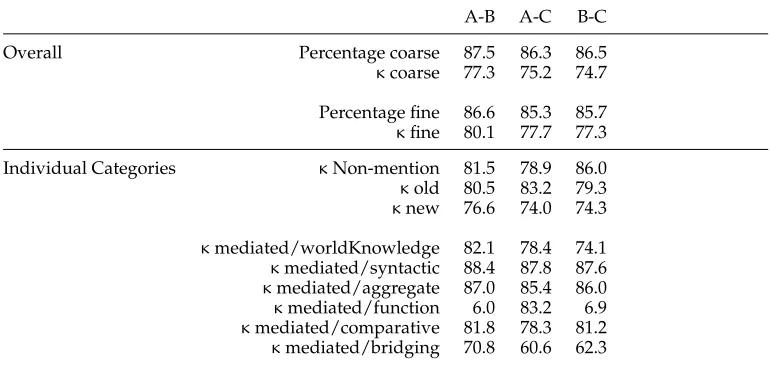
Agreement results, overall (top) and for individual categories (bottom). A-B A-C B-C
Overall Percentage coarse 87.5 86.3 86.5
κcoarse 77.3 75.2 74.7 Percentage fine 86.6 85.3 85.7
κfine 80.1 77.7 77.3 Individual Categories κNon-mention 81.5 78.9 86.0
κold 80.5 83.2 79.3
κnew 76.6 74.0 74.3
κmediated/worldKnowledge 82.1 78.4 74.1
κmediated/syntactic 88.4 87.8 87.6
κmediated/aggregate 87.0 85.4 86.0
κmediated/function 6.0 83.2 6.9
κmediated/comparative 81.8 78.3 81.2
κmediated/bridging 70.8 60.6 62.3
3.2 Agreement Study
An agreement study was carried out among three annotators. Annotator A is the scheme developer and a computational linguist. Annotators B and C have no linguistic training or education. Annotator A and B are fluent English speakers, living in English-speaking countries, but are not native speakers. Annotator C is a native speaker of English.
All potential mentions were pre-marked automatically using the WSJ syntactic noun phrase annotation. All non-initial mentions in an OntoNotes coreference chain were pre-marked asold. The annotation task consisted of excluding all non-mentions (such as non-referentialit) and marking all mentions for their information status as well as the antecedents for comparative and bridging anaphora. The scheme was developed on nine texts, which were also used for training the annotators. Inter-annotator agree-ment was measured on 26 new texts, which included 5,905 potential agree-mentions. The annotations of 1,499 of these were carried over from OntoNotes coreference annotation, leaving 4,406 potential mentions for annotation and agreement measurement.
Table 1 (top) shows percentage agreement as well as Cohen’s κ (Artstein and Poesio 2008) between all three possible annotator pairings at the coarse-grained (four categories: non-mention, old, new, mediated) and the fine-grained level (nine categories: non-mention, old, new and the six mediated subtypes). As our category distribution is highly unbalanced, Cohen’s kappa is necessary to report as it corrects for chance agreement achieved by just using majority categories.11 Table 1 (bottom) shows in-dividual category agreement, computed by merging all categories but one and then
Table 2
IS distribution in ISNotes. The last column indicates the percentage of each IS category relative to the total number of mentions.
Texts 50
Sentences 1,726
Mentions 10,980
old 3,237 29.5%
coreferent 3,143 28.6% generic or deictic pronoun 94 0.9%
mediated 3,708 33.8%
syntactic 1,592 14.5% world knowledge 924 8.4% bridging 663 6.0% comparative 253 2.3% aggregate 211 1.9% function 65 0.6%
new 4,035 36.7%
computing κ as usual. High reliability is achieved for most individual categories.12 The reliability of the category bridging is marginally reliable and more annotator-dependent, although higher than other previous attempts at bridging annotation (Poesio 2003; Gardent and Manu´elian 2005; Riester, Lorenz, and Seemann 2010). The agreement of selecting bridging antecedents is around 80% for all annotator pairings.
We investigated disagreements between Annotators A and B in bridging recogni-tion: Almost all cases are instances where one annotator identified bridging and the other onenew. Particularly frequent were borderline cases where the whole document had one major focus and subsequent NPs with a semantic relation to that focus could be seen either asnew(interpretable without the major focus) or bridging. As an example, consider a document on the companyToyotaand a later sentence stating Output had gone down. According to our guidelines, most of these cases are bridging, but they are easily overlooked.
The bridging annotations of the pairing A-B were used to create a consistent gold standard of the 35 texts (9 training, 26 testing), discussing all disagreed items between the annotators. Finally, Annotator A annotated a further 15 texts singly.
3.3 Corpus Analysis
IS distribution. Table 2 shows the class distribution. New mentions are the largest category (36.7%).Syntacticmentions are the largestmediatedcategory.
Bridging anaphora modification.Bridging anaphors can be definite NPs (Examples (9) and (11), indefinite NPs (Example (10)), or bare NPs (Examples (8), (12)–(14)). The only syntactic property shared is that bridging anaphora tend to have a simple internal structure with regard to modification. They are also easily confused with generics: friendsis used as a bridging anaphor in Example (14) but generically in Example (15).
(8) In June, farmers held ontomeat, milk and grain, waiting for July’s usual state-directed price rises. The Communists frozepricesinstead.
(9) To reduce it at the fund’s building, workers rubbed beeswax instead of polyurethane on the floors in the executive’s office. [1 sent.]The budgetwas only $400,000.
(10) Still,employeesdo occasionally try to smuggle out a gem or two. [2 sent.] A food catererstashed stones in the false bottom of a milk pail.
(11) His truckis parked across the field, in a row of grain sellers. [2 sent.] The farmer atthe next truckshouts, “Wheat!”
(12) The survey found that over a three-year period 22% ofthe firmssaid employees or owners had been robbed on their way to or from work or while on the job. [1 sent.] Crime was the reason that 26% reported difficulty recruiting personnel and that19%said they were considering moving.
(13) Mr. Leavitt, 37, was elected chairman earlier this year bythe company’snew board [. . . ] His father waschairmanandchief executiveuntil his death in an accident five years ago.
(14) Shemade money, but spent more.Friendspitched in. (15) Friends are part of the glue that holds life and faith together.
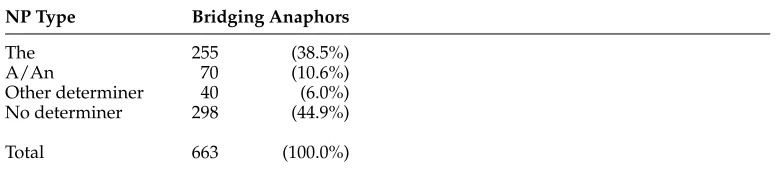
Table 3 shows the bridging anaphora distribution with regard to determiners: Only 38.5% of bridging anaphors are modified bythe, 44.9% of bridging anaphors are not modified by any determiners. This calls into question the strategy of several prior approaches (Vieira and Poesio 2000; Lassalle and Denis 2011; Cahill and Riester 2012) to limit themselves to bridging anaphors modified bythe.
[image:12.486.47.438.569.657.2]Bridging pair distance. We define the distance between a bridging anaphor and its antecedent as the distance between the anaphor and its closest preceding antecedent instantiation. The distribution of the distance for all 683 anaphor-antecedent pairs is
Table 3
Bridging anaphora distribution with respect to determiners.
NP Type Bridging Anaphors
The 255 (38.5%)
A/An 70 (10.6%)
Other determiner 40 (6.0%)
No determiner 298 (44.9%)
Figure 2
[image:13.486.53.444.311.400.2]The distribution of anaphor–antecedent distances in sentences.
Table 4
Bridging pair distribution with respect to relation types.
Relation Type Bridging Pairs
Action 16 (2.3%)
Set/Membership 45 (6.6%) part-of/attribute-of 92 (13.5%)
Other 530 (77.6%)
Total 683 (100.0%)
shown in Figure 2.13 We see that 77% of anaphors have antecedents occurring in the same or up to two sentences prior to the anaphor, although that still leaves a substantial number of instances that need relatively distant antecedents.
Bridging relations.The semantic relations between anaphor and antecedent are extremely diverse. Among 683 bridging pairs, only 2.3% correspond to an action, 6.6% to a set membership (see Example (2)) and 13.5% to a part-of/attribute-of relation between anaphor and antecedent (Table 4). A total of 77.6% of bridging relations fall under the category “other,” without further distinction. This includes encyclopedic relations such asrestaurant–the waiteras well as context-specific relations such aspalms–the thieves. Among all bridging antecedents, only 39 are represented by verbs or clauses.
Sibling anaphors.We call bridging anaphors “siblings” if they share the same antecedent (entity), and “non-siblings” are anaphors that do not share an antecedent with any other anaphor. In Example (1),The windows,The carpets, andwallsare sibling anaphors.
In ISNotes, 61.4% of the bridging anaphors are siblings and we will use this to good effect in our model for bridging antecedent selection.
4. Information Status and Bridging Anaphora Recognition
For IS recognition, each mention is assigned one of the eight classes old, mediated/ syntactic, mediated/WK, mediated/bridging, mediated/comparative, mediated/ aggregate,mediated/function, andnew. We make contributions to bridging recogni-tion as well as for IS recognirecogni-tion in general.
4.1 Motivation for the Task
IS recognition can be beneficial for NLP tasks such as determining constituent order in generation (Cahill and Riester 2009) or coreference resolution (Rahman and Ng 2011). Treating bridging anaphora recognition as part of IS recognition prior to antecedent selection implies that it is possible to recognize bridging anaphors without know-ing the antecedent. Predictknow-ing bridgknow-ing anaphors and their antecedents jointly might be more attractive because some antecedents could trigger subsequent bridging. In Example (1), the antecedent the Polish center could trigger the anaphor walls. How-ever, bridging anaphors can be solely indicated by referential patterns as nonsense Example (16) shows that the wugis clearly a bridging anaphor although we do not know the antecedent.14
(16) The blicket couldn’t be connected to the dax.The wugfailed.
In a similar vein, Clark (1975) distinguishes between bridging via necessary, prob-able, and inducible parts/roles. He argues that only in the first case does the antecedent trigger the bridging anaphor in the sense that we already think of the anaphor when we read/hear the antecedent. For instance, wallsin Example (1) are necessary parts of the antecedent the Polish centeraccording to common sense knowledge. However, windows and carpets are only probable or inducible parts of a building but still function as bridging anaphors in Example (1).
4.2 Method: Model
4.2.1 Model I: Collective Classification
Motivation.Twomediatedsubcategories account for accessibility via syntactic links to anotheroldormediatedmention.Mediated/syntacticis used when at least one child of a mention ismediatedorold, with child relations restricted to:
r
Possessive pronouns or possessive NPs(e.g., [[his]oldfather]mediated/syntactic)
r
Of-genitives (e.g., [The alcoholism of [his]oldfather]mediated/syntactic)r
Proper name premodifiers(e.g., [The [Federal Reserve]mediated/WKboss]mediated/syntactic)
r
Other prepositional phrases(e.g., [professors at [Cambridge]mediated/WK]mediated/syntactic)
The subcategory mediated/aggregate is for coordinations in which at least one of the children isoldormediated, e.g.,Not only George Bush but also Barack Obamais mediated/aggregateasBarack Obamaismediated/WK.
In these two cases, a mention’s IS depends directly on the IS of its children. This is therefore a case of so-called autocorrelation, a characteristic of relational data in which the value of one variable for one instance is highly correlated with the value of the same variable on another instance. By exploiting relational auto-correlation, collective classification (Jensen, Neville, and Gallagher 2004; Macskassy and Provost 2007) can significantly outperform independent supervised classification (Taskar, Segal, and Koller 2001; Neville and Jensen 2003; Domingos and Lowd 2009) and has been applied, for example, in part-of-speech tagging (Lafferty, McCallum, and Pereira 2001), Web page categorization (Taskar, Abbeel, and Koller 2002), opinion mining (Somasundaran et al. 2009; Burfoot, Bird, and Baldwin 2011), and entity linking (Fahrni and Strube 2012).
Detailed model. Mdenotes the set ofnmentions in a documentD, andSthe set of eight IS classes. Letsm be the IS class associated with a mentionm∈M,SM be the IS class
assignments for all mentions inM,SnMbe the set of all possible IS class assignments for M. The collective IS classification task can be represented as a log-linear model:
P(SM|M;w)= exp(w
·Φ(M,SM))
P
SM0∈SnMexp(w·Φ(M,SM
0)) (17)
wherewis the model’s weight vector, andΦ(M,SM) is the feature vector that takes all
IS class assignments for all mentions inMinto account. We defineΦ(M,SM) as:
Φ(M,SM)=
X
l∈Fl X
m∈M
Φl(m,sm)+
X
g∈Fg X
mi,mj∈M
Φg(smi,smj) (18)
whereΦl(m,sm) is a local feature function that looks at the mentionmand the target IS
classsm,Flis the set of local features,Φg(smi,smj) is a global feature function that looks at the target IS class assignments formi andmj at once, and Fg is the global feature
set.
This log-linear model can be represented using Markov logic networks (MLNs) (Domingos and Lowd 2009). An MLN is a statistical relational learning framework that combinesfirst order logicandMarkov networks. It provides us with a simple yet flexible language to construct joint models for bridging resolution. Moreover, our task-specific models can benefit from the advances in inference and learning algorithms for MLNs.
A Markov logic network is defined as a set of pairs (fi,wi), wherefiis a formula in
first-order logic andwiis a real number (Domingos and Lowd 2009). In first-order logic,
Table 5
Hidden predicates and formulas used for bridging anaphora recognition.mrepresents a mention,Mthe set of mentions in the whole document,san IS class,Sthe set of eight IS classes, andwthe weight learned from the data for the specific formula.
Hidden predicates p1 hasIS(m,s) Formulas Hard constraints
f1 ∀m∈M: |s∈S:hasIS(m,s)|=1 Joint inference formula template
fg (w) ∀mi,mj∈M∀smi,smj ∈S: jointInferenceFormula Constraint (mi,mj)
→hasIS(mi,smi) ∧ hasIS(mj,smj)
Non-joint inference formula template
fl (w) ∀m∈M∀s∈S: non-jointInferenceFormula Constraint (m,s)→hasIS(m,s)
In a ground Markov network, the probability distribution over the possible world SMis given by
P(SM)= Z1exp
X
i
wini(SM)
!
(19)
whereni(SM) is the number of true groundings of a local or a global feature functionFi
inSM,wiis the weight forFi, andZis the partition function. Table 5 shows the formula
templates to model IS recognition in MLNs.p1 is the hidden predicate that we want to predict (i.e., the information statussof a mention m).f1 models that each mention can only belong to one IS class, and fg andflare templates of joint inference formulas
and non-joint inference formulas, respectively.15 Details of specific formulas (features) instantiatingfgandflare described in Sections 4.3.1 and 4.3.2.
4.2.2 Model II: Cascading Collective Classification
Motivation for the model.As shown in Section 3, bridging anaphors have different deter-miners and few easily identifiable surface features. In addition, they are relatively rare, making up only 6% of noun phrases in our data. Such multi-class imbalance problems are an open research topic (Abe, Zadrozny, and Langford 2004; Zhou and Liu 2010; Wang and Yao 2012). Classification accuracy may be artificially high in case of extremely imbalanced data: Majority classes are favored, and minority classes are not recognized. Such a bias becomes stronger within the multi-class setting. To address this problem while still keeping the strength of collective inference within a multi-class setting, we
Figure 3
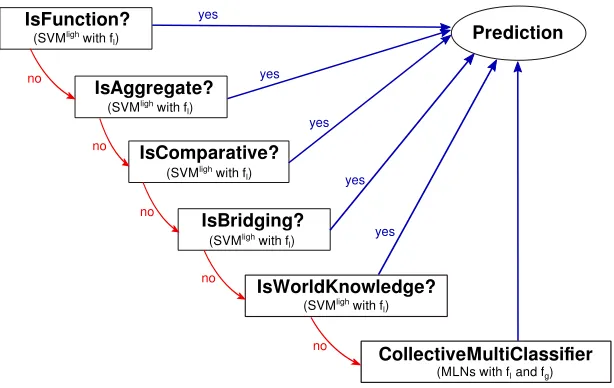
The cascading collective classification system.
integrate our collective classification model (Section 4.2.1) into a cascading collective classification system inspired by Omuya, Prabhakaran, and Rambow (2013).
Detailed Model.Unlike in the multi-class setting, learning from imbalanced data in the binary setting has been well studied (He and Garcia 2009). Therefore, our cascading collective classification system, shown in Figure 3, combines binary classifiers for mi-nority categories and a collective classifier for all categories in a pipeline. Specifically, for the five classesmediated/function,mediated/aggregate,mediated/comparative, mediated/bridging, andmediated/WKthat each constitutes less than the expected one-eighth of the instances, we develop five binary classifiers with SVMlight(Joachims 1999). These classifiers use only non-joint inference formulae, but have the advantage that we can tune the SVM parameter against data imbalance on the training set. We arrange them from the rarest to the most frequent category. Whenever a minority classifier predicts true, this class is assigned. When all minority classifiers say false, we back off to multi-class collective inference (Section 4.2.1). Omuya, Prabhakaran, and Rambow (2013, page 805) motivate a rarest to most frequent ordering on the task of dialogue act tagging by “the observation that the less frequent classes are also hard to predict correctly” and we follow their procedure. Such a framework substantially improves bridging anaphora recognition without jeopardizing performance on other IS classes (Section 4.4.3).
4.3 Method: Features
Section 4.3.1 details the relational features that instantiate the joint inference formula templatefg in Table 5. Section 4.3.2 details non-relational features that instantiate the
non-joint inference formula template fl in Table 5. Apart from the ISNotes corpus,
4.3.1 Relational Features
Syntactic hasChild relations.We link a mentionm1to a mentionm2via ahasChildrelation if (i)m2 is a possessive or prepositional modification ofm1; or (ii)m2 is a proper name premodifier of m1. For instance, the mention[professors at Cambridge]is linked to the mention[Cambridge]via ahasChildrelation.
Syntactic hasChildCoordination relations. We link a mention m1 to a mention m2 via a
hasChildCoordinationrelation if m1 is a coordination andm2 is one of its children. For example, the mention [Not only George Bush but also Barack Obama] is linked to the mention[Barack Obama]via ahasChildCoordinationrelation.
Syntactic ConjoinedTo relations.Conjoined mentions may have the same IS class. We link a mention m1 to a mention m2 via a ConjoinedTo relation if both m1 and m2 are the children of a coordination. For example,[George Bush]is linked to[Barack Obama]via aConjoinedTorelation as both are the children of the coordination[Not only George Bush but also Barack Obama].
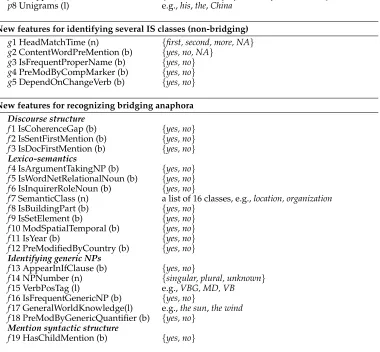
4.3.2 Non-relational Features.Table 6 shows all non-relational features for IS recognition.
Features p1–p8 from previous work. We adapt features p1–p8 from Nissim (2006) and Rahman and Ng (2011). A mention with complete string match to a previous one is likely to beold(p1,p2). The head match featurep3 (from Nissim’s PartialpreMention feature as well as coreference resolution [Vieira and Poesio 2000; Soon, Ng, and Lim 2001]) identifies old and mediated categories such as comparative anaphora. p4NPlength is motivated by Arnold et al. (2000, page 34): “items that are new to the discourse tend to be complex and items that are given tend to be simple.” There is a tendency for indefinite NPs to benew(Hawkins 1978) (p5). Subjects are likely to beold (p6) (Prince 1992). Pronouns tend to beold(p7). Rahman and Ng (2011) explore lexical features (p8), for example, mentions which include the lexical unit his are likely not to benew.
New features for identifying several IS classes (non-bridging). The new features (g1–g5) capture the classesoldas well asmediated/WK,mediated/comparative, andmediated/ function.g1HeadMatchTimeandg2ContentWordPreMentionare string match variations, giving a categorical version ofp3HeadMatchand a partial mention match going beyond the mention’s head, respectively.
Proper names not previously mentioned in the text but appearing in many other documents are likely to be hearer-old (IS classmediated/WK). To approximate this,g3 IsFrequentProperName measures if the mention is a proper name, occuring in at least 100 documents in the Tipster corpus (Harman and Liberman 1993).
Mediated/comparativementions are often indicated by surface clues such as pre-modifiers (e.g.,other,another). Ing4PreModByCompMarker, we check for such markers16 as well as the presence of adjectives or adverbs in the comparative form.
Table 6
Non-relational features for IS classification. “b” indicates binary features, “n” nominal features, “l” lexical features, “int” integer. A nominal feature draws the feature value from a restricted set. A lexical feature indicates the presence or absence of a lexical unit in a mention. The value “NA” stands for “not applicable” and is used for pronouns.
Feature Value
Features from previous work (Nissim 2006; Rahman and Ng 2011)
p1 FullPrevMention (n) {yes, no, NA}1
p2 FullMentionTime (n) {first, second, more, NA}
p3 HeadMatch (n) {yes, no, NA}
p4 NPlength (int) numeric, e.g.,5
p5 Determiner (n) {def, indef, dem, poss, bare, NA}
p6 GrammaticalRole (n) {subject, subjpass, object, predicate, pp, other}
p7 NPType (n) {common noun, proper noun, pronoun, other}
p8 Unigrams (l) e.g.,his,the,China
New features for identifying several IS classes (non-bridging) g1 HeadMatchTime (n) {first, second, more, NA}
g2 ContentWordPreMention (b) {yes, no, NA}
g3 IsFrequentProperName (b) {yes, no}
g4 PreModByCompMarker (b) {yes, no}
g5 DependOnChangeVerb (b) {yes, no}
New features for recognizing bridging anaphora Discourse structure
f1 IsCoherenceGap (b) {yes, no}
f2 IsSentFirstMention (b) {yes, no}
f3 IsDocFirstMention (b) {yes, no} Lexico-semantics
f4 IsArgumentTakingNP (b) {yes, no}
f5 IsWordNetRelationalNoun (b) {yes, no}
f6 IsInquirerRoleNoun (b) {yes, no}
f7 SemanticClass (n) a list of 16 classes, e.g.,location, organization f8 IsBuildingPart (b) {yes, no}
f9 IsSetElement (b) {yes, no}
f10 ModSpatialTemporal (b) {yes, no}
f11 IsYear (b) {yes, no}
f12 PreModifiedByCountry (b) {yes, no} Identifying generic NPs
f13 AppearInIfClause (b) {yes, no}
f14 NPNumber (n) {singular, plural, unknown}
f15 VerbPosTag (l) e.g.,VBG, MD, VB f16 IsFrequentGenericNP (b) {yes, no}
f17 GeneralWorldKnowledge(l) e.g.,the sun,the wind f18 PreModByGenericQuantifier (b) {yes, no}
Mention syntactic structure
f19 HasChildMention (b) {yes, no}
g5DependOnChangeVerbdetermines whether a number mention is the object of an increase/decrease verb and therefore is likely to be the IS classmediated/function.17
New features for recognizing bridging anaphors. Bridging anaphors are rarely marked by surface features but are often licensed because of discourse structure and/or lexical or world knowledge. Motivated by these observations, we develop discourse structure and lexico-semantic features indicating bridging anaphora. We also design features to separate genericity from bridging anaphora.
Discourse structure features (Table 6,f1–f3). Bridging is sometimes the only means to establish entity coherence to previous sentences/clauses (Grosz, Joshi, and Weinstein 1995; Poesio et al. 2004b). This is especially true fortopicNPs (Halliday and Hasan 1976). We therefore definecoherence gap sentencesas sentences that have none of the following three coherence elements: (1) entity coreference to previous sentences, as approximated via string match or the presence of pronouns; (2) comparative anaphora approximated by mentions modified via 10 comparative markers, or by the presence of adjectives or adverbs in the comparative (see alsog4PreModByCompMarker); or (3) proper names.18 Bridging Examples (1), (9), (10), (11), (12), (14), and (16) occur in coherence gap sentences under our definition. We approximate the topic of a sentence via the first mention (f2 IsSentFirstMention).f3IsDocFirstMentionmodels that bridging anaphors do not appear at the beginning of a text.
Lexico-semantic features (Table 6, f4–f12). Drawing on theories of noun types (L ¨obner 1985) and bridging sub-classes (Clark 1975; Poesio and Vieira 1998; Lassalle and Denis 2011), we capture lexical properties of head nouns of bridging.
L ¨obner (1985) distinguishes between relational nouns that take on at least one core semantic role (such asfriend) and sortal nouns (such astableorflower). He points out that relational nouns are more frequently used for bridging than sortal nouns (see Examples (8), (9), (13), and (14)).f4IsArgumentTakingNPandf5IsWordNetRelationalNoun capture relational nouns.f4 decides whether the argument taking ratio of a mention’s head is bigger than some thresholdk. We calculate the argument taking ratioα for a mention using NomBank (Meyers et al. 2004). For each mention,αis calculated via its head frequency in the NomBank annotation divided by the head’s total frequency in the WSJ corpus on which the NomBank annotation is based. The value of αreflects how likely an NP is to take arguments. For instance, the value ofαis 0.90 forhusband but 0.31 forchildren. We also extract around 4,000 relational nouns from WordNet, then determine whether the mention head appears in the list or not (f5 IsWordNetRelational-Noun). The core semantic role for a relational noun can of course also be filled NP-internally instead of anaphorically. We use the featuresf12PreModifiedByCountry(such asthe Egyptian president) andf19HasChildMention(for complex NPs that are likely to fill needed roles NP-internally) to address this.
Role terms (e.g., chairman) and kinship terms (e.g., husband) are also relational nouns.f6IsInquirerRoleNoundetermines whether the mention head appears under the rolecategory in the General Inquirer lexicon (Stone et al. 1966). The featuref7 Semantic-Class puts each mention into one of 16 coarse-grained semantic classes: {rolePerson, relativePerson, person∗, organization, geopolitical entity (GPE), location, nationality or
17 We extract increase/decrease verbs from the General Inquirer lexicon (Stone et al. 1966). The list contains the verbs{increase, raise, rise, climb, swell, ascend, jump, leap, scale, stretch, become, double, extend, grow, improve, strengthen, fall, drop, cut, slow, ease, reduce, descend, lower, slip}.
religious or political group (NORP), event, product, date, time, percent, money, ordinal, cardinal, other}, using the OntoNotes annotation for named entities and WordNet for common nouns. The category rolePerson matches person mentions whose head noun specifies a professional role such asmayor,director, orpresident, using a list of 100 such nouns from WordNet. The category relativePerson matches person mentions whose head noun specifies a family or friend role such ashusband,daughter, orfriend, using a list of 100 such nouns from WordNet. The category person∗is assigned to all other person mentions.
Because part-of relations are typical bridging relations (see Example (1) and Clark [1975]),f8 IsBuildingPartdetermines whether the mention head might be a part of a building, using a list of 45 nouns from the General Inquirer under the BldgPt category.
f9IsSetElementis used to identify set-membership bridging cases (see Example (12)), by checking whether the mention head is a number or indefinite pronoun (one, some, none, many, most) or modified by each, one. However, not all numbers are bridging cases, and we usef11IsYearto exclude some such cases.
Some bridging anaphors are indicated by spatial or temporal modifiers (see Example (11) and also Lassalle and Denis [2011]). We usef10 ModSpatialTemporal to detect these cases by compiling 22 such modifiers from the General Inquirer (Stone et al. 1966).19
Features to detect generic NPs (Table 6, f13–f18). Generic NPs (Example (15)) are easily confused with bridging. Inspired by Reiter and Frank (2010), we develop features (f13–f18) to exclude generics.
First, hypothetical entities are likely to refer to generic entities (Mitchell et al. 2002). We approximate this by determining whether the NP appears in an if-clause (f13AppearInIfClause). Also the NP’s number (e.g., singularor plural) and the clause tense/mood may play a role to decide genericity (Reiter and Frank 2010). The former is detected on the basis of the POS tag of the mention’s head word (f14NPNumber). The latter is often reflected by the verb form of the clause where the mention is present, such as VBGor MD VB VBG. So we use the POS tags of the clause verbs as lexical features (f15VerbPosTag).
The ACE-2 corpus (Mitchell et al. 2002) (distinct from our corpus) contains annota-tions for genericity. We collect all NPs from ACE-2 that are always used generically (f16 IsFrequentGenericNP). We also try to learn NPs that are uniquely identifiable without further description or anaphoric links such asthe sunorthe pope, by extracting common nouns that are annotated asmediated/WKfrom the training set and use these as lexical features (f17GeneralWorldKnowledge).
Motivated by the ACE-2 annotation guidelines, f18 PreModByGenericQuantifier identifies six quantifiers that may indicate genericity (all,no,neither,every,any,most).
4.4 Results and Discussion
4.4.1 Experimental Set-up. Because of the still limited size of our annotated corpus, especially for the rarer IS categories, we conduct experiments via document-wise 10-fold cross-validation. We use the OntoNotes named entity and syntactic annotation for feature extraction. The value of the parameter k in the feature f4 IsArgument-TakingNP (Table 6) is estimated for each fold separately: We first choose ten
documents randomly from the training set for each fold as the development set to estimatek’s value via a grid search overk∈ {0.5, 0.6, 0.7, 0.8, 0.9}, then the whole train-ing set is trained again ustrain-ing the optimized parameter. We use recall, precision, and F-score to measure the performance per category. Accuracy measures overall perfor-mance on all IS categories. Statistical significance is measured using McNemar’sχ2test (McNemar 1947).
4.4.2 Evaluation of New Non-relational Features. We reimplemented the two local IS classifiers in Nissim (2006) and Rahman and Ng (2011) as baselines (henceforth Nissim and RahmanNg), using their feature and algorithm choices. We then add our new features from Table 6 in Section 4.3.2 to the two baselines, yielding the following six systems.
Nissim.AlgorithmNissimis a J48 decision tree with standard settings in WEKA (Witten and Frank 2005), using featuresp1–p7 from Table 6.p8 is not used inNissim, because lexical features are not handled well by J48 (Nissim 2006).
Nissim plus g1–g5. Features g1–g5 from Table 6 are added toNissim. These new fea-tures are designed for the categories old, mediated/WK, mediated/comparative, and mediated/function.
Nissim plus g1–g5 plus f1–f19. Features f1–f19 from Table 6 designed for mediated/ bridging are added. As for algorithmNissim, we again exclude lexical features (f15 VerbPosTagandf17GeneralWorldKnowledge).
RahmanNg. Rahman and Ng (2011) use a binary SVM with a composite kernel (Joachims 1999; Moschitti 2006) on the Switchboard corpus. They use the one-versus-all strategy for multi-class classification and the featuresp1–p8 from Table 6. In addition, they use a tree kernel feature where the context of a mention is represented by its parent and its sibling nodes (without lexical leaves). Although this feature captures the syntactic context of a mention, it does not capture the internal structure of the mention itself nor the interaction between the IS of a mention and its children or parents.
RahmanNg plus g1–g5.Featuresg1–g5 from Table 6 are added.
RahmanNg plus g1–g5plus f1–f19.Featuresf1–f19 (Table 6) are added.
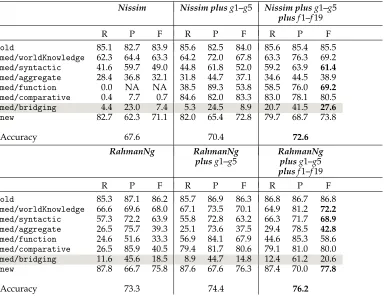
Results for adding the new features to Nissim are shown in Table 7 (top) and to RahmanNgin Table 7 (bottom). The final algorithm improves significantly over all previous models in overall accuracy, showing the effectiveness of our new features. Comparative anaphors are recognized reliably via a small set of comparative mark-ers. Including featuresg3IsFrequentProperNameandg5DependOnChangeVerbimproves results formediated/WKandmediated/function, respectively.
Features f1–f19 from Table 6 were specifically designed for bridging: They help Nissim plus g1–g5 plus f1–f19 improve the results for bridging substantially over Nissim plus g1–g5. They also help to delimit several other IS classes better, such as mediated/syntactic forNissim plus g1–g5plus f1–f19 andRahmanNg plus g1–g5plus f1–f19.
Table 7
Experimental results: compared to the baselineNissim(top) andRahman(bottom).Boldedscores indicate significant improvements relative to all other models (p<0.01).
Nissim Nissim plusg1–g5 Nissim plusg1–g5 plusf1–f19
R P F R P F R P F
old 85.1 82.7 83.9 85.6 82.5 84.0 85.6 85.4 85.5
med/worldKnowledge 62.3 64.4 63.3 64.2 72.0 67.8 63.3 76.3 69.2
med/syntactic 41.6 59.7 49.0 44.8 61.8 52.0 59.2 63.9 61.4
med/aggregate 28.4 36.8 32.1 31.8 44.7 37.1 34.6 44.5 38.9
med/function 0.0 NA NA 38.5 89.3 53.8 58.5 76.0 69.2
med/comparative 0.4 7.7 0.7 84.6 82.0 83.3 83.0 78.1 80.5
med/bridging 4.4 23.0 7.4 5.3 24.5 8.9 20.7 41.5 27.6
new 82.7 62.3 71.1 82.0 65.4 72.8 79.7 68.7 73.8
Accuracy 67.6 70.4 72.6
RahmanNg RahmanNg RahmanNg
plusg1–g5 plusg1–g5 plusf1–f19
R P F R P F R P F
old 85.3 87.1 86.2 85.7 86.9 86.3 86.8 86.7 86.8
med/worldKnowledge 66.6 69.6 68.0 67.1 73.5 70.1 64.9 81.2 72.2
med/syntactic 57.3 72.2 63.9 55.8 72.8 63.2 66.3 71.7 68.9
med/aggregate 26.5 75.7 39.3 25.1 73.6 37.5 29.4 78.5 42.8
med/function 24.6 51.6 33.3 56.9 84.1 67.9 44.6 85.3 58.6
med/comparative 26.5 85.9 40.5 79.4 81.7 80.6 79.1 81.0 80.0
med/bridging 11.6 45.6 18.5 8.9 44.7 14.8 12.4 61.2 20.6
new 87.8 66.7 75.8 87.6 67.6 76.3 87.4 70.0 77.8
Accuracy 73.3 74.4 76.2
may cover the lexical knowledge for bridging anaphora recognition that we model explicitly via features. Also although the overall IS classification performance of RahmanNg plus g1–g5 plus f1–f19 is significantly better than Nissim plus g1–g5 plus f1–f19, the former is worse than the latter with regard to bridging anaphora recog-nition. The one-versus-all strategy for a multi-class setting in Rahman and Ng (2011) is not suitable for identifying a minority class which lacks strong indicators such as bridging.
4.4.3 Evaluation of Collective and Cascaded Collective Classification. We now compare the best local classifier, RhamanNg plus g1–g5 plus f1–f19, to collective and cascaded collective classifiers (Collective and CascadedCollective). The MLN classifier Collective (Section 4.2.1) uses the non-relational features from Table 6 and adds the rela-tional features from Section 4.3.1. We usethebeast20 to learn weights and to perform
Table 8
Experimental results: Comparing the best local to collective and cascaded collective classifiers. Boldedscores indicate significant improvements compared to previous model (p<0.01).
RahmanNg Collective CascadedCollective plusg1–g5
plusf1–f19
R P F R P F R P F
old 86.8 86.7 86.8 85.7 84.7 85.2 83.1 85.7 84.4
med/worldKnowledge 64.9 81.2 72.2 64.2 80.5 71.4 65.6 79.5 71.9
med/syntactic 66.3 71.7 68.9 82.7 80.1 81.4 82.2 80.5 81.3
med/aggregate 29.4 78.5 42.8 71.6 78.2 74.8 71.1 77.7 74.3
med/function 44.6 85.3 58.6 56.9 90.2 69.8 61.5 83.3 70.8
med/comparative 79.1 81.0 80.0 81.4 84.8 83.1 83.4 82.7 83.1
med/bridging 12.4 61.2 20.6 25.9 49.9 34.1 48.7 43.8 46.1
new 87.4 70.0 77.8 84.5 75.7 79.9 81.3 77.7 79.5
Accuracy 76.2 78.9 78.4
inference.21thebeastuses cutting plane inference (Riedel 2008) to improve the accuracy and efficiency of MAP inference for MLNs.
The relational features in Collective lead to significant improvements in accuracy over the local model (Table 8), in particular for mediated/syntactic and mediated/ aggregateas well as their distinctions fromnew. Such improvement is in accordance with the linguistic relations among IS categories we analyzed in Section 4.2.1.22
Collec-tive also improves the F-score for bridging by 13.5% compared with the local model. This is mainly through improved recall, where the local model in Table 8 is very conservative with a recall score of only 12.4%.Collectivedoubles recall but at a certain loss to precision.
However, the results for the bridging category, including recall, are still low. In a multi-class setting, prediction is biased toward the classes with the highest priors. CascadedCollective classification (Section 4.2.2) addresses this problem by combining a sequence of minority binary classifiers (based on SVMs, using only non-relational features) with a final collective classifier (based on MLNs, using non-relational and re-lational features).CascadedCollectiveimproves bridging F-score and recall substantially without jeopardizing performance on other IS classes (Table 8, right). One question is whether the cascading algorithm is sufficient for improved bridging recognition with our additional non-relational bridging features f1–f19 being superfluous. We ran Cascaded Collectivewithout these features. Results worsened substantially to 74.4% over-all accuracy and 29.2 bridging F-measure. Our novel features (addressing linguistic properties of bridging) and the cascaded algorithm (addressing data sparseness) are complementary.
21 In 10-fold cross-validation, we have 45 training documents in each fold. In fold0, the ground Markov network ofCollectivefor the first training instance contains 5,831 variables and it takes around 35 minutes on an 8 CPU core machine to train the model.
Table 9
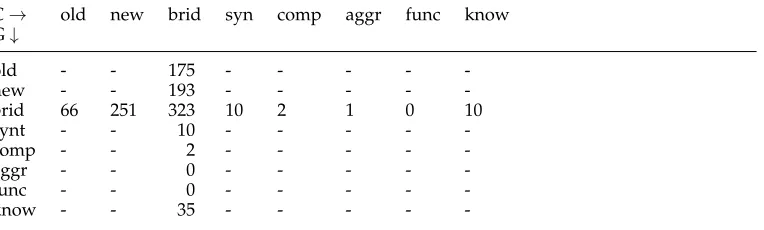
Confusion matrix ofCascadedCollectivefor bridging anaphora recognition. “C” indicates classifier tags, “G” gold tags. “brid” stands formediated/bridging, “syn”mediated/syntactic, “comp”
mediated/comparative, “aggr”mediated/aggregate, “func”mediated/function, “know” mediated/worldKnowledge.
C→ old new brid syn comp aggr func know G↓
old - - 175 - - - -
-new - - 193 - - - -
-brid 66 251 323 10 2 1 0 10
synt - - 10 - - - -
-comp - - 2 - - - -
-aggr - - 0 - - - -
-func - - 0 - - - -
-know - - 35 - - - -
-4.4.4 Error Analysis.Our performance on bridging recognition, although outperforming reimplementations of previous work, is still under 50% in all measures. We conducted an error analysis using our best modelCascadedCollective. We examine the confusion matrix (Table 9) of the model, concentrating only on the numbers related to bridging.
The highest proportion of recall errors is due to the fact that 251 bridging anaphors are misclassified as new. This can be explained as the syntactic form of many new instances and bridging anaphors are the same,newitems are more frequent, and our lexico-semantic features in particular only pick up on certain types of bridging.
Most precision errors are newandoldinstances being misclassified asmediated/ bridging. Manyoldinstances misclassified as bridging are definite NPs without further modification and common noun heads without a string match to a previous mention. An example would be an NP such asthe president, which can easily be coreferent to a previous president named by proper name (Barack Obama) or a bridging to a country or company. This coincides with the fact that in coreference resolution, common noun anaphors without head match are also hardest to detect (Martschat and Strube 2014). Future work attempting joint bridging and coreference resolution might help here.New items misclassified as bridging are also NPs with common noun heads and no modifica-tion (outside determiners) such ascontrolorthe back, often generics (see Examples (14) and (15)). In the latter cases how the phrase is embedded in the discourse plays an important role and is only partially modeled by our approach. Currently, the lexical semantic knowledge we explored only indicates that some NPs are more likely to be used as bridging anaphora than others.
5. Bridging Antecedent Selection
Bridging antecedent selection chooses an antecedent among all possible candidates for a given bridging anaphor. We make contributions in three areas for antecedent selection: (i) using joint modeling to tackle what we call sibling anaphora, (ii) developing a range of semantic and salience features for the problem, and (iii) proposing the novel concept of an anaphor’s discourse scope to delimit the list of possible candidate antecedents.
We do not resolve the latter and count our decisions in these cases as incorrect. The antecedent can be coreferent with prior mentions of the same entity. In Example (1), repeated as Example (20), The windowsis the bridging anaphor, the Polish center is the antecedent (mention), and the antecedent is coreferent to the center mentioned previously. We call such a coreference chain of antecedents theantecedent entity.
If we see bridging as independent of coreference resolution, we can select an-tecedents among all prior mentions—if not, then among all entities mentioned before the anaphor. The first case can be seen as a special case of the second one where all antecedent entities and candidates are chains of length 1 and we know nothing about their coreference properties. For our general model formulation, we assume the an-tecedent entity setting as the general case which subsumes the other setting. However, candidate generation, feature computation, and evaluation will vary for the two settings and therefore we explore both scenarios in the experiments.
(20) A cake topped with a replica ofthe centerwill be auctioned at an AIDS benefit at Sotheby’s in December. If Mr. McDonough’s plans get executed, as much as possible ofthe Polish centerwill be made from aluminum, steel and glass recycled from Warsaw’s abundant rubble. [2 sent.]The windowswill open.
The carpets won’t be glued down andwalls will be coated with non-toxic finishes.
5.1 Method: A Joint Model
Motivation.Many of our bridging anaphors are siblings—that is, they share the same antecedent (Section 3).Sibling anaphors clusteringtries to identify such siblings. We then use joint inference to model sibling anaphors clusteringandbridging antecedent selection together.
Detailed model. Adenotes the set ofnbridging anaphors in documentD.Edenotes the set of antecedent candidates in the whole document. Letcai/ajbe a sibling anaphors clus-tering assignment for bridging anaphorsai,aj∈A,CAbe a sibling anaphors clustering
result for all bridging anaphors inA, andCnAbe the set of all possible sibling anaphors clustering results forA. Leteabe an antecedent assignment for a bridging anaphora∈A,
EAbe an antecedent assignment result for all bridging anaphors inA, andEnAbe the set
of all possible antecedent assignment results forA. Joint inference forsibling anaphors clusteringandbridging antecedent selectioncan be represented as a log-linear model:
P(CA,EA|A;w)= exp(
w·Φ(A,CA,EA))
P
EA0∈EnA,CA0∈CnAexp(w·Φ(A,CA 0,E
A0))
(21)
where wis the model’s weight vector, Φ(A,CA,EA) is a “global” feature vector that
takes the entire clustering and antecedent assignments for all bridging anaphors in Ainto account. We defineΦ(A,CA,EA) as:
Φ(A,CA,EA)=
X
l∈Fc X
ai,aj∈A
Φl(ai,aj,cai/aj)+ X
k∈Fr X
a∈A
Φk(a,ea)
+X
g∈Fg X
ai,aj∈A
Φg(cai/aj,eai,eaj)
whereΦl(ai,aj,cai/aj) andΦk(a,ea) are local feature functions forsibling anaphors clustering andbridging antecedent selection, respectively. The former looks at two bridging anaphors aiandaj, the latter at the bridging anaphoraand the antecedent candidateea.FcandFr
are the sets of local features for these two tasks, respectively. The global feature function
Φg(cai/aj,eai,eaj) looks at the antecedent assignments foraiandajat the same time, and Fgis the set of global features.
Like our collective classification model (Section 4.2.1), this log-linear model can be represented using MLNs. In a ground Markov network for this task, the probability distribution over the possible worldCA,EAis given by
P(CA,EA)= Z1exp
X
i
wini(CA,EA)
!
(23)
whereni(CA,EA) is the number of true groundings of a local or a global feature function
Fiin (CA,EA),wiis the weight forFi, andZis the partition function.
Table 10 shows hard constraints and formula templates for this problem in MLNs. p1 and p2 are hidden predicates that we predict: choosing the antecedent for anaphora1 and deciding whethera1 anda2 are sibling anaphors.f1 models that each
Table 10
Hidden predicates, hard constraints, and formula templates used for bridging antecedent selection.a1,a2,a3represent bridging anaphors,Athe set of bridging anaphors in the whole document,ethe antecedent candidate,Eathe set of the antecedent candidates foraaccording to a’s discourse scope, andEthe set of antecedent candidates in the whole document.
Hidden predicates
p1 isBridging(a1,e)
p2 hasSameAntecedent(a1,a2)
Hard Constraints
f1 ∀a∈A: |e∈E:isBridging(a,e)| ≤1
f2 ∀a∈A∀e∈E: hasPairDistance(e,a,d)∧d<0→ ¬isBridging(a,e)
f3 ∀a1,a2∈A: a16=a2∧hasSameAntecedent(a1,a2)→hasSameAntecedent(a2,a1)
f4 ∀a1,a2,a3∈A: a16=a2∧a16=a3∧a26=a3∧hasSameAntecedent(a1,a2) ∧hasSameAntecedent(a2,a3)→hasSameAntecedent(a1,a3)
f5 ∀a1,a2∈A∀i∈E: a16=a2∧hasSameAntecedent(a1,a2)∧isBridging(a1,e) →isBridging(a2,e)
f6 ∀a1,a2∈A∀e∈E: a16=a2∧isBridging(a1,e)∧isBridging(a2,e) →hasSameAntecedent(a1,a2)
Formula template for sibling anaphors clustering
fc ∀a1,a2∈A: siblingAnaphorsClusteringFormula Template (a1,a2) →hasSameAntecedent(a1,a2)
Formula template for bridging antecedent selection
fr1 ∀a∈A∀e∈E: bridgingAnaResolutionFormula Template1 (a,e)→isBridging(a,e)