Original Article
Comparison of characteristics and survival between
incidental and suspected gallbladder carcinoma
Xinwei Yang1*, Junyi Chen2*, Zhijian Wen3*, Yan Ling4*, Jue Yang1, Xinzhou Yan1, Baohua Zhang1, Feng Shen1,
Mengchao Wu1
1Eastern Hepatobiliary Surgery Hospital, The Second Military Medical University, Shanghai, China; 2Department of General Surgery, Shanghai Fourth People’s Hospital, Shanghai, China; 3Department of Hepatobiliary Pancreatic Vascular Surgery, No.174 Hospital of PLA, Xiamen University, Xiamen, China; 4International Cooperation Labo-ratory on Signal Transduction, Eastern Hepatobiliary Surgery Institute, The Second Military Medical University, Shanghai, China. *Equal contributors.
Received October 26, 2017; Accepted March 14, 2018; Epub April 15, 2018; Published April 30, 2018
Abstract: At present, the prognostic impact of incidentally discovered GBC (PI-GBC) and preoperative suspected GBC (PS-GBC) has not been widely studied. We enrolled 276 gallbladder carcinoma (GBC) patients upon whom surgical resection with curative intent was performed between January 2004 and December 2014. Of the 276 patients, 80 were identified with postoperative incidentally discovered gallbladder cancer (PI-GBC) and 196 were suspected with preoperative imaging (PS-GBC). Postoperative incidental gallbladder cancer (PI-GBC) was of lower T-stage (p<0.001), the lower presence of hepatic invasion (p<0.001) and lymph node metastasis (p<0.001), less intra-operative bleeding (p<0.001), less operative time (p=0.001), and less postoperative complication (5.0% vs. 17.9%, p=0.004). In the 276 GBC group, multivariate analysis revealed that only T stage, lymph node metasta-sis and tumour location were independent prognostic factors were independent prognostic factors. Postoperative incidental gallbladder cancer has a significantly lower degree malignant and better survival than preoperatively suspected GBC. However, incidental gallbladder cancer is not an independent factor that affects the prognosis. Incidental gallbladder cancer does not predict better prognosis, while it is worth the attention of clinicians.
Keywords: Gallbladder cancer, incidental, suspected, tumor characteristics, prognosis
Introduction
Gallbladder cancer (GBC) is the most common malignancy of the biliary tract, accounting for 80%-95% of the biliary cancers worldwide [1]. The global rates for GBC exhibit striking vari-ability, reaching epidemic levels for some regions and ethnicities. A satisfactory outcome of GBC patients is critically dependent on an early diagnosis and most of these patients are usually faced with a poor prognosis due to diag-nosis at advanced stages [2]. In patients under-going surgery, extensive hepatectomy, with or without portal vein lymphadenectomy and bile duct resection, is often required of disease eradication, but with high morbidity and inci-dental mortality [3].
Several retrospective studies have examined prognostic factors for patients with GBC. Tumor
stage, according to the American Joint Com- mittee on Cancer (AJCC) staging system, is the strongest overall predictor of patient survival [4, 5]. Other prognostic factors include the extent of surgical re-section, lymph node sta-tus, age, and sex [5, 6]. The presentation and management of incidental GBC have been described previously [7, 8]. There are scant data, however, on the importance of incidental discovery of GBC as a prognostic indicator of patient survival. Incidental GBC may represent early-stage cancer that would eventually prog-ress to symptomatic disease, or it may repre-sent a unique histological entity with a different prognosis. In addition, it has not been analyzed in detail and is still controversial.
inciden-tal and suspected GBC. We hope to explore the impact of time of diagnosis on survival in patients with GBC and the interaction between preoperative suspicion and other known prog-nostic factors.
Materials and methods
Subjects
A prospectively maintained hepatobiliary sur-gery database at the Eastern Hepatobiliary Hospital was reviewed for all patients with a diagnosis of GBC that underwent surgical resection with curative intent between January 2004 and December 2014. Permission from the Second Military Medical University’s In- stitutional Review Board was obtained prior to data review. Written informed consent was obtained from all patients for surgical treat-ment and pathological examinations, according to institutional guidelines. All methods were carried out in accordance with relevant guide-lines and regulations. All experimental proto-cols were approved by the Licensing Committee of the Second Military Medical University.
Resection completeness was classified by: R0
without residuals on hepatic margins, R1 micro-scopically positive margin, and R2 macrosco- pic residuals on hepatic margins. R0 or R1 resections were considered to be surgical resection with curative intent. All patients that
Surgical procedures
Surgical procedures used to treat patients are summarized as follows. All patients underwent en bloc dissection of regional lymph nodes (lymph nodes along the hepatoduodenal liga-ment and common hepatic artery and behind pancreatic head) (Figure 2). Hepatectomies were carried out in all 276 patients. Resection of laparoscopic port sites was routinely per-formed in all patients receiving laparoscopic cholecystectomy. Combined resection of adja-cent organs was performed as long as R0 resection could be expected.
Statistical analysis
Data were analyzed with SPSS Version 17.0 for Windows (SPSS, Inc., Chicago, IL, USA) and
[image:2.612.91.375.72.293.2]sig-nificance level was set at p<0.05. Overall sur -vival was measured from the day of operation to death, including death due to cancer or other causes, or to the last day of follow up. Comparison between the two groups was per-formed using Student’s t-test for parametric data and Mann-Whitney U-test for non-para-metric data. Chi-square test was used for cate-gorical data. Survival curves were estimated with Kaplan-Meier method and compared by log-rank test. Cox regression analysis was car-ried out to determine which factor was the best prognostic determinant.
Figure 1. Actuarial survival curve between 80 PI-GBC and 196 PS-GBC pa-tients following surgical resection with curative intent.
had undergone either pallia-tive or exploratory surgery we- re excluded from analysis. In our experience, extensive inva- sion to the hepatoduodenal ligament, excessive presence of liver or peritoneal metasta-ses beyond areas near the gallbladder, or bulky lymph node metastases have been considered a contraindication to surgery. Accor-ding to the 7th UICC/AJCC TNM [9],
involve-ment of periaortic, pericaval, superior mesenteric ar-tery, and/or celiac artery lymph
no-des are classified as N2.
Results
Demographic data
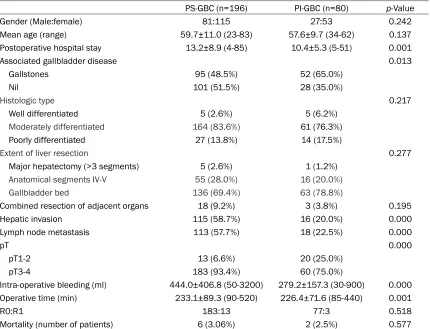
Of the 276 patients managed with curative intent for GBC during this 10-year inclusion period, 196 (71.0%) had preoperative suspi-cion of malignancy (preoperative suspisuspi-cion GBC, PS-GBC) and 80 (29.0%) were discovered incidentally (postoperative incidentally di- scovered GBC, PI-GBC). All patients were fol-lowed up for a mean period of 76.7 months. Comparison of tumor characteristics between PS-GBC and PI-GBC (Table 1)
The two cohorts were similar in age, gender, histological differentiation, extent of liver resec-tion, and combined resections of adjacent organs but some tumor characteristics differed
significantly. A higher proportion of associated
gallstones was associated with PI-GBC (p= 0.013), suggesting that presence of incidental-ly discovered gallbladder cancer might be cov-ered by the symptoms of gallstones. Rates of hepatic invasion (p<0.0001) and nodal
metas-tases (p<0.0001) were also significantly higher
in PS-GBC. A more advanced T category was
associated with preoperative suspicion GBC, suggesting more seriously local tumor invasion in PS-GBC patients. More intra-operative bleed-ing and operative time were found in PS-GBC group (P<0.001 and P=0.001), suggesting a wider range of lesion resection performed in PS-GBC patients. However, R0 resection rate was similar between PS-GBC and PI-GBC
(P=0.518). There was no significant difference
in mortality between PS-GBC and PI-GBC
(P=0.577). Morbidity was significantly lower in
PI-GBC patients than in PS-GBC patients (5.0% vs. 17.9%, p=0.004). Average postoperative hospital stay in PS-GBC patients was 13.2 days (range: 4-85 days), longer than PI-GBC patients (P=0.001).
Survival data in all 276 GBC patients
Median survival for PI-GBC was 39.9 versus 14.3 months for PS-GBC (p<0.001). Cumulative 1-, 3-, and 5-year survival rates in PI-GBC group (88.8%, 52.2%, and 33.0%, respectively) were
significantly better than those in the PS-GBC
group (57.5%, 25.7%, and 16.6%, p<0.001; Figure 1).
Risk factors in all 276 GBC patients
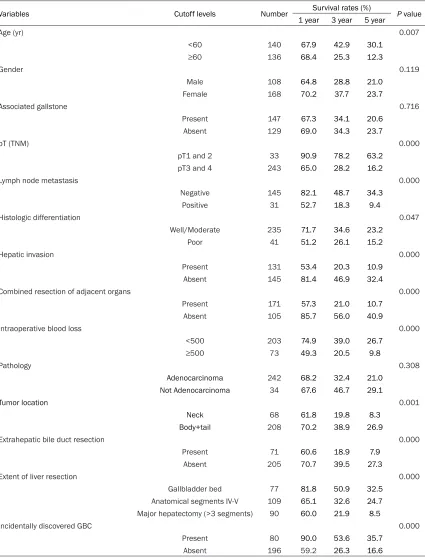
To identify factors influencing long-term surviv -al in -all 276 GBC patients, univariate and multi-variate analyses were performed. In unimulti-variate analysis, depth of invasion of the cancer (T stage), age, lymph node metastasis, histolo- gic differentiation, hepatic invasion, combined resection of adjacent organs, intraoperative blood loss, extrahepatic bile duct resection, tumour location, extent of liver resection and
preoperative suspicion were identified as sig
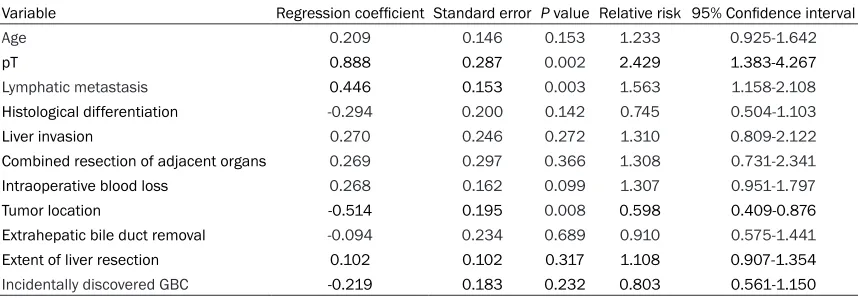
-nificant prognostic factors (Table 2). In multi-variate analysis, only T stage, hepatic invasion and the time from cholecystectomy to referral for re-operation were independent prognostic factor (Table 3). However, incidental gallblad-der cancer was not an independent prognostic factor in multivariate analysis.
Discussion
[image:4.612.93.523.96.425.2]Cancer of the gallbladder, a rare entity with poor prognosis, is often discovered incidentally during or after cholecystectomy. Approximately 0.2% of patients undergoing cholecystectomy will have incidental discovery of GBC (IGC) [10, 11]. As the number of cholecystectomy opera-tions increases, it is likely that the number of incidentally discovered GBC will also increase. An incidentally discovered GBC during the initial operation forces the surgeon to make a quick decision and presents an unexpected chal-lenge especially in postoperatively IGC patients. In order to effectively manage the diagnosis of disease and counseling patients, it is neces-sary to understand the tumor characteristics and survival between incidental and suspected gallbladder carcinoma.
Table 1. Demographic data of postoperative incidentally discovered gallbladder cancer (PI-GBC) and preoperatively suspected gallbladder carcinoma (PS-GBC)
PS-GBC (n=196) PI-GBC (n=80) p-Value Gender (Male:female) 81:115 27:53 0.242 Mean age (range) 59.7±11.0 (23-83) 57.6±9.7 (34-62) 0.137 Postoperative hospital stay 13.2±8.9 (4-85) 10.4±5.3 (5-51) 0.001
Associated gallbladder disease 0.013
Gallstones 95 (48.5%) 52 (65.0%)
Nil 101 (51.5%) 28 (35.0%)
Histologic type 0.217
Well differentiated 5 (2.6%) 5 (6.2%)
Moderately differentiated 164 (83.6%) 61 (76.3%)
Poorly differentiated 27 (13.8%) 14 (17.5%)
Extent of liver resection 0.277
Major hepatectomy (>3 segments) 5 (2.6%) 1 (1.2%)
Anatomical segments IV-V 55 (28.0%) 16 (20.0%)
Gallbladder bed 136 (69.4%) 63 (78.8%)
Combined resection of adjacent organs 18 (9.2%) 3 (3.8%) 0.195 Hepatic invasion 115 (58.7%) 16 (20.0%) 0.000 Lymph node metastasis 113 (57.7%) 18 (22.5%) 0.000
pT 0.000
pT1-2 13 (6.6%) 20 (25.0%)
pT3-4 183 (93.4%) 60 (75.0%)
Intra-operative bleeding (ml) 444.0±406.8 (50-3200) 279.2±157.3 (30-900) 0.000 Operative time (min) 233.1±89.3 (90-520) 226.4±71.6 (85-440) 0.001
R0:R1 183:13 77:3 0.518
Mortality (number of patients) 6 (3.06%) 2 (2.5%) 0.577
At present, the prognostic impact of incidentally discovered GBC and preoperative suspected GBC has not been widely studied. It is not clear whether incidental discovered gallbladder
[image:5.612.94.519.96.654.2]can-cer has the same prognosis, or poorer progno-sis, compared with the same stage of non- incidental gallbladder cancer. For incidental discovered gallbladder cancers, it is likely that Table 2. Univariate analysis of clinicopathologic variables related to survival in GBC patients who underwent surgical resection with curative intent (n=276)
Variables Cutoff levels Number Survival rates (%) P value
1 year 3 year 5 year
Age (yr) 0.007
<60 140 67.9 42.9 30.1
≥60 136 68.4 25.3 12.3
Gender 0.119
Male 108 64.8 28.8 21.0
Female 168 70.2 37.7 23.7
Associated gallstone 0.716
Present 147 67.3 34.1 20.6 Absent 129 69.0 34.3 23.7
pT (TNM) 0.000
pT1 and 2 33 90.9 78.2 63.2 pT3 and 4 243 65.0 28.2 16.2
Lymph node metastasis 0.000
Negative 145 82.1 48.7 34.3
Positive 31 52.7 18.3 9.4
Histologic differentiation 0.047
Well/Moderate 235 71.7 34.6 23.2
Poor 41 51.2 26.1 15.2
Hepatic invasion 0.000
Present 131 53.4 20.3 10.9
Absent 145 81.4 46.9 32.4
Combined resection of adjacent organs 0.000
Present 171 57.3 21.0 10.7
Absent 105 85.7 56.0 40.9
Intraoperative blood loss 0.000
<500 203 74.9 39.0 26.7
≥500 73 49.3 20.5 9.8
Pathology 0.308
Adenocarcinoma 242 68.2 32.4 21.0
Not Adenocarcinoma 34 67.6 46.7 29.1
Tumor location 0.001
Neck 68 61.8 19.8 8.3
Body+tail 208 70.2 38.9 26.9
Extrahepatic bile duct resection 0.000
Present 71 60.6 18.9 7.9
Absent 205 70.7 39.5 27.3
Extent of liver resection 0.000
Gallbladder bed 77 81.8 50.9 32.5 Anatomical segments IV-V 109 65.1 32.6 24.7 Major hepatectomy (>3 segments) 90 60.0 21.9 8.5
Incidentally discovered GBC 0.000
Present 80 90.0 53.6 35.7
the combined presence of cholecystitis com- plicates the diagnosis of gallbladder cancer. Several studies have reported the negative impact of cholecystitis on survival [12-14], although the exact mechanism has not been studied. Considering the relatively high propor-tion of residual cancerous lesions after re-oper-ation in this study, incomplete en bloc resection during cholecystectomy that causes spillage of cancer cells may affect the prognosis of gall-bladder cancer. Many studies warrant radical resection to improve survival [15-17]. In con-trast, a study reported that the tumor charac-teristics differed between suspected and inci-dental gallbladder cancer, and suggested that
incidental gallbladder cancer has a significant
better median survival [8]. In this study, we also found that the overall prognosis of incidentally discovered gallbladder cancer was better than preoperative suspected gallbladder cancer. This is why we strongly recommend reoperation in patients with postoperative incidentally dis-covered GBC. However, it is worth noting that incidentally discovered GBC was not the inde-pendent risk factors. This reminds us that there are special pathological features of the inciden-tally discovered GBC, but this does not mean that these patients have an earlier tumor stage and a better prognosis. Therefore, in clinical work, clinicians and patients should be valued.
The independent influence of the prognosis of
gallbladder cancer is still the T stage of the tumor, lymph node invasion, and tumour loca-tion. This is consistent with our previous litera-ture reports [18, 19].
Early-stage diagnosis and treatment, as well as varying pre- and intraoperative techniques, cer-tainly impact survival with GBC, but they do not
adequately explain the significance of inciden -tal diagnosis [8, 20, 21]. Controlling for age,
extent of surgery, the presence of gallstone dis-ease, country of origin, and stage of tumor are unable to explain the association. We hypothe-size that these data may suggest a previously unrecognized histological difference between cancer that becomes symptomatic and that which is detected only incidentally. It is possible that the growth patterns in these two situations differ biologically and carry different prognoses for the patient. Further research is warranted to fully understand the implications of the current study.
In conclusion, postoperative incidental
gall-bladder cancer has a significantly lower degree
malignant and better survival than preopera-tively suspected GBC. However, incidental gall-bladder cancer is not an independent factor that affects the prognosis. Incidental gallblad-der cancer does not predict better prognosis, while it is worth the attention of clinicians. Acknowledgements
This study was supported by grants from Na- tional Natural Science Foundation of China (Grant No: 81372674) and Shanghai Health Bureau (Grant No: 20124Y154 and 20164Y- 0109). We are grateful to Jing Du for assisting in the preparation of this manuscript.
Declaration of conflict of interest
None.
Address correspondence to: Baohua Zhang and Feng Shen, Eastern Hepatobiliary Surgery Hospital, The Second Military Medical University, 225 Changhai Road, Shanghai 200438, China. Tel: +86-15900439699; 86-21-81875261; E-mail: weice-Table 3. Results of multivariate analysis
Variable Regression coefficient Standard error P value Relative risk 95% Confidence interval
Age 0.209 0.146 0.153 1.233 0.925-1.642
pT 0.888 0.287 0.002 2.429 1.383-4.267
Lymphatic metastasis 0.446 0.153 0.003 1.563 1.158-2.108 Histological differentiation -0.294 0.200 0.142 0.745 0.504-1.103
Liver invasion 0.270 0.246 0.272 1.310 0.809-2.122
Combined resection of adjacent organs 0.269 0.297 0.366 1.308 0.731-2.341 Intraoperative blood loss 0.268 0.162 0.099 1.307 0.951-1.797
Tumor location -0.514 0.195 0.008 0.598 0.409-0.876
[image:6.612.91.520.85.234.2][email protected] (BHZ); [email protected] (FS)
References
[1] Bazoua G, Hamza N, Lazim T. Do we need his-tology for a normal-looking gallbladder? J He-patobiliary Pancreat Surg 2007; 14: 564-568. [2] Hundal R, Shaffer EA. Gallbladder cancer: epi-demiology and outcome. Clin Epidemiol 2014; 6: 99-109.
[3] Fong Y, Jarnagin W, Blumgart LH. Gallbladder cancer: comparison of patients presenting ini-tially for definitive operation with thosepresen -ting after prior noncurative intervention. Ann Surg 2000; 232: 557-569.
[4] Löhe F, Meimarakis G, Schauer C, Angele M, Jauch KW, Schauer RJ. The time of diagnosis impacts surgical management but not the outcome of patients with gallbladder carcin- oma. Eur J Med Res 2009; 14: 345-351. [5] Yildirim E, Celen O, Gulben K, Berberoglu U.
The surgical management of incidental gallbla-dder carcinoma. Eur J Surg Oncol 2005; 31: 45-52.
[6] Kayahara M, Nagakawa T, Nakagawara H, Kita-gawa H, Ohta T. Prognostic factors for gallblad-der cancer in Japan. Ann Surg 2008; 248: 807-814.
[7] Pawlik TM, Gleisner AL, Vigano L, Kooby DA, Bauer TW, Frilling A, Adams RB, Staley CA, Trin-dade EN, Schulick RD, Choti MA, Capussotti L. Incidence of finding residual disease for inci -dental gallbladder carcinoma: implications for re-resection. J Gastrointest Surg 2007; 11: 1478-1486.
[8] Mazer LM, Losada HF, Chaudhry RM, Velaz-quez-Ramirez GA, Donohue JH, Kooby DA, Na-gorney DM, Adsay NV, Sarmiento JM. Tumor characteristics and survival analysis of inci-dental versus suspected gallbladdercarcino-ma. J Gastrointest Surg 2012; 16: 1311-1317. [9] Edge SB, Byrd DR, Compton CC, Krebs
(Krankheit). AJCC cancer staging manual. 7th ed. Springer; New York, NY: 2010. Gallbladder Cancer; Springer Berlin 2011; pp. 211-7. [10] Muratore A, Polastri R, Bouzari H, Vergara V,
Capussotti L. Radical surgery for gallbladder cancer: a worthwhile operation? Eur J Surg On-col 2000; 26: 160-163.
[11] Goetze TO, Paolucci V. Adequate extent in radi-cal re-resection of incidental gallbladder carci-noma: analysis of the German Registry. Surg Endosc 2010; 24: 2156-2164.
[12] Choi SB, Han HJ, Kim CY, Kim WB, Song TJ, Suh SO, et al. Incidental gallbladder cancer diagno-sed following laparoscopic cholecystectomy. World J Surg 2009; 33: 2657-2663.
[13] Clemente G, Nuzzo G, De Rose AM, Giovannini I, La Torre G, Ardito F, Giuliante F. Unexpected gallbladder cancer after laparoscopic cholecy- stectomy for acute cholecystitis: aworrisome picture. J Gastrointest Surg 2012; 16: 1462-1468.
[14] Han HS, Cho JY, Yoon YS, Ahn KS, Kim H. Preo-perative inflammation is a prognostic factor for gallbladder carcinoma. Br J Surg 2011; 98: 111-116.
[15] Glauser PM, Strub D, Käser SA, Mattiello D, Rieben F, Maurer CA. Incidence, manageme- nt,and outcome of incidental gallbladder carci-noma: analysis of the database of the Swiss association of laparoscopic and thoracoscopic surgery. Surg Endosc 2010; 24: 2281-2286. [16] Yip VS, Gomez D, Brown S, Byrne C, White D,
Fenwick SW, Poston GJ, Malik HZ. Manage-ment of incidental and suspicious gallbladder cancer: foucus on early referral to a tertiary centre. HPB (Oxford) 2014; 16: 641-647. [17] Fuks D, Regimbeau JM, Le Treut YP, Bachellier
P, Raventos A, Pruvot FR, Chiche L, Farges O. Incidental gallbladder cancer by the AFC-GBC- 2009 Study Group. World J Surg 2011; 35: 1887-1897.
[18] Yang XW, Yuan JM, Chen JY, Yang J, Gao QG, Yan XZ, Zhang BH, Feng S, Wu MC. The prog-nostic importance of jaundice in surgical re-section with curative intent for gallbladder can-cer. BMC Cancer 2014; 14: 652.
[19] Yang XW, Yang J, Li L, Man XB, Zhang BH, Shen F, Wu MC. Analysis of the relationships betwe-en clinicopathologic factors and survival in gallbladder cancer following surgical resection with curative intent. PLoS One 2012; 7: e51513.
[20] Cucinotta E, Lorenzini C, Melita G, Iapichino G, Currò G. Incidental gall bladder carcinoma: does the surgical approach influence the out -come? ANZ J Surg 2005; 75: 795-798. [21] Chan KM, Yeh TS, Jan YY, Chen MF.