Proceedings of the 2016 Conference on Empirical Methods in Natural Language Processing, pages 1–11, Austin, Texas, November 1-5, 2016. c2016 Association for Computational Linguistics
Span-Based Constituency Parsing with a Structure-Label System and
Provably Optimal Dynamic Oracles
James Cross and Liang Huang
School of EECS, Oregon State University, Corvallis, OR, USA
{james.henry.cross.iii, liang.huang.sh}@gmail.com
Abstract
Parsing accuracy using efficient greedy transi-tion systems has improved dramatically in re-cent years thanks to neural networks. Despite striking results in dependency parsing, how-ever, neural models have not surpassed state-of-the-art approaches in constituency parsing. To remedy this, we introduce a new shift-reduce system whose stack contains merely sentence spans, represented by a bare min-imum of LSTM features. We also design the first provably optimal dynamic oracle for constituency parsing, which runs in amortized O(1) time, compared to O(n3) oracles for standard dependency parsing. Training with this oracle, we achieve the bestF1scores on both English and French of any parser that does not use reranking or external data.
1 Introduction
Parsing is an important problem in natural language processing which has been studied extensively for decades. Between the two basic paradigms of pars-ing, constituency parspars-ing, the subject of this paper, has in general proved to be the more difficult than dependency parsing, both in terms of accuracy and the run time of parsing algorithms.
There has recently been a huge surge of interest in using neural networks to make parsing decisions, and such models continue to dominate the state of the art in dependency parsing (Andor et al., 2016). In constituency parsing, however, neural approaches are still behind the state-of-the-art (Carreras et al., 2008; Shindo et al., 2012; Thang et al., 2015); see more details in Section 5.
To remedy this, we design a new parsing frame-work that is more suitable for constituency parsing, and that can be accurately modeled by neural net-works. Observing that constituency parsing is pri-marily focused on sentence spans (rather than indi-vidual words, as is dependency parsing), we propose
a novel adaptation of the shift-reduce system which reflects this focus. In this system, the stack consists of sentence spans rather than partial trees. It is also factored into two types of parser actions, structural and label actions, which alternate during a parse. The structural actions are a simplified analogue of shift-reduce actions, omitting the directionality of reduce actions, while the label actions directly as-sign nonterminal symbols to sentence spans.
Our neural model processes the sentence once for each parse with a recurrent network. We represent parser configurations with a very small number of span features (4 for structural actions and 3 for label actions). Extending Wang and Chang (2016), each span is represented as the difference of recurrent out-put from multiple layers in each direction. No pre-trained embeddings are required.
We also extend the idea of dynamic oracles from dependency to constituency parsing. The latter is significantly more difficult than the former due toF1 being a combination of precision and recall (Huang, 2008), and yet we propose a simple and extremely efficient oracle (amortizedO(1)time). This oracle is proved optimal forF1 as well as both of its compo-nents, precision and recall. Trained with this oracle, our parser achieves what we believe to be the best results for any parser without reranking which was trained only on the Penn Treebank and the French Treebank, despite the fact that it is not only linear-time, but also strictly greedy.
We make the following main contributions:
• A novel factored transition parsing system where the stack elements are sentence spans rather than partial trees (Section 2).
• A neural model where sentence spans are rep-resented as differences of output from a multi-layer bi-directional LSTM (Section 3).
• The first provably optimal dynamic oracle for
constituency parsing which is also extremely efficient (amortizedO(1)time) (Section 4).
• The bestF1 scores of any single-model, closed training set, parser for English and French.
We are also publicly releasing the source code for one implementation of our parser.1
2 Parsing System
We present a new transition-based system for con-stituency parsing whose fundamental unit of com-putation is the sentence span. It uses a stack in a similar manner to other transition systems, except that the stack contains sentence spans with no re-quirement that each one correspond to a partial tree structure during a parse.
The parser alternates between two types of tions, structural and label, where the structural ac-tions follow a path to make the stack spans corre-spond to sentence phrases in a bottom-up manner, while the label actions optionally create tree brack-ets for the top span on the stack. There are only two structural actions: shiftis the same as other transi-tion systems, whilecombinemerges the top two sen-tence spans. The latter is analogous to a reduce ac-tion, but it does not immediately create a tree struc-ture and is non-directional. Label actions do create a partial tree on top of the stack by assigning one or more non-terminals to the topmost span.
Except for the use of spans, this factored approach is similar to the odd-even parser from Mi and Huang (2015). The fact that stack elements do not have to be tree-structured, however, means that we can cre-ate productions with arbitrary arity, and no binariza-tion is required either for training or parsing. This also allows us to remove the directionality inherent in the shift-reduce system, which is at best an im-perfect fit for constituency parsing. We do follow the practice in that system of labeling unary chains of non-terminals with a single action, which means our parser uses a fixed number of steps,(4n−2)for a sentence ofnwords.
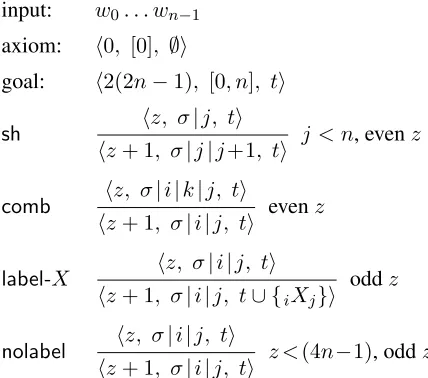
Figure 1 shows the formal deductive system for this parser. The stackσis modeled as a list of strictly
increasing integers whose first element is always
1code:https://github.com/jhcross/span-parser
input: w0. . . wn−1 axiom: h0, [0], ∅i
goal: h2(2n−1), [0, n], ti
sh hz, σ|j, ti
hz+ 1, σ|j|j+1, ti j < n, evenz
comb hz, σ|i|k|j, ti
hz+ 1, σ|i|j, ti evenz
label-X hz, σ|i|j, ti
hz+ 1, σ|i|j, t∪ {iXj}i oddz
nolabel hz, σ|i|j, ti
[image:2.612.314.528.59.248.2]hz+ 1, σ|i|j, ti z <(4n−1), oddz
Figure 1: Deductive system for the Structure/Label transition parser. The stackσis represented as a list of integers where the span defined by each consecutive pair of elements is a sentence segment on the stack. EachX is a nonterminal symbol or an ordered unary chain. The settcontains labeled spans of the formiXj, which at the end of a parse, fully define a parse tree.
zero. These numbers are word boundaries which de-fine the spans on the stack. In a slight abuse of no-tation, however, we sometimes think of it as a list of pairs(i, j), which are the actual sentence spans, i.e.,
every consecutive pair of indices on the stack, ini-tially empty. We represent stack spans by trapezoids (i
Some text and the symbol jor scaled) in the figures to emphasize that they may or not have tree stucture.
The parser alternates between structural actions and label actions according to the parity of the parser stepz. In even steps, it takes a structural action,
ei-ther combining the top two stack spans, which re-quires at least two spans on the stack, or introducing a new span of unit length, as long as the entire sen-tence is not already represented on the stack
In odd steps, the parser takes a label action. One possibility is labeling the top span on the stack,(i, j) with either a nonterminal label or an ordered unary chain (since the parser has only one opportunity to label any given span). Taking no action, designated nolabel, is also a possibility. This is essentially a null operation except that it returns the parser to an even step, and this action reflects the decision that (i, j)is not a (complete) labeled phrase in the tree. In the final step, (4n−2), nolabel is not allowed
S VP S VP NP NN
4fish5
VBG 3eating VBP 2like MD 1do NP PRP 0I
steps structural action label action stack after bracket 1–2 sh(I/PRP) Some text and the symbollabel-NP 0 or scaled
1
1 0NP1
3–4 sh(do/MD)Some text and the symbolnolabel 0 or scaled
1 1
Some text and the symbol or scaled
1 2
5–6 sh(like/VBP)Some text and the symbolnolabel 0 or scaled
1 1
Some text and the symbol or scaled
1 2
Some text and the symbol or scaled
1 3
7–8 comb Some text and the symbolnolabel 0 or scaled
1 1
Some text and the symbol or scaled
1 3
9–10 sh(eating/VBG)Some text and the symbolnolabel 0 or scaled
1 1
Some text and the symbol or scaled
1 3
Some text and the symbol or scaled
1 4
11–12 sh(fish/NN)Some text and the symbollabel-NP 0 or scaled
1 1
Some text and the symbol or scaled
1 3
Some text and the symbol or scaled
1 4
Some text and the symbol or scaled
1 5 4NP5 13–14 comb Some text and the symbollabel-S-VP 0 or scaled
1 1
Some text and the symbol or scaled
1 3
Some text and the symbol or scaled
1
5 3S5,3VP5 15–16 comb Some text and the symbollabel-VP 0 or scaled
1 1
Some text and the symbol or scaled
1
5 1VP5 17–18 comb Some text and the symbollabel-S 0 or scaled
1
5 0S5
[image:3.612.79.529.59.213.2](a) gold parse tree (b) static oracle actions
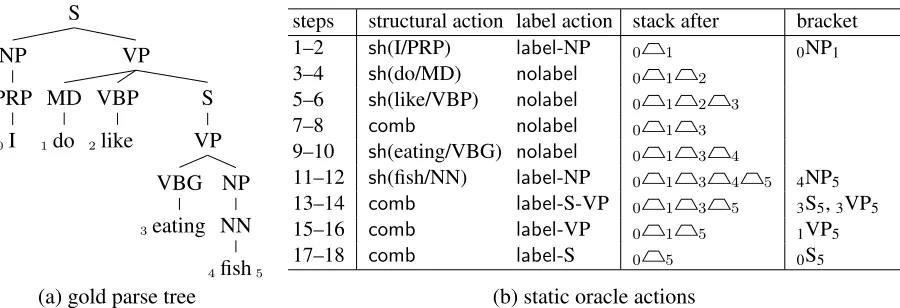
Figure 2:The running example. It contains one ternary branch and one unary chain (S-VP), and NP-PRP-I and NP-NN-fish are notunary chains in our system. Each stack is just a list of numbers but is visualized with spans here.
since the parser must produce a tree.
Figure 2 shows a complete example of applying this parsing system to a very short sentence (“I do like eating fish”) that we will use throughout this section and the next. The action in step 2 islabel -NP because “I” is a one-word noun phrase (parts of speech are taken as input to our parser, though it could easily be adapted to include POS tagging in label actions). If a single word is not a complete phrase (e.g., “do”), then the action after a shift is nolabel.
The ternary branch in this tree (VP→MD VBP S) is produced by our parser in a straightforward man-ner: after the phrase “do like” is combined in step 7, no label is assigned in step 8, successfully delay-ing the creation of a bracket until the verb phrase is fully formed on the stack. Note also that the unary production in the tree is created with a single action, label-S-VP, in step 14.
The static oracle to train this parser simply con-sists of taking actions to generate the gold tree with a “short-stack” heuristic, meaning combine first whenever combine and shift are both possible.
3 LSTM Span Features
Long short-term memory networks (LSTM) are a type of recurrent neural network model proposed by Hochreiter and Schmidhuber (1997) which are very effective for modeling sequences. They are able to capture and generalize from interactions among their sequential inputs even when separated by a long distance, and thus are a natural fit for
analyz-ing natural language. LSTM models have proved to be a powerful tool for many learning tasks in natural language, such as language modeling (Sundermeyer et al., 2012) and translation (Sutskever et al., 2014). LSTMs have also been incorporated into parsing in a variety of ways, such as directly encoding an en-tire sentence (Vinyals et al., 2015), separately mod-eling the stack, buffer, and action history (Dyer et al., 2015), to encode words based on their character forms (Ballesteros et al., 2015), and as an element in a recursive structure to combine dependency sub-trees with their left and right children (Kiperwasser and Goldberg, 2016a).
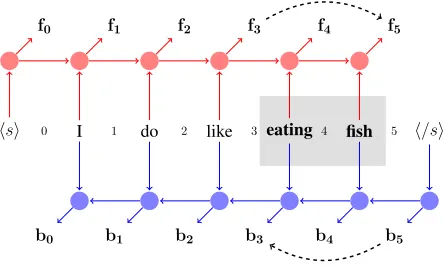
For our parsing system, however, we need a way to model arbitrary sentence spans in the context of the rest of the sentence. We do this by representing each sentence span as the elementwise difference of the vector outputs of the LSTM outputs at different time steps, which correspond to word boundaries. If the sequential output of the recurrent network for the sentence isf0, ..., fnin the forward direction and bn, ..., b0 in the backward direction then the span (i, j)would be represented as the concatenation of the vector differences(fj −fi)and(bi−bj).
The spans are represented using output from both backward and forward LSTM components, as can be seen in Figure 3. This is essentially the LSTM-Minus feature representation described by Wang and Chang (2016) extended to the bi-directional case. In initial experiments, we found that there was essen-tially no difference in performance between using the difference features and concatenating all
hsi 0 I do like eating fish h/si f0
b0 1 f1
b1 2 f2
b2 3 f3
b3 4 f4
b4 5 f5
[image:4.612.75.297.60.193.2]b5
Figure 3: Word spans are modeled by differences in LSTM output. Here the span3eating fish5is represented by the vector
differences (f5−f3) and (b3−b5). The forward difference corresponds to LSTM-Minus (Wang and Chang, 2016).
point vectors, but our approach is almost twice as fast.
This model allows a sentence to be processed once, and then the same recurrent outputs can be used to compute span features throughout the parse. Intuitively, this allows the span differences to learn to represent the sentence spans in the context of the rest of the sentence, not in isolation (especially true for LSTM given the extra hidden recurrent connec-tion, typically described as a “memory cell”). In practice, we use a two-layer bi-directional LSTM, where the input to the second layer combines the forward and backward outputs from the first layer at that time step. For each direction, the components from the first and second layers are concatenated to form the vectors which go into the span features. See Cross and Huang (2016) for more details on this ap-proach.
For the particular case of our transition con-stituency parser, we use only four span features to determine a structural action, and three to determine a label action, in each case partitioning the sentence exactly. The reason for this is straightforward: when considering a structural action, the top two spans on the stack must be considered to determine whether they should be combined, while for a label action, only the top span on the stack is important, since that is the candidate for labeling. In both cases the re-maining sentence prefix and suffix are also included. These features are shown in Table 1.
The input to the recurrent network at each time step consists of vector embeddings for each word
Action Stack LSTM Span Features StructuralSome text and the symbolσ|i|k|j 02i or scaled
1 k
Some text and the symbol or scaled
1
j2n
Label σ|i|j 02i
Some text and the symbol or scaled
1
j2n
Table 1:Features used for the parser. No label or tree-structure features are required.
and its part-of-speech tag. Parts of speech are pre-dicted beforehand and taken as input to the parser, as in much recent work in parsing. In our experi-ments, the embeddings are randomly initialized and learned from scratch together with all other network weights, and we would expect further performance improvement from incorporating embeddings pre-trained from a large external corpus.
The network structure after the the span features consists of a separate multilayer perceptron for each type of action (structural and label). For each ac-tion we use a single hidden layer with rectified linear (ReLU) activation. The model is trained on a per-action basis using a single correct per-action for each parser state, with a negative log softmax loss func-tion, as in Chen and Manning (2014).
4 Dynamic Oracle
The baseline method of training our parser is what is known as a static oracle: we simply generate the sequence of actions to correctly parse each training sentence, using a short-stack heuristic (i.e., combine first whenever there is a choice of shift and com-bine). This method suffers from a well-documeted problem, however, namely that it only “prepares” the model for the situation where no mistakes have been made during parsing, an inevitably incorrect assumption in practice. To alleviate this problem, Goldberg and Nivre (2013) define a dynamic oracle to return the best possible action(s) at any arbitrary configuration.
In this section, we introduce an easy-to-compute optimal dynamic oracle for our constituency parser. We will first define some concepts upon which the dynamic oracle is built and then show how optimal actions can be very efficiently computed using this framework. In broad strokes, in any arbitrary parser configurationcthere is a set of bracketst∗(c)from
the gold tree which it is still possible to reach. By following dynamic oracle actions, all of those brack-ets and only those brackbrack-ets will be predicted.
Even though proving the optimality of our dy-namic oracle (Sec. 4.3) is involved, computing the oracle actions is extremely simple (Secs. 4.2) and efficient (Sec. 4.4).
4.1 Preliminaries and Notations
Before describing the computation of our dynamic oracle, we first need to rigorously establish the de-sired optimality of dynamic oracle. The structure of this framework follows Goldberg et al. (2014). Definition 1. We denotec`τ c0 iff. c0 is the result of action τ on configuration c, also denoted
func-tionally asc0 = τ(c). We denote`to be the union
of`τ for all actionsτ, and`∗to be the reflexive and transitive closure of`.
Definition 2 (descendant/reachable trees). We de-note D(c) to be the set of final descendant trees derivable fromc, i.e.,D(c) ={t |c `∗ hz, σ, ti}.
This set is also called “reachable trees” fromc. Definition 3(F1). We define the standardF1metric of a tree twith respect to gold tree tG asF1(t) =
2rp
r+p,wherer= | t∩tG|
|tG| , p= |
t∩tG| |t| .
The following two definitions are similar to those for dependency parsing by Goldberg et al. (2014). Definition 4. We extend theF1 function to config-urations to define the maximum possibleF1from a given configuration:F1(c) = maxt1∈D(c)F1(t1). Definition 5(oracle). We can now define the desired dynamic oracle of a configurationcto be the set of actions that retrain the optimalF1:
oracle(c) ={τ |F1(τ(c)) = F1(c)}.
This abstract oracle is implemented bydyna(·)in Sec. 4.2, which we prove to be correct in Sec. 4.3. Definition 6 (span encompassing). We say span (i, j)is encompassed by span(p, q), notated(i, j) (p, q), iff.p≤i < j≤q.
Definition 7 (strict encompassing). We say span (i, j)is strictly encompassed by span(p, q), notated (i, j)≺(p, q), iff.(i, j)(p, q)and(i, j)6= (p, q).
We then extend this relation from spans to brackets, and notateiXj ≺ pYqiff. (i, j)≺(p, q).
0S5
1VP5
3S/VP5
4NP5
0
Some text and the symbol
or scaled
1
1
Some text and the symbol
or scaled
1
2
Some text and the symbol
or scaled
1
4 5
[image:5.612.347.494.58.227.2]I do like eating fish
Figure 4: Reachable brackets (w.r.t. gold tree in Fig. 1) for
c = h10, [0,1,2,4], {0NP1}i which mistakenly combines
“like eating”. Trapezoids indicate stack spans (the top one in red), and solid triangles denote reachable brackets, withleft(c) in blue and right(c) in cyan. The next reachable bracket,
next(c) = 1VP5, is in bold. Brackets3VP5 and3S5 (in
dot-ted triangle) cross the top span (thus unreachable), and0NP1is
already recognized (thus not inreach(c)either).
We next define a central concept, reachable brackets, which is made up of two parts, the left ones left(c)which encompass(i, j)without crossing any stack spans, and the right ones right(c) which are completely on the queue. See Fig. 4 for examples. Definition 8(reachable brackets). For any configu-rationc=hz, σ|i|j, ti, we define the set of reach-able gold brackets (with respect to gold treetG) as
reach(c) =left(c)∪right(c)
where the left- and right-reachable brackets are
left(c) ={pXq ∈tG|(i, j)≺(p, q), p∈σ|i} right(c) ={pXq ∈tG|p≥j}
for evenz, with the≺replaced byfor oddz.
Special case (initial):reach(h0, [0], ∅i) =tG. The notation p ∈ σ|isimply means(p, q) does not “cross” any bracket on the stack. Remember our stack is just a list of span boundaries, so ifp
coin-cides with one of them,(p, q)’s left boundary is not
crossing and its right boundaryqis not crossing
ei-ther sinceq≥jdue to(i, j)≺(p, q).
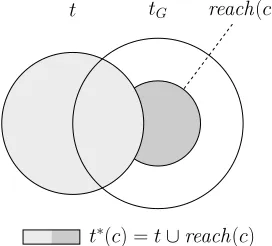
Also note thatreach(c)is strictly disjoint fromt,
i.e.,reach(c)∩t = ∅andreach(c) ⊆tG−t. See Figure 6 for an illustration.
Definition 9 (next bracket). For any configuration
c = hz, σ|i|j, ti, the next reachable gold bracket
(with respect to gold treetG) is the smallest reach-able bracket (strictly) encompassing(i, j):
next(c) = min≺left(c).
4.2 Structural and Label Oracles
For an even-step configurationc=hz, σ |i|j, ti, we denote the next reachable gold bracketnext(c) to be pXq, and define the dynamic oracle to be:
dyna(c) =
{sh} ifp=iandq > j
{comb} ifp < iandq =j
{sh,comb} ifp < iandq > j
(1)
As a special casedyna(h0, [0], ∅i) ={sh}. Figure 5 shows examples of this policy. The key insight is, if you follow this policy, you willnotmiss the next reachable bracket, but if you do not follow it, you certainly will. We formalize this fact below (with proof omitted due to space constraints) which will be used to prove the central results later. Lemma 1. For any configuration c, for any τ ∈ dyna(c), we havereach(τ(c)) =reach(c); for any
τ0 ∈/dyna(c), we havereach(τ(c))(reach(c). The label oracles are much easier than struc-tural ones. For an odd-step configuration c = hz, σ |i|j, ti, we simply check if(i, j)is a valid span in the gold tree tG and if so, label it accord-ingly, otherwise no label. More formally,
dyna(c) =
(
{label-X} if someiXj ∈tG
{nolabel} otherwise (2)
4.3 Correctness
To show the optimality of our dynamic oracle, we begin by defining a special treet∗(c)and show that it is optimal among all trees reachable from config-urationc. We then show that following our dynamic
oracle (Eqs. 1–2) fromcwill lead tot∗(c).
Definition 10 (t∗(c)). For any configuration c =
hz, σ, ti, we define the optimal treet∗(c)to include all reachable gold brackets and nothing else. More formally,t∗(c) =t∪reach(c).
configuration static dynamicoracle
0
Some text and the symbol or scaled
1 1
Some text and the symbol or scaled
1 2
Some text and the symbol or scaled
1
3 comb {comb,sh}
I do likeSome text and the symbol
∧
1 2 or scaled51 3
0
Some text and the symbol or scaled
1 1
Some text and the symbol or scaled
1 3
undef.
{sh}
I do like
t={...,1VP3}
1
∧
5Some text and the symbol or scaled
1
3
0
Some text and the symbol or scaled
1 1
Some text and the symbol or scaled
1 2
Some text and the symbol or scaled
1
4 {comb,sh}
I do like eating
∧
1 2 5Some text and the symbol or scaled
1
4
0
Some text and the symbol or scaled
1 1
Some text and the symbol or scaled
1 2
Some text and the symbol or scaled
1 4
Some text and the symbol or scaled
1
5 {comb}
I do like eating fishSome text and the symbol
∧
1 4 or scaled5 [image:6.612.314.541.54.280.2]1
Figure 5: Dynamic oracle with respect to the gold parse in Fig. 2. The last three examples are off the gold path with strike out indicating structural or label mistakes. Trapezoids denote stack spans (top one in red) and the blue triangle denotes the next reachable bracketnext(c)which is1VP5in all cases.
We can show by induction thatt∗(c)is attainable: Lemma 2. For any configurationc, the optimal tree is a descendant ofc, i.e.,t∗(c)∈ D(c).
The following Theorem shows thatt∗(c)is indeed the best possible tree:
Theorem 1 (optimality of t∗). For any configura-tionc,F1(t∗(c)) = F1(c).
Proof. (SKETCH) Sincet∗(c)adds all possible addi-tional gold brackets (the brackets inreach(c)), it is
not possible to get higher recall. Since it adds no in-correct brackets, it is not possible to get higher
pre-t tG reach(c)
t∗(c) =t∪reach(c)
Figure 6: The optimal treet∗(c)adds all reachable brackets and nothing else. Note thatreach(c)andtare disjoint.
[image:6.612.355.491.548.671.2]cision. SinceF1 is the harmonic mean of precision and recall, it also leads to the best possibleF1. Corollary 1. For any c = hz, σ, ti, for any t0 ∈
D(c)andt06=t∗(c), we haveF1(t0)<F1(c). We now need a final lemma about the policy dyna(·)(Eqs. 1–2) before proving the main result. Lemma 3. From anyc =hz, σ, ti, for any action τ ∈ dyna(c), we have t∗(τ(c)) = t∗(c). For any
actionτ0 ∈/dyna(c), we havet∗(τ0(c))6=t∗(c).
Proof. (SKETCH) By case analysis on even/odd z.
We are now able to state and prove the main the-oretical result of this paper (using Lemma 3, Theo-rem 1 and Corollary 1):
Theorem 2. The functiondyna(·)in Eqs. (1–2)
sat-isfies the requirement of a dynamic oracle (Def. 5):
dyna(c) =oracle(c)for any configurationc.
4.4 Implementation and Complexity
For any configuration, our dynamic oracle can be computed in amortized constant time since there are only O(n) gold brackets and thus bounding |reach(c)| and the choice of next(c). After each
action, next(c) either remains unchanged, or in the case of being crossed by a structural action or mislabeled by a label action, needs to be updated. This update is simply tracing the parent link to the next smallest gold bracket repeatedly until the new bracket encompasses span (i, j). Since there
are at most O(n) choices of next(c) and there are
O(n) steps, the per-step cost is amortized constant time. Thus our dynamic oracle is much faster than the super-linear time oracle for arc-standard depen-dency parsing in Goldberg et al. (2014).
5 Related Work
Neural networks have been used for constituency parsing in a number of previous instances. For example, Socher et al. (2013) learn a recursive network that combines vectors representing partial trees, Vinyals et al. (2015) adapt a sequence-to-sequence model to produce parse trees, Watanabe and Sumita (2015) use a recursive model applying a shift-reduce system to constituency parsing with
Network architecture
Word embeddings 50
Tag embeddings 20
Morphological embeddings† 10
LSTM layers 2
LSTM units 200 / direction ReLU hidden units 200 / action type
Training settings
Embedding intialization random
Training epochs 10
[image:7.612.315.546.54.221.2]Minibatch size 10 sentences Dropout (on LSTM output) p= 0.5 ADADELTA parameters ρ= 0.99,= 1×10⁻⁷
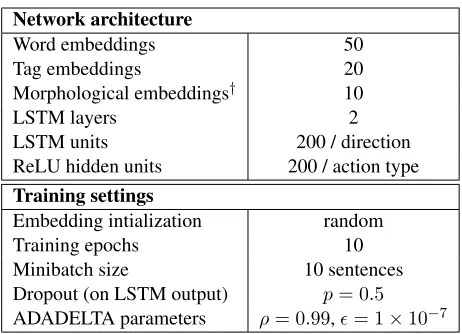
Table 2:Hyperparameters.†French only.
beam search, and Dyer et al. (2016) adapt the Stack-LSTM dependency parsing approach to this task. Durrett and Klein (2015) combine both neural and sparse features for a CKY parsing system. Our own previous work (Cross and Huang, 2016) use a recur-rent sentence representation in a head-driven tran-sition system which allows for greedy parsing but does not achieve state-of-the-art results.
The concept of “oracles” for constituency parsing (as the tree that is most similar totGamong all pos-sible trees) was first defined and solved by Huang (2008) in bottom-up parsing. In transition-based parsing, the dynamic oracle for shift-reduce depen-dency parsing costs worst-case O(n3) time (Gold-berg et al., 2014). On the other hand, after the sub-mission of our paper we became aware of a paral-lel work (Coavoux and Crabb´e, 2016) that also pro-posed a dynamic oracle for their own incremental constituency parser. However, it is not optimal due to dummy non-terminals from binarization.
6 Experiments
We present experiments on both the Penn English Treebank (Marcus et al., 1993) and the French Tree-bank (Abeill´e et al., 2003). In both cases, all state-action training pairs for a given sentence are used at the same time, greatly increasing training speed since all examples for the same sentence share the same forward and backward pass through the recur-rent part of the network. Updates are performed in minibatches of 10 sentences, and we shuffle the training sentences before each epoch. The results we report are trained for 10 epochs.
The only regularization which we employ during training is dropout (Hinton et al., 2012), which is applied with probability0.5to the recurrent outputs. It is applied separately to the input to the second LSTM layer for each sentence, and to the input to the ReLU hidden layer (span features) for each state-action pair. We use the ADADELTAmethod (Zeiler, 2012) to schedule learning rates for all weights. All of these design choices are summarized in Table 2.
In order to account for unknown words during training, we also adopt the strategy described by Kiperwasser and Goldberg (2016b), where words in the training set are replaced with the unknown-word symbolUNKwith probabilitypunk = z+fz(w) where f(w) is the number of times the word ap-pears in the training corpus. We choose the pa-rameter z so that the training and validation cor-pora have approximately the same proportion of un-known words. For the Penn Treebank, for exam-ple, we usedz = 0.8375so that both the validation set and the (rest of the) training set contain approx-imately 2.76% unknown words. This approach was helpful but not critical, improving F1 (on dev) by about 0.1 over training without any unknown words. 6.1 Training with Dynamic Oracle
The most straightforward use of dynamic oracles to train a neural network model, where we collect all action examples for a given sentence before updat-ing, is “training with exploration” as proposed by Goldberg and Nivre (2013). This involves parsing each sentence according to the current model and us-ing the oracle to determine correct actions for train-ing. We saw very little improvement on the Penn treebank validation set using this method, however. Based on the parsing accuracy on the training sen-tences, this appears to be due to the model overfitting the training data early during training, thus negating the benefit of training on erroneous paths.
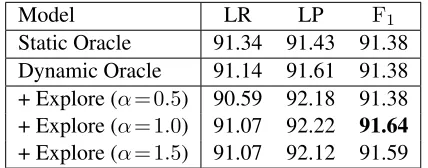
Accordingly, we also used a method recently pro-posed by Ballesteros et al. (2016), which specifi-cally addresses this problem. This method intro-duces stochasticity into the training data parses by randomly taking actions according to the softmax distribution over action scores. This introduces re-alistic mistakes into the training parses, which we found was also very effective in our case, leading to higher F1 scores, though it noticeably sacrifices
recall in favor of precision.
This technique can also take a parameterαto
flat-ten or sharpen the raw softmax distribution. The re-sults on the Penn treebank development set for var-ious values ofαare presented in Table 3. We were
surprised that flattening the distribution seemed to be the least effective, as training accuracy (taking into account sampled actions) lagged somewhat be-hind validation accuracy. Ultimately, the best results were forα= 1, which we used for final testing.
Model LR LP F1
Static Oracle 91.34 91.43 91.38 Dynamic Oracle 91.14 91.61 91.38 + Explore (α= 0.5) 90.59 92.18 91.38
+ Explore (α= 1.0) 91.07 92.22 91.64
[image:8.612.320.534.207.291.2]+ Explore (α= 1.5) 91.07 92.12 91.59
Table 3:Comparison of performance on PTB development set using different oracle training approaches.
6.2 Penn Treebank
Following the literature, we used the Wall Street Journal portion of the Penn Treebank, with stan-dard splits for training (secs 2–21), development (sec 22), and test sets (sec 23). Because our pars-ing system seamlessly handles non-binary produc-tions, minimal data preprocessing was required. For the part-of-speech tags which are a required input to our parser, we used the Stanford tagger with 10-way jackknifing.
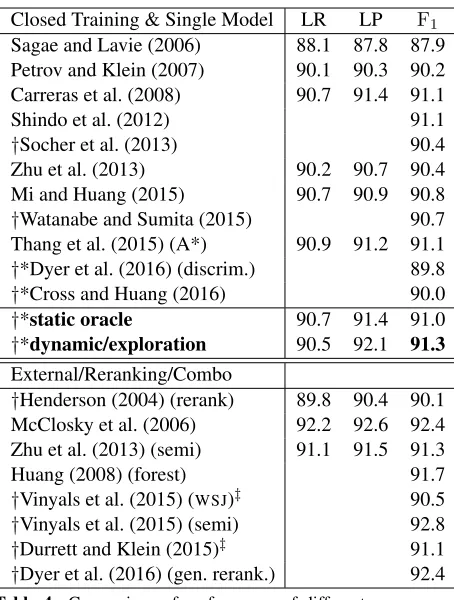
Table 4 compares test our results on PTB to a range of other leading constituency parsers. De-spite being a greedy parser, when trained using dy-namic oracles with exploration, it achieves the best F1 score of any closed-set single-model parser.
6.3 French Treebank
We also report results on the French treebank, with one small change to network structure. Specifically, we also included morphological features for each word as input to the recurrent network, using a small embedding for each such feature, to demonstrate that our parsing model is able to exploit such ad-ditional features.
We used the predicted morphological features, part-of-speech tags, and lemmas (used in place of word surface forms) supplied with the SPMRL 2014
Closed Training & Single Model LR LP F1
Sagae and Lavie (2006) 88.1 87.8 87.9 Petrov and Klein (2007) 90.1 90.3 90.2 Carreras et al. (2008) 90.7 91.4 91.1
Shindo et al. (2012) 91.1
†Socher et al. (2013) 90.4
Zhu et al. (2013) 90.2 90.7 90.4 Mi and Huang (2015) 90.7 90.9 90.8
†Watanabe and Sumita (2015) 90.7 Thang et al. (2015) (A*) 90.9 91.2 91.1
†*Dyer et al. (2016) (discrim.) 89.8
†*Cross and Huang (2016) 90.0
†*static oracle 90.7 91.4 91.0
†*dynamic/exploration 90.5 92.1 91.3
External/Reranking/Combo
†Henderson (2004) (rerank) 89.8 90.4 90.1 McClosky et al. (2006) 92.2 92.6 92.4 Zhu et al. (2013) (semi) 91.1 91.5 91.3
Huang (2008) (forest) 91.7
†Vinyals et al. (2015) (WSJ)‡ 90.5 †Vinyals et al. (2015) (semi) 92.8
†Durrett and Klein (2015)‡ 91.1
[image:9.612.75.302.54.354.2]†Dyer et al. (2016) (gen. rerank.) 92.4
Table 4: Comparison of performance of different parsers on PTB test set.†Neural. *Greedy.‡External embeddings.
Parser LR LP F1
Bj¨orkelund et al. (2014)∗,‡ 82.53 Durrett and Klein (2015)‡ 81.25 Coavoux and Crabb´e (2016) 80.56
static oracle 83.50 82.87 83.18
[image:9.612.75.301.405.483.2]dynamic/exploration 81.90 84.77 83.31
Table 5:Results on French Treebank.∗reranking,‡external.
data set (Seddah et al., 2014). It is thus possible that results could be improved further using an integrated or more accurate predictor for those features. Our parsing and evaluation also includes predicting POS tags for multi-word expressions as is the standard practice for the French treebank, though our results are similar whether or not this aspect is included.
We compare our parser with other recent work in Table 5. We achieve state-of-the-art results even in comparison to Bj¨orkelund et al. (2014), which uti-lized both external data and reranking in achieving the best results in the SPMRL 2014 shared task.
6.4 Notes on Experiments
For these experiments, we performed very little hy-perparameter tuning, due to time and resource con-traints. We have every reason to believe that per-formance could be improved still further with such techniques as random restarts, larger hidden lay-ers, external embeddings, and hyperparameter grid search, as demonstrated by Weiss et al. (2015).
We also note that while our parser is very accu-rate even with greedy decoding, the model is eas-ily adaptable for beam search, particularly since the parsing system already uses a fixed number of ac-tions. Beam search could also be made considerably more efficient by caching post-hidden-layer feature components for sentence spans, essentially using the precomputation trick described by Chen and Man-ning (2014), but on a per-sentence basis.
7 Conclusion and Future Work
We have developed a new transition-based con-stituency parser which is built around sentence spans. It uses a factored system alternating between structural and label actions. We also describe a fast dynamic oracle for this parser which can determine the optimal set of actions with respect to a gold training tree in an arbitrary state. Using an LSTM model and only a few sentence spans as features, we achieve state-of-the-art accuracy on the Penn Tree-bank for all parsers without reranking, despite using strictly greedy inference.
In the future, we hope to achieve still better re-sults using beam search, which is relatively straight-forward given that the parsing system already uses a fixed number of actions. Dynamic programming (Huang and Sagae, 2010) could be especially pow-erful in this context given the very simple feature representation used by our parser, as noted also by Kiperwasser and Goldberg (2016b).
Acknowledgments
We thank the three anonymous reviewers for com-ments, Kai Zhao, Lemao Liu, Yoav Goldberg, and Slav Petrov for suggestions, Juneki Hong for proof-reading, and Maximin Coavoux for sharing their manuscript. This project was supported in part by NSF IIS-1656051, DARPA FA8750-13-2-0041 (DEFT), and a Google Faculty Research Award.
References
Anne Abeill´e, Lionel Cl´ement, and Franc¸ois Toussenel. 2003. Building a treebank for french. In Treebanks, pages 165–187. Springer.
Daniel Andor, Chris Alberti, David Weiss, Aliaksei Severyn, Alessandro Presta, Kuzman Ganchev, Slav Petrov, and Michael Collins. 2016. Globally normal-ized transition-based neural networks. Proceedings of ACL.
Miguel Ballesteros, Chris Dyer, and Noah A Smith. 2015. Improved transition-based parsing by modeling characters instead of words with lstms. arXiv preprint arXiv:1508.00657.
Miguel Ballesteros, Yoav Goldberg, Chris Dyer, and Noah A Smith. 2016. Training with exploration improves a greedy stack-lstm parser. arXiv preprint arXiv:1603.03793.
Anders Bj¨orkelund, Ozlem Cetinoglu, Agnieszka Falen-ska, Rich´ard Farkas, Thomas Mueller, Wolfgang Seeker, and Zsolt Sz´ant´o. 2014. Introducing the ims-wrocław-szeged-cis entry at the spmrl 2014 shared task: Reranking and morpho-syntax meet unlabeled data. In Proceedings of the First Joint Workshop on Statistical Parsing of Morphologically Rich guages and Syntactic Analysis of Non-Canonical Lan-guages, pages 97–102.
Xavier Carreras, Michael Collins, and Terry Koo. 2008. Tag, dynamic programming, and the perceptron for efficient, feature-rich parsing. In Proceedings of the Twelfth Conference on Computational Natural Lan-guage Learning, pages 9–16. Association for Compu-tational Linguistics.
Danqi Chen and Christopher D Manning. 2014. A fast and accurate dependency parser using neural net-works. In Empirical Methods in Natural Language Processing (EMNLP).
Maximin Coavoux and Benoˆıt Crabb´e. 2016. Neural greedy constituent parsing with dynamic oracles. Pro-ceedings of ACL.
James Cross and Liang Huang. 2016. Incremental pars-ing with minimal features uspars-ing bi-directional lstm. Proceedings of ACL.
Greg Durrett and Dan Klein. 2015. Neural crf parsing. Proceedings of ACL.
Chris Dyer, Miguel Ballesteros, Wang Ling, Austin Matthews, and Noah A Smith. 2015. Transition-based dependency parsing with stack long short-term mem-ory. Empirical Methods in Natural Language Process-ing (EMNLP).
Chris Dyer, Adhiguna Kuncoro, Miguel Ballesteros, and Noah A Smith. 2016. Recurrent neural network gram-mars. Proceedings of HLT-NAACL.
Yoav Goldberg and Joakim Nivre. 2013. Training deterministic parsers with non-deterministic oracles.
Transactions of the association for Computational Linguistics, 1:403–414.
Yoav Goldberg, Francesco Sartorio, and Giorgio Satta. 2014. A tabular method for dynamic oracles in transition-based parsing.Trans. of ACL.
James Henderson. 2004. Discriminative training of a neural network statistical parser. In Proceedings of ACL.
Geoffrey E. Hinton, Nitish Srivastava, Alex Krizhevsky, Ilya Sutskever, and Ruslan Salakhutdinov. 2012. Im-proving neural networks by preventing co-adaptation of feature detectors. CoRR, abs/1207.0580.
Sepp Hochreiter and J¨urgen Schmidhuber. 1997. Long short-term memory. Neural computation, 9(8):1735– 1780.
Liang Huang and Kenji Sagae. 2010. Dynamic program-ming for linear-time incremental parsing. In Proceed-ings of ACL 2010.
Liang Huang. 2008. Forest reranking: Discriminative parsing with non-local features. InProceedings of the ACL: HLT, Columbus, OH, June.
Eliyahu Kiperwasser and Yoav Goldberg. 2016a. Easy-first dependency parsing with hierarchical tree lstms. arXiv preprint arXiv:1603.00375.
Eliyahu Kiperwasser and Yoav Goldberg. 2016b. Sim-ple and accurate dependency parsing using bidi-rectional LSTM feature representations. CoRR, abs/1603.04351.
Mitchell P Marcus, Mary Ann Marcinkiewicz, and Beat-rice Santorini. 1993. Building a large annotated cor-pus of english: The penn treebank.Computational lin-guistics, 19(2):313–330.
David McClosky, Eugene Charniak, and Mark Johnson. 2006. Reranking and self-training for parser adapta-tion. In Proceedings of the 21st International Con-ference on Computational Linguistics and the 44th annual meeting of the Association for Computational Linguistics, pages 337–344. Association for Computa-tional Linguistics.
Haitao Mi and Liang Huang. 2015. Shift-reduce con-stituency parsing with dynamic programming and pos tag lattice. In Proceedings of the 2015 Conference of the North American Chapter of the Association for Computational Linguistics: Human Language Tech-nologies.
Slav Petrov and Dan Klein. 2007. Improved inference for unlexicalized parsing. In Proceedings of HLT-NAACL.
Kenji Sagae and Alon Lavie. 2006. A best-first prob-abilistic shift-reduce parser. In Proceedings of the COLING/ACL on Main conference poster sessions, pages 691–698. Association for Computational Lin-guistics.
Djam´e Seddah, Sandra K¨ubler, and Reut Tsarfaty. 2014. Introducing the spmrl 2014 shared task on parsing morphologically-rich languages. InProceedings of the First Joint Workshop on Statistical Parsing of Mor-phologically Rich Languages and Syntactic Analysis of Non-Canonical Languages, pages 103–109. Hiroyuki Shindo, Yusuke Miyao, Akinori Fujino, and
Masaaki Nagata. 2012. Bayesian symbol-refined tree substitution grammars for syntactic parsing. In Pro-ceedings of the 50th Annual Meeting of the Association for Computational Linguistics: Long Papers-Volume 1, pages 440–448. Association for Computational Lin-guistics.
Richard Socher, John Bauer, Christopher D Manning, and Andrew Y Ng. 2013. Parsing with compositional vec-tor grammars. InACL (1), pages 455–465.
Martin Sundermeyer, Ralf Schl¨uter, and Hermann Ney. 2012. Lstm neural networks for language modeling. InINTERSPEECH, pages 194–197.
Ilya Sutskever, Oriol Vinyals, and Quoc V Le. 2014. Sequence to sequence learning with neural networks. InAdvances in neural information processing systems, pages 3104–3112.
Le Quang Thang, Hiroshi Noji, and Yusuke Miyao. 2015. Optimal shift-reduce constituent parsing with structured perceptron.
Oriol Vinyals, Łukasz Kaiser, Terry Koo, Slav Petrov, Ilya Sutskever, and Geoffrey Hinton. 2015. Grammar as a foreign language. InAdvances in Neural Informa-tion Processing Systems, pages 2755–2763.
Wenhui Wang and Baobao Chang. 2016. Graph-based dependency parsing with bidirectional lstm. In Pro-ceedings of ACL.
Taro Watanabe and Eiichiro Sumita. 2015. Transition-based neural constituent parsing. Proceedings of ACL-IJCNLP.
David Weiss, Chris Alberti, Michael Collins, and Slav Petrov. 2015. Structured training for neural network transition-based parsing. InProceedings of ACL. Matthew D. Zeiler. 2012. ADADELTA: an adaptive
learning rate method. CoRR, abs/1212.5701.
Muhua Zhu, Yue Zhang, Wenliang Chen, Min Zhang, and Jingbo Zhu. 2013. Fast and accurate shift-reduce con-stituent parsing. InACL (1), pages 434–443.
![Figure 4: Reachable brackets (w.r.t. gold tree in Fig. 1) forted triangle) cross the top span (thus unreachable), andalready recognized (thus not inc = ⟨10, [0, 1, 2, 4], {0NP1}⟩ which mistakenly combines“like eating”](https://thumb-us.123doks.com/thumbv2/123dok_us/1356698.668114/5.612.347.494.58.227/reachable-brackets-triangle-unreachable-andalready-recognized-mistakenly-combines.webp)