A U n i f o r m M e t h o d of G r a m m a r E x t r a c t i o n
a n d Its A p p l i c a t i o n s
F e i X i a a n d M a r t h a P a l m e r a n d A r a v i n d J o s h i D e p a r t m e n t o f C o m p u t e r a n d I n f o r m a t i o n Science
University of P e n n s y l v a n i a P h i l a d e l p h i a PA 19104, USA
{fxia,
mpalmer, j
oshi)@linc, cis.
upenn, edu
A b s t r a c t
Grammars are core elements of many NLP ap- plications. In this paper, we present a system that automatically extracts lexicalized gram- mars from annotated corpora. T h e data pro- duced by this system have been used in sev- eral tasks, such as training NLP tools (such as Supertaggers) and estimating the coverage of harid-crafted grammars. We report experi- mental results on two of those tasks and com- pare our approaches with related work.
1 I n t r o d u c t i o n
There are various g r a m m a r frameworks pro- posed for natural languages. We take Lexi- calized Tree-adjoining Grammars (LTAGs) as representative of a class of lexicalized gram- mars. LTAGs (Joshi et al., 1975) are ap- pealing for representing various phenomena in natural languages due to its linguistic and computational properties. In the last decade, LTAG has been used in several aspects of natural language understanding (e.g., pars- ing (Schabes, 1990; Srinivas, 1997), semantics (Joshi and Vijay-Shanker, 1999; Kallmeyer and Joshi, 1999), and discourse (Webber and Joshi, 1998)) and a number of NLP applica- tions (e.g., machine translation (Palmer et al., 1998), information retrieval (Chandrasekar and Srinivas, 1997), and generation (Stone and Doran, 1997; McCoy et al., 1992). This paper describes a system that extracts LTAGs from annotated corpora (i.e., Treebanks).
There has been much work done on extract- ing Context-Free grammars (CFGs) (Shirai et al., 1995; Charniak, 1996; Krotov et al., 1998). However, extracting LTAGs is more complicated than extracting CFGs because of the differences between LTAGs and CFGs. First, the primitive elements of an LTAG are lexicalized tree structures (called elementary trees), not context-free rules (which can be seen. as trees with d e p t h one). Therefore, an LTAG extraction algorithm needs to examine
a larger portion of a phrase structure to build an elementary tree. Second, the composition operations in LTAG are substitution (same as the one in a CFG) and adjunction. It is the operation of adjunction that distinguishes LTAG from all other formalisms. Third, un- like in CFGs, the parse trees (also known as derived trees in the LTAG) and the derivation trees (which describe how elementary trees are combined to form parse trees) are differ- ent in the LTAG formalism in the sense that a parse tree can be produced by several dis- tinct derivation trees. Therefore, to provide training data for statistical LTAG parsers, an LTAG extraction algorithm should also build derivation trees.
For each phrase structure in a Treebank, our system creates a fully bracketed phrase structure, a set of elementary trees and a derivation tree. The d a t a produced by our system have been used in several NLP tasks. We report experimental results on two of those applications and compare our ap- proaches with related work.
2 L T A G f o r m a l i s m
resulting structure of the combined etrees is called a d e r i v e d tree. The combination pro- cess is expressed as a d e r i v a t i o n tree.
Figure 1: The substitution operation
= > / _ _~
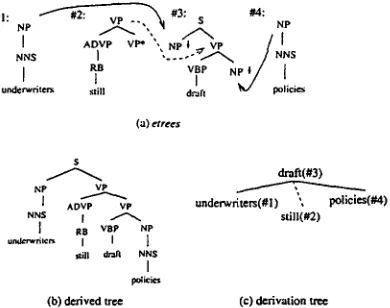
Figure 2: The adjunction operation Figure 3 shows the etrees, the derived tree, and the derivation tree for the sentence u n - d e r w r i t e r s still draft policies. Foot and sub- stitution nodes are marked b y . , and $, re- spectively. The dashed and solid lines in the derivation tree are for adjunction and substi- tution operations, respectively.
3 S y s t e m O v e r v i e w
We have built a system, called LexTract, for grammar extraction. The architecture of Lex- Tract is shown in Figure 4 (the parts that will be discussed in this paper are in bold). The core of LexTract is an extraction algorithm that takes a Treebank sentence such as the one in Figure 5 and produces the trees (el- ementary trees, derived trees and derivation trees) such as the ones in Figure 3.
3.1 T h e F o r m o f T a r g e t G r a m m a r s Without further constraints, the etrees in the target grammar could be of various shapes.
#, l : NP . 4 " - - . " A VP -- "- ~I ~ , #3. ' S -- ~:
N P
I A D V P VP* ". NP I VP '
s~s I " . . . . "~:~'-. i Ntis
xa v!31> NP t / I
I t i ~ Iicll~i
undenviStel'x still dr'aft Ix) '
(a) err¢¢a
draft(#3)
I ADVP VP u n d e r w d l e r s ( # 1 ) ", p o l i c i e s ( # 4 )
NNS l ~ s t i l l ( # 2 )
slill ~ NN$
I
(b) derived tree (c) derivation tr~
Figure 3: Etrees, derived tree and derivation tree for u n d e r w r i t e r s still draft policies
i l.~xTract Syslcm i matde:d
i ! L'rAo~
Treebonk ~peclflc tlerlvatim
t ~ i implaulible
Figure 4: Architecture of LexTract
((S (PP-LOC (IN at)
(NP (NNP FNX))) (NP-SBJ-I (NNS underwriters)) (ADVP (RiB still))
(VP (VBP draft) (NP (NNS policies)) (S-MNR
(NP-SBJ (-NONE- *- 1)) (VP (VBG using)
(NP
(NP (NN fountain) (NNS pens)) (CC and)
(NP (VBG blotting) (NN papers))))))))
Figure 5: A Treebank example
Our system recognizes three types of rela- tion (namely, predicate-argument, modifica- tion, and coordination relations) between the anchor of an etree and other nodes in the etree, and imposes the constraint that all the etrees to be extracted should fall into exactly one of the three patterns in Figure 6.
• The spine-etrees for predicate-argument relations. X ° is the head of X m and the anchor of the etree. T h e etree is formed by a spine X m --+ X m - 1 - ~ .. --+ X ° and the arguments of X °.
• The mod-etrees for modification rela- tions. The root of the etree has two chil- dren, one is a foot node with the label Wq, and the other node X m is a modifier
X m A
x '
X ° zP~,
lexical item
X m W q
A
Wq" X m ~ . . cclt x ~
xO zPl I x o z~
lcxical ilerrl I
Icxicalilem
(a) spinc..etree (b) mod-etz.~ (c) conj-etree
[image:2.596.362.561.51.178.2] [image:2.596.365.560.63.285.2] [image:2.596.132.327.555.709.2]of the foot node. X TM is f u r t h e r expanded into a spine-etree whose h e a d X ° is the anchor of the whole mod-etree.
• The conj-etrees for coordination rela- tions. In a conj-etree, the children of the root are two conjoined constituents and a node for a coordination conjunction. One conjoined constituent is marked as the foot node, and the other is expanded into a spine-etree whose head is the anchor of the whole tree.
Spine-etrees are initial trees, whereas mod- etrees and conj-etrees are auxiliary trees. 3.2 T r e e b a n k - s p e c i f i c i n f o r m a t i o n T h e phrase structures in the Treebank (ttrees
for short) are partially bracketed in the sense that arguments and modifiers are not struc- turally distinguished. In order to construct the etrees, which make such distinction, Lex- Tract requires its user to provide additional information in the form of t h r e e tables: a Head Percolation Table, an A r g u m e n t Table, and a Tagset Table.
A Head Percolation Table has previ- ously been used in several statistical parsers (Magerman, 1995; Collins, 1997) to find heads of phrases. Our strategy for choosing heads is similar to the one in (Collins, 1997). An Ar- gument Table informs LexTract what types of arguments a head can take. T h e Tagset Table specifies what function tags always m a r k ar- guments (adjuncts, heads, respectively). Lex- Tract marks each sibling of a h e a d as an argu- ment if the sibling can be an a r g u m e n t of the head according to the A r g u m e n t Table and none of the function tags of t h e sister indi- cates t h a t it is an adjunct. For example, in Figure 5, the head of the root S is the verb
draft, and the verb has two siblings: the noun phrase policies is m a r k e d as an argument of the verb because from the A r g u m e n t Table we know t h a t verbs in general can take an NP ob- ject; the clause is m a r k e d as a modifier of the verb because, although verbs in general can take a sentential argument, the Tagset Table informs LexTract t h a t the function tag -MNR
(manner) always m a r k s a modifier. 3.3 O v e r v i e w o f t h e E x t r a c t i o n
A l g o r i t h m
T h e extraction process has three steps: First, LexTract fully brackets each ttree; Second, LexTract decomposes the fully bracketed ttree
((S (PP-LOC (IN at)
(NP (NNP FNX))) (S (NP-SBJ-I (NNS underwriters))
(VP (ADVP (RB still)) (VP (VP (VBP draft)
(NP (NNS policies))) (S-MNR
(NP-SBJ (-NONE- *-1)) (VP (VBG using)
(NP (NP (NN fountain) (NP (NNS pens))) (CC and)
(NP (VBG blotting)
(NP (NN papers)))))))) )))
Figure 7: T h e fully bracketed ttree
into a set of etrees; Third, LexTract builds the derivation tree for the ttree.
3.3.1 F u l l y b r a c k e t i n g ttrees
As just mentioned, the ttrees in the Tree- bank do not explicitly distinguish arguments and modifiers, whereas etrees do. To account for this difference, we first fully bracket the
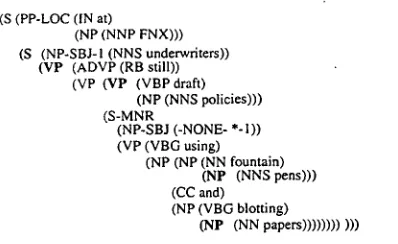
ttrees by adding intermediate nodes so t h a t at each level, one of the following relations holds between t h e head and its siblings: (1) head-argument relation, (2) modification re- lation, and (3) coordination relation. Lex- Tract achieves this by first choosing the head- child at each level and distinguishing argu- ments from adjuncts with t h e help of the three tables mentioned in Section 3.2, then adding intermediate nodes so t h a t the modifiers and arguments of a head a t t a c h to different levels. Figure 7 shows t h e fully bracketed ttree. T h e nodes inserted by LexTract are in bold face. 3.3.2 B u i l d i n g etrees
In this step, LexTract removes recursive struc- tures - which will become mod-etrees or conj- etrees - from the fully bracketed ttrees and
builds spine-etrees for the non-recursive struc- tures. Starting from the root of a fully brack- eted ttree, LexTract first finds a unique p a t h from the root to its head. It t h e n checks each node e on the path. If a sibling of e in t h e ttree
is marked as a modifier, LexTract marks e and e's parent, and builds a mod-etree (or a conj- etree if e has another sibling which is a con- junction) with e's parent as t h e root node, e as the foot node, and e's siblings as the modifier. Next, LexTract creates a spine-etree with the remaining u n m a r k e d nodes on the p a t h and their siblings. Finally, LexTract repeats this process for the nodes t h a t are not on the path. In Figure 8, which is the s a m e as the one in Figure 7 except t h a t some nodes are n u m b e r e d and split into t h e top and b o t t o m pairs, 1 the
[image:3.596.323.522.50.172.2]#5
s2.b -"----...L ¢"
2
" d I .
#6
Figure 8: T h e e x t r a c t e d et:rees can be seen as
a decomposition of the fully bracketed ttree
#1: #2: #3: #4: #5: #6:
S NP NP VP S NP
PP S" NNS ADVP VP = NPI VP NNS
,s NP ~ { I RB VBP Na
[ FNX undcrwriten; ~ I pollciex
still draft a[
#7: #8: #9: #10: #I [: #12:
Vp NP NP NP
" ~ I cc NP
v . s NN N . N~S I VBG ~ NP" NP" CCI NP
N e V P [ NN
l~,t,lntaln bloitln8
£
~ p e r uffm8
Figure 9: The e x t r a c t e d etrees from the fully
bracketed ttree
p a t h from the root $1 to the head VBP is
$1 ~ $2 ~ VP1 ~ VP2 --+ VP3 ~ V B P .
Along the p a t h t h e P P ~ at F N X - is a
modifier of $2; therefore, Sl.b, S2.t, and the
spine-etree rooted at P P form a mod-etree
# 1 . Similarly, t h e ADVP still is a modifier
of VP2 and $3 is a modifier of VP3, a n d the
corresponding structures form mod-etrees # 4
a n d # 7 . On the p a t h from the root to V B P ,
S l . t a n d S2.b are merged (and so are V P i . t
a n d VP3.b) to from t h e spine-etree # 5 . Re-
p e a t i n g this process for other nodes will gen- erate other trees such as trees # 2 , # 3 a n d # 6 .
T h e whole ttree yields twelve etrees as shown
in Figure 9.
3 . 3 . 3 B u i l d i n g d e r i v a t i o n t r e e s
T h e fully bracketed ttree is in fact a derived
tree of the sentence if the sentence is parsed
with the etrees e x t r a c t e d by LexTract. In ad-
d i t i o n to these etrees a n d the derived tree, we
the root of one etree is merged with a node in the other
etree. Splitting nodes into top and bottom pairs during the decomposition of the derived tree is the reverse process of merging nodes during parsing. For the sake of simplicity, we show the top and the bottom parts of a node only when the two parts will end up in different
etrees.
also need derivation trees to train statistical LTAG parsers. Recall t h a t , in general, given a derived tree, the derivation tree t h a t can generate t h e derived tree m a y not be unique.
Nevertheless, given t h e fully bracketed ttree,
the etrees, a n d the positions of the etrees in the ttree (see Figure 8), the derivation tree becomes u n i q u e if we choose either one of the following:
• We a d o p t the t r a d i t i o n a l definition of derivation trees (which allows at most one a d j u n c t i o n at any node) a n d a d d an ad- ditional constraint which says t h a t no ad- j u n c t i o n o p e r a t i o n is allowed at the foot node of a n y auxiliary tree. 2
• We a d o p t the definition of derivation trees in (Schabes a n d Shieber, 1992) (which allows multiple a d j u n c t i o n at a n y node) a n d require all mod-etrees adjoin
to the etree t h a t t h e y modify.
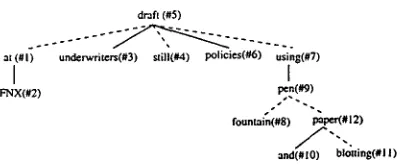
T h e user of LexTract can choose either op- tion and inform LexTract a b o u t his choice by setting a p a r a m e t e r . 3 F i g u r e 10 shows t h e derivation tree based on t h e second option.
draft (#5)
a[ (#1) underwriters(#3) ~i11(#4) policies(#6) using(#7)
I
I
FNX(#2) pen(#9)
fountain(#8) paper(#12)
[image:4.596.98.329.48.208.2]and(#10) bloldng(#l I)
Figure 10: T h e derivation tree for the sentence
3.4 U n i q u e n e s s o f d e c o m p o s i t i o n
To summarize, LexTract is a language- i n d e p e n d e n t g r a m m a r e x t r a c t i o n system, which takes Treebank-specific information
(see Section 3.2) a n d a ttree T , a n d creates
2Without this additional constraint, the derivation tree sometimes is not unique. For example, in Figure
8, both #4 and #7 modify the etree #5. If adjunc-
tion were allowed at foot nodes, ~4 could adjoin to
~7 at VP2.b, and #7 would adjoin to #5 at VPs.b.
An alternative is for #4 to adjoin to #5 at VPs.b and
for ~7 to adjoin to ~4 at VP2.t. The no-adjunction-
at-foot-node constraint would rule out the latter al- ternative and make the derivation tree unique. Note that this constraint has been adopted by several hand- crafted grammars such as the XTAG grammar for En- glish (XTAG-Group, 1998), because it eliminates this source of spurious ambiguity.
[image:4.596.363.567.380.463.2](1) a fully bracketed ttree T*, (2) a set E s e t of etrees, and (3) a derivation tree D for T*. Furthermore, E s e t is the only tree set that satisfies all the following conditions:
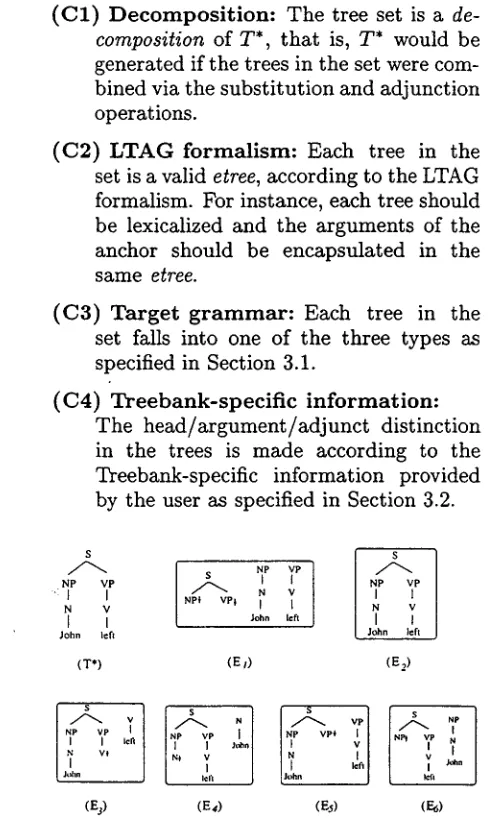
( C 1 ) D e c o m p o s i t i o n : T h e tree set is a de- c o m p o s i t i o n of T*, t h a t is, T* would be generated if the trees in the set were com- bined via the s u b s t i t u t i o n and adjunction operations.
( C 2 ) L T A G f o r m a l i s m : Each tree in the set is a valid etree, according to the LTAG formalism. For instance, each tree should be lexicalized and the arguments of the anchor should b e encapsulated in the same etree.
( C 3 ) T a r g e t g r a m m a r : Each tree in the set falls into one of the three types as specified in Section 3.1.
( C 4 ) T r e e b a n k - s p e c i f i c i n f o r m a t i o n : The h e a d / a r g u m e n t / a d j u n c t distinction in the trees is m a d e according to the Treebank-specific information provided by the user as specified in Section 3.2.
S
NP VP
< 1 I
N V
I t
John left
(T*)
Ja,. I I
John left
(E l) (E2)
[ &~m t lea lc~hn [ Icft
(E) (E,) (Es) (E6)
Figure 11: Tree sets for a fully bracketed ttree This uniqueness of the tree set m a y be quite surprising at first sight, considering that the n u m b e r of possible decompositions of T* is ~(2n), where n is the n u m b e r of nodes in T*. 4 Instead of giving a p r o o f of the uniqueness, 4Recall that the process of building etrees has two steps. First, LexTract treats each node as a pair of the top and bottom parts. The ttree is cut into pieces along the boundaries of the top and bottom parts of some nodes. The top and the bottom parts of each node belong to either two distinct pieces or one piece, as a result, there are 2 ~ distinct partitions. Second, some non-adjacent pieces in a partition can be glued together to form a bigger piece. Therefore, each par- tition will result in one or more decompositions of the ttree. In total, there are at least 2 n decompositions of the ttree.
we use an example to illustrate how the con- ditions ( C 1 ) - - ( C 4 ) rule out all the decompo- sitions except the one p r o d u c e d by LexTract. In Figure 11, the ttree T* has 5 nodes (i.e., S, NP, N, VP, a n d V). T h e r e are 32 distinct decompositions for T*, 6 of which are shown in the same figure. O u t of these 32 decom- positions, only five (i.e., E2 - - E6) are fully lexicalized - - that is, each tree in these tree sets is anchored by a lexical item. The rest, including E l , are not fully lexicalized, and are therefore ruled out b y the condition (C2). For the remaining five etree sets, E2 - - E4 are ruled out by the condition (C3), because each of these tree sets has one tree t h a t violates one constraint which says t h a t in a spine-etree an argument of the anchor should be a substitu- tion node, rather t h a n an internal node. For the remaining two, E5 is ruled out by (C4) because according to the H e a d Table provided by the user, the head of the S node should be V, not N . Therefore, E6, the tree set that is produced by LexTract, is the only etree set for T* that satisfies ( C 1 ) - - ( C 4 ) .
3.5 T h e E x p e r i m e n t s
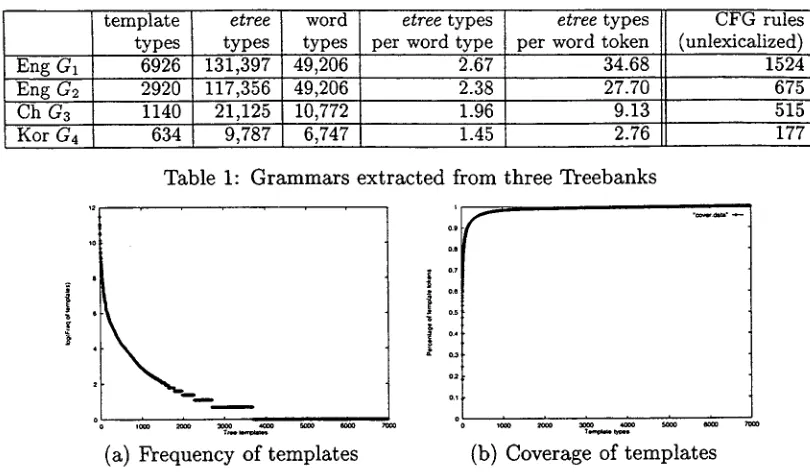
[image:5.596.64.309.112.521.2]etrees. The average numbers of etrees for each word type in G1 and G2 are 2.67 and-2.38 respectively. Because frequent words often anchor many etrees, the numbers increase by more than 10 times when we consider word
token, as shown in the fifth and sixth columns of the table. G3 and G4 are much smaller t h a n G1 and G2 because the Chinese and the Korean Treebanks are much smaller than the English Treebank.
In addition to LTAGs, by reading context- free rules off the etrees of a Treebank LTAG, LexTract also produces CFGs. The numbers of unlexicalized context-free rules from G1-- G4 are shown in the last column of Table 1. Comparing with other CFG extraction algo- rithms such as the one in (Krotov et al., 1998), the CFGs produced by LexTract have sev- eral good properties. For example, they allow unary rules and epsilon rules, they are more compact and the size of the g r a m m a r remains monotonic as the Treebank grows.
Figure 12 shows the log frequency of tem- plates and the percentage of template tokens covered by template types in G1. 6 In both cases, template types are sorted according to their frequencies and plotted on the X-axes. T h e figure indicates that a small portion of template types, which can be seen as the core of the grammar, cover majority of template tokens in the Treebank. For example, the first 100 (500, 1000 and 1500, resp.) templates cover 87.1% (96.6~o, 98.4% and 99.0% resp.) of the tokens, whereas about half (3411) of the templates each occur only once, account- ing for only 0.29% of template tokens in total. 4 A p p l i c a t i o n s o f L e x T r a c t
In addition to extract LTAGs and CFGs, Lex- Tract has been used to perform the following tasks:
• We use the Treebank grammars produced by LexTract to evaluate the coverage of hand-crafted grammars.
• We use the (word, template) sequence produced by LexTract to re-train Srini- vas' Supertaggers (Srinivas, 1997). • The derivation trees created by LexTract
are used to train a statistical LTAG parser (Sarkar, 2000). LexTract o u t p u t has also been used to train an L R LTAG parser (Prolo, 2000).
6Similar results hold for G2, G3 and G4.
• We have used LexTract to retrieve the data from Treebanks to test theoret- ical linguistic hypotheses such as the Tree-locality Hypothesis (Xia and Bleam, 20O0).
• LexTract has a filter that checks the plausibility of extracted etrees by decom- posing each etree into substructures and checking them. Implausible etrees are of- ten caused by Treebank annotation er- rors. Because LexTract maintains the mappings between etree nodes and ttree
nodes, it can detect certain types of an- notation errors. We have used LexTract for the final cleanup of the P e n n Chinese Treebank.
Due to space limitation, in this paper we will only discuss the first two tasks.
4.1 E v a l u a t i n g t h e c o v e r a g e o f h a n d - c r a f t e d g r a m m a r s
The XTAG g r a m m a r (XTAG-Group, 1998) is a hand-crafted large-scale g r a m m a r for En- glish, which has been developed at University of Pennsylvania in the last decade. It has been used in m a n y NLP applications such as gen- eration (Stone and Doran, 1997). Evaluating the coverage of such a g r a m m a r is i m p o r t a n t for both its developers and its users.
Previous evaluations (Doran et al., 1994; Srinivas et al., 1998) of the XTAG g r a m m a r use raw d a t a (i.e., a set of sentences with- out syntactic bracketing). The data are first parsed by an LTAG parser and the coverage of the g r a m m a r is measured as the percent- age of sentences in the d a t a that get at least one parse, which is not necessarily the correct parse. For more discussion on this approach, see (Prasad a n d Sarkar, 2000).
We propose a new evaluation m e t h o d t h a t takes advantage of Treebanks and LexTract. The idea is as follows: given a Treebank T and a hand-crafted g r a m m a r Gh, the coverage of
Gh on T can be measured by the overlap of Gh
and a Treebank g r a m m a r Gt that is produced by LexTract from T. In this case, we will esti- mate the coverage of the XTAG g r a m m a r on the English P e n n Treebank (PTB) using the Treebank g r a m m a r G2.
template etree types types Eng G1 6926 131,397 Eng G2 2920 117,356
Ch G3 1140 21,125
Kor G4 634 9,787
word types 49,206 49,206 10,772 6,747
etree types etree types CFG rules per word type i per word token (unlexicalized)
2.67~ 34.68 1524
2.38 27.70 675
1.96 9.13 515
1.45 2.76 177
Table 1: G r a m m a r s extracted from three Treebanks ' r
o.~
o.e
0.7
o.e
o.5
o.4
o ~
0 2
o.~
o
T ~ m T ~
(a) Frequency of templates (b) Coverage of t e m p l a t e s Figure 12: Template types and template tokens in G1
gard the t y p e of information that is present only in one grammar. As a result, the map- ping between two g r a m m a r s is not one-to-one.
XTAG G~ ~equency
matched unmatched total templates templates
497 507 1004
215 2705 2920
82.1% I 1 7 . 9 % [100% Table 2: Matched templates in two grammars
Table 2 shows that 497 templates in the XTAG g r a m m a r and 215 templates in G2 match, and the latter accounts for 82.1% of the template tokens in the P T B . The remain- ing 17.9% t e m p l a t e tokens in the P T B do not match any t e m p l a t e in the XTAG g r a m m a r because of one of the following reasons:
(T1) I n c o r r e c t t e m p l a t e s in G2: These tem- plates result from Treebank annotation er- rors, and therefore, are not in XTAG. (T2) C o o r d i n a t i o n in X T A G : the templates
for coordinations in XTAG are generated on the fly while parsing (Sarkar and Joshi, 1996), and are not part of the 1004 templates. Therefore, the conj-etrees in G2, which ac- count for 3.4% of the template tokens in the Treebank, do not match any templates in XTAG.
(T3) A l t e r n a t i v e analyses: XTAG and PTB sometimes choose different analyses for the same phenomenon. For example, the two grammars treat reduced relative clauses dif- ferently. As a result, the templates used to handle those phenomena in these two gram-
mars do not m a t c h according to our defini- tion.
(T4) C o n s t r u c t i o n s n o t c o v e r e d b y X T A G : Some of such constructions are the unlike coordination phrase (UCP), parenthetical (PRN), and ellipsis.
For ( T 1 ) - - ( T 3 ) , the X T A G g r a m m a r can handle the corresponding constructions al- though the templates used in two grammars look very different. To find out w h a t construc- tions are not covered by XTAG, we manually classify 289 of the most frequent u n m a t c h e d templates in G2 according to the reason why they are absent from X T A G . These 289 tem- plates account for 93.9% of all the u n m a t c h e d t e m p l a t e tokens in the Treebank. T h e results are shown in Table 3, where the percentage is with respect to all the tokens in the Treebank. From the table, it is clear t h a t the most com- mon reason for mis-matches is (T3). Combin- ing the results in Table 2 and 3, we conclude t h a t 97.2% of t e m p l a t e tokens in the Treebank are covered by XTAG, while another 1.7% are not. For the remaining 1.1% t e m p l a t e tokens, we do not know w h e t h e r or not t h e y are cov- ered by X T A G because we have not checked the remaining 2416 u n m a t c h e d t e m p l a t e s in G2. T
[image:7.596.110.515.50.286.2]T1 T2 T3 T4 total
type 51 52 ~93 93 289
freq 1 . 1 % 3 . 4 % 10.6% 1 . 7 % 16.8% Table 3: Classifications of 289 unmatched templates
by comparing templates in the XTAG gram- mar with the 'IYeebank g r a m m a r produced by LexTract, we estimate t h a t the XTAG gram- mar covers 97.2% of template tokens in the English Treebank. Comparing with previous evaluation approach, this :method has several advantages. First, the whole process is semi- automatic and requires little human effort. Second, the coverage can be calculated at ei- ther sentence level or etree level, which is more fine-grained. Third, the method provides a list of etrees that can be added to the gram- mar to improve its coverage. Fourth, there is no need to parse the whole corpus, which could have been very time-consuming.
4.2 T r a i n i n g S u p e r t a g g e r s
A Supertagger (Joshi and Srinivas, 1994; Srinivas, 1997) assigns an etree template to each word in a sentence. The templates are also called Supertags because they in- clude more information than Part-of-Speech tags. Srinivas implemented the first Supertag- ger, and he also built a Lightweight Depen- dency Analyzer that assembles the Supertags of words to create an almost-parse for the sen- tence. Supertaggers have been found useful for several applications, such as information retrieval (Chandrasekar and Srinivas, 1997).
To use a Treebank to train a Supertagger, the phrase structures in the Treebank have to be converted into (word, Supertag) sequences first. Producing such sequences is exactly one of LexTract's main functions, as shown previ- ously in Section 3.3.2 and Figure 9.
Besides LexTract, there are two other at- tempts in converting the English Penn Tree- bank to train a Supertagger. Srinivas (1997) uses heuristics to map structural information in the Treebank into Supertags. His method is different from LexTract in t h a t the set of Supertags in his method is chosen from the
pre-existing XTAG g r a m m a r before the con- version starts, whereas LexTract extracts the Supertag set from Treebanks. His conversion program is also designed for this particular Supertag set, and it is not very-easy to port it to another Supertag set. A third difference is that the Supertags in his converted data do
not always fit together, due to the discrep- ancy between the XTAG grammar and t h e Treebank annotation and the fact that the XTAG g r a m m a r does not cover all the tem- plates in the Treebank (see Section 4.1). In other words, even if the Supertagger is 100% accurate, it is possible that the correct parse for a sentence can not be produced by com- bining those Supertags in the sentence.
Another work in converting Treebanks into LTAGs is described in (Chen and Vijay- Shanker, 2000). The m e t h o d is similar to ours in that both work use Head Percolation Tables to find the head and both distinguish adjuncts from modifiers using syntactic tags and func- tional tags. Nevertheless, there are several differences: only LexTract explicitly creates fully bracketed ttrees, which are identical to the derived trees for the sentences. As a re- sult, building etrees can be seen as a task of decomposing the fully bracketed ttrees. The mapping between the nodes in fully bracketed
ttrees and etrees makes LexTract a useful tool for 'IYeebank annotation and error detection. The two approaches also differ in how they distinguish arguments from adjuncts and how they handle coordinations.
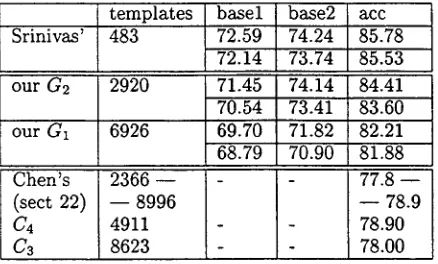
Table 4 lists the tagging accuracy of the same trigram Supertagger (Srinivas, 1997) trained and tested on the same original PTB data. s The difference in tagging accuracy is caused by different conversion algorithms that convert the original P T B data into the (word, template) sequences, which are fed to the Supertagger. The results of Chen & Vijay-Shanker's method come from their pa- per (Chen and Vijay-Shanker, 2000). They built eight grammars. We just list two of them which seem to be most relevant: C4 uses a re- duced tagset while C3 uses the P T B tagset. As for Srinivas' results, we did not use the re- sults reported in (Srinivas, 1997) and (Chen et al., 1999) because they are based on different training and testing data. 9 Instead, we re-ran
SAll use Section 2-21 of the P T B for training, and Section 22 or 23 for testing. W e choose those sec- tions because several state-of-thwart parsers (Collins, 1997; Ratnaparkhi, 1998; Charniak, 1997) are trained on Section 2-21 and tested on Section 23. W e include the results for Section 22 because (Chen and Vijay- Shanker, 2000) is tested on that section. For Srinivas'
and our grammars, the first line is the results tested on
Section 23, and the second line is the one for Section 22. Chen & Vijay-Shauker's results~e for Section 22 only.
[image:8.596.119.333.54.90.2]his S u p e r t a g g e r using his d a t a on t h e sections t h a t we have chosen. 1° We have calculated two baselines for each seg of data. T h e first one tags each word in testing d a t a with t h e most c o m m o n S u p e r t a g w.r.t t h e word in t h e training data. For an u n k n o w n word, just use its most c o m m o n Supertag. For the second baseline, we use a t r i g r a m P O S tagger to tag the words first, a n d t h e n for each word we use the most c o m m o n S u p e r t a g w.r.t, the (word, P O S tag) pair.
templates
Srinivas' 483
our G2 2920
our G1 6926
Chen's 2366 - -
(sect 22) - - 8996
C4 4911
C3 8623
basel base2
72.59 74.24
72.14 73.74
71.45 74.14
70.54 73.41
69.70 71.82
68.79 70.90
a c c
85.78 85.53 84.41 83.60 82.21 81.88 77.8 - - - - 78.9 78.90 78.O0
Table 4: S u p e r t a g g i n g results based on t h r e e different conversion algorithms
A few observations are in order. First, t h e baselines for S u p e r t a g g i n g are lower t h a n t h e one for P O S tagging, which is 91%, indicat- ing S u p e r t a g g i n g is h a r d e r t h a n P O S tagging. Second, the second baseline is slightly bet- ter t h a n the first baseline, indicating using
~°Noticeably, the results we report on Srinivas' data, 85.78% on Section 23 and 85.53% on Section 22, axe lower than 92.2% reported in (Srinivas, 1997) and 91.37% in (Chen et al., 1999). There axe several reasons for the difference. First, the size of training data in our report is smaller than the one for his pre- vious work; Second, we treat punctuation marks as normal words during evaluation because, like other
words, punctuation marks can anchor etrees, whereas
he treats the Supertags for punctuation marks as al- ways correct. Third, he used some equivalent classes during evaluations. If a word is mis-tagged as x, while the correct Supertag is y, he considers that not to be an error if x and y appear in the same equivalent class. We suspect that the reason that those Supertagging er- rors axe disregarded is that those errors might not af- fect parsing results when the Supertags are combined. For example, both adjectives and nouns can modify other nouns. The two templates (i.e. Supertags) rep- resenting these modification relations look the same except for the POS tags of the anchors. If a word which should be tagged with one Supertag is mis- tagged with the other Supertag, it is likely that the wrong Supertag can still fit with other Supertags in the sentence and produce the right parse. We did not use these equivalent classes in this experiment because we are not aware of a systematic way to find all the
cases in which Supertagging errors do not affect the final parsing results.
POS tags m a y improve t h e S u p e r t a g g i n g ac-
curacy, n T h i r d , the S u p e r t a g g i n g accuracy
using G2 is 1.3-1.9% lower t h a n t h e one using Srinivas' data. This is n o t surprising since t h e size of G2 is 6 times t h a t of Srinivas' g r a m m a r . Notice t h a t G1 is twice t h e size of G2 and the accuracy using G1 is 2% lower. Fourth, higher S u p e r t a g g i n g a c c u r a c y does not neces- sarily means t h e q u a l i t y o f converted d a t a are b e t t e r since t h e u n d e r l y i n g g r a m m a r s differ a lot with respect to t h e size a n d the coverage. A b e t t e r m e a s u r e will be t h e parsing accu- racy (i.e., t h e converted d a t a should be fed t o a common LTAG parser a n d t h e evaluations should b e based on p a r s i n g results). We are currently working on t h a t . Nevertheless, t h e experiments show t h a t t h e (word, t e m p l a t e ) sequences p r o d u c e d by L e x T r a c t are useful for training Supertaggers. O u r results are slightly lower t h a n t h e ones t r a i n e d on Srinivas' data, b u t our conversion a l g o r i t h m has several ap- pealing properties: L e x T r a c t does not use pre- existing S u p e r t a g set; L e x T r a c t is language- independent; the (word, S u p e r t a g ) sequence produced by L e x T r a c t fit together.
5 C o n c l u s i o n
We have presented a s y s t e m for g r a m m a r ex- traction t h a t produces an LTAG from a Tree- bank. T h e o u t p u t p r o d u c e d b y t h e s y s t e m has been used in m a n y N L P tasks, two o f which are discussed in t h e p a p e r . In t h e first task, by c o m p a r i n g t h e X T A G g r a m m a r with a Treebank g r a m m a r p r o d u c e d by L e x T r a c t , we estimate t h a t the X T A G g r a m m a r covers 97.2% of t e m p l a t e tokens in t h e English Tree- bank. We plan to use t h e T r e e b a n k g r a m m a r to improve t h e coverage o f t h e X T A G gram- mar. We have also f o u n d c o n s t r u c t i o n s t h a t are covered in the X T A G g r a m m a r b u t do not appear in t h e Treebank. In t h e second task, L e x T r a c t converts the T r e e b a n k into a f o r m a t t h a t can b e used to t r a i n Supertaggers, and the Supertagging a c c u r a c y is c o m p a t i b l e to, if not b e t t e r t h a n , the ones based on o t h e r con- version algorithms. For f u t u r e work, we plan to use derivation trees t o t r a i n LTAG parsers directly a n d use L e x T r a c t t o a d d semantic in- formation t o t h e P e n n T r e e b a n k .
R e f e r e n c e s
R. Chandrasekar and B. Srinivas. 1997. Glean- ing information from the Web: Using Syntax
to Filter out Irrelevant Information. In Proc. of
[image:9.596.90.309.199.331.2]A A A I 1997 Spring Symposium on NLP on the World Wide Web.
Eugene Charniak. 1996. Treebank Grammars. In
Proc. of AAAI-1996.
Eugene Charniak. 1997. Statistical Parsing with a Context-Free Grammar and Word Statistics. In Proc. of AAAI-1997.
John Chen and K. Vijay-Shanker. 2000. Auto- mated Extraction of TAGs from the Penn Tree- bank. In 6th International Workshop on Pars- ing Technologies (IWPT..2000), Italy.
John Chen, Srinivas Bangalore, and K. Vijay- Shanker. 1999. New Models for Improving Supertag Disambiguation. In Proc. of EACL- 1999.
Mike Collins. 1997. Three Generative, Lexicalised Models for Statistical Parsing. In Proc. of the 35th ACL.
C. Doran, D. Egedi, B. A. Hockey, B. Srinivas, and M. Zaidel. 1994. XTAG System - A Wide Coverage Grammar for English. In Proc. of COLING-1994, Kyoto, Japan.
Aravind Joshi and B. Srinivas. 1994. Disambigua- tion of Super Parts of Speech (or Supertags): Almost Parsing. In Proc. of COLING-1994.
Aravind Joshi and K. Vijay-Shanker. 1999. Com- positional Semantics with LTAG: How Much Underspecification Is Necessary? In Proc. of 3nd International Workshop on Computational Semantics.
Aravind K. Joshi, L. Levy, and M. Takahashi. 1975. Tree Adjunct Grammars. Journal of Computer and System Sciences.
Laura Kallmeyer and Aravind Joshi. 1999. Un- derspecified Semantics with LTAG.
Alexander Krotov, Mark Hepple, Robert Galzauskas, and Yorick Wilks. 1998. Compact- ing the Penn Treebank Grammar. In Proc. of A CL- COLING.
David M. Magerman. 1995. Statistical Decision- Tree Models for Parsing. In Proc. of the 33rd ACL.
M. Marcus, B. Santorini, and M. A. Marcinkiewicz. 1 9 9 3 . Building a Large Annotated Corpus of English: the Penn Treebank. Computational Lingustics.
K. F. McCoy, K. Vijay-Shanker, and G. Yang. 1992. A Functional Approach to Generation with TAG. In Proc. of the 30th A CL.
Martha Palmer, Owen Rainbow, and Alexis Nasr. 1998. Rapid Prototyping of Domain- Specific Machine Translation System. In Proc. of AMTA-1998, Langhorne, PA.
Rashmi Prasad and Anoop Sarkar. 2000. Compar- ing Test-Suite Based Evaluation and Corpus- Based Evaluation of a Wide-Coverage Grammar for English. In Proc. of LREC satellite work- shop Using Evaluation within HLT Programs: Results and Trends, Athen, Greece.
Carlos A. Prolo. 2000. An Efficient LR Parser Generator for TAGs. In 6th International
Workshop on Parsing Technologies (IWPT 2000), Italy.
Adwait Ratnaparkhi. 1998. Maximum Entropy Models for Natural Language Ambiguity Resolu- tion. Ph.D. thesis, University of Pennsylvania. Anoop Sarkar and Aravind Joshi. 1996. Coordi-
nation in Tree Adjoining Grammars: Formaliza- tion and Implementation. In Proc. of the 18th
COLING, Copenhagen, Denmark.
Anoop Sarkar. 2000. Practical Experiments in Parsing using Tree Adjoining Grammars. In
Proc. of 5th International Workshop on TAG and Related Frameworks (TAG+5).
The XTAG-Group. 1998. A Lexicalized Tree Ad- joining Grammar for English. Technical Report IRCS 98-18, University of Pennsylvania. Yves Schabes and Stuart Shieber. 1992. An Al-
ternative Conception of Tree-Adjoining Deriva- tion. In Proc. of the 20th Meeting of the Asso- ciation for Computational Linguistics.
Yves Schabes. 1990. Mathematical and Computa- tional Aspects of Lexicalized Grammars. Ph.D. thesis, University of Pennsylvania.
Kiyoaki Shirai, Takenobu Tokunaga, and Hozumi Tanaka. 1 9 9 5 . Automatic Extraction of Japanese Grammar from a Bracketed Corpus. In Proc. of Natural Language Processing Pacific Rim Symposium (NLPRS-1995).
B. Srinivas, Anoop Sarkar, Christine Doran, and Beth Ann Hockey. 1998. Grammar and Parser Evaluation in the XTAG Project. In Workshop on Evaluation of Parsing Systems, Granada, Spain.
B. Srinivas. 1997. Complexity of Lexical De- scriptions and Its Relevance to Partial Parsing.
Ph.D. thesis, University of Pennsylvania. Matthew Stone and Christine Doran. 1997. Sen-
tence Planning as Description Using Tree Ad- joining Grammar. In Proc. of the 35th A CL.
Bonnie Webber and Aravind Joshi. 1998. Anchor- ing a Lexicalized Tree Adjoining Grammar for Discourse. In Proc. of A CL-COLING Workshop on Discourse Relations and Discourse Markers.
Fei Xia and Tonia Bleam. 2000. A Corpus-Based Evaluation of Syntactic Locality in TAGs. In
Proc. of 5th International Workshop on TAG and Related Frameworks (TAG+5).
Fei Xia, Chunghye Han, Martha Palmer, and Aravind Joshi. 2000a. Comparing Lexicalized Treebank Grammars Extracted from Chinese, Korean, and English Corpora. In Proc. of the 2nd GT~inese Language Processing Workshop,
Hong Kong, China.