Lyrics, Music, and Emotions
Rada Mihalcea
University of North Texas [email protected]
Carlo Strapparava
FBK-irst [email protected]
Abstract
In this paper, we explore the classification of emotions in songs, using the music and the lyrics representation of the songs. We intro-duce a novel corpus of music and lyrics, con-sisting of 100 songs annotated for emotions. We show that textual and musical features can both be successfully used for emotion recog-nition in songs. Moreover, through compar-ative experiments, we show that the joint use of lyrics and music brings significant improve-ments over each of the individual textual and musical classifiers, with error rate reductions of up to 31%.
1 Introduction
Language and music are peculiar characteristics of human beings. The capability of producing and enjoying language and music appears in every hu-man society, regardless of the richness of its culture (Nettl, 2000).
Importantly, language and music complement each other in many different ways. For instance, looking at music and language in terms of fea-tures, we can observe that music organizes pitch and rhythm in ways that language does not, and it lacks the specificity of language in terms of seman-tic meaning. On the other hand, language is built from categories that are absent in music (e.g., nouns and verbs), whereas music seems to have a deeper power over our emotions than does ordinary speech. Composers, musicians, and researchers in poetry and literature alike have been long fascinated by the combination of language and music, even since the
time of the earliest written records of music encoun-tered in musical settings for poetry. Despite this in-terest, and despite the long history of the interaction between music and lyrics, there is only little work that explicitly focuses on the connection between music and lyrics.
In this paper, we focus on the connection between the musical and linguistic representations in popu-lar songs, and their role in the expression of affect. We introduce a novel corpus of lyrics and music, an-notated for emotions at line level, and explore the automatic recognition of emotions using both ttual and musical features. Through comparative ex-periments, we show that emotion recognition can be performed using either textual or musical features, and that the joint use of lyrics and music can im-prove significantly over classifiers that use only one dimension at a time. We believe our results demon-strate the promise of using joint music-lyric models for song processing.
2 Related Work
The literature on music analysis is noticeably large, and there are several studies concerning the music’s power over emotions (Juslin and Sloboda, 2001), thinking (Rauscher et al., 1993), or physical effort (Karageorghis and Priest, 2008).
In particular, there has been significant research in music and psychology focusing on the idea of a parallel between affective cues in music and speech (Sundberg, 1982; Scherer, 1995). For instance, (Scherer, 2004) investigated the types of emotions that can be induced by music, their mechanisms, and how they can be empirically measured. (Juslin and
Laukka, 2003) conducted a comprehensive review of vocal expressions and music performance, find-ing substantial overlap in the cues used to convey basic emotions in speech and music.
The work most closely related to ours is the com-bination of audio and lyrics for emotion classifica-tion in songs, as thoroughly surveyed in (Kim et al., 2010). Although several methods have been pro-posed, including a combination of textual features and beats per minute and MPEG descriptors (Yang and Lee, 2004); individual audio and text classifiers for arousal and valence, followed by a combination through meta-learning (Yang et al., 2008); and the use of crowdsourcing labeling from Last.fm to col-lect large datasets of songs annotated for emotions (Laurier et al., 2008; Hu et al., 2009), all this pre-vious work was done at song level, and most of it focused on valence-arousal classifications. None of the previous methods considered the fine-grained classification of emotions at line level, as we do, and none of them considered the six Ekman emotions used in our work.
Other related work consists of the development of tools for music accessing, filtering, classification, and retrieval, focusing primarily on music in digital format such as MIDI. For instance, the task of music retrieval and music recommendation has received a lot of attention from both the arts and the computer science communities (see for instance (Orio, 2006) for an introduction to this task). There are also sev-eral works on MIDI analysis. Among them, partic-ularly relevant to our research is the work by (Das et al., 2000), who described an analysis of predom-inant up-down motion types within music, through extraction of the kinematic variables of music veloc-ity and acceleration from MIDI data streams. (Catal-tepe et al., 2007) addressed music genre classifica-tion (e.g., classic, jazz, pop) using MIDI and au-dio features, while (Wang et al., 2004) automati-cally aligned acoustic musical signals with their cor-responding textual lyrics. MIDI files are typically organized into one or more parallel “tracks” for in-dependent recording and editing. A reliable system to identify the MIDI track containing the melody1 is very relevant for music information retrieval, and
1
A melody can be defined as a “cantabile” sequence of notes, usually the sequence that a listener can remember after hearing a song.
there are several approaches that have been proposed to address this issue (Rizo et al., 2006; Velusamy et al., 2007).
Another related study concerned with the interac-tion of lyrics and music using an annotated corpus is found in (O’Hara, 2011), who presented preliminary research that checks whether the expressive meaning of a particular harmony or harmonic sequence could be deduced from the lyrics it accompanies, by us-ing harmonically annotated chords from the Usenet group alt.guitar.tab.
Finally, in natural language processing, there are a few studies that mainly exploited the lyrics com-ponent of the songs, while generally ignoring the musical component. For instance, (Mahedero et al., 2005) dealt with language identification, structure extraction, and thematic categorization for lyrics. (Xia et al., 2008) addressed the task of sentiment classification in lyrics, recognizing positive and neg-ative moods in a large dataset of Chinese pop songs, while (Yang and Lee, 2009) approached the problem of emotion identification in lyrics, classifying songs from allmusic.com using a set of 23 emotions.
3 A Corpus of Music and Lyrics Annotated for Emotions
To enable our exploration of emotions in songs, we compiled a corpus of 100 popular songs (e.g.,
Danc-ing Queen by ABBA, Hotel California by Eagles, Let it Be by The Beatles). Popular songs exert a
lot of power on people, both at an individual level as well as on groups, mainly because of the mes-sage and emotions they convey. Songs can lift our moods, make us dance, or move us to tears. Songs are able to embody deep feelings, usually through a combined effect of both music and lyrics.
MIDI format. MIDI is an industry-standard pro-tocol that enables electronic musical instruments, computers, and other electronic equipment to com-municate and synchronize with each other. Unlike analog devices, MIDI does not transmit an audio signal: it sends event messages about musical no-tation, pitch, and intensity, control signals for pa-rameters such as volume, vibrato, and panning, and cues and clock signals to set the tempo. As an elec-tronic protocol, it is notable for its widespread adop-tion throughout the music industry.
MIDI files are typically created using computer-based sequencing software that organizes MIDI messages into one or more parallel “tracks” for in-dependent recording, editing, and playback. In most sequencers, each track is assigned to a specific MIDI channel, which can be then associated to specific in-strument patches. MIDI files can also contain lyrics, which can be displayed in synchrony with the music. Starting with the MIDI tracks of a song, we ex-tract and explicitly encode the following features. At the song level, the key of the song (e.g., G ma-jor, C minor). At the line level, we represent the raising, which is the musical interval (in half-steps) between the first note in the line and the most impor-tant note (i.e., the note in the line with the longest duration). Finally, at the note level, we encode the time code of the note with respect to the beginning of the song; the note aligned with the corresponding syllable; the degree of the note with relation to the key of the song; and the duration of the note.
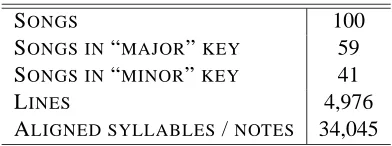
Table 1 shows statistics on the corpus. An exam-ple from the corpus, consisting of the first two lines from the Beatles’ song A hard day’s night, is illus-trated in Figure 3.
SONGS 100
SONGS IN“MAJOR” KEY 59 SONGS IN“MINOR”KEY 41
LINES 4,976
[image:3.612.86.282.544.617.2]ALIGNED SYLLABLES/NOTES 34,045
Table 1: Some statistics of the corpus
Emotion Annotations with Mechanical Turk. In order to explore the classification of emotions in songs, we needed a gold standard consisting of man-ual emotion annotations of the songs. Following
previous work on emotion annotation of text (Alm et al., 2005; Strapparava and Mihalcea, 2007), to annotate the emotions in songs we use the six ba-sic emotions proposed by (Ekman, 1993): ANGER, DISGUST,FEAR,JOY,SADNESS,SURPRISE. To col-lect the annotations, we use the Amazon Mechanical Turk service, which was previously found to pro-duce reliable annotations with a quality comparable to those generated by experts (Snow et al., 2008).
The annotations are collected at line level, with a separate annotation for each of the six emotions. We collect numerical annotations using a scale between 0 and 10, with 0 corresponding to the absence of an emotion, and 10 corresponding to the highest inten-sity. Each HIT (i.e., annotation session) contains an entire song, with a number of lines ranging from 14 to 110, for an average of 50 lines per song.
<token time=5760 orig−note=D’ degree=5 duration=810>HARD </token> <song filename=AHARDDAY.m2a>
<key time=0>G major</key>
<line pvers=1 raising=3 anger=1.5 disgust=0.7 sadness=2.5 surprise=0.8 >
</line>
<line pvers=2 raising=5 anger=3.5 disgust=2 sadness=1.2 surprise=0.2 >
</line>
<token time=5040 orig−note=B degree=3 duration=210>IT</token> <token time=5050 orig−note=B degree=3 duration=210>’S </token> <token time=5280 orig−note=C’ degree=4 duration=210>BEEN </token> <token time=5520 orig−note=B degree=3 duration=210>A </token>
<token time=6720 orig−note=D’ degree=5 duration=570>DAY</token> <token time=6730 orig−note=D’ degree=5 duration=570>’S </token> <token time=7440 orig−note=D’ degree=5 duration=690>NIGHT</token>
<token time=8880 orig−note=C’ degree=4 duration=212>AND </token> <token time=9120 orig−note=D’ degree=5 duration=210>I</token> <token time=9130 orig−note=D’ degree=5 duration=210>’VE </token>
[image:4.612.146.453.56.305.2]<token time=9600 orig−note=D’ degree=5 duration=210>WOR</token> <token time=9840 orig−note=F’ degree=7− duration=930>KING </token> <token time=10800 orig−note=D’ degree=5 duration=210>LI</token> <token time=11040 orig−note=C’ degree=4 duration=210>KE </token> <token time=11050 orig−note=C’ degree=4 duration=210>A </token> <token time=11280 orig−note=D’ degree=5 duration=330>D</token> <token time=11640 orig−note=C’ degree=4 duration=90>O</token> <token time=11760 orig−note=B degree=3 duration=330>G</token> <token time=9360 orig−note=C’ degree=4 duration=210>BEEN </token>
Figure 1: Two lines of a song in the corpus: It-’s been a hard day-’s night, And I-’ve been wor-king li-ke a d-o-g
For each song, we start by asking for ten annota-tions. After spam removal, we were left with about two-five annotations per song. The final annotations are produced by averaging the emotions scores pro-duced by the reliable annotators. Figure 3 shows an example of the emotion scores produced for two lines. The overall correlation between the remain-ing reliable annotators was calculated as 0.73, which represents a strong correlation.
For each of the six emotions, Table 2 shows the number of lines that had that emotion present (i.e., the score of the emotion was different from 0), as well as the average score for that emotion over all 4,976 lines in the corpus. Perhaps not surprisingly, the emotions that are dominant in the corpus areJOY
andSADNESS– which are the emotions that are of-ten invoked by people as the reason behind a song.
Note that the emotions do not exclude each other: i.e., a line that is labeled as containingJOYmay also contain a certain amount ofSADNESS, which is the reason for the high percentage of songs containing both JOY and SADNESS. The emotional load for the overlapping emotions is however very different. For instance, the lines that have a JOY score of 5
or higher have an averageSADNESS score of 0.34. Conversely, the lines with aSADNESSscore of 5 or
Number
Emotion lines Average
ANGER 2,516 0.95
DISGUST 2,461 0.71
FEAR 2,719 0.77
JOY 3,890 3.24
SADNESS 3,840 2.27
SURPRISE 2,982 0.83
Table 2: Emotions in the corpus of 100 songs: number of lines including a certain emotion, and average emotion score computed over all the 4,976 lines.
higher have aJOYscore of 0.22.
4 Experiments and Evaluations
Through our experiments, we seek to determine the extent to which we can automatically determine the emotional load of each line in a song, for each of the six emotion dimensions.
[image:4.612.347.502.349.463.2]emotion classification. The second set specifically focuses on the musical features. Finally, the last set of experiments makes joint use of textual and musi-cal features.
The experiments are run using linear regression,2 and the results are evaluated by measuring the Pear-son correlation between the classifier predictions and the gold standard. For each experiment, a ten-fold cross validation is run on the entire dataset.3
4.1 Textual Features
First, we attempt to identify the emotions in a line by relying exclusively on the features that can be de-rived from the lyrics of the song. We decided to fo-cus on those features that were successfully used in the past for emotion classification (Strapparava and Mihalcea, 2008). Specifically, we use: (1) unigram features obtained from a bag-of-words representa-tion, which are the features typically used by corpus-based methods; and (2) lexicon features, indicating the appartenance of a word to a semantic class de-fined in manually crafted lexicons, which are often used by knowledge-based methods.
Unigrams. We use a bag-of-words representation of the lyrics to derive unigram counts, which are then used as input features. First, we build a vo-cabulary consisting of all the words, including stop-words, occurring in the lyrics of the training set. We then remove those words that have a frequency be-low 10 (value determined empirically on a small de-velopment set). The remaining words represent the unigram features, which are then associated with a value corresponding to the frequency of the unigram inside each line. Note that we also attempted to use higher order n-grams (bigrams and trigrams), but evaluations on a small development dataset did not show any improvements over the unigram model, and thus all the experiments are run using unigrams.
Semantic Classes. We also derive and use coarse textual features, by using mappings between words and semantic classes. Specifically, we use the
Lin-2
We use the Weka machine learning toolkit.
3
There is no clear way to determine a baseline for these experiments. A simple baseline that we calculated, which as-sumed by default an emotional score equal to the average of the scores on the training data, and measured the correlation be-tween these default scores and the gold standard, consistently led to correlations close to 0 (0.0081-0.0221).
guistic Inquiry and Word Count (LIWC) and Word-Net Affect (WA) to derive coarse textual features. LIWC was developed as a resource for psycholin-guistic analysis (Pennebaker and Francis, 1999; Pennebaker and King, 1999). The 2001 version of LIWC includes about 2,200 words and word stems grouped into about 70 broad categories relevant to psychological processes (e.g., emotion, cognition). WA (Strapparava and Valitutti, 2004) is a resource that was created starting with WordNet, by annotat-ing synsets with several emotions. It uses several re-sources for affective information, including the emo-tion classificaemo-tion of Ortony (Ortony et al., 1987). From WA, we extract the words corresponding to the six basic emotions used in our experiments. For each semantic class, we infer a feature indicating the number of words in a line belonging to that class.
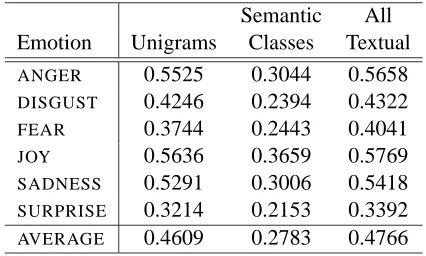
Table 3 shows the Pearson correlations obtained for each of the six emotions, when using only uni-grams, only semantic classes, or both.
Semantic All
Emotion Unigrams Classes Textual
ANGER 0.5525 0.3044 0.5658
DISGUST 0.4246 0.2394 0.4322
FEAR 0.3744 0.2443 0.4041
JOY 0.5636 0.3659 0.5769
SADNESS 0.5291 0.3006 0.5418 SURPRISE 0.3214 0.2153 0.3392
[image:5.612.317.530.341.469.2]AVERAGE 0.4609 0.2783 0.4766
Table 3: Evaluations using textual features: unigrams, semantic classes, and all the textual features.
4.2 Musical Features.
In a second set of experiments, we explore the role played by the musical features. While the musical notation of a song offers several characteristics that could be potentially useful for our classification ex-periments (e.g., notes, measures, dynamics, tempo), in these initial experiments we decided to focus on two main features, namely the notes and the key.
al-though other notations can also be used. Notes can be modified by “accidentals” – a sharp or a flat sym-bol that can change the note by half a tone. A written note can also have associated a value, which refers to its duration (e.g., whole note; eighth note). Simi-lar to the unigram features, for each note, we record a feature indicating the frequency of that note inside a line.
Key. The key of a song refers to the harmony or “pitch class” used for a song, e.g., C major, or F#. Sometime the term minor or major can be appended to a key, to indicate a minor or a major scale. For instance, a song in “the key of C minor” means that the song is harmonically centered on the note C, and it makes use of the minor scale whose first note is C. The key system is the structural foundation of most of the Western music. We use a simple feature that reflects the key of the song. Note that with a few ex-ceptions, when more than one key is used in a song, all the lines in a song will have the same key.
Table 4 shows the results obtained in these clas-sification experiments, when using only the notes as features, only the key, or both.
All
Emotion Notes Key Musical
ANGER 0.2453 0.4083 0.4405 DISGUST 0.1485 0.2922 0.3199
FEAR 0.1361 0.2203 0.2450
JOY 0.1533 0.3835 0.4001
SADNESS 0.1738 0.3502 0.3762
SURPRISE 0.0983 0.2241 0.2412
[image:6.612.320.529.56.185.2]AVERAGE 0.1592 0.3131 0.3371
Table 4: Evaluations using musical features: notes, key, and all the musical features.
4.3 Joint Textual and Musical Features.
To explore the usefulness of the joint lyrics and mu-sic representation, we also run a set of experiments that use all the textual and musical features. Table 5 shows the Pearson correlations obtained when us-ing all the features. To facilitate the comparison, the table also includes the results obtained with the textual-only and musical-only features (reported in Tables 3 and 4).
All All Textual &
Emotion Textual Musical Musical
ANGER 0.5658 0.4405 0.6679
DISGUST 0.4322 0.3199 0.5068
FEAR 0.4041 0.2450 0.4384
JOY 0.5769 0.4001 0.6456
SADNESS 0.5418 0.3762 0.6193 SURPRISE 0.3392 0.2412 0.3855
AVERAGE 0.4766 0.3371 0.5439
Table 5: Evaluations using both textual and musical fea-tures.
5 Discussion
One clear conclusion can be drawn from these ex-periments: the textual and musical features are both useful for the classification of emotions in songs, and, more importantly, their joint use leads to the highest classification results. Specifically, the joint model gives an error rate reduction of 12.9% with respect to the classifier that uses only textual fea-tures, and 31.2% with respect to the classifier that uses only musical features. This supports the idea that lyrics and music represent orthogonal dimen-sions for the classification of emotions in songs.
Among the six emotions considered, the largest improvements are observed forJOY,SADNESS, and
ANGER. This was somehow expected for the first two emotions, since they appear to be dominant in the corpus (see Table 2), but comes as a surprise forANGER, which is less dominant. Further explo-rations are needed to determine the reason for this effect.
Looking at the features considered, textual fea-tures appear to be the most useful. Nonetheless, the addition of the musical features brings clear im-provements, as shown in the last column from the same table.
Additionally, we made several further analyses of the results, as described below.
[image:6.612.88.279.391.520.2]All features, excluding
All Semantic Semantic Classes
Emotion Features Unigrams Classes Notes Key and Notes
ANGER 0.6679 0.4996 0.5525 0.6573 0.6068 0.6542 DISGUST 0.5068 0.3831 0.4246 0.5013 0.4439 0.4814
FEAR 0.4384 0.3130 0.3744 0.4313 0.4150 0.4114
JOY 0.6456 0.5141 0.5636 0.6432 0.5829 0.6274
SADNESS 0.6193 0.4586 0.5291 0.6176 0.5540 0.6029
SURPRISE 0.3855 0.3083 0.3214 0.3824 0.3421 0.3721
[image:7.612.111.495.56.200.2]AVERAGE 0.5439 0.4127 0.4609 0.5388 0.4908 0.5249
Table 6: Ablation studies excluding one feature group at a time.
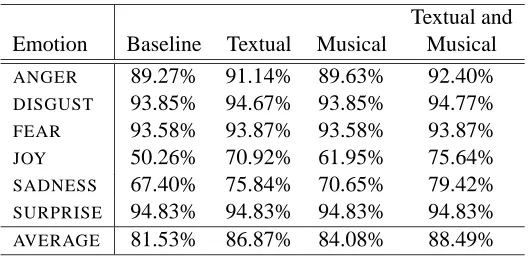
Textual and
Emotion Baseline Textual Musical Musical
ANGER 89.27% 91.14% 89.63% 92.40% DISGUST 93.85% 94.67% 93.85% 94.77%
FEAR 93.58% 93.87% 93.58% 93.87%
JOY 50.26% 70.92% 61.95% 75.64%
SADNESS 67.40% 75.84% 70.65% 79.42%
SURPRISE 94.83% 94.83% 94.83% 94.83%
AVERAGE 81.53% 86.87% 84.08% 88.49%
Table 7: Evaluations using a coarse-grained binary classification.
keeping only one group of features at a time; the re-sults obtained with the individual feature groups are already reported in Tables 3 and 4.
The ablation studies confirm the findings from our earlier experiments: while the unigrams and the keys are the most predictive features, the semantic classes and the notes are also contributing to the final clas-sification even if to a lesser extent. To measure the effect of these groups of somehow weaker features (semantic classes and notes), we also perform an ab-lation experiment where we remove both these fea-ture groups from the feafea-ture set. The results are re-ported in the last column of Table 6.
Coarse-grained classification. As an additional evaluation, we transform the task into a binary clas-sification by using a threshold empirically set at 3. Thus, to generate the coarse binary annotations, if the score of an emotion is below 3, we record it as “negative” (i.e., the emotion is absent), whereas if the score is equal to or above 3, we record it as “pos-itive” (i.e., the emotion is present).
For the classification, we use Support Vector
Ma-chines (SVM), which are binary classifiers that seek to find the hyperplane that best separates a set of pos-itive examples from a set of negative examples, with maximum margin (Vapnik, 1995). Applications of SVM classifiers to text categorization led to some of the best results reported in the literature (Joachims, 1998).
Table 7 shows the results obtained for each of the six emotions, and for the three major settings that we considered: textual features only, musical fea-tures only, and a classifier that jointly uses the tex-tual and the musical features. As before, the classi-fication accuracy for each experiment is reported as the average of the accuracies obtained during a ten-fold cross-validation on the corpus. The table also shows a baseline, computed as the average of the accuracies obtained when using the most frequent class observed on the training data for each fold.
[image:7.612.172.436.229.358.2]1,000 news headlines 4,976 song lines
Best result (Strapparava Joint Text
Emotion SEMEVAL’07 and Mihalcea, 08) and Music
ANGER 0.3233 0.1978 0.6679
DISGUST 0.1855 0.1354 0.5068
FEAR 0.4492 0.2956 0.4384
JOY 0.2611 0.1381 0.6456
SADNESS 0.4098 0.1601 0.6193
SURPRISE 0.1671 0.1235 0.3855
[image:8.612.151.457.55.199.2]AVERAGE 0.2993 0.1750 0.5439
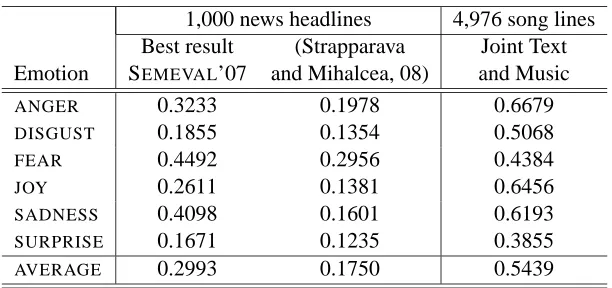
Table 8: Results obtained in previous work on emotion classification.
those emotions that are dominant in the corpus, i.e.,
JOYandSADNESS(see Table 2). The improvement obtained with the classifiers is much smaller for the other emotions (or even absent, e.g., forSURPRISE), which is also explained by their high baseline of over 90%.
Comparison to previous work. There is no pre-vious research that has considered the joint use of lyrics and songs representations for emotion classifi-cation at line level, and thus we cannot draw a direct comparison with other work on emotion classifica-tion in songs.
Nonetheless, as a point of reference, we consider the previous work done on emotion classification of texts. Table 8 shows the results obtained in previ-ous work for the recognition of emotions in a corpus consisting of 1,000 news headlines (Strapparava and Mihalcea, 2007) annotated for the same six emo-tions. Specifically, the table shows the best over-all correlation results obtained by the three emotion recognition systems in the SEMEVALtask on Affec-tive Text (Strapparava and Mihalcea, 2007): (Chau-martin, 2007; Kozareva et al., 2007; Katz et al., 2007). The table also shows the best results obtained in follow up work carried out on the same dataset (Strapparava and Mihalcea, 2008).
Except for one emotion (FEAR), the correlation figures we obtain are significantly higher than those reported in previous work. As mentioned before, however, a direct comparison cannot be made, since the earlier work used a different, smaller dataset. Moreover, our corpus of songs is likely to be more emotionally loaded than the news titles used in pre-vious work.
6 Conclusions
Popular songs express universally understood mean-ings and embody experiences and feelmean-ings shared by many, usually through a combined effect of both mu-sic and lyrics. In this paper, we introduced a novel corpus of music and lyrics, annotated for emotions at line level, and we used this corpus to explore the au-tomatic recognition of emotions in songs. Through experiments carried out on the dataset of 100 songs, we showed that emotion recognition can be per-formed using either textual or musical features, and that the joint use of lyrics and music can improve significantly over classifiers that use only one di-mension at a time.
The dataset introduced in this paper is available by request from the authors of the paper.
Acknowledgments
The authors are grateful to Rajitha Schellenberg for her help with collecting the emotion annota-tions. Carlo Strapparava was partially supported by a Google Research Award. Rada Mihalcea’s work was in part supported by the National Science Foun-dation award #0917170. Any opinions, findings, and conclusions or recommendations expressed in this material are those of the authors and do not neces-sarily reflect the views of the National Science Foun-dation.
References
Methods in Natural Language Processing, pages 347– 354, Vancouver, Canada.
Z. Cataltepe, Y. Yaslan, and A. Sonmez. 2007. Mu-sic genre classification using MIDI and audio features. Journal on Advances in Signal Processing.
F.R. Chaumartin. 2007. Upar7: A knowledge-based sys-tem for headline sentiment tagging. In Proceedings of the Fourth International Workshop on Semantic Evalu-ations (SemEval-2007), Prague, Czech Republic, June. M. Das, D. Howard, and S. Smith. 2000. The kinematic analysis of motion curves through MIDI data analysis. Organised Sound, 5(1):137–145.
P. Ekman. 1993. Facial expression of emotion. Ameri-can Psychologist, 48:384–392.
X. Hu, J. S. Downie, and A. F. Ehmann. 2009. Lyric text mining in music mood classification. In Proceed-ings of the International Society for Music Information Retrieval Conference, Kobe, Japan.
T. Joachims. 1998. Text categorization with Support Vector Machines: learning with mny relevant features. In Proceedings of the European Conference on Ma-chine Learning, pages 137–142, Chemnitz, Germany. P. Juslin and P. Laukka. 2003. Communication of
emo-tion in vocal expression and music performance: Dif-ferent channels, same code? Psychological Bulletin, 129:770–814.
P. N. Juslin and J. A. Sloboda, editors. 2001. Music and Emotion: Theory and Research. Oxford University Press.
C. Karageorghis and D. Priest. 2008. Music in sport and exercise : An update on research and application. The Sport Journal, 11(3).
P. Katz, M. Singleton, and R. Wicentowski. 2007. Swat-mp:the semeval-2007 systems for task 5 and task 14. In Proceedings of the Fourth International Workshop on Semantic Evaluations (SemEval-2007), Prague, Czech Republic, June.
Y. Kim, E. Schmidt, R. Migneco, B. Morton, P. Richard-son, J. Scott, J. Speck, and D. Turnbull. 2010. Mu-sic emotion recognition: A state of the art review. In International Symposium on Music Information Re-trieval.
Z. Kozareva, B. Navarro, S. Vazquez, and A. Mon-toyo. 2007. Ua-zbsa: A headline emotion classifi-cation through web information. In Proceedings of the Fourth International Workshop on Semantic Evalua-tions (SemEval-2007), Prague, Czech Republic, June. C. Laurier, J. Grivolla, and P. Herrera. 2008. Multimodal
music mood classification using audio and lyrics. In Proceedings of the International Conference on Ma-chine Learning and Applications, Barcelona, Spain. J. Mahedero, A. Martinez, and P. Cano. 2005.
Natu-ral language processing of lyrics. In Proceedings of MM’05, Singapore, November.
B. Nettl. 2000. An ethnomusicologist contemplates universals in musical sound and musical culture. In N. Wallin, B. Merker, and S. Brown, editors, The origins of music, pages 463—472. MIT Press, Cam-bridge, MA.
T. O’Hara. 2011. Inferring the meaning of chord se-quences via lyrics. In Proceedings of 2nd Workshop on Music Recommendation and Discovery (WOMRAD 2011), Chicago, IL, October.
N. Orio. 2006. Music retrieval: A tutorial and re-view. Foundations and Trends in Information Re-trieval, 1(1):1–90, November.
A. Ortony, G. L. Clore, and M. A. Foss. 1987. The ref-erential structure of the affective lexicon. Cognitive Science, (11).
J. Pennebaker and M. Francis. 1999. Linguistic inquiry and word count: LIWC. Erlbaum Publishers.
J. Pennebaker and L. King. 1999. Linguistic styles: Lan-guage use as an individual difference. Journal of Per-sonality and Social Psychology, (77).
F. Rauscher, G. Shaw, and K. Ky. 1993. Music and spa-tial task performance. Nature, 365.
D. Rizo, P. Ponce de Leon, C. Perez-Sancho, A. Pertusa, and J. Inesta. 2006. A pattern recognition approach for melody track selection in MIDI files. In Proceed-ings of 7th International Symposyum on Music Infor-mation Retrieval (ISMIR-06), pages 61–66, Victoria, Canada, October.
K. Scherer. 1995. Expression of emotion in voice and music. Journal of Voice, 9:235–248.
K. Scherer. 2004. Which emotions can be induced by music? what are the underlying mechanisms? and how can we measure them ? Journal of New Music Research, 33:239–251.
R. Snow, B. O’Connor, D. Jurafsky, and A. Ng. 2008. Cheap and fast – but is it good? evaluating non-expert annotations for natural language tasks. In Proceedings of the Conference on Empirical Methods in Natural Language Processing, Honolulu, Hawaii.
C. Strapparava and R. Mihalcea. 2007. Semeval-2007 task 14: Affective text. In Proceedings of the 4th International Workshop on the Semantic Evaluations (SemEval 2007), Prague, Czech Republic.
C. Strapparava and R. Mihalcea. 2008. Learning to iden-tify emotions in text. In Proceedings of the ACM Con-ference on Applied Computing ACM-SAC 2008, Fort-aleza, Brazile.
C. Strapparava and A. Valitutti. 2004. Wordnet-affect: an affective extension of wordnet. In Proceedings of the 4th International Conference on Language Re-sources and Evaluation, Lisbon.
V. Vapnik. 1995. The Nature of Statistical Learning The-ory. Springer, New York.
S. Velusamy, B. Thoshkahna, and K. Ramakrishnan. 2007. Novel melody line identification algorithm for polyphonic MIDI music. In Proceedings of 13th In-ternational Multimedia Modeling Conference (MMM 2007), Singapore, January.
Y. Wang, M. Kan, T. Nwe, A. Shenoy, and J. Yin. 2004. LyricAlly: Automatic synchronization of acoustic mu-sical signals and textual lyrics. In Proceedings of MM’04, New York, October.
Y. Xia, L. Wang, K.F. Wong, and M. Xu. 2008. Lyric-based song sentiment classification with sentiment vector space model. In Proceedings of the Association for Computational Linguistics, Columbus, Ohio. D. Yang and W. Lee. 2004. Disambiguating music
emotion using software agents. In Proceedings of the International Conference on Music Information Re-trieval, Barcelona, Spain.
D. Yang and W. Lee. 2009. Music emotion identification from lyrics. In Proceedings of 11th IEEE Symposium on Multimedia.