Proceedings of the 2019 Conference on Empirical Methods in Natural Language Processing 1324
uniblock
: Scoring and Filtering Corpus
with Unicode Block Information
Yingbo Gao Weiyue Wang Hermann Ney
Human Language Technology and Pattern Recognition Group Computer Science Department
RWTH Aachen University D-52056 Aachen, Germany
<surname>@i6.informatik.rwth-aachen.de
Abstract
The preprocessing pipelines in Natural Lan-guage Processing usually involve a step of re-moving sentences consisted of illegal charac-ters. The definition of illegal characters and the specific removal strategy depend on the task, language, domain, etc, which often lead to tiresome and repetitive scripting of rules. In this paper, we introduce a simple statistical method,uniblock1, to overcome this prob-lem. For each sentence, uniblock gener-ates a fixed-size feature vector using Unicode block information of the characters. A Gaus-sian mixture model is then estimated on some clean corpus using variational inference. The learned model can then be used to score sen-tences and filter corpus. We present exper-imental results on Sentiment Analysis, Lan-guage Modeling and Machine Translation, and show the simplicity and effectiveness of our method.
1 Introduction
Identification and removal of sentences with ille-gal characters is a common heuristic in the prepro-cessing pipelines in Natural Language Proprepro-cessing (NLP). While it has benefits of controlling the vo-cabulary size and dropping noisy data, it is often a tedious work to come up with appropriate rules and removal strategies when facing with different tasks, languages and domains. The lack of clear definition of what is illegal exacerbates the prob-lem. For example, modern Chinese text may allow characters such as: traditional and simplified Chi-nese characters, special punctuation marks, full-width characters, emojis, mathematical symbols, Latin characters, currency symbols, scientific no-tations, etc. As a result, scripting robust rules often requires a considerable amount of time and effort.
1The source code is available at https://github. com/ringoreality/uniblock
In this paper, we introduce a simple statistical method,uniblock, to address the problem. The motivation of our approach is straightforward -good rules may vary greatly depending on the situ-ation, therefore instead of designing rules by hand, we use “rules” defined by data. We assume that some clean corpus is available, in which all the characters are deemed legal and the character dis-tributions are similar to the test cases. It is possi-ble to learn a probabilistic model, which describes the clean corpus and assigns scores to sentences in another corpus. The scores can further be used for filtering. Since the legalness of characters is in question, Unicode block information is a natu-ral choice for obtaining feature vectors. Note that, by designing alternative feature vectors, one can potentially adaptuniblockto implement other corpus filtering heuristics.
We develop uniblock mainly for Machine Translation (MT). It can also be easily applied to other NLP tasks. We present experimental results on Sentiment Analysis (SA), Language Modeling (LM) and MT, and show the simplicity and effec-tiveness of our method.
2 Related Work
Raw data in NLP is often noisy. Khayrallah and Koehn (2018) categorize five common noise sources in parallel corpora and count only about 23% of the sentences in the raw 2016 ParaCrawl corpus2 to be “Okay”. Although illegal charac-ters is not listed as a separate noise source, mis-use of characters and shifting of character distribu-tions may result in a sentence being classified into one of the five noise sources. In previous work, a supervised model using bag-of-words transla-tion features is developed to classify clean and noisy data (Xu and Koehn,2017;Khayrallah et al.,
2018). In contrast, our model, which is trained in an unsupervised manner, tackles the illegal char-acter problem explicitly.
Koehn et al. (2018) describe a shared task on parallel corpus filtering. While participating sys-tems focus on addressing both monolingual flu-ency and bilingual adequacy, character-level fil-tering is common to all submissions. Junczys-Dowmunt(2018) applies a language identification model to implicitly remove sentences with illegal characters. Rossenbach et al. (2018) keep sen-tences with more than three words, with each word having at least one character from the predefined alphabet of the language. Lu et al.(2018) remove characters outside of a predefined alphabet. Ash et al. (2018) count most frequent characters, set a cutoff around eighty for each language, and re-move sentences with illegal characters. Erdmann and Gwinnup (2018) get rid of lines containing characters from the Unicode general category of “other”. Papavassiliou et al. (2018) simply con-sider Latin Unicode characters to be legal.
Unicode is the de facto standard for encoding characters from various languages, domains and sources (The Unicode Consortium,2019). It uses “blocks” to group characters with similar origins or functions. The current version 12.0 defines 300 blocks, including Basic Latin, Latin-1 Supple-ment, CJK (Chinese, Japanese and Korean) Sym-bols and Punctuation, etc. To identify the legal-ness of characters, the Unicode block information provides meaningful discriminative signals.
The Gaussian Mixture Model (GMM) is a clas-sic algorithm that assumes data is generated from a mixture of finite number of Gaussian distribu-tions, whose parameters are typcially estimated with the Expectation–Maximization (EM) algo-rithm. An extension to the EM algorithm is vari-ational inference, which has the advantage of au-tomatically choosing the number of components. Bishop(2006) gives a comprehensive introduction to the topic. We use the implementation of varia-tional Bayesian estimation of Gaussian mixtures fromscikit-learn(Pedregosa et al.,2011).
3 Methodology
3.1 Feature Vectors
In order to assign meaningful scores to sentences and eventually filter out those who contain ille-gal characters, we first need to design appropri-ate features. We believe, the Unicode block
in-formation has a good property that the blocks are grouped by origin and function. For instance, CJK Symbols and Punctuation has a dedicated Unicode block in range U+3000...U+303F. Specifically, we count the appearances of characters in each of the 300 blocks. This will result in feature vectors
c1, c2, ..., cB with a fixed length of B = 300.
If we further normalize them by the total num-ber of characters in each sentence, probability dis-tributions over the 300 blocks can be obtained. We observe that there are only few blocks whose counts are non-zero in natural language texts. This calls for dimensionality reduction methods. Em-pirically, we drop the zero-count dimensions di-rectly during training and assign conceptually low scores3when a non-zero count is seen during scor-ing. That is, we use normalized feature vectors
e = e1, e2, ..., eB0, where 1,2, ..., B0 are
dimen-sions inBwhose original counts are non-zero, for training.
3.2 Bayesian Gaussian Mixture Model
Although many corpora are noisy, it is not appro-priate to deem all sentences in them “dirty”. While generating synthetic noisy data is always an op-tion, it is unrealistic to cover all types of noises. Compared to the difficulty to obtain negatively la-belled data, the development set is often available and can be deemed “clean” with high confidence. Therefore, we take the development set as training data for our scoring system and treat the problem as a clustering task rather than a classification task. We assume that the training feature vectorseare generated by a mixture of Gaussian distributions.
p(e) =
K
X
k=1
πkN(e|µk,Σk)
πk∼ DP(α)
µk∼ N(µ0, r
1
τ)
Σk∼ WB0(V, n)
(1)
In the equation above,kis a running index in the number of mixturesK, πk is the mixture weight
for thek-th Gaussian,µkis aB0-dimensional vec-tor parametrizing the k-th mean, Σk is the k-th B0×B0covariance matrix. We further impose
pri-ors on the model parameters:πkfollows a Dirich-let Process (DP), which is parametrized by con-cetration priorα;µkfollows a Normal distribution
(N), which is parametrized by theB0-dimensional mean priorµ0 and the precision prior τ; Σk
fol-lows a Wishart distribution (W) in B0, which is parametrized by the covariance priorV and degree of freedom priorn. We estimate the model param-eters using the EM algorithm. Note that operat-ing inB0 dimensions leads to significantly better model convergence than training inBdimensions.
3.3 Scoring and Filtering
Once the model is trained till convergence, it is possible to use it to assign scores to unseen fea-ture vectors. We directly use the weighted log probabilities as scores. Compared to the sentences used during uniblock training, higher scored sentences have more similar Unicode block count distributions, or fewer illegal characters. Regard-ing how to remove noisy sentences, we implement two straightforward ideas: absolute thresholding and relative thresholding. The former removes sentences with scores lower than a given thresh-old while the later removes a given percentage of low-scored sentences. We also add support for fil-tering parallel data. A simple method is to com-bine scores across parallel sentences with a spec-ified reduction method (minimum, maximum, av-erage), and then apply thresholds. Alternatively, one can use the lowest score seen during training as an absolute threshold for each language and fil-ter parallel data in a “one bad, remove all” manner.
4 Experiments
We conduct experiments on three NLP tasks: SA, LM and MT. As shown in related work, many dif-ferent heuristics are used for the purpose of ille-gal character filtering, and there is no generally accepted “golden rule”. Therefore, we focus on comparing “no filtering” versus “filtering”, to ex-amine how our method performs.
4.1 Sentiment Analysis
We conduct SA experiments on the Stanford Twit-ter Sentiment (STS) corpus (Go et al.,2009) using fastText (Joulin et al., 2017). Given 1.6M auto-matically annotated tweets, the task is to predict postive or negative sentiments on 498 test tweets. For the baseline, we use minimal preprocessing to handle casing, weblinks, usernames, hashtags and spacing in the raw training tweets, without explicit character-level filtering. Foruniblock, we additionally train a GMM on the tweets in the
test set4 and use the minimum score as an abso-lute threshold to filter the training corpus. In total, about 0.9% training tweets are filtered out. We ob-serve that only one Unicode block exists in the test set, which means all sentences with characters in other blocks are assigned conceptually low scores and removed. In this particular case, our general method reduces to a simple filtering rule similar to that ofPapavassiliou et al. (2018). As shown in Table1, our method improves the test accuracy over the baseline by 0.6%.
test accuracy [%] baseline 81.6 uniblock 82.2
Table 1: Test accuracies on STS.
4.2 Language Modeling
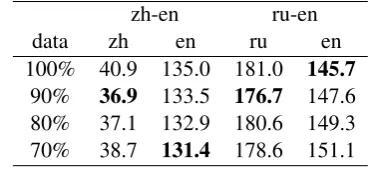
In MT pipelines, language models are often used for corpus filtering, fusion techniques andN-best reranking. Therefore, we perform LM experi-ments on MT corpora. Specifically, we take mono-lingual data from parallel corpora of WMT19 (Barrault et al.,2019) Chinese-English (zh-en) and Russian-English (ru-en) as training data. We use newsdev2017 for both sides of zh-en and new-stest2016 for both sides of ru-en as development data. We concatenate newstest2017 and new-stest2018 as test data for all four sides. The sizes of the corpora (WMT) are summarized in Table2.
zh-en ru-en train 26M 25M
valid 2K 3K
[image:3.595.366.468.509.565.2]test 6K 6K
Table 2: Number of sentence pairs in WMT.
zh-en ru-en
data zh en ru en
[image:3.595.321.506.610.704.2]100% 40.9 135.0 181.0 145.7 90% 36.9 133.5 176.7 147.6 80% 37.1 132.9 180.6 149.3 70% 38.7 131.4 178.6 151.1
Table 3: Test perplexities on WMT.
4No develepment set is available for STS, this is why we
side score parallel text
zh -48523.31 リリスノト
en 53.82 Open Directory - Unix
zh 67.71 健康、整洁、卫生和清洁技术组织
en -158.57 Salubrit´e, propret´e, hygi`ene et techniques d’assainissement zh 0.00 从系统目录→位置→传送我的位置... en 0.00 From System Menu→Location→Send My Location...
zh 36.01 在25℃下测定了样品的总交换容量和平衡等温线.
en 40.65 Cation exchange capacity and equilibria isotherm at 25℃were determined.
zh 68.63 财务政策及发展小组
[image:4.595.80.522.62.214.2]en 53.82 Financial Policy and Development Unit
Table 4: Several text samples from the zh-en parallel corpus withuniblockscores. We find empirically: sen-tences with only foreign characters are scored very low; sensen-tences with some foreign characters are scored low; sentences with characters in unseen blocks are scored 0; sentences with only few foreign characters are scored high; sentences with no illegal characters are scored very high. Foreign (or illegal) characters are underlined.
For each of the four LM subtasks, we train uniblockon the corresponding development set and filter out 10%, 20% and 30% of the raw train-ing corpus. We train 2-layer LSTM language mod-els with hidden dimensions being 1024. For the zh subtask, we train character-level language mod-els and include all seen characters in the vocab-ulary. For the other 3 subtasks, top 100k fre-quent words are used as the vocabulary and the rest of the words are replaced with unknown tokens. All LM experiments are conducted using the RE-TURNN framework (Doetsch et al., 2017;Zeyer et al.,2018). As shown in Table3, we see consis-tent improvements in theuniblock-filtered se-tups of zh, ru and en under zh-en. For en under ru-en, the baseline system outperformsuniblock -filtered ones.
4.3 Machine Translation
We train MT systems to show the simplicity and effectiveness of our method in a more challeng-ing task. We use the same parallel corpora as in Section 4.2 and train systems in four directions: zh-en, en-zh, ru-en and en-ru. The raw training corpora are filtered with uniblock as before. Before examining the performance of the transla-tion systems, we first manually examine some fil-tered text samples. Five parallel text samples with uniblockscores are shown in Table 4. We ob-serve that the trained GMM works properly and in-deed assigns low scores to unreasonable or “dirty” sentences. We believe that uniblock is supe-rior to other rule-based methods because the rela-tive quality of the sentences is modeled. For ex-ample, a hard rule may eliminate a complete
sen-tence pair encountering even one℃symbol, while uniblockonly gives a small penalization due to the fact that one occurrence of the symbol℃does not alter the count-based feature vectoremuch.
zh-en en-zh
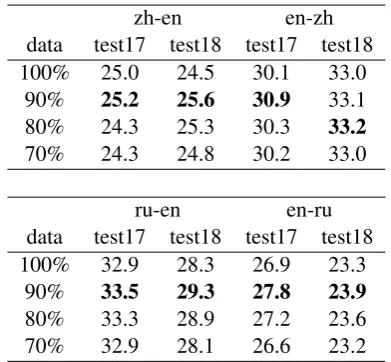
data test17 test18 test17 test18 100% 25.0 24.5 30.1 33.0
90% 25.2 25.6 30.9 33.1 80% 24.3 25.3 30.3 33.2 70% 24.3 24.8 30.2 33.0
ru-en en-ru
data test17 test18 test17 test18 100% 32.9 28.3 26.9 23.3
90% 33.5 29.3 27.8 23.9 80% 33.3 28.9 27.2 23.6 70% 32.9 28.1 26.6 23.2
Table 5: Case-sensitive BLEU(%) scores on four differ-ent translation tasks.
[image:4.595.318.514.357.538.2]by uniblock use a subset of the full corpus. We take the checkpoint with the lowest perplex-ity on the validation set and report case-sensitive BLEU(%) (Papineni et al., 2002) scores on new-stest2017 and newstest2018 using the sacreBLEU
(Post,2018) software. The translation qualities of the systems are shown in Table5. As can be seen, without altering the architecture or the optimiza-tion process, only applyinguniblockas a cor-pus filtering step leads to consistent improvements over the baseline systems for all four directions, up to 1.1 BLEU(%).
Linguistically, the zh-en and ru-en language pairs are rather distant. For more closely-related language pairs such as French and English, our method should also perform well. As shown in Table 4, a Chinese sentence could be corrupted with Japanese characters and an English sentence could be corrupted with French characters. For both cases, our method is able to discriminate the illegal characters and assign low scores to these sentences. Note that, our method would fail, if “clean” and “dirty” sentences share one exact same block. Because then after normalization all the feature vectors will be essentially the same and therefore indistinguishable. In this case, one should carefully design other features so that the GMM is able to assign meaningful scores. How-ever, when “clean” and “dirty” sentences share the same set of blocks, our method still works fine because after normalization the empirical distribu-tions are probably different.
5 Conclusion
In this work, we develop a simple and effective statistical method calleduniblock. Using Uni-code block information as feature vectors, a GMM is estimated with variational inference on some clean corpus, which can then be used to score and filter corpus. We release our implementation which supports parallel corpus filtering and differ-ent thresholding. Our experimdiffer-ents show concrete and consistent improvements in SA, LM and MT.
We believe that the method can be extended and improved by examining other dimensionality re-duction methods and alternatives to GMM, and by introducing other heuristics into the feature vector, such as sentence length and punctuation marks5.
5Common punctuation marks lie in the same Unicode
block range U+0000..U+007F as the English alphabet and are currently not separated.
Acknowledgements
This work has received funding from the European Research Council (ERC) (under the European Union’s Horizon 2020 research and innovation programme, grant agreement No 694537, project ”SEQCLAS”) and the Deutsche Forschungsgemeinschaft (DFG; grant agreement NE 572/8-1, project ”CoreTec”). The GPU com-puting cluster was supported by DFG (Deutsche Forschungsgemeinschaft) under grant INST 222/1168-1 FUGG.
References
Tom Ash, Remi Francis, and Will Williams. 2018. The speechmatics parallel corpus filtering system for wmt18. InProceedings of the Third Conference on Machine Translation: Shared Task Papers, pages 853–859.
Lo¨ıc Barrault, Ondˇrej Bojar, Marta R. Costa-juss`a, Christian Federmann, Mark Fishel, Yvette Gra-ham, Barry Haddow, Matthias Huck, Philipp Koehn, Shervin Malmasi, Christof Monz, Mathias M¨uller, Santanu Pal, Matt Post, and Marcos Zampieri. 2019. Findings of the 2019 conference on machine trans-lation (wmt19). InProceedings of the Fourth Con-ference on Machine Translation (Volume 2: Shared Task Papers, Day 1), pages 1–61, Florence, Italy. Association for Computational Linguistics.
Christopher M Bishop. 2006. Pattern recognition and machine learning. springer.
Patrick Doetsch, Albert Zeyer, Paul Voigtlaender, Ilia Kulikov, Ralf Schl¨uter, and Hermann Ney. 2017. Returnn: The rwth extensible training framework for universal recurrent neural networks. In2017 IEEE International Conference on Acoustics, Speech and Signal Processing (ICASSP), pages 5345–5349. IEEE.
Grant Erdmann and Jeremy Gwinnup. 2018. Coverage and cynicism: The afrl submission to the wmt 2018 parallel corpus filtering task. InProceedings of the Third Conference on Machine Translation: Shared Task Papers, pages 872–876.
Alec Go, Richa Bhayani, and Lei Huang. 2009. Twit-ter sentiment classification using distant supervision.
CS224N Project Report, Stanford, 1(12):2009.
Armand Joulin, Edouard Grave, Piotr Bojanowski, and Tomas Mikolov. 2017. Bag of tricks for efficient text classification. InProceedings of the 15th Con-ference of the European Chapter of the Association for Computational Linguistics: Volume 2, Short Pa-pers, pages 427–431. Association for Computational Linguistics.
Marcin Junczys-Dowmunt. 2018. Dual conditional cross-entropy filtering of noisy parallel corpora.
arXiv preprint arXiv:1809.00197.
Huda Khayrallah and Philipp Koehn. 2018. On the impact of various types of noise on neural machine translation. arXiv preprint arXiv:1805.12282.
Huda Khayrallah, Hainan Xu, and Philipp Koehn. 2018. The jhu parallel corpus filtering systems for wmt 2018. InProceedings of the Third Conference on Machine Translation: Shared Task Papers, pages 896–899.
Philipp Koehn, Huda Khayrallah, Kenneth Heafield, and Mikel L Forcada. 2018. Findings of the wmt 2018 shared task on parallel corpus filtering. In Pro-ceedings of the Third Conference on Machine Trans-lation: Shared Task Papers, pages 726–739.
Taku Kudo and John Richardson. 2018. Sentencepiece: A simple and language independent subword tok-enizer and detoktok-enizer for neural text processing.
arXiv preprint arXiv:1808.06226.
Jun Lu, Xiaoyu Lv, Yangbin Shi, and Boxing Chen. 2018. Alibaba submission to the wmt18 parallel cor-pus filtering task. InProceedings of the Third Con-ference on Machine Translation: Shared Task Pa-pers, pages 917–922.
Vassilis Papavassiliou, Sokratis Sofianopoulos, Prokopis Prokopidis, and Stelios Piperidis. 2018. The ilsp/arc submission to the wmt 2018 parallel corpus filtering shared task. InProceedings of the Third Conference on Machine Translation: Shared Task Papers, pages 928–933.
Kishore Papineni, Salim Roukos, Todd Ward, and Wei-Jing Zhu. 2002. Bleu: a method for automatic eval-uation of machine translation. In Proceedings of the 40th annual meeting on association for compu-tational linguistics, pages 311–318. Association for Computational Linguistics.
F. Pedregosa, G. Varoquaux, A. Gramfort, V. Michel, B. Thirion, O. Grisel, M. Blondel, P. Pretten-hofer, R. Weiss, V. Dubourg, J. Vanderplas, A. Pas-sos, D. Cournapeau, M. Brucher, M. Perrot, and E. Duchesnay. 2011. Scikit-learn: Machine learning in Python. Journal of Machine Learning Research, 12:2825–2830.
Matt Post. 2018. A call for clarity in reporting BLEU scores. InProceedings of the Third Conference on Machine Translation: Research Papers, pages 186– 191, Belgium, Brussels. Association for Computa-tional Linguistics.
Nick Rossenbach, Jan Rosendahl, Yunsu Kim, Miguel Grac¸a, Aman Gokrani, and Hermann Ney. 2018. The rwth aachen university filtering system for the wmt 2018 parallel corpus filtering task. In Proceed-ings of the Third Conference on Machine Transla-tion: Shared Task Papers, pages 946–954.
The Unicode Consortium. 2019. The unicode standard, version 12.0.0. http://www.unicode.org/
versions/Unicode12.0.0/.
Ashish Vaswani, Noam Shazeer, Niki Parmar, Jakob Uszkoreit, Llion Jones, Aidan N Gomez, Łukasz Kaiser, and Illia Polosukhin. 2017. Attention is all you need. InAdvances in neural information pro-cessing systems, pages 5998–6008.
Hainan Xu and Philipp Koehn. 2017. Zipporah: a fast and scalable data cleaning system for noisy web-crawled parallel corpora. InProceedings of the 2017 Conference on Empirical Methods in Natural Lan-guage Processing, pages 2945–2950.