Predicting Dialect Variation in Immigrant Contexts
Using Light Verb Constructions
A. Seza Do˘gru¨oz
Netherlands Institute for Advanced Study Wassenaar, Netherlands
Preslav Nakov
Qatar Computing Research Institute Tornado Tower
floor 10, P.O. Box 5825, Doha, Qatar
Abstract
Languages spoken by immigrants change due to contact with the local languages. Capturing these changes is problematic for current language technologies, which are typically developed for speakers of the standard dialect only. Even when dialec-tal variants are available for such technolo-gies, we still need to predict which di-alect is being used. In this study, we dis-tinguish between the immigrant and the standard dialect of Turkish by focusing on Light Verb Constructions. We experiment with a number of grammatical and contex-tual features, achieving over 84% accuracy (56% baseline).
1 Introduction
Human languages are in constant evolution, driven in part by contact with other languages (Uriel, 1953; Thomason, 2008). In immigrant contexts, bilingual and multilingual speakers act as agents of change by transmitting borrowed words and ex-pressions across languages (Grosjean, 2014). De-pending on social factors such as duration and in-tensity of contact with the local languages, large-scale spread of borrowed elements could lead to differences between the contact and non-contact dialects of the same language (Winford, 2005). For example, Spanish spoken by immigrants in USA sounds different in comparison to Spanish spoken in South America (Corval´an, 2003).
In this study, we focus on the immigrant di-alect of Turkish as spoken in the Netherlands (NL-Turkish), which differs from Turkish spo-ken in Turkey (TR-Turkish). In contact situa-tions, it is common for verbs to be borrowed across languages and integrated as nominal com-plements of Light Verb Constructions (LVCs) (Ed-wards and Gardner-Chloros, 2007; Butt, 2010).
NL-Turkish LVCs are changing due to Dutch in-fluence (Do˘gru¨oz and Backus, 2007; Do˘gru¨oz and Backus, 2009; Do˘gru¨oz and Gries, 2012). How-ever, assessing Dutch influence is not always easy since NL-Turkish LVCs still co-exist with the TR-Turkish LVCs. This study aims to automatically identify the features that can distinguish between NL-Turkish and TR-Turkish LVCs.
Our study would benefit Machine Translation systems targeting dialectal variation. It differs from studies concerning the well-established di-alectal variations of Arabic, e.g., Levantine, Gulf, Egyptian, Maghrebi (Salloum and Habash, 2012), EU vs. Brazilian Portuguese (Marujo et al., 2011) or Turkish vs. Tatar (Altintas and Cicekli, 2002). In contrast, we are interested in developing lan-guage technologies forimmigrantdialects, which are often understudied and lack written resources due to their unofficial status. When immigrant speakers face communication difficulties (e.g., bu-reaucratic affairs with the local officials, teacher-parent meetings, doctor-patient conversations) in the local languages (e.g., Dutch) of the host coun-try, they are often provided with translation equiv-alents in the standard dialect (e.g., TR-Turkish) of their native languages. However, these trans-lations ignore the evolution of the immigrant di-alect.1 By identifying the differences between two
dialects of the same variety, we aim to improve Machine Translation systems targeting immigrant speakers. Our contributions are the following:
• We are the first to predict on-going dialect variation in immigrant contexts as opposed to studying established dialect variations.
• We are also the first to compare bilingual LVCs with the monolingual ones across two dialects of the same language.
1One of the authors failed the driving test in the
Nether-lands due to the dialect variation in the Turkish translation.
• Our comparison of grammatical versus con-textual features reveals context to be much more important.
• We experiment with LVCs extracted from natural spoken data rather than relying on iso-lated occurences, out of context.
2 Method
We follow Baldwin and Kim (2010) and Butt (2010) in their definitions of LVCs, which state that there is a unity between the nominal and the verbal complements, but the meaning of the verb is somewhat bleached. In this study, we focus on Turkish LVCs with the verbal complements of yapmak/etmek, which both can be translated as “make/do”. LVCs with these verbal complements are undergoing change in NL-Turkish (Do˘gru¨oz and Backus, 2009).
We experiment with the following features to predict NL-Turkish vs. TR-Turkish LVCs.
2.1 Nominal Features
In addition to traditional LVCs (e.g. [¨ut¨u yap-mak] “iron do” (to iron) with both complements of Turkish origins), there is also foreign influ-ence on Turkish LVCs. Section 2.1.1 describes the foreign influence on both NL-Turkish and TR-Turkish nominal complements based on their ety-mological origins.
2.1.1 Influence on Nominal Complements Dutch Influence In example (1), the Dutch verb overplaats is nominalized through the infinitive marker (-en) and precedes the Turkish verb yap-makto form a Turkish-Dutch bilingual LVC.
Example 1:
O arkadas¸ [overplaats-en yap-ıl-acak-tı.] That friend [replace-inf2do-pass-fut-past].
That friend would have been replaced.
In addition to borrowing nominalized Dutch verbs to form bilingual LVCs, Dutch LVCs are also translated as a chunk into NL-Turkish. These translated LVCs sound unconventional to TR-Turkish speakers (Do˘gru¨oz and Gries, 2012). In example (2), the LVC [sınav yapmak] “exam do” is a literal translation of the Dutch [examen doen] “exam-pl do”, which is used to describe how stu-dents take high school exams to graduate.
2acc: accusative, fut:future, inf:infinitive, past:past tense,
part: participle, pres: present tense, pl: plural, poss: poss-esive, prog:progressive tense, sg: singular
In a similar context, TR-Turkish speakers would have used [sınav-a girmek] “exam enter” instead. These LVCs are also classified as having their ori-gins in another language.
Example 2:
¨Uc¸ g¨und¨ur [sınav yap-ıyor-uz]. Three day [exam do-prog-1pl].
We are having exams for the last three days.
Other Foreign Influences Although Dutch in-fluence is clearly present in NL-Turkish LVCs, TR-Turkish LVCs are also not free of foreign in-fluence. We have come across Arabic, Persian, French and English influences on Turkish LVCs with nominalized foreign verbs or literally trans-lated LVCs as chunks. Example (3) illustrates how a borrowed Arabic verb (hitap, “address”) is in-tegrated as a nominal complement into a Turkish LVC [hitap etmek] “address do”.
Example 3:
Hoca-m diye [hitap edi-yo-z] biz.
Teacher-poss.1sg like [address do-prog-1pl] we.
We address (him) as the teacher.
Example (4) illustrates how an English LVC [do sports] is borrowed into Turkish as a chunk [spor yapmak] “sports do”.
Example 4:
Yazın [spor yap-ıyo-z]. summer spor do-prog-1pl We do sports in summer.
We have identified the etymological origins of LVCs in both corpora using an online etymolog-ical dictionary.3 Although LVCs of Dutch origin
only occur in NL-Turkish, LVCs borrowed from other languages (e.g., Arabic, English, French) oc-cur both in NL-Turkish and in TR-Turkish.
2.1.2 Case Marking
We also came across Turkish [N V] constructions with “yapmak” and “etmek” where the nominal complement acts as the object of the verb.
Turkish marks the direct objects with accusative case marking if they are definite (Enc¸, 1991). In example (5), the nominal element is the object of the verb, and thus it has the accusative marker.
Example 5:
Ben kendi [is¸-im-i yap-ıyor-um.] I own [work-poss.1sg-acc do-prog-1sg]. I do my own work.
However, indefinite objects of the verb are left unmarked for case. In example (6),yapmaktakes an indefinite object (food) as the complement. The boundary between [N V] constructions with in-definite nominal objects and LVCs are somewhat blurry. In both cases, the meaning of the verbal complement is bleached out and the nominal com-plement weighs heavier than the verbal one. We will not dwell further on this subtle distinction, but we plan future work on this topic following Cook et al. (2007) and Vincze et al. (2013).
Example 6:
Bazen [yemek yap-ar-dı-m] Sometimes [food do-pres-past-1sg] I used to sometimes prepare food.
Since Dutch does not mark objects of the verb morphologically, NL-Turkish speakers have diffi-culty (e.g., unnecessary addition or omission of case markers) in determining the definiteness of the nominal complements in [N V] constructions (Do˘gru¨oz and Backus, 2009). Therefore, we ex-pect this feature to differentiate well between NL-Turkish and TR-NL-Turkish [N V] constructions and LVCs withyapmak/etmekas verbal complements.
2.2 Verbal Complements 2.2.1 Finiteness
The verbs in LVCs are assumed to be flexible for inflection (Baldwin and Kim, 2010). However, we know little about how fineteness contributes to the formation of LVCs. To the best of our knowledge, finiteness has not been tested as a feature for iden-tifying LVCs earlier. Therefore, we encoded the finiteness on yapmak/etmek as a binary (yes/no) feature in both data sets. Example (7) illustrates a non-finite LVC where the verb stem (et) is accom-panied with an infinitive marker (-mek).
Example 7:
Misafir-ler-e [ikram et-mek] ic¸in al-dı-k Guest-pl-dat [serve do-inf.] for buy-past-1pl We bought (it) to serve the guests.
2.2.2 Type
NL-Turkish speakers could use other light verbs than TR-Turkish speakers for the same LVC con-struction. In example (8), the NL-Turkish speaker uses [do˘gum etmek] “birth do” instead of [do˘gum yapmak] “birth do”, which is commonly preferred by TR-Turkish speakers. To capture this differ-ence between the two dialects, we include the verb type as a feature as well.
Example 8:
Orda kadın [do˘gum et-ti]. There lady [birth do-past]. The lady gave birth there. 2.3 Word Order in LVCs
To the best of our knowledge, the influence of word order in LVCs has not been investigated as a feature. Although Turkish has a relatively flexi-ble constituent order, object-verb (OV) is the most frequent word order for both NL-Turkish and TR-Turkish (Do˘gru¨oz and Backus, 2007). NL-TR-Turkish speakers have adopted Dutch word order verb-object (VO) for some syntactic constructions, but we know little about the word order variation for LVCs. Encoding the word order of LVCs as a binary feature (OV vs. VO) could give us clues about differences or similarities of LVC use in NL-Turkish and in TR-NL-Turkish. In example (9), the nominal complement (one thing) follows the ver-bal complement instead of preceding it as seen in earlier examples.
Example 9:
[Yap-acak bir s¸ey] yok. [Do-part. one thing] exist.not There is nothing to do. 2.4 Context
So far, most studies were carried out ignoring the context of LVCs but focusing on their inher-ent grammatical features (e.g., lexical, syntactic, semantic or morphological). However, the con-text of an utterance could potentially provide addi-tional useful cues. Since our data comes from nat-ural conversations, we also experimented with the contextual information (words surrounding LVCs) as a feature for both data sets.
3 Data
Our data comes from spoken NL-Turkish (46 speakers from the Netherlands, 74,461 words) and TR-Turkish (22 speakers from Turkey, 28,731 words) corpora collected by one of the authors. LVC’s are automatically extracted from the data using their stem forms (“yap-”, “et-” without the infinitive -mEk). Table 1 illustrates the frequency of [N V] constructions withetmekandyapmakin both data sets.
# etmek # yapmak # Total
NL-Turkish 449 543 992
TR-Turkish 527 755 1282
Total 976 1298
4 Experiments
Our aim is to build a classifier that can determine whether a particular utterance containing an LVC (with the verbsyapmakoretmek) is uttered by an NL-Turkish or a TR-Turkish speaker.
We make use the following features in our classifier: (1) words from the context of the LVCs, (2) type of the light verb (yapmak or etmek), (3) the nominal complements, (4) finite-ness of the verb (finite/non-finite), (5) case marking on the nominal complement (yes/no), (6) word order (VO/OV), and (7) etymolog-ical origins of the nominal complement (Ara-bic/Dutch/French/English/Persian/Turkish/mixed).
For the contextual features, we experiment with two models: (a) we distinguish between a word extracted from the context to the left or to the right of the verb (yapmakoretmek) in the feature space, and (b) we do not make a distinction in terms of context. The reason to experiment with option (a) is due to the potential importance of the word order. While the word order variation is already modeled through feature (6), we also include the context as an additional feature to test its effect. On the down side, adding context doubles the fea-ture space size and could lead to data sparseness issues. For the context words, we did not filter out stopwords since they are part of natural speech.
For our experiments, we used an SVM classifier as implemented in LibSVM. We used a linear ker-nel; more complex kernels did not help. We report results for a 5-fold cross-validation.
[image:4.595.74.293.624.740.2]5 Results
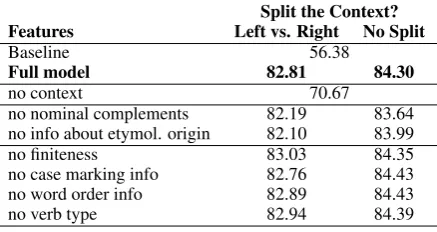
Table 2 illustrates the results of our experiments. All models outperform the majority class base-line of always predicting TR-Turkish (which is 56.38% accuracy) by a sizable margin. Further-more, splitting the context into left/right yields ap-proximately 1.5% absolute drop in accuracy.
Split the Context? Features Left vs. Right No Split
Baseline 56.38
Full model 82.81 84.30
no context 70.67
no nominal complements 82.19 83.64 no info about etymol. origin 82.10 83.99
no finiteness 83.03 84.35
no case marking info 82.76 84.43
no word order info 82.89 84.43
no verb type 82.94 84.39
Table 2: Cross-validation accuracy (5 folds).
The lower part of the table shows the results when turning off each of the feature types. The context seems to be the most important feature since its exclusion leads to a drop from low-to-mid eighties to about 70% accuracy. Except the nominal complements and the information about etymological origins, most other features seem to have marginal impact on accuracy. Excluding the two features (nominal complements and etymo-logical origins) lead to approximately 0.5% ab-solute drop in accuracy. The impact of the last four features in the table is tiny; excluding some of them even leads to a tiny improvement.
Overall, we can conclude that by far the most important features are the context features (with-out the left/right context split). The other use-ful features are the nominal complements and the information about the etymological origin of the borrowed LVCs. The remaining four linguistic features seem to be largely irrelevant.
6 Conclusion and Future Work
Language technologies are usually developed for standard dialects, ignoring the linguistic differ-ences in other dialects such as those in immigrant contexts. One of the reasons for this is the ficulty of assessing and predicting linguistic dif-ferences across dialects. This is similar to ef-forts to translate well-established Arabic dialects (Bakr et al., 2008; Sawaf, 2010), or to adapt be-tween Brazilian and European Portuguese (Marujo et al., 2011), Czech–Slovak (Hajiˇc et al., 2000), Spanish–Portuguese (Nakov and Ng, 2009; Nakov and Ng, 2012), Turkish–Crimean Tatar (Altintas and Cicekli, 2002), Irish–Scottish Gaelic (Scan-nell, 2006), Bulgarian–Macedonian (Nakov and Tiedemann, 2012), Malay–Indonesian (Wang et al., 2012) or Mandarin–Cantonese (Zhang, 1998). In this work, we have built a classifier that uses LVCs to differentiate between two different Turk-ish dialects: standard and immigrant. The results indicate that contextual features are most useful for this task. Although this requires further inves-tigation, we can explain it by the thousands of fea-tures context generates: each contextual word is a feature. Thus, it is very hard for our grammatical features to compete against contextual features but they do have an impact.
References
Kemal Altintas and Ilyas Cicekli. 2002. A machine translation system between a pair of closely related languages. InProceedings of the 17th International Symposium on Computer and Information Sciences, ISCIS ’02, pages 192–196, Orlando, FL, USA. Hitham Abo Bakr, Khaled Shaalan, and Ibrahim
Ziedan. 2008. A hybrid approach for converting written Egyptian colloquial dialect into diacritized Arabic. In Proceedings of the 6th International Conference on Informatics and Systems, INFOS ’08, Cairo, Egypt.
Timothy Baldwin and Su Nam Kim, 2010. In Nitin Indurkhya and Fred J. Damerau (eds.), Handbook of Natural Language Processing, chapter Multiword expressions, pages 267–292. CRC Press, Boca Ra-ton, USA, second edition.
Miriam Butt, 2010. In Mengistu Amberber, Brett Baker, and Mark Harvey (eds.), Complex predi-cates: cross-linguistic perspectives on event struc-ture, chapter The light verb jungle: still hacking away, pages 48–78. Cambridge University Press. Paul Cook, Afsaneh Fazly, and Suzanne Stevenson.
2007. Pulling their weight: Exploiting syntactic forms for the automatic identification of idiomatic expressions in context. InProceedings of MWE ’07, pages 41–48, Prague, Czech Republic.
Carmen Silva Corval´an. 2003. Otra mirada a la ex-presi´on del sujeto como variable sint´actica. Lengua, variaci´on y contexto: Estudios dedicados a Hum-berto L´opez Morales, 2:849–860.
A. Seza Do˘gru¨oz and Ad Backus. 2007. Postverbal el-ements in immigrant Turkish: Evidence of change? International Journal of Bilingualism, 11(2):185– 220.
A. Seza Do˘gru¨oz and Ad Backus. 2009. Innova-tive constructions in Dutch Turkish: An assessment of ongoing contact-induced change. Bilingualism: Language and Cognition, 12(01):41–63.
A. Seza Do˘gru¨oz and Stefan Gries. 2012. Spread of on-going changes in an immigrant language: Turk-ish in the Netherlands. Review of Cognitive Linguis-tics, 10(2).
Malcolm Edwards and Penelope Gardner-Chloros. 2007. Compound verbs in codeswitching: Bilin-guals making do? International Journal of Bilin-gualism, 11(1):73–91.
M¨urvet Enc¸. 1991. The semantics of specificity. Lin-guistic Inquiry, 22(1):1–25.
Franc¸ois Grosjean. 2014. Bicultural bilinguals. Inter-national Journal of Bilingualism, pages 1–15. Jan Hajiˇc, Jan Hric, and Vladislav Kuboˇn. 2000.
Ma-chine translation of very close languages. In Pro-ceedings of ANLP ’00, pages 7–12, Seattle, WA, USA.
Lu´ıs Marujo, Nuno Grazina, Tiago Lu´ıs, Wang Ling, Lu´ısa Coheur, and Isabel Trancoso. 2011. BP2EP -adaptation of Brazilian Portuguese texts to European Portuguese. In Proceedings of EAMT ’11, pages 129–136, Leuven, Belgium.
Preslav Nakov and Hwee Tou Ng. 2009. Improved statistical machine translation for resource-poor lan-guages using related resource-rich lanlan-guages. In Proceedings of EMNLP ’09, pages 1358–1367, Sin-gapore.
Preslav Nakov and Hwee Tou Ng. 2012. Improving statistical machine translation for a resource-poor language using related resource-rich languages. J. Artif. Intell. Res. (JAIR), 44:179–222.
Preslav Nakov and J¨org Tiedemann. 2012. Combin-ing word-level and character-level models for ma-chine translation between closely-related languages. InProceedings of ACL ’12, Jeju Island, Korea. Wael Salloum and Nizar Habash. 2012. Elissa: A
di-alectal to standard Arabic machine translation sys-tem. InProceedings of COLING ’12, pages 385– 392, Mumbai, India.
Hassan Sawaf. 2010. Arabic dialect handling in hybrid machine translation. InProceedings of AMTA ’10, Denver, Colorado.
Kevin Scannell. 2006. Machine translation for closely related language pairs. InProceedings of the LREC 2006 Workshop on Strategies for developing machine translation for minority languages, pages 103–107, Genoa, Italy.
Sarah Thomason. 2008. Social and linguistic factors as predictors of contact-induced change. Journal of language contact, 2(1):42–56.
Weinreich Uriel. 1953. Languages in contact: Find-ings and problems. Publications of the Linguistic Circle of New York, vol. 1.
Veronika Vincze, Istv´an Nagy, and Rich´ard Farkas. 2013. Identifying English and Hungarian light verb constructions: A contrastive approach. In Proceed-ings of ACL ’13, pages 255–261, Sofia, Bulgaria. Pidong Wang, Preslav Nakov, and Hwee Tou Ng.
2012. Source language adaptation for resource-poor machine translation. In Proceedings of EMNLP-CoNLL ’12, pages 286–296, Jeju Island, Korea. Donald Winford. 2005. Contact-induced changes:
Classification and processes. Diachronica, 22(2):373–427.