• No results found

Using LSA and Noun Coordination Information to Improve the Recall and Precision of Automatic Hyponymy Extraction

N/A
N/A
Protected

Academic year: 2020

Share "Using LSA and Noun Coordination Information to Improve the Recall and Precision of Automatic Hyponymy Extraction"

Copied!
8
0
0

Loading.... (view fulltext now)

Full text

(1)

Using LSA and Noun Coordination Information to Improve the Precision

and Recall of Automatic Hyponymy Extraction

Scott Cederberg

Dominic Widdows

Center for the Study of Language and Information

210 Panama Street

Stanford University

Stanford CA 94305

{

cederber,dwiddows

}

@csli.stanford.edu

Abstract

In this paper we demonstrate methods of im-proving both the recall and the precision of au-tomatic methods for extraction of hyponymy (IS A) relations from free text. By applying la-tent semantic analysis (LSA) to filter extracted hyponymy relations we reduce the rate of er-ror of our initial pattern-based hyponymy ex-traction by 30%, achieving precision of 58%. Applying a graph-based model of noun-noun similarity learned automatically from coordi-nation patterns to previously extracted correct hyponymy relations, we achieve roughly a five-fold increase in the number of correct hy-ponymy relations extracted.

1

Introduction

This paper demonstrates that mathematical models for measuring semantic similarity between concepts can be used to improve the learning of hyponymy relationships between concepts from free text. In particular, we show that latent semantic analysis can be used to filter results, giving an increase in precision, and that neighbors in a graph built from coordination information can be used to improve recall.

The goal of extracting semantic information from text is well-established, and has encouraged work on lexical acquisition (Roark and Charniak, 1998), information ex-traction (Cardie, 1997), and ontology engineering (Hahn and Schnattinger, 1998). The purpose of this kind of work is to collect information about the meanings of lexi-cal items or phrases, and the relationships between them, so that the process of building semantic resources (such as ontologies and dictionaries) by hand can be automated or at least helped.

One of the standard ways of arranging concepts is in a concept hierarchy or taxonomy such as the WordNet noun taxonomy (Fellbaum, 1998). The fundamental relation-ship between objects in a taxonomy is called hyponymy,

wherey is a hyponym ofxif everyyis also anx. For example, every trout is also a fish, so we say that trout is a hyponym (“below name”) of fish and conversely, fish is a hypernym (“above name”) of trout. Other names ex-ist for variants of the hyponymy relationship, such as an

IS Arelationship, a parent-node / child-node relationship, and a broader term / narrower term relationship. It is also noted that the genus of an object, in traditional lexico-graphic terms, is often a hypernym of that object (Guthrie et al., 1996). Throughout this paper we will write y<x

for the relationship “yis a hyponym ofx”. In this paper, we use the hyponymy relationship to describe subset re-lationships, so we regard y<x to be true if the set ofy’s can reasonably be said to be a subset of the set ofx’s.1

Because hyponymy relationships are so central to knowledge engineering, there have been numerous at-tempts to learn them from text, beginning with those of Hearst (1992). We review this work in Section 2, where we reproduce similar experiments as a baseline from which to expand. The rest of the paper demon-strates ways in which other mathematical models built from text corpora can be used to improve hyponymy ex-traction. In Section 3, we show how latent semantic anal-ysis can be used to filter potential relationships accord-ing to their “semantic plausibility”. In Section 4, we show how correctly extracted relationships can be used as “seed-cases” to extract several more relationships, thus improving recall; this work shares some similarities with that of Caraballo (1999). In Section 5 we show that com-bining the techniques of Section 3 and Section 4 improves both precision and recall. Section 6 demonstrates that

1Another possible view is that “hyponymy” should only

re-fer to core relationships, not contingent ones (so pheasant<

bird might be accepted but pheasant<food might not be,

(2)

linguistic tools such as lemmatization can be used to re-liably put the extracted relationships into a normalized or “canonical” form for addition to a semantic resource.

2

Pattern-Based Hyponymy Extraction

The first major attempt to extract hyponyms from text was that of Hearst (1992), described in more detail in (Hearst, 1998), who extracted relationships from the text of Grolier’s Encyclopedia. The method is illustrated by the following example. The sentence excerpt

Even then, we would trail behind other Euro-pean Community members, such as Germany, France and Italy. . . (BNC)2

indicates that Germany, France, and Italy are all Euro-pean Community members. More generally, phrases of the form

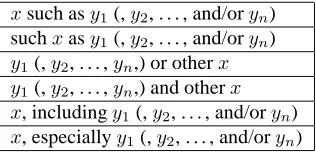
xsuch asy1(y2, . . . , and/oryn)

frequently indicate that the yi are all hyponyms of the hypernym x. Hearst identifies several other con-structions that have a tendency to indicate hyponymy, calling these constructions lexicosyntactic patterns, and analyses the results. She reports that 52% of the re-lations extracted by the “or other” pattern (see Ta-ble 1) were judged to be “pretty good relations”. A more recent variant of this technique was implemented by Alfonseca and Manandhar (2001), who compare the collocational patterns of words from The Lord of the

Rings with those of words in the WordNet taxonomy,

adding new nouns to WordNet with an accuracy of 28%. Using a much more knowledge-intensive approach, Hahn and Schnattinger (1998) improve “learning accu-racy” from around 50% to over 80% by forming a number of hypotheses and accepting only those which are most consistent with their current ontology. Their methods are like ours in that the “concept learning” combines infor-mation from several occurrences, but differ in that they rely on a detailed existing ontology into which to fit the new relationships between concepts.

Our initial experiment was to construct a hyponymy extraction system based on the six lexicosyntactic pat-terns identified in (Hearst, 1998), which are listed in Ta-ble 1. We first used a chunker to mark noun groups, and then recognized and extracted noun groups occurring as part of one of the extraction patterns.3

We applied these extraction patterns to an approxi-mately 430,000-word extract from the beginning of the

2

This excerpt and others in this paper are from the British National Corpus.

3

The chunker used was LT CHUNK, from the University of Edinburgh’s Language Tech-nology Group. It can be downloaded from http://www.ltg.ed.ac.uk/software/chunk/.

xsuch asy1(,y2, . . . , and/oryn)

suchxasy1(,y2, . . . , and/oryn)

y1(,y2, . . . ,yn,) or otherx

y1(,y2, . . . ,yn,) and otherx

x, includingy1(,y2, . . . , and/oryn)

[image:2.612.314.472.71.147.2]

x, especiallyy1(,y2, . . . , and/oryn)

Table 1: The lexicosyntactic patterns described by Hearst (1998), which we used in the work described in this paper. Each of these patterns is taken to indicate the hyponymy relation(s)yi<x.

British National Corpus (BNC). The patterns extracted 513 relations. We selected 100 of the extracted relations at random and each author evaluated them by hand, scor-ing each relation on a scale from 4 (correct) to 0 (incor-rect), defined as follows:

4. Extracted hypernym and hyponym exactly correct as extracted.

3. Extracted hypernym and hyponym are correct after a slight modification, such as depluralization or the removal of an article (e.g. a, the) or other preceding word.

2. Extracted hypernym and hyponym have something correct, e.g. a correct noun without a necessary prepositional phrase, a correct noun with a superflu-ous prepositional phrase, or a noun + prepositional phrase where the object of the preposition is correct but the preposition itself and the noun to which it attaches are superfluous. Thus these hyponymy re-lations are potentially correct but will require poten-tially difficult processing to extract an exactly cor-rect relation. Some of the errors which would need to be corrected were in preprocessing (e.g. on the part of the noun-group chunker) and others were er-rors caused by our hyponymy extractor (e.g. tacking on too many or too few prepositional phrases).

1. The relation extracted is correct in some sense, but is too general or too context specific to be useful. This category includes relations that could be made useful by anaphora resolution (e.g. replacing “this” with its referent).

0. The relation extracted is incorrect. This results when the constructions we recognize are used for a pur-pose other than indicating the hyponymy relation.

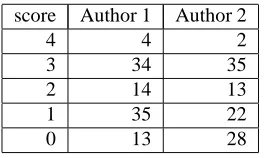
The results of each of the authors’ evaluations of the 100-relation random sample are show in Table 2.4 For

4

(3)

score Author 1 Author 2

4 4 2

3 34 35

2 14 13

1 35 22

[image:3.612.71.203.70.149.2]

0 13 28

Table 2: Number of the 100 randomly selected hyponymy relations (of 513 extracted) to which each of the authors assigned the five available scores.

purposes of calculating precision, we consider those rela-tions with a score of 4 or 3 to be correct and those with a lower score to be incorrect. After discussion between the authors on disputed annotations to create “gold standard” annotations, we found that 40 of the 100 relations in our random sample were correct according to this criterion. In other words, 40% of the relations extracted were ex-actly correct or would be correct with the use of minor post-processing consisting of lemmatization and removal of common types of qualifying words. (We describe our application of such post-processing in Section 6.)

Thus our initial implementation of Hearst-style hy-ponymy extraction achieved 40% precision. This is less than the 52% precision reported in (Hearst, 1998). We believe this discrepancy to be mainly due to the dif-ference between working with the BNC and Grolier’s encyclopedia—as noted by Hearst, the encyclopedia is designed to be especially rich in conceptual relationships presented in an accessible format.

Various problems with the pattern-based extraction method explain the 60% of extracted relations that were incorrect and/or useless. One problem is that the con-structions that we assume to indicate hyponymy are often used for other purposes. For instance, the pattern

xincludingy1,y2, . . . , andyn

which indicates hyponymy in sentences such as

Illnesses, including chronic muscle debility, herpes, tremors and eye infections, have come and gone. (BNC)

and is a quite productive source of hyponymy relations, can be used instead to indicate group membership:

agreement regarding the assignment of scores of 4, 3, and 2 is quite high. Indeed, considering the rougher distinction we use for reporting precision, in which scores of 4 and 3 are deemed correct and scores of 2, 1, and 0 are deemed incorrect, we found that inter-annotator agreement across all relations annotated (in-cluding those from this random sample and those from the sam-ple described in Section 3) was 86%. We discussed each of the relations in the 14% of cases where we disagreed until we reached agreement; this produced the “gold standard” annota-tions to which we refer.

Often entire families including young children need practical home care . . . (BNC)

While all children are members of families, the hy-ponymy relationship child<family does not hold, since

it is not true that all children are families.

Another source of errors in lexicosyntactic hyponymy extraction is illustrated by the sentence

A kit such as Edme Best Bitter, Tom Caxton Best Bitter, or John Bull Best Bitter will be a good starting kit. (BNC)

which indicates the (potentially useful) relations Edme

Best Bitter<beer-brewing kit, Tom Caxton Best Bitter

<beer-brewing kit, and John Bull Best Bitter < beer-brewing kit, but only when we use the context to infer

that the type of “kit” referred to is a beer-brewing kit, a process that is difficult by automatic means. Without this inference, the extracted relations Edme Best Bitter<kit,

etc., while correct in a certain sense, are not helpful. One frequent source of such problems is anaphora that require resolution.

There are also problems related to prepositional phrase attachment.

3

Improving Precision Using Latent

Semantic Analysis

Solving all of the problems with pattern-based hyponymy extraction that we describe above would require near-human-level language understanding, but we have ap-plied a far simpler technique for filtering out many of the incorrect and spurious extracted relations with good re-sults, using a variant of latent semantic analysis (LSA) (Deerwester et al., 1990; Baeza-Yates and Ribiero-Neto, 1999, p. 44). LSA is a method for representing words as points in a vector space, whereby words which are re-lated in meaning should be represented by points which are near to one another. The LSA model we built is sim-ilar to that described in (Sch ¨utze, 1998). First 1000 fre-quent content words (i.e. not on the stoplist)5were chosen as “content-bearing words”. Using these content-bearing words as column labels, the other words in the corpus were assigned row vectors by counting the number of times they occured within a 15-word context window of a content-bearing word. Singular-value decomposition (Deerwester et al., 1990) was then used to reduce the number of dimensions from 1000 to 100. Similarity be-tween two vectors (points) was measured using the cosine of the angle between them, in the same way as the simi-larity between a query and a document is often measured

5

(4)

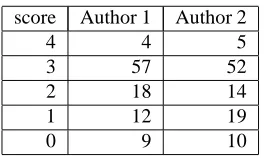
score Author 1 Author 2

4 4 5

3 57 52

2 18 14

1 12 19

[image:4.612.71.203.69.149.2]

0 9 10

Table 3: Number of the 100 top-ranked hyponymy re-lations (of 513 extracted) to which each of the authors assigned the five available scores.

in information retrieval (Baeza-Yates and Ribiero-Neto, 1999, p. 28). Effectively, we could use LSA to measure the extent to which two wordsxandy usually occur in similar contexts. This LSA similarity score will be called

sim(x, y).

Since we expect a hyponym and its hypernym to be semantically similar, we can use the LSA similarity be-tween two terms as a test of the plausibility of a putative hyponymy relation between those terms. If their similar-ity is low, it is likely that they do not have a true and use-ful hyponymy relationship; the relation was probably ex-tracted erroneously for one or more of the reasons listed above. If the similarity between two terms is high, we have increased confidence that a hyponymy relationship exists between them, because we know that they are at least in similar “semantic regions”.

We ranked the 513 putative hyponym/hypernym pairs that we extracted from our trial excerpt of the BNC ac-cording to the similarity between the putative hypernym and the putative hyponym in each pair; i.e. for each pair xandywhere the relationship y<x had been suggested,

we calculated the cosine similarity sim(x, y), then we ranked the extracted relations from highest to lowest sim-ilarity. We then manually evaluated the accuracy of the top 100 extracted relations according to this ranking us-ing the 5-point scale described in Section 2. We found that 58 of these 100 top-ranked relations received scores of 4 or 3 according to our “gold standard” annotations. Comparing this 58% precision with the 40% precision obtained on a random sample in Section 2, we determine that LSA achieved a 30% reduction in error (see Table 3 for a breakdown of annotation results by author).6

Thus LSA proved quite an effective filter. LSA pro-vides broad-based semantic information learned statis-tically over many occurences of words; lexicosyntactic hyponymy extraction learns semantic information from specific phrases within a corpus. Thus we have bene-fitted from combining local patterns with statistical

in-6

It should be noted that 24 of the top 100 hyponymy rela-tions evaluated in this section were also in the randomly-chosen sample of 100 relations described in Section 2. Thus there were a total of 176 distinct hyponymy relations across both test sets.

formation. Considered in analogy with the process by which humans learn from reading, we might think of the semantic information learned by LSA as background knowledge that is applied by the reader when determining what can accurately be gleaned from a particular sentence when it is read.

4

Improving Recall Using Coordination

Information

One of the main challenges facing hyponymy extraction is that comparatively few of the correct relations that might be found in text are expressed overtly by the simple lexicosyntactic patterns used in Section 2, as was appar-ent in the results presappar-ented in that section.

This problem has been addressed by Caraballo (1999), who describes a system that first builds an unlabelled hi-erarchy of noun clusters using agglomerative bottom-up clustering of vectors of noun coordination information. The leaves of this hierarchy (corresponding to nouns) are assigned hypernyms using Hearst-style lexicosyntac-tic patterns. Internal nodes in the hierarchy are then la-belled with hypernyms of the leaves they subsume ac-cording to a vote of these subsumed leaves.

We proceed along similar lines, using noun coordi-nation information and an alternative graph-based clus-tering method. We do not build a complete hierarchy, but our method nonetheless obtains additional hypernym-hyponym pairs not extracted by lexicosyntactic patterns.

Our method is based on the following sort of inference. Consider the sentence

This is not the case with sugar, honey, grape must, cloves and other spices which increase its merit. (BNC)

which provides evidence that clove is a kind of spice. Given this, the sentence

Ships laden with nutmeg or cinnamon, cloves or coriander once battled the Seven Seas to bring home their precious cargo. (BNC)

might suggest that nutmeg, cinnamon, and coriander are also spices, because they appear to be similar to cloves. Thus we can learn the hyponymy relations nutmeg <

spice, cinnamon < spice, and coriander < spice that

are not directly attested by lexicosyntactic patterns in our training corpus.

(5)

y1,y2, andy3

suggests that there is some link betweeny1 andy2, etc. Performing this analysis on a whole corpus results in a data structure which holds a collection of nouns and ob-served noun-noun relationships. If we think of the nouns as nodes and the noun-noun relationships as edges, this data structure is a graph (Bollob´as, 1998), and combina-toric methods can be used to analyze its structure.

Work using such techniques for lexical acquisition has proceeded by building classes of related words from a single “seed-word” with some desired property (such as being a representative of a paticular semantic class). For example, in order to extract a class of words referring to kinds of disease from a corpus, you start with a single seed-word such as typhoid, and then find other nouns that occur in lists with typhoid. Using the graph model de-scribed above, Widdows and Dorow (2002) developed a combinatoric algorithm for growing clusters from a sin-gle seed-word, and used these methods to find correct new members for chosen categories with an accuracy of over 80%.

The idea that certain patterns can be identified using finite-state techniques and used as evidence for seman-tic relationships is the same as Hearst’s (1992), but ap-pears to be more effective for finding just similar words rather than hypernyms because there are many more in-stances of simple coordination patterns than of hyper-nymy patterns—in the lists we used to extract these re-lationships, we see much more cooccurence of words on the same ontological level than between words from dif-ferent ontological levels. For example, in the BNC there are 211 instances of the phrase “fruit and vegetables” and 9 instances of “carrots and potatoes”, but no instances of “fruit and potatoes”, only 1 instance of “apples and veg-etables”, and so on.

This sort of approach should be ideal for improving the recall of automatic hyponymy extraction, by using the hyponym from each of the correct hypernym/hyponym pairs as a seed-word for the category represented by the hypernym—for example, from the relationship clove <

spice, the word clove could be taken as a seed-word, with

the assumption that words which frequently occur in co-ordination with clove are also names of spices.

We used the algorithm of (Widdows and Dorow, 2002) on the British National Corpus to see if many more hy-ponymy relations would be extracted in this way. For each correct pair y<x wherey was a single-word hy-ponym ofxdiscovered by the lexicosyntactic patterns of Section 2, we collected the 10 words most similar toy ac-cording to this algorithm and tested to see if these neigh-bors were also hyponyms ofx.

Of the 176 extracted hyponyms that we evaluated by hand in the overlapping test sets described in Section 2

and Section 3, 95 were rated 4 or 3 on our 5-point scor-ing system (Section 2) by at least one of the authors. Con-sidering these correct or nearly-correct relations in their hand-corrected form, we found that 45 of these 95 rela-tions involved single-word hyponyms. (We restricted our attention to these 45 relations because the graph model was built using only single words as nodes in the graph.) This set of 45 correct hypernym “seed-pairs” was ex-tended by another potential 459 pairs (slightly more than 10 for each seed-pair because if there was a tie for 10th place both neighbors were used). Of these, 211 (46%) were judged to be correct hypernym pairs and 248 (54%) were not.7This accuracy compares favorably with the ac-curacy of 40% obtained for the raw hyponymy extraction experiments in Section 2, suggesting that inferring new relations by using corpus-based similarities to previously known relations is more reliable than trying to learn com-pletely new relations even if they are directly attested in the corpus. However, our accuracy falls way short of the figure of 82% reported by Widdows and Dorow (2002). We believe this is because the classes in (Widdows and Dorow, 2002) are built from carefully selected seed-examples: ours are built from an uncontrolled sample of seed-examples extracted automatically from a corpus. We outline three cases where this causes a critical differ-ence.

The ambiguity of “mass”

One of the correct hyponymy relations extracted in our experiments in Section 2 was mass<religious service.

Using mass as a seed suggested the following candidates as potential hyponyms of religious service:

Seed Semantically Similar Words

mass length weight angle shape depth height range charge size momentum

All these neighbors are related to the “measurement of physical property” sense of the word mass rather than the “religious service” sense. The inferred hyponymy rela-tions are all incorrect because of this mismatch.

The specific properties of “nitrogen”

Another true relation we extracted was nitrogen< nu-trient. Using the same process as above gave the

follow-ing neighbors of nitrogen:

Seed Semantically Similar Words

nitrogen methane dioxide carbon hydrogen methanol vapour ammonia oxide oxygen monoxide water

These neighboring terms are not in general nutrients, and the attempt to infer new hyponymy relations is a

fail-7

(6)

ure in this case. While the relationship nitrogen< nu-trient is one of the many facts which go to make up the

vast store of world-knowledge that an educated adult uses for reasoning, it is not a necessary property of nitrogen itself, and one could arguably “know” the meaning of nitrogen without being aware of this fact. In traditional lexicographic terms, the fact that nitrogen is a nutrient might be regarded as part of the differentiae rather than the genus of nitrogen. Had our seed-pair instead been

nitrogen <gas or nitrogen <chemical element, many

correct hyponymy relations would have been inferred by our method, and both of these classifications are central to the meaning of nitrogen.

Accurate levels of abstraction for “dill”

Finally, even when the hyponymy relationship y <x

used as a seed-case was central to the meaning ofy and all of the neighbors of y were related to this meaning, they were still not always hyponyms ofxbut sometimes members of a more general category. For example, using the correct seed-pair dill<herb we retrieved the

follow-ing suggested hyponyms for herb:

Seed Semantically Similar Words

dill rind fennel seasoning juice sauce pepper parsley vinegar oil pur

All of these items are related to dill, but only some of them are herbs. The other items should also be placed in the same general area of a taxonomy as dill, but as cooking ingredients rather than specifically herbs.

In spite of these problems, the algorithm for improv-ing recall by addimprov-ing neighbors of the correct hyponyms worked reasonably well, obtaining 211 correct relation-ships from 45 seeds, an almost fivefold increase in recall, with an accuracy of 46%, which is better than that of our baseline pattern-matching hyponymy extractor.

It is possible that using coordination (such as co-occurence in lists) as a measure of noun-noun similarity is well-adapted for this sort of work, because it mainly extracts “horizontal” relationships between items of sim-ilar specificity or simsim-ilar generality. Continuing the ge-ometric analogy, these mainly “horizontal” relationships might be expected to combine particularly well with seed examples of “vertical” relationships, i.e. hyponymy rela-tionships.

5

Combining LSA and Coordination to

Improve Precision and Recall

Having used two separate techniques to improve preci-sion and recall in isolation, it made sense to combine our methods to improve performance overall. This was accomplished by applying LSA filtering as described in Section 3 to the results obtained by extending our initial hypernym pairs with coordination patterns in Section 4.

LSA filtering of extended results: phase I

The first application of filtering to the additional hy-ponymy relations obtained using noun-cooccurrence was straightforward. We took the 459 potential hyponymy relationships obtained in Section 4. For each of the prospective hyponymsyof a given hypernymx, we com-puted the LSA similaritysim(x, y). We then considered only those potential hyponyms whose LSA similarity to the hypernym surpassed a certain threshhold. Using this technique with an experimentally determined threshhold of 0.15, we obtained a set of 260 hyponymy relations of which 166 were correct (64%, as opposed to the 46% correct in the unfiltered results). The LSA filtering had removed 154 incorrect relationships and only 45 correct ones, reducing the overall error rate by 33%.

In particular, this technique removed all but one of the spurious religious service hyponyms which were ob-tained through inappropriate similarities with mass in the example in Section 4, though it was much less effective in filtering the neighbors of nitrogen and dill, as might be expected.

LSA filtering of extended results: phase II

For some of the hyponymy relations to which we ap-plied our extension technique, the hypernym had multiple words.8 In some of these cases, it was clear that one of the words in the hypernym had a meaning more closely related to the original (correct) hyponym. For instance, in the mass<religious service relation, the word religious

tells us more about the appropriate meaning of mass than does the word service. It thus seemed that, at least in cer-tain cases, we might be able to get more traction in LSA filtering of potential additional hyponyms by first select-ing a particular word from the hypernym as the “most important” and using that word rather than the entire hy-pernym for filtering.9

We thus applied a simple two-step algorithm to refine the filtering technique presented above:

1. The LSA similarity between the original (correct) hyponym and each word in the hypernym is com-puted. The words of the hypernym are ranked ac-cording to these similarities.

2. The word in the hypernym that has the highest LSA similarity to the original (correct) hyponym is used instead of the entire hypernym for phase-I-style fil-tering.

8

The graph model used to obtain new candidate hyponyms was built using single words, which is why our extended results include some multiword expressions among the hypernyms but only single word hyponyms.

9

(7)

This filtering technique, with an LSA-similarity thresh-hold of 0.15, resulted in the extraction of 35 correct and 25 incorrect relationships. In contrast, using LSA simi-larity with the whole expression rather than the most im-portant word resulted in the extraction of 32 correct and 30 incorrect relationships for those hypernyms with mul-tiple words. On the face of it, selecting only the most important part of the hypernym for comparison enabled us to obtain more correct and fewer incorrect relations, but it is also clear that by this stage in our experiments our sample of seed-relationships had become too small for these results to be statistically significant.

However, the examples we considered did demonstrate another point—that LSA could help to determine which parts of a multiword expression were semantically rel-evant. For example, one of the seed-relationships was

France<European Community member. Finding that

sim(france,european)>sim(france,community),

we could infer that the adjective European was central to the meaning of the hyponym, whereas for the example

wallflowers<hardy biennials the opposite conclusion,

that hardy is an adjectival modifier which isn’t central to the relationship, could be drawn. However, these conclu-sions could also be drawn by using established colloca-tion extraccolloca-tion techniques (Manning and Sch ¨utze, 1999, Ch. 5) to find semantically significant multiword expres-sions.

6

Obtaining Canonical Forms for

Relations

An important part of extracting semantic relations like those discussed in this paper is converting the terms in the extracted relations to a canonical form. In the case of our extracted hyponymy relations, such normalization consists of two steps:

1. Removing extraneous articles and qualifiers. Our extracted hyponyms and hypernyms were often in the form “anotherx”, “somex”, and so forth, where xis the hypernym or hyponym that we actually want to consider.

2. Converting nouns to their singular form. This is el-ementary morphological analysis, or a limited form of lemmatization.

We performed the second of these steps using the morphmorphological analysis software (Minnen et al., 2001).10 To perform the first step of removing modifiers, we implemented a Perl script to do the following:

10

This software is freely available from

http://www.cogs.susx.ac.uk/lab/nlp/carroll/morph.html.

• Remove leading determiners from the beginning of the hypernym and from the beginning of the hy-ponym.

• Remove leading prepositions from the beginning of the hypernym. Doing this after removing leading determiners eliminates the common “those of” con-struction.

• Remove cardinal numbers from the hypernym and the hyponym.

• Remove possessive prefixes from the hypernym and the hyponym.

• Remove “set of” and “number of” from the hy-pernym and the hyponym. This ad hoc but rea-sonable procedure eliminates common troublesome constructions not covered by the above rules.

• Remove leading adjectives from hypernyms, but not from hyponyms. In addition to removing “other”, this amounts to playing it safe. By removing leading adjectives we make potential hypernyms more gen-eral, and thus more likely to be a superset of their potential hyponym. While this removal sometimes makes the learned relationship less useful, it sel-dom makes it incorrect. We leave adjectives on hy-ponyms to make them more specific, and thus more likely to be a subset of their purported hypernym.

Using these simple rules, we were able to convert 73 of the 78 relations orginally scored as 3 (see Section 2) to relations receiving a score of 4. This demonstrates as a “proof of concept” that comparatively simple language processing techniques can be used to map relationships from the surface forms in which they were observed in text to a canonical form which could be included in a se-mantic resource.

7

Conclusion and Further Work

(8)

This paper suggests many possibilities for future work. First of all, it would be interesting to apply LSA to a sys-tem for building an entire hypernym-labelled ontology in roughly the way described in (Caraballo, 1999), perhaps by using an LSA-weighted voting method to determine which hypernym would be used to label each node. We are considering how to extend our techniques to such a task.

Also, systematic comparison of the lexicosyntactic patterns used for extraction to determine the relative pro-ductiveness and accuracy of each pattern might prove illuminating, as would comparison across different cor-pora to determine the impact of the topic area and medium/format of documents on the effectiveness of hy-ponymy extraction. Ultimately, the ability to predict a

priori how well a knowledge-extraction system will work

on a previously unseen corpus will be crucial to its use-fulness.

Applying the techniques of this paper to a system that used mutual bootstrapping (Riloff and Jones, 1999) to find additional extraction patterns would also be interest-ing (such an approach is suggested in (Hearst, 1998)). And of course, further refinement of the mathematical models we use and our methods of learning them, includ-ing more sophisticated use of available tools for linclud-inguistic pre-processing, such as the identification and indexing of multiword expressions, could further improve the preci-sion and recall of hyponymy extraction techniques.

Acknowledgements

This research was supported in part by the Research Collaboration between the NTT Communication Science Laboratories, Nippon Telegraph and Telephone Corpora-tion and CSLI, Stanford University, and by EC/NSF grant IST-1999-11438 for the MUCHMORE project. Thanks also to Stanley Peters for his helpful comments on an ear-lier draft.

References

Enrique Alfonseca and Suresh Manandhar. 2001. Im-proving an ontology refinement method with hy-ponymy patterns. In Third International Conference

on Language Resources and Evaluation, pages 235–

239, Las Palmas, Spain.

Ricardo Baeza-Yates and Berthier Ribiero-Neto. 1999.

Modern Information Retrieval. Addison Wesley / ACM Press.

B´ela Bollob´as. 1998. Modern Graph Theory. Num-ber 184 in Graduate Texts in Mathematics. Springer-Verlag.

Sharon Caraballo. 1999. Automatic construction of a hypernym-labeled noun hierarchy from text. In 37th

Annual Meeting of the Association for Computational Linguistics: Proceedings of the Conference, pages

120–126.

Claire Cardie. 1997. Empirical methods in information extraction. AI Magazine, 18:65–79.

Scott Deerwester, Susan Dumais, George Furnas, Thomas Landauer, and Richard Harshman. 1990. In-dexing by latent semantic analysis. Journal of the American Society for Information Science, 41(6):391–

407.

Christiane Fellbaum, editor. 1998. WordNet: An

Elec-tronic Lexical Database. MIT Press, Cambridge MA.

L Guthrie, J Pustejovsky, Y Wilks, and B Slator. 1996. The role of lexicons in natural language processing.

Communications of the ACM, 39(1):63–72.

Udo Hahn and Klemens Schnattinger. 1998. Towards text knowledge engineering. In AAAI/IAAI, pages 524–531.

Marti A. Hearst. 1992. Automatic acquisition of hy-ponyms from large text corpora. In COLING, Nantes, France.

Marti A. Hearst, 1998. WordNet: An Electronic Lexical

Database, chapter 5, Automated discovery of WordNet

relations, pages 131–152. MIT Press, Cambridge MA.

Christopher D. Manning and Hinrich Sch ¨utze. 1999.

Foundations of Statistical Natural Language Process-ing. The MIT Press, Cambridge, Massachusetts.

Guido Minnen, John Carroll, and Darren Pearce. 2001. Applied morphological processing of english. Natural

Language Engineering, 7(3):207–223.

Ellen Riloff and Rosie Jones. 1999. Learning dictionar-ies for infomation extraction by multi-level bootstrap-ping. In Proceedings of the Sixteenth National

Confer-ence on Artificial IntelligConfer-ence, pages 472–479. AAAI.

Ellen Riloff and Jessica Shepherd. 1997. A corpus-based approach for building semantic lexicons. In Claire Cardie and Ralph Weischedel, editors, Proceedings of

the Second Conference on Empirical Methods in Natu-ral Language Processing, pages 117–124. Association

for Computational Linguistics, Somerset, New Jersey.

Brian Roark and Eugene Charniak. 1998. Noun-phrase co-occurence statistics for semi-automatic semantic lexicon construction. In COLING-ACL, pages 1110– 1116.

Hinrich Sch ¨utze. 1998. Automatic word sense discrimi-nation. Computational Linguistics, 24(1):97–124.

Dominic Widdows and Beate Dorow. 2002. A graph model for unsupervised lexical acquisition. In 19th

In-ternational Conference on Computational Linguistics,

Figure

Table 1:The lexicosyntactic patterns described byHearst (1998), which we used in the work described inthis paper
Table 2: Number of the 100 randomly selected hyponymyrelations (of 513 extracted) to which each of the authorsassigned the five available scores.
Table 3: Number of the 100 top-ranked hyponymy re-lations (of 513 extracted) to which each of the authorsassigned the five available scores.

References

Related documents