Deception Detection in Russian Texts
Olga Litvinova and Tatiana LitvinovaVoronezh State Pedagogical University
Lenina St, 86, Voronez, Voronezhskaya oblast’, 394024 olga litvinova [email protected]
centr rus [email protected]
Pavel Seredin
Voronezh State University Universitetskaya pl., 1, Voronez,
Voronezhskaya oblast’, 394036 [email protected]
John Lyell
Higher School of Economics Myasnitskaya ul., 20, Moskva, 101000
Abstract
Psychology studies show that people de-tect deception no more accurately than by chance, and it is therefore important to velop tools to enable the detection of ception. The problem of deception de-tection has been studied for a significant amount of time, however in the last 10-15 years we have seen methods of com-putational linguistics being employed with greater frequency. Texts are processed using different NLP tools and then clas-sified as deceptive/truthful using modern machine learning methods. While most of this research has been performed for the English language, Slavic languages have never been the focus of detection decep-tion studies. This paper deals with de-ception detection in Russian narratives re-lated to the theme ”How I Spent Yester-day”. It employs a specially designed cor-pus of truthful and deceptive texts on the same topic from each respondent, such that N = 113. The texts were processed using Linguistic Inquiry and Word Count software that is used in most studies of text-based deception detection. The av-erage amount of parameters, a majority of which were related to Part-of-Speech, lexical-semantic group, and other frequen-cies. Using standard statistical analy-sis, statistically significant differences be-tween false and truthful Russian texts was uncovered. On the basis of the chosen pa-rameters our classifier reached an accuracy of 68.3%. The accuracy of the model was
found to depend on the author’s gender. 1 Introduction
Deception is defined as the intentional falsification of truth made to cause a false impression or lead to a false conclusion (Burgoon and Buller, 1994). Psychology studies show that all types of people students, psychologists, judges, law enforcement personnel detect deception no more accurate than chance (Bond and DePaulo, 2006). Vrij (2010) pointed out that machines are far outperform hu-mans at detecting deception. Therefore, creation of new automatic techniques to detect deception are vital.
Scientists have been studying deception for a long time, attempting to design text analysis tech-niques to identify deceptive information. How-ever, it is only very recently that methods of modern computational linguistics and data anal-ysis have been employed in addressing this issue (Newman et al., 2003). With the growing number of Internet communications it is increasingly im-portant to identify deceptive information in short written texts. This poses a great deal of challenge as there are no non-verbal cues in textual informa-tion, unlike in face-to-face communication.
Obviously there is no single linguistic feature which can with high accuracy partition deceptive from truthful texts. It is thus important to utilize a combination of certain frequency-based text pa-rameters, making up what can be called a linguis-tic deception profile. The use of a selection of var-ious parameters is vital in analyzing texts for de-ceptive information and Vrij was right to say that, a verbal cue uniquely related to deception, akin to Pinocchios growing nose, does not exist. How-ever, some verbal cues can be viewed as weak
agnostic indicators of deceit (2010). In this way, it seems clear that a combination of features is more effective than isolated categories.
To discern deceptive patterns in communica-tion in the field of Natural Language Processing (NLP), over the last 10-15 years, new approaches to deception detection have arisen, relying essen-tially on the analysis of stylistic features, mostly automatically collected, as with a vast majority of similarly related NLP tasks, for example, in native language identification (NLI), the task of detect-ing an authors native language form their second language writing (Shervin and Dras, 2015).
Many recent studies involving automated lin-guistic cue analysis, including studies concern-ing deception detection, have leveraged a general-purpose, psycho-social dictionary such as Linguis-tic Inquiry and Word Count (LIWC) (Pennebaker et al., 2007).
Most papers dealing with automated deception detection were performed using English texts with the evaluation of reliability/truthfulness of the nar-rative being addressed as a text classification task employing machine learning methods. However, more recently in NLP tasks, methods and models are tested across different languages (see Shervin & Dras (2015) an example of such work in the field of NLI).
To the best of our knowledge, the problem of deception detection as an NLP task has not to date been addressed for Russian, which is connected in large part to the lack of applicable data sets. The lack of standard data sets for this task motivated us to construct our own data set a corpus of truth-ful and deceptive narratives, written in Russian, on an identical topic from the same author. The corpus contains detailed information about each author (gender, age, psychological testing results etc.), and represents an additional contribution to this work. The corpus is now available on request, but in the near future it will be available only on a specially created site.
Using the previously mentioned corpus, a statis-tically significant difference between truthful and deceptive texts from the same author, written us-ing an identical theme, was discovered. Utiliz-ing these parameters we offer a new approach to the evaluation of the reliability/truthfulness of the Russian written narrative. The classifier was test separately for both men and women.
2 Related Work
Deception detection (in the framework of compu-tational linguistics) is usually conceived of as a text classification problem where a system should classify an unseen document as either truthful or deceptive. Such a system is first trained on known instances of deception. One of the first studies to employ this approach was the one by Newman et al. (2003), who showed that by using super-vised machine learning methods and quantitative text parameters as features one can automatically classify texts as deceptive or truthful. The authors obtained a correct classification of liars and truth-tellers at a rate of 67% when the topic was constant and a rate of 61% overall.
Frequently used features have been token un-igrams and LIWC lexicon words starting origi-nally with the above paper by Newman. LIWC (Pennebaker et al., 2007) is a text analysis pro-gram that counts words in psychologically mean-ingful categories. LIWC processes text based on 4 main dimensions: standard linguistic dimen-sions (1), psychosocial processes (2), relativity (3) and personal concerns (4). Within each di-mension, a number of variables are presented, for example, the psychosocial processes dimension contains variable sets representing affective and emotional processes, cognitive processes and so forth. Using the LIWC 2015, up to 88 output vari-ables can be computed for each text, including 19 standard linguistic dimensions (e.g., word count, percentage of pronouns, articles), 25 word cate-gories tapping psychological constructs (e.g., af-fect, cognition), 10 dimensions related to relativity (time, space, motion), 19 personal concern cate-gories (e.g., work, home, leisure activities), 3 mis-cellaneous dimensions (e.g., swear words, non-fluencies, fillers), and 12 dimensions concerning punctuation information. The default dictionary contains 2300 words, which are used as the ba-sis for output categories. With a few exceptions, the output variables represent only a percentage of the total words found in LIWC dictionary (Pen-nebaker et al., 2007).
opinions on three controversial topics similar to Newman et al. (2003). They achieved an average classification performance of 70%, which is sig-nificantly higher than the 50% baseline. It is worth noting that they also tested the portability of the classifiers across topics, using two topics as train-ing sets and the third topic as a test set. The fact that the average accuracy was significantly higher than the 50% baseline indicates that the learning process relies on clues specific to truth/deception, and it is not bound to a particular topic.
In a similar study of Spanish texts (Almela et al., 2013), the discriminatory power of almost all LIWC variables under the first two dimensions (linguistic and psychological processes), the most relevant ones, have been checked (73.6%).
Until now, very little attention has been paid to address the identification of deception based on demographic data using computational ap-proaches because of the scarcity of resources for this task (Prez-Rosas and Mihalcea, 2014). We are aware of only two other resources for decep-tion detecdecep-tion where demographic data is available (Prez-Rosas and Mihalcea, 2014; Verhoeven and Daelemans, 2014).
In the study (Fornaciari et al., 2013) the au-thors combined deception detection and person-ality recognition techniques, in order to get some insight regarding the possible relation between de-ception and personality traits from the point of view of their linguistic expression. They found that the machine learning models perform better with subjects showing certain kinds of personality traits (when taking into account the author’s com-munication style, deceptive statements are more easily distinguished). However, as the authors themselves suggest, the relatively small amount of respondents allowed them to obtain only a few types of personalities.
In the study by Levitan et al. (2016) for oral speech it was shown that for deception detection, when they included binned NEO-scores, as well as gender and language, in addition to the prosodic and LIWC feature sets, accuracy of the classifier went up to 65%, i.e. there is a 25% relative in-crease over the majority class baseline and a 13% absolute increase.
For this particular study, we have made use of Linguistic Inquiry and Word Count. We used a LIWC Russian dictionary and also designed our own dictionaries (see explanations below).
The analysis was performed along 104 parameters used to distinguish truthful and deceptive texts.
3 Data and Settings
Firstly, in order to address the subject at hand, we must study a corpus containing truthful and decep-tive texts. Collecting this type of text corpus con-stitutes a scientific task in itself (Fitzpatrick and Bachenko, 2012). Most text corpora being stud-ied presently have a volume of limitations caused by too few respondents, as well as a paucity of deceptive and truthful texts written by the same individual and for the data set as a whole, due in large part to the difficulty of obtaining a con-trol sample of texts in which the same author tells the truth for the sake of comparison. What is im-portant in developing methods of lie detection in texts is to identify changes in the idiolect of the same individual when they produce both deceptive and truthful texts on the same topic. Additionally, as was noted, most corpora contain only English texts.
Another downside of the existing corpora is the shortage of detailed metadata providing the au-thors personal information (gender, age, education level, psychological testing data, etc.) to establish the effects of personality traits on how deceptive texts are produced.
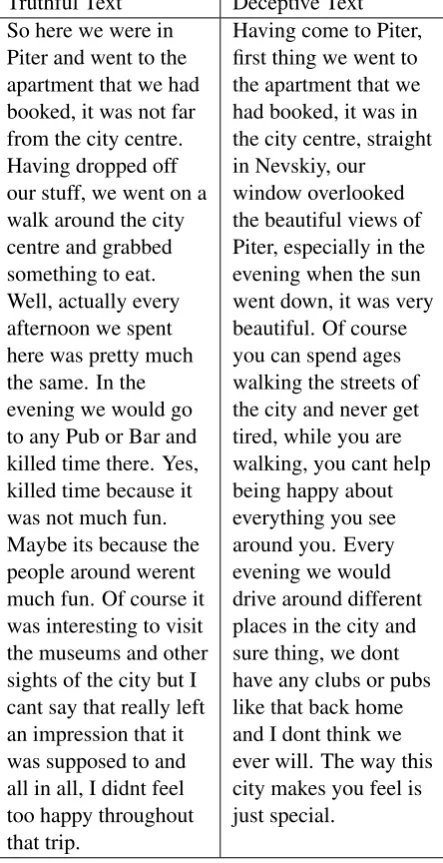
In our paper we have used a text corpus Rus-sian Deception Bank. It was launched in 2014 as part of a text corpus called RusPersonality (Litvi-nova et al., 2016). Deception Bank currently contains truthful and deceptive narratives (average text length is 221 words, SD = 15.2) of the same individuals on the same topic (How I spent yester-day) (see example in Table 1).
Since it was not a spontaneously produced lan-guage, it was deemed necessary to minimize the effect of the observers paradox by not explain-ing the ultimate aim of the research to the par-ticipants. In addition, to motivate them, the re-spondents were told that their texts (without infor-mation of which of them were truthful and which were not) would be evaluated by a trained psy-chologist who would attempt to tell a truthful text from a deceptive one. Each respondent whose texts would not be correctly evaluated would be awarded with a cinema ticket voucher.
Truthful Text Deceptive Text So here we were in
Piter and went to the apartment that we had booked, it was not far from the city centre. Having dropped off our stuff, we went on a walk around the city centre and grabbed something to eat. Well, actually every afternoon we spent here was pretty much the same. In the evening we would go to any Pub or Bar and killed time there. Yes, killed time because it was not much fun. Maybe its because the people around werent much fun. Of course it was interesting to visit the museums and other sights of the city but I cant say that really left an impression that it was supposed to and all in all, I didnt feel too happy throughout that trip.
[image:4.595.75.297.69.501.2]Having come to Piter, first thing we went to the apartment that we had booked, it was in the city centre, straight in Nevskiy, our window overlooked the beautiful views of Piter, especially in the evening when the sun went down, it was very beautiful. Of course you can spend ages walking the streets of the city and never get tired, while you are walking, you cant help being happy about everything you see around you. Every evening we would drive around different places in the city and sure thing, we dont have any clubs or pubs like that back home and I dont think we ever will. The way this city makes you feel is just special.
Table 1: Sample statements from the same author
to extend it. Apart from truthful and deceptive texts by each individual, Russian Deception Bank (as well as all the texts in RusPersonality) comes with metadata which provides detailed informa-tion about their authors (gender, age, psycholog-ical testing results). Hence, the annotated Russian Deception Bank will enable authors personal fea-tures (psychological and physical) to be consid-ered as a factor contributing to the production of their deceptive texts.
We argue that these data are critical in design-ing an objective method of identifydesign-ing intention-ally deceptive information (Levitan et al., 2016). Each text was entered into a separate text file, and misspellings were corrected. Each of the 226 text files was analyzed using LIWC 2015 and a
Rus-sian language dictionary based on LIWC2007. We have employed a basic Russian language dictionary that comes with the LIWC software and additionally developed our own users dictionaries (see explanations below). It’s worth noting that the program’s Russian dictionary is a simple trans-lation of the corresponding English LIWC dictio-nary. For our study we selected categories that were the least dependent on the content of the texts. Hence the following parameters were se-lected:
• I STANDARD LINGUISTIC DIMENSIONS (19),
• II PSYCHOLOGICAL PROCESS DIMEN-SIONS (Affective Processes - 5, Cognitive Processes - 8, Perceptual Processes - 3, Rela-tivity - 3),
• All Punctuation parameters (11).
Users dictionaries were also compiled accord-ing to the user manual:
• a dictionary of 20 most frequent function words in Russian Freq FW (20 parameters ac-count for the uses of each word in a text and 1 parameter represents the proportion of the total uses of all such words in a text)
• a dictionary of demonstrative pronouns and adverbs Deictic (1 parameter accounts for the proportion of these words per to the total word length of a text)
• discourse markers DM (10)
• a dictionary of intensifiers and downtowners Intens (2 parameters)
• a dictionary of pronouns as parts of speech Pron (10)
• a dictionary of perception vocabulary Per-ceptLex (1 parameter)
• a dictionary of pronouns and adverbs describ-ing the speaker Ego (I, my, in my opinion) (1 parameter)
• a dictionary of emotional words Emo (nega-tive and posi(nega-tive, 2 parameters).
It was necessary to compile these particular dic-tionaries owing to the fact that the Russian dictio-nary that came with the software was a translation of a corresponding English dictionary and did not stand independent testing, i.e. if all the variables from the first group are identified unambiguously, there are doubts as to the semantic category of the second group and thus they have to be evaluated independently and objectively. The results were processed using SPSS 23.0 software.
4 Experiments
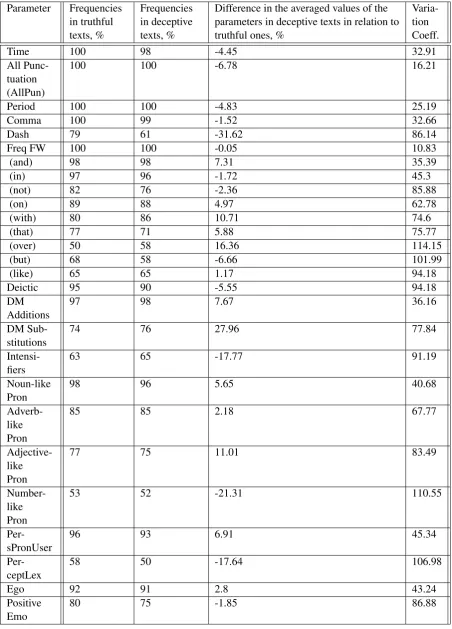
Originally we excluded the parameters that had a frequency of less than 50%. Here frequency of a parameter is defined as a ratio of non-zero values of a parameter to the number of all of the analyzed texts (both truthful and deceptive ones). The se-lected parameters are identified in the Table.
Further on we calculated and evaluated the vari-ation coefficient of the text parameters that indi-cates the range of a linguistic parameter in the texts by the same author (Viktor V. Levitsky , 2004). This can be done using the following ra-tio:
V =
Pn
i ∗|xT ix−T ixDi|
n ∗100% (1)
wherexT iis the value of the i-th parameter in a truthful text,xDiis the value of the i-th parameter in a deceptive text, and n is a selection size. The computed variation coefficients are shown in Table 2.
A statistical analysis (see Table 2) showed that the computed variation coefficient for the selected parameters ranges significantly. The parameters with correlation coefficient over 50 % were ex-cluded at the next stage (see Levitsky (2004); Litvinova, (2015)).
In order to understand how the parameters of truthful and deceptive texts by the same author change in relation to the absolute value, we calcu-lated the averaged values of each parameter. Table 2 presents a relative change in each parameter in deceptive texts in relation to truthful ones (in per-centages).
In order to determine which of the originally selected text parameters could be used in further calculations, we tried to establish a connection be-tween the variation coefficients of the text param-eters, frequencies of the parameters in the texts
as well as the difference between the average val-ues of the text parameters in a selection of truthful and deceptive texts. Using the methods of correla-tion analysis, we found that for a statistical signif-icance level p¡0.05 there is no connection between the frequency of a parameter and a difference be-tween the average values of truthful and decep-tive texts. At the same time the calculation of the Pearson correlation coefficient for frequencies of the text parameters and their variation coefficient showed that there is a considerably strong connec-tion r¿0.9 at p¡0.05 (a linear dependence between the two values). Therefore there is one important conclusion to be made: the use of only average values of text parameters in a selection is not al-ways the best option as it does not allow for the distribution of a certain parameter in deceptive and truthful texts by the same author. In order to con-sider a type of the distribution of text parameters in the corpora of truthful and deceptive texts we used one of the most effective criteria for checking the normality is the use of the Shapiro-Wilk test for normality as it is stronger compared to the alter-native criteria for small samples. However, some of the text parameters in deceptive texts (Sixltr, AllPunc, PersPronUser) change their distribution differently. Only the parameters with the follow-ing characteristics were chosen for the model to evaluate truthful and deceptive texts:
they are frequent (i.e. occur in no less than half of the texts); vary reasonably in the texts by the same author (on average in a selection); have nor-mal distribution (since we have Student’s statistics as a basis of our classifier).
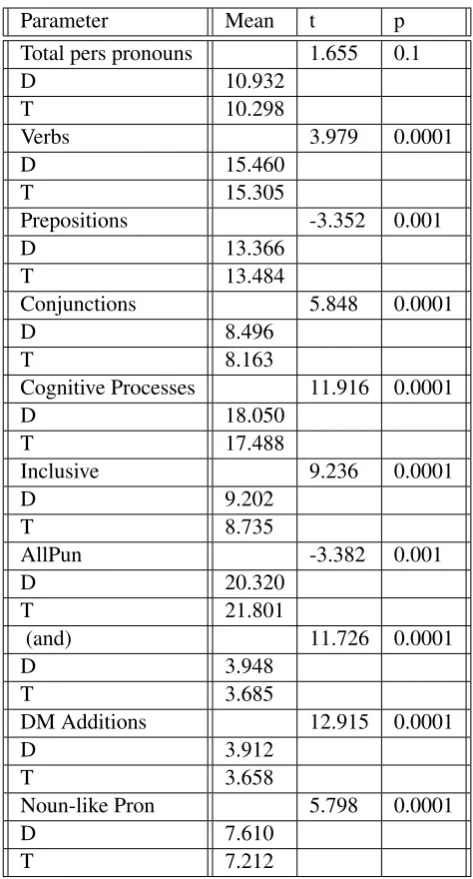
It should be noted that in order to design the models, the parameters that are normally dis-tributed in the corpus of truthful texts were em-ployed. According to the calculation, only 10 pa-rameters are normally distributed in truthful texts (see Table 3).
Parameter Frequencies in truthful texts, %
Frequencies in deceptive texts, %
Difference in the averaged values of the parameters in deceptive texts in relation to truthful ones, %
Varia-tion Coeff. Words per
sentence (WPS)
100 100 5.53 22.47
Words¿6 letters (Sixltr)
100 100 -0.6 15.09
Function words (FW)
100 100 1.59 11.32
Total
pronouns 97 99 2.59 29.14
Total pers
pronouns 97 98 6.11 29.78
1st pers
singular 94 93 5.71 38.54
1st pers
plural 68 67 4.94 86.06
3rd pers
singular 88 86 5.39 70.40
3rd pers
plural 87 83 -7.57 70.72
Verbs 100 100 3.02 27.37
Adverbs 88 89 -3 59.92
Preposi-tions 100 100 -1.03 19.70
Conjunc-tions 100 100 3.94 27.93
Negations 83 76 2.91 87.17
Quantifiers 95 89 1.75 64.971
Numbers 56 52 13.46 121.19
Cognitive
Processes 100 100 3.14 21.711
Insight 90 91 7.78 58.24
Causation 87 84 4.54 73.46
Discrep-ancy 65 60 -7.95 99.84
Tentative 78 76 2.73 83.32
Certainty 86 85 0.5 60.72
Inhibition 52 50 -3.92 117.41
Inclusive 100 98 5.24 33.96
Exclusive 83 76 2.73 72.3
Perceptual
Processes 92 88 -11.67 58.07
Seeing 60 58 -13.75 95.76
Hearing 66 70 12.90 92.06
Feeling 54 47 -25.75 117.58
Parameter Frequencies in truthful texts, %
Frequencies in deceptive texts, %
Difference in the averaged values of the parameters in deceptive texts in relation to truthful ones, %
Varia-tion Coeff.
Time 100 98 -4.45 32.91
All Punc-tuation (AllPun)
100 100 -6.78 16.21
Period 100 100 -4.83 25.19
Comma 100 99 -1.52 32.66
Dash 79 61 -31.62 86.14
Freq FW 100 100 -0.05 10.83
(and) 98 98 7.31 35.39
(in) 97 96 -1.72 45.3
(not) 82 76 -2.36 85.88
(on) 89 88 4.97 62.78
(with) 80 86 10.71 74.6
(that) 77 71 5.88 75.77
(over) 50 58 16.36 114.15
(but) 68 58 -6.66 101.99
(like) 65 65 1.17 94.18
Deictic 95 90 -5.55 94.18
DM
Additions 97 98 7.67 36.16
DM
Sub-stitutions 74 76 27.96 77.84
Intensi-fiers 63 65 -17.77 91.19
Noun-like
Pron 98 96 5.65 40.68
Adverb-like Pron
85 85 2.18 67.77
Adjective-like Pron
77 75 11.01 83.49
Number-like Pron
53 52 -21.31 110.55
Per-sPronUser 96 93 6.91 45.34
Per-ceptLex 58 50 -17.64 106.98
Ego 92 91 2.8 43.24
Positive
[image:7.595.74.527.89.719.2]Emo 80 75 -1.85 86.88
Parameter Mean t p Total pers pronouns 1.655 0.1
D 10.932
T 10.298
Verbs 3.979 0.0001
D 15.460
T 15.305
Prepositions -3.352 0.001
D 13.366
T 13.484
Conjunctions 5.848 0.0001
D 8.496
T 8.163
Cognitive Processes 11.916 0.0001
D 18.050
T 17.488
Inclusive 9.236 0.0001
D 9.202
T 8.735
AllPun -3.382 0.001
D 20.320
T 21.801
(and) 11.726 0.0001
D 3.948
T 3.685
DM Additions 12.915 0.0001
D 3.912
T 3.658
Noun-like Pron 5.798 0.0001
D 7.610
[image:8.595.180.417.59.499.2]T 7.212
Table 3: Statistical differences between deceptive (D) and truthful (T) texts
standpoint are a greater amount of verbs, personal pronouns, pronominal nouns, conjunctive rela-tionship markers, and a lesser amount of prepo-sitions and punctuation marks. As it seems, this is connected to the fact that texts which contain such characteristics demand less cognitive effort in their creation, however this is merely a proposi-tion and, of course, would need to be verified.
The basis of this model is Rocchio classifi-cation. For text classification we first created two centroids [ST1...ST10] and [SD1...SD10], based on the previously attained values ofST iand
SDi. These serve as averages of all the 10 various chosen parameters in both the truthful and deceit-ful texts..
For each text, in order to find whether they are
or are not truthful, we then need to find the vec-tor S, which consists of all elements Si, i.e. the 10 aforementioned parameters. Our classifier then determines the truthfulness of a text based on the similarity between the vectors of the test docu-ments and the centroids specific to truthful and de-ceitful texts.
simi-larity between two vectors.
The similarity of vector S and centroid ST is measured thus:
χ2 T = n1
n X
i
(ST i−Si)2
ST i (2)
Analogously, the similarity of vectorSand cen-troidSD is measured as such:
χ2 D = n1
n X
i
(SDi−Si)2
SDi (3)
We will assume, that in order to determine the type of text, it is sufficient to compare the values of
χ2
T andχ2D. The text in question will be classified as deceitful ifχ2
T > χ2D and classified as truthful ifχ2
T < χ2D
In order to test this approach, before designing the model, the texts were divided into the learn-ing and test sets (70 %, i.e. 158 texts for train and 30 %, i.e. 68 texts for tests). In order to evaluate the suggested model the overall accuracy, which is the percentage of texts that are classified correctly, was computed. The accuracy of the suggested ap-proach evaluated on the total test corpus was 68.3 %. Since data set has an equal distribution be-tween truthful and deceptive texts, the baseline is 50 %.
In our study the accuracy of the model was tested individually for males and females and so was the overall one. The classification accuracy for males was 73.3 % and 63.3 % for females. Hence the analysis indicates that models for de-tecting deception in written texts could be fur-ther improved by considering the characteristics of their authors.
5 Conclusion
The average classification accuracy of 68.3 % al-though higher than the 50% baseline indicates that classification task is difficult and more research is needed to discover what methodology could be ap-propriate to improve the results. The analysis re-vealed that models for detecting deception in writ-ten texts could be significantly improved by con-sidering the characteristics of their authors. Males and females lie in different ways. Thus models should be further designed for deceptive/truthful texts by males/females, for peoples of different ages, different psychological profiles in order for
them to be more accurate. This is a promising re-search field, however it has not been properly ad-dressed as part of text-based deception detection because of the scarcity of resources for this task. We assume that the corpus of deceptive and truth-ful Russian texts with metadata providing various personal information about their authors (gender, age, education, results of psychological and neu-ropsychological testing and so forth) would con-tribute to further improvements in this field. Cur-rently we are extending our corpus using real texts - recordings of job candidates in one of Russia’s largest industrial companies. All of the candidates took a series of psychological tests. Parts of the interviews were classed as truthful/deceptive us-ing polygraph readus-ings, collection of extra infor-mation about the candidates as well as follow-up interviews. To the best of our knowledge, the cor-pus being designed has no equivalents.
The corpus is to be further expanded by increas-ing the number of texts as well as respondents. The features of the production of deceptive texts depending on the gender, age and psychological characteristics of their authors are also to be iden-tified. There are plans to design a corpus of decep-tive and truthful texts in the first language (Rus-sian) as well as the second language (English) by the same author in order to identify possible struc-tural and lexical differences between the linguistic expression of deceit in both languages.
Further we plan to expand upon our list of parameters and utilize various machine learning algorithms for classifying truthful and deceitful texts, and then compare these results to the method mentioned in this paper.
Acknowledgments
This research is supported by a grant from the Russian Foundation for Basic Research, N 15-34-01221 Lie Detection in a Written Text: A Corpus Study.
References
Angela Almela, Rafael Valencia-Garca, and Pascual Cantos. 2013. Seeing through deception: A compu-tational approach to deceit detection in written com-munication. Linguistic Evidence in Security, Law and Intelligence (LESLI), 1(1).
Judee K. Burgoon and David B. Buller. 1994. Inter-personal deception: Ill effects of deceit on perceived communication and non-verbal behavior dynamics. Journal of Nonverbal Behavior, 18(2):155–184.
Eileen Fitzpatrick and Joan Bachenko. 2012. Building a data collection for deception research. In Eileen Fitzpatrick, Joan Bachenko, and Tommaso Forna-ciari, editors,Proceedings of the EACL Workshop on Computational Approaches to Deception Detection, pages 31–38.
Tommaso Fornaciari, Fabio Celli, and Massimo Poe-sio. 2013. The effect of personality type on decep-tive communication style. InIntelligence and Secu-rity Informatics Conference (EISIC). IEEE.
Sarah Ita Levitan, Yocheved Levitan, Guozhen An, Michelle Levine, Andrew Rosenberg, Rivka Levi-tan, and Julia Hirschberg. 2016. Identifying indi-vidual differences in gender, ethnicity, and personal-ity from dialogue for deception detection. InNAACL Workshop on Computational Approaches to Decep-tion DetecDecep-tion, San Diego.
Tatyana Litvinova, Olga Litvinova, Olga Zagorovskaya, Pavek Seredin, Alexander Sboev, and Olga Romanchenko. 2016. ”ruspersonality”: A russian corpus for authorship profiling and decep-tion detecdecep-tion. InInternational FRUCT Conference on Intelligence, Social Media and Web (ISMW FRUCT 2016), pages 1–7, St. Petersburg, RU.
Tatiana Litvinova. 2015. On the problem of stability of parameters of idiostyle. InProceedings of Southern Federal University, pages 98–106.
Rada Mihalcea and Carlo Strapparava. 2009. The lie detector: Explorations in the automatic recognition of deceptive language. InProceedings of the Associ-ation for ComputAssoci-ational Linguistics (ACL-IJCNLP 2009), pages 1–7, Singapore, SG.
Matthew L. Newman, James W. Pennebaker, Diane S.Berry, and Jane Richards. 2003. Lying words: Predicting deception from linguistic styles. Per-sonality and Social Psychology Bulletin, 29(5):665– 675.
James W. Pennebaker, Cindy K. Chung, Molly Ire-land, Amy L. Gonzales, and Roger J. Booth, 2007. The Development and Psychometric Properties of LIWC2007. Linguistic Inquiry and Word Count (LIWC), Austin, TX.
Vernica Prez-Rosas and Rada Mihalcea. 2014. Gen-der differences in deceivers writing style. Journal Lecture Notes in Computer Science, 8856:163–174.
Malmasi Shervin and Mark Dras. 2015. Multilingual native language identification. Natural Language Engineering, 1:1–53.
Ben Verhoeven and Walter Daelemans. 2014. Clips stylometry investigation (csi) corpus: A dutch cor-pus for the detection of age, gender, personal-ity, sentiment and deception in text. In Proceed-ings of the Ninth International Conference on Lan-guage Resources and Evaluation (LREC14), Reyk-javik, IS. European Language Resources Associa-tion (ELRA).
Viktor V. Levitsky . 2004. Quantitative methods in linguistics. Nova Kniga, Vinnytsia, UKR.