Characterization of Material Parameters
S. M. Humayun Kabir, Tae-In Yeo, Sang-Ho Kim
Abstract—The present work is concerned with the characterization of hardening parameters for an elasto-plastic continuum model, taking into account the memory effect of plastic strain amplitude, in order to predict the hysteretic responses of 429EM steel. This elasto-plastic three-dimensional model is based on the internal thermodynamic variables which composed of the nonlinear kinematic hardening and isotropic hardening with the plastic strain memorization. The emphasis is put on the determination of strain memory parameters along with other material parameters of the proposed model in order to better simulate the behavior of the material at different strain range. The material parameters are calibrated with the experimental stabilized loops of stress-strain curves available in the literature. The predicted stabilized loops from the simulation with the determined parameters show good agreement with the experimental results signifying the validity of the considered model.
Index Terms— Elasto-plastic continuum model, Material parameters, Nonlinear hardening law, Plastic strain memory, Stabilized hysteresis loops.
I. INTRODUCTION
Under cyclic loading, the structural materials show complicated mechanical responses involved with the plastic deformation at isothermal and anisothermal conditions. In the framework of elasto-plasticity, many constitutive models were established to describe these cyclic inelastic responses of the materials. The concepts, based on the internal thermodynamic variables for time-independent plasticity, have been studied under many different ways in order to generalize the classical isotropic and kinematic theories [1]. Based on the yield surface, Mroz [2] proposed the multiyield surface model and Dafalias & Popov [3] proposed a model with two surfaces only. Armstrong and Frederick [4] proposed the nonlinear kinematic rule in terms of differential equation which was developed further by Chaboche [1] and Ohno and Wang [5].Various hardening rules including multi-surfaces, two surfaces with the stationary limit surface and non-linear surface were reviewed by Chaboche [1]. Some significant modifications on kinematic hardening were done by Chaboche [6] and Dafalias et al.[7] concerned with the time independent plasticity theories in the range of cyclic loading. Furthermore, Valanis [8] proposed the plasticity
theory without the concept of yield surface based on endochronic theory. Iwan [9] and Besseling [10] proposed the overlay model based on an approach which views the system as consisting of a series of ideal elasto-plastic element. From the subject point of view i.e., at describing the cyclic elasto-plastic behavior of materials, all these models are said to be meaningful and representative examples.
Manuscript received November 24, 2008.
S. M. H. Kabir is with the School of Mechanical and Automotive Engg., University of Ulsan, P.O Box18 Ulsan 680-749, Republic of Korea, (phone: +82-10-2914-5243; fax:+82-052-259-1680; e-mail:[email protected]). Tae-In Yeo is with the School of Mechanical and Automotive Engg., University of Ulsan, P.O Box18 Ulsan 680-749, Republic of Korea. (email: [email protected])
S. Kim is with the School of Mechanical and Automotive Engg., University of Ulsan, P.O Box18 Ulsan 680-749, Republic of Korea. (email: [email protected])
Various alloy steels are facilitated in a variety of engineering structural applications such as automotive structure, pressure vessels, and so on. It is possible that the structural components made from these alloy steels are subjected to cyclic loading. The 429EM ferritic stainless steel is generally a good selection in the exhaust systems of the automobile engines as well as many high temperature-structures due to its excellent corrosion resistance and enhanced thermal fatigue resistance. So the material parameters and mechanical properties of 429EM steel in elasto-plastic cyclic behavior have been the object of many studies during recent years on life prediction of high-temperature structures.
Many real materials usually exhibit cyclic hardening or softening which depends, in general, not only on the number of cycles but also on strain amplitude. It has been observed that some alloy steels present a significant strain range-dependent cyclic hardening under strain-controlled cyclic loading in different experimental studies [1], [11]-[13]. Chaboche et al. [14] proposed first the strain amplitude dependence of cyclic hardening in the constitutive model to describe the cyclic hardening behavior of SS316 stainless steel under varied strain amplitude. Then, Ohno [15] extended this concept by introducing a cyclic non-hardening region, inside which the cyclic hardening does not takes place, to describe the dependence of cyclic hardening on the strain amplitude. It consists of an index surface in the space of plastic strain with a hardening variable that memorize the maximum plastic strain amplitude experienced by the material. Therefore, this strain amplitude dependency of cyclic hardening should be considered by the constitutive model used for analyzing structural components subjected to cyclic loading.
Experimental studies of the 429EM steel in [12] and [13] revealed a complex behavior under elasto-plastic cyclic loading. In addition to the classical Bauschinger effect and cyclic hardening, a memory effect of the plastic strain amplitude was observed. Yoon et al. [12] and Yoon [13] have studied the low cycle fatigue tests of 429EM steel at different temperatures and proposed a model, based on the overlay model, that has the ability of describing the change of the stress amplitude and the strain range dependence in hysteresis loops. And they determined the set of parameters for their proposed constitutive model.
three-dimensional elasto-plastic model that can describe the plastic response of 429EM steel under cyclic loading conditions. The emphasis is put on identifying the complete material parameters including the parameters of the plastic strain memorization in order to better simulate the stabilized elasto-plastic cyclic behavior of the 429EM steel at different strain range. This elasto-plastic law is based on the internal thermodynamic variables and takes into account the combined nonlinear kinematic hardening and isotropic hardening with plastic strain memory effect of Chaboche [1].The material parameters in terms of this Chaboche model are calibrated utilizing the available experimental stress-strain curves obtained from [12] and [13]. On the basis of the experimental results, a cyclic hardening is observed. The calibration of material parameters in this paper has been carried out under strain-controlled cyclic loading.
The paper is organized as follows. Section II concisely describes the adopted constitutive equations including memory effect of plastic strain amplitude. Section III contains a presentation of integration procedure in brief. Section IV is devoted to the strategy of material parameters determination concerning the elasto-plastic cyclic behavior of 429EM steel. Section V describes the simulation of the adopted constitutive model utilizing the determined parameters and comparison of analysis results with those of the experiment. Finally the closing remarks are presented in Section VI.
II. CONSTITUTIVE EQUATIONS
The constitutive equations dealt with the time-independent elasto-plastic behavior of structures subjected to cyclic loading must take into account the complex phenomena of Bauschinger effect, cyclic hardening and strain memory effect. The constitutive equations adopted here is commonly called Chaboche model which combines the nonlinear kinematic and isotropic hardenings with memory effect [1] .The general expression of this model is the following: (every italicized bold variable indicates a tensor, for example, σ represents stress tensor. This is the convention to be adopted throughout the paper.)
A. Decomposition of Strain
e
ε ε εp
(1) where, is the total strain tensor, is the elastic strain
tensor and
ε
ε
ep
ε
is the plastic strain tensor. B. Associated Flow Rule With Yield Criterion( / )
dεp d f σ
0
(2) with Von Mises yield criteria,
*
( )
f J σ- x R k (3) where, f is the yield function, d is the plastic multiplier which is derived from the hardening rule through
the consistency condition when the plastic flow occurs,
0
f df
( f / σ)
*
k J σ
gives the direction of the increment of plastic strain tensor, x is the kinematic hardening tensor called back stress tensor, is the isotropic internal stress or drag stress, is a temperature dependent material parameter which represents the initial size of the elastic domain, and is defined by Von Mises criterion as follows,
R
( - x)
( ) (3 / 2)( ) : ( )
J σ- x σ- x σ- x (4) where, σ and x are the deviatoric part of the stress tensor and back stress tensor respectively. The tensorial operation ‘:’ on two second order tensors A and implies the following,
B
: A Bij ij
A B (5)
C. The Non-linear Kinematic Hardening
The evolution of the back stress ( ) in kinematic hardening is based on Prager’s linear hardening law and a recall term which can be written in its simplest form as,
x
(3
x / 2) p
d C ε p
d xdp (6) where, is the accumulated plastic strain. C and are material parameters describing the kinematic hardening. This modification of Prager’s rule initially proposed by Armstrong and Frederick [4] to take into account the non-linear evolution of the back stress.
D. Plastic Strain Memory and Isotropic Hardening To express the dependence between the saturated value of the isotropic internal stress and the maximum plastic strain amplitude, a model has been proposed first in [14]. The general formulation consists of having an non-hardening index surface in the space of plastic strain. The evolution of this enveloping surface is described by,
(2 / 3) ( p
F J )q 0
0
ε ξ
F
(7) where, and are the radius and the center of this non-hardening surface. The change in the memory state takes place only if
q ξ
and (F/εp) :dεp 0. The evolution rule for q and can be defined by the following two equations,
ξ
* ( )F n n:
dqH dp (8)
* *
(1 ) ) 3 / 2
dξ H( n dp
)
:
F n n (9)
load surface ( f 0) and to the memory surface (F0) respectively which are defined as follows,
*
3 ( )
and )
- x - x
)dp
)
Q dq
3 ( )
2 ( 2 ( )
p p
J J
σ ε -ξ
n n
σ ε -ξ (10)
The isotropic hardening law is then modified to take into account the evolution of . The evolution of the drag stress
in (3) can be written as,
q R
(
dRb QR (11)
where, is the asymptotic value of the isotropic hardening variable R and is the material parameter which describes the rapidity of the isotropic hardening. The following relation reveals the dependence between the asymptotic value Q of the isotropic hardening variable and the size of the non-hardening memory surface,
Q
b
q
2 ( s
dQ Q
max/ 2)
p
max
p
(12) In the case of uniaxial (tension-compression) loading with
the constant plastic strain amplitude, q leads to the amplitude of the plastic strain, i.e.,
max/ 2
p
q (13)
Then integrating (12), the saturation value of the isotropic hardening becomes,
max ( 0
( ) ( s ( s) p
Q q Q Q Q Q e ) (14)
where, represents the maximum plastic strain range and
s
Q , Q0 , and are the four material parameters regarding memorization of the plastic strain.
There are nine material parameters E, k*, C, , , b , s
Q , Q0, and which need to be determined using the proposed model for 429EM steel. We determine these parameters in section IV in such a way so that they minimize the error between the experimental curves and numerical curves deduced from the model, which is the prime objective of this paper.
III. INTEGRATION OF THE CONSTITUTIVE EQUATIONS In this section, numerical integration procedure for the Chaboche model is presented. In contrast to linear elastic problems in which there exists a unique relationship between stress and elastic strain, no such uniqueness holds for plasticity problems due to non-linear nature. An incremental approach is therefore almost always necessary to solve the cyclic plasticity equations numerically for capturing the history dependence inelastic behavior of material.
The implicit Backward Euler algorithm is favored by many researchers, such as Ortiz and Popov [16], Chaboche and Cailletaud [17], for large increments because of its stability
and accuracy characteristics. An implicit algorithm for the combined non-linear kinematic/isotropic hardening has also been proposed by Doghri [18] and modified by Mahnken [19], whereby discretized rate equation reduced to one-dimensional problem. In this implicit scheme only a plastic multiplier (equivalently, accumulated plastic strain for von-Mises material) appears to be unknown. We apply the implicit integration scheme in a strain-driven approach to the proposed model in a similar fashion described in [19]. We employ this integration scheme due to two reasons, a). the resulting relations for linearization of the constitutive equations are obtained in a straightforward manner which avoids the inversion of second order tensors, and b). the resulting problem is reduced to one-dimensional problem which gives the opportunity to combine the Newton-Rhapson method with different one dimensional solution scheme , such as the Bisection method or the Pegasus method, for rapid convergence. We decompose the external loading in iterative procedure in order to check the yield criteria at each step and to follow correctly the hardening rule. The resulting discretized equations for the constitutive equations mentioned in section II are summarized as follows,
1 1 1
1 1
( )
(3 ) 0
n n n n
tr
n n
f J
G C p R k
*
σ x
(15)
with
1 2 ( ) ( ) ( ) :
n n e n e
tr G K Kb
σ ε ε I ε ε I
(16)
1
1/(1 )
n
p
(17) where, the index n1 represents the current time step and
the symbol ‘’ stands for the increment, for example,
p
defines the increment of the accumulated plastic strain. and
G K are the lame constants. Kb is the elastic bulk modulus and pis the unknown variable at the current time step which is solved in the iterative procedure. We combine the Bisection method with the Newton-Rhapson iteration for better convergence in the iterative procedure.
IV. ON THE PARAMETERS IDENTIFICATION
parameters in terms of the proposed model, we adopt the following procedure.
Considering the fact that low cycle fatigue failure occurs usually after several hundreds of load cycles, the parameters are calibrated using the stabilized loops. Fig.1 shows the experimental stabilized hysteresis loop (
Q
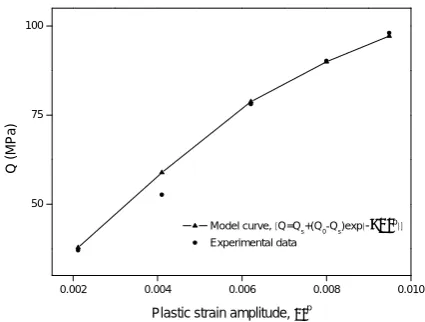
) for different strain amplitude obtained from [12]. The Young’s modulus is derived directly from the linear part of the stabilized hysteresis loop. Fig.2 shows the experimental stabilized hysteresis loops in transposed stress versus transposed strain plot obtained from Fig.1 where each of the hysteresis loops translated to the lower peak. From Fig.2 we can stated that the superposition of the stabilized stress-strain loops (tensile branch) is impossible and the cyclic curve is different from that predicted by the Masing’s rule. Fig.3 describes the translation of hysteresis loops for superposing the upper branches of the all stabilized hysteresis loops. Isotropic hardening is a phenomenon in the progressive behavior of cycle by cycle, but for a single cycle it can be considered constant. Therefore, for the stabilized loop isotropic hardening will be taken constant. Taking this fact into account, the differences in the translational values in Fig.3 provide us the differences in the asymptotic values of twice the isotropic hardening variable R. After measuring the differences in the saturated values ( ), we define the function of (14) and its coefficients
E
max
( p
Q ) Qs, Q0, and
. In Fig.4, the experimental data are compared to the computed ones after identifying the parameters of the plastic strain memorization.
[image:4.595.327.534.69.234.2] [image:4.595.326.534.278.436.2]After estimating the saturated values Q of the isotropic hardening variable for the strain amplitude pointed out in Fig.3, we deduct these values from the stress range which leads to the pure kinematic effect. Choosing the initial size of the elastic domain, is evaluated [20], and then the experimental kinematic hardening (
R
k*
x) is easily extracted from the plastic response of the stabilized loop. Utilizing this stabilized hysteresis data with the built-in calibration procedure of the ABAQUS code [21], C and are determined primarily. And the values of Cand are further calibrated to fit well with the hysteresis loops for the uniaxial cyclic loading.
-0.8 -0.6 -0.4 -0.2 0.0 0.2 0.4 0.6 0.8 -400
-200 0 200 400
Str
e
ss,
(M
Pa)
Strain, (%)
[image:4.595.327.540.492.653.2]
Fig. 1. Experimental stabilized hysteresis loops obtained from [12].
0.0 0.2 0.4 0.6 0.8 1.0 1.2 1.4
0 200 400 600 800
S
tre
ss,
(M
P
a
)
Strain,
Fig. 2. Hysteresis loops adjusted to the lower peak.
0.0 0.2 0.4 0.6 0.8 1.0 1.2 1.4
0 200 400 600 800
St
ress,
MP
a
Strain, (%)
Fig. 3. Translation of hysteresis loops defining the asymptotic value of isotropic hardening variable.
0.002 0.004 0.006 0.008 0.010
50 75 100
Q (M
P
a
)
Plastic strain amplitude, p
Model curve, [Q=Q
s+(Q0-Qs)exp(- p)]
Experimental data
Fig. 4. Identification of parameters for plastic strain memorization.
Then the coefficient bof (11), the pace of the isotropic hardening, is calculated from the evolution of isotropic hardening variable . Fig.5 illustrates the relationship between the experimental stress amplitude and accumulated plastic strain (
R
(/ 2 ) -p ) for different strain amplitude obtained from [13]. The evolution of in (11) is related to the stress amplitude during cyclic test as follows [1],
[image:4.595.70.277.603.760.2]0 0
( ) /(s )R Q/ 1 exp(bp) (18)
where, s and 0 are the stress ranges for the
stabilize cycle and the first cycle respectively and is the stress range in between. Utilizing Fig.5, we plot the total history data of (18) which is shown in Fig.6. From the history plot in Fig.6, it reveals that the pace of isotropic hardening ( ) depends only on the accumulated plastic strain, independent of specific strain amplitude. In Fig.5 and Fig.6, we show only the strain amplitude of
b
/ 2 0.3%
and
/ 2 0.7%
[image:5.595.318.527.68.231.2] [image:5.595.317.527.285.441.2] but the above observation is also true for other strain amplitudes in between.
Table. I gives the different material parameters which are determined. The unit of material parameters k*, C, Qs, is MPa, the unit of E is GPa, and all others are dimensionless.
0
Q
V. SIMULATION OF THE CONSTITUTIVE EQUATIONS AND COMPARISON OF RESULTS
The model figured out from the uniaxial simulation is adequate for a reproduction of the real three dimensional behavior of the material. In addition to the simplicity of analysis, uniaxial simulation allows determining and calibrating the model parameters straightforwardly
0.0 0.5 1.0 1.5 2.0
250 300 350
S
tr
e
ss
amp
lit
u
de,
(MP
a
)
Accumulated plastic strain, p
[image:5.595.61.282.383.546.2]
Fig. 5. Variation of stress amplitude with accumulated plastic strain obtained from [13].
0.0 0.5 1.0 1.5 2.0
0.0 0.4 0.8
(
-0
)/
(
s
-0
)
Accumulated plastic strain, p (-
0)/(s-0) = 1-e -15.69p
Fig. 6. Variation of hardening with accumulated plastic strain.
-0.8 -0.6 -0.4 -0.2 0.0 0.2 0.4 0.6 0.8
-400 -200 0 200 400
Str
e
s
s,
MP
a)
Strain,
Symbols : Experimental data Solid lines : Simulation results
Fig.7. Experimental and uniaxial simulation responses (stabilized loop).
-0.8 -0.6 -0.4 -0.2 0.0 0.2 0.4 0.6 0.8
-400 -200 0 200 400
S
tr
e
ss,
MP
a)
Strain, (%)
Experiment FE simulation
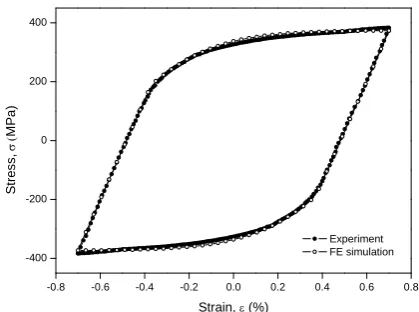
Fig 8. Stabilized loops - a comparison between experimental results and FE simulation at / 20.7%.
with minimum memory required for analysis. Fig.7 shows, to comparison purpose, the experimental and computed stabilized responses when the whole loading history is considered in the uniaxial simulation. This comparison evidences that the simulation results with the identified material parameters predict well the experimental stabilized loops for all the strain amplitudes except at the strain amplitude of 0.4% but the shape of the loop remains unchanged. This happens because the identified asymptotic value Q for the strain amplitude of 0.4% overestimate the experimental ones as shown in Fig.4. However, the analysis result for the strain amplitude of 0.4% at isothermal conditions would be acceptable from the viewpoint of safety in design. In the uniaxial simulation, we assign the value
0.01
to take into account the gradual effect into the memorization. The higher the value of , the higher the rate of rapidity in stabilization of stress.
Table I. Material parameters for 429EM steel at 2000C.
E *
k C b Qs Q0
[image:5.595.70.284.598.758.2]This three-dimensional model is introduced into a finite element (FE) program ABAQUS through user-defined material subroutine called UMAT [21] with the determined parameters. For numerical simulation, an axisymmetric version of the cylindrical sample (the cylindrical sample that described in [12]) is employed. In FE simulation, only one finite element, in the middle of the sample, is submitted to an imposed strain / 2 0.7% and subsequently analysis is carried out. The stabilized cyclic response of the material is calculated by employing a 3-D 8-noded isoparametric brick element with full-integrated formulation (C3D8 element in ABAQUS). Fig.8 gives a comparison of stabilized loops ( )between experimental data and FE simulation for the strain range / 20.7%.
For all the discussed simulation, very good correlation is obtained between the responses simulated using the determined parameters and the experimental observations. Comparisons reveal that the obtained parameters of the proposed model for describing the inelastic behavior of 429EM steel approach as well as can be expected, those in the experimental curves. These parameters are said to be stationary because a small variation of parameters does not have significant influence on the stabilized response of the material.
VI. CONCLUSION
The proposed model with plastic strain memorization for describing the stabilized cyclic response of 429EM steel is verified by using the available test results. The model is tested through the uniaxial simulation and FE simulation utilizing the determined material parameters. The computed responses agree reasonably well with the experimental results. The aim of the study is the characterization of hardening parameters for an elasto-plastic continuum model, taking into account the memorization effect of plastic strain amplitude. The use of continuum mechanics constitutive models into engineering application encounter the difficulties to find references about the material parameters obtained by experimental data. Therefore, unveiling the material parameters to find the stabilized hysteresis response of the steel in the case of elasto-plastic cyclic loading, is an imperative step regarding fatigue life studies.
The determined material parameters are the elemental to extend the results into the continuum damage model. Therefore, coupling the adopted model with a damage law to predict the life of the selected material is what we shall do in our future work.
REFERENCES
[1] J. L. Chaboche, “Time-independent constitutive theories for cyclic plasticity”, Int. J. Plasticity,vol. 2(2), 1986, pp. 149–188.
[2] Z. Mroz, “On the description of anisotropic work hardening”, J. Mech. Phys. Solids, vol 15, 1967, pp. 163-175.
[3] Y. F. Dafalias, and E.P. Popov, “Plastic internal variables formalism of cyclic plasticity”, J. Appl. Mech., vol. 43, 1976, pp. 645-650. [4] P. J. Armstrong and C.O. Frederick, “A mathematical representation of
the multiaxial Bauschinger effect”, G.E.G.B. Report RD/B/N, 1966, pp.731-747.
[5] N. Ohno and J. D. Wang, “Transformation of a nonlinear kinematic hardening rule to a multi-surface form under isothermal and
nonisothermal conditions”, Int. J. Plasticity, vol. 7, 1991, pp. 879–
891.
[6] J. L. Chaboche, “On some modifications of kinematic hardening to improve the description of ratcheting effects”, Int. J. Plasticity, vol. 7, 1991, pp. 661–678.
[7] Y. F. Dafalias, K. I. Kourousis and G. J. Saridis, “Multiplicative AF kinematic hardening in plasticity”, Int. J. Solid Structures, vol. 45, 2008, pp. 2861-2880.
[8] K. C. Valanis, “Theory of visco-plasticity without a yield surface”, Arch. Mech., vol. 23, 1971, pp. 517-526.
[9] W. D. Iwan, “A distributed-element model for hysteresis and it’s steady-state dynamic response”, J. Appl. Mech., 1966, pp. 893-900. [10] J. F. Besseling, “A theory of elastic, plastic and creep”, J. Appl.Mech.,
vol. 80, 1958, pp. 529-536
[11] N. Ohno, “Recent topics in constitutive modeling of cyclic plasticity and viscoplasticity”, Appl. Mech. Rev., vol. 43, 1990, pp. 283–295. [12] S. Yoon, S. Hong and S. Lee, “Phenomenological description of cyclic
deformation using the overlay Model”, Material science and engineering, vol. A364, 2004, pp.17-26.
[13] S. Yoon, “Inelastic analysis and life prediction for structures subject to thermomechanical loading”, PhD thesis , 2003, Department of Mechanical Engineering, Korea Advanced Institute of Science and Technology (KAIST), Daejeon, Korea
[14] J. L. Chaboche, K. Dang Van and G. Cordier, “Modelization of the Strain Memory effect on the cyclic Hardening of 316 Stainless Steel”, Transactions of SMIRT 5, vol. L, 1979, Paper No. L11/3.
[15] N. Ohno, “A constitutive model of cyclic plasticity with a non-hardening strain region”, J. Appl. Mech., vol. 49, 1982, pp. 721-727.
[16] M. Ortiz and E. P. Popov, “Accuracy and stability of integration algorithm for elastoplastic constitutive equations”, Int. J. Numer. Meth. Eng., vol. 21, 1985, pp. 1561-1575.
[17] J. L. Chaboche and G. Cailletaud, “Integration methods for complex plastic constitutive equations”, Comp. Meth. Appl. Mech. Engng., vol. 133, 1996, pp. 125-155.
[18] I. Doghri, “Fully implicit integration and consistent tangent modulus in elasto-plasticity”, Int. J. Numer. Meth. Eng. vol. 36, 1993, pp. 3915–3932.
[19] R. Mahnken, “Improved implementation of an algorithm for nonlinear isotropic – kinematic hardening”, Commun. Numer. Meth. Engng., vol. 15, 1999, pp. 745-754.